
Theoretical vs Actual Yield: Calculate Yield and Explain Losses
Learn how to calculate theoretical yield, actual yield, and percentage yield using a balanced equation and the limiting reagent. Understand why incomplete reactions, competing reactions, and product loss during purification can reduce the final yield.
You calculate that a reaction should produce 5.00 g of a solid, but after filtering, washing, and drying, you recover only 4.10 g. Has the reaction failed? Did you use the wrong equation, or did you lose some of the product?
Before reading on, predict whether the missing 0.90 g proves that the product never formed. It doesn’t. Some product might never have formed, or it might have formed and then been lost during separation. The mass you recover cannot tell you which explanation is correct on its own.
Theoretical yield vs actual isolated yield
| Theoretical yield | 5.00 g — maximum predicted by stoichiometry |
|---|---|
| Actual isolated yield | 4.10 g — pure, dry product recovered Difference: 0.90 g; cause not identified by yield alone |
This is the problem that theoretical yield, actual yield, and percentage yield help you analyse. They tell you how much product a reaction could produce, how much you actually obtained, and how the two quantities compare.
01What theoretical yield and actual yield mean
Theoretical yield: how much product could form?
The theoretical yield is the maximum amount of a specified product predicted from the balanced chemical equation and the starting quantities of reactants.
It assumes that the limiting reagent is completely consumed in the desired reaction and that the reactants follow the equation being used.
The theoretical yield is a calculated value, not a guarantee about what you will collect in a laboratory.
Actual yield: how much product did you obtain?
The actual yield is the amount of product obtained experimentally.
When calculating an isolated yield, use the amount of pure product recovered after separation and purification. For a solid, this usually means the mass of the dry, pure product.
If a sample contains water or other impurities, its total mass is not necessarily the actual yield of the desired product.
Percentage yield: how do the two compare?
The percentage yield expresses the actual yield as a percentage of the theoretical yield.
\[ \boxed{ \%\text{ yield} = \frac{\text{actual yield}} {\text{theoretical yield}} \times 100\% } \]
Use the same units for both yields. You can compare grams with grams, or moles with moles, but not grams with moles.
For the opening example:
\[ \begin{aligned} \%\text{ yield} &=\frac{4.10\text{ g}}{5.00\text{ g}}\times100\%\\ &=82.0\% \end{aligned} \]
You recovered 82.0% of the theoretical amount as isolated product.
That tells you how much you recovered relative to the maximum predicted amount. It does not tell you why the yield was below 100%.
02The calculation: follow the correct order
The biggest mistake in yield questions is jumping straight to the percentage calculation. You need the theoretical yield first, and that means working through the balanced equation.
Step 1: Balance the chemical equation
Consider ammonia synthesis:
\[ \ce{N2(g) + 3H2(g) -> 2NH3(g)} \]
The coefficients give the mole ratio:
\[ 1\text{ mol }\ce{N2} : 3\text{ mol }\ce{H2} : 2\text{ mol }\ce{NH3} \]
The equation does not say that one gram of nitrogen reacts with three grams of hydrogen. Its coefficients describe ratios of particles, and therefore ratios of moles.

- N₂
- H₂
- NH₃
Step 2: Convert each reactant quantity into moles
Chemical equations give mole ratios, so you usually need to convert the starting quantities into moles before comparing them.
For a known mass:
\[ n=\frac{m}{M} \]
where:
- \(n\) is the amount in moles, in mol;
- \(m\) is the mass, in grams;
- \(M\) is the molar mass, in \(\mathrm{g\,mol^{-1}}\).
For a solution with a known concentration:
\[ n=cV \]
where \(c\) is the concentration in \(\mathrm{mol\,L^{-1}}\), and \(V\) is the solution volume in litres.
Convert millilitres to litres before substituting into \(n=cV\).
Step 3: Identify the limiting reagent
The limiting reagent is the reactant that runs out first according to the balanced equation. It determines the maximum amount of product that can form through that reaction.
A useful way to picture the coefficients is as a recipe ratio. If a recipe requires one unit of A for every three units of B, the ingredient that runs out first limits how many complete batches you can make.
The analogy tracks quantities, not reaction speed or mechanism. In chemistry, you must use the balanced equation and amounts in moles to find which reagent limits the reaction.
For each reactant, divide its available mole amount by its coefficient in the balanced equation. The smallest result identifies the limiting reagent.
For example, in
\[ \ce{N2 + 3H2 -> 2NH3} \]
if you have 0.400 mol of \(\ce{N2}\) and 0.900 mol of \(\ce{H2}\):
- Nitrogen could support \(0.400/1=0.400\) mol of reaction.
- Hydrogen could support \(0.900/3=0.300\) mol of reaction.
Hydrogen is the limiting reagent. The available nitrogen is more than enough to react with it.
Do not simply choose the reactant with the smaller mass or even the smaller number of moles. The coefficient ratio matters.
Step 4: Calculate the theoretical yield
Use the limiting reagent and the balanced equation to calculate the maximum moles of your desired product.
Then convert the product amount into the units requested.
For a product whose molar mass is known:
\[ m=nM \]
For a gas, you may instead be asked to calculate its volume using the molar gas volume under the stated conditions.
Step 5: Calculate percentage yield
Once you have the theoretical yield, use the experimentally measured actual yield.
\[ \%\text{ yield} = \frac{\text{actual yield}} {\text{theoretical yield}} \times100\% \]
The six steps to percentage yield
- Balance equation
Establish the correct mole ratios.
- Convert to moles
Calculate the amount of each reactant.
- Find limiting reagent
Use mole amounts and coefficients.
- Calculate theoretical yield
Find the maximum possible product.
- Measure isolated product
Use the mass of pure, dry product recovered.
- Calculate percentage yield
Actual yield ÷ theoretical yield × 100%.
Keep this order in mind. If the theoretical yield is wrong, the percentage yield will be wrong even if your final division is perfect.
03Worked examples
Worked example: Calculate the percentage yield of a gas
A student reacts 2.40 g of magnesium with 0.100 mol of hydrochloric acid. The reaction is:
\[ \ce{Mg(s) + 2HCl(aq) -> MgCl2(aq) + H2(g)} \]
The student collects 0.990 L of hydrogen at 25°C and 100 kPa. Use a molar gas volume of \(24.8\ \mathrm{L\,mol^{-1}}\) and a molar mass of magnesium of \(24.3\ \mathrm{g\,mol^{-1}}\).
Calculate the theoretical volume of hydrogen and the percentage yield.
Step 1
\[ \begin{aligned} n(\ce{Mg}) &=\frac{m}{M}\\ &=\frac{2.40\text{ g}}{24.3\text{ g mol}^{-1}}\\ &=0.0988\text{ mol} \end{aligned} \]
The amount of hydrochloric acid is already given as 0.100 mol.
Step 2
The equation requires two moles of \(\ce{HCl}\) for every mole of \(\ce{Mg}\).
Compare the amount of each reactant with its coefficient:
\[ \begin{aligned} \ce{Mg}:&\quad 0.0988/1=0.0988\\ \ce{HCl}:&\quad 0.100/2=0.0500 \end{aligned} \]
Hydrochloric acid is the limiting reagent because it supports fewer reaction batches.
Step 3
The equation gives a ratio of two moles of \(\ce{HCl}\) to one mole of \(\ce{H2}\).
\[ \begin{aligned} n(\ce{H2}) &=0.100\times\frac{1}{2}\\ &=0.0500\text{ mol} \end{aligned} \]
Step 4
Using \(V=nV_m\), where \(V_m\) is the molar gas volume:
\[ \begin{aligned} V(\ce{H2}) &=nV_m\\ &=(0.0500)(24.8)\\ &=1.24\text{ L} \end{aligned} \]
The theoretical yield is 1.24 L of hydrogen.
Step 5
\[ \begin{aligned} \%\text{ yield} &=\frac{0.990\text{ L}}{1.24\text{ L}}\times100\%\\ &=79.8\% \end{aligned} \]
The percentage yield is 79.8%.
The student collected about 80% of the theoretical hydrogen volume. This calculation does not establish whether the reaction was incomplete, some gas escaped, or the collection process failed to capture all the hydrogen produced.
Worked example: Calculate the yield of a precipitate
A student mixes 25.0 mL of 0.200 mol L\(^{-1}\) calcium chloride solution with 40.0 mL of 0.150 mol L\(^{-1}\) sodium carbonate solution.
The reaction is:
\[ \ce{CaCl2(aq) + Na2CO3(aq) -> CaCO3(s) + 2NaCl(aq)} \]
After filtering, washing, and drying the precipitate, the student obtains 0.430 g of calcium carbonate.
Calculate the theoretical yield of calcium carbonate and the percentage yield. Use \(M(\ce{CaCO3})=100.1\ \mathrm{g\,mol^{-1}}\).
Step 1
Convert each volume to litres before using \(n=cV\).
For calcium chloride:
\[ \begin{aligned} n(\ce{CaCl2}) &=cV\\ &=(0.200)(0.0250)\\ &=0.00500\text{ mol} \end{aligned} \]
For sodium carbonate:
\[ \begin{aligned} n(\ce{Na2CO3}) &=cV\\ &=(0.150)(0.0400)\\ &=0.00600\text{ mol} \end{aligned} \]
Step 2
The balanced equation has a 1:1 mole ratio between calcium chloride and sodium carbonate.
Calcium chloride has the smaller mole amount, so it is the limiting reagent.
Step 3
The equation gives a 1:1 ratio between calcium chloride and calcium carbonate.
\[ n(\ce{CaCO3})=0.00500\text{ mol} \]
Step 4
\[ \begin{aligned} m(\ce{CaCO3}) &=nM\\ &=(0.00500)(100.1)\\ &=0.5005\text{ g} \end{aligned} \]
The theoretical yield is 0.501 g to three significant figures.
Step 5
\[ \begin{aligned} \%\text{ yield} &=\frac{0.430\text{ g}}{0.5005\text{ g}}\times100\%\\ &=85.9\% \end{aligned} \]
The percentage yield is 85.9%.
The student recovered less calcium carbonate than the theoretical maximum. Some product may not have formed, or some may have been lost during filtration, washing, or transfer. Calcium carbonate particles could also have passed through the filter, or some product could have remained in the liquid.
The mass alone cannot distinguish these possibilities.
04Why is the actual yield lower than the theoretical yield?
A percentage yield below 100% is common. It does not automatically mean the balanced equation or stoichiometric calculation is wrong.
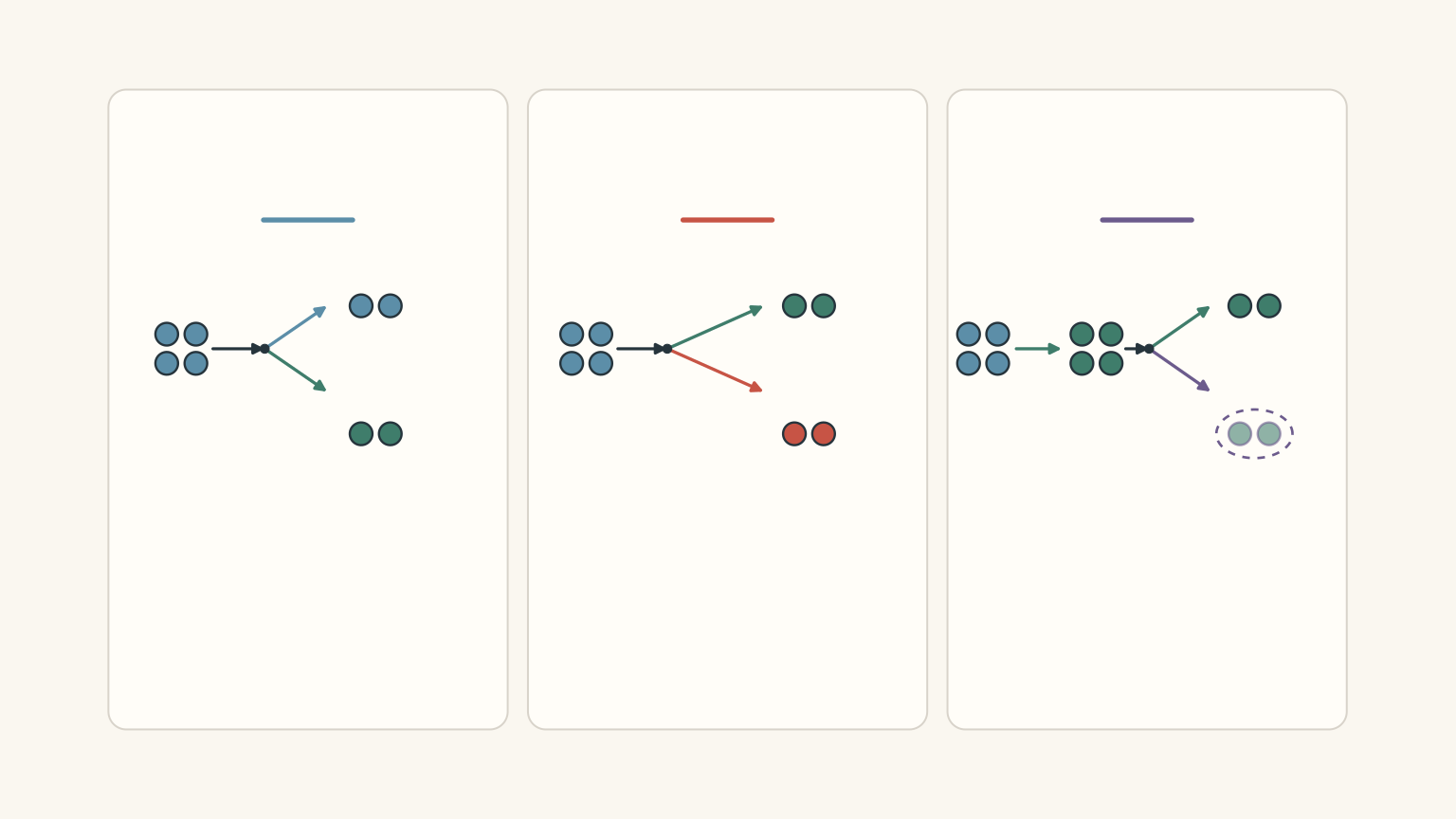
There are three important explanations to consider.
1. The reaction is incomplete
The theoretical yield calculation assumes that the limiting reagent is completely consumed in the desired reaction.
In reality, a reaction may stop before all the limiting reagent has reacted. Some reactant remains, so less product forms than predicted.
This can happen because the reaction is slow or because a reversible reaction reaches equilibrium while both reactants and products are still present.
For a reversible reaction, reaching equilibrium does not mean all reactants have been converted into products. The reaction can be behaving as expected while the actual yield remains below the theoretical maximum.
2. A competing reaction produces something else
Sometimes a reactant is consumed, but it forms a different product instead of the one you want.
For example, ethanol can form ethene through dehydration:
\[ \ce{C2H5OH -> C2H4 + H2O} \]
Under suitable conditions, ethanol can also form diethyl ether:
\[ \ce{2C2H5OH -> C2H5OC2H5 + H2O} \]
If some ethanol follows the second pathway, less is available to form ethene.
Notice the difference from an incomplete reaction: the ethanol may have reacted, but not all of it formed the desired product. The equation for the desired reaction can be balanced correctly even when a competing reaction reduces the yield.
3. The product forms but is lost during separation or purification
This is especially important when you need to isolate a solid or purify a substance.
The desired product may form successfully, but some of it never reaches the final sample you weigh.
Examples include:
- A precipitate remains on the sides of a container during transfer.
- Fine solid particles pass through a filter.
- Some product dissolves in the liquid and is discarded with the filtrate.
- A product remains dissolved in the solvent during recrystallisation.
- Some material is lost while transferring, washing, or purifying the product.
In these cases, the amount of product formed can be greater than the amount isolated.
Can the same percentage yield have different causes?
Yes. This is one of the most useful distinctions in yield calculations.
Suppose three experiments all produce an isolated yield of 82%. Their results could arise from very different processes:
- In the first, 82% of the theoretical amount of target product forms, and all of it is recovered.
- In the second, the full theoretical amount forms, but only 82% is recovered.
- In the third, 90% of the theoretical amount forms, and 91.1% of that product is recovered.
All three can give an isolated yield of approximately 82%.
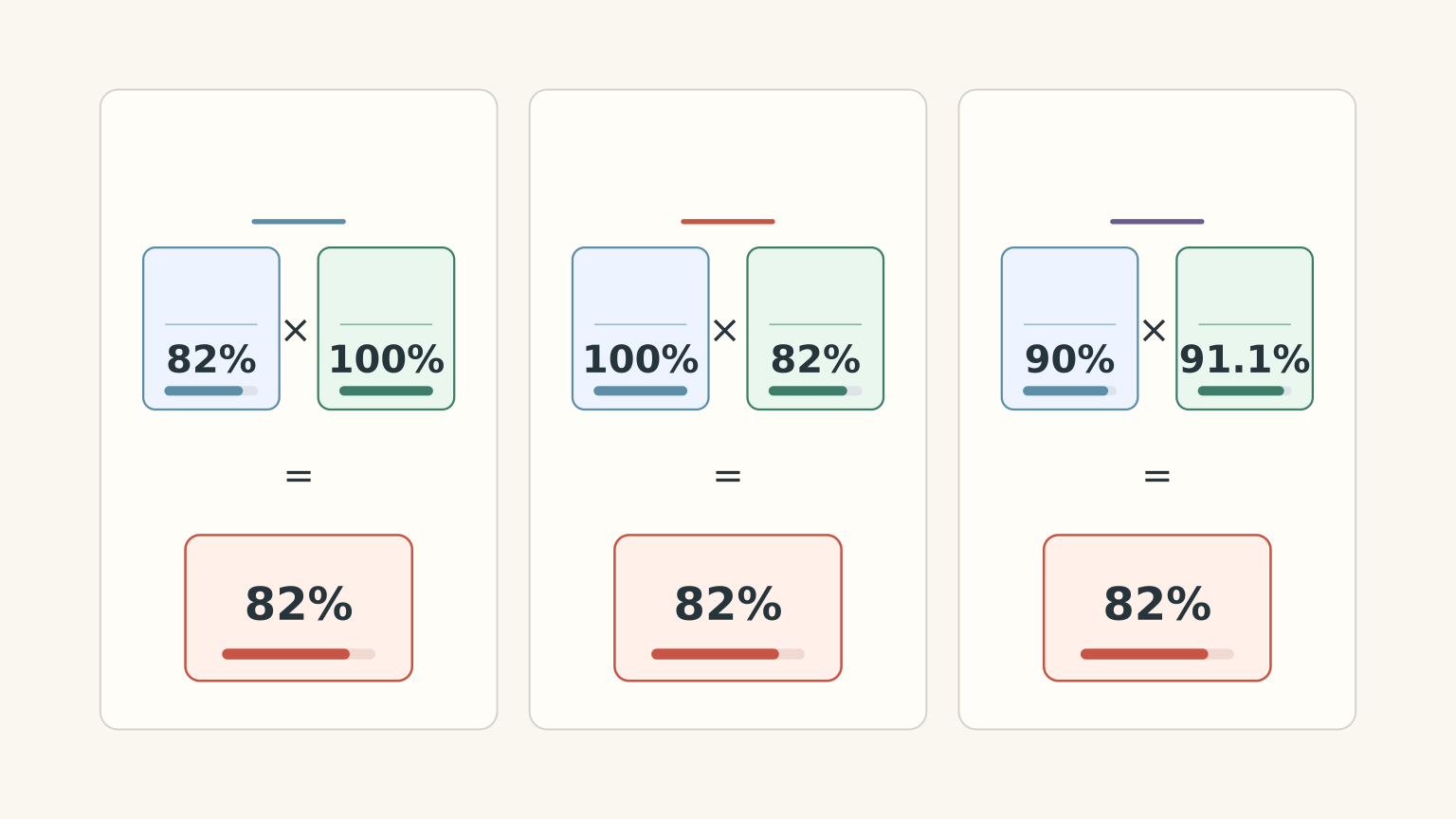
For a simplified two-stage calculation, you can express this relationship as:
\[ \begin{aligned} \text{isolated yield fraction} ={}&\text{fraction of theoretical product formed}\\ &\times\text{fraction of formed product recovered} \end{aligned} \]
This is a useful way to track where product is lost. Incomplete reactions and competing reactions can reduce the amount of target product formed, while separation and purification losses reduce the fraction recovered.
The measured percentage yield alone does not tell you how much each process contributed.
What if the percentage yield is greater than 100%?
A yield above 100% is a warning sign, not evidence that the reaction has beaten stoichiometry.
The actual mass may be artificially high because the product contains water, solvent, or other impurities. There may also be an error in weighing, measuring the reactants, identifying the limiting reagent, or calculating the theoretical yield.
For example, a solid that has not dried completely can weigh more than the same mass of pure, dry product. You must not count the retained water as product.
For yield calculations, the key question is always: How much of the measured material is actually the desired product?
05Questions and solutions
Question 1
Ammonia is produced according to the equation:
\[ \ce{N2(g) + 3H2(g) <=> 2NH3(g)} \]
A mixture contains 0.400 mol of nitrogen and 0.900 mol of hydrogen. After the reaction, 7.65 g of ammonia is obtained.
Calculate:
(a) the theoretical yield of ammonia in grams;
(b) the percentage yield.
Use \(M(\ce{NH3})=17.0\ \mathrm{g\,mol^{-1}}\).
Solution 1
The theoretical yield is 10.2 g of ammonia, and the percentage yield is 75.0%.
Step 1: Identify the limiting reagent.
The equation requires three moles of hydrogen for every mole of nitrogen.
The nitrogen could support 0.400 mol of reaction, while the hydrogen could support:
\[ \frac{0.900}{3}=0.300\text{ mol of reaction} \]
Hydrogen is the limiting reagent.
Step 2: Calculate the theoretical amount of ammonia.
The mole ratio of hydrogen to ammonia is 3:2.
\[ \begin{aligned} n(\ce{NH3}) &=0.900\times\frac{2}{3}\\ &=0.600\text{ mol} \end{aligned} \]
Step 3: Convert to mass.
\[ \begin{aligned} m(\ce{NH3}) &=nM\\ &=(0.600)(17.0)\\ &=10.2\text{ g} \end{aligned} \]
This is the theoretical yield.
Step 4: Calculate the percentage yield.
\[ \begin{aligned} \%\text{ yield} &=\frac{7.65}{10.2}\times100\%\\ &=75.0\% \end{aligned} \]
The experiment produced 75.0% of the theoretical amount. Because ammonia synthesis is reversible, equilibrium may limit product formation, but the percentage alone cannot establish whether equilibrium, separation losses, or other factors explain the result.
Question 2
Zinc reacts with copper(II) sulfate according to the equation:
\[ \ce{Zn(s) + CuSO4(aq) -> ZnSO4(aq) + Cu(s)} \]
A student adds 2.00 g of zinc to 50.0 mL of 0.500 mol L\(^{-1}\) copper(II) sulfate solution. After the reaction, 1.20 g of dry copper is recovered.
(a) Identify the limiting reagent.
(b) Calculate the theoretical yield of copper in grams.
(c) Calculate the percentage yield.
(d) Another student argues that zinc must be the limiting reagent because its mass is smaller than the mass of copper(II) sulfate dissolved in the solution. Explain why this reasoning is incorrect.
Use \(M(\ce{Zn})=65.4\ \mathrm{g\,mol^{-1}}\) and \(M(\ce{Cu})=63.55\ \mathrm{g\,mol^{-1}}\).
Solution 2
Copper(II) sulfate is the limiting reagent, the theoretical yield is 1.59 g of copper, and the percentage yield is 75.5%.
Step 1: Calculate the moles of zinc.
\[ \begin{aligned} n(\ce{Zn}) &=\frac{m}{M}\\ &=\frac{2.00}{65.4}\\ &=0.0306\text{ mol} \end{aligned} \]
Step 2: Calculate the moles of copper(II) sulfate.
Convert 50.0 mL to 0.0500 L.
\[ \begin{aligned} n(\ce{CuSO4}) &=cV\\ &=(0.500)(0.0500)\\ &=0.0250\text{ mol} \end{aligned} \]
Step 3: Identify the limiting reagent.
The equation has a 1:1 mole ratio between zinc and copper(II) sulfate.
There are 0.0306 mol of zinc but only 0.0250 mol of copper(II) sulfate. Copper(II) sulfate is therefore the limiting reagent.
Step 4: Calculate the theoretical yield.
The equation gives a 1:1 ratio between copper(II) sulfate and copper.
\[ \begin{aligned} n(\ce{Cu}) &=0.0250\text{ mol}\\ m(\ce{Cu}) &=(0.0250)(63.55)\\ &=1.58875\text{ g}\\ &\approx1.59\text{ g} \end{aligned} \]
Step 5: Calculate the percentage yield.
\[ \begin{aligned} \%\text{ yield} &=\frac{1.20}{1.58875}\times100\%\\ &=75.5\% \end{aligned} \]
Step 6: Explain the mass comparison.
The other student’s reasoning is incorrect because the limiting reagent is determined using moles and the balanced equation, not by comparing masses.
Zinc has the greater mole amount, even though its mass is smaller than the mass of the dissolved copper(II) sulfate. Since the mole ratio is 1:1, copper(II) sulfate runs out first.
The 75.5% yield also does not prove that the reaction was incomplete. Some copper may have formed but been lost during separation, or some copper(II) sulfate may have remained unreacted.
Question 3
A synthesis follows the equation \(\ce{A + B -> P}\), where A and B react in a 1:1 mole ratio to form product P.
The theoretical yield of P is 4.00 g. A quantitative analysis immediately after the reaction finds 3.70 g of P in the crude mixture.
After purification, 2.80 g of pure, dry P is isolated. Analysis of the remaining liquid finds another 0.75 g of P.
Assume the analyses are accurate and that P is neither formed nor decomposed during purification.
(a) Calculate the isolated percentage yield.
(b) Calculate the percentage of the theoretical amount of P that had formed before purification.
(c) Account for the difference between the amount of P present before purification and the amount isolated. Does the evidence prove that the reaction itself was incomplete?
Solution 3
The isolated percentage yield is 70.0%, but 92.5% of the theoretical amount of P had already formed before purification.
Step 1: Calculate the isolated percentage yield.
The isolated yield uses the pure, dry product actually recovered.
\[ \begin{aligned} \%\text{ yield} &=\frac{2.80}{4.00}\times100\%\\ &=70.0\% \end{aligned} \]
Step 2: Calculate the amount of theoretical product formed before purification.
The crude mixture contained 3.70 g of P.
\[ \begin{aligned} \%\text{ formed} &=\frac{3.70}{4.00}\times100\%\\ &=92.5\% \end{aligned} \]
This measures the amount of target product present relative to the theoretical maximum, rather than the amount ultimately isolated.
Step 3: Account for the product lost during purification.
The difference between the amount present before purification and the amount isolated is:
\[ 3.70-2.80=0.90\text{ g} \]
Of this difference, 0.75 g remains in the liquid. The remaining difference is:
\[ 0.90-0.75=0.15\text{ g} \]
The 0.15 g is not accounted for by the measurements. It may have been lost elsewhere during the work-up, such as during transfer or filtration.
Step 4: Evaluate the evidence.
The evidence indicates that the reaction formed close to the theoretical amount of P, but the purification did not recover all of it.
The low isolated yield is therefore largely explained by product recovery losses. However, the data do not establish whether all the starting reactants were consumed or whether competing reactions occurred. Those questions require additional evidence.
Question 4
Ethanol can undergo two competing reactions:
Desired reaction:
\[ \ce{C2H5OH -> C2H4 + H2O} \]
Competing reaction:
\[ \ce{2C2H5OH -> C2H5OC2H5 + H2O} \]
A starting sample contains 0.200 mol of ethanol. After reaction, 0.120 mol of ethene and 0.0300 mol of diethyl ether are measured.
Assume these are the only reactions and that product collection is quantitative.
(a) Calculate the percentage yield of ethene relative to the theoretical maximum.
(b) Calculate the amount of ethanol remaining unreacted.
(c) Calculate the percentage of the ethanol that reacted which formed ethene.
(d) Explain why the percentage yield of ethene does not equal the percentage of ethanol that reacted.
Solution 4
The ethene yield is 60.0%, even though 90.0% of the ethanol reacted. The difference arises because some ethanol formed a competing product.
Step 1: Calculate the theoretical yield of ethene.
The desired reaction has a 1:1 mole ratio between ethanol and ethene.
If all 0.200 mol of ethanol formed ethene, the theoretical yield would be 0.200 mol.
Step 2: Calculate the percentage yield of ethene.
\[ \begin{aligned} \%\text{ yield} &=\frac{0.120}{0.200}\times100\%\\ &=60.0\% \end{aligned} \]
Step 3: Calculate the ethanol consumed by each reaction.
The desired reaction consumes one mole of ethanol per mole of ethene:
\[ n(\text{ethanol used for ethene})=0.120\text{ mol} \]
The competing reaction consumes two moles of ethanol per mole of diethyl ether:
\[ \begin{aligned} n(\text{ethanol used for ether}) &=2(0.0300)\\ &=0.0600\text{ mol} \end{aligned} \]
The total amount of ethanol consumed is:
\[ 0.120+0.0600=0.180\text{ mol} \]
Therefore, the amount remaining unreacted is:
\[ 0.200-0.180=0.0200\text{ mol} \]
Step 4: Calculate the percentage of reacted ethanol that formed ethene.
\[ \begin{aligned} \%\text{ forming ethene} &=\frac{0.120}{0.180}\times100\%\\ &=66.7\% \end{aligned} \]
Step 5: Explain the difference.
The fraction of ethanol that reacted was:
\[ \frac{0.180}{0.200}\times100\%=90.0\% \]
However, only 66.7% of the consumed ethanol followed the desired pathway to ethene.
The remaining consumed ethanol formed diethyl ether. The 60.0% ethene yield reflects both the unreacted ethanol and the ethanol diverted into the competing reaction. It does not mean that only 60.0% of the ethanol reacted.
Question 5
Heating calcium carbonate produces calcium oxide and carbon dioxide:
\[ \ce{CaCO3(s) -> CaO(s) + CO2(g)} \]
A student heats 10.0 g of pure calcium carbonate and recovers 5.60 g of solid. Analysis shows that the recovered solid is 20.0% calcium carbonate by mass and 80.0% calcium oxide.
Assume these are the only solid substances present, all unreacted calcium carbonate remains in the recovered solid, and any calcium oxide that should have formed but is absent was lost during handling. No competing reactions occur.
Use:
- \(M(\ce{CaCO3})=100.1\ \mathrm{g\,mol^{-1}}\)
- \(M(\ce{CaO})=56.1\ \mathrm{g\,mol^{-1}}\)
One student claims that the percentage yield is 100% because the total recovered solid has approximately the same mass as the theoretical yield of calcium oxide. Another claims that only 80.0% of the calcium carbonate decomposed because the isolated percentage yield is 80.0%.
Evaluate both claims. Calculate:
(a) the theoretical yield of calcium oxide;
(b) the percentage of the starting calcium carbonate that decomposed;
(c) the actual percentage yield of calcium oxide;
(d) the percentage of the calcium oxide expected from the reacted calcium carbonate that was recovered.
Solution 5
Neither claim is fully correct. The isolated percentage yield of calcium oxide is 80.0%, but 88.8% of the starting calcium carbonate decomposed. The two percentages measure different things.
Step 1: Calculate the theoretical yield of calcium oxide.
First, calculate the starting amount of calcium carbonate.
\[ \begin{aligned} n(\ce{CaCO3}) &=\frac{10.0}{100.1}\\ &=0.0999\text{ mol} \end{aligned} \]
The equation gives a 1:1 mole ratio between calcium carbonate and calcium oxide. If all the starting calcium carbonate decomposed, the theoretical amount of calcium oxide would be 0.0999 mol.
\[ \begin{aligned} m(\ce{CaO}) &=nM\\ &=(0.0999)(56.1)\\ &=5.60\text{ g} \end{aligned} \]
The theoretical yield is 5.60 g of calcium oxide.
Step 2: Determine the actual mass of pure calcium oxide.
The recovered solid contains 20.0% calcium carbonate and 80.0% calcium oxide by mass.
The mass of unreacted calcium carbonate is:
\[ \begin{aligned} m(\ce{CaCO3}) &=0.200(5.60)\\ &=1.12\text{ g} \end{aligned} \]
The mass of calcium oxide actually recovered is:
\[ \begin{aligned} m(\ce{CaO}) &=0.800(5.60)\\ &=4.48\text{ g} \end{aligned} \]
The total recovered mass cannot be treated as the product mass because 1.12 g of it is unreacted calcium carbonate, not calcium oxide.
Step 3: Calculate the percentage of calcium carbonate that decomposed.
Initially, there were 10.0 g of calcium carbonate. Of this, 1.12 g remains unreacted.
The mass of calcium carbonate that decomposed is:
\[ 10.0-1.12=8.88\text{ g} \]
Because the unreacted and initial material are both calcium carbonate, their mass ratio also gives their mole ratio.
\[ \begin{aligned} \%\text{ decomposed} &=\frac{8.88}{10.0}\times100\%\\ &=88.8\% \end{aligned} \]
The percentage of starting calcium carbonate that decomposed is 88.8%, not 80.0%.
The 20.0% figure in the question describes the composition of the recovered solid, not the fraction of the original calcium carbonate that remained unreacted.
Step 4: Calculate the actual percentage yield.
The actual yield is the mass of pure calcium oxide recovered, not the total mass of the solid mixture.
\[ \begin{aligned} \%\text{ yield} &=\frac{4.48}{5.60}\times100\%\\ &=80.0\% \end{aligned} \]
The actual isolated yield is 80.0%.
The first student’s claim is wrong because the recovered solid contains unreacted calcium carbonate. Although the total mass happens to match the theoretical mass of calcium oxide, not all the recovered material is calcium oxide.
Step 5: Calculate the calcium oxide expected from the calcium carbonate that reacted.
Only the decomposed calcium carbonate could produce calcium oxide. The amount that reacted was:
\[ \begin{aligned} n(\ce{CaCO3}\text{ reacted}) &=\frac{8.88}{100.1}\\ &=0.0887\text{ mol} \end{aligned} \]
The theoretical mass of calcium oxide from this reacted amount is:
\[ \begin{aligned} m(\ce{CaO}\text{ expected}) &=(0.0887)(56.1)\\ &\approx4.98\text{ g} \end{aligned} \]
Only 4.48 g was recovered. The recovery percentage for the calcium oxide expected from the reacted calcium carbonate is therefore:
\[ \begin{aligned} \%\text{ recovered} &=\frac{4.48}{4.98}\times100\%\\ &\approx90.0\% \end{aligned} \]
About 90.0% of the calcium oxide expected from the reacted calcium carbonate was recovered.
This result shows why the second student’s reasoning is also wrong. The isolated yield combines how much of the reactant decomposed with how much of the expected product was recovered. The reaction converted 88.8% of the starting calcium carbonate, and about 90.0% of the calcium oxide expected from that reacted material was recovered. Together, these give an overall isolated yield of approximately 80.0%.
The key distinction is between conversion, which describes how much reactant reacts, and yield, which describes how much desired product is obtained relative to the theoretical maximum.
Once you can separate conversion, competing reactions, and product recovery, you can use the same reasoning to interpret equilibrium reactions and decide whether a low yield is more likely to improve through changes to reaction conditions or through better separation and purification.