
How to Identify a Primary Alcohol from Its Structure
Learn how to identify primary alcohols by counting the carbon atoms attached to the OH-bearing carbon. Use worked examples, oxidation tests, reaction comparisons, and challenging HSC Chemistry questions to check your understanding.
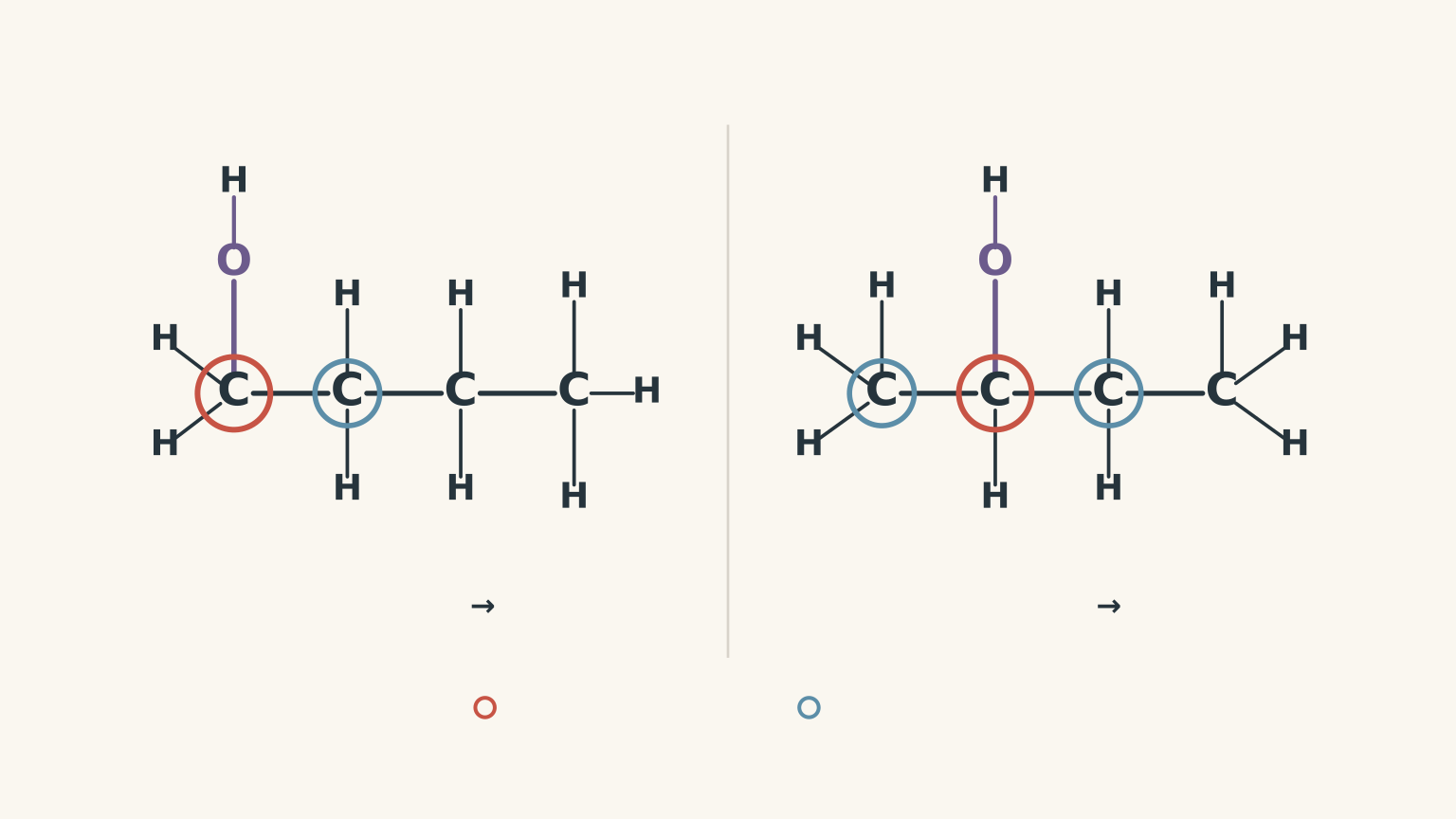
Two alcohols can have the same molecular formula but behave differently when oxidised. Compare \(\ce{CH3CH2CH2CH2OH}\) and \(\ce{CH3CH(OH)CH2CH3}\). Both contain four carbon atoms and an \(\ce{-OH}\) group. Which one is a primary alcohol?
The first structure, butan-1-ol, is primary. The second, butan-2-ol, is secondary. The difference is the carbon directly bonded to the \(\ce{-OH}\) group.
A primary alcohol has its hydroxyl group (\(\ce{-OH}\)) attached to a carbon atom that is bonded to exactly one other carbon atom. That carbon normally has two hydrogen atoms, giving the local structure \(\ce{-CH2OH}\).
Due to technical limitations, this figure may display incorrectly or contain inaccuracies. Please check key details against your course materials.
01How to identify a primary alcohol in a structural formula
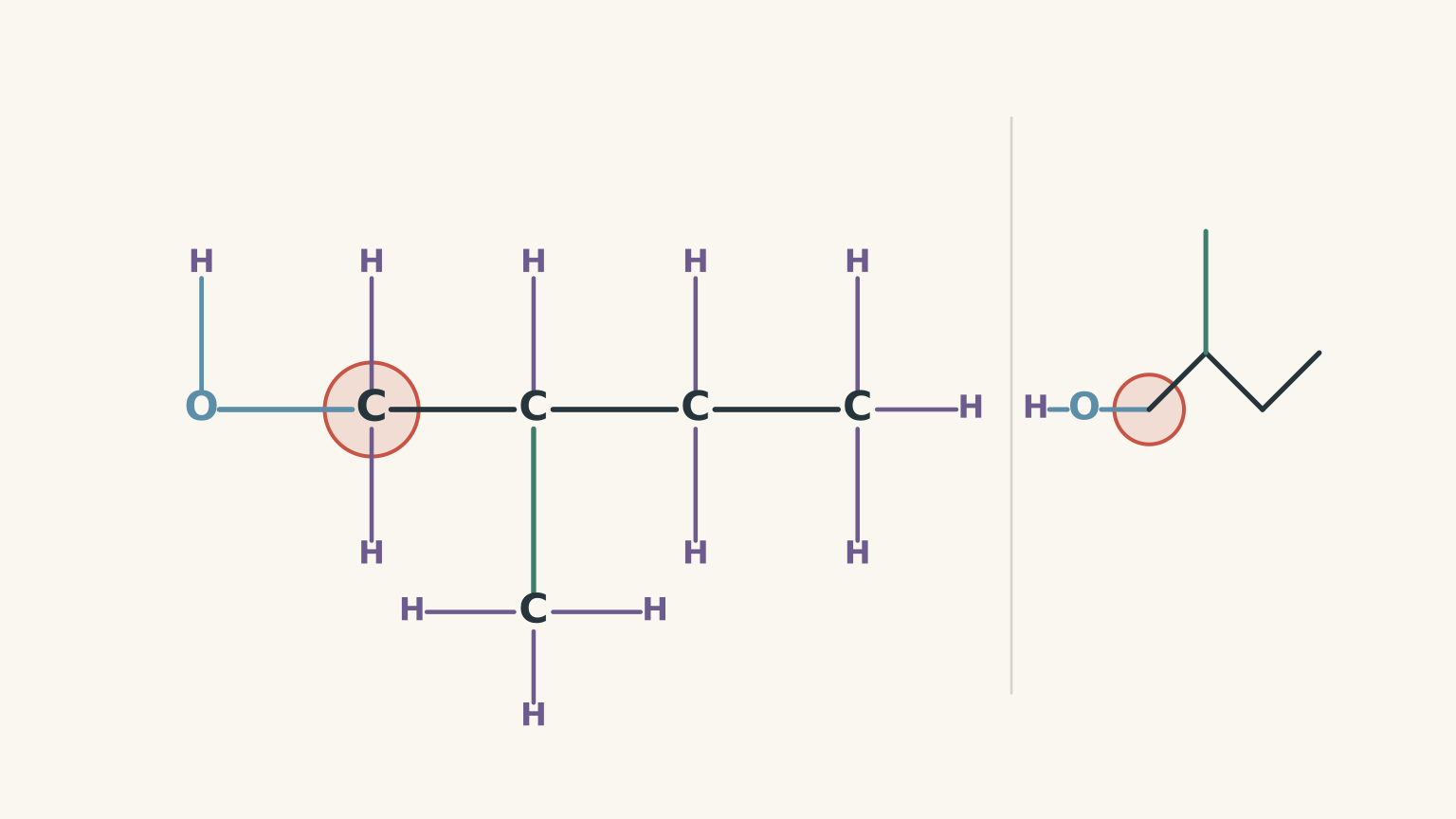
Start by finding the hydroxyl group. Then follow the bond from its oxygen atom to the carbon carrying it.
Count only the carbon atoms directly bonded to that carbon. Do not count the total number of carbon atoms in the molecule.
| Alcohol classification | Carbon neighbours of the OH-bearing carbon | Hydrogen atoms on that carbon |
|---|---|---|
| Primary (\(1^\circ\)) | 1 | 2 |
| Secondary (\(2^\circ\)) | 2 | 1 |
| Tertiary (\(3^\circ\)) | 3 | 0 |
The hydrogen count provides a useful second check. Carbon normally forms four covalent bonds, so a carbon bonded to oxygen and one other carbon has two bonds available for hydrogen.
Consider the condensed structural formula of 2-methylbutan-1-ol:
\[ \ce{CH3CH2CH(CH3)CH2OH} \]
The carbon carrying the hydroxyl group is the final \(\ce{CH2}\). It is bonded to oxygen, two hydrogen atoms, and one carbon atom.
That makes the alcohol primary, even though the carbon chain is branched.
The branch does not change the classification because it is not directly attached to the OH-bearing carbon.
Due to technical limitations, this figure may display incorrectly or contain inaccuracies. Please check key details against your course materials.
Three structural mistakes worth avoiding
A condensed formula can hide the exact position of the hydroxyl group. Watch for these cases:
- \(\ce{CH3CH2CH2OH}\) is primary because its OH-bearing carbon has one carbon neighbour.
- \(\ce{CH3CH(OH)CH3}\) is secondary because the OH-bearing carbon has two carbon neighbours.
- \(\ce{(CH3)3COH}\) is tertiary because the OH-bearing carbon has three carbon neighbours.
The position of the oxygen matters too. In \(\ce{CH3OCH2CH3}\), oxygen sits between two carbon groups. This compound is an ether, not an alcohol, because it has no hydroxyl group.
Similarly, the \(\ce{-OH}\) in a carboxylic acid group, \(\ce{-COOH}\), does not make that group an alcohol.
Methanol, \(\ce{CH3OH}\), is a special case. Its OH-bearing carbon has zero carbon neighbours, so it does not literally satisfy the one-neighbour rule. It is often grouped with primary alcohols because of its oxidation behaviour. When classifying methanol, recognise and explain this exception.
For a broader comparison of all three classes, see Primary, Secondary and Tertiary Alcohols for HSC Chemistry.
Worked example: Classify a branched alcohol and predict its oxidation product
Classify \(\ce{CH3CH(CH3)CH2CH2OH}\) and predict the first organic product formed when it is oxidised using acidified potassium dichromate, with the product distilled off promptly.
Step 1
The structure ends in \(\ce{CH2OH}\). That carbon has one carbon neighbour and two hydrogen atoms.
Therefore, the compound is a primary alcohol: 3-methylbutan-1-ol.
Step 2
A primary alcohol can be oxidised to an aldehyde. The carbon carrying the hydroxyl group loses hydrogen and forms a carbon-oxygen double bond.
The rest of the carbon skeleton remains unchanged in this reaction.
Step 3
The first oxidation product is 3-methylbutanal:
\[ \ce{CH3CH(CH3)CH2CHO} \]
Using \(\ce{[O]}\) to represent the oxidising agent, the simplified equation is:
\[ \begin{aligned} &\ce{CH3CH(CH3)CH2CH2OH + [O]}\\ &\ce{-> CH3CH(CH3)CH2CHO + H2O} \end{aligned} \]
Step 4
Heating with acidified potassium dichromate allows oxidation to occur. Prompt distillation removes the volatile aldehyde from the oxidising mixture, reducing its opportunity to undergo further oxidation to a carboxylic acid.
Simply identifying the alcohol as primary is not enough to determine the final product. The reaction conditions matter.
02Why primary alcohols behave differently during oxidation
The classification method becomes more useful when you look at the bonds that oxidation changes.
A simple model is to focus on the hydrogen atoms attached to the OH-bearing carbon.
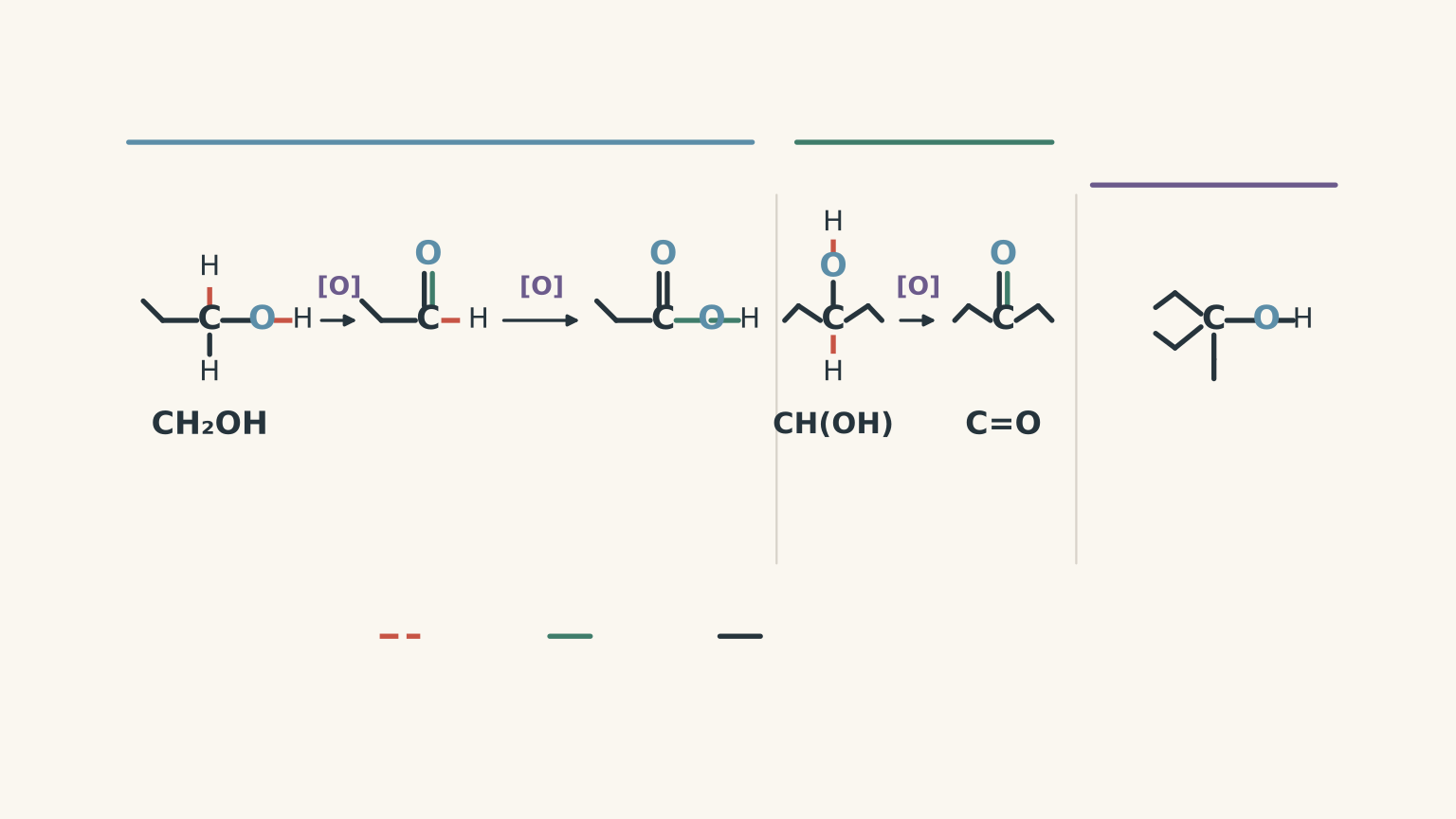
A primary alcohol has two of these hydrogen atoms. During its first oxidation, the carbon loses one hydrogen while the hydroxyl group loses its hydrogen, and a carbonyl group, \(\ce{C=O}\), forms.
The usual reaction is:
\[ \ce{RCH2OH + [O] -> RCHO + H2O} \]
Here, \(\ce{R}\) represents a carbon-containing group. The product, \(\ce{RCHO}\), is an aldehyde. The notation \(\ce{[O]}\) represents an oxidising agent, not a free oxygen atom.
Under suitable further oxidation, the aldehyde becomes a carboxylic acid:
\[ \ce{RCHO + [O] -> RCOOH} \]
Compare that with a secondary alcohol. Its OH-bearing carbon has one hydrogen and two carbon neighbours. Oxidation produces a ketone instead.
A tertiary alcohol has no hydrogen attached to its OH-bearing carbon. It does not undergo the same ordinary oxidation with acidified dichromate without breaking carbon-carbon bonds.
Due to technical limitations, this figure may display incorrectly or contain inaccuracies. Please check key details against your course materials.
This gives a useful prediction table for standard school-level oxidation conditions.
| Starting alcohol | Oxidising conditions | Expected organic product |
|---|---|---|
| Primary | Acidified \(\ce{K2Cr2O7}\), heat, prompt distillation | Aldehyde |
| Primary | Excess acidified \(\ce{K2Cr2O7}\), heat under reflux | Carboxylic acid |
| Secondary | Acidified \(\ce{K2Cr2O7}\), heat | Ketone |
| Tertiary | Acidified \(\ce{K2Cr2O7}\), ordinary school-lab conditions | No corresponding oxidation |
Distillation and reflux do different jobs. Distillation removes a volatile product from the reaction mixture. Reflux condenses vapour and returns it to the flask, allowing continued reaction without losing much of the volatile material.
For the detailed distinction between aldehyde and acid formation, see Primary Alcohol Oxidation Products: Aldehydes and Acids.
03An experiment that shows why colour alone cannot identify a primary alcohol
Suppose the structural formula is unavailable. Could you identify a primary alcohol simply by adding an oxidising agent and watching for a colour change?
A student might predict that only primary alcohols produce a positive oxidation test. That seems reasonable if they remember that primary alcohols form aldehydes.
Unfortunately, secondary alcohols are also oxidised.
The first design: An oxidation colour test
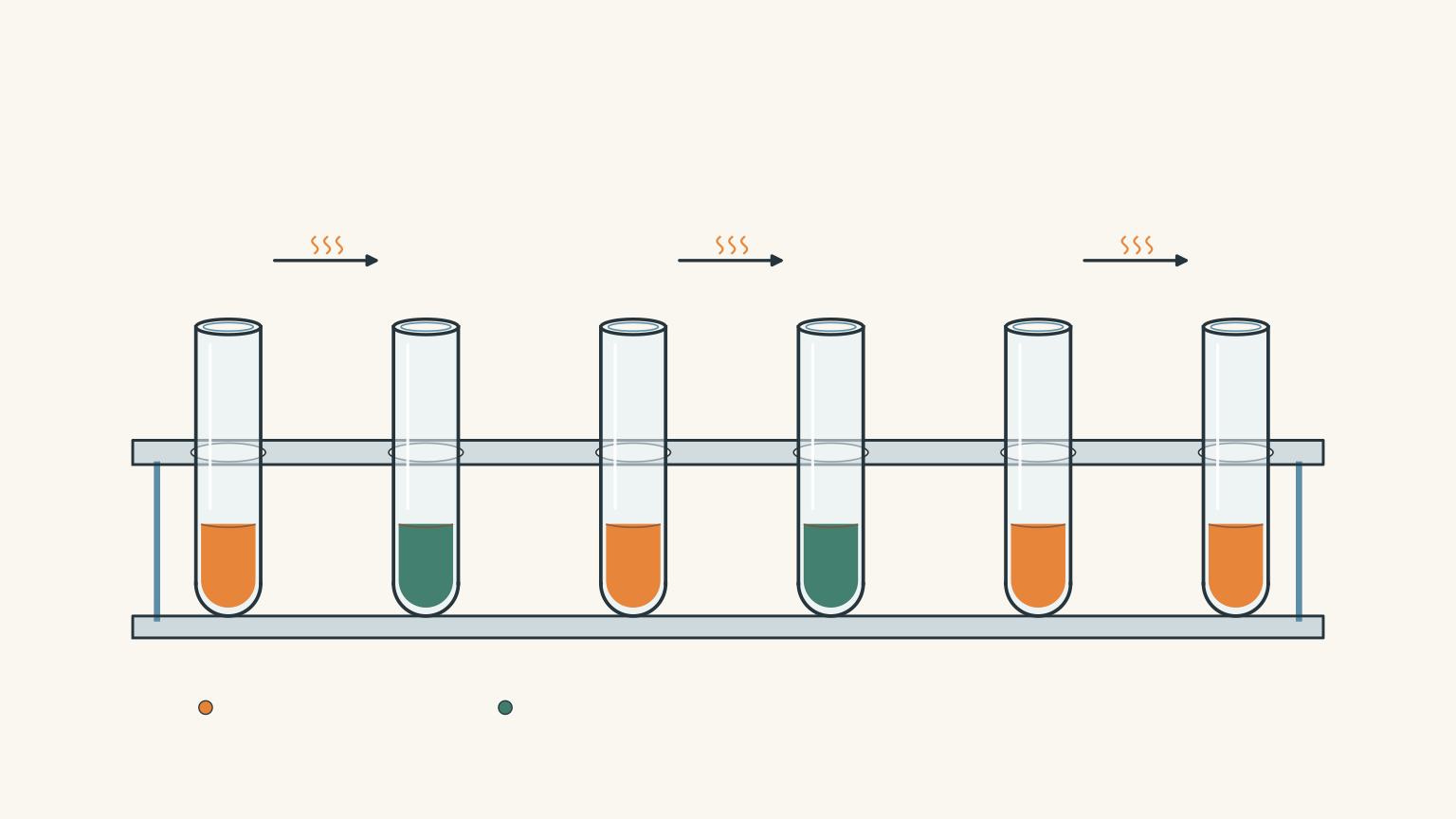
Consider three separate test tubes containing pure samples of butan-1-ol, butan-2-ol, and 2-methylpropan-2-ol.
Each sample is warmed with acidified potassium dichromate(VI), \(\ce{K2Cr2O7}\). The reagent contains orange dichromate ions, which are reduced to green chromium(III) ions when oxidation occurs.
The expected outcomes are:
| Alcohol | Classification | Predicted colour observation |
|---|---|---|
| Butan-1-ol | Primary | Orange to green |
| Butan-2-ol | Secondary | Orange to green |
| 2-methylpropan-2-ol | Tertiary | Remains orange |
These are predicted textbook outcomes, not measurements from an experiment performed for this article.
Due to technical limitations, this figure may display incorrectly or contain inaccuracies. Please check key details against your course materials.
The design can distinguish an ordinarily oxidisable alcohol from a tertiary alcohol in this restricted comparison.
But it cannot distinguish a primary alcohol from a secondary alcohol. Both reduce the dichromate ions, so both produce a colour change.
The key limitation is that the colour change reports a redox reaction. It does not directly identify the organic product.
The revised design: Identify the oxidation product
A more useful experiment investigates what the alcohol becomes.
Consider the two remaining possibilities: butan-1-ol and butan-2-ol.
For a controlled first oxidation, the alcohol and acidified oxidising agent are heated in a distillation flask. The flask connects through a side arm to a downward-sloping condenser, which leads into a receiving vessel.
As the volatile organic product forms, it can leave the heated flask as vapour. It travels through the condenser, cools, returns to liquid, and collects in the receiver.
Cooling water flows into the lower connection of the condenser jacket and out through the upper connection, keeping the jacket filled with cooling water.
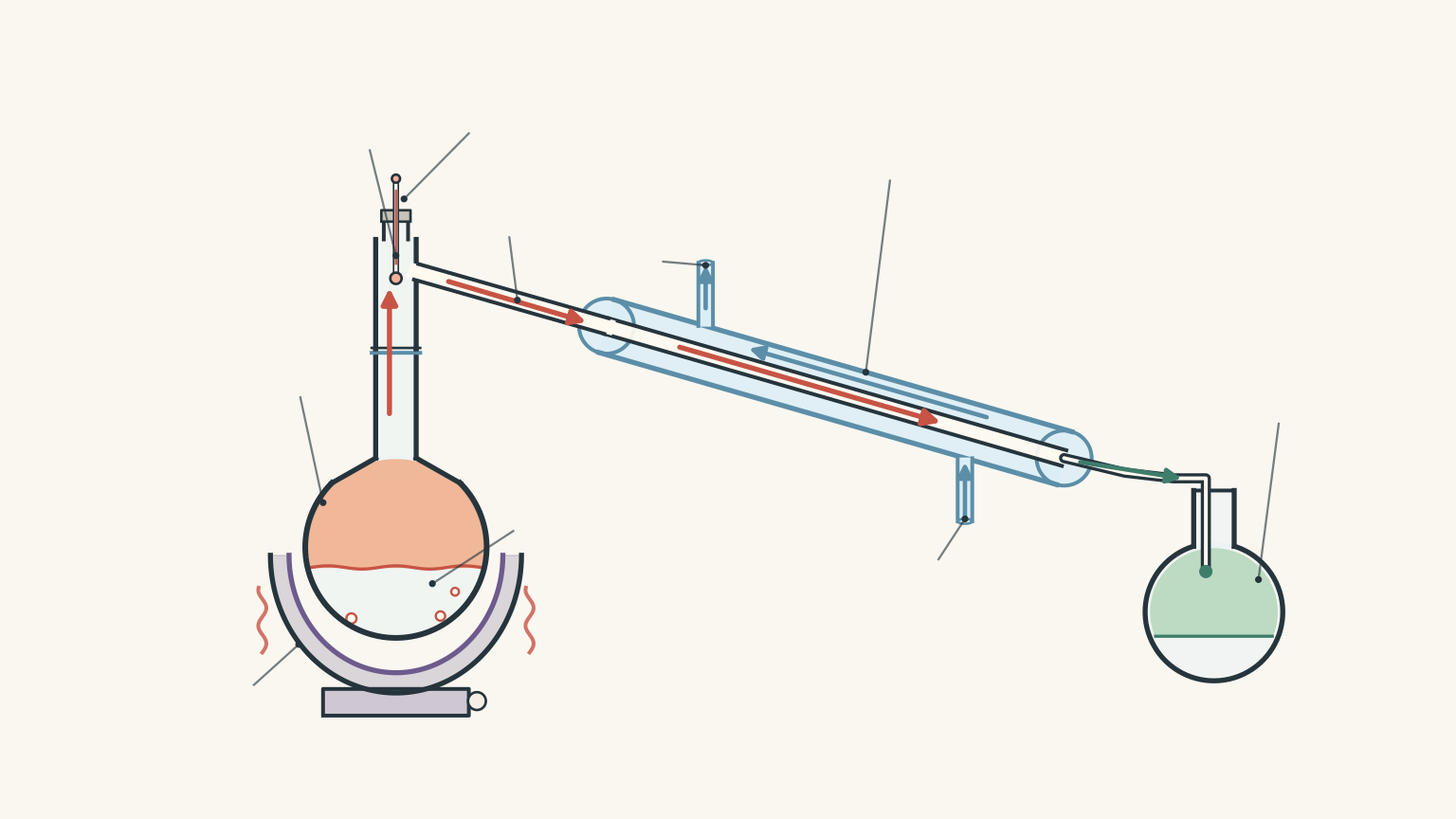
Due to technical limitations, this figure may display incorrectly or contain inaccuracies. Please check key details against your course materials.
The revised experiment separates the product so it can be tested.
Under suitable conditions:
- Butan-1-ol produces butanal, an aldehyde.
- Butan-2-ol produces butan-2-one, a ketone.
An aldehyde-specific test provides additional evidence. For example, Tollens’ reagent can produce a silver deposit with an aldehyde, while an ordinary ketone such as butan-2-one gives a negative result under the same test conditions.
The positive aldehyde result supports the identification of the starting alcohol as primary.
This reasoning assumes a pure alcohol, controlled oxidation, and a sufficiently clean, identified carbonyl product. Other reducing substances can interfere with chemical tests, so a single observation is not universal proof of structure.
Chromium(VI) compounds and Tollens’ reagent also have significant laboratory hazards. This is an explanation of experimental reasoning, not a home experiment.
Worked example: Can two oxidation products have the same mass?
Two separate 0.0500 mol samples of alcohol isomers are oxidised using acidified potassium dichromate and prompt distillation.
- Sample A: \(\ce{CH3CH2CH(CH3)CH2OH}\)
- Sample B: \(\ce{CH3CH(OH)CH2CH2CH3}\)
Identify the first oxidation product from each sample and calculate the theoretical mass collected.
Assume complete conversion to the first carbonyl product, no further oxidation, and no product loss. Use a molar mass of \(86.0\ \mathrm{g\,mol^{-1}}\) for each carbonyl product.
Step 1
Sample A is 2-methylbutan-1-ol. Its OH-bearing carbon is bonded to one other carbon, making it primary.
Sample B is pentan-2-ol. Its OH-bearing carbon has two carbon neighbours, making it secondary.
Step 2
Sample A forms the aldehyde 2-methylbutanal:
\[ \ce{CH3CH2CH(CH3)CHO} \]
Sample B forms the ketone pentan-2-one:
\[ \ce{CH3COCH2CH2CH3} \]
Both products have molecular formula \(\ce{C5H10O}\).
Step 3
Each alcohol forms one mole of its first carbonyl product per mole of alcohol.
Let \(n\) be the amount in moles, \(M\) the molar mass, and \(m\) the mass.
\[ \begin{aligned} n &= 0.0500\ \mathrm{mol}\\ M &= 86.0\ \mathrm{g\,mol^{-1}}\\ m &= nM\\ &= 0.0500 \times 86.0\ \mathrm{g}\\ &= 4.30\ \mathrm{g} \end{aligned} \]
The theoretical collected mass is 4.30 g for either sample under the stated ideal assumptions.
Step 4
The equal theoretical masses do not identify which alcohol is primary.
Both samples also produce an orange-to-green dichromate colour change.
The decisive distinction is the structure of the oxidation product: an aldehyde from A and a ketone from B.
The important lesson is that experimental evidence must identify the property you actually need. Oxidation occurring is not the same as an aldehyde being formed.
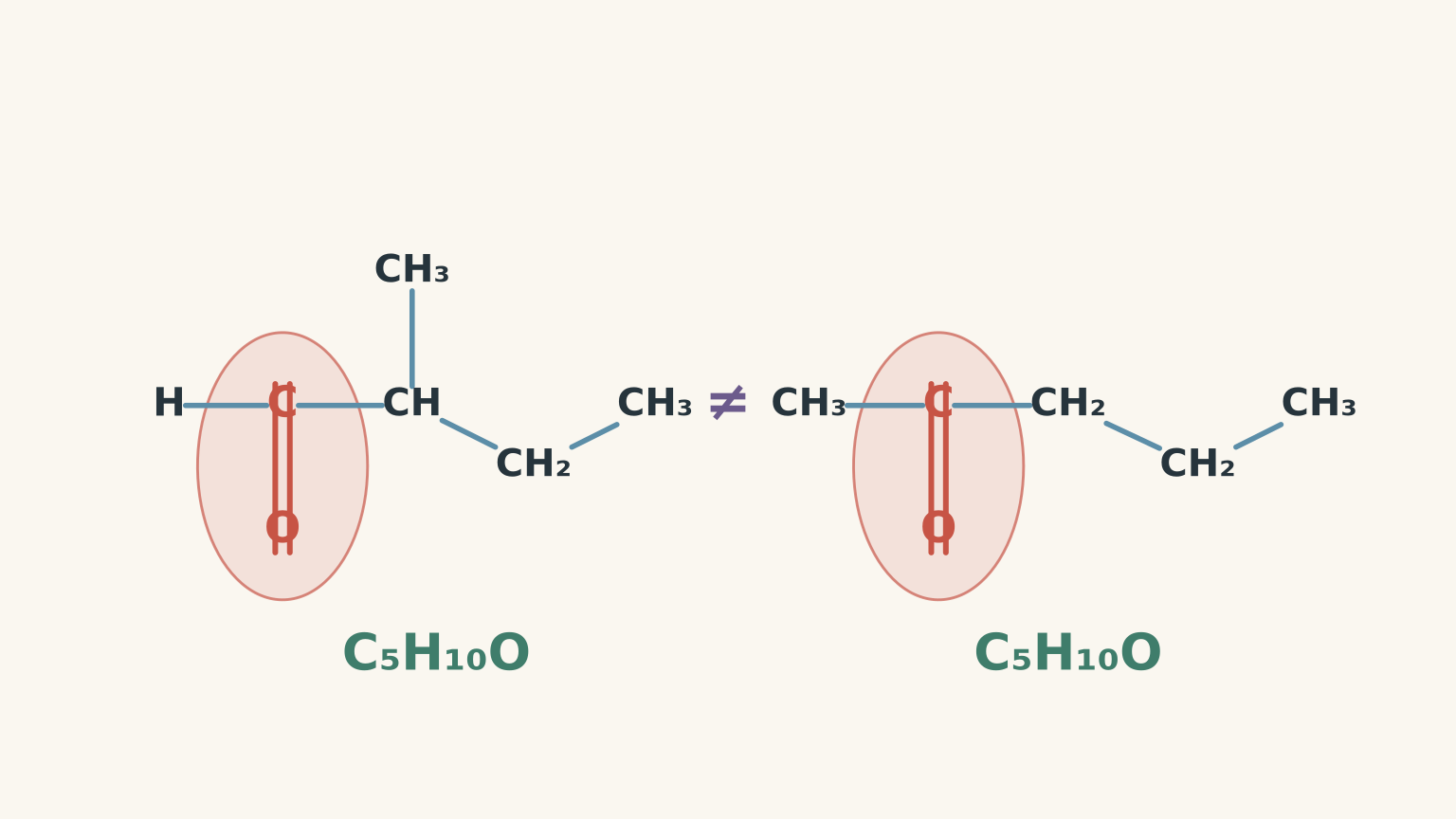
Due to technical limitations, this figure may display incorrectly or contain inaccuracies. Please check key details against your course materials.
04How primary alcohol classification connects to substitution and elimination
Alcohol classification predicts some reactions well, but it is not a complete reaction rule.
Three reactions use different structural information.
Substitution: Replacing the hydroxyl group
In a substitution reaction, the hydroxyl group is replaced by another group.
For example, ethanol reacts with hydrogen bromide under suitable concentrated-acid and warming conditions to form bromoethane:
\[ \ce{CH3CH2OH + HBr -> CH3CH2Br + H2O} \]
The carbon skeleton remains unchanged in this simplified reaction.
An important detail is that the hydroxyl group is a poor leaving group on its own. Acidic conditions help convert it into water, which can leave more readily.
Primary, secondary, and tertiary alcohols can undergo substitution under appropriate conditions, although their reaction pathways and competing reactions can differ.
A successful substitution therefore does not prove that the starting alcohol was primary.
Elimination: Removing water to form an alkene
An alcohol can undergo dehydration when heated with a suitable concentrated acid, such as sulfuric acid.
For ethanol, heating with concentrated \(\ce{H2SO4}\) at approximately \(170^\circ\mathrm{C}\) can favour formation of ethene:
\[ \ce{CH3CH2OH -> CH2=CH2 + H2O} \]
In a straightforward dehydration, the OH-bearing carbon loses its hydroxyl group, and an adjacent carbon supplies a hydrogen atom. A carbon-carbon double bond forms between these neighbouring carbons.
The neighbouring carbon is called the beta carbon.
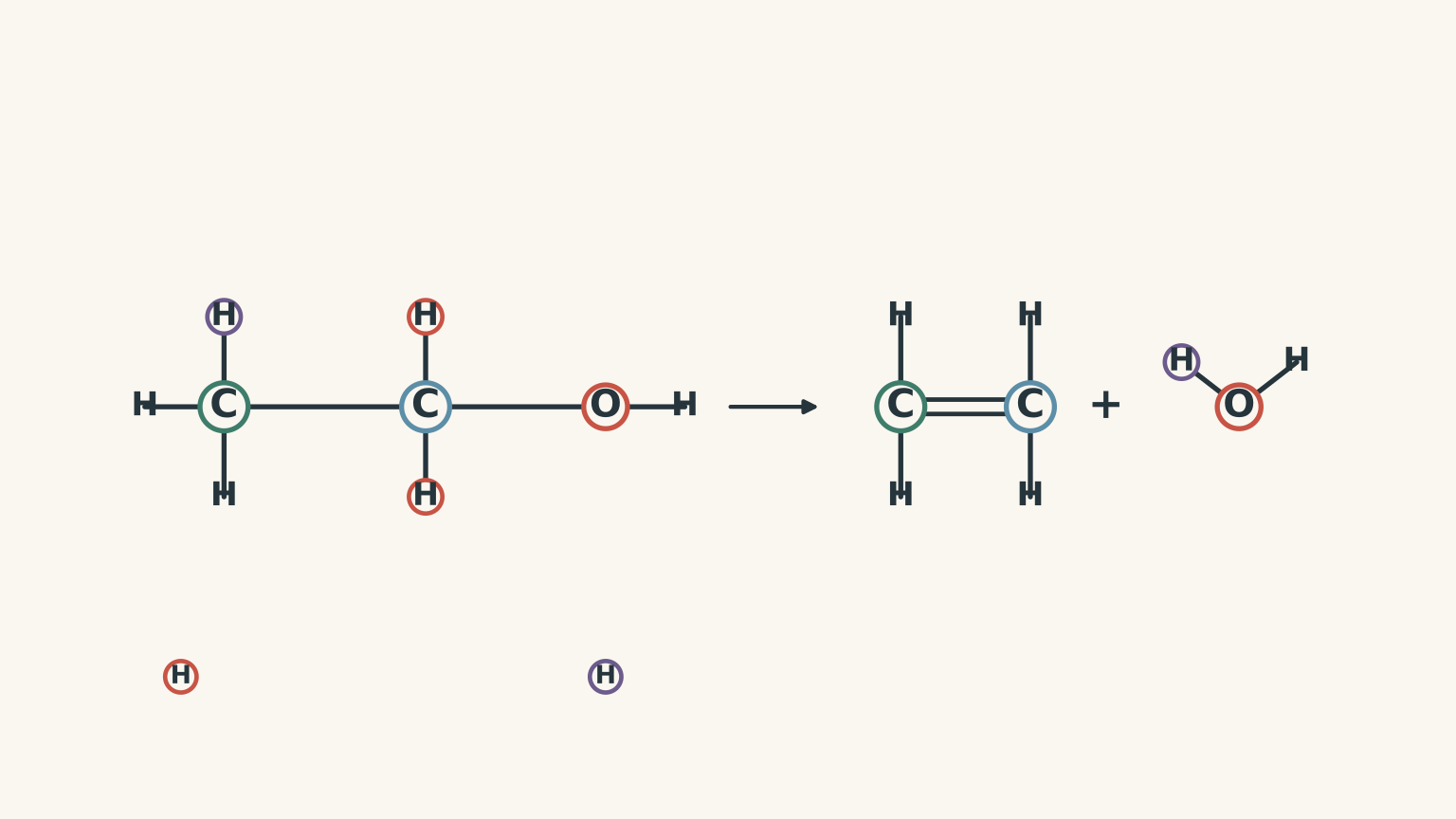
Due to technical limitations, this figure may display incorrectly or contain inaccuracies. Please check key details against your course materials.
Notice the difference:
- Oxidation of a primary alcohol depends on hydrogen atoms attached to the OH-bearing carbon.
- Direct elimination depends on an available hydrogen on an adjacent carbon.
- Substitution depends on replacing the hydroxyl group under suitable reaction conditions.
These requirements are related, but they are not identical.
An alkene can also be formed from a haloalkane by elimination, for example using ethanolic potassium hydroxide and heat. The same requirement for a hydrogen on the carbon adjacent to the leaving group applies.
This becomes especially interesting in highly branched molecules. Being primary does not guarantee that a simple elimination can occur without rearrangement.
05Questions and solutions
Question 1
Classify propan-1-ol, \(\ce{CH3CH2CH2OH}\), as primary, secondary, or tertiary.
Predict its first oxidation product when heated with acidified potassium dichromate and the product is distilled off promptly. Write a simplified reaction equation.
Solution 1
Propan-1-ol is a primary alcohol, and its first oxidation product is propanal.
The carbon carrying the \(\ce{-OH}\) group is the terminal \(\ce{CH2}\) carbon. It is bonded to only one other carbon atom.
When oxidised under conditions that favour removal of the first product, this primary alcohol forms an aldehyde.
The reaction is:
\[ \ce{CH3CH2CH2OH + [O] -> CH3CH2CHO + H2O} \]
The product \(\ce{CH3CH2CHO}\) is propanal.
Prompt distillation helps prevent further oxidation of the aldehyde to propanoic acid. Without the stated conditions, predicting propanal as the final isolated product would be incomplete.
Question 2
Four compounds have the same molecular formula, \(\ce{C5H12O}\).
| Candidate | Condensed structural formula |
|---|---|
| A | \(\ce{CH3CH2CH(CH3)CH2OH}\) |
| B | \(\ce{CH3CH(OH)CH2CH2CH3}\) |
| C | \(\ce{CH3C(OH)(CH3)CH2CH3}\) |
| D | \(\ce{CH3OCH2CH2CH2CH3}\) |
Two unknown pure samples, X and Y, are known to be among these candidates. The following results are illustrative experimental data.
- X produces no orange-to-green colour change when warmed with acidified potassium dichromate. An independent infrared spectrum confirms the presence of an O-H bond.
- Y produces an orange-to-green colour change. Its first carbonyl oxidation product is promptly separated and gives a positive aldehyde test.
Identify X and Y.
Explain why the dichromate colour observations alone cannot establish their identities. Predict the first oxidation product of candidate B under suitable conditions.
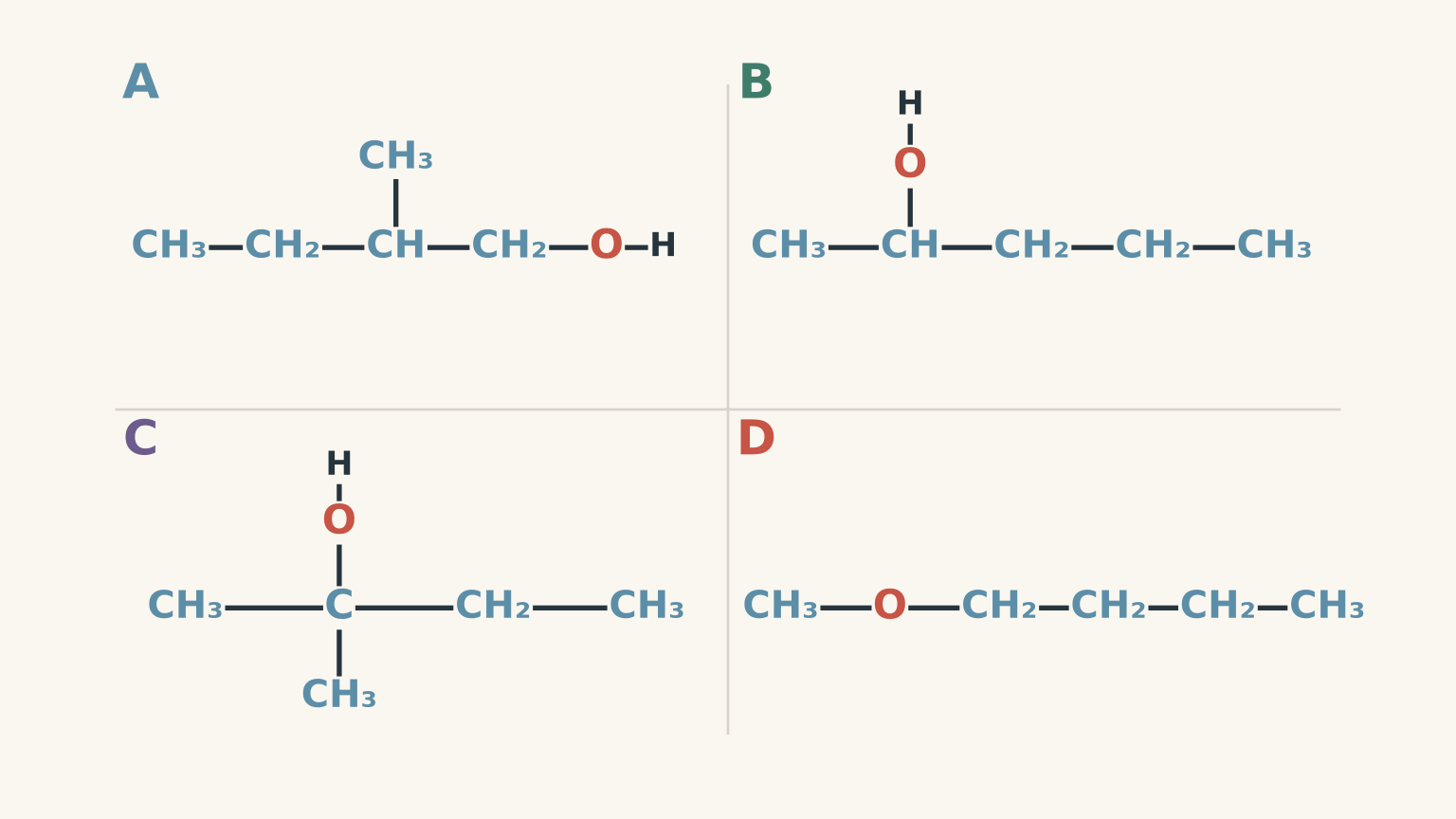
Due to technical limitations, this figure may display incorrectly or contain inaccuracies. Please check key details against your course materials.
Solution 2
X is candidate C, 2-methylbutan-2-ol, and Y is candidate A, 2-methylbutan-1-ol. Candidate B produces pentan-2-one on oxidation.
To identify X, first consider its negative dichromate test.
Candidate C is tertiary because its OH-bearing carbon has three carbon neighbours and no hydrogen attached to that carbon. It does not undergo ordinary oxidation with acidified dichromate.
Candidate D is an ether. It also lacks an oxidisable alcohol group under these conditions, so a negative oxidation result alone cannot distinguish C from D.
The independent O-H evidence eliminates D, which has no O-H bond. Therefore X must be C.
For Y, a positive dichromate result leaves A and B as possibilities.
Candidate A is primary and produces an aldehyde, 2-methylbutanal:
\[ \ce{CH3CH2CH(CH3)CHO} \]
Candidate B is secondary and produces a ketone, pentan-2-one:
\[ \ce{CH3COCH2CH2CH3} \]
The positive aldehyde test identifies the product of A, so Y must be candidate A.
The tempting mistake is to interpret the colour test as a complete classification test. It only establishes that oxidation occurred under the test conditions.
Even a negative result does not automatically mean the compound is a tertiary alcohol. It may not be an alcohol at all.
Question 3
Two alcohols, R and S, have molecular formula \(\ce{C3H8O}\).
- R is propan-1-ol, \(\ce{CH3CH2CH2OH}\).
- S is propan-2-ol, \(\ce{CH3CH(OH)CH3}\).
Each alcohol is separately reacted with concentrated hydrogen bromide under suitable warming conditions to produce a bromoalkane.
The bromoalkanes are isolated and then separately heated with ethanolic potassium hydroxide under conditions favouring elimination.
A student predicts that because the final alkene from both routes is propene, R and S must belong to the same alcohol class.
Evaluate the prediction. Identify the bromoalkane intermediates, explain the possible elimination products, and state how controlled oxidation of the original alcohols would distinguish their classes.
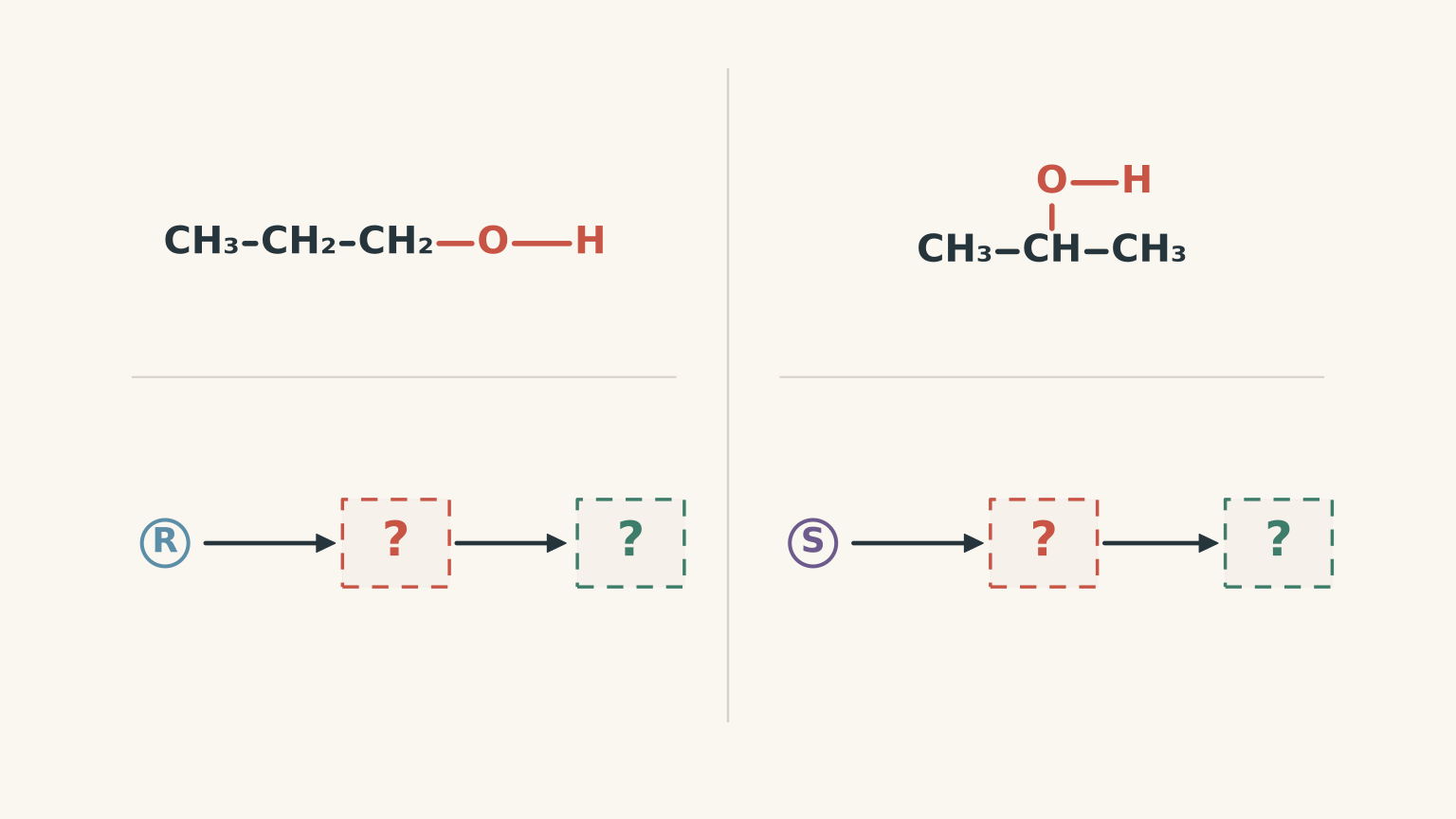
Due to technical limitations, this figure may display incorrectly or contain inaccuracies. Please check key details against your course materials.
Solution 3
The student’s prediction is incorrect. R is primary and S is secondary, but both reaction sequences can produce propene.
R is primary because its OH-bearing carbon has one carbon neighbour. S is secondary because its OH-bearing carbon has two.
Under suitable substitution conditions, R forms 1-bromopropane:
\[ \ce{CH3CH2CH2OH + HBr -> CH3CH2CH2Br + H2O} \]
S forms 2-bromopropane:
\[ \ce{CH3CH(OH)CH3 + HBr -> CH3CHBrCH3 + H2O} \]
These bromoalkanes are structural isomers.
When the bromoalkanes are heated with ethanolic potassium hydroxide under elimination-favouring conditions, both can form propene.
From 1-bromopropane:
\[ \ce{CH3CH2CH2Br + KOH -> CH3CH=CH2 + KBr + H2O} \]
From 2-bromopropane:
\[ \ce{CH3CHBrCH3 + KOH -> CH3CH=CH2 + KBr + H2O} \]
Both structures allow removal of bromine and a hydrogen from neighbouring carbon atoms, forming the same carbon-carbon double bond.
Therefore, observing propene does not identify which bromoalkane, or which original alcohol, was used. Other reactions may compete, so the equations describe the intended elimination pathways rather than guaranteed quantitative yields.
Controlled oxidation would distinguish the original alcohol classes through their products.
R produces propanal, an aldehyde:
\[ \ce{CH3CH2CH2OH + [O] -> CH3CH2CHO + H2O} \]
S produces propanone, a ketone:
\[ \ce{CH3CH(OH)CH3 + [O] -> CH3COCH3 + H2O} \]
Both oxidations can change dichromate from orange to green. The distinction comes from identifying the aldehyde or ketone.
The important constraint is that different starting structures can converge to the same product under elimination, while oxidation preserves enough structural information to distinguish them.
Question 4
Consider pentane-1,4-diol:
\[ \ce{HOCH2CH2CH2CH(OH)CH3} \]
A 0.0200 mol sample is heated under reflux with excess acidified potassium dichromate until both oxidisable alcohol groups have reacted.
Assume the ordinary oxidation pathways apply, the carbon skeleton does not break, and no side reactions occur.
- Classify each hydroxyl group separately.
- Predict the final organic oxidation product and write the overall simplified equation using \(\ce{[O]}\).
- Calculate the amount of formal \(\ce{[O]}\) equivalents required for complete conversion of the sample.
- A spectrum of the final product still shows an O-H absorption. A student concludes that an alcohol group must have survived because tertiary alcohol groups resist oxidation. Explain the error.
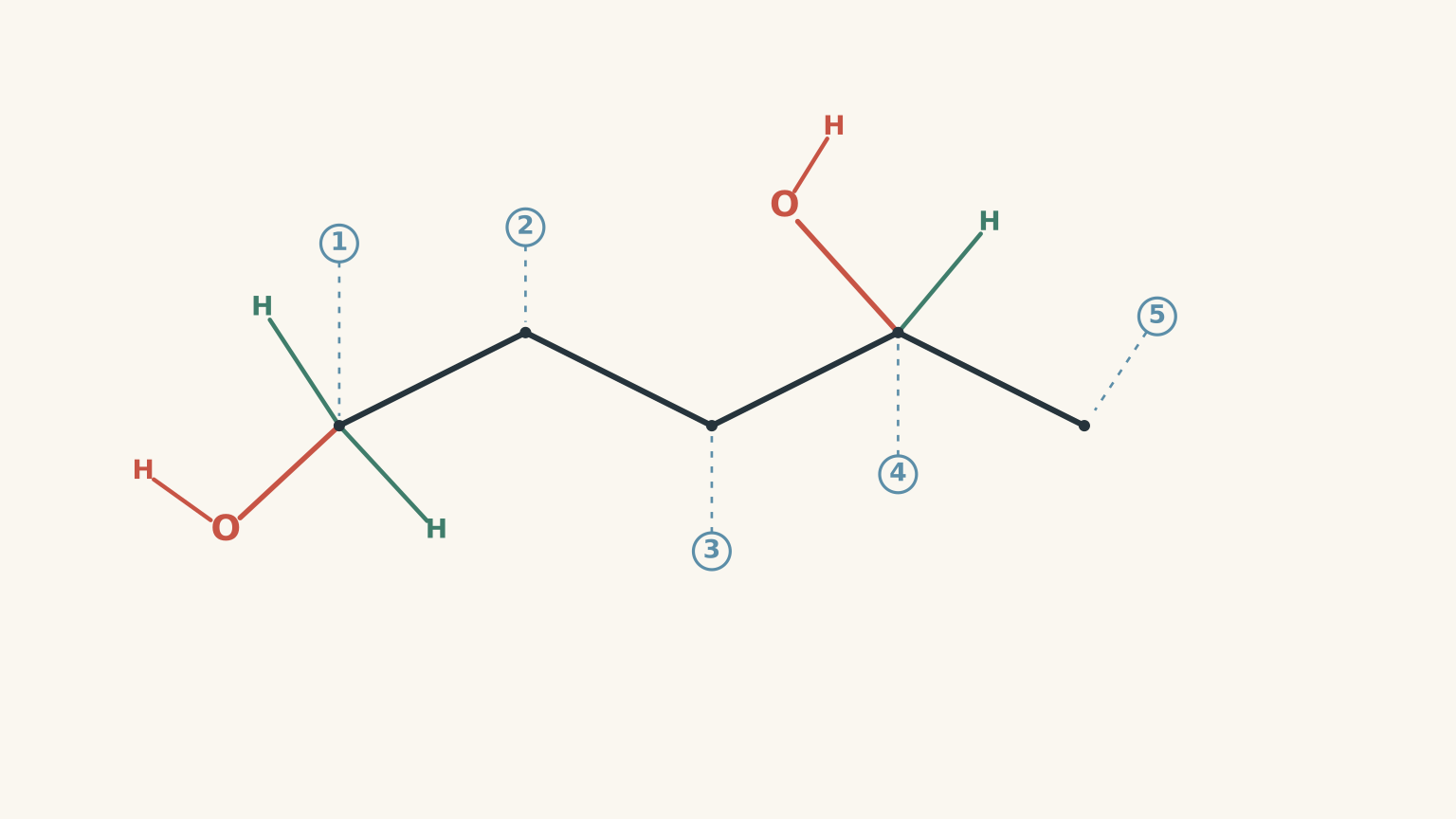
Due to technical limitations, this figure may display incorrectly or contain inaccuracies. Please check key details against your course materials.
Solution 4
Pentane-1,4-diol contains one primary and one secondary alcohol group. Under the stated complete oxidation conditions, it forms \(\ce{HOOCCH2CH2COCH3}\), and the 0.0200 mol sample requires 0.0600 mol of formal \(\ce{[O]}\) equivalents.
The first hydroxyl group is on carbon 1:
\[ \ce{HOCH2-} \]
That carbon has only one carbon neighbour, so this is a primary alcohol group.
The second hydroxyl group is on carbon 4:
\[ \ce{-CH(OH)-} \]
That carbon has two carbon neighbours, so this is a secondary alcohol group.
Under reflux with excess oxidant, the primary alcohol group is oxidised through an aldehyde to a carboxylic acid.
The secondary alcohol group is oxidised to a ketone.
The resulting product is:
\[ \ce{HOOCCH2CH2COCH3} \]
This is 4-oxopentanoic acid.
The overall simplified organic equation is:
\[ \begin{aligned} &\ce{HOCH2CH2CH2CH(OH)CH3}\\ &\ce{+ 3[O] -> HOOCCH2CH2COCH3}\\ &\ce{+ 2H2O} \end{aligned} \]
To calculate the required oxidant equivalents, recognise that full oxidation of a primary alcohol group to a carboxylic acid uses two formal \(\ce{[O]}\) equivalents. Oxidation of the secondary alcohol group to a ketone uses one.
That gives three formal equivalents per molecule of the diol.
Let \(n\) represent the amount in moles:
\[ \begin{aligned} n(\ce{[O]}) &= 3n(\text{diol})\\ &= 3(0.0200)\\ &= 0.0600\ \mathrm{mol} \end{aligned} \]
This is a formal oxidising-equivalent calculation, not the number of moles of actual dichromate reagent.
The final O-H observation does not mean an alcohol survived.
The oxidised product contains a carboxylic acid group, \(\ce{-COOH}\), which includes an O-H bond. That hydroxyl is part of a carboxylic acid functional group, not an alcohol group.
The student has confused the presence of an O-H bond with the presence of an alcohol.
There is also no tertiary alcohol group in the original molecule.
This is why compounds with more than one functional group must be analysed site by site. Calling the whole molecule simply ‘primary’ or ‘secondary’ would hide information needed to predict its reactions.
Question 5
Two alcohols have the same molecular formula, \(\ce{C5H12O}\).
Alcohol A:
\[ \ce{(CH3)3CCH2OH} \]
Alcohol B:
\[ \ce{(CH3)2CHCH2CH2OH} \]
A student makes two predictions:
- Alcohol A is tertiary because it contains a carbon bonded to three methyl groups.
- Both alcohols must form alkenes by ordinary elimination because both have an OH group at the end of their structures.
Consider three separate reaction investigations.
Investigation 1: Each alcohol undergoes controlled oxidation with acidified potassium dichromate. Its first carbonyl product is removed promptly by distillation.
Investigation 2: The corresponding bromoalkanes, \(\ce{(CH3)3CCH2Br}\) and \(\ce{(CH3)2CHCH2CH2Br}\), are supplied independently. They are heated with ethanolic KOH under conditions favouring elimination. Assume carbon-carbon bonds do not rearrange during this elimination.
Investigation 3: Pure alcohol A is heated under strongly acidic dehydration conditions. Suppose an alkene genuinely derived from A is identified among the products.
Answer all of the following.
- Classify A and B correctly, and identify their first oxidation products.
- Explain which corresponding bromoalkane can undergo a straightforward elimination to an alkene without carbon-skeleton rearrangement. Give the alkene structure.
- Explain why the other bromoalkane cannot undergo the same direct elimination, even though it is a primary bromoalkane.
- Does the assumed observation of an alkene from A under strongly acidic conditions prove that A was incorrectly classified? Explain what the reaction pathway would have to involve.
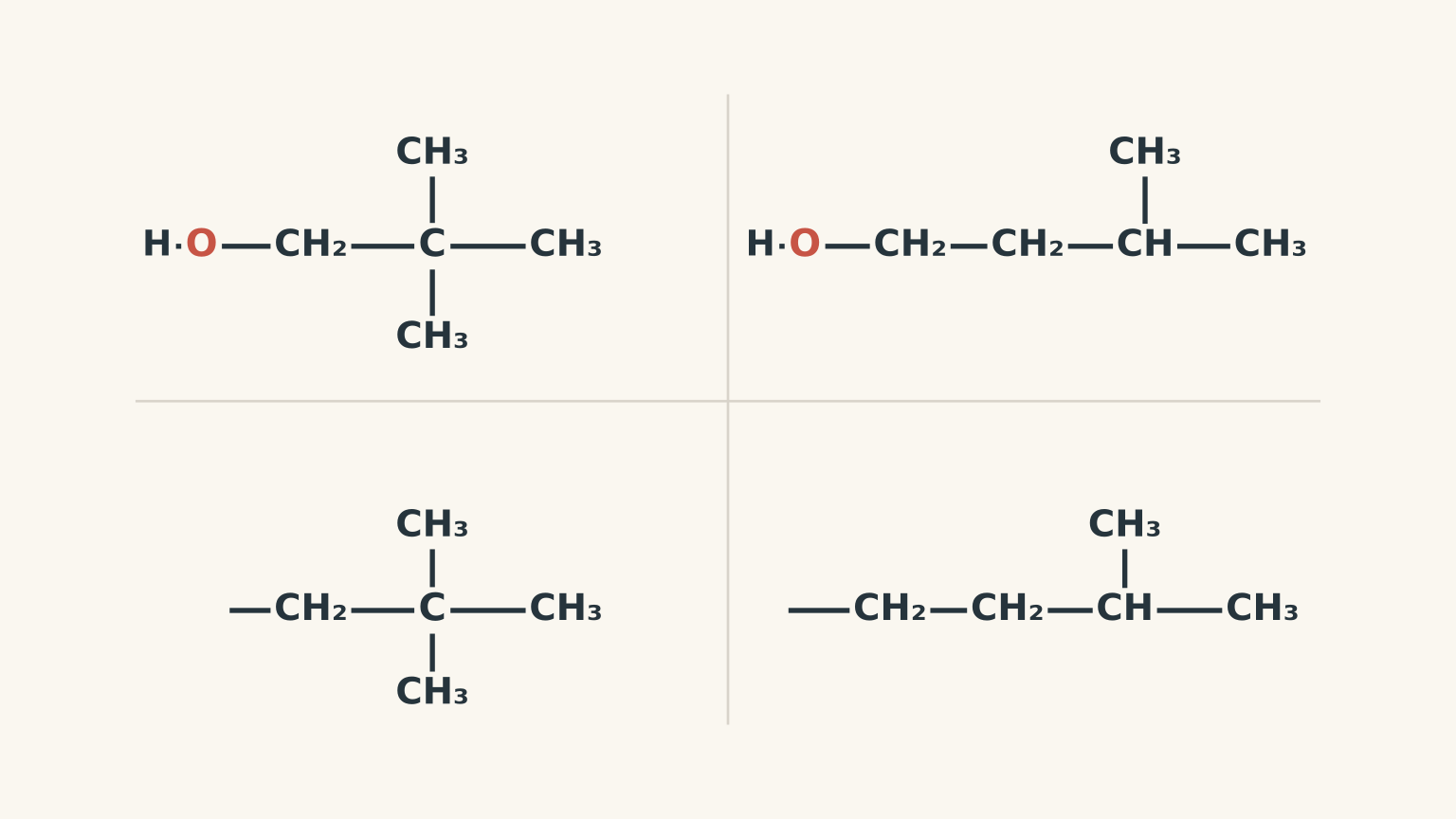
Due to technical limitations, this figure may display incorrectly or contain inaccuracies. Please check key details against your course materials.
Solution 5
Both A and B are primary alcohols. Both can undergo oxidation to aldehydes, but only B’s corresponding bromoalkane can undergo an ordinary carbon-skeleton-preserving beta-elimination. An alkene obtained from A under strongly acidic conditions would not disprove its primary classification.
The first prediction fails because the student has examined the wrong carbon.
In A, the carbon directly attached to the hydroxyl group is the \(\ce{CH2OH}\) carbon. It has one carbon neighbour and two hydrogen atoms.
The carbon bonded to three methyl groups is the adjacent carbon, not the OH-bearing carbon.
Therefore, A is 2,2-dimethylpropan-1-ol, a primary alcohol.
B is 3-methylbutan-1-ol, also primary. Its terminal \(\ce{CH2OH}\) carbon likewise has one carbon neighbour.
Under controlled oxidation, A forms 2,2-dimethylpropanal:
\[ \ce{(CH3)3CCHO} \]
B forms 3-methylbutanal:
\[ \ce{(CH3)2CHCH2CHO} \]
The oxidation classification works for both because each OH-bearing carbon has the hydrogen atoms needed for normal primary-alcohol oxidation.
The elimination question is different.
In the corresponding bromoalkane from B,
\[ \ce{(CH3)2CHCH2CH2Br} \]
the carbon carrying bromine is next to a \(\ce{CH2}\) carbon. That adjacent carbon has hydrogen atoms available for removal.
A straightforward elimination can therefore produce 3-methylbut-1-ene:
\[ \ce{(CH3)2CHCH=CH2} \]
For elimination using ethanolic potassium hydroxide and heat, the simplified equation is:
\[ \begin{aligned} &\ce{(CH3)2CHCH2CH2Br + KOH}\\ &\ce{-> (CH3)2CHCH=CH2}\\ &\ce{+ KBr + H2O} \end{aligned} \]
Now examine A’s corresponding bromoalkane:
\[ \ce{(CH3)3CCH2Br} \]
Its bromine-bearing carbon is attached to a central carbon that already has four carbon-carbon bonds: one to \(\ce{CH2Br}\) and three to methyl groups.
That central carbon has no hydrogen atoms.
A direct beta-elimination would need to remove bromine from the \(\ce{CH2Br}\) carbon and hydrogen from its immediate carbon neighbour.
But there is no hydrogen available on that neighbour.
The hydrogen atoms on the three methyl groups cannot simply replace this missing beta hydrogen. Those methyl carbons are not directly adjacent to the bromine-bearing carbon.
Therefore, the corresponding bromoalkane from A cannot form an alkene through the proposed carbon-skeleton-preserving elimination. This does not establish that every possible reaction with ethanolic KOH is impossible; it rules out that specific elimination pathway.
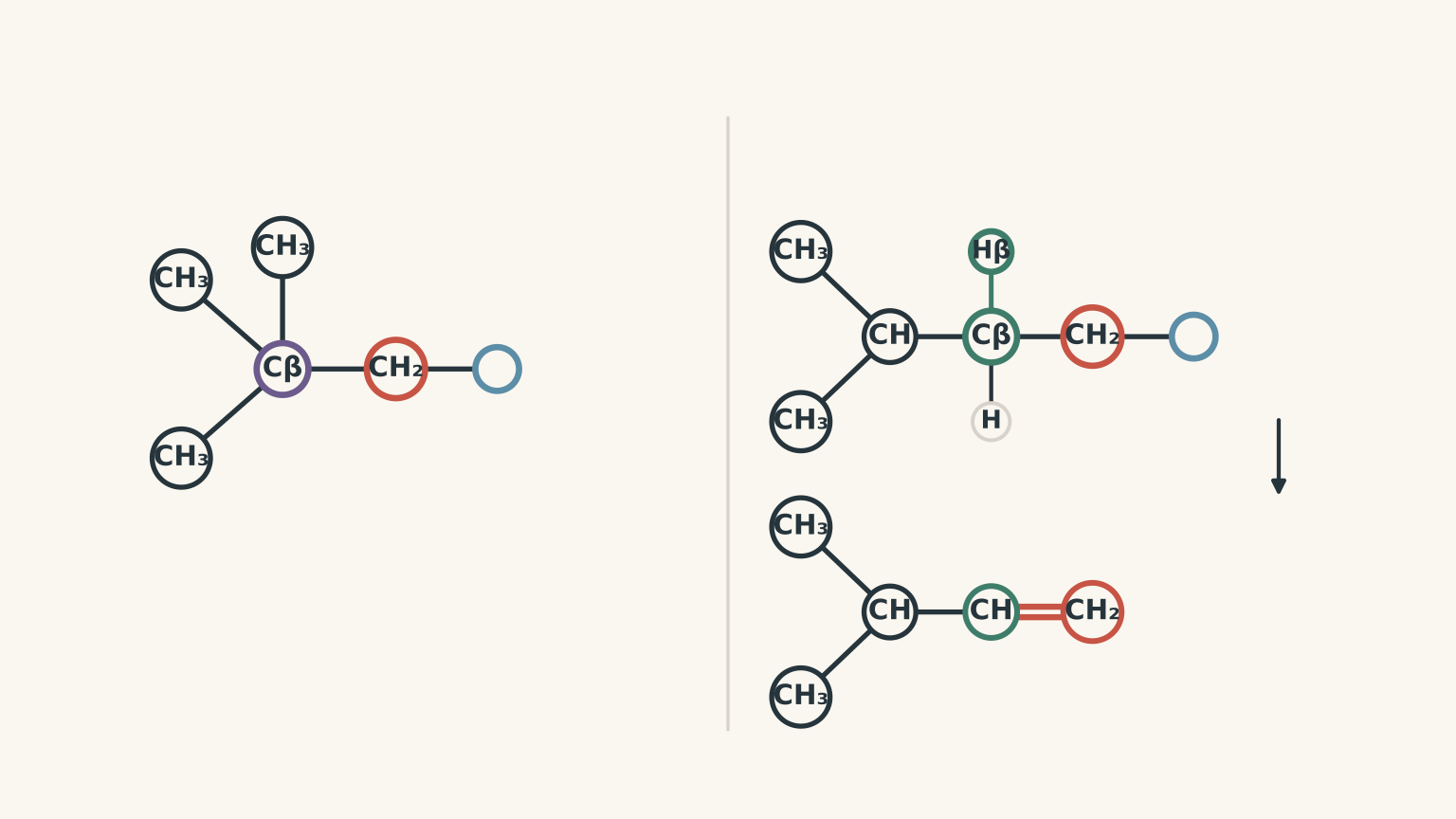
Due to technical limitations, this figure may display incorrectly or contain inaccuracies. Please check key details against your course materials.
The final investigation introduces another important limitation.
Strongly acidic dehydration conditions can allow rearrangement reactions, especially in structures where a straightforward elimination is unfavourable.
If a genuine alkene product is obtained from A, that does not mean its original hydroxyl group was attached to a tertiary carbon.
Its classification is fixed by the original structural formula.
Instead, the observed alkene would require a reaction pathway other than the simple, unchanged-skeleton dehydration assumed earlier. Carbon-skeleton rearrangement is one possible explanation.
We cannot determine the exact alkene produced from the information supplied, so claiming one particular rearranged product would be unjustified.
The deeper point is that alcohol classification and alkene formation depend on different structural constraints.
For oxidation, examine hydrogen atoms on the OH-bearing carbon. For direct elimination, examine hydrogen atoms on the adjacent carbon. For substitution, consider the reagent, leaving group, and possible competing pathways.
That is the next useful decision whenever an HSC question gives you an alcohol structure and asks what it will do: identify the functional group first, then examine the particular bonds the stated reaction would have to change.