
Why Distillation Helps Collect Aldehydes During Alcohol Oxidation
Learn why aldehydes are distilled from the reaction mixture during primary alcohol oxidation, how distillation differs from reflux, and why alcohol classification determines the oxidation product. Includes apparatus explanations, worked examples, and HSC-style practice questions.
You can oxidise propan-1-ol to propanal, but there’s a problem: leave the propanal sitting in the hot reaction mixture and it can be oxidised again to propanoic acid. You might successfully make the aldehyde without collecting much of it.
Distillation solves this problem by removing the volatile aldehyde from the reaction mixture as it forms. The aldehyde vapour travels through a condenser, cools, and is collected in a separate receiver. This reduces the time the aldehyde spends in contact with the oxidising agent, making further oxidation less likely.
Before going further, predict what happens if you attach a vertical condenser above the reaction flask and allow the vapour to condense and run back down. Have you collected the aldehyde?
No. You’ve set up reflux, not distillation. That difference is central to understanding the experiment.
Due to technical limitations, this figure may display incorrectly or contain inaccuracies. Please check key details against your course materials.
01Why the aldehyde needs to leave the reaction mixture
Consider the oxidation of propan-1-ol.
Propan-1-ol is a primary alcohol because the carbon attached to its hydroxyl group, \(\ce{-OH}\), is bonded to only one other carbon atom.
Its oxidation can occur in two stages:
\[ \ce{CH3CH2CH2OH + [O] -> CH3CH2CHO + H2O} \]
The first product is propanal, an aldehyde.
However, propanal can undergo further oxidation:
\[ \ce{CH3CH2CHO + [O] -> CH3CH2COOH} \]
The second product is propanoic acid.
The overall pathway is therefore:
\[ \text{Propan-1-ol} \rightarrow \text{Propanal} \rightarrow \text{Propanoic acid} \]
The aldehyde is an intermediate. It is a product of the first reaction, but also a reactant in the second.
This creates two competing possibilities:
- Remove the aldehyde from the reaction mixture before it undergoes further oxidation.
- Leave the aldehyde in contact with the oxidising agent, allowing further oxidation to occur.
Distillation favours the first possibility.
The important distinction is that distillation does not change the chemical identity of the first oxidation product. It physically separates that product from the reaction environment.
If you need to revise the complete oxidation pathways, see Oxidation of Alcohols: Predicting HSC Chemistry Products.
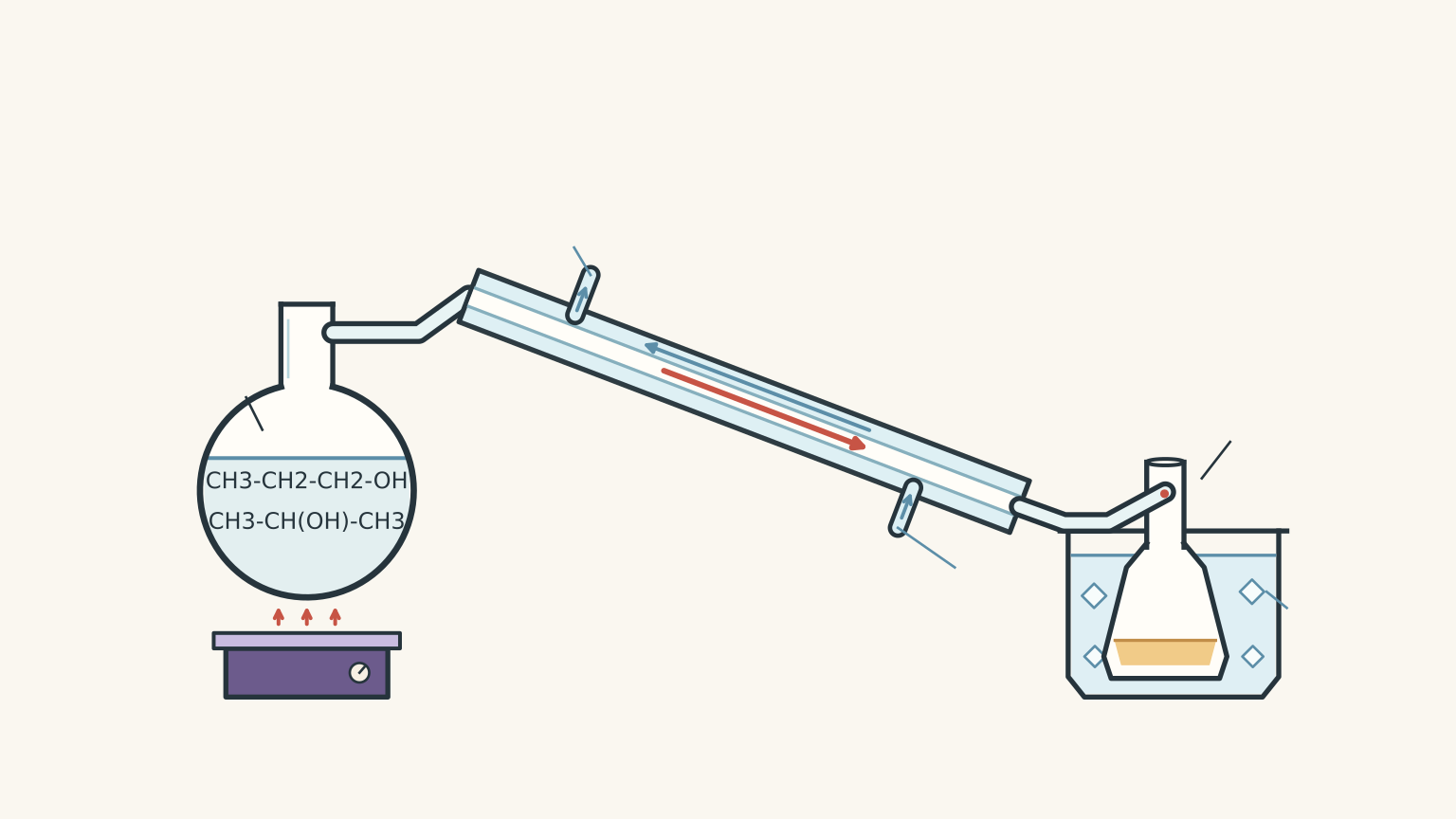
02How the distillation apparatus collects the aldehyde
A typical school-level investigation uses a primary alcohol and an oxidising agent such as acidified potassium dichromate(VI), \(\ce{K2Cr2O7}\).
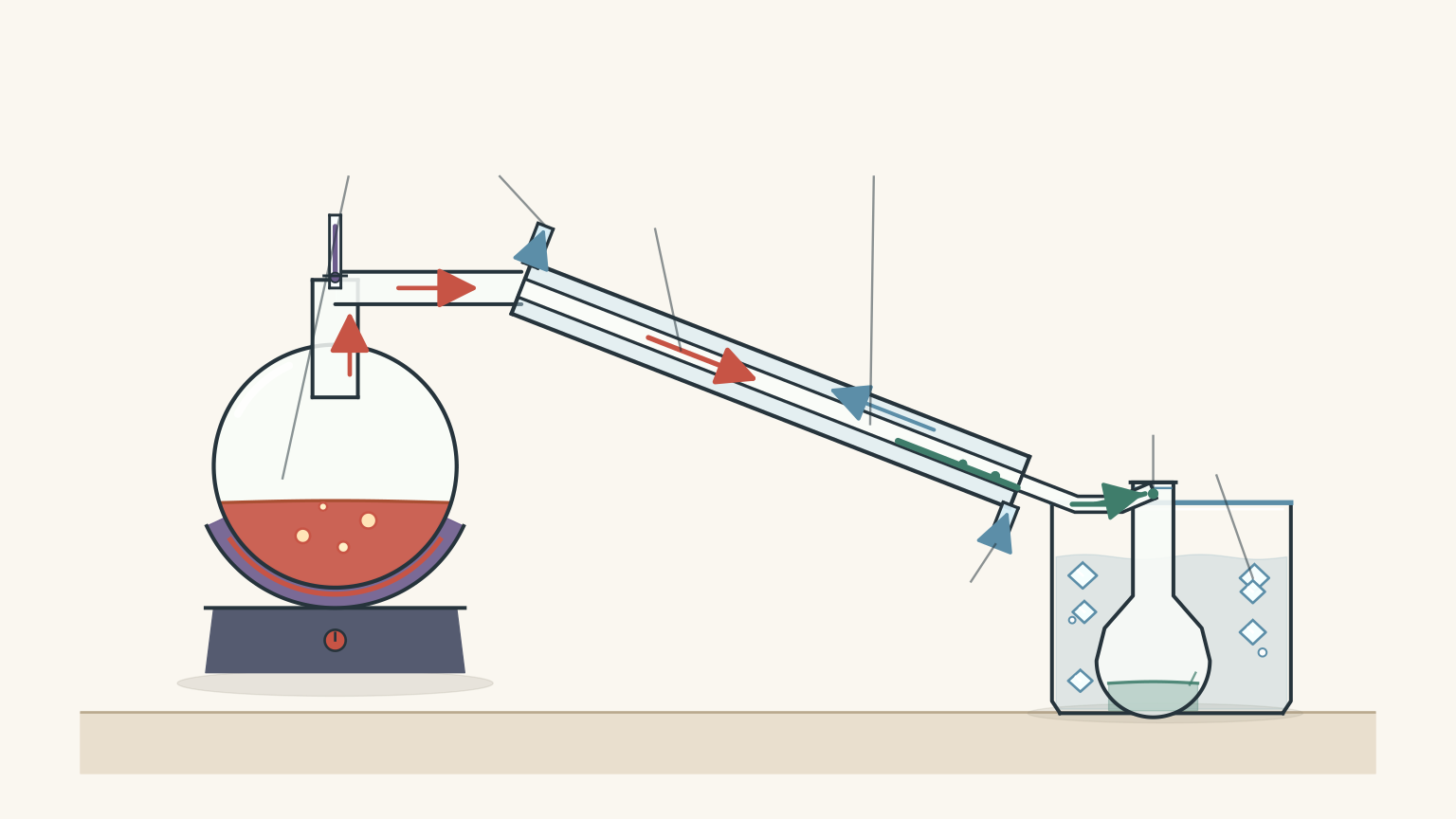
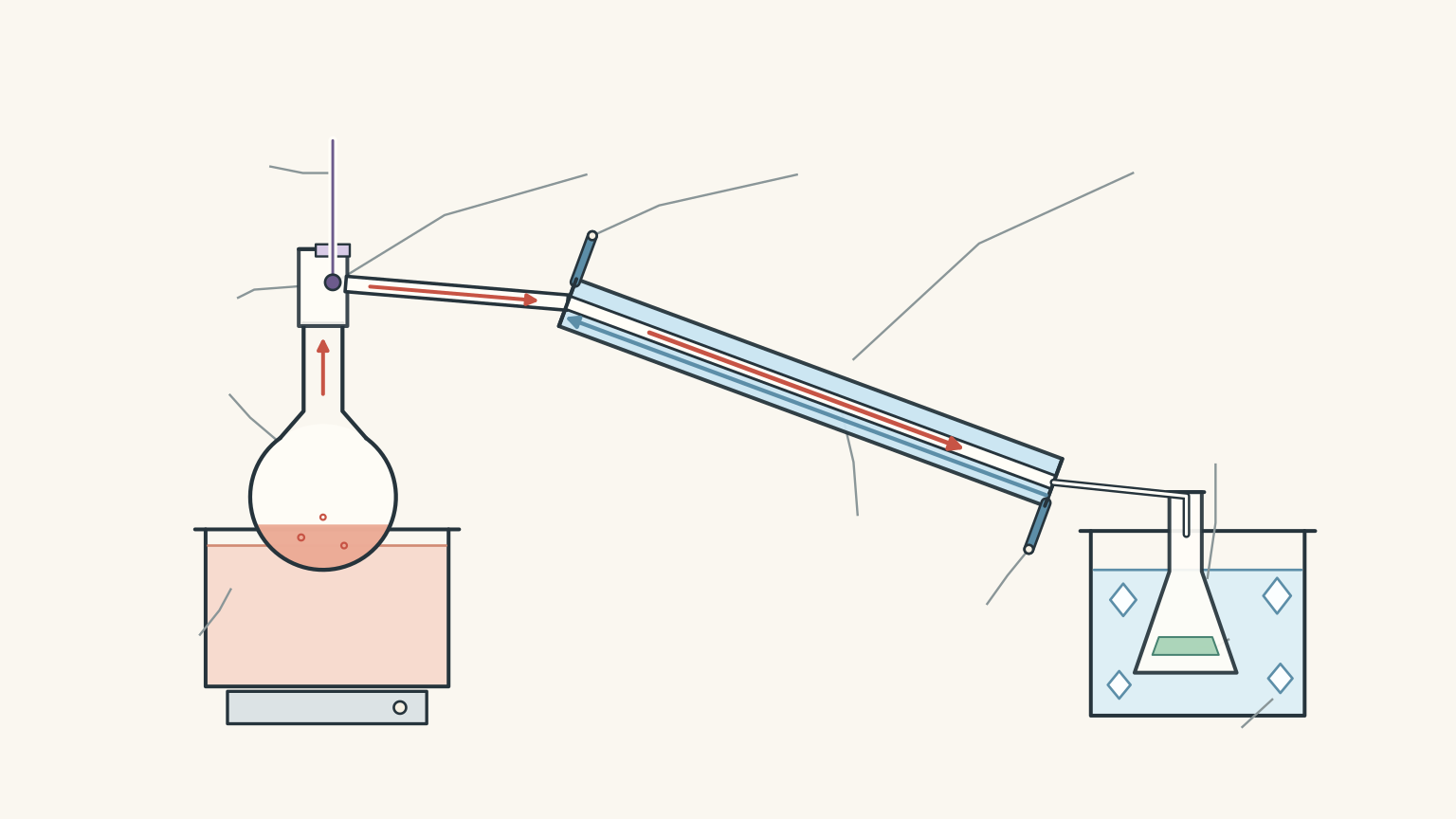
The apparatus contains five important parts:
1. Reaction flask
The round-bottom flask contains the primary alcohol and acidified potassium dichromate(VI).
The mixture is heated carefully. As the alcohol reacts, the aldehyde product forms in the flask.
2. Distillation head and thermometer
Vapour travels upwards from the reaction flask and enters the distillation head.
The thermometer bulb should sit level with the side arm leading into the condenser. This allows it to measure the temperature of the vapour entering the condenser, rather than the temperature of the liquid at the bottom of the flask.
3. Water-cooled condenser
The vapour enters the inner tube of the condenser.
Cold water flows through the surrounding jacket. It enters through the lower connection and leaves through the upper connection, keeping the jacket filled with cooling water.
As the vapour loses thermal energy, it condenses into liquid.
4. Receiving flask
The condensed liquid flows down the sloping condenser and enters a separate receiving flask.
This liquid is called the distillate.
5. Cooling bath
The receiving flask can be placed in an ice bath to help retain the volatile aldehyde.
Due to technical limitations, this figure may display incorrectly or contain inaccuracies. Please check key details against your course materials.
Notice the direction in which the liquid travels.
The aldehyde leaves the reaction flask, moves through the condenser, and enters a different container. It is no longer sitting in the oxidising mixture.
This is what reduces the opportunity for further oxidation.
Why not just use a condenser?
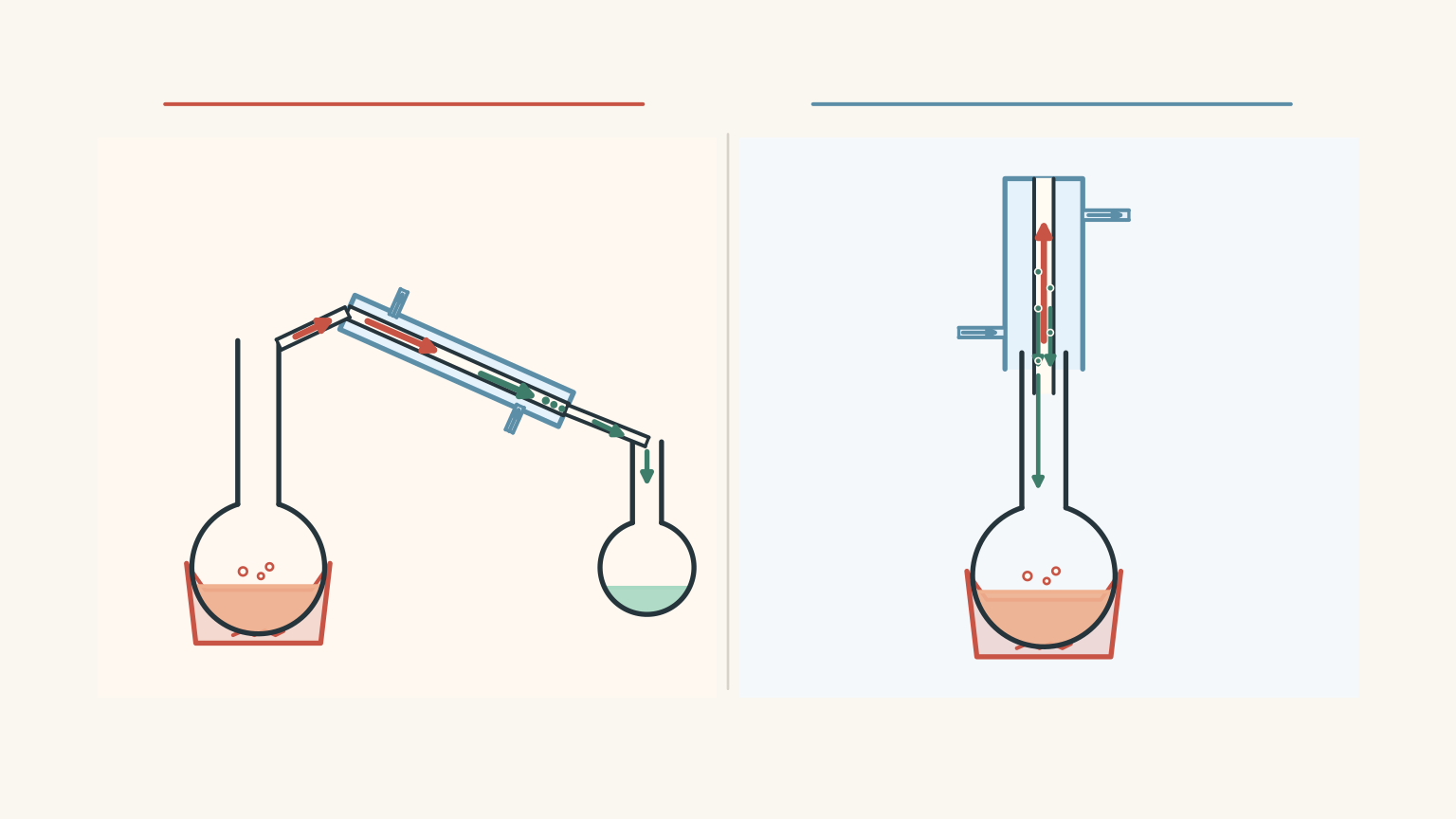
A condenser is used in both distillation and reflux. The difference is where the condensed liquid goes.
| Feature | Distillation | Reflux |
|---|---|---|
| Condenser position | Sloping towards a separate receiver | Vertical above the reaction flask |
| Vapour movement | Vapour leaves the reaction flask | Vapour rises above the flask |
| Condensed liquid | Collected separately | Returns to the original flask |
| Aldehyde contact with oxidant | Reduced | Maintained |
| Favoured outcome for a primary alcohol | Aldehyde | Carboxylic acid, with sufficient oxidant and heating |
In reflux, volatile substances are not deliberately removed from the reaction mixture. They evaporate, condense, and return to the flask.
That is useful when you want a reaction to continue without losing volatile reactants or products.
However, it is not the arrangement you want when collecting an aldehyde that can undergo further oxidation.
Due to technical limitations, this figure may display incorrectly or contain inaccuracies. Please check key details against your course materials.
03Why aldehydes can be collected by distillation
Distillation works because different substances have different volatilities.
Volatility describes how readily a substance enters the gas phase. A substance with a lower boiling point is generally more volatile than a comparable substance with a higher boiling point.
Consider the oxidation of ethanol to ethanal.
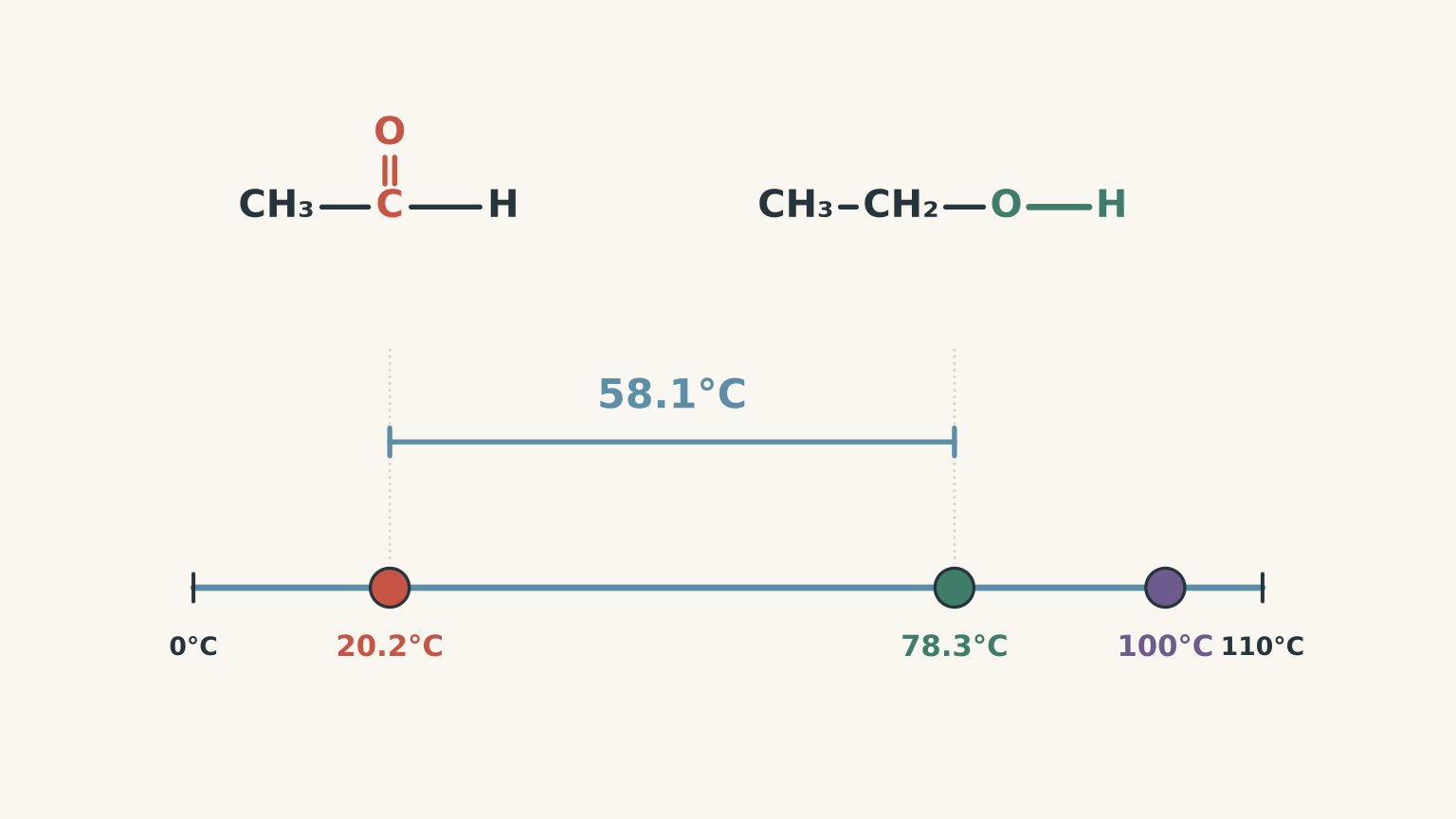
The normal boiling points of the pure substances at atmospheric pressure are:
| Substance | Normal boiling point |
|---|---|
| Ethanal (aldehyde) | 20.2°C |
| Ethanol (alcohol) | 78.3°C |
| Water | 100°C |
The difference between the boiling points of ethanal and ethanol is substantial.
\[ \Delta T = 78.3 - 20.2 \]
\[ \boxed{\Delta T = 58.1^\circ\text{C}} \]
Ethanal has a much lower boiling point than ethanol, so it is considerably more volatile.
Why?
Ethanol molecules can form hydrogen bonds with one another because they contain an \(\ce{O-H}\) bond. These relatively strong intermolecular attractions require energy to overcome.
Ethanal molecules cannot donate hydrogen bonds to one another because they do not contain an \(\ce{O-H}\) bond. Their intermolecular attractions are weaker overall.
Consequently, less energy is needed to separate ethanal molecules into the gas phase.
Due to technical limitations, this figure may display incorrectly or contain inaccuracies. Please check key details against your course materials.
This difference in volatility helps the aldehyde enter the vapour travelling away from the reaction mixture.
However, there are two important limitations.
First, the aldehyde must actually be condensed and collected.
Pure ethanal has a boiling point of approximately 20.2°C at atmospheric pressure. It is therefore extremely volatile around ordinary laboratory temperatures.
If the receiving flask is too warm, some ethanal may evaporate again instead of remaining in the receiver. Cooling the condenser and receiver helps reduce this loss.
Second, pure-substance boiling points do not tell you the exact temperature of a reacting mixture.
The reaction flask contains several substances, including alcohol, water, oxidising agent, and organic products. Their combined vapour behaviour is more complicated than the boiling point of any one pure substance.
A thermometer reading is therefore not automatically proof that the collected liquid is pure aldehyde.
Distillation favours separation based on volatility, but it does not guarantee complete purity.
04What would a fair experiment demonstrate?
We can investigate the purpose of distillation by comparing two otherwise identical oxidation experiments.
Suppose we prepare two reaction flasks, each containing the same quantity of propan-1-ol and acidified potassium dichromate(VI).
We keep the following conditions constant:
- Initial amount of propan-1-ol.
- Concentration and quantity of oxidising agent.
- Heating conditions.
- Reaction time.
- Atmospheric pressure.
The only intended difference is the apparatus.
Experiment A uses distillation.
Experiment B uses reflux.
Predicting the results
In Experiment A, propanal forms and can travel out of the reaction flask. The condenser cools the vapour, and the receiver collects the liquid.
Because propanal spends less time in contact with the oxidising agent, further oxidation is reduced.
In Experiment B, propanal remains in the reaction system because the condenser returns it to the flask.
If sufficient oxidising agent is present and heating continues, more propanal can be converted into propanoic acid.
The expected results are:
| Observation | Experiment A: Distillation | Experiment B: Reflux |
|---|---|---|
| Aldehyde formation | Yes | Yes, initially |
| Aldehyde removed from reaction flask | Yes | No deliberate removal |
| Further oxidation of aldehyde | Reduced | Favoured |
| Expected main organic product | Propanal | Propanoic acid |
What does the colour change tell us?
Acidified potassium dichromate(VI) is orange.
During oxidation, dichromate ions are reduced to chromium(III) ions, which are green.
Therefore, an orange-to-green colour change provides evidence that a redox reaction has occurred.
But there is a catch.
The colour change does not tell you whether the organic product is an aldehyde or a carboxylic acid.
Both experiments can show the colour change because oxidation occurs in both.
To investigate the organic product, you need additional evidence.
For example:
- Tollens’ reagent can be used to test for an aldehyde. A positive result produces a silver mirror under suitable conditions.
- 2,4-DNPH can identify a carbonyl-containing compound through formation of an orange or yellow precipitate. However, it reacts with both aldehydes and ketones, so it does not distinguish between them.
A positive Tollens’ test supports the presence of an aldehyde. It does not establish that the entire sample is pure aldehyde.
What could go wrong with the original design?
Imagine that the student uses a vertical condenser and assumes the aldehyde will collect because vapour is being produced.
The problem is that the condensed liquid returns to the reaction flask. The aldehyde remains exposed to the oxidising agent.
The design needs to be revised so that the condenser leads to a separate receiver.
There is another possible problem: even with the correct distillation arrangement, an inadequately cooled receiver can allow the volatile aldehyde to escape.
The revised arrangement therefore needs both:
- A condenser directing the distillate away from the reaction flask.
- A sufficiently cooled receiving flask to retain the volatile product.
The experiment demonstrates an important distinction between making a product and successfully isolating it.
Practical note: Acidified potassium dichromate(VI) contains hazardous chromium(VI) compounds, while alcohols and aldehydes can be volatile and flammable. Any practical investigation must follow teacher-approved microscale procedures, appropriate ventilation, and laboratory safety requirements. Do not use an open flame or seal the distillation apparatus.
05Don’t confuse oxidation with substitution or elimination
Distillation is a physical separation technique. It does not determine which chemical reaction an alcohol undergoes.
Before predicting a product, classify the alcohol by counting how many carbon atoms are attached to the carbon carrying the \(\ce{-OH}\) group.
| Alcohol classification | Carbon atoms attached to the \(\ce{C-OH}\) carbon | Usual oxidation product |
|---|---|---|
| Primary | 1 | Aldehyde, then potentially carboxylic acid |
| Secondary | 2 | Ketone |
| Tertiary | 3 | No normal oxidation under standard HSC alcohol-oxidation conditions |
This classification is particularly important when predicting oxidation products.
For example, propan-2-ol is a secondary alcohol:
\[ \ce{CH3CH(OH)CH3} \]
Its oxidation produces propanone:
\[ \ce{CH3CH(OH)CH3 + [O] -> CH3COCH3 + H2O} \]
Distillation can help remove a volatile ketone from the reaction mixture too. However, it cannot turn a ketone into an aldehyde.
The product’s identity comes from the starting alcohol and the chemical reaction, not from the distillation apparatus.
Substitution: replacing the hydroxyl group
In a substitution reaction, the hydroxyl group is replaced by another atom or group.
For example, ethanol reacts with hydrogen bromide to produce bromoethane:
\[ \ce{CH3CH2OH + HBr -> CH3CH2Br + H2O} \]
The reaction replaces \(\ce{-OH}\) with bromine.
The product is a haloalkane, not an aldehyde.
Elimination: forming a carbon-carbon double bond
In an elimination reaction, atoms are removed from adjacent carbon atoms, allowing a carbon-carbon double bond to form.
For example, heating ethanol with concentrated sulfuric acid at approximately \(170^\circ\text{C}\) produces ethene:
\[ \ce{CH3CH2OH ->[conc. H2SO4,\ 170^\circ C] CH2=CH2 + H2O} \]
This reaction removes water from the alcohol.
The product is an alkene, not an aldehyde.
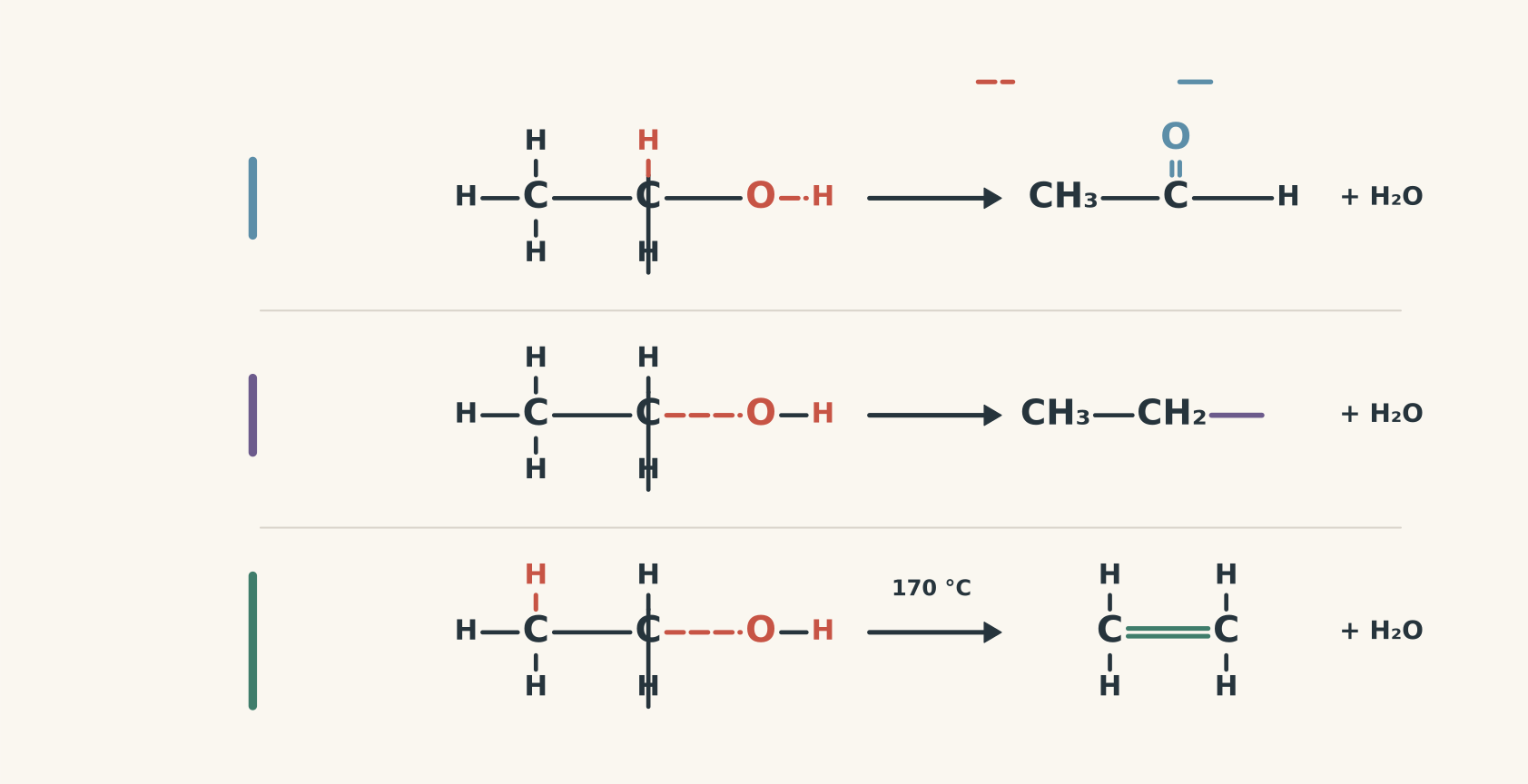
Due to technical limitations, this figure may display incorrectly or contain inaccuracies. Please check key details against your course materials.
A particularly useful contrasting case is 2-methylpropan-2-ol, a tertiary alcohol.
Its structure is:
\[ \ce{(CH3)3COH} \]
The carbon carrying the hydroxyl group is attached to three other carbon atoms. It has no hydrogen attached to it.
Under normal HSC alcohol-oxidation conditions, it does not undergo the usual oxidation to a carbonyl compound.
However, it can still undergo substitution or elimination under suitable conditions.
For example, substitution with HBr produces 2-bromo-2-methylpropane:
\[ \ce{(CH3)3COH + HBr -> (CH3)3CBr + H2O} \]
Acid-catalysed elimination produces 2-methylpropene:
\[ \ce{(CH3)3COH ->[conc. H2SO4,\ heat] CH2=C(CH3)2 + H2O} \]
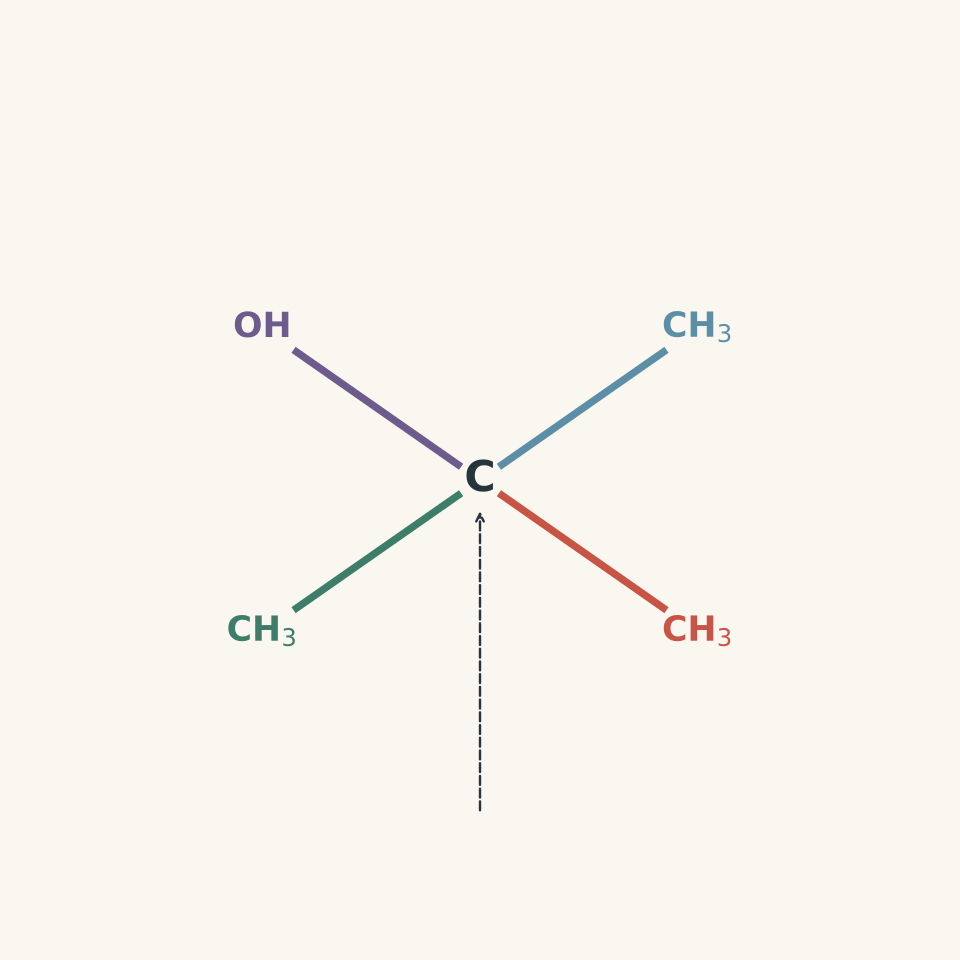
Due to technical limitations, this figure may display incorrectly or contain inaccuracies. Please check key details against your course materials.
The key is to identify the reaction family before predicting the product:
- Oxidation changes the bonding around the carbon carrying the hydroxyl group.
- Substitution replaces the hydroxyl group.
- Elimination removes groups from adjacent atoms and forms a double bond.
Only the first of these explains the production of an aldehyde during controlled oxidation.
06Worked examples
Worked example: Comparing the volatility of an alcohol and its aldehyde
Pure ethanal has a normal boiling point of \(20.2^\circ\text{C}\), while pure ethanol has a normal boiling point of \(78.3^\circ\text{C}\).
Calculate the boiling point difference and explain how it helps the collection of ethanal.
Step 1
\[ T_{\text{ethanol}}=78.3^\circ\text{C} \]
\[ T_{\text{ethanal}}=20.2^\circ\text{C} \]
Step 2
\[ \begin{aligned} \Delta T &= T_{\text{ethanol}}-T_{\text{ethanal}}\\ &=78.3-20.2\\ &=58.1^\circ\text{C} \end{aligned} \]
Step 3
Ethanal has a boiling point \(58.1^\circ\text{C}\) lower than ethanol.
It is therefore much more volatile and can preferentially enter the vapour leaving the reaction flask.
The condenser then cools the vapour, allowing ethanal to be collected separately.
The boiling point difference supports the separation, but it does not guarantee a pure distillate. Other volatile substances may also enter the vapour.
Worked example: Calculating the percentage yield of collected aldehyde
A student oxidises \(0.0800\text{ mol}\) of ethanol under controlled conditions.
Assume all the ethanol could theoretically form ethanal, and the student collects \(1.76\text{ g}\) of ethanal.
Calculate the percentage yield of ethanal collected.
Use the molar mass of ethanal:
\[ M(\ce{CH3CHO})=44.05\text{ g mol}^{-1} \]
Step 1
\[ \ce{CH3CH2OH + [O] -> CH3CHO + H2O} \]
The mole ratio of ethanol to ethanal is \(1:1\).
Therefore, the theoretical amount of ethanal is:
\[ n(\ce{CH3CHO})=0.0800\text{ mol} \]
Step 2
Use:
\[ m=nM \]
Substitute:
\[ \begin{aligned} m&=0.0800\times44.05\\ &=3.524\text{ g}\\ &=3.52\text{ g} \end{aligned} \]
Step 3
\[ \text{Percentage yield} = \frac{\text{Actual mass}}{\text{Theoretical mass}} \times100 \]
\[ \begin{aligned} \text{Percentage yield} &=\frac{1.76}{3.524}\times100\\ &=49.9\% \end{aligned} \]
\[ \boxed{\text{Percentage yield}=49.9\%} \]
The student collected approximately half the theoretical amount of ethanal.
This does not necessarily mean that only half the ethanol reacted. Some ethanal could have escaped during collection, remained in the apparatus, or undergone further oxidation.
The percentage yield measures the amount of product isolated relative to the theoretical amount, not simply the percentage of alcohol that reacted.
07Questions and solutions
Question 1
A student oxidises propan-1-ol using acidified potassium dichromate(VI). The reaction is heated using a distillation apparatus, and the distillate is collected in a cooled receiving flask.
Identify the expected organic product and explain why distillation is used.
Solution 1
The expected organic product is propanal.
Propan-1-ol is a primary alcohol because the carbon attached to the hydroxyl group is bonded to only one other carbon atom.
Primary alcohols can undergo oxidation to aldehydes:
\[ \ce{CH3CH2CH2OH + [O] -> CH3CH2CHO + H2O} \]
Propanal can undergo further oxidation to propanoic acid if it remains in contact with the oxidising agent.
Distillation removes the volatile propanal from the reaction flask as it forms. The condenser cools the vapour, and the separate receiving flask collects the liquid.
This reduces the opportunity for propanal to undergo further oxidation.
Question 2
Two students carry out separate oxidation experiments using identical quantities of propan-1-ol and acidified potassium dichromate(VI).
- Student A uses a sloping condenser connected to a separate receiving flask.
- Student B uses a vertical condenser that returns condensed liquid to the reaction flask.
Both students observe the dichromate solution change from orange to green.
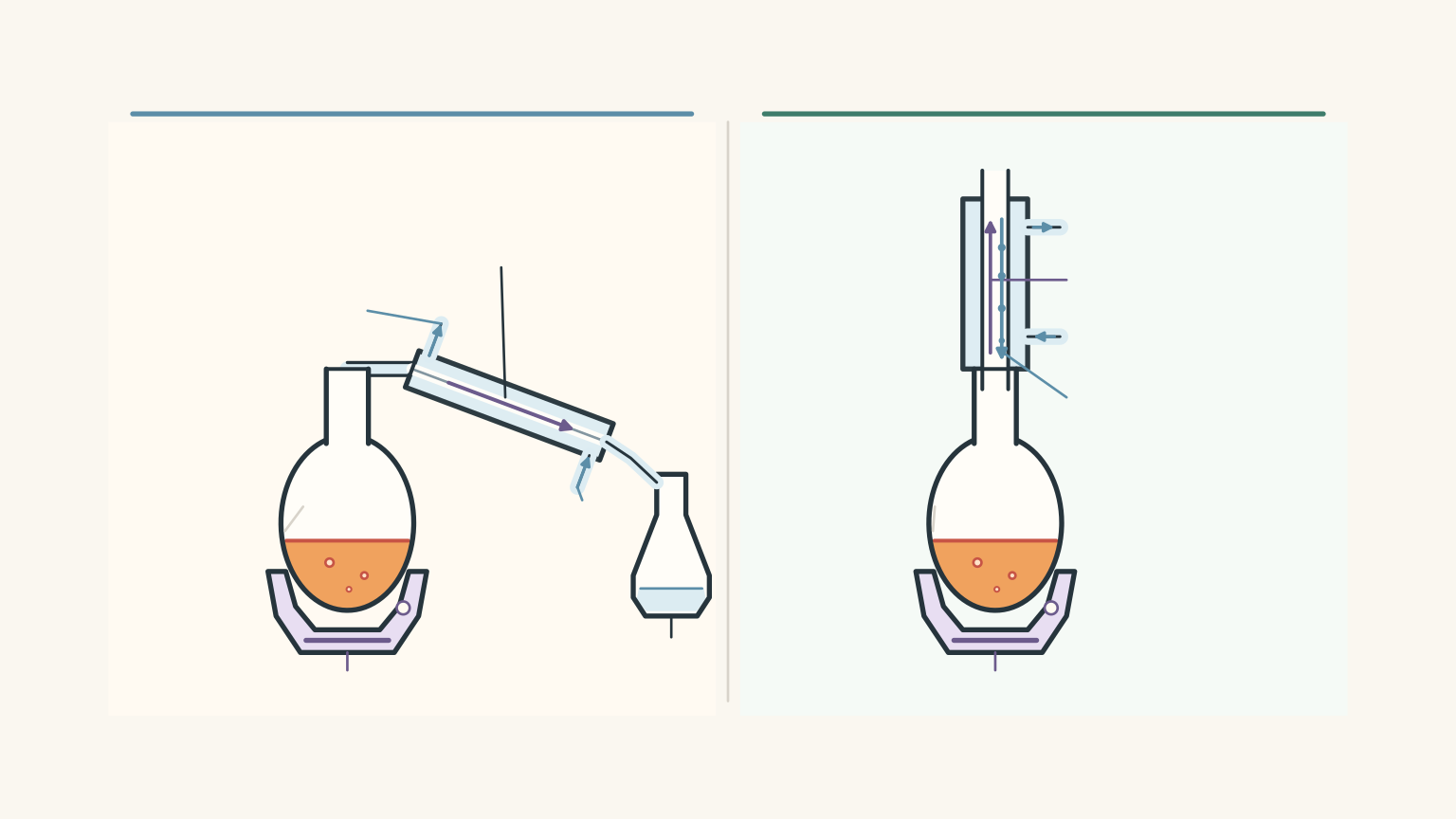
Due to technical limitations, this figure may display incorrectly or contain inaccuracies. Please check key details against your course materials.
(a) Explain why Student A is more likely to collect an aldehyde.
(b) Predict the main organic product expected in Student B’s reaction if sufficient excess oxidising agent and heating time are provided.
(c) Explain why the orange-to-green colour change does not establish that an aldehyde has been produced.
Solution 2
(a) Student A is more likely to collect propanal because the distillation apparatus physically separates the volatile aldehyde from the oxidising mixture.
Propanal forms during the oxidation of propan-1-ol. It enters the vapour, travels through the condenser, and is collected in a separate receiver.
Its contact with the oxidising agent is therefore reduced, limiting further oxidation.
Student B’s condenser returns the condensed vapour to the original reaction flask. The aldehyde remains exposed to the oxidising agent.
(b) The expected main organic product is propanoic acid.
Propan-1-ol is first oxidised to propanal:
\[ \ce{CH3CH2CH2OH + [O] -> CH3CH2CHO + H2O} \]
The propanal can then undergo further oxidation:
\[ \ce{CH3CH2CHO + [O] -> CH3CH2COOH} \]
Because reflux returns the aldehyde to the reaction mixture, it has more opportunity to undergo this second oxidation.
(c) The colour change only establishes that the dichromate(VI) ions have been reduced during a redox reaction.
Orange dichromate(VI) ions become green chromium(III) ions.
This can happen whether the primary alcohol is oxidised to an aldehyde or further oxidised to a carboxylic acid.
The colour change therefore provides evidence of oxidation, but additional chemical testing is needed to identify the organic product.
Question 3
A student oxidises \(0.125\text{ mol}\) of propan-1-ol using acidified potassium dichromate(VI).
Assume that:
- 70% of the initial propan-1-ol is converted into propanal.
- All converted alcohol forms propanal, with no further oxidation.
- 80% of the propanal produced is successfully collected in the receiving flask.
Calculate the mass of propanal collected.
The molar mass of propanal is \(58.08\text{ g mol}^{-1}\).
Solution 3
The mass of propanal collected is \(4.07\text{ g}\).
The calculation must account for both the conversion of the alcohol and the recovery of the aldehyde.
Step 1: Calculate the amount of propan-1-ol converted.
\[ \begin{aligned} n_{\text{converted}} &=0.125\times0.70\\ &=0.0875\text{ mol} \end{aligned} \]
Step 2: Calculate the amount of propanal formed.
The reaction has a \(1:1\) mole ratio between propan-1-ol and propanal.
Therefore:
\[ n(\text{propanal formed})=0.0875\text{ mol} \]
Step 3: Account for the collection efficiency.
Only 80% of the propanal reaches the receiver.
\[ \begin{aligned} n_{\text{collected}} &=0.0875\times0.80\\ &=0.0700\text{ mol} \end{aligned} \]
Step 4: Calculate the collected mass.
\[ m=nM \]
\[ \begin{aligned} m&=0.0700\times58.08\\ &=4.0656\text{ g} \end{aligned} \]
\[ \boxed{m=4.07\text{ g}} \]
The final collected mass is \(4.07\text{ g}\).
Notice that two different processes affected the final yield.
The first was the conversion of the starting alcohol into propanal. The second was the physical recovery of the propanal through distillation.
Even if the reaction produces a substantial amount of aldehyde, some may be lost during collection.
Question 4
A student investigates an alcohol with the following structural formula:
\[ \ce{(CH3)3COH} \]
The student performs three separate experiments:
- Experiment A: The alcohol is heated with acidified potassium dichromate(VI) using distillation.
- Experiment B: A separate sample is warmed with hydrogen bromide.
- Experiment C: Another sample is heated with concentrated sulfuric acid under dehydrating conditions.
(a) Classify the alcohol as primary, secondary, or tertiary.
(b) Explain why Experiment A does not produce an aldehyde under normal HSC oxidation conditions.
(c) Identify the organic product in Experiment B and name the reaction type.
(d) Identify the organic product in Experiment C and name the reaction type.
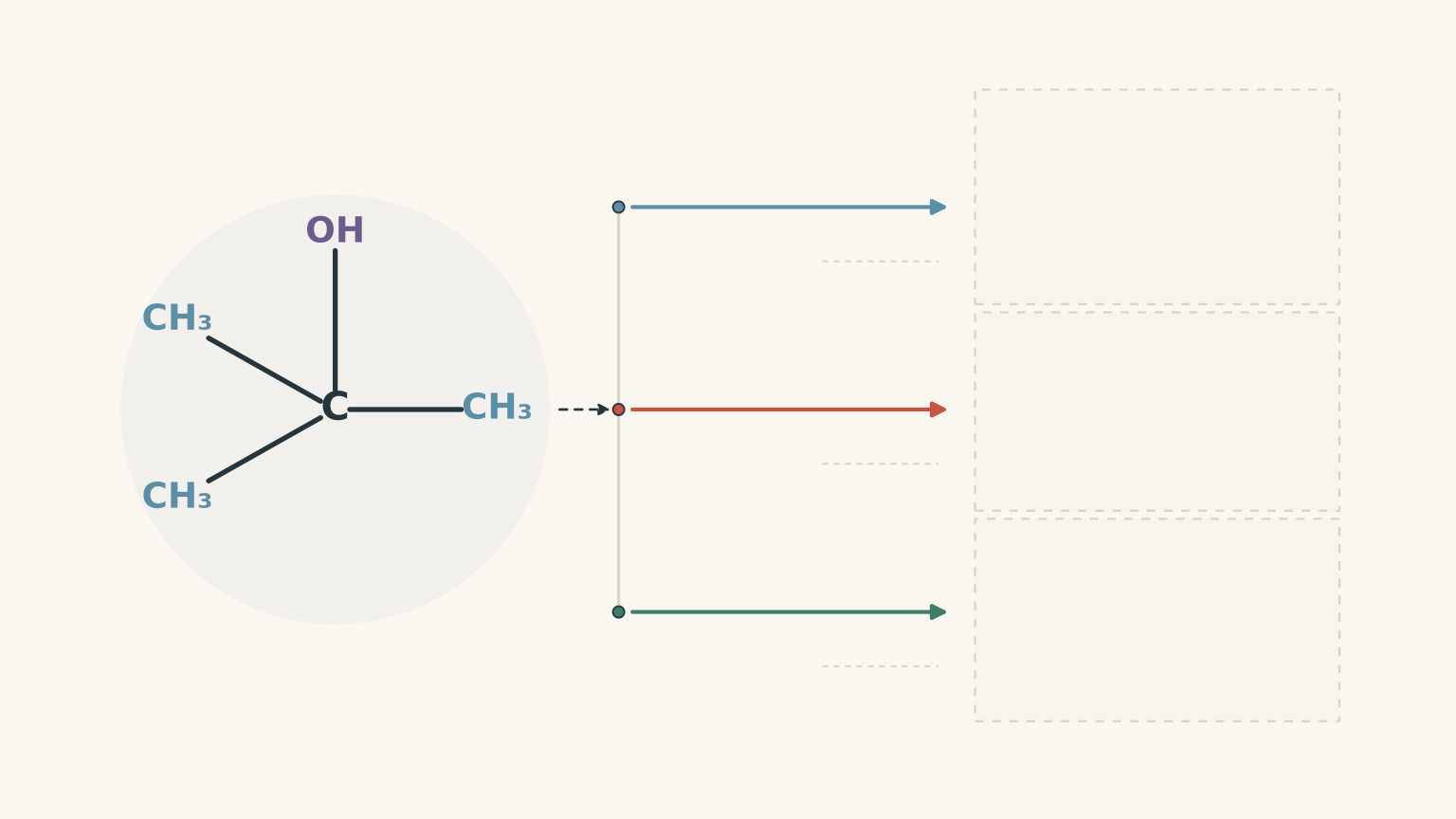
Due to technical limitations, this figure may display incorrectly or contain inaccuracies. Please check key details against your course materials.
Solution 4
(a) The alcohol is tertiary.
The carbon carrying the hydroxyl group is bonded to three other carbon atoms.
This is the defining feature of a tertiary alcohol.
(b) Experiment A does not produce an aldehyde because the alcohol is tertiary.
The carbon attached to the hydroxyl group has no hydrogen atoms bonded directly to it.
Under normal HSC alcohol-oxidation conditions, oxidation of an alcohol to a carbonyl compound requires the removal of hydrogen from the carbon carrying the hydroxyl group.
Because this hydrogen is absent, the usual oxidation pathway does not occur.
Using distillation does not change this structural limitation. Distillation can separate a suitable volatile product, but it cannot make a tertiary alcohol behave like a primary alcohol.
(c) Experiment B produces 2-bromo-2-methylpropane through a substitution reaction.
The hydroxyl group is replaced by a bromine atom:
\[ \ce{(CH3)3COH + HBr -> (CH3)3CBr + H2O} \]
The reaction is substitution because one group attached to the carbon chain is replaced by another.
(d) Experiment C produces 2-methylpropene through an elimination reaction.
The alcohol loses water, and a carbon-carbon double bond forms:
\[ \ce{(CH3)3COH ->[conc. H2SO4,\ heat] CH2=C(CH3)2 + H2O} \]
The reaction is elimination because atoms are removed from adjacent positions, forming a double bond.
These experiments demonstrate why reaction conditions and alcohol classification must be considered together.
The same tertiary alcohol can undergo substitution or elimination even though it does not undergo the usual oxidation to an aldehyde or ketone.
Question 5
A chemist wants to collect pure propanal but accidentally starts with an equimolar mixture of propan-1-ol and propan-2-ol.
The mixture is oxidised using acidified potassium dichromate(VI), with the products distilled immediately into a cooled receiver.
Assume that both alcohols undergo complete oxidation and that both carbonyl products enter the collected fraction.
The following normal boiling points are supplied:
| Compound | Normal boiling point |
|---|---|
| Propanal | 48.0°C |
| Propanone | 56.1°C |
The collected fraction has a boiling range of 47-57°C.
The student performs two chemical tests:
- 2,4-DNPH produces an orange precipitate.
- Tollens’ reagent produces a silver mirror.
The student concludes:
“The product must be pure propanal because Tollens’ reagent confirms an aldehyde, and the boiling range includes propanal’s boiling point.”
Evaluate this conclusion.
Your response should:
- Identify the organic products formed from both starting alcohols.
- Explain why both products can enter the distillate.
- Interpret the results of both chemical tests.
- Explain what distillation has achieved and what it has failed to achieve.
- Propose a more reliable way of collecting pure propanal.
Due to technical limitations, this figure may display incorrectly or contain inaccuracies. Please check key details against your course materials.
Solution 5
The student’s conclusion is incorrect. The collected fraction cannot be identified as pure propanal from the evidence provided. It can contain both propanal and propanone.
This question requires you to separate three different ideas: alcohol classification, oxidation, and physical separation.
Step 1: Identify the oxidation product from each starting alcohol.
Propan-1-ol is a primary alcohol:
\[ \ce{CH3CH2CH2OH} \]
Its oxidation produces propanal:
\[ \ce{CH3CH2CH2OH + [O] -> CH3CH2CHO + H2O} \]
Propan-2-ol is a secondary alcohol:
\[ \ce{CH3CH(OH)CH3} \]
Its oxidation produces propanone:
\[ \ce{CH3CH(OH)CH3 + [O] -> CH3COCH3 + H2O} \]
Because the starting alcohols are present in equal molar amounts and both are assumed to undergo complete conversion, equal molar amounts of propanal and propanone are produced.
The tempting mistake is to assume that distillation makes every alcohol produce an aldehyde.
It does not. The classification of each starting alcohol determines its oxidation product.
Step 2: Compare the boiling points of the two products.
Propanal boils at \(48.0^\circ\text{C}\).
Propanone boils at \(56.1^\circ\text{C}\).
The difference is:
\[ \begin{aligned} \Delta T&=56.1-48.0\\ &=8.1^\circ\text{C} \end{aligned} \]
The boiling points are relatively close.
Both products are volatile and can enter the vapour leaving the reaction flask. A simple distillation may not separate them cleanly.
The collected fraction can therefore contain both carbonyl compounds.
Step 3: Interpret the 2,4-DNPH test.
The orange precipitate indicates the presence of a carbonyl-containing compound.
Both propanal and propanone contain a carbonyl group:
- Propanal is an aldehyde.
- Propanone is a ketone.
Therefore, a positive 2,4-DNPH result is consistent with either compound or a mixture of both.
It does not establish that the sample contains pure propanal.
Step 4: Interpret the Tollens’ test.
The silver mirror indicates that an aldehyde is present.
Propanal gives a positive Tollens’ test because aldehydes can be oxidised while reducing silver ions to metallic silver.
Propanone does not normally give this positive result.
However, a positive test only establishes the presence of an aldehyde. It does not show that the sample contains nothing else.
The silver mirror could be produced by the propanal in a mixture that also contains propanone.
This is the precise flaw in the student’s reasoning: evidence that a substance is present is not proof that it is the only substance present.
Step 5: Evaluate the purpose of distillation.
Distillation has still achieved something important.
It has helped remove both volatile carbonyl products from the oxidising mixture.
This reduces the opportunity for propanal to undergo further oxidation to propanoic acid.
However, the apparatus has not necessarily separated propanal from propanone.
These are two different separation problems:
- Removing volatile products from the oxidising environment.
- Separating two volatile products from each other.
A simple distillation can help with the first without successfully achieving the second.
Step 6: Propose a better experimental design.
The most reliable approach is to separate the two starting alcohols before oxidation.
The chemist should oxidise pure propan-1-ol separately, using controlled conditions and distilling propanal into a cooled receiving flask as it forms.
This avoids producing propanone in the first place.
Alternatively, a suitable fractionating column could improve the separation of propanal and propanone because their boiling points are different. However, their relatively small boiling-point difference means that complete separation cannot simply be assumed.
The central lesson is that distillation controls where a product goes, not which product the chemical reaction creates.
A good experimental design must account for both the chemistry happening in the flask and the physical properties of the substances being collected.
The next useful concept is fractional distillation: once you understand how distillation removes an aldehyde from an oxidising mixture, you can investigate how a fractionating column separates two volatile substances with relatively close boiling points.