
Synthesis Reactions: Predicting Products and Balancing Equations
Learn how to recognise synthesis reactions, predict likely products, write correct chemical formulas, and balance equations without changing subscripts. Includes worked examples and original HSC-style questions with solutions.
Burn magnesium ribbon in oxygen and you get a white solid, magnesium oxide. The first equation looks simple:
\[ \ce{Mg + O2 -> ?} \]
Before reading on, predict the product. Oxygen arrives as \(\ce{O2}\), so should the product be \(\ce{MgO2}\)?
No. The product is \(\ce{MgO}\). That small difference exposes the main skill in synthesis reactions: you must work out the correct chemical formula before you balance the equation. If you try to balance first, it is very easy to invent a compound that does not actually exist in the form you have written.
01What a synthesis reaction is really showing
A synthesis reaction occurs when two or more reactants combine to form one product substance.
The basic pattern is:
\[ \ce{A + B -> AB} \]
Here, \(A\) and \(B\) simply represent reactants. They are not telling you that one particle of \(A\) must combine with exactly one particle of \(B\).
A slightly silly way to picture it is two people arriving separately at a school formal and leaving as one couple. The useful part of the analogy is that separate starting groups have combined into one new group. The analogy breaks quickly, though. Atoms do not necessarily combine one-to-one, and the ratio depends on chemical structure and, for ionic compounds, electrical charge.
For example:
\[ \ce{2Na + Cl2 -> 2NaCl} \]
There are two reactant substances, sodium and chlorine, but only one product substance, sodium chloride.
Notice that the product has a coefficient of 2. That does not mean there are two different products. Both units are still the same substance, \(\ce{NaCl}\).
Synthesis is a pattern, not a guarantee
Recognising the pattern is useful, but do not overuse it.
Seeing two substances on the left does not prove they will react, and knowing that a reaction is synthesis does not always tell you the exact product. Some elements can form more than one compound, and the product can depend on conditions.
So the useful question is not merely:
“Are there two reactants?”
It is:
“Do these reactants combine to form one identifiable product, and do I have enough chemical information to determine its formula?”
That second question becomes important later.
02Formula first, balancing second
Suppose aluminium reacts with oxygen.
A common mistake is to see \(\ce{O2}\) and immediately try to attach two oxygen atoms to each aluminium atom. That might produce \(\ce{AlO2}\).
But \(\ce{O2}\) describes elemental oxygen before the reaction. It does not tell you the aluminium-to-oxygen ratio inside the new compound.
For an ionic product, the ratio is determined by charge.
Aluminium commonly forms \(\mathrm{Al}^{3+}\) ions. Oxide ions are \(\mathrm{O}^{2-}\).
The positive and negative charges must balance overall. The smallest combination that does this is:
- 2 aluminium ions: total charge \(+6\)
- 3 oxide ions: total charge \(-6\)
So the formula is:
\[ \ce{Al2O3} \]
Only after getting that formula right should you balance the full equation.
This gives a useful decision sequence:
- Identify the likely product.
- Write its correct chemical formula.
- Write the unbalanced equation.
- Balance using coefficients only.
- Count every type of atom to check your answer.
That order matters.
03Predicting common synthesis products
For the simpler synthesis reactions you meet in Year 11 Chemistry, the identities of the reactants often give you a strong clue about the product.
| Reactants | Common product pattern | Example |
|---|---|---|
| metal + non-metal | ionic compound | \(\ce{2Na + Cl2 -> 2NaCl}\) |
| metal + oxygen | metal oxide | \(\ce{2Mg + O2 -> 2MgO}\) |
| non-metal + oxygen | non-metal oxide | \(\ce{C + O2 -> CO2}\) |
| some metal oxides + water | metal hydroxide | \(\ce{CaO + H2O -> Ca(OH)2}\) |
| some non-metal oxides + water | oxyacid | \(\ce{CO2 + H2O -> H2CO3}\) |
These are useful patterns, not universal laws. For example, not every metal oxide reacts readily with water, and some elements form several different oxides.
Use the information in the question, your knowledge of common ions and compounds, and any stated reaction conditions.
04Do not forget elemental molecules
Several non-metals exist naturally as molecules containing two atoms when they appear as pure elements.
The ones worth recognising are:
| Element | Formula |
|---|---|
| hydrogen | \(\ce{H2}\) |
| nitrogen | \(\ce{N2}\) |
| oxygen | \(\ce{O2}\) |
| fluorine | \(\ce{F2}\) |
| chlorine | \(\ce{Cl2}\) |
| bromine | \(\ce{Br2}\) |
| iodine | \(\ce{I2}\) |
This affects the reactant side of your equation.
For example, chlorine gas is \(\ce{Cl2}\), not \(\ce{Cl}\):
\[ \ce{Ca + Cl2 -> CaCl2} \]
But once chlorine becomes part of calcium chloride, the formula \(\ce{CaCl2}\) is determined by the ionic charges, not by the fact that elemental chlorine started as \(\ce{Cl2}\).
05Coefficients and subscripts do completely different jobs
This distinction causes a large fraction of balancing errors.
Consider:
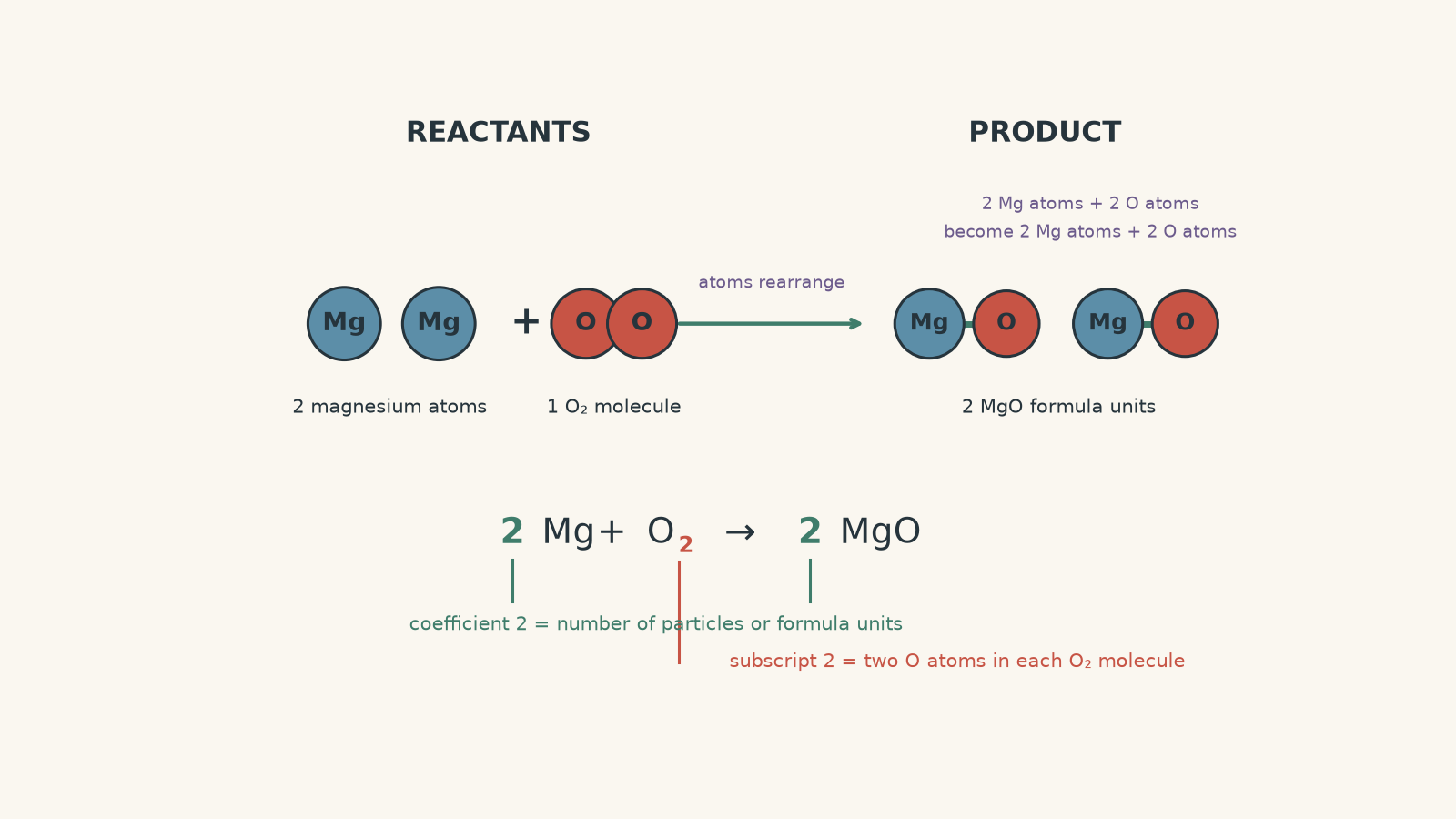
\[ \ce{2MgO} \]
The subscript in \(\ce{MgO}\) is effectively 1 magnesium atom for every 1 oxygen atom. Subscripts are part of the compound’s identity.
The coefficient 2 tells you that there are two formula units of \(\ce{MgO}\).
Changing a coefficient changes the amount of a substance.
Changing a subscript changes the substance itself.
For example:
- \(\ce{MgO}\) is magnesium oxide.
- \(\ce{MgO2}\) has a different composition and cannot be substituted just because it makes an equation easier to balance.
That is why this is correct:
\[ \ce{2Mg + O2 -> 2MgO} \]
You balance the two oxygen atoms by placing a 2 in front of \(\ce{MgO}\), not by changing its formula.
If the conservation idea behind balancing is still shaky, it is worth reviewing Rearrangement of Atoms in Reactions: HSC Chemistry Guide. A chemical equation works because atoms are rearranged, not created or destroyed.
Worked example: Calcium reacts with chlorine
Calcium metal reacts with chlorine gas to form calcium chloride. Predict the product and write a balanced chemical equation.
Step 1
Calcium is a metal and chlorine is a non-metal, so we expect an ionic compound.
Calcium forms \(\mathrm{Ca}^{2+}\) ions, while chlorine forms \(\mathrm{Cl}^{-}\) ions.
Step 2
One \(\mathrm{Ca}^{2+}\) ion requires two \(\mathrm{Cl}^{-}\) ions for a total charge of zero.
Therefore, the product is:
\[ \ce{CaCl2} \]
Step 3
Elemental calcium is \(\ce{Ca}\), while elemental chlorine is diatomic, \(\ce{Cl2}\).
The unbalanced equation is therefore:
\[ \ce{Ca + Cl2 -> CaCl2} \]
Step 4
There is:
- 1 Ca atom on each side
- 2 Cl atoms on each side
So the equation is already balanced:
\[ \boxed{\ce{Ca(s) + Cl2(g) -> CaCl2(s)}} \]
The coefficients are \(1:1:1\). One amount of calcium reacts with one equivalent amount of chlorine molecules to form calcium chloride.
Worked example: Aluminium reacts with oxygen
Aluminium metal reacts with oxygen gas to form aluminium oxide. Predict the product and write a balanced chemical equation.
Step 1
Aluminium commonly forms \(\mathrm{Al}^{3+}\), while oxygen forms \(\mathrm{O}^{2-}\).
To balance the charges, we need 2 aluminium ions and 3 oxide ions:
\[ 2(+3) + 3(-2) = 0 \]
Therefore, aluminium oxide is:
\[ \ce{Al2O3} \]
Step 2
Elemental oxygen exists as \(\ce{O2}\):
\[ \ce{Al + O2 -> Al2O3} \]
Step 3
There are 2 oxygen atoms in each \(\ce{O2}\) molecule and 3 oxygen atoms in each formula unit of \(\ce{Al2O3}\).
The smallest number divisible by both 2 and 3 is 6.
So use 3 \(\ce{O2}\) molecules and 2 \(\ce{Al2O3}\) formula units:
\[ \ce{Al + 3O2 -> 2Al2O3} \]
There are now 6 oxygen atoms on both sides.
Step 4
Two \(\ce{Al2O3}\) formula units contain 4 aluminium atoms, so place 4 in front of aluminium:
\[ \boxed{\ce{4Al(s) + 3O2(g) -> 2Al2O3(s)}} \]
The equation now represents conservation of both elements:
- Al: \(4 = 4\)
- O: \(6 = 6\)
The important part was not the arithmetic. It was keeping two jobs separate: ionic charges determined the formula \(\ce{Al2O3}\), then coefficients balanced the number of atoms.
06Why a synthesis reaction can also belong to another category
Reaction categories can overlap.
Burning magnesium is a good example:
\[ \ce{2Mg + O2 -> 2MgO} \]
It is a synthesis reaction because two reactants combine to form one product substance.
It can also be described as a combustion reaction because magnesium reacts with oxygen and releases energy.
So reaction names are descriptions of patterns. They are not necessarily exclusive boxes where each reaction must belong to exactly one category.
That matters when a question asks you to justify a classification. Point to the relevant feature of the equation rather than relying only on the label.
07The most tempting mistake: changing the product to make balancing easier
Imagine you are given:
\[ \ce{Al + O2 -> Al2O3} \]
A student notices that oxygen appears in twos on the left and threes on the right. They change the product to \(\ce{AlO2}\), giving:
\[ \ce{Al + O2 -> AlO2} \]
It now looks easier to balance.
The arithmetic has become easier because the chemistry has been changed.
A chemical formula is not an adjustable bookkeeping device. \(\ce{Al2O3}\) tells you the composition of aluminium oxide. Once that formula has been established, balancing can change only the coefficients.
Think of a subscript as part of a person’s name and a coefficient as the number of people with that name. If you need three Alexes, you write “3 Alex”. You do not rename Alex as “Alex3”. Slightly ridiculous, but it captures the distinction.
08When the product cannot be predicted from the pattern alone
Suppose a question says:
Iron reacts with oxygen in a synthesis reaction. Predict the exact formula of the iron oxide.
There is a problem.
Iron can form compounds in more than one oxidation state. Iron oxides include \(\ce{FeO}\), \(\ce{Fe2O3}\), and \(\ce{Fe3O4}\). The words “iron reacts with oxygen” do not, by themselves, identify which oxide has formed.
So you should not invent a product merely because the question looks like a familiar synthesis pattern.
If the question instead tells you that iron(III) oxide forms, then the oxidation state provides the missing information. Iron(III) means \(\mathrm{Fe}^{3+}\), giving \(\ce{Fe2O3}\), and the balanced equation is:
\[ \ce{4Fe + 3O2 -> 2Fe2O3} \]
This is an important limit of the simple \(A+B\rightarrow AB\) model. It helps you recognise the structure of a synthesis reaction, but chemistry still determines what \(AB\) actually is.
09A reliable method under exam conditions
When you need to predict and balance a synthesis reaction, use this order:
- Identify the reactants correctly. Remember diatomic elemental molecules such as \(\ce{O2}\), \(\ce{N2}\), and \(\ce{Cl2}\).
- Decide whether one product substance is expected.
- Determine the product formula from chemical knowledge. For an ionic product, use the ion charges.
- Do not alter that formula while balancing.
- Add coefficients until each element has the same number of atoms on both sides.
- Reduce the coefficients to the smallest whole-number ratio.
- Check whether you actually had enough information to predict the product.
That final check is what stops pattern recognition turning into guessing.
10Questions and solutions
Question 1
Lithium metal reacts with bromine to form lithium bromide. Predict the product formula and write the balanced chemical equation.
Solution 1
The balanced equation is:
\[ \boxed{\ce{2Li + Br2 -> 2LiBr}} \]
Lithium forms \(\mathrm{Li}^{+}\) ions and bromine forms \(\mathrm{Br}^{-}\) ions, so the ions combine in a \(1:1\) ratio. The product formula is therefore \(\ce{LiBr}\).
Elemental bromine is diatomic, so the reactant must be written as \(\ce{Br2}\). Starting with
\[ \ce{Li + Br2 -> LiBr} \]
there are two bromine atoms on the left but only one on the right. Place a coefficient of 2 before \(\ce{LiBr}\), then balance lithium:
\[ \ce{2Li + Br2 -> 2LiBr} \]
There are now 2 Li atoms and 2 Br atoms on each side.
Question 2
Magnesium reacts with nitrogen gas to form magnesium nitride. Predict the product formula and write the balanced chemical equation.
Solution 2
The product is \(\ce{Mg3N2}\), and the balanced equation is:
\[ \boxed{\ce{3Mg + N2 -> Mg3N2}} \]
Magnesium forms \(\mathrm{Mg}^{2+}\), while nitride ions are \(\mathrm{N}^{3-}\).
The smallest equal positive and negative charge is 6:
\[ 3(+2)=+6 \]
and
\[ 2(-3)=-6 \]
So three magnesium ions combine with two nitride ions, giving \(\ce{Mg3N2}\).
Elemental nitrogen is already present as \(\ce{N2}\). One \(\ce{Mg3N2}\) formula unit contains three magnesium atoms, so a coefficient of 3 is required before \(\ce{Mg}\).
The \(3:1:1\) coefficient ratio describes the amounts reacting. The subscripts 3 and 2 in \(\ce{Mg3N2}\) describe the composition of the compound.
Question 3
Sodium oxide reacts with water according to a synthesis reaction, producing sodium hydroxide.
Write the balanced equation. A student argues that it cannot be a synthesis reaction because the balanced equation has a coefficient of 2 in front of the product. Explain whether the student is correct.
Solution 3
The balanced equation is:
\[ \boxed{\ce{Na2O + H2O -> 2NaOH}} \]
The student’s conclusion is incorrect. This is still a synthesis reaction because there is only one product substance, sodium hydroxide.
Count the atoms before balancing:
\[ \ce{Na2O + H2O -> NaOH} \]
The left side contains 2 Na atoms, 2 H atoms, and 2 O atoms in total. Placing a coefficient of 2 before sodium hydroxide gives:
\[ \ce{Na2O + H2O -> 2NaOH} \]
Now both sides contain:
- 2 Na atoms
- 2 H atoms
- 2 O atoms
The coefficient 2 means that two formula units, or two moles when working at the macroscopic scale, of sodium hydroxide are produced per stoichiometric reaction. It does not create a second type of product.
The trap is confusing number of product particles with number of product substances.
Question 4
A student is asked to write the reaction between aluminium and oxygen. They write:
\[ \ce{2Al + O2 -> 2AlO} \]
Their equation is balanced. Explain why it is still chemically incorrect, and give the correct balanced equation.
Solution 4
The student’s equation is atom-balanced, but the product formula is incorrect. The correct equation is:
\[ \boxed{\ce{4Al + 3O2 -> 2Al2O3}} \]
Balancing atoms is only useful once the substances themselves have been written correctly.
Aluminium forms \(\mathrm{Al}^{3+}\) ions and oxide ions are \(\mathrm{O}^{2-}\). A neutral ionic compound therefore requires two aluminium ions and three oxide ions:
\[ 2(+3)+3(-2)=0 \]
so the correct formula is \(\ce{Al2O3}\), not \(\ce{AlO}\).
Starting from:
\[ \ce{Al + O2 -> Al2O3} \]
use 6 oxygen atoms as the lowest common multiple of 2 and 3:
\[ \ce{Al + 3O2 -> 2Al2O3} \]
The two \(\ce{Al2O3}\) units contain four aluminium atoms, giving:
\[ \ce{4Al + 3O2 -> 2Al2O3} \]
The trap is assuming that an atom-balanced equation must be chemically valid. Conservation of atoms is necessary, but the formulas of the substances must also be correct.
Question 5
A chemist observes that iron and oxygen are the only reactants in a reaction and that only one solid product is collected.
A student concludes that the product formula must be \(\ce{Fe2O3}\) because the reaction is a synthesis reaction.
Is that conclusion justified? If later analysis shows that the product is iron(III) oxide, write the balanced equation.
Solution 5
The initial conclusion is not justified from the information given. If the product is later identified as iron(III) oxide, the balanced equation is:
\[ \boxed{\ce{4Fe + 3O2 -> 2Fe2O3}} \]
The observation does support classifying the reaction as synthesis: two reactant substances combine to give one product substance.
However, that pattern does not determine the exact formula. Iron can have more than one oxidation state and forms more than one oxide. Knowing only that iron and oxygen react is therefore insufficient to prove that the product is \(\ce{Fe2O3}\).
Once the product is specified as iron(III) oxide, the situation changes. Iron(III) corresponds to \(\mathrm{Fe}^{3+}\), while oxide is \(\mathrm{O}^{2-}\), giving the formula \(\ce{Fe2O3}\).
The unbalanced equation is:
\[ \ce{Fe + O2 -> Fe2O3} \]
Balancing gives:
\[ \ce{4Fe + 3O2 -> 2Fe2O3} \]
The important hidden assumption was that the reaction classification somehow fixed iron’s oxidation state. It does not.
Question 6
The synthesis of magnesium nitride is represented by:
\[ \ce{3Mg + N2 -> Mg3N2} \]
Imagine a particle model containing 8 magnesium atoms and 3 nitrogen molecules. Assume the reaction proceeds until one reactant can no longer react.
How many formula units of \(\ce{Mg3N2}\) can form, and what particles remain unreacted?
Solution 6
A maximum of 2 formula units of \(\ce{Mg3N2}\) can form. After the reaction, 2 Mg atoms and 1 \(\ce{N2}\) molecule remain.
The balanced equation tells us the required particle ratio:
\[ \ce{3Mg + N2 -> Mg3N2} \]
Each formula unit of magnesium nitride requires:
- 3 Mg atoms
- 1 \(\ce{N2}\) molecule
For 2 formula units:
\[ \ce{6Mg + 2N2 -> 2Mg3N2} \]
Starting with 8 Mg atoms and 3 \(\ce{N2}\) molecules leaves:
\[ 8-6=2 \]
Mg atoms, and
\[ 3-2=1 \]
\(\ce{N2}\) molecule.
A third formula unit would require another 3 Mg atoms, but only 2 remain. Magnesium is therefore the limiting reactant in this particle model.
This is where balancing begins to do more than tidy an equation. The coefficients give a quantitative ratio between reacting particles and, later, between reacting amounts in moles. That connection is the next step from synthesis reactions into stoichiometry and limiting-reactant calculations.