
Bond Enthalpy and Conservation of Energy in HSC Chemistry
Learn how bond breaking and bond formation determine reaction enthalpy, and how conservation of energy explains exothermic and endothermic reactions.
A hydrogen-oxygen mixture can release a huge amount of heat when it reacts. But there’s an awkward detail: before new O-H bonds can form, existing H-H and O=O bonds have to be disturbed and broken, and that costs energy.
Predict the sign first. If you could take one mole of H-H bonds and pull the hydrogen atoms completely apart, would energy come out, or would you need to put energy in? You need to put energy in. The reaction releases energy only because forming the new bonds releases even more energy than was needed to break the old ones.
That energy accounting is the core idea behind bond enthalpy.
01Breaking bonds costs energy
Picture two magnets stuck together. To separate them, you have to pull against the attraction. When you let them come back together, they accelerate towards each other, and energy is released into their surroundings.
A chemical bond behaves similarly in one important way. Two bonded atoms are at a lower potential energy than the same atoms separated from each other. Moving them apart therefore requires an input of energy.
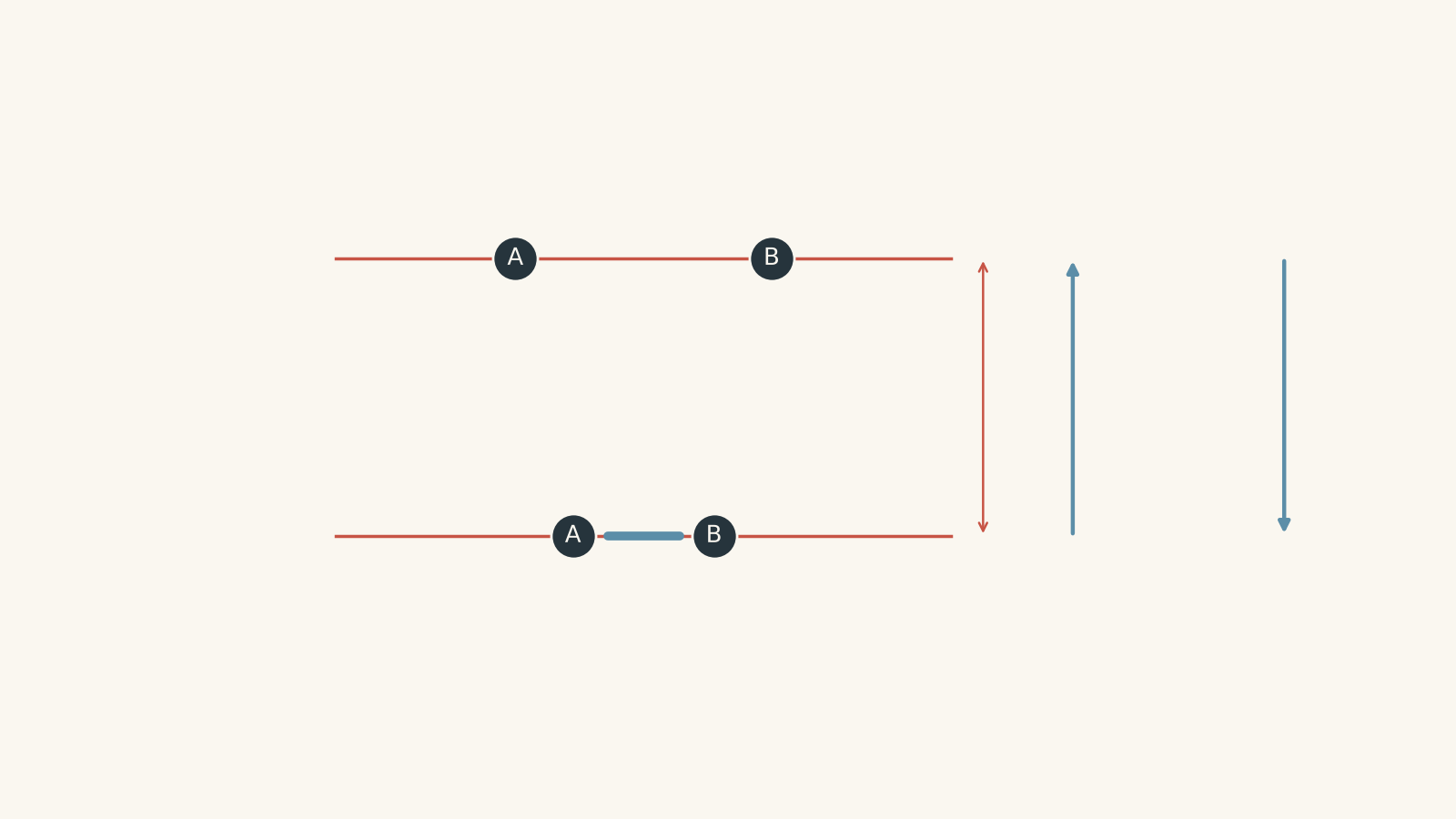
This gives us two rules:
| Process | Energy change of the chemical system |
|---|---|
| Break a bond | Energy absorbed |
| Form a bond | Energy released |
The magnet analogy has a limit. Atoms aren’t tiny bar magnets, and real chemical bonding comes from electrostatic interactions and quantum mechanics. The useful part of the analogy is simply the energy direction: separating an attractive, stable arrangement costs energy.
This immediately fixes one of the most tempting chemistry misconceptions.
A student might say, “Reactions release energy because bonds break.”
It sounds reasonable because we talk casually about “energy stored in bonds”. But breaking a bond never supplies the bond-breaking energy. It requires it.
Energy can be released overall because the product bonds are more energetically favourable than the bonds that had to be broken.
02What bond enthalpy measures
The bond enthalpy \(D\) is the energy required to break one mole of a particular bond in gaseous species.
For example, if
\[ D(\ce{H-H})=436\ \mathrm{kJ\,mol^{-1}}, \]
then breaking one mole of H-H bonds requires \(436\ \mathrm{kJ}\).
So:
\[ \ce{H2(g) -> 2H(g)} \]
has an enthalpy change of approximately
\[ \Delta H=+436\ \mathrm{kJ\,mol^{-1}}. \]
The positive sign matters. Energy has entered the chemical system.
Run the process backwards:
\[ \ce{2H(g) -> H2(g)} \]
and the energy change changes sign:
\[ \Delta H=-436\ \mathrm{kJ\,mol^{-1}}. \]
The same strong bond that is expensive to break releases a large amount of energy when it forms.
That is worth remembering: a strong bond isn’t an energy-filled bond waiting to burst. It is a particularly stable, low-energy arrangement.
03Reaction enthalpy is an energy balance
Consider a general reaction.
We can imagine carrying it out through a completely artificial two-stage path:
- break the reactant bonds until we have separated gaseous atoms;
- rearrange those atoms and form all the product bonds.
The reaction does not need to occur by this mechanism in real life. This is bookkeeping.
Breaking the reactant bonds raises the energy. Forming the product bonds lowers it.
So the approximate reaction enthalpy is
\[ \Delta H_{\mathrm{rxn}} \approx \sum D(\text{bonds broken}) - \sum D(\text{bonds formed}). \]
Here:
- \(\Delta H_{\mathrm{rxn}}\) is the enthalpy change for the reaction as written, usually in \(\mathrm{kJ\,mol^{-1}}\);
- \(D\) is a bond enthalpy in \(\mathrm{kJ\,mol^{-1}}\);
- the first sum is the energy required to break reactant bonds;
- the second sum is the magnitude of the energy released when product bonds form.
Notice the subtraction. Bond enthalpy tables normally give positive numbers because they report the energy required to break bonds.
Predict the sign before calculating
Suppose breaking the reactant bonds requires \(700\ \mathrm{kJ}\), while forming the product bonds releases \(900\ \mathrm{kJ}\).
The reaction has taken in \(700\ \mathrm{kJ}\) and then released \(900\ \mathrm{kJ}\). What is left?
\[ \Delta H=700-900=-200\ \mathrm{kJ}. \]
The system has lost \(200\ \mathrm{kJ}\) overall. The reaction is exothermic.
If the bond-breaking cost were larger than the bond-forming release, \(\Delta H\) would be positive and the reaction would be endothermic.
| Comparison | Sign of \(\Delta H\) | Reaction |
|---|---|---|
| More energy released forming bonds than absorbed breaking bonds | Negative | Exothermic |
| More energy absorbed breaking bonds than released forming bonds | Positive | Endothermic |
04Conservation of energy hasn’t disappeared
An exothermic reaction doesn’t destroy energy from the reacting chemicals. Energy is transferred from the chemical system to the surroundings.
If a reaction at constant pressure has
\[ \Delta H=-183\ \mathrm{kJ}, \]
then the reaction system loses \(183\ \mathrm{kJ}\) of enthalpy. With heat as the relevant energy transfer, the surroundings gain that energy.
For an endothermic reaction, the direction reverses. The chemical system gains energy from its surroundings.
Conservation of energy therefore does not mean that \(\Delta H\) must equal zero. It means that any energy lost by one part of the complete system must appear somewhere else.
05Worked example: forming hydrogen chloride
Calculate the reaction enthalpy for
\[ \ce{H2(g) + Cl2(g) -> 2HCl(g)} \]
using these bond enthalpies:
| Bond | Bond enthalpy |
|---|---|
| H-H | \(436\ \mathrm{kJ\,mol^{-1}}\) |
| Cl-Cl | \(243\ \mathrm{kJ\,mol^{-1}}\) |
| H-Cl | \(431\ \mathrm{kJ\,mol^{-1}}\) |
Step 1
The reactants contain one H-H bond and one Cl-Cl bond.
\[ E_{\mathrm{broken}} = 436+243 = 679\ \mathrm{kJ\,mol^{-1}}. \]
Step 2
Two HCl molecules are produced, so two H-Cl bonds form.
\[ E_{\mathrm{formed}} = 2(431) = 862\ \mathrm{kJ\,mol^{-1}}. \]
Step 3
\[ \Delta H \approx 679-862 = -183\ \mathrm{kJ\,mol^{-1}}. \]
Step 4
The reaction is exothermic. Breaking H-H and Cl-Cl bonds requires \(679\ \mathrm{kJ\,mol^{-1}}\), but forming H-Cl bonds releases about \(862\ \mathrm{kJ\,mol^{-1}}\).
The product bonding therefore lowers the system’s energy by about \(183\ \mathrm{kJ\,mol^{-1}}\) overall.
06You don’t always need to count every bond
When the same bonds appear unchanged on both sides of a reaction, their contributions cancel.
This is particularly useful in organic reactions. Instead of counting twenty bonds and hoping your tally survives, look for what actually changes.
07Worked example: hydrogenating ethene
Estimate the enthalpy change for
\[ \ce{C2H4(g) + H2(g) -> C2H6(g)} \]
using:
| Bond | Bond enthalpy |
|---|---|
| C=C | \(614\ \mathrm{kJ\,mol^{-1}}\) |
| C-C | \(347\ \mathrm{kJ\,mol^{-1}}\) |
| C-H | \(413\ \mathrm{kJ\,mol^{-1}}\) |
| H-H | \(436\ \mathrm{kJ\,mol^{-1}}\) |
A common mistake is to say, “The C=C double bond becomes a C-C single bond, so we just subtract those two bond enthalpies.”
That misses the hydrogen.
Step 1
The four C-H bonds already present in ethene remain in the product, so they cancel from the accounting.
The relevant changes are:
- break one C=C bond;
- break one H-H bond;
- form one C-C bond;
- form two new C-H bonds.
Step 2
\[ E_{\mathrm{broken}} = 614+436 = 1050\ \mathrm{kJ\,mol^{-1}}. \]
Step 3
\[ E_{\mathrm{formed}} = 347+2(413) = 1173\ \mathrm{kJ\,mol^{-1}}. \]
Step 4
\[ \Delta H \approx 1050-1173 = -123\ \mathrm{kJ\,mol^{-1}}. \]
The estimated reaction enthalpy is therefore
\[ \boxed{\Delta H\approx-123\ \mathrm{kJ\,mol^{-1}}}. \]
The reaction is exothermic because the C-C and two new C-H bonds formed release more energy than is required to disrupt the C=C and H-H bonds.
08Why an exothermic reaction may still need ignition
There’s another prediction worth making.
If forming the products lowers the system’s energy, should an exothermic reaction begin automatically as soon as the reactants touch?
Not necessarily.
The reacting particles may first need enough energy to distort or partially break existing bonds and reach the high-energy arrangement that allows new bonds to develop. This minimum barrier is related to activation energy.
So these two statements can both be true:
- a reaction requires an initial energy input;
- the reaction releases energy overall.
A match can start the combustion of hydrogen, for example, without being the source of all the energy eventually released.
Activation energy is about the barrier along the route. Reaction enthalpy is about the energy difference between the starting and finishing states.
Don’t confuse them.
09Why bond enthalpy answers are usually estimates
The equation
\[ \Delta H_{\mathrm{rxn}} \approx \sum D(\text{broken}) - \sum D(\text{formed}) \]
contains an approximation sign for a reason.
Many values in a bond enthalpy table are average bond enthalpies. A C-H bond in methane does not have exactly the same energetic environment as a C-H bond in ethane, ethene, or chloromethane.
We group them under “C-H” because the average is useful, not because every C-H bond in every molecule is energetically identical.
This leads to an important distinction:
- conservation of energy is exact;
- a calculation based on average bond enthalpies is approximate.
If an average-bond calculation differs slightly from an accurately measured reaction enthalpy, conservation of energy has not failed. The model has limited precision.
10Physical states matter as well
Bond enthalpies describe bonds in gaseous species.
Suppose your chemical equation produces liquid water. A bond-enthalpy calculation based on O-H bonds effectively takes you to gaseous water molecules. To obtain liquid water, you must also account for condensation.
That phase change releases additional energy.
This is why you should always read state symbols:
\[ \ce{H2O(g)} \]
and
\[ \ce{H2O(l)} \]
are chemically the same substance, but they are not the same energetic state.
The same warning applies when a reactant begins as a solid or liquid but the bond enthalpy data refer to a gaseous molecule. Any required vaporisation, sublimation, or other physical change has an enthalpy cost.
11A better way to picture the whole calculation
The bond-enthalpy method can be thought of as an imaginary detour.
Reactants are taken upwards in energy to separated gaseous atoms. The atoms are then taken downwards in energy as product bonds form.
You care about the difference between the starting level and the finishing level.
That is where conservation of energy becomes powerful: the actual reaction may follow a complicated mechanism involving collisions, intermediates, catalysts, and several stages, but the overall enthalpy change depends only on the initial and final states.
This is the same idea that will later become Hess’s law.
12Questions and solutions
Question 1
Ammonia can be formed according to
\[ \ce{N2(g) + 3H2(g) -> 2NH3(g)}. \]
Use the following bond enthalpies:
| Bond | Bond enthalpy |
|---|---|
| N≡N | \(945\ \mathrm{kJ\,mol^{-1}}\) |
| H-H | \(436\ \mathrm{kJ\,mol^{-1}}\) |
| N-H | \(391\ \mathrm{kJ\,mol^{-1}}\) |
Estimate \(\Delta H\) for the reaction as written, and state whether it is exothermic or endothermic.
Solution 1
The reaction is exothermic, with \(\Delta H\approx-93\ \mathrm{kJ\,mol^{-1}}\) for the equation as written.
The bonds broken are one N≡N bond and three H-H bonds:
\[ E_{\mathrm{broken}} = 945+3(436) = 2253\ \mathrm{kJ\,mol^{-1}}. \]
Two \(\ce{NH3}\) molecules contain six N-H bonds altogether:
\[ E_{\mathrm{formed}} = 6(391) = 2346\ \mathrm{kJ\,mol^{-1}}. \]
Therefore,
\[ \Delta H \approx 2253-2346 = -93\ \mathrm{kJ\,mol^{-1}}. \]
The negative sign means the formation of the six N-H bonds releases about \(93\ \mathrm{kJ\,mol^{-1}}\) more energy than is required to break the N≡N and H-H bonds.
The tempting mistake is to look at the very strong N≡N bond and conclude that the reaction must be endothermic. That considers only the energy cost. The energy released by all six new N-H bonds must also be included.
Question 2
Ethyne can be hydrogenated to ethane in two stages:
\[ \ce{C2H2(g) + H2(g) -> C2H4(g)} \]
followed by
\[ \ce{C2H4(g) + H2(g) -> C2H6(g)}. \]
Use:
| Bond | Bond enthalpy |
|---|---|
| C≡C | \(839\ \mathrm{kJ\,mol^{-1}}\) |
| C=C | \(614\ \mathrm{kJ\,mol^{-1}}\) |
| C-C | \(347\ \mathrm{kJ\,mol^{-1}}\) |
| C-H | \(413\ \mathrm{kJ\,mol^{-1}}\) |
| H-H | \(436\ \mathrm{kJ\,mol^{-1}}\) |
Calculate the bond-enthalpy estimate for each stage and for the overall reaction
\[ \ce{C2H2(g) + 2H2(g) -> C2H6(g)}. \]
Then explain why adding the two stage enthalpies must give the same bond-enthalpy estimate as calculating the overall bond changes directly.
Solution 2
The estimates are approximately \(-165\ \mathrm{kJ\,mol^{-1}}\) for the first stage, \(-123\ \mathrm{kJ\,mol^{-1}}\) for the second stage, and \(-288\ \mathrm{kJ\,mol^{-1}}\) overall.
For the first stage, two C-H bonds already present in ethyne remain present in ethene. The relevant changes are therefore:
- break one C≡C bond and one H-H bond;
- form one C=C bond and two additional C-H bonds.
The bond-breaking energy is
\[ E_{\mathrm{broken}} = 839+436 = 1275\ \mathrm{kJ\,mol^{-1}}. \]
The bond-forming energy magnitude is
\[ E_{\mathrm{formed}} = 614+2(413) = 1440\ \mathrm{kJ\,mol^{-1}}. \]
Hence,
\[ \Delta H_1 \approx 1275-1440 = -165\ \mathrm{kJ\,mol^{-1}}. \]
For the second stage, the changes are:
- break one C=C bond and one H-H bond;
- form one C-C bond and two new C-H bonds.
So
\[ \begin{aligned} E_{\mathrm{broken}}&=614+436=1050\ \mathrm{kJ\,mol^{-1}},\\ E_{\mathrm{formed}}&=347+2(413)=1173\ \mathrm{kJ\,mol^{-1}},\\ \Delta H_2&\approx1050-1173=-123\ \mathrm{kJ\,mol^{-1}}. \end{aligned} \]
Adding the stages gives
\[ \Delta H_{\mathrm{overall}} \approx -165+(-123) = -288\ \mathrm{kJ\,mol^{-1}}. \]
We can check this by considering the direct overall change. Across the complete reaction, one C≡C bond and two H-H bonds are replaced by one C-C bond and four additional C-H bonds:
\[ \begin{aligned} E_{\mathrm{broken}} &= 839+2(436) = 1711\ \mathrm{kJ\,mol^{-1}},\\ E_{\mathrm{formed}} &= 347+4(413) = 1999\ \mathrm{kJ\,mol^{-1}},\\ \Delta H_{\mathrm{overall}} &\approx 1711-1999\\ &= -288\ \mathrm{kJ\,mol^{-1}}. \end{aligned} \]
The tempting route is to count every bond separately in every molecule. That works in principle, but it hides the useful cancellations.
The deeper reason the two approaches agree is conservation of energy. The intermediate \(\ce{C2H4}\) is produced in the first stage and consumed in the second. Its energetic contribution cancels when the stages are added, leaving only the original reactants and final products.
Question 3
Consider
\[ \ce{H2(g) + I2(s) -> 2HI(g)}. \]
Use:
\[ D(\ce{H-H})=436\ \mathrm{kJ\,mol^{-1}}, \]
\[ D(\ce{I-I})=151\ \mathrm{kJ\,mol^{-1}}, \]
and
\[ D(\ce{H-I})=299\ \mathrm{kJ\,mol^{-1}}. \]
The enthalpy required to sublime iodine,
\[ \ce{I2(s) -> I2(g)}, \]
is \(+62.4\ \mathrm{kJ\,mol^{-1}}\).
Estimate the enthalpy change for the reaction. Explain why simply applying the three bond enthalpies without considering the state of iodine predicts the wrong sign.
Solution 3
The estimated enthalpy change is \(+51.4\ \mathrm{kJ\,mol^{-1}}\), so the reaction is endothermic under the stated conditions.
First imagine gaseous iodine:
\[ \ce{H2(g) + I2(g) -> 2HI(g)}. \]
Breaking H-H and I-I bonds requires
\[ E_{\mathrm{broken}} = 436+151 = 587\ \mathrm{kJ\,mol^{-1}}. \]
Forming two H-I bonds releases
\[ E_{\mathrm{formed}} = 2(299) = 598\ \mathrm{kJ\,mol^{-1}}. \]
So for gaseous iodine,
\[ \Delta H \approx 587-598 = -11\ \mathrm{kJ\,mol^{-1}}. \]
But the actual reactant in the question is \(\ce{I2(s)}\), not \(\ce{I2(g)}\).
Before the gaseous I-I bond enthalpy can be applied, the iodine must be sublimed:
\[ \ce{I2(s) -> I2(g)} \qquad \Delta H=+62.4\ \mathrm{kJ\,mol^{-1}}. \]
Therefore,
\[ \begin{aligned} \Delta H_{\mathrm{overall}} &\approx 62.4+(-11)\\ &= +51.4\ \mathrm{kJ\,mol^{-1}}. \end{aligned} \]
The tempting calculation stops at \(-11\ \mathrm{kJ\,mol^{-1}}\) because it treats solid iodine as though it were already gaseous iodine.
Bond enthalpy \(D(\ce{I-I})\) describes breaking the I-I bond in gaseous \(\ce{I2}\). It does not include the energy needed to overcome the intermolecular attractions holding solid iodine together.
The phase change is large enough to reverse the predicted sign of the overall enthalpy change.
Question 4
Methane undergoes complete combustion:
\[ \ce{CH4(g) + 2O2(g) -> CO2(g) + 2H2O(l)}. \]
Use these average bond enthalpies:
| Bond | Bond enthalpy |
|---|---|
| C-H | \(413\ \mathrm{kJ\,mol^{-1}}\) |
| O=O | \(498\ \mathrm{kJ\,mol^{-1}}\) |
| C=O in \(\ce{CO2}\) | \(805\ \mathrm{kJ\,mol^{-1}}\) |
| O-H | \(463\ \mathrm{kJ\,mol^{-1}}\) |
At the relevant conditions, take the enthalpy of vaporisation of water to be
\[ \Delta H_{\mathrm{vap}} = +44\ \mathrm{kJ\,mol^{-1}}. \]
The measured reaction enthalpy producing liquid water is approximately \(-890\ \mathrm{kJ\,mol^{-1}}\).
Calculate:
- the bond-enthalpy estimate if the water is treated as gaseous;
- the corrected estimate for liquid water;
- the difference between that estimate and the measured value.
Does the remaining difference violate conservation of energy?
Solution 4
The bond-enthalpy estimate is \(-814\ \mathrm{kJ\,mol^{-1}}\) for gaseous water and approximately \(-902\ \mathrm{kJ\,mol^{-1}}\) after accounting for condensation to liquid water. The \(12\ \mathrm{kJ\,mol^{-1}}\) difference from the stated measured value does not violate conservation of energy.
For the reactants, four C-H bonds and two O=O bonds must be broken:
\[ \begin{aligned} E_{\mathrm{broken}} &= 4(413)+2(498)\\ &= 1652+996\\ &= 2648\ \mathrm{kJ\,mol^{-1}}. \end{aligned} \]
The products contain two C=O bonds in one \(\ce{CO2}\) molecule and four O-H bonds across two water molecules:
\[ \begin{aligned} E_{\mathrm{formed}} &= 2(805)+4(463)\\ &= 1610+1852\\ &= 3462\ \mathrm{kJ\,mol^{-1}}. \end{aligned} \]
The bond-enthalpy result therefore corresponds to formation of gaseous water:
\[ \Delta H_{\mathrm{gas}} \approx 2648-3462 = -814\ \mathrm{kJ\,mol^{-1}}. \]
The required product, however, is liquid water.
Condensing one mole of water is the reverse of vaporisation, so
\[ \Delta H_{\mathrm{cond}} = -44\ \mathrm{kJ\,mol^{-1}}. \]
Two moles of water are produced:
\[ \Delta H_{\mathrm{cond,total}} = 2(-44) = -88\ \mathrm{kJ\,mol^{-1}}. \]
Therefore,
\[ \begin{aligned} \Delta H_{\mathrm{liquid}} &\approx -814-88\\ &= -902\ \mathrm{kJ\,mol^{-1}}. \end{aligned} \]
Compared with the stated measured value,
\[ -890\ \mathrm{kJ\,mol^{-1}}, \]
the estimate is \(12\ \mathrm{kJ\,mol^{-1}}\) more negative.
The tempting conclusion is that conservation of energy has somehow failed because two calculations do not match exactly.
That is not what has happened. Conservation of energy applies to the actual physical system. Our calculation used average C-H and O-H bond enthalpies, so it replaced molecule-specific energetic values with averages.
Correcting the phase of water removes a major source of disagreement. The smaller remaining discrepancy reflects the approximation in the bond-enthalpy model, along with any rounding in the supplied data.
Question 5
Suppose measurements made under the same conditions give these reaction enthalpies:
\[ \ce{CH4(g) + Cl2(g) -> CH3Cl(g) + HCl(g)} \]
\[ \Delta H_1=-104\ \mathrm{kJ\,mol^{-1}}, \]
and
\[ \ce{CH3Cl(g) + Cl2(g) -> CH2Cl2(g) + HCl(g)} \]
\[ \Delta H_2=-100\ \mathrm{kJ\,mol^{-1}}. \]
An average bond-enthalpy table predicts almost the same value for both reactions because, on paper, each reaction breaks one C-H bond and one Cl-Cl bond, and forms one C-Cl bond and one H-Cl bond.
A student argues:
“That can’t be right. If the same types of bonds are broken and formed, conservation of energy says the two reaction enthalpies must be equal.”
Determine whether the student’s claim is correct. Then combine the first reaction with the reverse of the second to find \(\Delta H\) for
\[ \ce{CH4(g) + CH2Cl2(g) -> 2CH3Cl(g)}. \]
An average bond-count calculation predicts approximately \(0\ \mathrm{kJ\,mol^{-1}}\) for this final reaction because there are six C-H bonds and two C-Cl bonds on each side. Explain why the non-zero result does not permit energy to be created in a reaction cycle.
Solution 5
The student’s claim is incorrect, and the combined reaction has \(\Delta H=-4\ \mathrm{kJ\,mol^{-1}}\). The difference is completely compatible with conservation of energy because average bond enthalpies are not exact molecule-specific energies.
Start with
\[ \ce{CH4 + Cl2 -> CH3Cl + HCl} \]
with
\[ \Delta H_1=-104\ \mathrm{kJ\,mol^{-1}}. \]
Reverse the second reaction:
\[ \ce{CH2Cl2 + HCl -> CH3Cl + Cl2}. \]
Reversing a reaction reverses the sign of its enthalpy change, so
\[ \Delta H_{\mathrm{reverse\ 2}} = +100\ \mathrm{kJ\,mol^{-1}}. \]
Now add the two equations:
\[ \begin{aligned} \ce{CH4 + Cl2} &\ce{-> CH3Cl + HCl}\\ \ce{CH2Cl2 + HCl} &\ce{-> CH3Cl + Cl2} \end{aligned} \]
The \(\ce{Cl2}\) and \(\ce{HCl}\) cancel, giving
\[ \ce{CH4(g) + CH2Cl2(g) -> 2CH3Cl(g)}. \]
Its enthalpy change is
\[ \begin{aligned} \Delta H &= -104+100\\ &= -4\ \mathrm{kJ\,mol^{-1}}. \end{aligned} \]
At first this looks strange. Count the average bond types.
The reactants contain, in total:
- six C-H bonds;
- two C-Cl bonds.
The products contain exactly the same counts:
- six C-H bonds;
- two C-Cl bonds.
So a model in which every C-H bond has exactly one fixed energy and every C-Cl bond has exactly one fixed energy predicts
\[ \Delta H\approx0. \]
The hinge is that this fixed-bond-energy model is not exact.
A C-H bond in \(\ce{CH4}\) does not necessarily have precisely the same dissociation enthalpy as a C-H bond in \(\ce{CH3Cl}\) or \(\ce{CH2Cl2}\). Changing neighbouring atoms changes the electronic environment of the whole molecule. The same is true of the C-Cl bonds.
Average bond enthalpies deliberately hide those small molecular differences.
Conservation of energy instead applies to the exact energies of the complete initial and final states. If the measured values are \(-104\) and \(-100\ \mathrm{kJ\,mol^{-1}}\), conservation requires the combined reaction to have
\[ \Delta H=-4\ \mathrm{kJ\,mol^{-1}}. \]
There is no way to turn that into free energy by constructing a closed cycle. To return
\[ \ce{2CH3Cl} \]
to
\[ \ce{CH4 + CH2Cl2}, \]
the final reaction would have to be reversed. Its enthalpy change would then be
\[ +4\ \mathrm{kJ\,mol^{-1}}, \]
exactly cancelling the \(-4\ \mathrm{kJ\,mol^{-1}}\) released on the forward trip.
The tempting mistake is subtle: treating an average bond-enthalpy model as though it were more fundamental than conservation of energy. It isn’t. If approximate bond data and an exact closed energy cycle disagree, the approximation is the part that must give way.
13What this idea unlocks next
Bond enthalpy gives you a microscopic picture of reaction enthalpy: energy must be supplied to disrupt the reactants, energy is released as new bonding arrangements form, and the balance determines the sign of \(\Delta H\).
The more general idea is even more useful. Because the overall energy change depends on the initial and final states rather than the route taken between them, you can calculate an unknown reaction enthalpy by adding and reversing other reactions.
That is Hess’s law. It takes the conservation argument used here and lets you work with measured enthalpies of combustion, formation, phase changes, and other reactions without pretending that every reaction actually proceeds through separated gaseous atoms.