
Combustion Reactions: Products and Equations for HSC Chemistry
Learn how to identify combustion reactions, predict products, and balance equations for complete and incomplete combustion. Includes worked examples and original HSC-style questions with solutions.
Two Bunsen burners can use the same fuel but produce very different flames. With good air flow, the flame is blue and clean. Restrict the oxygen supply, and the flame can become yellow, produce soot, and form poisonous carbon monoxide.
Before reading on, predict what changed chemically. The fuel is the same, so why aren’t the products the same?
The key is the oxygen supply. Combustion is not just about knowing that a fuel reacts with oxygen. You also need to decide whether there is enough oxygen for the carbon in the fuel to be fully oxidised.
01The first decision: is this a combustion reaction?
In the HSC course, recognise a combustion reaction when a substance reacts with oxygen, \(\ce{O2}\), and releases energy.
For carbon-based fuels, the reactants often look like:
\[
\ce{fuel + O2 -> products}
\]
A hydrocarbon contains only carbon and hydrogen. Methane, \(\ce{CH4}\), propane, \(\ce{C3H8}\), and octane, \(\ce{C8H18}\), are examples.
Alcohols such as ethanol, \(\ce{C2H5OH}\), also burn. They already contain oxygen, but they still require \(\ce{O2}\) from the surroundings.
Combustion is different from simply having oxygen somewhere in an equation. The oxygen molecule, \(\ce{O2}\), must be a reactant in the combustion process.
If you are still building confidence with conservation of atoms and balancing equations, review rearrangement of atoms in reactions. The same rule controls every equation here: atoms can rearrange, but they cannot appear or disappear.
02Think of oxygen as the limiting resource
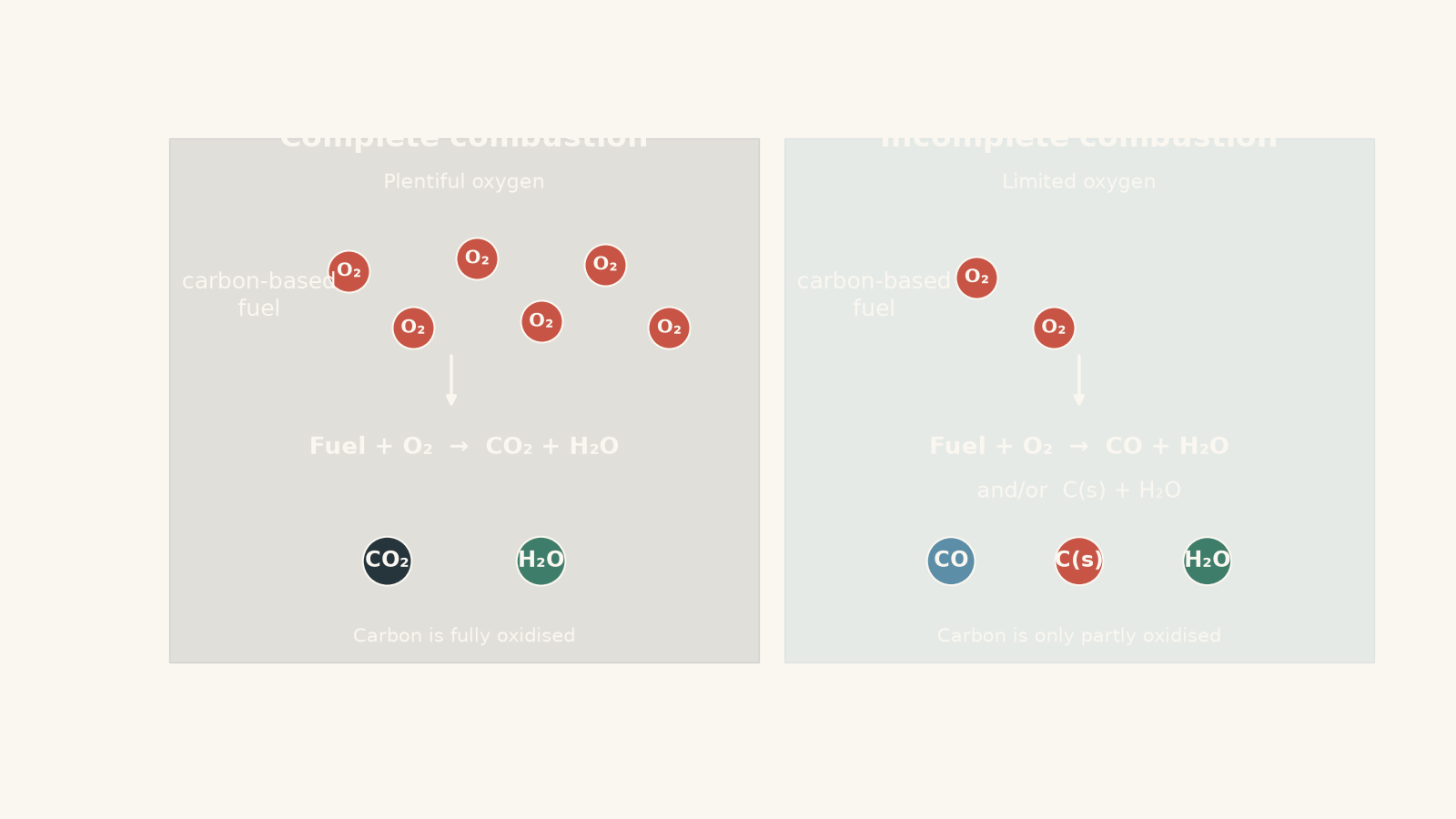
Picture every carbon atom trying to leave the reaction attached to two oxygen atoms as \(\ce{CO2}\). Hydrogen usually leaves attached to oxygen as water, \(\ce{H2O}\).
If there is enough oxygen, carbon can be fully oxidised to carbon dioxide.
If oxygen is scarce, some carbon may leave as carbon monoxide, \(\ce{CO}\), or even as solid carbon, \(\ce{C}\), which appears as soot.
It is a bit like allocating seats on a very small bus. In the ideal arrangement, every carbon gets its full oxygen allocation. If the oxygen bus is already packed, some carbon has to travel with less.
The analogy stops there. Atoms do not choose partners, and a real flame contains many short-lived intermediate species. The useful idea is simply that the amount of available oxygen affects the final products.
03Complete combustion
For a hydrocarbon, complete combustion produces:
- carbon dioxide, \(\ce{CO2}\)
- water, \(\ce{H2O}\)
So the pattern is:
\[
\ce{hydrocarbon + O2 -> CO2 + H2O}
\]
The word complete refers to the carbon being fully oxidised to carbon dioxide. It does not mean you can skip balancing the equation.
A reliable balancing order is:
- balance carbon
- balance hydrogen
- balance oxygen last
Oxygen comes last because it appears in both carbon dioxide and water.
Worked example: Complete combustion of ethane
Write a balanced equation for the complete combustion of ethane, \(\ce{C2H6}\).
Step 1
Complete combustion gives carbon dioxide and water.
\[
\ce{C2H6 + O2 -> CO2 + H2O}
\]
Step 2
There are 2 carbon atoms in \(\ce{C2H6}\), so place a coefficient of 2 before \(\ce{CO2}\).
\[
\ce{C2H6 + O2 -> 2CO2 + H2O}
\]
Step 3
There are 6 hydrogen atoms in ethane. Each water molecule contains 2 hydrogen atoms, so we need 3 water molecules.
\[
\ce{C2H6 + O2 -> 2CO2 + 3H2O}
\]
Step 4
The products now contain:
- \(2 \times 2 = 4\) oxygen atoms in \(\ce{2CO2}\)
- \(3 \times 1 = 3\) oxygen atoms in \(\ce{3H2O}\)
That is 7 oxygen atoms altogether.
Since each \(\ce{O2}\) molecule contains 2 oxygen atoms, we initially need \(\frac{7}{2}\ce{O2}\):
\[
\ce{C2H6 + \frac{7}{2}O2 -> 2CO2 + 3H2O}
\]
Step 5
Multiply every coefficient by 2.
\[
\boxed{\ce{2C2H6 + 7O2 -> 4CO2 + 6H2O}}
\]
This equation says that 2 moles of ethane require 7 moles of oxygen for complete combustion.
04Why you should never change a subscript to balance combustion
Suppose you need more oxygen on the product side. You cannot turn \(\ce{CO2}\) into \(\ce{CO3}\).
That would not be balancing. You would have changed carbon dioxide into a different chemical formula.
Only change coefficients, the numbers placed in front of formulas.
For example:
\[
\ce{2CO2}
\]
means two carbon dioxide molecules, or two moles of carbon dioxide.
By contrast,
\[
\ce{CO3}
\]
would describe a different ratio of atoms entirely.
This is one of the most common balancing mistakes because changing a subscript can make the atom count look right while making the chemistry wrong.
05Incomplete combustion
Now return to the yellow, smoky flame.
If there is not enough oxygen for all the carbon to become \(\ce{CO2}\), combustion is incomplete.
For the simplified reactions used at HSC level, the important carbon-containing products are:
| Oxygen conditions | Likely carbon-containing product | Other main product |
|---|---|---|
| Sufficient oxygen | \(\ce{CO2}\) | \(\ce{H2O}\) |
| Limited oxygen | \(\ce{CO}\) | \(\ce{H2O}\) |
| Very restricted oxygen | \(\ce{C}\) as soot | \(\ce{H2O}\) |
Real flames can contain mixtures of \(\ce{CO2}\), \(\ce{CO}\), soot, unburnt fuel, and other species. An exam equation usually gives you enough information to use a simplified set of products.
That creates an important rule:
“Incomplete combustion” by itself does not always specify one unique equation.
If the question states that carbon monoxide forms, use \(\ce{CO}\). If it states that soot or carbon forms, use \(\ce{C}\). If evidence shows a mixture, you may need to account for more than one carbon-containing product.
Worked example: Incomplete combustion of ethanol to carbon monoxide
Ethanol, \(\ce{C2H5OH}\), burns with a restricted oxygen supply. Assume carbon monoxide and water are the only products. Write the balanced equation.
Step 1
\[
\ce{C2H5OH + O2 -> CO + H2O}
\]
Step 2
Ethanol contains 2 carbon atoms, so form 2 carbon monoxide molecules.
\[
\ce{C2H5OH + O2 -> 2CO + H2O}
\]
Step 3
\(\ce{C2H5OH}\) contains 6 hydrogen atoms altogether. We therefore need 3 water molecules.
\[
\ce{C2H5OH + O2 -> 2CO + 3H2O}
\]
Step 4
The products contain:
- 2 oxygen atoms in \(\ce{2CO}\)
- 3 oxygen atoms in \(\ce{3H2O}\)
Total oxygen atoms on the right: \(5\).
But ethanol already contains 1 oxygen atom. That means only 4 more oxygen atoms are needed from \(\ce{O2}\).
Two \(\ce{O2}\) molecules supply those 4 atoms.
\[
\boxed{\ce{C2H5OH + 2O2 -> 2CO + 3H2O}}
\]
The important detail is the oxygen already present in ethanol. Treating ethanol like a hydrocarbon and forgetting that oxygen atom gives the wrong coefficient.
06What if solid carbon forms?
Suppose methane burns with a severely restricted oxygen supply and the simplified products are carbon and water.
Start with:
\[
\ce{CH4 + O2 -> C + H2O}
\]
Carbon is already balanced.
Four hydrogen atoms require 2 water molecules:
\[
\ce{CH4 + O2 -> C + 2H2O}
\]
The 2 water molecules contain 2 oxygen atoms, so one \(\ce{O2}\) is required:
\[
\boxed{\ce{CH4 + O2 -> C + 2H2O}}
\]
The solid carbon represents soot in this simplified model.
Notice that this reaction uses much less oxygen than complete combustion:
\[
\ce{CH4 + 2O2 -> CO2 + 2H2O}
\]
That comparison is the whole idea behind incomplete combustion. Less oxygen is available, so carbon finishes in a less oxidised form.
07A fast decision process for combustion questions
When you see a combustion equation, do not start balancing immediately.
First decide what products are chemically justified.
| What the question tells you | What you should do |
|---|---|
| Complete combustion of a hydrocarbon | Write \(\ce{CO2}\) and \(\ce{H2O}\) |
| Complete combustion of an alcohol | Write \(\ce{CO2}\) and \(\ce{H2O}\), then include the oxygen already in the alcohol when balancing |
| Incomplete combustion producing carbon monoxide | Write \(\ce{CO}\) and \(\ce{H2O}\) |
| Incomplete combustion producing soot | Write \(\ce{C}\) and \(\ce{H2O}\) |
| Only says “incomplete combustion” | Check whether the question gives evidence about \(\ce{CO}\), soot, or a mixture |
| Products are already supplied | Do not replace them with the products you expected. Balance the equation actually given |
Once the products are settled, balance carbon, then hydrogen, then oxygen.
That order is a method, not a law of nature. It is simply efficient because oxygen often appears in several products.
08A useful hydrocarbon shortcut
For a hydrocarbon with formula \(\ce{C_xH_y}\), complete combustion can be represented as:
\[
\ce{C_xH_y + (x + \frac{y}{4})O2 -> xCO2 + \frac{y}{2}H2O}
\]
Here:
- \(x\) is the number of carbon atoms in one hydrocarbon molecule
- \(y\) is the number of hydrogen atoms
The formula comes directly from conservation of atoms.
There are \(x\) carbon atoms, so you need \(x\ce{CO2}\).
There are \(y\) hydrogen atoms, so you need \(\frac{y}{2}\ce{H2O}\).
Those products determine the amount of oxygen required.
This is useful for checking your work, but it is not a substitute for understanding the balancing process. It also applies only to hydrocarbons. Do not use it unchanged for oxygen-containing fuels such as ethanol.
09Combustion is not the same as synthesis
A reaction such as:
\[
\ce{2Mg + O2 -> 2MgO}
\]
can be described as combustion because magnesium burns in oxygen.
It can also fit the pattern of a synthesis reaction because two reactants form one product.
Reaction classifications can overlap. The label depends on which feature of the reaction you are discussing. If you need to compare the patterns, see synthesis reactions: predicting products and balancing equations.
10The misconception to watch for
A student sees the words “incomplete combustion of propane” and immediately writes:
\[
\ce{2C3H8 + 7O2 -> 6CO + 8H2O}
\]
The equation is balanced, and it does represent one possible simplified incomplete combustion reaction.
But was carbon monoxide actually specified?
If not, the equation is not uniquely determined. Propane could also form soot under more severe oxygen restriction, or a mixture of \(\ce{CO2}\) and \(\ce{CO}\).
This is why product prediction comes before balancing.
A perfectly balanced equation can still answer the wrong chemical question.
11Questions and solutions
Question 1
A student writes the following equation for the complete combustion of propane:
\[
\ce{C3H8 + 4O2 -> 3CO2 + 4H2O}
\]
Is the equation balanced? If not, correct it.
Solution 1
No. The correct equation is \(\ce{C3H8 + 5O2 -> 3CO2 + 4H2O}\).
Carbon and hydrogen are already balanced:
- carbon: \(3\) atoms on each side
- hydrogen: \(8\) atoms on each side
Now count oxygen on the product side.
The \(\ce{3CO2}\) contains \(3 \times 2 = 6\) oxygen atoms.
The \(\ce{4H2O}\) contains \(4 \times 1 = 4\) oxygen atoms.
So the products contain:
\[
6 + 4 = 10 \text{ oxygen atoms}
\]
Each \(\ce{O2}\) molecule contains 2 oxygen atoms, so:
\[
\frac{10}{2}=5
\]
Therefore:
\[
\boxed{\ce{C3H8 + 5O2 -> 3CO2 + 4H2O}}
\]
The original equation had only 8 oxygen atoms on the reactant side, so it did not conserve oxygen atoms.
Question 2
Methanol, \(\ce{CH3OH}\), undergoes complete combustion. Predict the products and write a balanced equation.
Solution 2
The products are carbon dioxide and water, and the balanced equation is \(\ce{2CH3OH + 3O2 -> 2CO2 + 4H2O}\).
Start with the complete-combustion products:
\[
\ce{CH3OH + O2 -> CO2 + H2O}
\]
One methanol molecule contains 1 carbon atom and 4 hydrogen atoms, so:
\[
\ce{CH3OH + O2 -> CO2 + 2H2O}
\]
The products contain 4 oxygen atoms in total:
- 2 in \(\ce{CO2}\)
- 2 in \(\ce{2H2O}\)
Methanol already supplies 1 oxygen atom, so another 3 oxygen atoms are required from \(\ce{O2}\):
\[
\ce{CH3OH + \frac{3}{2}O2 -> CO2 + 2H2O}
\]
Multiply every coefficient by 2:
\[
\boxed{\ce{2CH3OH + 3O2 -> 2CO2 + 4H2O}}
\]
The main trap is forgetting the oxygen atom already present in \(\ce{CH3OH}\).
Question 3
Butane, \(\ce{C4H10}\), undergoes incomplete combustion. Analysis shows that carbon monoxide is the only carbon-containing product. Write a balanced equation.
Solution 3
The balanced equation is \(\ce{2C4H10 + 9O2 -> 8CO + 10H2O}\).
Because carbon monoxide is specified, write:
\[
\ce{C4H10 + O2 -> CO + H2O}
\]
Balance the 4 carbon atoms:
\[
\ce{C4H10 + O2 -> 4CO + H2O}
\]
Balance the 10 hydrogen atoms:
\[
\ce{C4H10 + O2 -> 4CO + 5H2O}
\]
The products now contain:
\[
4 + 5 = 9 \text{ oxygen atoms}
\]
That requires \(\frac{9}{2}\ce{O2}\):
\[
\ce{C4H10 + \frac{9}{2}O2 -> 4CO + 5H2O}
\]
Multiply every coefficient by 2:
\[
\boxed{\ce{2C4H10 + 9O2 -> 8CO + 10H2O}}
\]
The equation uses less oxygen than complete combustion because the carbon forms \(\ce{CO}\) rather than being fully oxidised to \(\ce{CO2}\).
Question 4
A question states only that pentane, \(\ce{C5H12}\), undergoes incomplete combustion.
A student writes:
\[
\ce{2C5H12 + 11O2 -> 10CO + 12H2O}
\]
Is this the only possible balanced equation for incomplete combustion? Explain your answer and give another simplified possibility.
Solution 4
No. The student’s equation is a valid simplified incomplete-combustion equation, but it is not the only possibility.
Incomplete combustion means there is insufficient oxygen for all carbon to be fully oxidised to \(\ce{CO2}\). Depending on the conditions, carbon monoxide, solid carbon, or a mixture of products may form.
For example, if the question states that solid carbon forms, a simplified equation is:
\[
\ce{C5H12 + O2 -> C + H2O}
\]
Balance carbon and hydrogen:
\[
\ce{C5H12 + O2 -> 5C + 6H2O}
\]
The 6 water molecules contain 6 oxygen atoms, requiring 3 oxygen molecules:
\[
\boxed{\ce{C5H12 + 3O2 -> 5C + 6H2O}}
\]
Both this equation and the student’s carbon monoxide equation describe incomplete combustion under simplified assumptions.
The trap is assuming that the phrase incomplete combustion automatically means carbon monoxide only. More information about the products is needed for a unique equation.
Question 5
Two sealed containers initially contain the same amount of propane.
After ignition, container A contains only carbon dioxide and water. No propane or oxygen remains.
Container B contains water, carbon dioxide, carbon monoxide, and some unreacted propane.
A student claims that container A must initially have contained excess oxygen because its combustion was complete.
Evaluate the claim.
Solution 5
The claim is incorrect. Container A needed sufficient oxygen for complete combustion, but the information does not show that the oxygen was in excess.
Complete combustion of propane is:
\[
\ce{C3H8 + 5O2 -> 3CO2 + 4H2O}
\]
The stoichiometric ratio is therefore:
\[
1\text{ mol }\ce{C3H8}:5\text{ mol }\ce{O2}
\]
If container A began with exactly 5 moles of oxygen for every mole of propane, both reactants could be completely consumed, leaving only carbon dioxide and water.
That matches the observation that no propane and no oxygen remained.
An excess of oxygen would mean more oxygen was supplied than the reaction required. If that excess remained after the reaction, oxygen would appear among the final substances.
Container B had insufficient usable oxygen for complete combustion. Some carbon therefore formed \(\ce{CO}\) instead of only \(\ce{CO2}\), and some propane remained unreacted.
The misconception is treating “complete combustion” and “excess oxygen” as identical ideas. Complete combustion requires enough oxygen to fully oxidise the fuel that reacts. Exactly the stoichiometric amount can be enough.
Question 6
One mole of butane, \(\ce{C4H10}\), reacts with exactly \(5.50\) moles of \(\ce{O2}\).
Assume all the butane reacts and the only products are \(\ce{CO2}\), \(\ce{CO}\), and \(\ce{H2O}\).
Determine the amount, in moles, of \(\ce{CO2}\) and \(\ce{CO}\) produced.
Solution 6
The reaction produces \(2.00\) mol of \(\ce{CO2}\) and \(2.00\) mol of \(\ce{CO}\).
Start with hydrogen.
One mole of \(\ce{C4H10}\) contains 10 moles of hydrogen atoms. These form:
\[
\frac{10}{2}=5.00\text{ mol }\ce{H2O}
\]
So 5.00 moles of water are produced.
The original \(5.50\) moles of \(\ce{O2}\) contain:
\[
5.50 \times 2 = 11.0\text{ mol of oxygen atoms}
\]
The water uses 5.00 moles of oxygen atoms, leaving:
\[
11.0-5.00=6.00\text{ mol of oxygen atoms}
\]
for the carbon-containing products.
Let \(a\) be the moles of \(\ce{CO2}\) and \(b\) be the moles of \(\ce{CO}\).
There are 4 moles of carbon atoms from one mole of butane, so:
\[
a+b=4
\]
The carbon oxides must contain the remaining 6 moles of oxygen atoms:
\[
2a+b=6
\]
Subtract the first equation from the second:
\[
(2a+b)-(a+b)=6-4
\]
so:
\[
a=2
\]
Then:
\[
b=4-2=2
\]
Therefore:
\[
\boxed{2.00\text{ mol }\ce{CO2}}
\]
and
\[
\boxed{2.00\text{ mol }\ce{CO}}
\]
A balanced equation representing the same ratio is:
\[
\boxed{\ce{2C4H10 + 11O2 -> 4CO2 + 4CO + 10H2O}}
\]
The important idea is that incomplete combustion does not have to produce only one form of carbon. When the oxygen supply lies between the amounts required for different idealised product sets, a mixture of \(\ce{CO2}\) and \(\ce{CO}\) can satisfy conservation of both carbon and oxygen.
Once you can choose the correct combustion products before balancing, the next useful step is to connect these equations to stoichiometry. A balanced combustion equation does more than conserve atoms. Its coefficients tell you the mole ratios needed to calculate oxygen requirements, fuel consumption, and the amounts of products formed.