
Reversible Chemical Reactions: HSC Chemistry Guide
Learn how to identify reversible reactions and use practical observations to show that products can react to reform reactants. Includes worked examples and challenging HSC-style questions.
Heat pink hydrated cobalt(II) chloride and it turns blue. That looks like an ordinary chemical change: reactant gone, product made.
But now let the blue solid cool and give it water. The pink colour returns.
Before reading further, make a prediction. Did the first reaction somehow get “undone”, or did a second, unrelated reaction just happen to make something pink?
That distinction is the point of a reversible reaction. We need evidence that the products of a reaction can themselves react to re-form the original reactants.
01What makes a reaction reversible?
Start with a simple reaction:
\[ \ce{A + B -> C + D} \]
Here, A and B are the reactants. C and D are the products.
If C and D can also react to produce A and B under suitable conditions, there is a reverse reaction:
\[ \ce{C + D -> A + B} \]
Rather than write both equations separately, we represent the whole system as:
\[ \ce{A + B <=> C + D} \]
The reaction from left to right is the forward reaction. The reaction from right to left is the reverse reaction.
A useful first picture is a Lego model. A and B are pieces that can be joined into C and D, but the new arrangement can also be taken apart and rearranged back into A and B.
The analogy breaks fairly quickly. Molecules don’t have fingers pulling them apart. Chemical bonds must break and form through collisions and energy changes, so one direction may occur much more readily than the other.
That gives us an important point:
A reversible reaction does not have to contain equal amounts of reactants and products.
It only means that both directions can occur to a meaningful extent under the conditions being considered.
02What would actually count as evidence?
Suppose a colourless reactant forms a red product. Seeing red appear tells you the forward reaction occurred.
It tells you nothing yet about whether the reaction is reversible.
You need another observation showing that the product can be converted back towards the original reactant.
| Observation | What it tells you |
|---|---|
| Reactants change into products | The forward reaction occurs |
| Products later produce the original reactants | A reverse reaction occurs |
| The change can be repeated in both directions | Stronger evidence that the process is reversible |
| Only the original colour returns | Suggestive, but colour alone does not prove chemical identity |
| A product escapes from the apparatus | The reverse reaction may become difficult to observe even if it is chemically possible |
That last row is easy to miss. If a gaseous product leaves an open test tube, the material needed for the reverse reaction may simply be gone.
So an apparently one-way reaction is not automatically an irreversible reaction.
03Practical evidence: hydrated cobalt(II) chloride
A classic way to see reversibility is through the hydration and dehydration of cobalt(II) chloride.
Hydrated cobalt(II) chloride is pink. When sufficiently dehydrated, cobalt(II) chloride is blue.
A simplified representation is:
\[ \ce{CoCl2.6H2O(s) <=> CoCl2(s) + 6H2O} \]
The left-hand substance is cobalt(II) chloride hexahydrate. The \(6\ce{H2O}\) means that six water molecules are associated with each formula unit of \(\ce{CoCl2}\) in the crystal.
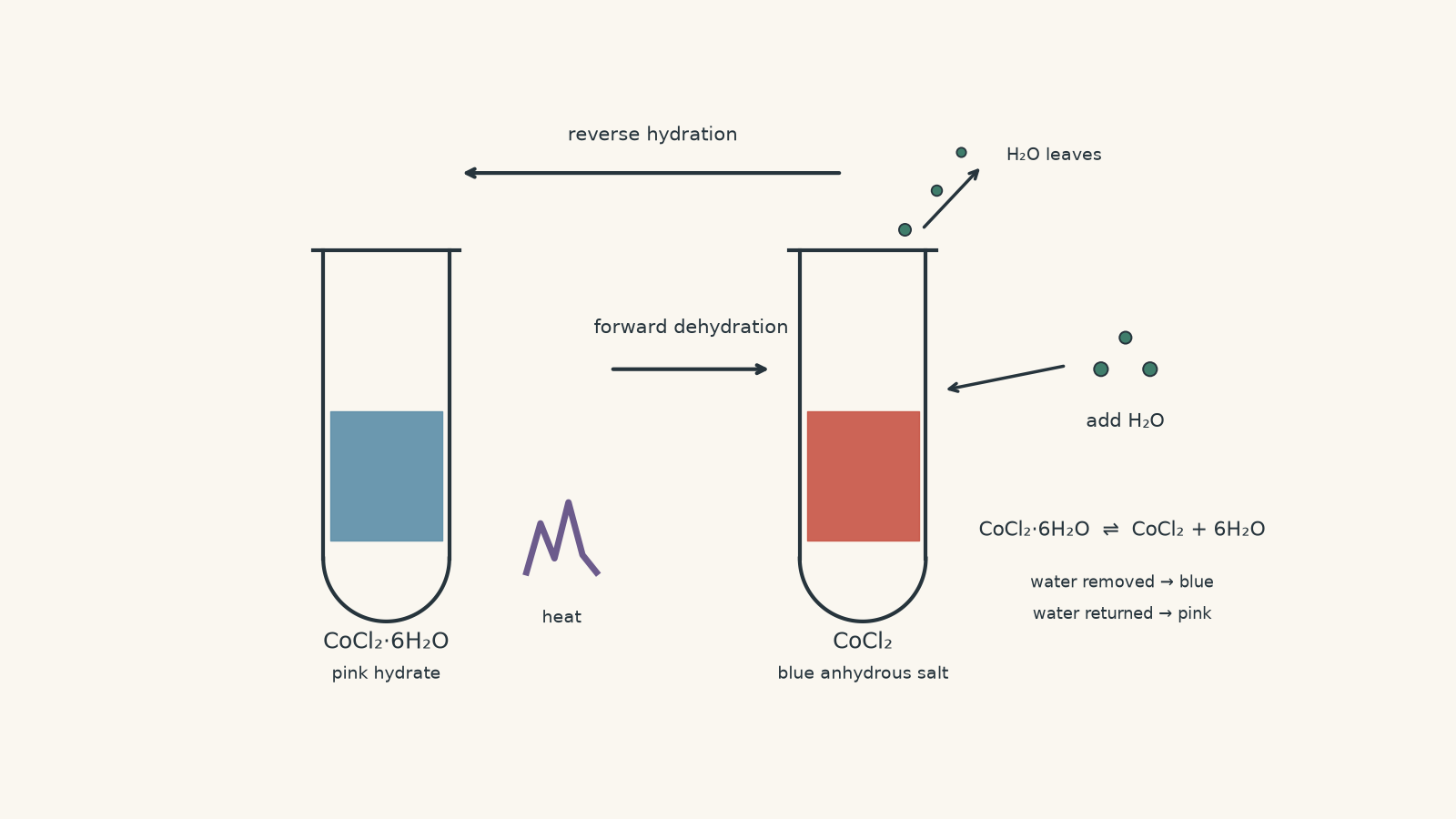
Follow the experiment in order
Imagine a small sample of pink \(\ce{CoCl2.6H2O}\) in a test tube.
When it is heated, water is driven from the hydrated crystal. The solid becomes blue.
So far, we have evidence for dehydration:
\[ \ce{CoCl2.6H2O -> CoCl2 + 6H2O} \]
Now cool the blue material before adding water.
The solid becomes pink again as hydrated cobalt(II) chloride forms:
\[ \ce{CoCl2 + 6H2O -> CoCl2.6H2O} \]
The important observation isn’t simply “pink changed to blue”.
It is the full cycle:
pink \(\rightarrow\) blue \(\rightarrow\) pink.
The product of the first change, dehydrated cobalt(II) chloride, has become a reactant in the reverse change.
These are school-laboratory observations. Cobalt salts require appropriate handling, PPE, and teacher supervision.
Why the mass matters as well as the colour
Colour is useful evidence, but mass gives us a second test.
If heating really removes six water molecules per formula unit of \(\ce{CoCl2.6H2O}\), the decrease in mass should match that chemical formula.
That makes the argument much stronger than saying, “Well, it went blue, so something probably happened.”
Worked example: Does the mass change support reversibility?
A student heats 2.38 g of pink \(\ce{CoCl2.6H2O}\). The sample becomes blue and reaches a constant mass of 1.30 g. After it has cooled, water is added and the solid becomes pink again. After excess surface water is removed, its mass is 2.36 g.
Use \(M(\ce{CoCl2}) = 129.8\ \text{g mol}^{-1}\) and \(M(\ce{H2O}) = 18.0\ \text{g mol}^{-1}\). Explain whether the observations support reversible dehydration and hydration.
Step 1
\[ M(\ce{CoCl2.6H2O}) =129.8+6(18.0) =237.8\ \text{g mol}^{-1} \]
Of every 237.8 g of hydrate, 129.8 g is anhydrous \(\ce{CoCl2}\).
Step 2
\[ m(\ce{CoCl2}) =2.38\times\frac{129.8}{237.8} =1.30\ \text{g} \]
The predicted mass is essentially identical to the observed 1.30 g.
That supports the idea that heating removed the water of crystallisation rather than randomly destroying some of the sample.
Step 3
The blue product became pink again, and the mass returned from 1.30 g to 2.36 g.
The original mass was 2.38 g, so the difference is only:
\[ 2.38-2.36=0.02\ \text{g} \]
A small difference like this could result from experimental loss, incomplete rehydration, or measurement uncertainty.
Step 4
The evidence supports this cycle:
\[ \ce{CoCl2.6H2O <=> CoCl2 + 6H2O} \]
Heating favoured dehydration. Returning water allowed the blue product to form the pink hydrated reactant again.
The result does more than show a repeated colour change. The mass change also agrees with the expected loss and regain of water.
04A second example: the iron(III)-thiocyanate reaction
Now consider a reaction that stays in solution:
\[ \ce{Fe^3+(aq) + SCN^-(aq) <=> FeSCN^2+(aq)} \]
The \(\ce{FeSCN^2+}\) species produces a strong red colour.
So when \(\mathrm{Fe}^{3+}\) ions and \(\ce{SCN^-}\) ions are mixed and the solution becomes red, we have clear evidence that the forward reaction occurs.
But remember our rule: formation of a product does not prove reversibility.
We need evidence for the other direction.
In a suitably prepared equilibrium mixture, changing the conditions can make the red colour decrease as some \(\ce{FeSCN^2+}\) converts back into \(\mathrm{Fe}^{3+}\) and \(\ce{SCN^-}\). Reversing that change in conditions can make the red colour become stronger again.
The useful observation is not merely that the solution can be different shades of red. It is that the same chemical system can be pushed in one direction and then back in the other.
Worked example: Did heating destroy the red product?
Two identical sealed test tubes contain the same red iron(III)-thiocyanate mixture. Tube A is warmed and becomes noticeably paler. Tube B is kept at the original temperature and remains the same colour. When Tube A is returned to its original temperature, its red colour returns.
A student says, “Heating must have permanently destroyed the red \(\ce{FeSCN^2+}\). Cooling just made a new red substance.” Evaluate the student’s explanation.
Step 1
Tube B remained unchanged, so the colour change in Tube A is associated with the temperature change rather than simply the passage of time.
Step 2
If heating had irreversibly destroyed the red species, simply returning Tube A to its original temperature would not be expected to restore the original chemical system.
Instead, the red colour returns.
That is evidence that the change can occur in both directions.
Step 3
The system is represented by:
\[ \ce{Fe^3+(aq) + SCN^-(aq) <=> FeSCN^2+(aq)} \]
When the red colour decreases, there is less \(\ce{FeSCN^2+}\). This is consistent with the reverse reaction forming more \(\mathrm{Fe}^{3+}\) and \(\ce{SCN^-}\).
When the red colour returns, the forward reaction has again produced more \(\ce{FeSCN^2+}\).
Step 4
The reversible colour change, together with the unchanged control, supports the conclusion that the chemical system responds reversibly to the change in conditions.
Colour by itself is not perfect identification of a chemical species. Strong experimental conclusions come from combining observations with known chemical behaviour and appropriate controls.
05Reversible does not mean “50% each way”
This is probably the most tempting mistake.
Consider:
\[ \ce{A + B <=> C + D} \]
A student sees the double arrow and imagines half the particles sitting on the left and half sitting on the right.
That isn’t what the symbol says.
The equilibrium might contain mostly A and B. It might contain mostly C and D. It might be somewhere in between.
The double arrow tells you that the forward and reverse reactions are both possible.
It does not tell you the final proportions.
Later, the equilibrium constant \(K\) will give you quantitative information about how strongly the equilibrium position favours products or reactants.
06Reversible is also not the same as “at equilibrium”
These two ideas are related, but they are not interchangeable.
A reaction is reversible if forward and reverse reactions can both occur.
A system is at dynamic equilibrium when, in a closed system, the forward and reverse reactions occur at equal rates.
At equilibrium, reactions have not stopped. The opposing rates are equal, so there is no overall change in the macroscopic concentrations.
Think about a crowded train station with the same number of people on each platform from minute to minute. That does not necessarily mean nobody is moving. Twenty people could cross one way while twenty cross the other way.
The analogy breaks because molecules react through collisions rather than walking through ticket gates, but it captures the important point: constant amounts do not require zero activity.
07The major misconception: “If I can make the reactants again somehow, the reaction was reversible”
Not necessarily.
Consider magnesium burning:
\[ \ce{2Mg(s) + O2(g) -> 2MgO(s)} \]
Magnesium oxide can, with a sufficiently different chemical or industrial process, eventually be converted into magnesium again.
That fact does not mean a strip of burning magnesium is undergoing a readily reversible reaction.
Cool the magnesium oxide after the flame disappears. Does it spontaneously split back into shiny magnesium and oxygen gas?
No.
This matters because “I can make magnesium again somehow” is different from “the products undergo the reverse of the original reaction under the conditions being studied”.
For HSC-style reasoning, ask:
- Do the products themselves take part in a reverse reaction?
- Can changing the conditions make the system move back towards the original reactants?
- Is the reversal observed in the same chemical system, rather than through an entirely different sequence of reactions?
- Are the observations repeatable and chemically consistent?
Reversibility is always discussed with conditions in mind.
08How to recognise reversible-reaction evidence in an exam question
Don’t search only for a double arrow. Sometimes you are expected to infer reversibility from observations.
A useful decision process is:
- Identify what changed during the forward reaction.
- Identify the products that were formed.
- Look for evidence that those products later decrease while the original reactants reappear.
- Check whether the second change is genuinely the reverse process rather than an unrelated reaction.
- Use more than one observation where possible: colour, mass, gas formation, precipitation, concentration data, or repeated cycling.
- Check whether products have escaped from the system.
That sixth point becomes especially important once you start studying equilibrium.
A reversible reaction in an open container may never reach equilibrium because matter can leave the system.
09Why one observation can fool you
Suppose a blue substance becomes pink when water is added.
That alone is not enough to say, “reversible reaction”.
Perhaps the blue substance reacted with water to produce a completely different pink compound.
To make the argument stronger, you would want several pieces of evidence pointing to the same model:
- the expected water is lost during heating,
- the measured mass change matches the chemical formula,
- adding water restores the original properties,
- the cycle can be repeated,
- no unexplained products appear.
Science rarely rests on a colour being vaguely familiar.
The job is to ask which chemical explanation accounts for all the evidence with the fewest unsupported assumptions.
10Questions and solutions
Question 1
A sample of pink hydrated cobalt(II) chloride is heated and becomes blue. After cooling, water is added and the sample becomes pink again.
Identify the observation that provides evidence for a reverse reaction, and write a reversible equation representing the process.
Solution 1
The return of the blue product to the pink hydrated substance after water is added is the evidence for the reverse reaction.
Heating alone only demonstrates the forward dehydration:
\[ \ce{CoCl2.6H2O -> CoCl2 + 6H2O} \]
The later return of the pink hydrate shows that the dehydrated product can react with water:
\[ \ce{CoCl2 + 6H2O -> CoCl2.6H2O} \]
The complete process can therefore be represented as:
\[ \ce{CoCl2.6H2O <=> CoCl2 + 6H2O} \]
The tempting mistake is to call the reaction reversible as soon as the pink solid turns blue. That first observation proves only that dehydration occurs. The blue-to-pink change supplies evidence for the reverse direction.
Question 2
A student begins with 3.00 g of \(\ce{CoCl2.6H2O}\) and heats it. The remaining solid has a mass of 1.78 g and appears mostly blue, with a few pink regions.
Use \(M(\ce{CoCl2})=129.8\ \text{g mol}^{-1}\), \(M(\ce{H2O})=18.0\ \text{g mol}^{-1}\), and assume no cobalt chloride was lost.
(a) Calculate the mass that would remain if dehydration were complete.
(b) Estimate the average number of moles of water still present per mole of \(\ce{CoCl2}\).
(c) Water is then added. The sample becomes uniformly pink and, after excess surface water is removed, has a mass of 2.96 g. Explain what the complete set of observations tells you about reversibility.
Solution 2
The sample was not completely dehydrated; the mass data indicate that an average of about \(0.63\) mol of water remained per mole of \(\ce{CoCl2}\), and the later return towards the original pink state supports reversible hydration.
For part (a), first find the molar mass of the hydrate:
\[ M(\ce{CoCl2.6H2O}) =129.8+6(18.0) =237.8\ \text{g mol}^{-1} \]
The mass of anhydrous \(\ce{CoCl2}\) expected from 3.00 g of hydrate is:
\[ m =3.00\times\frac{129.8}{237.8} =1.64\ \text{g} \]
Complete dehydration should therefore leave about \(1.64\ \text{g}\).
The observed mass was \(1.78\ \text{g}\), which is higher. Something remains in addition to the expected anhydrous \(\ce{CoCl2}\).
For part (b), the amount of original hydrate was:
\[ n(\ce{CoCl2.6H2O}) =\frac{3.00}{237.8} =0.0126\ \text{mol} \]
There are therefore \(0.0126\ \text{mol}\) of \(\ce{CoCl2}\) formula units in the sample.
Their anhydrous mass should be:
\[ m(\ce{CoCl2}) =0.0126\times129.8 =1.64\ \text{g} \]
The remaining water has a mass of approximately:
\[ 1.78-1.64=0.14\ \text{g} \]
So:
\[ n(\ce{H2O}) =\frac{0.14}{18.0} =7.8\times10^{-3}\ \text{mol} \]
The average water-to-\(\ce{CoCl2}\) ratio is therefore:
\[ \frac{7.8\times10^{-3}}{0.0126} \approx0.62 \]
Using unrounded values gives about \(0.63\) mol of water per mole of \(\ce{CoCl2}\).
This does not mean the student has discovered a pure compound with the neat formula \(\ce{CoCl2.0.63H2O}\). The residue could contain a mixture of differently hydrated material. The patchy blue and pink appearance supports that interpretation.
For part (c), adding water causes the solid to return to a uniform pink appearance and the mass returns close to its original 3.00 g:
\[ 3.00-2.96=0.04\ \text{g} \]
The small difference could be caused by loss of sample, incomplete rehydration, or measurement uncertainty.
Taken together, the mass decrease on heating, evidence that some water remained when heating was incomplete, and the return of the pink hydrated material after adding water support reversible dehydration and hydration.
The trap is to treat the 1.78 g residue as proof of a new fixed chemical formula. The data establish an average composition of the sample, not necessarily one pure hydrate.
Question 3
The reaction
\[ \ce{Fe^3+(aq) + SCN^-(aq) <=> FeSCN^2+(aq)} \]
produces a red solution because of \(\ce{FeSCN^2+}\).
A student adds extra \(\mathrm{Fe}^{3+}\) to a red mixture and observes that it becomes darker red. The student then adds reagent X. Independent testing has shown that X removes free \(\mathrm{Fe}^{3+}\) ions by binding them strongly, but X does not directly react with \(\ce{FeSCN^2+}\). After X is added, the solution gradually becomes much paler.
The student argues, “The red product can’t be turning back into reactants because X only removes free \(\mathrm{Fe}^{3+}\).”
Explain why the observation actually provides evidence for the reverse reaction.
Solution 3
The fading red colour provides evidence that \(\ce{FeSCN^2+}\) is undergoing the reverse reaction to replace some of the \(\mathrm{Fe}^{3+}\) removed by X.
The relevant reversible reaction is:
\[ \ce{Fe^3+(aq) + SCN^-(aq) <=> FeSCN^2+(aq)} \]
Adding extra \(\mathrm{Fe}^{3+}\) is followed by a darker red colour, consistent with additional \(\ce{FeSCN^2+}\) being produced.
Now consider X.
We are explicitly told that X does not directly destroy or bleach \(\ce{FeSCN^2+}\). It removes free \(\mathrm{Fe}^{3+}\).
If the reverse reaction did not occur, removing free \(\mathrm{Fe}^{3+}\) would provide no pathway for existing red \(\ce{FeSCN^2+}\) to disappear.
Instead, the red colour gradually fades. This is consistent with:
\[ \ce{FeSCN^2+(aq) -> Fe^3+(aq) + SCN^-(aq)} \]
As the reverse reaction produces \(\mathrm{Fe}^{3+}\), X removes those newly formed ions. More \(\ce{FeSCN^2+}\) can then dissociate, so the amount of red species decreases.
The student’s tempting argument focuses only on the direct action of X. The crucial interaction is indirect: X changes the amount of one reactant, and the reversible chemical system responds through the reverse reaction.
This is also why controls matter. Without the information that X does not directly react with \(\ce{FeSCN^2+}\), simple fading would have more than one plausible explanation.
Question 4
A sealed two-section tube is used to investigate hydrated cobalt(II) chloride.
Initially, one section contains 2.38 g of pink \(\ce{CoCl2.6H2O}\), while the other section is empty.
When the pink section is heated while the second section is kept cool:
- the solid becomes blue,
- its mass, measured separately before sealing in an equivalent trial, falls to 1.30 g,
- about 1.08 g of water is collected in the cooler section.
After the apparatus cools, the collected water is allowed to contact the blue solid. The solid becomes pink again and returns to \(2.38\ \text{g}\) within experimental uncertainty. The cycle can be repeated.
Two explanations are proposed.
Model R: the hydrate undergoes reversible dehydration and hydration.
Model P: heating irreversibly creates a completely different blue cobalt compound, and adding water then causes an unrelated irreversible reaction that happens to create a pink material.
Using the evidence provided, compare the two models. Explain why the sealed apparatus makes the evidence stronger, and identify one limitation that still prevents the observations alone from revealing every microscopic detail of the reaction.
Solution 4
Model R is much more consistent with the complete set of observations: the measured amount of water, recovery of the original mass, and repeatable transfer of water out of and back into the cobalt chloride system all support reversible dehydration and hydration.
First consider the expected water content of 2.38 g of \(\ce{CoCl2.6H2O}\).
The molar mass is:
\[ M(\ce{CoCl2.6H2O}) =129.8+6(18.0) =237.8\ \text{g mol}^{-1} \]
The fraction due to water is:
\[ \frac{108.0}{237.8} \]
So the expected mass of water is:
\[ m(\ce{H2O}) =2.38\times\frac{108.0}{237.8} =1.08\ \text{g} \]
That matches the collected water.
The expected remaining \(\ce{CoCl2}\) mass is:
\[ 2.38-1.08=1.30\ \text{g} \]
Again, that matches the observation.
These numbers are not arbitrary. They are exactly what the formula \(\ce{CoCl2.6H2O}\) predicts for loss of six water molecules per formula unit.
The sealed apparatus strengthens the evidence because the water is not simply lost to the room. The product removed from the heated solid is physically retained in the same system.
When that collected water is returned to the 1.30 g blue solid, the original 2.38 g pink material is recovered within experimental uncertainty.
So the sequence is:
\[ \text{pink hydrate} \rightarrow \text{blue solid + water} \rightarrow \text{pink hydrate} \]
Repeating the same cycle makes an accidental colour coincidence increasingly poor as an explanation.
Model P is not logically impossible merely because it is complicated. Scientific evidence rarely lets us prove that no imaginable alternative mechanism exists. However, Model P requires extra, unsupported substances and reactions even though reversible hydration explains the measured stoichiometry, mass recovery, water transfer, and repeatability together.
The sealed system is particularly useful because it prevents the major red herring of missing matter. In an open tube, failure to recover the original hydrate could simply mean water escaped.
A limitation remains: macroscopic observations such as colour and mass do not reveal every bond-breaking event or every short-lived intermediate. More detailed chemical or spectroscopic evidence would be needed to establish a complete microscopic mechanism.
The trap is to say either “the colours prove everything” or “nothing can ever be concluded without seeing individual molecules”. Neither is good scientific reasoning. The evidence strongly supports one model while still having a clear limit.
Question 5
A closed vessel contains the reversible reaction
\[ \ce{A + BC <=> AB + C} \]
at constant temperature.
Measurements show that the concentrations of A, BC, AB, and C remain constant for a long period.
Scientists then replace a tiny fraction of the existing AB molecules with chemically identical AB molecules in which the B atom contains a detectable isotope. The total concentration of AB is kept unchanged, so the overall concentrations of all four substances are initially unchanged.
After some time, the labelled B atoms are detected in BC molecules as well as in AB molecules. The total concentrations of A, BC, AB, and C have still not measurably changed.
Three students make claims:
- Student 1: “The labelled B appearing in BC proves the reverse reaction is occurring.”
- Student 2: “The concentrations are constant, so neither reaction can be occurring.”
- Student 3: “If AB is reacting backwards, the amount of AB must continuously decrease.”
Assess all three claims and explain why this experiment gives unusually strong evidence for reversibility.
Solution 5
Student 1 is correct, while Students 2 and 3 confuse no net concentration change with no molecular reaction. The movement of labelled B from product AB into reactant BC directly shows that the reverse reaction is occurring.
Start with the reverse direction:
\[ \ce{AB + C -> A + BC} \]
Initially, the detectable isotope is deliberately placed in some AB molecules.
Later, that same labelled B is found inside BC.
Under the reaction pathway given in the question, B can move from AB into BC through the reverse reaction. The labelled atoms therefore act as tracers: they let us follow individual atoms even when the total amounts of substances look unchanged.
Student 1’s claim is supported.
Now consider Student 2.
The total concentrations remain constant, but this does not require both rates to be zero.
Suppose, during a particular time interval, 100 AB molecules undergo the reverse reaction while 100 new AB molecules are produced by the forward reaction.
There is no net change in the number of AB molecules:
\[ 100\text{ formed}-100\text{ consumed}=0 \]
Yet reactions have occurred in both directions.
The same reasoning applies to A, BC, and C.
Student 2 has confused a macroscopic observation – constant concentration – with a microscopic claim that molecules have stopped reacting.
Student 3 makes a subtler mistake.
Yes, the reverse reaction consumes AB:
\[ \ce{AB + C -> A + BC} \]
But the forward reaction simultaneously produces AB:
\[ \ce{A + BC -> AB + C} \]
If the two rates are equal, AB can be continuously consumed and continuously produced while its total concentration remains constant.
The isotope reveals this hidden turnover. An unlabelled AB molecule can disappear through the reverse reaction while another AB molecule forms elsewhere through the forward reaction. A normal concentration measurement cannot distinguish the old molecule from the new one.
The fair hinge in this question is that “unchanged” depends on what you measure.
The concentrations are unchanged.
The identities and locations of particular labelled atoms are not.
That is unusually strong evidence for reversibility because it does not rely merely on a colour returning or a bulk property changing. The tracer directly shows atoms from a product entering a reactant while the system has no overall concentration change.
This is the microscopic picture behind dynamic equilibrium.
11What reversibility lets you understand next
Once you accept that forward and reverse reactions can occur at the same time, an initially strange possibility becomes reasonable: a reaction mixture can look completely unchanged even while enormous numbers of particles continue reacting.
That is dynamic equilibrium.
The next question is no longer simply, “Can the reaction go backwards?”
It becomes: why does a reversible system settle at a particular mixture of reactants and products, and what happens when temperature, concentration, pressure, or volume is changed?
Those questions lead directly to equilibrium position, Le Chatelier’s principle, and the equilibrium constant \(K\).