
Strong vs Weak, Concentrated vs Dilute Acids and Bases
Learn how acid and base strength differs from concentration using particle models, pH data, equilibrium constants, and worked HSC Chemistry examples.
Which has the lower pH: \(1.00 \times 10^{-3}\ \mathrm{mol\,L^{-1}}\) hydrochloric acid, or \(0.100\ \mathrm{mol\,L^{-1}}\) ethanoic acid?
You might pick hydrochloric acid because HCl is a strong acid, while ethanoic acid is weak. But at \(25^\circ\mathrm{C}\), the HCl has pH \(3.00\), while the ethanoic acid has pH about \(2.88\).
So the weak acid solution actually has the lower pH.
That sounds contradictory only if we treat strength and concentration as the same thing. They are not. Strength tells us how an acid or base reacts with water. Concentration tells us how much of it is present per volume of solution.
01Strength and concentration are two different knobs
Picture a crowded party where everyone is carrying a proton.
For an acid, concentration is roughly how many proton-carrying people are in the room. Strength is how readily each one hands over that proton to water.
A nearly empty room of very willing donors represents a dilute strong acid. A packed room of reluctant donors represents a concentrated weak acid. The packed room can sometimes produce more \(\ce{H3O+}\) overall, even though each individual acid particle is less willing to donate.
The analogy has a limit. Molecules do not make individual choices. The actual proportions are controlled by equilibrium, and for weak acids and bases the fraction that reacts changes when the solution is diluted.
The distinction can be summarised like this:
| Property | Concentration | Strength |
|---|---|---|
| Main question | How much solute is present per volume? | How strongly does the acid or base react with water? |
| Typical measure | \(\mathrm{mol\,L^{-1}}\) | \(K_a\) for a weak acid or \(K_b\) for a weak base |
| Changes when water is added? | Yes | No, at a fixed temperature |
| Can be high or low independently? | Yes | Yes |
| Can pH alone determine it? | No | No |
There is also no universal concentration at which a solution suddenly becomes “concentrated”. Concentrated and dilute are comparative descriptions.
02What the particles actually look like
Suppose we make equal-concentration solutions of HCl and ethanoic acid, \(\ce{CH3COOH}\).
HCl is a strong acid in water. For ordinary HSC calculations, we treat its proton transfer to water as essentially complete:
\[
\ce{HCl(aq) + H2O(l) -> H3O+(aq) + Cl-(aq)}
\]
If the HCl concentration is \(0.100\ \mathrm{mol\,L^{-1}}\), we therefore expect approximately
\[
[\ce{H3O+}] = 0.100\ \mathrm{mol\,L^{-1}}
\]
where square brackets mean equilibrium concentration.
Ethanoic acid is different:
\[
\ce{CH3COOH(aq) + H2O(l) <=> H3O+(aq) + CH3COO-(aq)}
\]
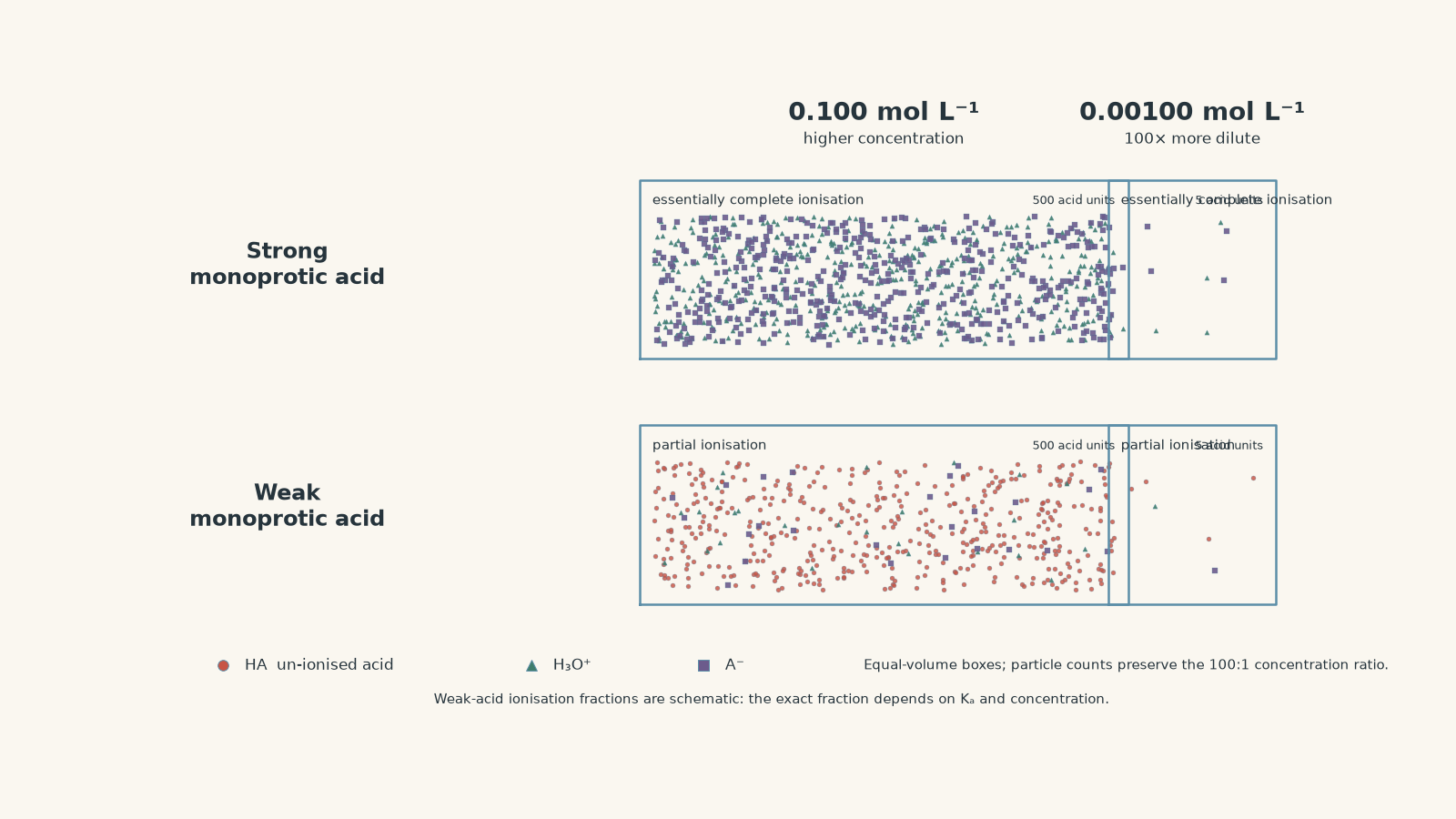
Most ethanoic acid molecules remain as \(\ce{CH3COOH}\). Only a smaller fraction transfers a proton to water at any moment.
This means a particle diagram of the HCl solution would show mainly \(\ce{H3O+}\) and \(\mathrm{Cl}^{-}\), while the ethanoic acid solution would show mostly intact \(\ce{CH3COOH}\), with fewer \(\ce{H3O+}\) and \(\ce{CH3COO-}\) ions.
The same distinction applies to bases.
A strong base such as sodium hydroxide dissociates essentially completely:
\[
\ce{NaOH(aq) -> Na+(aq) + OH-(aq)}
\]
A weak base such as ammonia establishes an equilibrium with water:
\[
\ce{NH3(aq) + H2O(l) <=> NH4+(aq) + OH-(aq)}
\]
Notice something important: ammonia does not contain an \(\ce{OH-}\) group. It produces \(\ce{OH-}\) by accepting a proton from water. That proton-transfer picture is developed further in Conjugate Acid-Base Pairs and Proton Transfer.
03Strength becomes precise through equilibrium
The simple mental model is that stronger acids donate protons more readily. We can now make that precise.
For a weak acid represented by \(\ce{HA}\),
\[
\ce{HA(aq) + H2O(l) <=> H3O+(aq) + A-(aq)}
\]
and
\[
K_a = \frac{[\ce{H3O+}][\mathrm{A}^{-}]}{[\ce{HA}]}
\]
A larger \(K_a\) means the equilibrium lies further towards ionised products, so the acid is stronger.
For a weak base represented by \(\ce{B}\),
\[
\ce{B(aq) + H2O(l) <=> BH+(aq) + OH-(aq)}
\]
and
\[
K_b = \frac{[\ce{BH+}][\ce{OH-}]}{[\ce{B}]}
\]
A larger \(K_b\) means a stronger base.
For a given acid or base in water, \(K_a\) or \(K_b\) is fixed at a specified temperature. Adding water changes the concentrations in the equilibrium mixture, but it does not turn a weak acid into a strong acid.
That last point causes a surprisingly common mistake.
When a weak acid is diluted, its percentage ionisation usually increases. But its \(K_a\) does not change. A larger fraction reacting after dilution does not mean the acid has somehow become chemically stronger.
04Why pH does not tell you strength by itself
At \(25^\circ\mathrm{C}\),
\[
\mathrm{pH}=-\log_{10}[\ce{H3O+}]
\]
and
\[
\mathrm{pOH}=-\log_{10}[\ce{OH-}]
\]
with
\[
\mathrm{pH}+\mathrm{pOH}=14.00
\]
The pH tells us the equilibrium hydronium concentration. It does not tell us how much acid had to be present to produce that hydronium concentration.
Consider these four acid solutions at \(25^\circ\mathrm{C}\). For ethanoic acid, use \(K_a=1.8\times10^{-5}\).
| Solution | Acid strength | Acid concentration | Approximate pH |
|---|---|---|---|
| HCl | Strong | \(0.100\ \mathrm{mol\,L^{-1}}\) | \(1.00\) |
| HCl | Strong | \(0.00100\ \mathrm{mol\,L^{-1}}\) | \(3.00\) |
| \(\ce{CH3COOH}\) | Weak | \(0.100\ \mathrm{mol\,L^{-1}}\) | \(2.88\) |
| \(\ce{CH3COOH}\) | Weak | \(0.00100\ \mathrm{mol\,L^{-1}}\) | \(3.90\) |
Look at the middle two rows.
The \(0.100\ \mathrm{mol\,L^{-1}}\) weak acid has a lower pH than the \(0.00100\ \mathrm{mol\,L^{-1}}\) strong acid.
The HCl is still the stronger acid. Its lower concentration simply means there are far fewer acid particles present in each litre.
This is why statements such as “the solution with the lower pH contains the stronger acid” are unsafe unless concentration and acid identity are also controlled. For more on interpreting pH measurements, see pH and Acid-Base Strength: HSC Chemistry Explained.
05Reading solution data without falling for the obvious answer
When an exam gives you concentration and pH data, separate the questions before calculating anything.
| Data given | What you can safely conclude |
|---|---|
| Concentration only | How much solute is present, but not necessarily its pH |
| pH only | \([\ce{H3O+}]\), but not acid strength or total acid concentration |
| \(K_a\) values | Relative strength of acids under comparable conditions |
| \(K_b\) values | Relative strength of bases under comparable conditions |
| Same concentration and different pH | Useful evidence about relative acid or base behaviour, provided the species are comparable |
| pH before and after dilution | Information about how equilibrium responds, but not a change in \(K_a\) or \(K_b\) |
For a simple monoprotic strong acid at an ordinary HSC concentration,
\[
[\ce{H3O+}] \approx c_{\text{acid}}
\]
because essentially all the acid contributes a proton.
For a weak acid, that shortcut fails. If an initial concentration \(c\) of \(\ce{HA}\) produces an equilibrium hydronium concentration \(x\), then
\[
[\ce{H3O+}]=x,\qquad [\mathrm{A}^{-}]=x,\qquad [\ce{HA}]=c-x
\]
so
\[
K_a=\frac{x^2}{c-x}
\]
That equation connects the particle model to measurable solution data.
The equivalent weak-base relationship is
\[
K_b=\frac{x^2}{c-x}
\]
when \(x=[\ce{OH-}]\) for a base that reacts with water in a 1:1 ratio.
Worked example: Diluting a strong acid
A student dilutes \(25.0\ \mathrm{mL}\) of \(0.0800\ \mathrm{mol\,L^{-1}}\) HCl to a total volume of \(200.0\ \mathrm{mL}\). Calculate the final pH at \(25^\circ\mathrm{C}\), and state whether the acid has become weaker.
Step 1
The number of moles of HCl does not change during dilution, so
\[
c_1V_1=c_2V_2
\]
where \(c_1\) and \(c_2\) are the initial and final concentrations, and \(V_1\) and \(V_2\) are the corresponding volumes.
\[
c_2
=\frac{c_1V_1}{V_2}
=\frac{(0.0800)(25.0)}{200.0}
=0.0100\ \mathrm{mol\,L^{-1}}
\]
The same volume unit can be used on top and bottom because it cancels.
Step 2
HCl ionises essentially completely, so
\[
[\ce{H3O+}]\approx0.0100\ \mathrm{mol\,L^{-1}}
\]
Step 3
\[
\mathrm{pH}
=-\log_{10}(0.0100)
=2.00
\]
Step 4
The final pH is \(2.00\). The solution has become more dilute, but HCl has not become a weaker acid. Its acid strength has not changed.
The particles are simply spread through a larger volume.
Worked example: A concentrated weak base can have a higher pH
Compare \(0.00100\ \mathrm{mol\,L^{-1}}\) NaOH with \(0.100\ \mathrm{mol\,L^{-1}}\) ammonia, \(\ce{NH3}\), at \(25^\circ\mathrm{C}\). For ammonia, \(K_b=1.8\times10^{-5}\). Which base is stronger, and which solution has the higher pH?
Step 1
NaOH is a strong base and dissociates essentially completely:
\[
[\ce{OH-}]=0.00100\ \mathrm{mol\,L^{-1}}
\]
Therefore,
\[
\mathrm{pOH}=-\log_{10}(0.00100)=3.00
\]
and
\[
\mathrm{pH}=14.00-3.00=11.00
\]
Step 2
\[
\ce{NH3(aq) + H2O(l) <=> NH4+(aq) + OH-(aq)}
\]
Let \(x\) be the equilibrium concentration of \(\ce{OH-}\), in \(\mathrm{mol\,L^{-1}}\).
Then
\[
K_b=\frac{x^2}{0.100-x}
\]
Because \(K_b\) is small, first test the approximation \(0.100-x\approx0.100\):
\[
1.8\times10^{-5}
\approx\frac{x^2}{0.100}
\]
so
\[
x
\approx\sqrt{(1.8\times10^{-5})(0.100)}
=1.34\times10^{-3}\ \mathrm{mol\,L^{-1}}
\]
Only about \(1.34\%\) of the ammonia reacts, so the approximation is reasonable.
Step 3
\[
\mathrm{pOH}
=-\log_{10}(1.34\times10^{-3})
\approx2.87
\]
Therefore,
\[
\mathrm{pH}\approx14.00-2.87=11.13
\]
Step 4
NaOH is the stronger base, because it dissociates essentially completely in water while ammonia is weak.
However, the \(0.100\ \mathrm{mol\,L^{-1}}\) ammonia solution has the higher pH: about \(11.13\) compared with \(11.00\).
Its much greater concentration outweighs its weaker base behaviour in this comparison.
06The misconceptions worth catching
A dilute strong acid is still a strong acid. If you dilute HCl from \(1.0\ \mathrm{mol\,L^{-1}}\) to \(1.0\times10^{-3}\ \mathrm{mol\,L^{-1}}\), its concentration has changed by a factor of 1000. Its identity and acid strength have not.
A concentrated weak acid is still weak. You can have a large amount of weak acid in each litre while only a small fraction is ionised at equilibrium.
A lower pH does not automatically mean a stronger acid. It means a greater equilibrium \([\ce{H3O+}]\). That could be caused by greater strength, greater concentration, or both.
Finally, a larger percentage ionisation after dilution does not mean a weak acid has become stronger. Strength is represented by \(K_a\). Percentage ionisation describes the particular equilibrium mixture at that concentration.
07Questions and solutions
Question 1
A \(0.00200\ \mathrm{mol\,L^{-1}}\) solution of \(\ce{HNO3}\) is described by a student as a “weak acid because it is very dilute”.
Calculate its pH at \(25^\circ\mathrm{C}\), and correct the student’s statement.
Solution 1
The solution has pH \(2.70\), and \(\ce{HNO3}\) is a strong acid even when its solution is dilute.
Nitric acid is treated as essentially completely ionised in an HSC aqueous solution:
\[
\ce{HNO3(aq) + H2O(l) -> H3O+(aq) + NO3-(aq)}
\]
Therefore,
\[
[\ce{H3O+}]
=0.00200\ \mathrm{mol\,L^{-1}}
\]
and
\[
\mathrm{pH}
=-\log_{10}(0.00200)
=2.699
\approx2.70
\]
The tempting mistake is to use weak and dilute as synonyms. They describe different properties. Here, dilute describes the relatively low concentration. Strong describes the essentially complete reaction of \(\ce{HNO3}\) with water.
Question 2
Ethanoic acid has \(K_a=1.8\times10^{-5}\) at \(25^\circ\mathrm{C}\).
Calculate the pH and percentage ionisation of:
(a) \(0.100\ \mathrm{mol\,L^{-1}}\) ethanoic acid
(b) \(0.0100\ \mathrm{mol\,L^{-1}}\) ethanoic acid.
Use your results to explain what dilution does to both pH and percentage ionisation.
Solution 2
Dilution raises the pH from about \(2.88\) to \(3.38\), but increases the percentage ionisation from about \(1.33\%\) to \(4.15\%\).
For ethanoic acid,
\[
\ce{CH3COOH + H2O <=> H3O+ + CH3COO-}
\]
Let \(x=[\ce{H3O+}]\).
For part (a),
\[
1.8\times10^{-5}
=\frac{x^2}{0.100-x}
\]
Rearranging gives
\[
x^2+(1.8\times10^{-5})x-(1.8\times10^{-6})=0
\]
Taking the physically meaningful positive solution,
\[
x=1.33\times10^{-3}\ \mathrm{mol\,L^{-1}}
\]
Therefore,
\[
\mathrm{pH}
=-\log_{10}(1.33\times10^{-3})
\approx2.88
\]
The percentage ionisation is
\[
\frac{1.33\times10^{-3}}{0.100}\times100
=1.33\%
\]
For part (b),
\[
1.8\times10^{-5}
=\frac{x^2}{0.0100-x}
\]
which gives
\[
x=4.15\times10^{-4}\ \mathrm{mol\,L^{-1}}
\]
Therefore,
\[
\mathrm{pH}
=-\log_{10}(4.15\times10^{-4})
\approx3.38
\]
and
\[
\text{percentage ionisation}
=\frac{4.15\times10^{-4}}{0.0100}\times100
=4.15\%
\]
The apparently strange result is that the acid becomes less acidic by pH, yet a larger fraction of its molecules ionises.
There is no contradiction. Dilution lowers the total acid concentration. The equilibrium then shifts towards greater ionisation, partially opposing that decrease. It does not oppose it enough to keep \([\ce{H3O+}]\) constant, so the pH still rises.
The acid has not become stronger: \(K_a\) remains \(1.8\times10^{-5}\).
Question 3
A \(0.0500\ \mathrm{mol\,L^{-1}}\) solution of an unknown base has a measured pH of \(10.97\) at \(25^\circ\mathrm{C}\). Assume the base reacts with water in a 1:1 ratio:
\[
\ce{B + H2O <=> BH+ + OH-}
\]
Estimate \(K_b\). Then compare the measured pH with the pH the solution would have if the base behaved as a strong base at the same concentration.
Solution 3
The base has \(K_b\approx1.8\times10^{-5}\), so the data are consistent with a weak base; a \(0.0500\ \mathrm{mol\,L^{-1}}\) strong base would instead have pH about \(12.70\).
From the measured pH,
\[
\mathrm{pOH}=14.00-10.97=3.03
\]
Therefore,
\[
[\ce{OH-}]
=10^{-3.03}
=9.33\times10^{-4}\ \mathrm{mol\,L^{-1}}
\]
Let
\[
x=9.33\times10^{-4}\ \mathrm{mol\,L^{-1}}
\]
Then
\[
[\ce{BH+}]=x
\]
and
\[
[\ce{B}]
=0.0500-x
=0.0491\ \mathrm{mol\,L^{-1}}
\]
Hence,
\[
K_b
=\frac{[\ce{BH+}][\ce{OH-}]}{[\ce{B}]}
=\frac{(9.33\times10^{-4})^2}{0.0491}
\approx1.8\times10^{-5}
\]
Now test the competing strong-base model.
If the base were strong and produced one \(\ce{OH-}\) per formula unit,
\[
[\ce{OH-}]=0.0500\ \mathrm{mol\,L^{-1}}
\]
so
\[
\mathrm{pOH}
=-\log_{10}(0.0500)
=1.301
\]
and
\[
\mathrm{pH}
=14.00-1.301
=12.70
\]
The tempting route is to look at pH \(10.97\), notice that it is well above 7, and call the base “strong”. But pH measures the final \(\ce{OH-}\) concentration. Comparing that concentration with the known \(0.0500\ \mathrm{mol\,L^{-1}}\) amount of base shows that only a small fraction reacted.
Question 4
At \(25^\circ\mathrm{C}\), a student prepares \(1.0\times10^{-8}\ \mathrm{mol\,L^{-1}}\) HCl and argues:
HCl is strong, so \([\ce{H3O+}]=1.0\times10^{-8}\ \mathrm{mol\,L^{-1}}\). Therefore the pH is \(8.00\).
That would apparently mean adding a strong acid to water produced an alkaline solution.
Find the correct pH by including the autoionisation of water. Use
\[
K_w=1.0\times10^{-14}
\]
and assume ideal dilute behaviour.
Solution 4
The correct pH is about \(6.98\), not \(8.00\).
The student’s calculation fails because at such an extremely low acid concentration, water itself is an important source of \(\ce{H3O+}\). We can no longer pretend that every hydronium ion came from HCl.
Because HCl is strong,
\[
[\mathrm{Cl}^{-}]
=1.0\times10^{-8}\ \mathrm{mol\,L^{-1}}
\]
Charge balance requires the total positive charge from \(\ce{H3O+}\) to equal the negative charge from both \(\mathrm{Cl}^{-}\) and \(\ce{OH-}\):
\[
[\ce{H3O+}]
=
[\mathrm{Cl}^{-}]+[\ce{OH-}]
\]
Let
\[
h=[\ce{H3O+}]
\]
Then
\[
[\ce{OH-}]
=\frac{K_w}{h}
=\frac{1.0\times10^{-14}}{h}
\]
so
\[
h
=1.0\times10^{-8}
+\frac{1.0\times10^{-14}}{h}
\]
Multiplying by \(h\),
\[
h^2-(1.0\times10^{-8})h-1.0\times10^{-14}=0
\]
Taking the positive solution,
\[
h
=
\frac{1.0\times10^{-8}
+\sqrt{(1.0\times10^{-8})^2+4(1.0\times10^{-14})}}{2}
\]
\[
h
\approx1.05\times10^{-7}\ \mathrm{mol\,L^{-1}}
\]
Therefore,
\[
\mathrm{pH}
=-\log_{10}(1.05\times10^{-7})
\approx6.98
\]
The result also passes a useful physical check. Pure water at \(25^\circ\mathrm{C}\) has \([\ce{H3O+}]=1.0\times10^{-7}\ \mathrm{mol\,L^{-1}}\). Adding HCl should increase that value slightly, not somehow push it below the pure-water value and make the solution alkaline.
The shortcut \([\ce{H3O+}]\approx c_{\text{strong acid}}\) is therefore not an exact law. It is an excellent approximation only when the strong acid contributes far more hydronium than water does.
Question 5
Two monoprotic acid solutions, X and Y, both have pH \(3.00\) at \(25^\circ\mathrm{C}\).
X is a strong acid.
Y is a weak acid with
\[
K_a=1.0\times10^{-4}
\]
(a) Find the formal acid concentration of X and Y.
(b) Each solution is then diluted by a factor of 100. Calculate the new pH of each.
(c) Which solution now has the lower pH, and why does that not contradict X being the stronger acid?
Assume ideal solution behaviour and neglect water autoionisation except where it would materially affect the result.
Solution 5
After the 100-fold dilution, the weak-acid solution Y has the lower pH: about \(4.18\), compared with about \(5.00\) for X. This does not make Y the stronger acid.
Initially, both solutions have pH \(3.00\), so
\[
[\ce{H3O+}]
=10^{-3.00}
=1.00\times10^{-3}\ \mathrm{mol\,L^{-1}}
\]
For strong acid X, essentially complete ionisation means
\[
c_X
=1.00\times10^{-3}\ \mathrm{mol\,L^{-1}}
\]
Now consider weak acid Y.
Let its formal concentration be \(c_Y\). At equilibrium,
\[
[\ce{H3O+}]
=[\mathrm{A}^{-}]
=x
=1.00\times10^{-3}\ \mathrm{mol\,L^{-1}}
\]
and
\[
[\ce{HA}]=c_Y-x
\]
Using the given \(K_a\),
\[
1.0\times10^{-4}
=
\frac{(1.00\times10^{-3})^2}
{c_Y-1.00\times10^{-3}}
\]
Rearranging,
\[
c_Y-1.00\times10^{-3}
=
\frac{1.00\times10^{-6}}{1.0\times10^{-4}}
=0.0100
\]
so
\[
c_Y=0.0110\ \mathrm{mol\,L^{-1}}
\]
This is the first important result. The two solutions had identical pH values, but Y contained eleven times as much acid overall.
Now dilute both solutions by a factor of 100.
For X,
\[
c_X
=\frac{1.00\times10^{-3}}{100}
=1.00\times10^{-5}\ \mathrm{mol\,L^{-1}}
\]
The strong-acid approximation gives
\[
[\ce{H3O+}]
\approx1.00\times10^{-5}\ \mathrm{mol\,L^{-1}}
\]
so
\[
\mathrm{pH}_X\approx5.00
\]
Water autoionisation produces only a small correction here, so \(5.00\) is suitable to the stated precision.
For Y,
\[
c_Y
=\frac{0.0110}{100}
=1.10\times10^{-4}\ \mathrm{mol\,L^{-1}}
\]
Let the new equilibrium hydronium concentration be \(x\).
\[
1.0\times10^{-4}
=
\frac{x^2}{1.10\times10^{-4}-x}
\]
Rearranging,
\[
x^2+(1.0\times10^{-4})x-1.10\times10^{-8}=0
\]
The positive solution is
\[
x=6.62\times10^{-5}\ \mathrm{mol\,L^{-1}}
\]
Therefore,
\[
\mathrm{pH}_Y
=-\log_{10}(6.62\times10^{-5})
\approx4.18
\]
So after equal dilution,
\[
\mathrm{pH}_Y<\mathrm{pH}_X
\]
even though Y is the weak acid.
The tempting prediction is that the strong acid must always have the lower pH. The missing constraint is total acid concentration.
Initially, X was essentially completely ionised, so it had no large reservoir of un-ionised acid molecules waiting to react. Its hydronium concentration therefore fell almost in proportion to the 100-fold dilution.
Y started with much more total acid. Before dilution, its percentage ionisation was
\[
\frac{1.00\times10^{-3}}{0.0110}\times100
\approx9.1\%
\]
After dilution it became
\[
\frac{6.62\times10^{-5}}{1.10\times10^{-4}}\times100
\approx60.2\%
\]
Dilution allowed a much larger fraction of Y to ionise, partially replacing the hydronium lost through dilution.
Yet Y has not become a strong acid. Its \(K_a\) is still \(1.0\times10^{-4}\).
That distinction – concentration tells you how much acid or base is present, while \(K_a\) or \(K_b\) describes its equilibrium strength – is what you need next when analysing conjugate acid-base pairs, buffers, neutralisation, and titration curves.