
Mass Relationships in Chemical Reactions: HSC Chemistry Guide
Learn how to interpret mass changes in open and closed reaction systems, use balanced equations to calculate mass relationships, and avoid common conservation-of-mass mistakes.
You heat 2.50 g of magnesium in an open crucible. After it reacts, the white solid left behind has a mass of about 4.15 g.
Where did the extra mass come from?
A tempting answer is that something has gone wrong because a chemical reaction shouldn’t create mass. The better prediction is that the magnesium has gained matter from somewhere outside the crucible. It has: oxygen from the air has become part of the solid product.
That observation gets to the heart of mass measurements in chemical reactions. The law of conservation of mass still holds, but you have to be very clear about what is inside the system you are measuring.
01Start with the system boundary
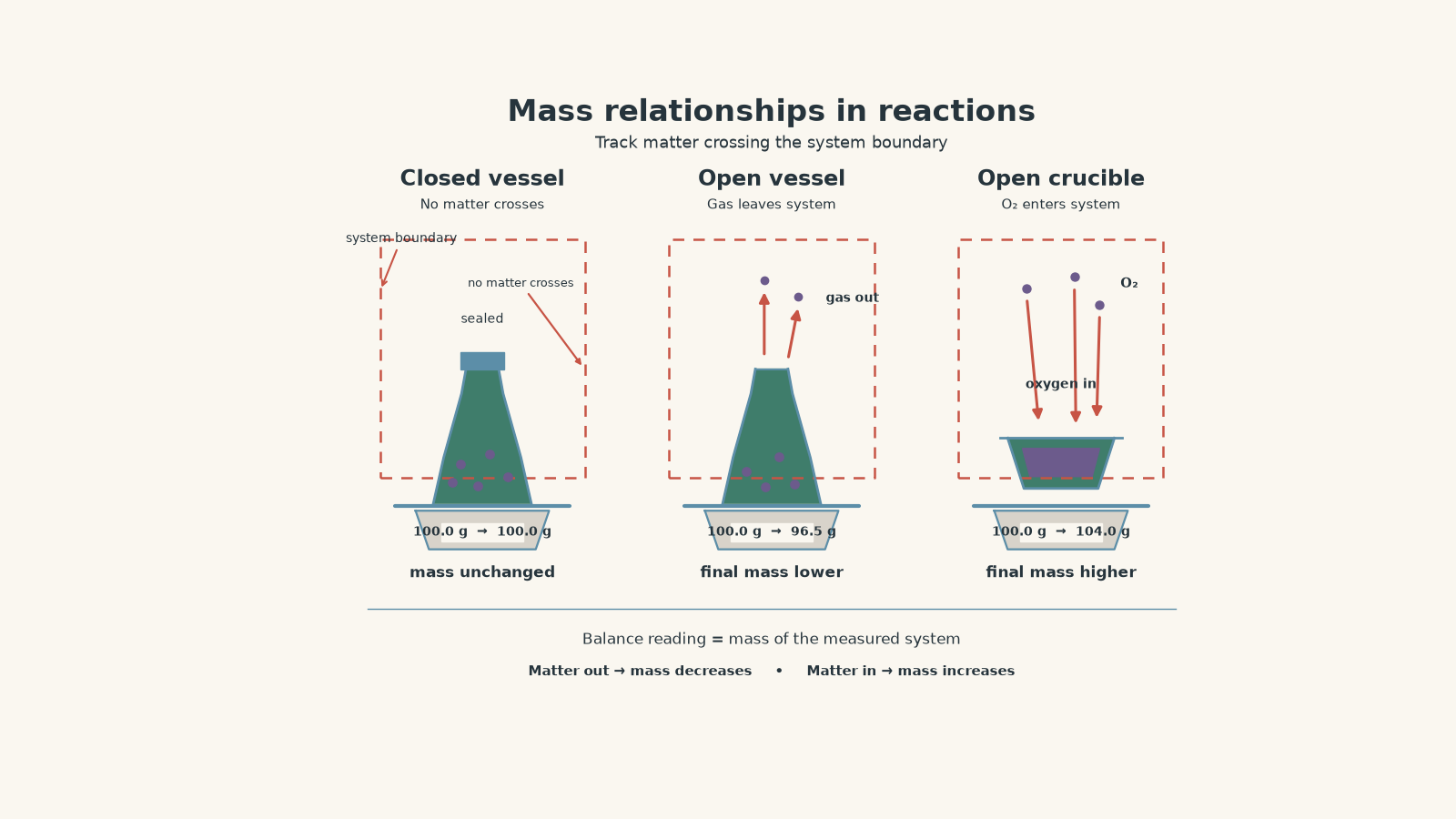
Imagine drawing an invisible box around everything whose mass you are measuring.
If the box is completely closed, matter cannot enter or leave. For an ordinary chemical reaction:
\[
m_{\text{reactants}} = m_{\text{products}}
\]
where \(m\) is mass, usually measured in grams (g).
The atoms don’t disappear or appear. They are rearranged into different combinations.
But many laboratory reactions happen in open beakers, flasks, or crucibles. Now matter can cross your imaginary boundary.
That can make the measured mass:
- stay approximately constant
- decrease because matter leaves, often as a gas
- increase because matter enters, such as oxygen from the air
So “the balance reading changed” and “mass was not conserved” are not the same statement.
A useful mental model
Think of the reaction vessel like a house party.
If all the doors and windows are locked, the number of people inside can change rooms, swap seats, or form extremely awkward new social groups, but the total number of people in the house stays the same.
Open the front door and the head count inside can change.
Atoms behave similarly in the conservation model. A reaction rearranges them, while an open system allows some atoms to cross the boundary.
The analogy breaks because chemical atoms are conserved according to the balanced reaction, while party guests can make their own questionable decisions. The useful part is simply the boundary.
02What a balance actually tells you
A balance doesn’t know which substances are reactants or products. It only measures the mass currently sitting on it.
Suppose you place a sealed flask containing two reactants on a balance. The initial reading includes:
- the flask
- both reactants
- the air or gas trapped inside the flask
After the reaction, the balance includes:
- the same flask
- all products
- any unreacted reactant
- any gases still trapped inside
If nothing has entered or left, the total measured mass should remain the same within experimental uncertainty.
Now remove the stopper and let a gaseous product escape. The balance is no longer weighing that gas, so the reading falls.
Mass hasn’t vanished. Your measured system has changed.
03Why balanced equations predict mass relationships
Consider magnesium reacting with oxygen:
\[
\ce{2Mg(s) + O2(g) -> 2MgO(s)}
\]
The equation is balanced because it contains two magnesium atoms and two oxygen atoms on each side.
Its coefficients tell us a particle ratio, and therefore a mole ratio:
\[
2\text{ mol Mg} : 1\text{ mol O}_2 : 2\text{ mol MgO}
\]
They do not tell us a gram ratio.
This is one of the easiest stoichiometry mistakes to make. The equation does not say that 2 g of magnesium reacts with 1 g of oxygen.
Why not? Magnesium atoms and oxygen molecules don’t have the same mass.
To turn the mole relationship into a mass relationship, we need molar mass.
Recall:
\[
n = \frac{m}{M}
\]
where:
- \(n\) is amount in moles (mol)
- \(m\) is mass in grams (g)
- \(M\) is molar mass in grams per mole (\(\text{g mol}^{-1}\))
For magnesium:
\[
M(\ce{Mg}) = 24.31\text{ g mol}^{-1}
\]
For oxygen gas:
\[
M(\ce{O2}) = 32.00\text{ g mol}^{-1}
\]
For magnesium oxide:
\[
M(\ce{MgO}) = 40.31\text{ g mol}^{-1}
\]
The balanced equation therefore represents:
\[
2(24.31)\text{ g Mg} + 32.00\text{ g O}_2
\rightarrow 2(40.31)\text{ g MgO}
\]
or:
\[
48.62\text{ g} + 32.00\text{ g}
\rightarrow 80.62\text{ g}
\]
The total mass is the same on both sides.
That is conservation of mass expressed quantitatively.
04Worked example: Why does magnesium gain mass?
2.50 g of magnesium is heated in an open crucible until it reacts completely with oxygen to form magnesium oxide. Calculate the theoretical mass of oxygen that reacts and the final mass of magnesium oxide.
\[
\ce{2Mg(s) + O2(g) -> 2MgO(s)}
\]
Use \(M(\ce{Mg}) = 24.31\text{ g mol}^{-1}\) and \(M(\ce{MgO}) = 40.31\text{ g mol}^{-1}\).
Step 1
\[
n(\ce{Mg}) = \frac{m}{M}
= \frac{2.50}{24.31}
= 0.1028\text{ mol}
\]
Step 2
The equation has a \(2:2\) ratio between \(\ce{Mg}\) and \(\ce{MgO}\), so the mole ratio is \(1:1\).
\[
n(\ce{MgO}) = 0.1028\text{ mol}
\]
Step 3
\[
m(\ce{MgO}) = nM
= 0.1028 \times 40.31
= 4.14\text{ g}
\]
Step 4
\[
m(\ce{O2\ incorporated}) = 4.14 – 2.50
= 1.64\text{ g}
\]
The theoretical final solid mass is 4.14 g, including 1.64 g of oxygen from the air.
The balance reading for the solid increases because our original 2.50 g measurement did not include the atmospheric oxygen that later entered the crucible. If we considered the magnesium and the surrounding oxygen as one sufficiently large system, mass would still be conserved.
05Mass loss can tell you how much gas formed
Now consider the opposite situation.
Sodium carbonate reacts with hydrochloric acid:
\[
\ce{Na2CO3(aq) + 2HCl(aq) -> 2NaCl(aq) + H2O(l) + CO2(g)}
\]
Suppose the reaction takes place in an open flask. Carbon dioxide can leave.
Predict what happens to the balance reading.
It decreases.
But be precise about why. The reaction itself isn’t destroying mass. The balance is simply no longer supporting the carbon dioxide molecules that escaped into the room.
If carbon dioxide is the only significant material leaving, the decrease in measured mass can be used to estimate the mass of carbon dioxide produced.
That “if” matters. Spillage, evaporation, or droplets carried out with the gas would spoil the assumption.
06Worked example: Use mass loss to find how much reactant reacted
Sodium carbonate reacts with excess hydrochloric acid in an open flask:
\[
\ce{Na2CO3(aq) + 2HCl(aq) -> 2NaCl(aq) + H2O(l) + CO2(g)}
\]
The mass of the flask and contents is 153.80 g immediately before mixing and 152.70 g after the reaction has finished. Assume carbon dioxide is the only substance that leaves the flask. Calculate the mass of sodium carbonate that reacted.
Use \(M(\ce{CO2}) = 44.01\text{ g mol}^{-1}\) and \(M(\ce{Na2CO3}) = 105.99\text{ g mol}^{-1}\).
Step 1
\[
\Delta m = 153.80 – 152.70
= 1.10\text{ g}
\]
Because carbon dioxide is assumed to be the only material leaving:
\[
m(\ce{CO2}) = 1.10\text{ g}
\]
Step 2
\[
n(\ce{CO2}) = \frac{m}{M}
= \frac{1.10}{44.01}
= 0.0250\text{ mol}
\]
Step 3
The equation shows:
\[
1\text{ mol }\ce{Na2CO3} : 1\text{ mol }\ce{CO2}
\]
Therefore:
\[
n(\ce{Na2CO3}) = 0.0250\text{ mol}
\]
Step 4
\[
m(\ce{Na2CO3})
= nM
= 0.0250 \times 105.99
= 2.65\text{ g}
\]
So 2.65 g of sodium carbonate reacted.
Notice what the balance allowed us to do. We couldn’t see or collect the carbon dioxide directly, but the mass change gave us quantitative information about it.
07The decision rule: what does a mass change mean?
When you see before-and-after mass data, don’t immediately reach for a formula. First decide what crossed the system boundary.
| Observation | A likely explanation | What to check |
|---|---|---|
| Final mass is approximately unchanged | No significant matter entered or left | Was the system closed? |
| Final mass is lower | Matter left the measured system | Was a gas produced? Could liquid have evaporated or splashed? |
| Final mass is higher | Matter entered the measured system | Did the substance react with oxygen, water vapour, or another atmospheric substance? |
| Change is different from the stoichiometric prediction | The experiment may not match the ideal model | Incomplete reaction, product loss, contamination, gas retention, or measurement uncertainty |
The key habit is:
identify the system first, then interpret the mass.
08Measuring solids and liquids properly
The calculation is only as useful as the measurements behind it.
For a solid, you might measure the container first and then measure the container plus solid:
\[
m_{\text{solid}}
=
m_{\text{container + solid}}
–
m_{\text{container}}
\]
The same approach works for a liquid:
\[
m_{\text{liquid}}
=
m_{\text{container + liquid}}
–
m_{\text{container}}
\]
This is often better than trying to transfer a substance after weighing it because some material can remain stuck to the original container.
For before-and-after reaction measurements, try to keep everything except the reaction itself consistent:
- use the same balance
- use the same reaction vessel
- avoid losing material during transfer
- keep the outside of the vessel dry
- allow hot equipment to cool before making precise comparisons
- prevent splashing
- use a closed system when you need to retain a gaseous product
- repeat measurements when appropriate
A balance reading that changes by 0.01 g is not automatically chemically meaningful if your experimental uncertainty is of a similar size.
09The most tempting misconception: “mass of reactants equals mass of visible products”
That statement is incomplete.
Suppose calcium carbonate is heated strongly:
\[
\ce{CaCO3(s) -> CaO(s) + CO2(g)}
\]
If you begin with 10.0 g of calcium carbonate, the calcium oxide left in the crucible will have a mass below 10.0 g.
Has conservation of mass failed?
No. Some of the original atoms are now in carbon dioxide gas, which has left the crucible.
The correct comparison is:
\[
m(\ce{CaCO3})
=
m(\ce{CaO}) + m(\ce{CO2})
\]
not:
\[
m(\ce{CaCO3}) = m(\ce{CaO})
\]
Conservation applies to all products, including invisible ones.
The reverse trap occurs when a metal is oxidised. The final solid can be heavier than the initial metal because oxygen has entered from outside the original measured sample.
10Mass ratios come from mole ratios, not directly from coefficients
Consider:
\[
\ce{2Al(s) + 3Cl2(g) -> 2AlCl3(s)}
\]
The coefficients give the mole relationship:
\[
2\text{ mol Al} : 3\text{ mol Cl}_2 : 2\text{ mol AlCl}_3
\]
They do not give:
\[
2\text{ g Al} : 3\text{ g Cl}_2
\]
To obtain a mass relationship, convert each amount using its molar mass.
This gives you a reliable three-stage method for almost every mass-mass stoichiometry problem:
\[
\boxed{\text{mass} \rightarrow \text{moles} \rightarrow \text{mole ratio} \rightarrow \text{mass}}
\]
Don’t skip the middle.
The balanced equation speaks in moles. Your balance speaks in grams. Molar mass translates between them.
11When experimental mass and theoretical mass disagree
Real measurements don’t always land exactly on the theoretical value.
Suppose stoichiometry predicts that 4.14 g of magnesium oxide should form, but the experiment gives 3.93 g.
“The law of conservation of mass failed” is not a good explanation.
You would first investigate whether:
- some magnesium failed to react
- some solid product escaped during heating
- material was lost during handling
- the reactant contained impurities
- the balance measurements had significant uncertainty
Now suppose the measured mass is unexpectedly higher than predicted. Different possibilities become relevant:
- the product was contaminated
- the product or container was wet
- another substance from the surroundings also reacted
- the original reactant wasn’t pure
The direction of the error matters. Good experimental analysis doesn’t just list random errors. It asks whether each proposed problem would make the measured result too high, too low, or simply more variable.
12Questions and solutions
Question 1
Two solutions with masses of 12.40 g and 8.60 g are mixed inside a sealed container. A precipitate forms, but no matter can enter or leave the container.
Ignoring measurement uncertainty, what mass should the contents have after the reaction?
Solution 1
The contents should have a total mass of 21.00 g.
Because the system is closed, the total mass before and after the chemical reaction is conserved.
\[
m_{\text{initial}}
= 12.40 + 8.60
= 21.00\text{ g}
\]
Therefore:
\[
m_{\text{final}} = 21.00\text{ g}
\]
The formation of a solid precipitate changes how the atoms are arranged, but it does not remove matter from the sealed system.
Question 2
A 3.18 g sample of copper is heated in air and forms 3.98 g of copper oxide.
Calculate the mass of oxygen incorporated into the solid and explain why the measured solid becomes heavier.
Solution 2
The copper has incorporated 0.80 g of oxygen, so the solid becomes heavier because oxygen entered the measured sample from the air.
The increase in solid mass is:
\[
m(\ce{O})
= 3.98 – 3.18
= 0.80\text{ g}
\]
The initial measurement included only the copper sample. During heating, oxygen from the surrounding atmosphere reacted with the copper and became part of the solid copper oxide.
There is no conflict with conservation of mass. The mistake would be to treat the original copper alone as a closed system when matter was actually entering it.
Question 3
Pure calcium carbonate decomposes when heated:
\[
\ce{CaCO3(s) -> CaO(s) + CO2(g)}
\]
A student strongly heats 5.00 g of calcium carbonate in an open crucible until decomposition is complete.
Calculate the theoretical mass of calcium oxide remaining and the decrease in the mass of the crucible contents.
Use:
\[
M(\ce{CaCO3}) = 100.09\text{ g mol}^{-1}
\]
\[
M(\ce{CaO}) = 56.08\text{ g mol}^{-1}
\]
\[
M(\ce{CO2}) = 44.01\text{ g mol}^{-1}
\]
Solution 3
The theoretical calcium oxide mass is 2.80 g, and the crucible contents should decrease in mass by 2.20 g.
First convert calcium carbonate to moles:
\[
n(\ce{CaCO3})
=
\frac{5.00}{100.09}
=
0.04996\text{ mol}
\]
The equation gives a \(1:1\) mole ratio between calcium carbonate and calcium oxide:
\[
n(\ce{CaO}) = 0.04996\text{ mol}
\]
Now calculate its mass:
\[
m(\ce{CaO})
=
nM
=
0.04996 \times 56.08
=
2.80\text{ g}
\]
The expected mass decrease is therefore:
\[
\Delta m
=
5.00 – 2.80
=
2.20\text{ g}
\]
This lost measured mass corresponds to carbon dioxide leaving the open crucible.
We can check:
\[
m(\ce{CO2})
=
0.04996 \times 44.01
=
2.20\text{ g}
\]
So the complete mass relationship is approximately:
\[
5.00\text{ g }\ce{CaCO3}
\rightarrow
2.80\text{ g }\ce{CaO}
+
2.20\text{ g }\ce{CO2}
\]
The balance reading falls because the balance no longer measures the carbon dioxide after it escapes.
Question 4
A reaction in an open flask produces a gas. Stoichiometric calculations predict that 0.92 g of gas is formed.
The flask and contents decrease in mass by only 0.66 g. There is no spillage, evaporation is negligible, and the gas is the only substance that can cross the system boundary.
A student claims that 0.26 g of matter has been destroyed because the predicted gas mass and measured mass loss are different.
Evaluate this conclusion.
Solution 4
The conclusion is incorrect. The data indicate that about 0.26 g of the gas has remained within the measured system rather than being destroyed.
The reaction produces:
\[
m_{\text{gas formed}} = 0.92\text{ g}
\]
but only:
\[
m_{\text{gas escaped}} = 0.66\text{ g}
\]
has crossed the system boundary.
Therefore the gas remaining in the flask is:
\[
m_{\text{gas remaining}}
=
0.92 – 0.66
=
0.26\text{ g}
\]
It could, for example, still occupy the space above the liquid or remain dissolved in the liquid.
The tempting mistake is to assume that all gas formed must immediately escape. Formation of a gas and loss of that gas from the measured system are two different events.
Conservation of mass is entirely consistent with the results.
Question 5
A student reacts a carbonate with excess acid inside a sealed bottle. The reactants initially have a combined mass of 25.00 g, and the reaction forms 2.20 g of carbon dioxide.
The student predicts that the contents will have a final mass of 22.80 g because:
\[
25.00 – 2.20 = 22.80\text{ g}
\]
Is this prediction correct? What would happen to the measured mass if the bottle were then opened and exactly 2.20 g of carbon dioxide escaped, with no other material lost?
Solution 5
The sealed bottle should still contain 25.00 g of matter. After it is opened and 2.20 g of carbon dioxide escapes, the measured contents would fall to 22.80 g.
While the bottle is sealed, carbon dioxide is a product, but it has not left the system.
Therefore:
\[
m_{\text{final, sealed}} = 25.00\text{ g}
\]
The student’s subtraction wrongly treats “gas formed” as equivalent to “mass lost from the system”.
Once the bottle is opened and 2.20 g of carbon dioxide actually crosses the system boundary:
\[
m_{\text{final, open}}
=
25.00 – 2.20
=
22.80\text{ g}
\]
The reaction happened before the bottle was opened, but the balance reading changes only when matter physically leaves the measured system.
Question 6
A metal \(X\) has a molar mass of \(40.0\text{ g mol}^{-1}\). A 2.00 g sample is heated in air until it forms 2.80 g of a pure oxide.
Use the mass data to determine the simplest formula of the oxide. Then explain why simply comparing the gram masses of metal and oxygen would not be enough to determine the formula.
Solution 6
The simplest formula of the oxide is \(\ce{XO}\), because the metal and oxygen are present in an approximately \(1:1\) mole ratio.
First find the oxygen mass gained from the air:
\[
m(\ce{O})
=
2.80 – 2.00
=
0.80\text{ g}
\]
Now convert each element’s mass to moles.
For metal \(X\):
\[
n(X)
=
\frac{2.00}{40.0}
=
0.0500\text{ mol}
\]
For oxygen atoms:
\[
n(\ce{O})
=
\frac{0.80}{16.00}
=
0.0500\text{ mol}
\]
The mole ratio is therefore:
\[
X:\ce{O}
=
0.0500:0.0500
=
1:1
\]
So the simplest formula is:
\[
\ce{XO}
\]
The 2.00 g to 0.80 g mass ratio cannot be read directly as a particle ratio because atoms of \(X\) and oxygen have different masses. Chemical formulae describe numbers of particles, so the measured masses must first be converted to moles.
This is the bigger idea behind mass relationships in reactions. A balance gives you grams, but a balanced chemical equation describes particles through mole ratios. Once you can move confidently between those two descriptions, the next step is full stoichiometry: using a measured amount of one substance to predict how much of another reactant is required or how much product can form.