
Hess’s Law for Stepped Reactions in HSC Chemistry
Learn how to rearrange, scale, and combine thermochemical equations to calculate reaction enthalpy using Hess's law. Includes worked examples, state-symbol traps, and challenging HSC-style questions.
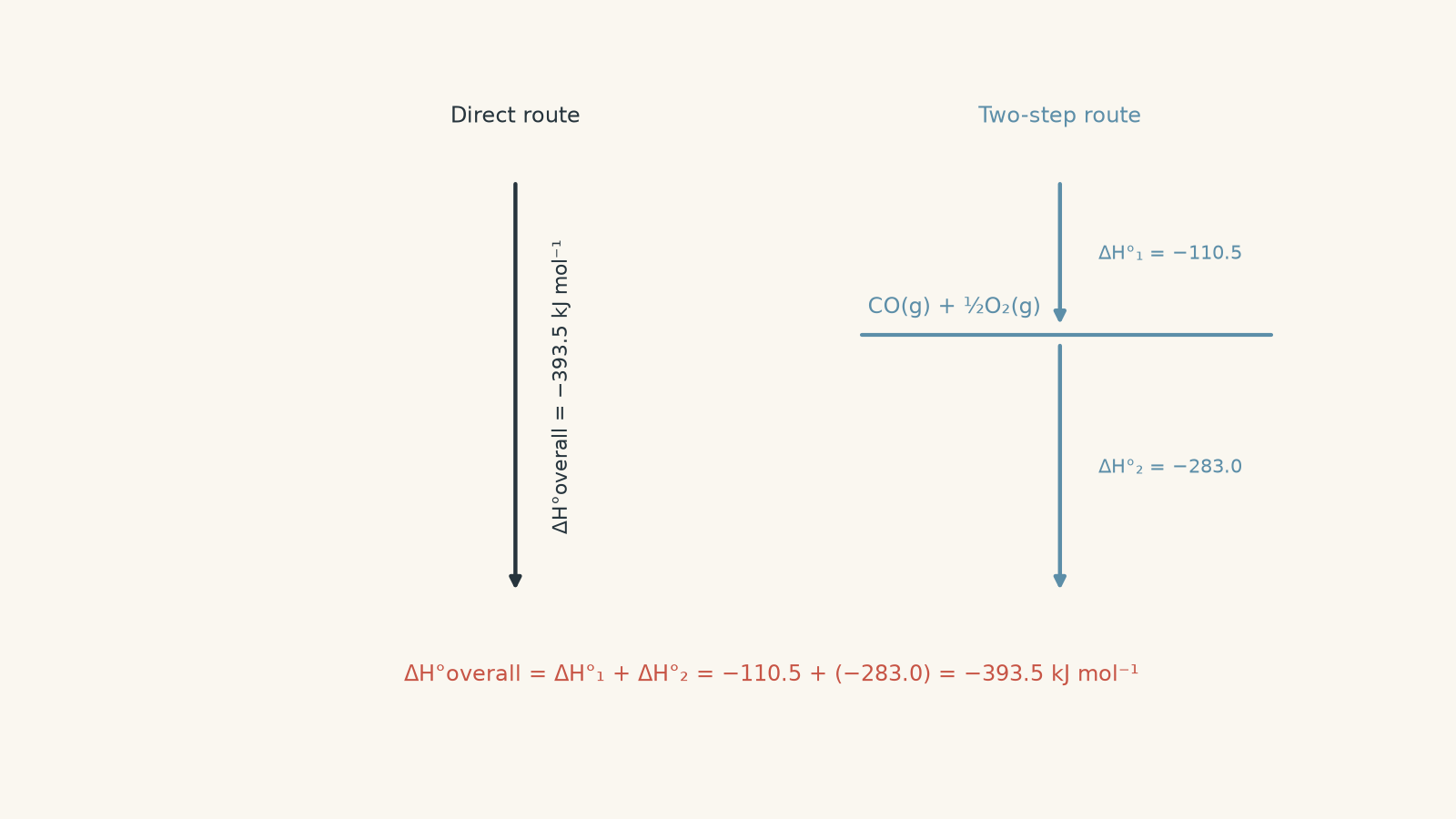
Suppose carbon burns all the way to carbon dioxide. It could get there directly, or it could first form carbon monoxide and then burn again. Would taking the extra step change the total enthalpy change?
It feels as though it might. Two reactions sound like they should release a different amount of energy from one reaction. But if the starting substances and final substances are exactly the same, the total enthalpy change must also be the same. That is the idea behind Hess’s law, and it lets us calculate reaction enthalpies even when the reaction we care about is difficult to measure directly.
01The problem Hess’s law solves
Consider these two routes from carbon to carbon dioxide.
Direct route:
\[
\ce{C(graphite) + O2(g) -> CO2(g)}
\]
Two-step route:
\[
\ce{C(graphite) + \frac{1}{2}O2(g) -> CO(g)}
\]
followed by
\[
\ce{CO(g) + \frac{1}{2}O2(g) -> CO2(g)}
\]
The intermediate \(\ce{CO(g)}\) appears in the middle, but it is not present at the start or the end.
Now imagine walking from the ground floor of a building to level 12. You could take one lift, or stop at levels 4 and 9 on the way. Your route changes, but your final change in height does not.
Enthalpy works in a similar way. The intermediate stages can change, but the difference between the initial and final enthalpy is fixed.
The analogy has a limit. Enthalpy is not literally height, and the mechanism of a chemical reaction involves molecular collisions, bonds, and energy transfer. The useful part of the analogy is only this: the change depends on the endpoints, not on how many intermediate stops you invent.
02Hess’s law comes from a state function
Enthalpy, \(H\), is a state function. That means its value depends on the state of the system, not the path used to reach that state.
For an overall reaction,
\[
\Delta H = H_{\text{products}}-H_{\text{reactants}}
\]
So if a reaction occurs through several steps,
\[
\Delta H^\circ_{\text{overall}}
=
\Delta H^\circ_1+\Delta H^\circ_2+\Delta H^\circ_3+\cdots
\]
The degree symbol means the enthalpy change refers to substances in their specified standard states. Standard enthalpy data are usually quoted at 298 K and a standard pressure of 100 kPa, unless the data state otherwise.
This gives us Hess’s law:
If several chemical equations add to produce a target equation, their enthalpy changes add to produce the enthalpy change of that target equation.
The chemistry is therefore partly an equation-matching problem. Your job is to rearrange the supplied reactions until unwanted substances cancel and the target reaction remains.
03The three operations you need
There are only three mathematical moves.
| What you do to the chemical equation | What you must do to \(\Delta H^\circ\) |
|---|---|
| Reverse the reaction | Reverse the sign |
| Multiply every coefficient by \(n\) | Multiply \(\Delta H^\circ\) by \(n\) |
| Add reactions | Add their \(\Delta H^\circ\) values |
The second rule is easy to forget. If one mole of reaction releases 100 kJ, two identical moles release 200 kJ.
The first rule is even more important. If
\[
\ce{A -> B}
\qquad
\Delta H^\circ=-50\text{ kJ mol}^{-1}
\]
then going backwards requires
\[
\ce{B -> A}
\qquad
\Delta H^\circ=+50\text{ kJ mol}^{-1}
\]
Chemically, you have asked the system to undo the original change. The energy change must therefore reverse too.
Worked example: Finding the enthalpy of carbon monoxide formation
Use the following data to calculate the standard enthalpy change for
\[
\ce{C(graphite) + \frac{1}{2}O2(g) -> CO(g)}
\]
Given:
\[
\ce{C(graphite) + O2(g) -> CO2(g)}
\qquad
\Delta H^\circ=-393.5\text{ kJ mol}^{-1}
\]
\[
\ce{CO(g) + \frac{1}{2}O2(g) -> CO2(g)}
\qquad
\Delta H^\circ=-283.0\text{ kJ mol}^{-1}
\]
Step 1
The target contains \(\ce{CO(g)}\) as a product. In the supplied second reaction, \(\ce{CO(g)}\) is a reactant. So reverse that reaction.
\[
\ce{CO2(g) -> CO(g) + \frac{1}{2}O2(g)}
\qquad
\Delta H^\circ=+283.0\text{ kJ mol}^{-1}
\]
Step 2
\[
\begin{aligned}
\ce{C(graphite) + O2(g)} &\ce{-> CO2(g)} \\
\ce{CO2(g)} &\ce{-> CO(g) + \frac{1}{2}O2(g)}
\end{aligned}
\]
The \(\ce{CO2(g)}\) cancels.
There is also \(\ce{O2(g)}\) on both sides. Cancelling half a mole leaves
\[
\ce{C(graphite) + \frac{1}{2}O2(g) -> CO(g)}
\]
which is exactly the target equation.
Step 3
\[
\Delta H^\circ
=
-393.5+283.0
=
-110.5\text{ kJ mol}^{-1}
\]
So the standard enthalpy change is \(-110.5\text{ kJ mol}^{-1}\).
The negative sign matters. Forming one mole of carbon monoxide from graphite and oxygen, as written, is exothermic.
04Treat chemical states as part of the formula
A very common mistake is cancelling substances because their chemical formulas match.
You may cancel \(\ce{H2O(l)}\) with \(\ce{H2O(l)}\).
You may not cancel \(\ce{H2O(l)}\) with \(\ce{H2O(g)}\).
Liquid water and water vapour have different enthalpies. Changing one into the other requires an enthalpy change, so their states are part of the information.
The same warning applies to allotropes such as \(\ce{C(graphite)}\) and \(\ce{C(diamond)}\). Both are carbon, but they are different states of carbon with different enthalpies.
A reliable habit is to copy the state symbols every time you rearrange an equation. They are not decoration.
05A harder Hess cycle: scale, reverse, then cancel
Sometimes none of the supplied equations resembles the target very closely. That is when students often start guessing signs.
Don’t guess. Work from the species you need.
Worked example: Forming methanol from its combustion data
Calculate \(\Delta H^\circ\) for
\[
\ce{C(graphite) + 2H2(g) + \frac{1}{2}O2(g) -> CH3OH(l)}
\]
using:
\[
\ce{C(graphite) + O2(g) -> CO2(g)}
\qquad
\Delta H^\circ=-393.5\text{ kJ mol}^{-1}
\]
\[
\ce{H2(g) + \frac{1}{2}O2(g) -> H2O(l)}
\qquad
\Delta H^\circ=-285.8\text{ kJ mol}^{-1}
\]
\[
\ce{CH3OH(l) + \frac{3}{2}O2(g) -> CO2(g) + 2H2O(l)}
\qquad
\Delta H^\circ=-726.5\text{ kJ mol}^{-1}
\]
Step 1
The target contains \(2\ce{H2(g)}\), so multiply the hydrogen combustion reaction by 2.
\[
\ce{2H2(g) + O2(g) -> 2H2O(l)}
\qquad
\Delta H^\circ=2(-285.8)=-571.6\text{ kJ mol}^{-1}
\]
Step 2
The combustion equation consumes methanol. The target produces it, so reverse the combustion equation.
\[
\ce{CO2(g) + 2H2O(l) -> CH3OH(l) + \frac{3}{2}O2(g)}
\]
\[
\Delta H^\circ=+726.5\text{ kJ mol}^{-1}
\]
Step 3
\[
\begin{aligned}
\ce{C(graphite) + O2(g)} &\ce{-> CO2(g)}\\
\ce{2H2(g) + O2(g)} &\ce{-> 2H2O(l)}\\
\ce{CO2(g) + 2H2O(l)} &\ce{-> CH3OH(l) + \frac{3}{2}O2(g)}
\end{aligned}
\]
Cancel \(\ce{CO2(g)}\) and \(2\ce{H2O(l)}\).
There are \(2\ce{O2(g)}\) on the left and \(\frac{3}{2}\ce{O2(g)}\) on the right, leaving \(\frac{1}{2}\ce{O2(g)}\) on the left.
The net equation is
\[
\ce{C(graphite) + 2H2(g) + \frac{1}{2}O2(g) -> CH3OH(l)}
\]
Step 4
\[
\begin{aligned}
\Delta H^\circ
&=
-393.5-571.6+726.5\\
&=
-238.6\text{ kJ mol}^{-1}
\end{aligned}
\]
So the formation of one mole of liquid methanol by the target reaction has
\[
\Delta H^\circ=-238.6\text{ kJ mol}^{-1}
\]
The calculation looks longer than the first example, but the logic has not changed. Rearrange equations until they add to the target, then perform the same operations on their enthalpy changes.
06Standard enthalpies of formation are a ready-made Hess cycle
Doing all that cancellation every time would become tedious. Standard enthalpy of formation data package the same Hess-law idea into a useful shortcut.
The standard enthalpy of formation, \(\Delta H_f^\circ\), is the enthalpy change when one mole of a substance forms from its constituent elements in their standard states.
For any reaction,
\[
\Delta H^\circ_{\mathrm{rxn}}
=
\sum \nu\Delta H_f^\circ(\text{products})
–
\sum \nu\Delta H_f^\circ(\text{reactants})
\]
Here, \(\nu\) is the stoichiometric coefficient of each substance.
Think of this as taking every reactant back to the elements, then building every product from those elements. The imaginary intermediate route does not need to happen in reality. Hess’s law allows it because only the initial and final states determine \(\Delta H^\circ\).
For example, consider
\[
\ce{CH4(g) + 2O2(g) -> CO2(g) + 2H2O(l)}
\]
Using the rounded practice data
| Substance | \(\Delta H_f^\circ\) in \(\text{kJ mol}^{-1}\) |
|---|---|
| \(\ce{CH4(g)}\) | \(-74.8\) |
| \(\ce{O2(g)}\) | \(0\) |
| \(\ce{CO2(g)}\) | \(-393.5\) |
| \(\ce{H2O(l)}\) | \(-285.8\) |
we obtain
\[
\begin{aligned}
\Delta H^\circ_{\mathrm{rxn}}
&=
[(-393.5)+2(-285.8)]
–
[(-74.8)+2(0)]\\
&=
-965.1+74.8\\
&=
-890.3\text{ kJ mol}^{-1}
\end{aligned}
\]
So combustion of methane according to the equation releases \(890.3\text{ kJ mol}^{-1}\).
In an HSC question, use the numerical data supplied in the question or approved data source rather than memorising the rounded values used here.
07Why some formation enthalpies are zero
A tempting rule is:
“Elements have zero standard enthalpy of formation.”
That is incomplete.
The correct rule is that an element has \(\Delta H_f^\circ=0\) only when it is in its standard state.
Examples include:
- \(\ce{O2(g)}\) for oxygen,
- \(\ce{H2(g)}\) for hydrogen, and
- \(\ce{C(graphite)}\) for carbon.
But \(\ce{O3(g)}\) is not oxygen’s standard state, and \(\ce{C(diamond)}\) is not carbon’s standard state. Their standard enthalpies of formation are not zero.
That small detail becomes important whenever a question includes phases or allotropes.
08A fast way to organise a Hess’s law problem
Before touching the numbers, write the target reaction at the top of your page.
Then work through this sequence:
- Find a supplied equation containing a useful species.
- Decide which side that species needs to be on.
- Reverse the equation if necessary.
- Match the coefficient by multiplying the whole equation.
- Apply exactly the same operation to \(\Delta H^\circ\).
- Add the equations.
- Cancel only identical species in identical states.
- Check that the surviving equation is exactly the target.
- Only then add the enthalpy values.
This order prevents most sign mistakes.
The important check is step 8. If your equations do not actually reduce to the target reaction, the enthalpy calculation cannot be correct, even if the arithmetic looks neat.
09Hess’s law is not the same as bond enthalpy
Both methods deal with reaction energy, but they use different information.
Hess’s law with measured standard enthalpies compares complete thermodynamic states. If the data are appropriate and internally consistent, the pathway you choose does not alter the overall \(\Delta H\).
Mean bond enthalpies instead estimate the energy required to break and form bonds, usually using average gas-phase values. That method is especially useful for connecting the macroscopic enthalpy change to what is happening at the bonding level, but its values are often approximate.
If you want to connect Hess’s law to that particle-level energy bookkeeping, see Bond Enthalpy and Conservation of Energy in HSC Chemistry.
10The misconception that causes the most trouble
Suppose you reverse this reaction:
\[
\ce{A -> B}
\qquad
\Delta H^\circ=-80\text{ kJ mol}^{-1}
\]
A student may correctly reverse the equation but leave the enthalpy as \(-80\text{ kJ mol}^{-1}\).
Why does that mistake feel plausible? Because \(\Delta H^\circ\) can start to look like a fixed property printed beside a chemical equation.
It is not. It describes a change from one direction to another.
Forwards, the system loses 80 kJ per mole of reaction:
\[
\ce{A -> B}
\]
Backwards, it must gain the same amount:
\[
\ce{B -> A}
\]
so
\[
\Delta H^\circ=+80\text{ kJ mol}^{-1}
\]
A similar mistake happens when coefficients are doubled without doubling \(\Delta H^\circ\). The enthalpy belongs to the amount of reaction represented by the entire equation.
11Questions and solutions
Question 1
Given
\[
\ce{N2(g) + O2(g) -> 2NO(g)}
\qquad
\Delta H^\circ=+180.5\text{ kJ mol}^{-1}
\]
and
\[
\ce{2NO(g) + O2(g) -> 2NO2(g)}
\qquad
\Delta H^\circ=-114.1\text{ kJ mol}^{-1}
\]
calculate \(\Delta H^\circ\) for
\[
\ce{N2(g) + 2O2(g) -> 2NO2(g)}
\]
and state whether the overall reaction is endothermic or exothermic.
Solution 1
The overall enthalpy change is \(+66.4\text{ kJ mol}^{-1}\), so the reaction is endothermic.
The two supplied equations can be added exactly as written:
\[
\begin{aligned}
\ce{N2(g) + O2(g)} &\ce{-> 2NO(g)}\\
\ce{2NO(g) + O2(g)} &\ce{-> 2NO2(g)}
\end{aligned}
\]
The \(2\ce{NO(g)}\) cancels, leaving
\[
\ce{N2(g) + 2O2(g) -> 2NO2(g)}
\]
Therefore,
\[
\begin{aligned}
\Delta H^\circ
&=
(+180.5)+(-114.1)\\
&=
+66.4\text{ kJ mol}^{-1}
\end{aligned}
\]
A tempting mistake is to focus on the second reaction being exothermic and conclude that the overall process must also be exothermic. It does not. The first step requires more energy than the second step releases, leaving a positive overall \(\Delta H^\circ\).
Question 2
Use the following standard enthalpy changes:
\[
\ce{C(graphite) + O2(g) -> CO2(g)}
\qquad
\Delta H^\circ=-393.5\text{ kJ mol}^{-1}
\]
\[
\ce{H2(g) + \frac{1}{2}O2(g) -> H2O(l)}
\qquad
\Delta H^\circ=-285.8\text{ kJ mol}^{-1}
\]
\[
\ce{C2H6(g) + \frac{7}{2}O2(g) -> 2CO2(g) + 3H2O(l)}
\qquad
\Delta H^\circ=-1559.9\text{ kJ mol}^{-1}
\]
Calculate the standard enthalpy change for
\[
\ce{2C(graphite) + 3H2(g) -> C2H6(g)}
\]
Solution 2
The standard enthalpy change is \(-84.5\text{ kJ mol}^{-1}\).
The target requires two carbon atoms, so multiply the carbon combustion reaction by 2:
\[
\ce{2C(graphite) + 2O2(g) -> 2CO2(g)}
\]
\[
\Delta H^\circ=2(-393.5)=-787.0\text{ kJ mol}^{-1}
\]
The target also requires three moles of hydrogen, so multiply the hydrogen combustion equation by 3:
\[
\ce{3H2(g) + \frac{3}{2}O2(g) -> 3H2O(l)}
\]
\[
\Delta H^\circ=3(-285.8)=-857.4\text{ kJ mol}^{-1}
\]
Ethane must be a product in the target, but it is a reactant in its combustion equation. Reverse that equation:
\[
\ce{2CO2(g) + 3H2O(l) -> C2H6(g) + \frac{7}{2}O2(g)}
\]
\[
\Delta H^\circ=+1559.9\text{ kJ mol}^{-1}
\]
Adding the three equations cancels \(\ce{CO2(g)}\), \(\ce{H2O(l)}\), and \(\ce{O2(g)}\), leaving
\[
\ce{2C(graphite) + 3H2(g) -> C2H6(g)}
\]
The enthalpy change is
\[
\begin{aligned}
\Delta H^\circ
&=
-787.0-857.4+1559.9\\
&=
-84.5\text{ kJ mol}^{-1}
\end{aligned}
\]
The tempting route is to add the three quoted enthalpy values immediately. That fails because the chemical equations, as supplied, do not yet add to the target reaction. The ethane equation must first be reversed, and the carbon and hydrogen equations must be scaled.
Question 3
The following reactions occur under standard conditions:
\[
\ce{CH4(g) + H2O(g) -> CO(g) + 3H2(g)}
\qquad
\Delta H^\circ=+206.1\text{ kJ mol}^{-1}
\]
\[
\ce{CO(g) + H2O(g) -> CO2(g) + H2(g)}
\qquad
\Delta H^\circ=-41.2\text{ kJ mol}^{-1}
\]
and
\[
\ce{H2O(l) -> H2O(g)}
\qquad
\Delta H^\circ=+44.0\text{ kJ mol}^{-1}
\]
Calculate:
a. \(\Delta H^\circ\) for
\[
\ce{CH4(g) + 2H2O(g) -> CO2(g) + 4H2(g)}
\]
b. \(\Delta H^\circ\) for
\[
\ce{CH4(g) + 2H2O(l) -> CO2(g) + 4H2(g)}
\]
Solution 3
The answers are \(+164.9\text{ kJ mol}^{-1}\) for part a and \(+252.9\text{ kJ mol}^{-1}\) for part b.
For part a, add the first two equations:
\[
\begin{aligned}
\ce{CH4(g) + H2O(g)} &\ce{-> CO(g) + 3H2(g)}\\
\ce{CO(g) + H2O(g)} &\ce{-> CO2(g) + H2(g)}
\end{aligned}
\]
The \(\ce{CO(g)}\) cancels, giving
\[
\ce{CH4(g) + 2H2O(g) -> CO2(g) + 4H2(g)}
\]
Hence,
\[
\begin{aligned}
\Delta H^\circ
&=
206.1-41.2\\
&=
+164.9\text{ kJ mol}^{-1}
\end{aligned}
\]
For part b, the water begins as liquid rather than vapour. Two moles of liquid water must first be converted into two moles of water vapour:
\[
\ce{2H2O(l) -> 2H2O(g)}
\]
\[
\Delta H^\circ=2(+44.0)=+88.0\text{ kJ mol}^{-1}
\]
Add this to the result from part a:
\[
\begin{aligned}
\Delta H^\circ
&=
164.9+88.0\\
&=
+252.9\text{ kJ mol}^{-1}
\end{aligned}
\]
The trap is to treat \(\ce{H2O(l)}\) and \(\ce{H2O(g)}\) as interchangeable because both are chemically water. They are not the same thermodynamic state. Converting the liquid reactant into vapour requires energy, making the liquid-water version more endothermic.
Question 4
The following combustion data are available:
\[
\ce{C2H4(g) + 3O2(g) -> 2CO2(g) + 2H2O(l)}
\qquad
\Delta H^\circ=-1411.0\text{ kJ mol}^{-1}
\]
\[
\ce{H2(g) + \frac{1}{2}O2(g) -> H2O(l)}
\qquad
\Delta H^\circ=-285.8\text{ kJ mol}^{-1}
\]
\[
\ce{C2H6(g) + \frac{7}{2}O2(g) -> 2CO2(g) + 3H2O(l)}
\qquad
\Delta H^\circ=-1559.9\text{ kJ mol}^{-1}
\]
a. Calculate \(\Delta H^\circ\) for the hydrogenation reaction
\[
\ce{C2H4(g) + H2(g) -> C2H6(g)}
\]
A second data set describes combustion to water vapour:
\[
\ce{C2H4(g) + 3O2(g) -> 2CO2(g) + 2H2O(g)}
\qquad
\Delta H^\circ=-1323.0\text{ kJ mol}^{-1}
\]
\[
\ce{H2(g) + \frac{1}{2}O2(g) -> H2O(g)}
\qquad
\Delta H^\circ=-241.8\text{ kJ mol}^{-1}
\]
\[
\ce{C2H6(g) + \frac{7}{2}O2(g) -> 2CO2(g) + 3H2O(g)}
\qquad
\Delta H^\circ=-1427.9\text{ kJ mol}^{-1}
\]
b. Show that the second data set gives the same hydrogenation enthalpy.
c. A student accidentally uses the first two liquid-water values but reverses the ethane combustion equation from the water-vapour data set. Determine the enthalpy they would calculate, identify the actual net reaction represented by their equations, and explain why their answer is not the hydrogenation enthalpy.
Solution 4
The correct hydrogenation enthalpy is \(-136.9\text{ kJ mol}^{-1}\). Mixing the two data sets produces \(-268.9\text{ kJ mol}^{-1}\), but that value includes condensation of three moles of water and therefore does not describe hydrogenation alone.
For part a, add the combustion of ethene to the combustion of hydrogen:
\[
\ce{C2H4(g) + H2(g) + \frac{7}{2}O2(g) -> 2CO2(g) + 3H2O(l)}
\]
Their combined enthalpy is
\[
-1411.0-285.8=-1696.8\text{ kJ mol}^{-1}
\]
Reverse ethane combustion:
\[
\ce{2CO2(g) + 3H2O(l) -> C2H6(g) + \frac{7}{2}O2(g)}
\]
\[
\Delta H^\circ=+1559.9\text{ kJ mol}^{-1}
\]
Adding gives
\[
\ce{C2H4(g) + H2(g) -> C2H6(g)}
\]
and
\[
\begin{aligned}
\Delta H^\circ
&=
-1696.8+1559.9\\
&=
-136.9\text{ kJ mol}^{-1}
\end{aligned}
\]
For part b, use the water-vapour data consistently:
\[
\begin{aligned}
\Delta H^\circ
&=
-1323.0-241.8+1427.9\\
&=
-136.9\text{ kJ mol}^{-1}
\end{aligned}
\]
The answer is unchanged. That is exactly what Hess’s law predicts: if all equations describe a consistent alternative path between the same initial and final states, the overall enthalpy change must be the same.
For part c, the student’s numerical calculation is
\[
\begin{aligned}
\Delta H^\circ
&=
-1411.0-285.8+1427.9\\
&=
-268.9\text{ kJ mol}^{-1}
\end{aligned}
\]
That arithmetic is not the main error. The equations no longer add to the requested reaction.
The first two reactions produce a total of \(3\ce{H2O(l)}\). Reversed ethane combustion consumes \(3\ce{H2O(g)}\). Those substances cannot cancel.
The true net reaction is
\[
\ce{C2H4(g) + H2(g) + 3H2O(g) -> C2H6(g) + 3H2O(l)}
\]
So the student’s cycle contains two processes:
\[
\ce{C2H4(g) + H2(g) -> C2H6(g)}
\]
and condensation of three moles of water:
\[
\ce{3H2O(g) -> 3H2O(l)}
\]
Using the data above, each mole of condensation releases approximately \(44.0\text{ kJ}\). Three moles therefore contribute
\[
3(-44.0)=-132.0\text{ kJ}
\]
and
\[
-136.9-132.0=-268.9\text{ kJ mol}^{-1}
\]
which exactly explains the student’s result.
The tempting assumption is that matching chemical formulas are enough for cancellation. The constraint that changes the result is the physical state. Hess’s law only works cleanly when you track the complete thermodynamic state of every species.
Question 5
At 298 K, the following data are available:
\[
\ce{C(graphite) + O2(g) -> CO2(g)}
\qquad
\Delta H^\circ=-393.5\text{ kJ mol}^{-1}
\]
\[
\ce{C(diamond) + O2(g) -> CO2(g)}
\qquad
\Delta H^\circ=-395.4\text{ kJ mol}^{-1}
\]
\[
\ce{CO(g) + \frac{1}{2}O2(g) -> CO2(g)}
\qquad
\Delta H^\circ=-283.0\text{ kJ mol}^{-1}
\]
The standard molar entropies of graphite and diamond are approximately
\[
S^\circ_{\ce{graphite}}=5.7\text{ J mol}^{-1}\text{K}^{-1}
\]
and
\[
S^\circ_{\ce{diamond}}=2.4\text{ J mol}^{-1}\text{K}^{-1}
\]
a. Use Hess’s law to determine \(\Delta H^\circ\) for
\[
\ce{C(graphite) -> C(diamond)}
\]
b. Determine \(\Delta H^\circ\) for
\[
\ce{C(diamond) + \frac{1}{2}O2(g) -> CO(g)}
\]
c. A student argues that part a must equal zero because graphite and diamond are both elemental carbon. Explain the error.
d. Calculate \(\Delta G^\circ\) at 298 K for
\[
\ce{C(diamond) -> C(graphite)}
\]
using
\[
\Delta G^\circ=\Delta H^\circ-T\Delta S^\circ
\]
and state what the result does, and does not, tell you about why diamonds can persist.
Solution 5
Graphite to diamond has \(\Delta H^\circ=+1.9\text{ kJ mol}^{-1}\), diamond oxidation to carbon monoxide has \(\Delta H^\circ=-112.4\text{ kJ mol}^{-1}\), and diamond to graphite has \(\Delta G^\circ\approx-2.9\text{ kJ mol}^{-1}\) at 298 K. The key constraints are that only the standard state of an element has \(\Delta H_f^\circ=0\), and thermodynamic favourability does not tell us how quickly a reaction occurs.
For part a, use graphite combustion as written and reverse diamond combustion:
\[
\ce{C(graphite) + O2(g) -> CO2(g)}
\qquad
\Delta H^\circ=-393.5\text{ kJ mol}^{-1}
\]
\[
\ce{CO2(g) -> C(diamond) + O2(g)}
\qquad
\Delta H^\circ=+395.4\text{ kJ mol}^{-1}
\]
Adding and cancelling \(\ce{CO2(g)}\) and \(\ce{O2(g)}\) gives
\[
\ce{C(graphite) -> C(diamond)}
\]
Therefore,
\[
\begin{aligned}
\Delta H^\circ
&=
-393.5+395.4\\
&=
+1.9\text{ kJ mol}^{-1}
\end{aligned}
\]
Diamond therefore lies slightly higher in enthalpy than graphite.
For part b, use diamond combustion and reverse carbon monoxide combustion:
\[
\ce{C(diamond) + O2(g) -> CO2(g)}
\qquad
\Delta H^\circ=-395.4\text{ kJ mol}^{-1}
\]
\[
\ce{CO2(g) -> CO(g) + \frac{1}{2}O2(g)}
\qquad
\Delta H^\circ=+283.0\text{ kJ mol}^{-1}
\]
Adding them leaves
\[
\ce{C(diamond) + \frac{1}{2}O2(g) -> CO(g)}
\]
so
\[
\begin{aligned}
\Delta H^\circ
&=
-395.4+283.0\\
&=
-112.4\text{ kJ mol}^{-1}
\end{aligned}
\]
For part c, the student’s rule is incomplete. The standard enthalpy of formation is zero only for an element in its standard state.
Graphite is the standard state of carbon under these conditions, so
\[
\Delta H_f^\circ[\ce{C(graphite)}]=0
\]
Diamond is another allotrope. From part a,
\[
\Delta H_f^\circ[\ce{C(diamond)}]=+1.9\text{ kJ mol}^{-1}
\]
The fact that both substances contain only carbon atoms does not make their thermodynamic states identical.
For part d, reverse the result from part a:
\[
\ce{C(diamond) -> C(graphite)}
\]
so
\[
\Delta H^\circ=-1.9\text{ kJ mol}^{-1}
\]
The entropy change is
\[
\begin{aligned}
\Delta S^\circ
&=
S^\circ_{\ce{graphite}}-S^\circ_{\ce{diamond}}\\
&=
5.7-2.4\\
&=
+3.3\text{ J mol}^{-1}\text{K}^{-1}
\end{aligned}
\]
Convert this to kilojoules:
\[
\Delta S^\circ=0.0033\text{ kJ mol}^{-1}\text{K}^{-1}
\]
At \(T=298\text{ K}\),
\[
\begin{aligned}
\Delta G^\circ
&=
\Delta H^\circ-T\Delta S^\circ\\
&=
-1.9-(298)(0.0033)\\
&=
-1.9-0.98\\
&\approx
-2.9\text{ kJ mol}^{-1}
\end{aligned}
\]
The negative \(\Delta G^\circ\) means conversion from diamond to graphite is thermodynamically favourable under these standard conditions.
It does not mean the conversion must be fast.
That is the final trap. Hess’s law tells us about enthalpy differences between states. Gibbs free energy helps decide thermodynamic favourability. Neither calculation, by itself, gives the reaction rate. Diamond can persist because conversion to graphite faces a very large kinetic barrier.
That distinction is the useful next step after Hess’s law: once you can calculate \(\Delta H^\circ\) reliably, you can combine it with entropy to determine \(\Delta G^\circ\), while keeping a separate question in mind – even if a reaction is thermodynamically allowed, can it actually proceed at a significant rate?