
Raoult’s Law: Calculating Vapour Pressure in Ideal Mixtures
Learn how Raoult's law connects liquid composition to vapour pressure in ideal mixtures. This extension guide explains partial pressures, vapour composition, and vapour-pressure calculations through worked examples and challenging practice questions.
A sealed flask contains equal moles of two miscible liquids, A and B, at a constant temperature. Pure A has a vapour pressure of 80 kPa, while pure B has a vapour pressure of 20 kPa.
Would you expect the vapour above the mixture to contain equal amounts of A and B?
No. For an ideal mixture, A contributes a partial pressure of 40 kPa and B contributes 10 kPa. The resulting vapour is 80% A and 20% B, even though the liquid is 50% A and 50% B.
This difference between liquid composition and vapour composition is the central idea behind Raoult’s law. It allows us to predict the vapour pressure of a liquid mixture using the mole fractions of its components and the vapour pressures of the pure substances.
Syllabus note: Raoult’s law is extension material beyond the required Year 11 Chemistry 2025 syllabus. It is not a required assessment topic. Year 11 Quantitative chemistry provides the prerequisite knowledge, particularly mole calculations, mole fractions, and the ideal gas equation \(PV=nRT\). NESA’s 2025 Chemistry syllabus is scheduled for implementation from 2028.
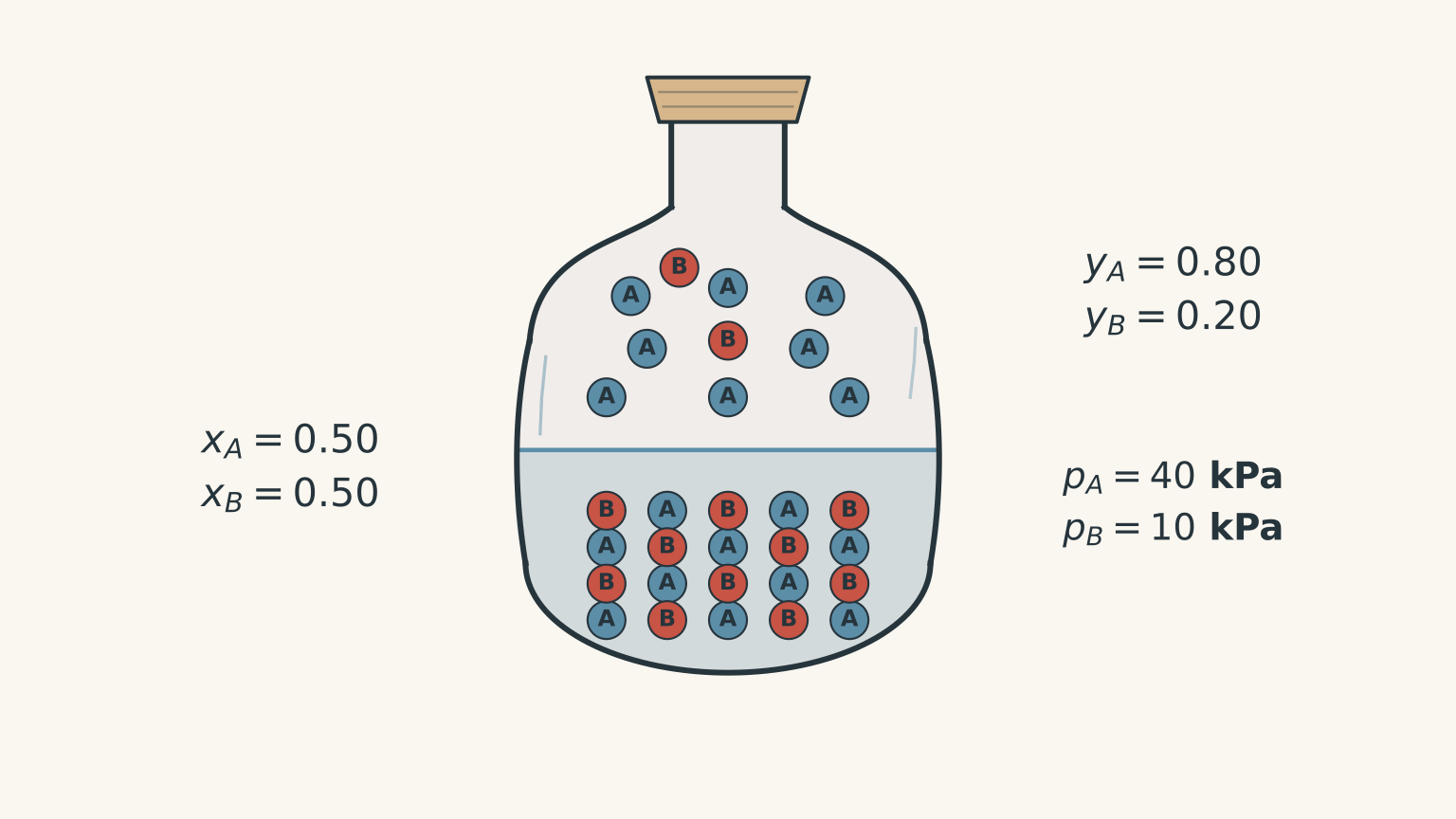
Due to technical limitations, this figure may display incorrectly or contain inaccuracies. Please check key details against your course materials.
01Why vapour pressure depends on liquid composition
Start with the ideal gas model
In Year 11 Quantitative chemistry, you learn to manipulate the ideal gas equation:
\[ PV=nRT \]
where:
- \(P\) is gas pressure, measured in pascals or kilopascals
- \(V\) is gas volume, measured in litres or cubic metres
- \(n\) is the amount of gas, measured in moles
- \(R\) is the ideal gas constant
- \(T\) is absolute temperature, measured in kelvin.
This equation describes the relationship between the pressure, volume, temperature, and amount of an ideal gas. You can use it to calculate the amount of gas present under standard temperature and pressure (STP), or under other specified conditions.
Now imagine a liquid inside a sealed container.
Some liquid molecules escape into the space above the liquid. At the same time, some gas molecules return to the liquid through condensation.
Eventually, the system reaches dynamic equilibrium. The rates of evaporation and condensation become equal, and the pressure of the vapour remains constant.
This is the equilibrium vapour pressure.
When the liquid contains two volatile substances, both can enter the vapour phase. Each contributes to the pressure above the liquid.
We need a way to calculate how much pressure each substance contributes.
Two different mole fractions
Before introducing Raoult’s law, we need to distinguish two quantities that are easy to confuse.
The first is the mole fraction in the liquid.
For a mixture containing A and B:
\[ x_A=\frac{n_A}{n_A+n_B} \]
Here:
- \(x_A\) is the mole fraction of A in the liquid
- \(n_A\) is the amount of A in moles
- \(n_B\) is the amount of B in moles.
The mole fraction tells us what proportion of the liquid’s total amount is made up of a particular component.
For a binary mixture:
\[ x_A+x_B=1 \]
If a liquid contains 2 mol of A and 3 mol of B, for example:
\[ x_A=\frac{2}{2+3}=0.40 \]
\[ x_B=\frac{3}{2+3}=0.60 \]
A makes up 40% of the liquid on a mole basis.
The second quantity is the mole fraction in the vapour.
We use \(y_A\) and \(y_B\) to represent the mole fractions of A and B in the gas phase.
For a binary vapour mixture:
\[ y_A+y_B=1 \]
These two types of mole fraction describe different phases.
| Symbol | Meaning |
|---|---|
| \(x_A\) | Mole fraction of A in the liquid |
| \(x_B\) | Mole fraction of B in the liquid |
| \(y_A\) | Mole fraction of A in the vapour |
| \(y_B\) | Mole fraction of B in the vapour |
| \(P_A^\ast\) | Vapour pressure of pure liquid A |
| \(p_A\) | Partial pressure of A above the mixture |
The asterisk in \(P_A^\ast\) indicates the vapour pressure of the pure substance, rather than its partial pressure in a mixture.
One important detail: mole fractions are calculated using moles, not masses. If a question provides masses, convert them into moles before calculating the liquid composition.
02Raoult’s law
The relationship between liquid composition and vapour pressure
Consider two volatile liquids, A and B, that form an ideal solution.
An ideal solution is a mixture in which the intermolecular interactions between different molecules are sufficiently similar to those between molecules of the same substance.
In other words, A-B attractions are approximately comparable to A-A and B-B attractions.
Under this assumption, each component’s partial vapour pressure is proportional to its mole fraction in the liquid.
This relationship is Raoult’s law:
\[ \boxed{p_A=x_A P_A^\ast} \]
For component B:
\[ \boxed{p_B=x_B P_B^\ast} \]
Here:
- \(p_A\) and \(p_B\) are the partial vapour pressures of A and B
- \(x_A\) and \(x_B\) are their liquid mole fractions
- \(P_A^\ast\) and \(P_B^\ast\) are their pure-substance vapour pressures at the same temperature.
Notice that the equation uses the liquid mole fraction, not the vapour mole fraction.
This is the key distinction.
A component’s partial pressure depends on how much of that component is present in the liquid and how readily the pure substance produces vapour at that temperature.
Calculating total vapour pressure
Once we know the partial pressures, calculating the total vapour pressure is straightforward.
Dalton’s law of partial pressures states that the total pressure of an ideal gas mixture is the sum of the partial pressures of its components.
Therefore:
\[ P_{\text{total}}=p_A+p_B \]
Substituting Raoult’s law:
\[ \boxed{ P_{\text{total}}= x_A P_A^\ast+x_B P_B^\ast } \]
This is the equation you will use most often when calculating the total vapour pressure of an ideal binary liquid mixture.
Because \(x_A+x_B=1\), we can also write:
\[ P_{\text{total}}= x_A P_A^\ast+(1-x_A)P_B^\ast \]
This equation shows that the total vapour pressure changes linearly with the liquid mole fraction of A when the temperature remains constant.
Why the vapour composition is different from the liquid composition
Return to our original question.
Suppose the liquid contains equal mole fractions of A and B:
\[ x_A=x_B=0.50 \]
However, the pure vapour pressures are different:
\[ P_A^\ast=80\text{ kPa} \]
\[ P_B^\ast=20\text{ kPa} \]
Using Raoult’s law:
\[ p_A=0.50\times80=40\text{ kPa} \]
\[ p_B=0.50\times20=10\text{ kPa} \]
The total pressure is:
\[ P_{\text{total}}=40+10=50\text{ kPa} \]
We can now calculate the mole fraction of A in the vapour.
The partial pressure of A represents its contribution to the total gas pressure:
\[ y_A=\frac{p_A}{P_{\text{total}}} \]
Therefore:
\[ y_A=\frac{40}{50}=0.80 \]
Similarly:
\[ y_B=\frac{10}{50}=0.20 \]
The liquid contains 50% A, but the vapour contains 80% A.
Why?
A has a higher pure-substance vapour pressure. At the same temperature, pure A produces a greater equilibrium vapour pressure than pure B.
Consequently, A is enriched in the vapour phase.
We describe A as being more volatile than B.
The important point is that the more volatile substance does not need to be the majority component in the liquid to become the majority component in the vapour.
The general equation for the vapour mole fraction of A is:
\[ \boxed{ y_A= \frac{x_A P_A^\ast} {x_A P_A^\ast+x_B P_B^\ast} } \]
This combines Raoult’s law with Dalton’s law.
It is particularly useful when a question asks for the composition of the vapour rather than just its total pressure.
03Worked examples
Worked example: Calculate the vapour pressure of an ideal mixture
An ideal liquid mixture contains 30% A and 70% B by mole. At the specified temperature, the pure vapour pressure of A is 100 kPa and the pure vapour pressure of B is 40 kPa.
Calculate the partial vapour pressure of each component, the total vapour pressure, and the mole fractions of A and B in the vapour.
Step 1
\[ x_A=0.30,\qquad x_B=0.70 \]
\[ P_A^\ast=100\text{ kPa} \]
\[ P_B^\ast=40\text{ kPa} \]
Step 2
\[ p_A=x_A P_A^\ast \]
\[ p_A=0.30\times100 \]
\[ p_A=30.0\text{ kPa} \]
Step 3
\[ p_B=x_B P_B^\ast \]
\[ p_B=0.70\times40 \]
\[ p_B=28.0\text{ kPa} \]
Step 4
Using Dalton’s law:
\[ P_{\text{total}}=p_A+p_B \]
\[ P_{\text{total}}=30.0+28.0 \]
\[ \boxed{P_{\text{total}}=58.0\text{ kPa}} \]
Step 5
For A:
\[ y_A=\frac{30.0}{58.0}=0.517 \]
For B:
\[ y_B=\frac{28.0}{58.0}=0.483 \]
Final result:
| Quantity | A | B |
|---|---|---|
| Liquid mole fraction | 0.300 | 0.700 |
| Partial pressure | 30.0 kPa | 28.0 kPa |
| Vapour mole fraction | 0.517 | 0.483 |
Although A makes up only 30% of the liquid, it makes up approximately 51.7% of the vapour.
This happens because A has a considerably higher pure-substance vapour pressure than B.
Worked example: Calculate vapour pressure using component masses
An ideal liquid mixture is prepared using 23.0 g of A and 60.0 g of B.
Their molar masses are:
- A: 46.0 g mol\(^{-1}\)
- B: 60.0 g mol\(^{-1}\).
At the specified temperature, the pure vapour pressures are:
- A: 90.0 kPa
- B: 30.0 kPa.
Calculate the total vapour pressure and the mole fraction of A in the vapour.
Step 1
Use:
\[ n=\frac{m}{M} \]
where \(m\) is mass and \(M\) is molar mass.
For A:
\[ n_A=\frac{23.0}{46.0} =0.500\text{ mol} \]
For B:
\[ n_B=\frac{60.0}{60.0} =1.00\text{ mol} \]
Step 2
The total amount is:
\[ n_{\text{total}}=0.500+1.00 =1.50\text{ mol} \]
Therefore:
\[ x_A=\frac{0.500}{1.50}=0.333 \]
\[ x_B=\frac{1.00}{1.50}=0.667 \]
Notice that although the masses were not equal, we can now express the composition of the liquid on a mole basis.
Step 3
For A:
\[ p_A=0.333\times90.0 \]
\[ p_A=30.0\text{ kPa} \]
For B:
\[ p_B=0.667\times30.0 \]
\[ p_B=20.0\text{ kPa} \]
Step 4
\[ P_{\text{total}}=30.0+20.0 \]
\[ \boxed{P_{\text{total}}=50.0\text{ kPa}} \]
Step 5
\[ y_A=\frac{p_A}{P_{\text{total}}} \]
\[ y_A=\frac{30.0}{50.0} \]
\[ \boxed{y_A=0.600} \]
The vapour contains 60.0% A, even though the liquid contains only 33.3% A.
The more volatile component becomes enriched in the vapour.
This example demonstrates an important calculation sequence:
- Convert masses into moles.
- Calculate liquid mole fractions.
- Apply Raoult’s law to find partial pressures.
- Add the partial pressures to find total pressure.
- Divide each partial pressure by the total pressure to find vapour composition.
04What happens when a component does not evaporate?
So far, we have considered two volatile liquids. Both components contribute to the vapour above the solution.
However, what happens when we dissolve a substance that has a negligible vapour pressure?
Consider adding a nonvolatile substance C to a liquid mixture containing A and B.
A nonvolatile substance has a pure-substance vapour pressure that is approximately zero under the specified conditions.
Mathematically:
\[ P_C^\ast\approx0 \]
Applying Raoult’s law:
\[ p_C=x_C P_C^\ast\approx0 \]
Therefore, C contributes almost nothing to the total vapour pressure.
However, C still counts when calculating the liquid mole fractions.
For a mixture containing A, B, and C:
\[ x_A+x_B+x_C=1 \]
The total vapour pressure becomes:
\[ P_{\text{total}}= x_A P_A^\ast+x_B P_B^\ast \]
Notice that the mole fractions of A and B are now calculated using the total number of moles of all three substances.
You cannot simply calculate the mole fractions of A and B as though C were absent.
This is an important distinction when working with nonvolatile solutes.
Why adding a nonvolatile solute lowers vapour pressure
Imagine a solution containing water and a dissolved nonvolatile substance.
Before the solute is added, the liquid mole fraction of water is 1.00.
After adding the solute, the mole fraction of water decreases.
According to Raoult’s law:
\[ p_{\text{water}}= x_{\text{water}}P_{\text{water}}^\ast \]
Since the pure water vapour pressure remains constant at a fixed temperature, decreasing the water mole fraction decreases its partial vapour pressure.
This is the basis of vapour-pressure lowering, which connects to the broader topic of colligative properties.
It also helps explain why adding a nonvolatile solute can increase the boiling point of a solvent.
There is an interesting extra result when two volatile substances are present alongside a nonvolatile solute.
If the ratio of A to B in the liquid remains unchanged, adding C decreases both partial pressures by the same proportional factor.
The total pressure decreases, but the ratio of A to B in the vapour remains unchanged.
We will use this idea in the practice questions.
05When does Raoult’s law work?
Raoult’s law is a model, not a universal rule for every liquid mixture.
It works most accurately when the components form an ideal solution.
This generally requires the intermolecular attractions between unlike molecules to be similar to those between like molecules.
For example, benzene and toluene form a mixture that behaves approximately ideally under suitable conditions because their molecular properties and intermolecular interactions are similar.
However, consider two substances whose molecules attract each other much more strongly than they attract molecules of their own type.
Their tendency to escape into the vapour phase may decrease when they are mixed.
The actual vapour pressure can then be lower than the value predicted by Raoult’s law.
This is called a negative deviation from Raoult’s law.
The opposite can also occur.
If unlike molecules attract each other less strongly than like molecules, molecules may escape into the vapour phase more readily than predicted.
The actual vapour pressure is then higher than the ideal prediction.
This is called a positive deviation.
The practical lesson is simple: do not automatically apply Raoult’s law to every mixture of liquids.
Check whether the question specifies an ideal solution or provides experimental data that support the assumption.
Other important assumptions include:
- The components form one homogeneous liquid phase.
- The temperature remains constant.
- The pure-component vapour pressures are measured at that same temperature.
- The vapour behaves approximately as an ideal gas.
- No chemical reaction changes the identities of the components.
If these conditions are not satisfied, the calculated result may not accurately represent the real mixture.
06An application: Distillation
Raoult’s law helps explain why distillation can separate liquid mixtures.
Suppose a liquid mixture contains two volatile substances, A and B, and A is more volatile.
We know that A has a higher pure-substance vapour pressure than B.
At equilibrium, the vapour above the liquid will therefore contain a greater mole fraction of A than the original liquid does.
If this vapour is collected and condensed, the resulting liquid is enriched in A.
This is the basic principle behind distillation.
Repeated vaporisation and condensation can further separate components with different volatilities. Industrial fractional distillation uses this principle to separate complex liquid mixtures, including petroleum fractions.
Raoult’s law is therefore useful beyond calculating a pressure.
It connects liquid composition to vapour composition and helps explain how separation processes work.
07A reliable method for Raoult’s law calculations
When approaching a quantitative question, use this sequence.
| Step | What to do |
|---|---|
| 1 | Identify the components and check whether the mixture is ideal. |
| 2 | Convert any given masses into moles. |
| 3 | Calculate each liquid mole fraction using all liquid components. |
| 4 | Find each partial pressure using \(p_i=x_iP_i^\ast\). |
| 5 | Add the partial pressures to calculate total pressure. |
| 6 | Calculate vapour mole fractions using \(y_i=p_i/P_{\text{total}}\). |
If the question also provides the volume of the vapour space and asks for the amount of gas present, you can return to the ideal gas equation:
\[ n_{\text{vapour}}= \frac{P_{\text{total}}V}{RT} \]
For an individual component:
\[ n_A=\frac{p_AV}{RT} \]
This is where your Year 11 ideal gas knowledge becomes useful again.
Raoult’s law determines the equilibrium partial pressures from the liquid composition. The ideal gas equation can then determine how many moles of vapour occupy a known volume.
One model describes the liquid-to-vapour relationship; the other describes the gas itself.
08Questions and solutions
The following questions progress from standard calculations to more demanding problems involving multiple components and phase compositions.
Question 1
An ideal liquid mixture contains 25% A and 75% B by mole.
At a constant temperature, the pure vapour pressures are:
- A: 100 kPa
- B: 40 kPa.
Calculate:
a) The partial pressure of each component.
b) The total vapour pressure.
c) The mole fraction of A and B in the vapour.
Solution 1
The partial pressures are 25 kPa for A and 30 kPa for B. The total vapour pressure is 55 kPa, and the vapour contains approximately 45.5% A and 54.5% B.
Step 1: Identify the liquid mole fractions.
\[ x_A=0.25,\qquad x_B=0.75 \]
Step 2: Calculate the partial pressures using Raoult’s law.
For A:
\[ p_A=0.25\times100 \]
\[ p_A=25\text{ kPa} \]
For B:
\[ p_B=0.75\times40 \]
\[ p_B=30\text{ kPa} \]
Step 3: Calculate the total pressure.
\[ P_{\text{total}}=25+30 \]
\[ \boxed{P_{\text{total}}=55\text{ kPa}} \]
Step 4: Calculate the vapour mole fractions.
For A:
\[ y_A=\frac{25}{55}=0.455 \]
For B:
\[ y_B=\frac{30}{55}=0.545 \]
Therefore:
\[ \boxed{y_A=0.455,\qquad y_B=0.545} \]
Although A is more volatile, B still makes up the majority of the vapour.
This is because B is present in a much greater proportion in the liquid.
However, A is enriched in the vapour: its mole fraction increases from 0.25 in the liquid to approximately 0.455 in the vapour.
Question 2
An ideal binary liquid mixture contains volatile components A and B.
At a particular temperature, their pure vapour pressures are:
\[ P_A^\ast=100\text{ kPa} \]
\[ P_B^\ast=40\text{ kPa} \]
The measured total vapour pressure above the mixture is 64 kPa.
Calculate:
a) The liquid mole fraction of A.
b) The liquid mole fraction of B.
c) The partial pressure of each component.
d) The vapour mole fraction of A.
A student suggests that the mole fraction of A must be 0.64 because the total pressure is 64 kPa and the pure vapour pressure of A is 100 kPa.
Explain why this reasoning is incorrect.
Solution 2
The liquid mole fraction of A is 0.400, not 0.640. The liquid mole fraction of B is 0.600, and the vapour contains 62.5% A.
Step 1: Write the total pressure equation.
\[ P_{\text{total}}= x_A P_A^\ast+x_B P_B^\ast \]
Because the mixture is binary:
\[ x_B=1-x_A \]
Substitute:
\[ 64=100x_A+40(1-x_A) \]
Step 2: Expand and simplify.
\[ 64=100x_A+40-40x_A \]
\[ 24=60x_A \]
\[ \boxed{x_A=0.400} \]
Step 3: Calculate the mole fraction of B.
\[ x_B=1-0.400 \]
\[ \boxed{x_B=0.600} \]
Step 4: Calculate the partial pressures.
For A:
\[ p_A=0.400\times100 \]
\[ p_A=40\text{ kPa} \]
For B:
\[ p_B=0.600\times40 \]
\[ p_B=24\text{ kPa} \]
Check:
\[ 40+24=64\text{ kPa} \]
Step 5: Calculate the vapour mole fraction of A.
\[ y_A=\frac{40}{64} \]
\[ \boxed{y_A=0.625} \]
The student’s mistake is treating the total pressure as though it were the partial pressure of A.
The total pressure includes contributions from both components. You must account for B before determining the liquid composition.
This is why the total pressure equation must be written as the sum of the individual partial pressures.
Question 3
Two volatile substances, A and B, form an ideal binary solution.
At a fixed temperature:
\[ P_A^\ast=100\text{ kPa} \]
\[ P_B^\ast=25\text{ kPa} \]
A student argues:
“The vapour can contain more than 50% A only if the original liquid contains more than 50% A.”
Is this statement correct?
Consider a liquid containing 30% A and 70% B by mole.
a) Calculate the partial pressures and the vapour mole fraction of A.
b) Explain why the student’s prediction is incorrect.
c) Explain whether a more volatile component is always enriched in the vapour for an ideal binary mixture.
Solution 3
The statement is incorrect. A liquid containing only 30% A produces a vapour containing approximately 63.2% A. More generally, if A has a higher pure vapour pressure than B, its vapour mole fraction is greater than its liquid mole fraction for every non-pure binary composition.
Step 1: Calculate the partial pressure of A.
\[ p_A=0.30\times100 \]
\[ p_A=30.0\text{ kPa} \]
Step 2: Calculate the partial pressure of B.
\[ p_B=0.70\times25 \]
\[ p_B=17.5\text{ kPa} \]
Step 3: Calculate the total vapour pressure.
\[ P_{\text{total}}=30.0+17.5 \]
\[ P_{\text{total}}=47.5\text{ kPa} \]
Step 4: Calculate the vapour mole fraction of A.
\[ y_A=\frac{30.0}{47.5} \]
\[ \boxed{y_A=0.632} \]
A makes up approximately 63.2% of the vapour, despite representing only 30% of the liquid.
Step 5: Explain the general relationship.
For an ideal binary solution:
\[ y_A= \frac{x_A P_A^\ast} {x_A P_A^\ast+(1-x_A)P_B^\ast} \]
Subtracting the liquid mole fraction gives:
\[ y_A-x_A= \frac{x_A(1-x_A)(P_A^\ast-P_B^\ast)} {P_{\text{total}}} \]
For any mixture containing both components:
\[ 0<x_A<1 \]
If A is more volatile:
\[ P_A^\ast>P_B^\ast \]
Every term in the numerator is therefore positive, and the denominator is also positive.
Consequently:
\[ \boxed{y_A>x_A} \]
This proves that A is enriched in the vapour for every non-pure composition.
However, enrichment does not necessarily mean that A makes up more than 50% of the vapour. That depends on both the liquid composition and the relative pure vapour pressures.
The student’s mistake is confusing enrichment with majority composition.
Question 4
An ideal liquid solution contains three components:
- 0.20 mol of volatile A
- 0.30 mol of volatile B
- 0.50 mol of nonvolatile C.
At a constant temperature:
\[ P_A^\ast=100\text{ kPa} \]
\[ P_B^\ast=40\text{ kPa} \]
Assume the pure vapour pressure of C is negligible.
a) Calculate the liquid mole fractions of all three components.
b) Calculate the partial pressures of A and B and the total vapour pressure.
c) Calculate the mole fraction of A in the vapour.
d) An additional 1.00 mol of C is dissolved in the mixture. No A or B is lost. Calculate the new total vapour pressure and vapour mole fraction of A.
e) Explain why the total pressure changes but the vapour composition does not.
Solution 4
Initially, the total vapour pressure is 32 kPa and the vapour mole fraction of A is 0.625. After adding 1.00 mol of C, the total pressure falls to 16 kPa, but the vapour mole fraction of A remains 0.625.
Step 1: Calculate the initial total number of moles.
\[ n_{\text{total}}=0.20+0.30+0.50 \]
\[ n_{\text{total}}=1.00\text{ mol} \]
Step 2: Calculate the liquid mole fractions.
For A:
\[ x_A=\frac{0.20}{1.00}=0.20 \]
For B:
\[ x_B=\frac{0.30}{1.00}=0.30 \]
For C:
\[ x_C=\frac{0.50}{1.00}=0.50 \]
Check:
\[ 0.20+0.30+0.50=1.00 \]
Step 3: Calculate the partial pressures.
C is nonvolatile, so its contribution is negligible.
For A:
\[ p_A=0.20\times100=20\text{ kPa} \]
For B:
\[ p_B=0.30\times40=12\text{ kPa} \]
Step 4: Calculate the total pressure.
\[ P_{\text{total}}=20+12 \]
\[ \boxed{P_{\text{total}}=32\text{ kPa}} \]
Step 5: Calculate the initial vapour composition.
\[ y_A=\frac{20}{32} \]
\[ \boxed{y_A=0.625} \]
Step 6: Account for the additional nonvolatile C.
The new amount of C is:
\[ n_C=0.50+1.00=1.50\text{ mol} \]
The new total amount is:
\[ n_{\text{total}}=0.20+0.30+1.50 \]
\[ n_{\text{total}}=2.00\text{ mol} \]
The new liquid mole fractions are:
\[ x_A=\frac{0.20}{2.00}=0.10 \]
\[ x_B=\frac{0.30}{2.00}=0.15 \]
\[ x_C=\frac{1.50}{2.00}=0.75 \]
Step 7: Recalculate the partial pressures.
For A:
\[ p_A=0.10\times100=10\text{ kPa} \]
For B:
\[ p_B=0.15\times40=6\text{ kPa} \]
Therefore:
\[ \boxed{P_{\text{total}}=10+6=16\text{ kPa}} \]
Step 8: Recalculate the vapour composition.
\[ y_A=\frac{10}{16} \]
\[ \boxed{y_A=0.625} \]
The vapour composition has not changed.
Why?
Adding C has reduced the liquid mole fractions of both A and B by the same proportional factor.
Their partial pressures have both halved:
- A decreases from 20 kPa to 10 kPa.
- B decreases from 12 kPa to 6 kPa.
The ratio between their partial pressures remains unchanged:
\[ \frac{20}{12}=\frac{10}{6} \]
Therefore, their relative proportions in the vapour remain the same.
This is a useful result: adding a nonvolatile component can lower the total vapour pressure without changing the relative composition of the vapour produced by the remaining volatile components, provided their liquid mole ratio is unchanged and the ideal-solution assumptions hold.
Question 5
An ideal liquid solution contains three components:
- A, which is volatile
- B, which is volatile
- C, which is effectively nonvolatile.
At a fixed temperature, the pure vapour pressures of A and B are:
\[ P_A^\ast=100\text{ kPa} \]
\[ P_B^\ast=40\text{ kPa} \]
The equilibrium vapour above the solution has:
\[ P_{\text{total}}=64.0\text{ kPa} \]
and
\[ y_A=0.78125 \]
Assume the vapour behaves as an ideal gas and the liquid forms one homogeneous ideal solution.
a) Calculate the partial pressures of A and B.
b) Determine the liquid mole fractions \(x_A\), \(x_B\), and \(x_C\).
c) A second solution at the same temperature has exactly the same total vapour pressure. Construct a different valid liquid composition that produces this same total pressure but a different vapour composition.
d) Explain why knowing the total vapour pressure alone is insufficient to determine the liquid composition when a nonvolatile third component is present. Explain why this problem would be different if the mixture contained only A and B.
Solution 5
The liquid mole fractions are \(x_A=0.50\), \(x_B=0.35\), and \(x_C=0.15\). A different valid composition, \(x_A=0.40\), \(x_B=0.60\), and \(x_C=0\), produces the same total vapour pressure but a different vapour composition.
The key is to use the measured vapour composition to recover the partial pressures before applying Raoult’s law.
Step 1: Calculate the partial pressure of A.
The vapour mole fraction is related to partial pressure through Dalton’s law:
\[ y_A=\frac{p_A}{P_{\text{total}}} \]
Rearranging:
\[ p_A=y_A P_{\text{total}} \]
Substitute:
\[ p_A=0.78125\times64.0 \]
\[ \boxed{p_A=50.0\text{ kPa}} \]
Step 2: Calculate the partial pressure of B.
Since C is nonvolatile, the vapour contains only A and B.
Therefore:
\[ P_{\text{total}}=p_A+p_B \]
Rearranging:
\[ p_B=64.0-50.0 \]
\[ \boxed{p_B=14.0\text{ kPa}} \]
Step 3: Calculate the liquid mole fraction of A.
Apply Raoult’s law:
\[ p_A=x_A P_A^\ast \]
Rearrange:
\[ x_A=\frac{p_A}{P_A^\ast} \]
Substitute:
\[ x_A=\frac{50.0}{100} \]
\[ \boxed{x_A=0.50} \]
Step 4: Calculate the liquid mole fraction of B.
\[ x_B=\frac{p_B}{P_B^\ast} \]
\[ x_B=\frac{14.0}{40} \]
\[ \boxed{x_B=0.35} \]
Step 5: Determine the liquid mole fraction of C.
All three liquid mole fractions must add to one:
\[ x_A+x_B+x_C=1 \]
Therefore:
\[ x_C=1-0.50-0.35 \]
\[ \boxed{x_C=0.15} \]
The original liquid composition is:
| Component | Liquid mole fraction |
|---|---|
| A | 0.50 |
| B | 0.35 |
| C | 0.15 |
| Total | 1.00 |
Step 6: Construct a different liquid composition with the same total pressure.
Consider a binary mixture containing:
\[ x_A=0.40,\qquad x_B=0.60 \]
and no C.
Its partial pressures would be:
\[ p_A=0.40\times100=40\text{ kPa} \]
\[ p_B=0.60\times40=24\text{ kPa} \]
Therefore:
\[ P_{\text{total}}=40+24 \]
\[ \boxed{P_{\text{total}}=64\text{ kPa}} \]
This is exactly the same total pressure as the original solution.
However, its vapour composition is:
\[ y_A=\frac{40}{64} \]
\[ \boxed{y_A=0.625} \]
Compare the two solutions:
| Quantity | Original solution | Alternative solution |
|---|---|---|
| \(x_A\) | 0.50 | 0.40 |
| \(x_B\) | 0.35 | 0.60 |
| \(x_C\) | 0.15 | 0 |
| Total pressure | 64 kPa | 64 kPa |
| \(y_A\) | 0.78125 | 0.625 |
Both solutions have the same total vapour pressure, but their liquid compositions and vapour compositions are different.
Step 7: Explain why total pressure alone is insufficient.
For a binary mixture containing only A and B:
\[ x_A+x_B=1 \]
The total pressure equation becomes:
\[ P_{\text{total}}= x_A P_A^\ast+(1-x_A)P_B^\ast \]
There is only one unknown liquid mole fraction. If the two pure vapour pressures are different, the total pressure uniquely determines the liquid composition.
However, when C is added:
\[ x_A+x_B+x_C=1 \]
Because C is nonvolatile, the total pressure is still:
\[ P_{\text{total}}= x_A P_A^\ast+x_B P_B^\ast \]
There are now two unknown volatile-component mole fractions.
One pressure measurement provides only one independent equation. It cannot uniquely determine both \(x_A\) and \(x_B\).
The additional vapour composition measurement provides the missing information.
The tempting mistake is to assume that the vapour mole fraction of A is also its liquid mole fraction. They are not interchangeable:
\[ y_A=0.78125 \]
but:
\[ x_A=0.50 \]
The vapour composition tells us how the gas is distributed. Raoult’s law then allows us to work backwards to the liquid composition.
This is the conceptual difference between knowing the total pressure of a binary mixture and reconstructing the composition of a mixture containing a nonvolatile third component.
09Where to go next
Raoult’s law connects the composition of a liquid to the pressure and composition of the vapour above it.
Once you can distinguish liquid mole fractions from vapour mole fractions, you can start investigating what happens when dissolved substances change the vapour pressure of a solvent.
That leads directly into colligative properties, including boiling point elevation and freezing point depression.
The important connection is that these effects are not isolated rules. They follow from how dissolved particles change the behaviour of a liquid and its equilibrium with the vapour phase.
10Further reading
- OpenStax: Chemistry – Colligative Properties – mole fractions, vapour-pressure lowering, Raoult’s law, and distillation.
- Chemistry LibreTexts: Ideal Solutions – Raoult’s Law – ideal solutions, partial pressures, and deviations from Raoult’s law.
- NESA: Chemistry 11-12 Syllabus (2025) – official NSW Chemistry syllabus information.