
Atom Economy: Formula, Calculations and Percentage Yield
Learn to calculate atom economy, compare synthesis routes, and distinguish theoretical atom efficiency from percentage yield in this chemistry extension guide.
Two chemical reactions can produce the same substance, yet send very different amounts of their starting material into unwanted products.
Consider ethanol. Fermenting glucose produces ethanol and carbon dioxide. Reacting ethene with water produces ethanol without a second product in the balanced equation. Both reactions conserve mass, so which one makes better use of its starting atoms?
The ethene reaction has the higher theoretical efficiency. Every atom from its reactants ends up in ethanol. During fermentation, some carbon and oxygen atoms end up in carbon dioxide instead.
Atom economy measures this difference. It tells us how much of the material entering a chemical reaction could theoretically become the product we actually want.
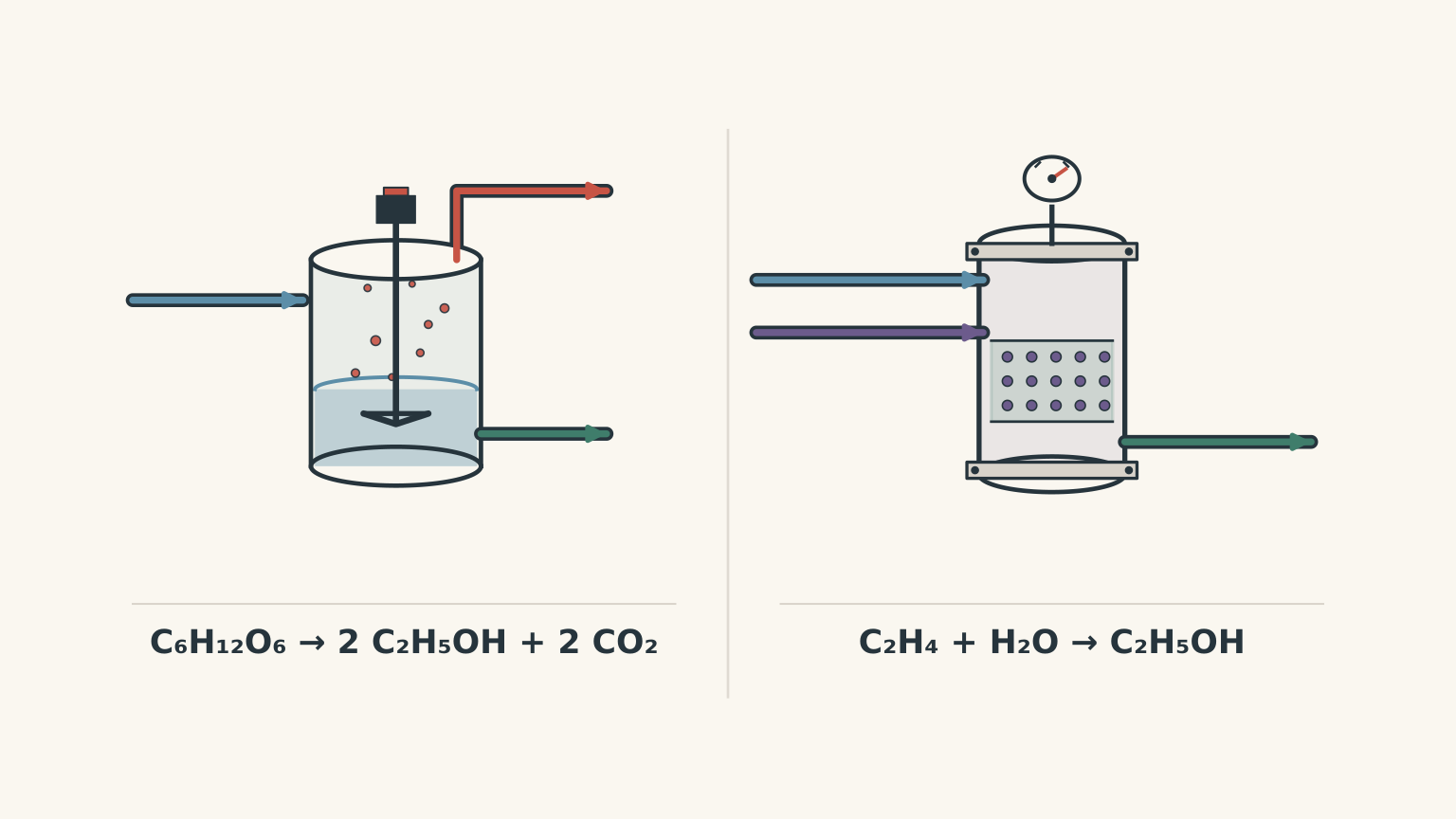
Due to technical limitations, this figure may display incorrectly or contain inaccuracies. Please check key details against your course materials.
Atom economy is an extension beyond the required content of the NSW Chemistry 11-12 Syllabus (2025). The syllabus is scheduled for implementation from 2028. Its Year 11 Quantitative chemistry focus provides the prerequisites, but atom economy itself is not a required syllabus calculation.
You can understand it using ideas you already know: relative atomic mass, the mole, balanced equations, and conservation of mass.
01Start with carbon-12: how do we measure the mass of atoms?
A carbon atom is much heavier than a hydrogen atom. But both are so small that measuring their masses in grams would give inconveniently tiny numbers.
Chemists use a reference instead.
The relative atomic mass, \(A_r\), of an element compares the average mass of one of its atoms with one-twelfth of the mass of a carbon-12 atom.
Carbon-12 is an isotope containing six protons and six neutrons. A carbon-12 atom has a relative atomic mass of exactly 12 on this scale.
For the calculations in this article, we’ll use these rounded values:
| Element | Symbol | Relative atomic mass |
|---|---|---|
| Hydrogen | H | 1 |
| Carbon | C | 12 |
| Oxygen | O | 16 |
| Sodium | Na | 23 |
| Calcium | Ca | 40 |
| Iron | Fe | 56 |
| Bromine | Br | 80 |
Relative atomic mass has no units because it is a ratio. The values on the periodic table are generally averages that account for naturally occurring isotopes, which is why ordinary carbon has a relative atomic mass of approximately 12.01 rather than exactly 12.
From atomic mass to molar mass
Suppose you have ethanol, \(\ce{C2H6O}\).
One molecule contains two carbon atoms, six hydrogen atoms, and one oxygen atom.
Its molar mass is:
\[ \begin{aligned} M(\ce{C2H6O}) &=2(12)+6(1)+16\\ &=46\ \mathrm{g\,mol^{-1}} \end{aligned} \]
Here, \(M\) means molar mass, measured in grams per mole.
One mole of ethanol therefore has a mass of approximately 46 g.
This is the bridge between the atomic scale and the practical scale. By adding relative atomic masses, you can calculate how much a mole of a substance weighs.
Atom economy uses that same calculation to compare the masses of different substances in a reaction.
02Why conserving mass isn’t the same as using atoms efficiently
Consider the balanced equation for glucose fermentation:
\[ \ce{C6H12O6 -> 2C2H6O + 2CO2} \]
Before calculating, predict what happens to the six carbon atoms in glucose.
Do all six finish in ethanol?
No. Each ethanol molecule contains two carbon atoms, so the two ethanol molecules contain four altogether. The remaining two carbon atoms finish in carbon dioxide.
Nothing has disappeared. The atoms have simply been rearranged into different products.
If you’d like to refresh that foundation, see our guide to the rearrangement of atoms in chemical reactions.
Now account for the masses.
One mole of glucose has a molar mass of:
\[ \begin{aligned} M(\ce{C6H12O6}) &=6(12)+12(1)+6(16)\\ &=180\ \mathrm{g\,mol^{-1}} \end{aligned} \]
The products are:
- Two moles of ethanol: \(2\times46=92\ \mathrm{g}\).
- Two moles of carbon dioxide: \(2\times44=88\ \mathrm{g}\).
The total product mass is \(92+88=180\ \mathrm{g}\), exactly matching the starting glucose mass.
But if ethanol is the only substance we want, just 92 g out of the original 180 g becomes the target product.
That’s the key distinction:
Conservation of mass accounts for every product. Atom economy accounts for the fraction ending up in the desired product.
A useful mental model is building something with LEGO bricks. You start with a pile of pieces and construct the object you want, but some pieces end up in a second, unwanted build.
The limitation is that atoms aren’t identical bricks. Oxygen atoms contribute much more mass than hydrogen atoms, and chemical bonding restricts how atoms can rearrange. So the useful fraction must be calculated by mass, not simply by counting atoms.
03The atom economy formula
For a balanced chemical reaction:
\[ \mathrm{AE} =\frac{m_{\mathrm{target}}} {m_{\mathrm{in}}}\times100\% \]
Where:
- \(\mathrm{AE}\) is the percentage atom economy.
- \(m_{\mathrm{target}}\) is the theoretical mass of the desired product, in grams.
- \(m_{\mathrm{in}}\) is the total mass of the stoichiometrically required reactants, in grams.
Both masses must refer to the same amount of reaction, as specified by the balanced equation.
Atom economy is theoretical. It assumes the intended reaction occurs exactly as written, with no competing reactions or losses. It counts the reactants consumed according to the equation, not extra quantities of unused reactants.
The result must lie between 0% and 100%.
In a complete, balanced equation, conservation of mass also means you can use the total mass of all products as the denominator. Both methods give the same answer.
What does 100% atom economy mean?
Consider the hydration of ethene:
\[ \ce{C2H4 + H2O -> C2H6O} \]
The masses are:
- Ethene: \(28\ \mathrm{g\,mol^{-1}}\).
- Water: \(18\ \mathrm{g\,mol^{-1}}\).
- Ethanol: \(46\ \mathrm{g\,mol^{-1}}\).
Therefore:
\[ \mathrm{AE} =\frac{46}{28+18}\times100\% =100\% \]
Every atom from the stoichiometric reactants appears in ethanol.
Compare that with glucose fermentation:
\[ \mathrm{AE} =\frac{2(46)}{180}\times100\% =51.1\% \]
Both routes make ethanol, but their balanced equations have very different theoretical incorporation rates.
That doesn’t automatically make hydration the environmentally preferable process. Ethene and glucose can have different sources, and the processes may require different amounts of energy, equipment, and other materials.
Atom economy answers one specific question about the reaction equation. It is not a complete environmental assessment.
04Worked example: How efficiently can iron be extracted?
In a simplified industrial reduction reaction, iron(III) oxide reacts with carbon monoxide to produce iron and carbon dioxide:
\[ \ce{Fe2O3 + 3CO -> 2Fe + 3CO2} \]
Calculate the percentage atom economy if iron is the desired product.
Step 1
The target is iron, \(\ce{Fe}\), not carbon dioxide.
The balanced equation produces two moles of iron for every mole of iron(III) oxide consumed.
Step 2
For iron(III) oxide:
\[ M(\ce{Fe2O3}) =2(56)+3(16) =160\ \mathrm{g\,mol^{-1}} \]
For carbon monoxide:
\[ M(\ce{CO}) =12+16 =28\ \mathrm{g\,mol^{-1}} \]
The coefficient of 3 in front of carbon monoxide matters. Three moles are consumed, not one.
The total reactant mass for the equation as written is:
\[ m_{\mathrm{in}} =160+3(28) =244\ \mathrm{g} \]
Step 3
Two moles of iron have a mass of:
\[ m_{\mathrm{target}}=2(56)=112\ \mathrm{g} \]
Step 4
\[ \begin{aligned} \mathrm{AE} &=\frac{112}{244}\times100\%\\ &=45.9\% \end{aligned} \]
The theoretical atom economy is 45.9%.
For every 244 g of reactants consumed in the ideal reaction, 112 g becomes iron.
What happens to the remaining mass?
The reaction produces three moles of carbon dioxide:
\[ m(\ce{CO2})=3(44)=132\ \mathrm{g} \]
And \(112+132=244\ \mathrm{g}\), confirming conservation of mass.
The process might recover essentially all the iron that the equation predicts, yet still have an atom economy below 50%. A high percentage yield cannot eliminate the carbon dioxide required by that particular equation.
05How to calculate the atom economy of a synthesis route
A synthesis route is a sequence of reactions used to make a final product.
The complication is that a chemical produced in one step may be consumed in the next. You must not count that intermediate as fresh material entering the whole route.
The simplest method is to write the balanced equations, add them together, and cancel substances that are produced and later consumed in equal amounts.
Then calculate atom economy from the overall equation.
Worked example: Which route to ethanol has better atom economy?
A proposed two-step route converts ethene into ethanol through the intermediate bromoethane.
The reactions are:
Step A:
\[ \ce{C2H4 + HBr -> C2H5Br} \]
Step B:
\[ \ce{C2H5Br + NaOH -> C2H6O + NaBr} \]
Calculate the atom economy of the complete route, then compare it with direct hydration of ethene.
Assume both routes behave ideally according to their stated equations.
Step 1
Bromoethane is produced in Step A and consumed in Step B.
It cancels from the overall reaction:
\[ \ce{C2H4 + HBr + NaOH} \]
\[ \ce{-> C2H6O + NaBr} \]
This is the net equation for the route.
Step 2
Ethene:
\[ M(\ce{C2H4})=2(12)+4(1)=28 \]
Hydrogen bromide:
\[ M(\ce{HBr})=1+80=81 \]
Sodium hydroxide:
\[ M(\ce{NaOH})=23+16+1=40 \]
Each molar mass is in \(\mathrm{g\,mol^{-1}}\).
The total reactant mass for the net equation is:
\[ m_{\mathrm{in}}=28+81+40=149\ \mathrm{g} \]
Step 3
The route produces one mole of ethanol, with a mass of 46 g.
Therefore:
\[ \begin{aligned} \mathrm{AE} &=\frac{46}{149}\times100\%\\ &=30.9\% \end{aligned} \]
The remaining \(149-46=103\ \mathrm{g}\) appears as sodium bromide, \(\ce{NaBr}\).
Step 4
The direct route is:
\[ \ce{C2H4 + H2O -> C2H6O} \]
Its atom economy is:
\[ \mathrm{AE} =\frac{46}{28+18}\times100\% =100\% \]
Direct hydration has a higher theoretical atom economy: 100%, compared with 30.9% for the two-step route.
The useful insight is not merely that fewer steps are better. It’s that the two-step route uses hydrogen bromide and sodium hydroxide but sends much of their mass into sodium bromide rather than ethanol.
The intermediate bromoethane must not be added to the reactant mass a second time. It is already accounted for through the external materials used to produce it.
This is a theoretical comparison, not a practical recommendation for carrying out either synthesis.
06Atom economy versus percentage yield
Here’s a tempting mistake: assuming a reaction with 100% atom economy must produce 100% of its expected product.
It doesn’t.
Atom economy describes how the balanced equation distributes reactant mass among products.
Percentage yield describes how much desired product you actually obtain compared with the theoretical amount.
\[ \mathrm{Yield} =\frac{m_{\mathrm{isolated}}} {m_{\mathrm{theoretical}}}\times100\% \]
Here, \(m_{\mathrm{isolated}}\) is the mass of product collected, and \(m_{\mathrm{theoretical}}\) is the maximum product mass predicted from the supplied reactants.
Suppose the hydration of ethene could theoretically produce 46.0 g of ethanol, but only 29.9 g is isolated.
Its percentage yield is:
\[ \frac{29.9}{46.0}\times100\%=65.0\% \]
Its atom economy remains 100%, because the balanced equation hasn’t changed.
The missing product could be associated with unreacted materials, competing reactions, or recovery losses. Without information about the actual process, you cannot determine exactly where that mass went.
What atom economy cannot tell you
Two reactions can have the same atom economy but very different environmental impacts.
Atom economy does not directly measure:
- Percentage yield or how completely reactants are converted.
- Extra reactants supplied beyond the required stoichiometric quantities.
- Solvents, washing liquids, and separation materials that are not included as consumed reactants in the equation.
- Energy demand, hazards, toxicity, or the origins of raw materials.
- Whether unwanted co-products can be recovered and put to useful purposes.
A catalyst is not normally counted as a consumed reactant if it is regenerated in the net reaction. Real catalysts may still need replacement or recovery, creating costs and waste outside this simple calculation.
This is why the American Chemical Society’s green chemistry principles treat atom economy as one important part of designing more efficient chemical processes, rather than as a complete measure of sustainability.
The most useful approach is to calculate atom economy first, then investigate actual yield, material recovery, and the wider process.
07Questions and solutions
Question 1
Calcium oxide, commonly called quicklime, can be produced by the thermal decomposition of calcium carbonate:
\[ \ce{CaCO3 -> CaO + CO2} \]
Calculate the percentage atom economy when calcium oxide is the desired product.
Explain why the reaction cannot have 100% atom economy for calcium oxide, even though mass is conserved.
Solution 1
The atom economy is 56%. The remaining 44% of the theoretical reactant mass becomes carbon dioxide rather than calcium oxide.
First, calculate the molar masses:
\[ \begin{aligned} M(\ce{CaCO3})&=40+12+3(16)\\ &=100\ \mathrm{g\,mol^{-1}}\\ M(\ce{CaO})&=40+16\\ &=56\ \mathrm{g\,mol^{-1}} \end{aligned} \]
There is one mole of calcium carbonate and one mole of calcium oxide in the balanced equation.
Therefore:
\[ \mathrm{AE} =\frac{56}{100}\times100\% =56\% \]
The other product, carbon dioxide, has a molar mass of 44 g mol\(^{-1}\). The masses add to \(56+44=100\ \mathrm{g}\).
The tempting argument is that a perfectly balanced reaction should have perfect atom economy. But balancing only guarantees conservation of mass. It doesn’t guarantee all the mass finishes in the particular product we want.
Question 2
A manufacturer heats sodium hydrogen carbonate to produce sodium carbonate:
\[ \ce{2NaHCO3 -> Na2CO3 + CO2 + H2O} \]
Initially, only sodium carbonate is sold. Later, another company agrees to buy the carbon dioxide as well.
In practice, the manufacturer recovers 75% of the carbon dioxide produced. Assume all the sodium carbonate is collected and the reaction proceeds completely as written.
(a) Calculate the theoretical atom economy when sodium