
Chemical Oxygen Demand: How COD Is Measured and Calculated
Explore how chemical oxygen demand (COD) measures oxidisable material in wastewater using dichromate oxidation. Learn the experimental method, oxygen-equivalent calculations, titration techniques, and how to interpret COD results through worked examples and challenging questions.
Two wastewater samples can look almost identical but have very different effects on the oxygen available in a river. One might contain relatively little oxidisable material, while the other could consume large amounts of oxygen as its contaminants break down.
How could a laboratory compare the two without identifying and measuring every chemical in each sample?
One approach is to deliberately oxidise the material in each water sample using a known amount of a chemical oxidising agent. By measuring how much oxidising agent is consumed, we can calculate an equivalent amount of oxygen. This measurement is called chemical oxygen demand (COD).
This article is an extension beyond the required NSW HSC Chemistry syllabus. Year 11 quantitative chemistry provides the prerequisite knowledge, particularly calculating moles from measured quantities and applying stoichiometric ratios. COD itself is not a required HSC assessment topic.
01Why measure chemical oxygen demand?
Consider what happens when organic material enters a river.
Microorganisms break down much of this material through biological reactions. These reactions use dissolved oxygen from the water. If the oxygen consumption is greater than the rate at which oxygen is replenished, dissolved oxygen levels fall, potentially harming aquatic organisms.
A laboratory therefore needs a way to estimate how much oxygen a wastewater sample could demand.
One possible approach is to measure biological oxygen demand.
Biochemical oxygen demand (BOD) measures the amount of dissolved oxygen consumed by microorganisms as they break down material in a water sample over a specified period. A commonly used measurement is \(BOD_5\), which records oxygen consumption over five days.
Five days is a long time to wait when a wastewater treatment plant needs to monitor changing conditions.
Chemical oxygen demand provides a faster alternative. Instead of waiting for microorganisms to break down the sample, the laboratory uses a chemical oxidising agent to oxidise susceptible substances under controlled conditions.
A COD determination commonly takes a few hours rather than five days.
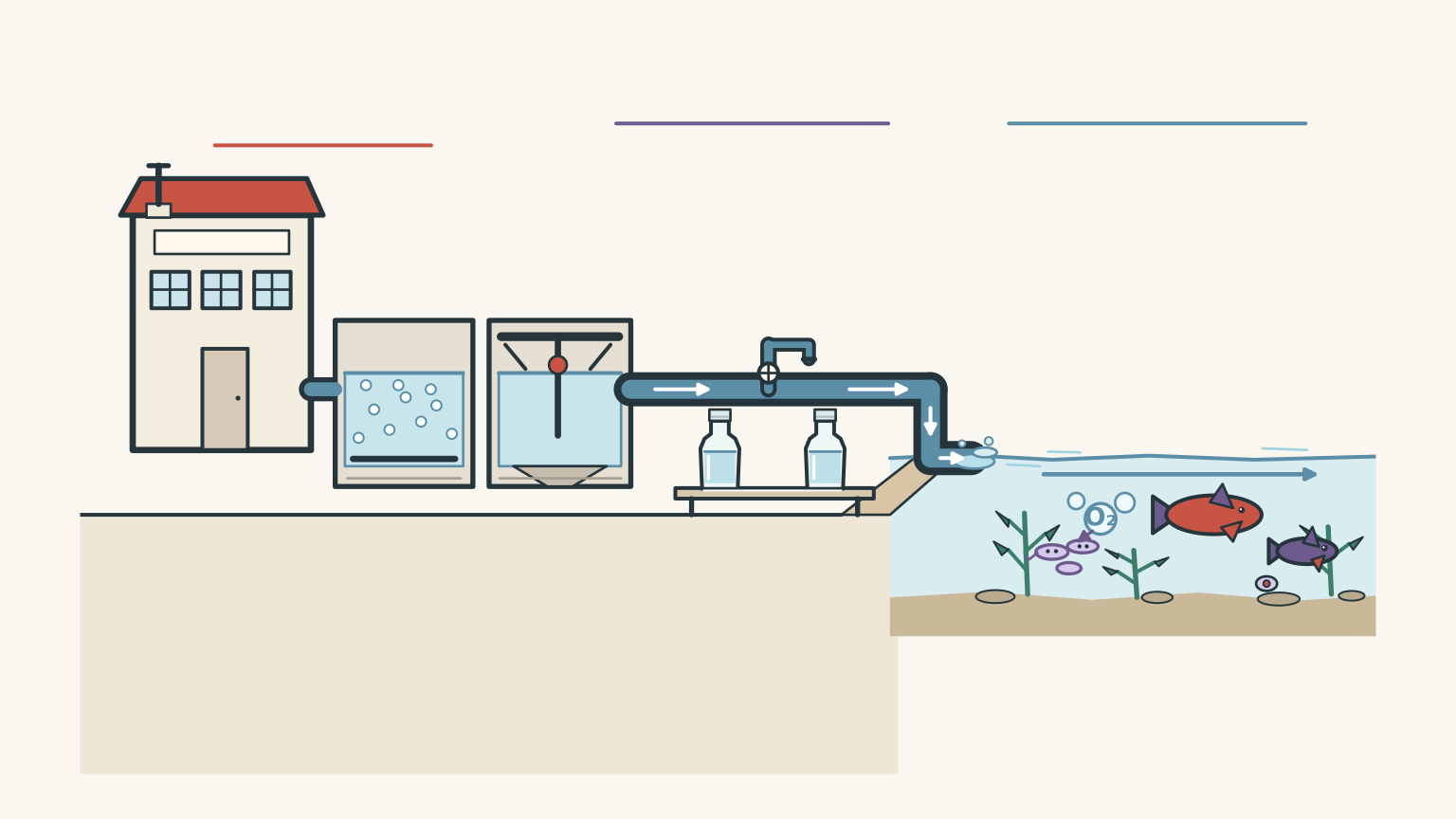
Due to technical limitations, this figure may display incorrectly or contain inaccuracies. Please check key details against your course materials.
COD and BOD measure different things
Before going further, predict this:
If a sample has a high COD, must it also have a high BOD?
Not necessarily.
The difference is the type of oxidation taking place.
| Measurement | What happens | What it indicates |
|---|---|---|
| BOD₅ | Microorganisms consume dissolved oxygen while breaking down material over five days. | Oxygen demand associated with biological decomposition under the test conditions. |
| COD | A chemical oxidising agent reacts with oxidisable substances under specified laboratory conditions. | The oxygen-equivalent amount of chemical oxidation. |
COD is often higher than BOD₅ because a chemical oxidising agent can react with substances that microorganisms cannot readily break down.
For example, a wastewater sample might contain an organic compound that microorganisms struggle to decompose. The compound could still react with the chemical oxidising agent used in a COD test.
Consequently, the COD could be relatively high while the BOD₅ remains comparatively low.
The two measurements are related, but they are not interchangeable. A relationship between COD and BOD₅ established for one wastewater stream cannot automatically be applied to another.
The FAO’s wastewater characterisation guide discusses this distinction and the use of both measurements in wastewater treatment.
02How the COD measurement developed
The measurement problem was not simply finding an oxidising agent. It was finding a method that produced a useful, repeatable estimate of oxidisable material.
Earlier methods used potassium permanganate as the oxidising agent. However, methods based on different oxidants do not necessarily oxidise the same range of compounds.
Research into dichromate-based methods led to the reflux approach described by W. A. Moore, R. C. Kroner, and C. C. Ruchhoft in 1949.
The dichromate method subsequently became the standard approach in many water-quality applications, replacing permanganate as the standard method around 1965.
The historical development is documented in the review Chemical Oxygen Demand: Historical Perspectives and Future Challenges.
The important experimental idea was to use a known excess of a strong oxidising agent, allow it to react with the sample under controlled conditions, and then measure how much remained.
This turns a complicated mixture of unknown substances into a measurable quantity.
03The dichromate reflux experiment
The most useful way to understand the experiment is to follow the chemicals through the apparatus.
Potassium dichromate, \(\ce{K2Cr2O7}\), supplies dichromate ions, \(\mathrm{Cr_{2}O_{7}}^{2-}\), which act as the oxidising agent.
The reaction takes place in a strongly acidic solution containing sulphuric acid. Silver sulphate is included as a catalyst to help oxidise certain organic compounds, particularly some aliphatic compounds.
A typical titrimetric reflux apparatus has the following arrangement:
- At the bottom: A heat-resistant flask contains a measured volume of wastewater and a known excess of potassium dichromate in the acidic reaction mixture.
- Above the flask: A water-cooled condenser is connected vertically to the flask.
- Through the condenser: Cooling water enters through the lower connection and leaves through the upper connection.
- During heating: Vapour rises from the reaction flask, cools inside the condenser, and returns to the flask as liquid.
This arrangement is called a reflux system.
The purpose of reflux is to maintain the reaction at an elevated temperature while reducing the loss of liquid and volatile substances.
The mixture is heated for a fixed period, commonly two hours in the conventional dichromate method.
What should happen during the reaction?
Suppose the wastewater contains organic substances that can be oxidised by dichromate.
These substances act as reducing agents because they donate electrons to the dichromate ions.
Dichromate accepts those electrons and is reduced to chromium(III) ions.
The dichromate ions are orange, while chromium(III) ions produce a green colour in the reaction mixture.
As more dichromate is consumed, more chromium(III) is produced.
What would you expect if the wastewater contained more oxidisable material?
It should consume more dichromate, producing more chromium(III). Less dichromate should remain after digestion.
This is the central observation behind the COD method.
However, colour alone is not sufficiently reliable for a quantitative result. The remaining dichromate must be measured.
Why is a blank necessary?
A laboratory also prepares a blank.
The blank contains the same reagents and undergoes the same treatment as the wastewater sample, but distilled or deionised water replaces the wastewater.
The blank provides a reference for the amount of dichromate initially available and helps account for background effects from the reagents and apparatus.
Compare the two experiments:
| Observation | Blank | Wastewater sample |
|---|---|---|
| Oxidisable material from wastewater | Absent | Present |
| Dichromate initially added | Known amount | Same known amount |
| Dichromate consumed | Ideally negligible | Depends on the sample |
| Dichromate remaining | Greater amount | Smaller amount |
The difference between the blank and sample tells us how much oxidising capacity was consumed by the wastewater.
This comparison is much more useful than simply looking at the final colour.
04Converting dichromate consumption into oxygen equivalents
Here is where your Year 11 quantitative chemistry becomes useful.
In a typical stoichiometry problem, you might measure the mass of a reactant, calculate its number of moles, and use a balanced chemical equation to determine the amount of product formed.
COD uses the same basic reasoning.
The difference is that we use electron transfer to establish the stoichiometric relationship between dichromate and oxygen.
Step 1: Understand the dichromate reduction
In acidic solution, the dichromate half-equation is:
\[ \ce{Cr2O7^2- + 14H+ + 6e- -> 2Cr^3+ + 7H2O} \]
One mole of dichromate ions accepts six moles of electrons.
The dichromate ion is therefore reduced because it gains electrons.
Step 2: Establish the equivalent reaction for oxygen
When oxygen is reduced to water in acidic solution, its half-equation is:
\[ \ce{O2 + 4H+ + 4e- -> 2H2O} \]
One mole of oxygen molecules accepts four moles of electrons.
Notice the difference:
- One mole of dichromate accepts 6 mol of electrons.
- One mole of oxygen accepts 4 mol of electrons.
Both oxidising agents can therefore be compared using the number of electrons they accept.
Step 3: Establish the mole ratio
For every mole of dichromate consumed, six moles of electrons are accepted.
For every mole of oxygen equivalent, four moles of electrons are accepted.
Therefore:
\[ 6\text{ mol }e^- = 1.5\text{ mol }O_2 \]
This gives the relationship:
\[ \boxed{ n(O_2)_{\text{equivalent}} = 1.5n(\mathrm{Cr_{2}O_{7}}^{2-}) } \]
Here:
- \(n(O_2)_{\text{equivalent}}\) is the amount of oxygen, in moles, with the same electron-accepting capacity.
- \(n(\mathrm{Cr_{2}O_{7}}^{2-})\) is the amount of dichromate consumed, in moles.
- The factor 1.5 comes from the ratio of six electrons to four electrons.
This is an oxidant-equivalent calculation.
We are not measuring oxygen gas directly. We are calculating how much oxygen would be required to accept the same number of electrons.
One mole of dichromate consumed is equivalent to:
\[ 1.5 \times 32.00 = 48.00\text{ g} \]
of oxygen.
The molar mass of oxygen gas, \(\ce{O2}\), is \(32.00\text{ g mol}^{-1}\).
Why the oxygen equivalent depends on the substance
Consider glucose.
If glucose undergoes complete oxidation to carbon dioxide and water, its balanced equation is:
\[ \ce{C6H12O6 + 6O2 -> 6CO2 + 6H2O} \]
One mole of glucose requires six moles of oxygen.
This means 180.16 g of glucose has a theoretical oxygen demand of 192.00 g.
The oxygen demand per gram of glucose is therefore approximately:
\[ \frac{192.00}{180.16} = 1.07\text{ g O}_2/\text{g glucose} \]
Now compare ethanol:
\[ \ce{C2H5OH + 3O2 -> 2CO2 + 3H2O} \]
One mole of ethanol requires three moles of oxygen.
Its theoretical oxygen demand is:
\[ \frac{96.00}{46.07} = 2.08\text{ g O}_2/\text{g ethanol} \]
The same mass of ethanol therefore has almost twice the theoretical oxygen demand of glucose.
This answers our earlier prediction: equal masses of different compounds do not necessarily have equal oxygen demands.
The difference comes from their chemical compositions and oxidation states.
These calculations assume complete oxidation to the stated products. An actual COD test is an operational measurement, so not every compound necessarily reacts completely under the prescribed conditions.
Worked example: Calculate COD from dichromate consumption
A laboratory analyses a 25.0 mL wastewater sample. It initially contains \(1.50 \times 10^{-3}\) mol of dichromate ions.
After digestion, a calibrated measurement shows that \(1.10 \times 10^{-3}\) mol of dichromate remains.
Calculate the COD of the wastewater in mg/L.
Step 1
The initial amount was greater than the final amount.
\[ n_{\text{consumed}} = n_{\text{initial}}-n_{\text{remaining}} \]
\[ =1.50\times10^{-3} -1.10\times10^{-3} \]
\[ =4.00\times10^{-4}\text{ mol} \]
Step 2
Use the electron-equivalent relationship:
\[ n(O_2)_{\text{equivalent}} = 1.5n(\mathrm{Cr_{2}O_{7}}^{2-}) \]
\[ =1.5(4.00\times10^{-4}) \]
\[ =6.00\times10^{-4}\text{ mol} \]
Step 3
The molar mass of \(\ce{O2}\) is \(32.00\text{ g mol}^{-1}\).
\[ m=nM \]
\[ =(6.00\times10^{-4})(32.00) \]
\[ =0.0192\text{ g} \]
Converting to milligrams:
\[ m=19.2\text{ mg} \]
Step 4
The original sample volume was:
\[ 25.0\text{ mL}=0.0250\text{ L} \]
Therefore:
\[ COD=\frac{19.2}{0.0250} \]
\[ \boxed{COD=768\text{ mg/L}} \]
The wastewater has a COD of 768 mg of oxygen equivalent per litre.
This does not mean that the sample contained 768 mg of dissolved oxygen or 768 mg of organic compounds. It means that its measured oxidising-agent consumption corresponds to 768 mg of oxygen per litre.
05Measuring the remaining dichromate by titration
We now have a way to convert the amount of dichromate consumed into oxygen equivalents.
But how does the laboratory determine the amount of dichromate remaining?
A common approach is to titrate the remaining dichromate with a standard solution of ferrous ammonium sulphate (FAS).
FAS supplies iron(II) ions, \(\mathrm{Fe}^{2+}\).
These ions act as reducing agents because they lose electrons and become iron(III) ions, \(\mathrm{Fe}^{3+}\).
The half-equation is:
\[ \ce{Fe^2+ -> Fe^3+ + e-} \]
Each iron(II) ion donates one electron.
The reaction with the remaining dichromate is:
\[ \ce{Cr2O7^2- + 14H+ + 6Fe^2+ -> 2Cr^3+ + 6Fe^3+ + 7H2O} \]
The balanced equation tells us that:
\[ 1\text{ mol dichromate} : 6\text{ mol Fe}^{2+} \]
This allows the remaining dichromate to be quantified through the volume of FAS required.
How the titration works
After digestion, the reaction mixture is cooled and the remaining dichromate is titrated using a standardised FAS solution.
A ferroin indicator is used to identify the endpoint.
The indicator produces a distinct colour change when the remaining dichromate has been reduced.
The important comparison is between the FAS volumes used for the blank and the wastewater sample.
- The blank contains more remaining dichromate, so it requires more FAS.
- The wastewater sample contains less remaining dichromate, so it requires less FAS.
The difference in FAS volumes represents the amount of dichromate consumed by the sample.
Deriving the COD titration equation
Let:
- \(A\) = volume of FAS used for the blank, in mL.
- \(B\) = volume of FAS used for the wastewater sample, in mL.
- \(M\) = molar concentration of FAS, in mol/L.
- \(V_s\) = original wastewater sample volume, in mL.
The difference in titre is:
\[ \Delta V=A-B \]
Since each mole of \(\mathrm{Fe}^{2+}\) donates one mole of electrons, the difference in FAS consumption gives the electron equivalents used by the sample.
Four moles of electrons correspond to one mole of oxygen equivalent.
Therefore, one millimole of \(\mathrm{Fe}^{2+}\) corresponds to:
\[ \frac{1}{4}\text{ mmol O}_2 \]
Converting to mass:
\[ \frac{1}{4}\times32.00 = 8.00\text{ mg O}_2 \]
So each millimole of FAS represented by the titre difference corresponds to 8.00 mg of oxygen equivalent.
This leads to the standard calculation:
\[ \boxed{ COD= \frac{(A-B)M\times8000}{V_s} } \]
The result is expressed in mg/L as oxygen.
The factor 8000 accounts for the conversion from millimoles of iron(II) to milligrams of oxygen, followed by conversion from millilitres of sample to litres.
This version uses FAS molarity. Because each iron(II) ion transfers one electron, its numerical molarity is equal to its normality for this reaction.
The equation assumes that chloride interference is negligible or has been corrected separately, and that the sample has been oxidised under the specified method conditions.
Worked example: Calculate COD from titration results
A laboratory performs a dichromate reflux test using a 25.00 mL wastewater sample.
The following results are obtained:
| Measurement | Volume |
|---|---|
| FAS titre for blank, \(A\) | 24.60 mL |
| FAS titre for sample, \(B\) | 17.20 mL |
| FAS concentration, \(M\) | 0.1000 mol/L |
| Original sample volume, \(V_s\) | 25.00 mL |
Calculate the COD in mg/L.
Step 1
\[ \Delta V=A-B \]
\[ =24.60-17.20 \]
\[ =7.40\text{ mL} \]
The sample required less FAS because some dichromate had already been consumed during digestion.
Step 2
\[ COD= \frac{(A-B)M\times8000}{V_s} \]
Substitute the values:
\[ COD= \frac{(7.40)(0.1000)(8000)} {25.00} \]
\[ COD= \frac{5920}{25.00} \]
\[ \boxed{COD=236.8\text{ mg/L}} \]
Step 3
The wastewater has a COD of 236.8 mg/L.
This means that the oxidisable substances in one litre of the sample consumed an amount of dichromate equivalent to 236.8 mg of oxygen under the specified test conditions.
Notice that we did not need to identify every substance in the wastewater. The titration measured the overall oxidising-agent consumption.
06What COD can and cannot tell you
COD is useful because wastewater usually contains a mixture of substances.
Trying to identify and quantify every individual compound would be difficult and time-consuming. COD provides an overall measure that can be used to compare samples and monitor treatment processes.
However, the word chemical is important.
COD measures the consumption of a chemical oxidising agent. It does not exclusively measure organic material.
Inorganic substances can contribute to COD
Consider iron(II) ions.
They can be oxidised to iron(III):
\[ \ce{Fe^2+ -> Fe^3+ + e-} \]
This means iron(II) also donates electrons to dichromate.
Consequently, a wastewater sample containing iron(II) can have a higher COD even if its organic content is unchanged.
Other inorganic reducing substances, including sulphides and nitrites, can also contribute.
COD is therefore more accurately described as a measure of oxidisable material rather than a direct measurement of organic matter.
Chloride creates a particularly important interference
Wastewater can contain significant concentrations of chloride ions, especially when it comes from saline environments or industrial processes involving salt.
Chloride ions can also be oxidised by dichromate.
This creates a problem.
The dichromate consumed by chloride would be incorrectly attributed to the other oxidisable substances in the sample, producing an artificially high COD result.
Standard dichromate methods commonly use mercury(II) sulphate to complex chloride ions and reduce this interference.
However, mercury compounds are highly toxic, so their use creates a significant environmental and waste-disposal problem.
The US EPA Method 410.4 identifies chloride as a positive interference and describes the use of mercury(II) sulphate to control it.
Some alternative methods avoid mercury, but their applicability can be restricted by sample composition. A laboratory must use a method validated for the particular sample.
Not every organic compound is completely oxidised
The conventional dichromate method is powerful, but it does not guarantee complete oxidation of every possible organic compound.
Some compounds resist oxidation under the prescribed conditions. Volatile compounds can also be lost during sample handling or digestion if the method does not retain them adequately.
The measured COD therefore depends on the method’s conditions.
These include:
- The concentration and amount of dichromate.
- The acidity of the reaction mixture.
- The digestion temperature and duration.
- The presence of a suitable catalyst.
- The composition and preparation of the wastewater sample.
This is why COD is called an operational measurement. Its value is defined by the result obtained using a specified analytical procedure.
Two laboratories comparing results should use compatible methods and appropriate quality-control procedures.
A later experimental design: Closed reflux
The conventional reflux apparatus is not the only way to perform COD testing.
A later development uses small, sealed digestion tubes containing measured amounts of sample and reagents.
The tubes are heated in a controlled digestion block. One established procedure, described in US EPA Method 410.4, uses a digestion temperature of 150°C for two hours.
Instead of titrating the remaining dichromate, the laboratory can measure the light absorbed by the chromium(III) produced during digestion.
This is called spectrophotometry.
In the EPA method, the measurement is made at a wavelength of 600 nm.
A greater concentration of chromium(III) corresponds to greater dichromate reduction and, under the calibrated method conditions, a higher COD.
The closed-tube method uses smaller reagent volumes and allows multiple samples to be processed efficiently.
However, it does not remove the underlying limitations of dichromate oxidation. It also retains significant chemical and pressure hazards.
Both methods require appropriate laboratory controls. Potassium dichromate contains toxic chromium(VI), many standard procedures use highly toxic mercury salts, and concentrated sulphuric acid is extremely corrosive. Hot digestion vessels can also present serious pressure and thermal hazards.
These are controlled analytical methods for trained laboratory personnel, not experiments to reproduce without appropriate facilities, supervision, and hazardous-waste management.
07Questions and solutions
The following questions build from standard COD calculations towards the interpretation of experimental results. Assume the conventional dichromate method unless a question specifies otherwise.
Question 1
A wastewater sample of volume 25.0 mL is analysed using a 0.0500 mol/L FAS solution.
The FAS titres are:
- Blank: 22.40 mL
- Wastewater sample: 16.10 mL
Calculate the COD of the wastewater in mg/L.
Solution 1
The COD is 100.8 mg/L.
The blank requires more FAS because it contains more unreacted dichromate. The difference in titres measures the oxidising capacity consumed by the wastewater.
Step 1: Calculate the difference in titres.
\[ A-B=22.40-16.10 \]
\[ =6.30\text{ mL} \]
Step 2: Apply the COD equation.
\[ COD= \frac{(A-B)M\times8000}{V_s} \]
Substitute:
\[ COD= \frac{(6.30)(0.0500)(8000)} {25.0} \]
\[ =\frac{2520}{25.0} \]
\[ \boxed{COD=100.8\text{ mg/L}} \]
The result represents 100.8 mg of oxygen equivalent per litre of wastewater.
Question 2
A laboratory adds an excess of potassium dichromate to a 25.0 mL wastewater sample.
After digestion, the amount of dichromate consumed is calculated to be \(1.25\times10^{-4}\) mol.
(a) Calculate the number of moles of oxygen equivalent to the dichromate consumed.
(b) Calculate the mass of oxygen equivalent consumed.
(c) Determine the COD of the original wastewater in mg/L.
Solution 2
The COD is 240 mg/L.
The important step is recognising that dichromate and oxygen accept different numbers of electrons per mole. Their mole ratio must therefore be established using the reduction half-equations.
Step 1: Calculate the oxygen-equivalent amount.
One mole of dichromate accepts six moles of electrons, while one mole of oxygen accepts four.
Therefore:
\[ n(O_2)_{\text{equivalent}} = 1.5n(\mathrm{Cr_{2}O_{7}}^{2-}) \]
\[ =1.5(1.25\times10^{-4}) \]
\[ =1.875\times10^{-4}\text{ mol} \]
Step 2: Calculate the mass of oxygen equivalent.
Using the molar mass of oxygen gas:
\[ m=nM \]
\[ =(1.875\times10^{-4})(32.00) \]
\[ =0.00600\text{ g} \]
Converting to milligrams:
\[ m=6.00\text{ mg} \]
Step 3: Convert the sample volume into litres.
\[ 25.0\text{ mL}=0.0250\text{ L} \]
Step 4: Calculate COD.
\[ COD=\frac{6.00}{0.0250} \]
\[ \boxed{COD=240\text{ mg/L}} \]
The result means that the sample consumed dichromate equivalent to 240 mg of oxygen per litre.
Question 3
Two wastewater samples are tested for COD and BOD₅.
| Sample | COD (mg/L) | BOD₅ (mg/L) |
|---|---|---|
| X | 400 | 280 |
| Y | 400 | 80 |
(a) Calculate the ratio \(BOD_5/COD\) for each sample.
(b) Which sample has the greater biological oxygen demand over the five-day test period?
(c) Explain why the two samples can have identical COD values but substantially different BOD₅ values.
(d) Can the ratios be used to establish the exact percentage of organic material that is biodegradable? Explain.
Solution 3
Sample X has the greater biological oxygen demand, with a \(BOD_5/COD\) ratio of 0.70 compared with 0.20 for sample Y. However, neither ratio establishes an exact biodegradable percentage.
Step 1: Calculate the ratio for sample X.
\[ \frac{BOD_5}{COD} = \frac{280}{400} \]
\[ \boxed{0.70} \]
Step 2: Calculate the ratio for sample Y.
\[ \frac{BOD_5}{COD} = \frac{80}{400} \]
\[ \boxed{0.20} \]
Step 3: Compare the biological oxygen demands.
Sample X has a BOD₅ of 280 mg/L, while sample Y has a BOD₅ of 80 mg/L.
Therefore, microorganisms consumed substantially more dissolved oxygen when testing sample X.
Both samples have the same COD because their total consumption of the chemical oxidising agent corresponds to the same oxygen-equivalent concentration.
However, the substances responsible for that demand need not be the same.
Sample Y could contain a greater proportion of compounds that react with dichromate but are difficult for microorganisms to break down.
Step 4: Evaluate what the ratios mean.
The \(BOD_5/COD\) ratio is sometimes used as an approximate indicator of biodegradability.
A higher ratio generally suggests that a greater proportion of the measured chemical oxygen demand is associated with material that microorganisms can break down during the BOD test.
However, the ratio is affected by the chemical composition of the sample and the conditions of the biological test.
It is not an exact percentage of biodegradable organic material.
The important distinction is that COD measures chemical oxidisability, whereas BOD₅ measures biological oxygen consumption over a particular period.
Question 4
A wastewater sample produces an uncorrected COD result of 310 mg/L.
Further analysis establishes that:
- Chloride interference contributes 90 mg/L of oxygen equivalent to the measured COD.
- The sample contains \(0.50\text{ mmol/L}\) of iron(II) ions.
- All iron(II) ions are oxidised to iron(III) ions during the COD test.
- There are no other inorganic reducing substances present.
Calculate the estimated COD contribution from organic substances.
Explain why simply reporting the original COD as the organic content would be incorrect.
Solution 4
The estimated COD contribution from organic substances is 216 mg/L.
The original result includes both the chloride interference and the oxygen-equivalent demand from iron(II). Both contributions must be accounted for before estimating the organic contribution.
Step 1: Calculate the oxygen-equivalent contribution from iron(II).
The oxidation half-equation is:
\[ \ce{Fe^2+ -> Fe^3+ + e-} \]
Each iron(II) ion donates one electron.
One mole of oxygen accepts four moles of electrons, so:
\[ 4\text{ mol Fe}^{2+} \equiv 1\text{ mol O}_2 \]
The iron(II) concentration is:
\[ 0.50\text{ mmol/L} \]
Therefore:
\[ n(O_2)_{\text{equivalent}} = \frac{0.50}{4} \]
\[ =0.125\text{ mmol/L} \]
Step 2: Convert the oxygen-equivalent amount into mass concentration.
\[ m=0.125\times32.00 \]
\[ =4.00\text{ mg/L} \]
Iron(II) therefore contributes 4.00 mg/L to the measured COD.
Step 3: Subtract both non-organic contributions.
The measured COD is 310 mg/L.
The chloride contribution is 90 mg/L, and the iron(II) contribution is 4.00 mg/L.
Therefore:
\[ COD_{\text{organic}} = 310-90-4.00 \]
\[ \boxed{COD_{\text{organic}}=216\text{ mg/L}} \]
Step 4: Explain the significance.
The original COD cannot automatically be interpreted as organic content because dichromate reacts with inorganic reducing substances as well.
Chloride also interferes by consuming dichromate, producing an artificially high result.
The corrected estimate of 216 mg/L is valid under the assumptions provided: the chloride correction is accurate, the iron(II) is fully oxidised, and no other interfering substances contribute.
This is why understanding the chemistry of the sample is just as important as performing the calculation.
Question 5
A laboratory is analysing a wastewater sample with a particularly high COD.
Each test vessel initially contains \(0.500\text{ mmol}\) of dichromate ions.
A blank requires 30.0 mL of 0.1000 mol/L FAS to reduce all the remaining dichromate.
The laboratory performs two tests using the same well-mixed wastewater.
Test A: Undiluted sample
A 10.0 mL aliquot of the original wastewater is digested.
After digestion, no FAS is required to reach the titration endpoint.
Test B: Fivefold diluted sample
The wastewater is diluted by a factor of five using deionised water.
A 10.0 mL aliquot of the diluted wastewater is digested using the same initial amount of dichromate.
After digestion, 24.0 mL of 0.1000 mol/L FAS is required to reach the endpoint.
Assume that:
- The dilution is exact, so each 10.0 mL diluted aliquot contains 2.00 mL of original wastewater.
- Both aliquots represent the same well-mixed sample.
- The dichromate is in excess in Test B.
- All relevant oxidisable material reacts under the prescribed digestion conditions.
- There are no chloride or other analytical interferences.
Answer the following:
(a) Verify that the blank titre is consistent with the initial amount of dichromate.
(b) Calculate the amount of dichromate consumed in Test B.
(c) Calculate the COD of the diluted wastewater and then determine the COD of the original wastewater.
(d) A student argues that Test A gives an exact COD because all \(0.500\text{ mmol}\) of dichromate was consumed. Explain why this conclusion is not justified by Test A alone.
(e) Explain why the diluted test provides a more useful measurement, even though it contains less wastewater.
Solution 5
The original wastewater has a COD of 2400 mg/L.
The key issue is that Test A exhausts its entire supply of dichromate. Once that happens, the experiment cannot distinguish between a sample that consumes exactly the available dichromate and one that would consume considerably more.
Test B retains some dichromate, allowing the remaining amount to be measured.
Step 1: Verify the blank titre.
The blank requires 30.0 mL of 0.1000 mol/L FAS.
Calculate the amount of iron(II) used:
\[ n(\mathrm{Fe}^{2+}) = 0.0300\times0.1000 \]
\[ =0.00300\text{ mol} \]
Since six moles of iron(II) reduce one mole of dichromate:
\[ n(\mathrm{Cr_{2}O_{7}}^{2-}) = \frac{0.00300}{6} \]
\[ =0.000500\text{ mol} \]
\[ =0.500\text{ mmol} \]
This agrees with the initial dichromate amount.
The blank titre is therefore consistent with the information provided.
Step 2: Calculate the dichromate remaining in Test B.
The diluted sample requires 24.0 mL of FAS.
\[ n(\mathrm{Fe}^{2+}) = 0.0240\times0.1000 \]
\[ =0.00240\text{ mol} \]
Using the six-to-one stoichiometric relationship:
\[ n(\mathrm{Cr_{2}O_{7}}^{2-})_{\text{remaining}} = \frac{0.00240}{6} \]
\[ =0.000400\text{ mol} \]
\[ =0.400\text{ mmol} \]
Step 3: Calculate the amount of dichromate consumed in Test B.
The initial amount was 0.500 mmol.
The remaining amount was 0.400 mmol.
Therefore:
\[ n_{\text{consumed}} = 0.500-0.400 \]
\[ \boxed{0.100\text{ mmol}} \]
Step 4: Convert dichromate consumption into oxygen equivalents.
\[ n(O_2)_{\text{equivalent}} = 1.5(0.100) \]
\[ =0.150\text{ mmol} \]
Convert this into mass:
\[ m=0.150\times32.00 \]
\[ =4.80\text{ mg} \]
The diluted sample aliquot therefore consumed dichromate equivalent to 4.80 mg of oxygen.
Step 5: Calculate the COD of the diluted wastewater.
The diluted aliquot has a volume of 10.0 mL.
\[ 10.0\text{ mL}=0.0100\text{ L} \]
Therefore:
\[ COD_{\text{diluted}} = \frac{4.80}{0.0100} \]
\[ =480\text{ mg/L} \]
Step 6: Correct for the dilution.
The original wastewater was diluted by a factor of five.
Therefore:
\[ COD_{\text{original}} = 5\times COD_{\text{diluted}} \]
\[ =5\times480 \]
\[ \boxed{COD_{\text{original}}=2400\text{ mg/L}} \]
The original wastewater has a COD of 2400 mg/L.
Step 7: Explain why Test A does not establish an exact COD.
This is the most important conceptual part of the question.
In Test A, all 0.500 mmol of dichromate was consumed.
The corresponding minimum oxygen equivalent is:
\[ n(O_2)_{\text{equivalent}} = 1.5(0.500) \]
\[ =0.750\text{ mmol} \]
The corresponding oxygen-equivalent mass is:
\[ m=0.750\times32.00 \]
\[ =24.0\text{ mg} \]
This amount was consumed by just 10.0 mL of original wastewater.
Therefore, Test A establishes a minimum COD of:
\[ COD_{\min} = \frac{24.0}{0.0100} \]
\[ \boxed{COD_{\min}=2400\text{ mg/L}} \]
However, it does not establish that the actual COD is exactly 2400 mg/L.
The tempting conclusion is that the sample must have consumed exactly the amount of oxidant supplied.
But the experiment cannot tell us whether the sample required:
- Exactly 0.500 mmol of dichromate.
- 0.600 mmol of dichromate.
- 1.000 mmol of dichromate.
In every case, the available 0.500 mmol would be completely consumed.
There would be no remaining dichromate to titrate, so the measurement has reached its upper analytical limit.
Step 8: Explain why Test B is more useful.
Dilution reduces the amount of oxidisable material entering the test vessel without changing the original wastewater’s COD.
The diluted sample still consumes dichromate, but enough remains for the laboratory to measure it accurately.
This allows the original COD to be calculated using the dilution factor.
The result from Test B is consistent with the minimum value established by Test A.
The important analytical principle is that a quantitative method needs to operate within its measurable range. Exhausting the available oxidising agent does not produce an exact measurement; it produces a lower limit.
08Where COD leads next
COD gives us a useful estimate of the chemical oxidising capacity of a wastewater sample. But interpreting water quality requires more than one measurement.
Three useful concepts follow naturally from this topic.
- BOD₅: Compare chemical oxidisability with biological oxygen consumption to understand how readily wastewater can be broken down by microorganisms.
- Total organic carbon (TOC): Measure the amount of carbon present in organic compounds rather than their oxygen-equivalent demand.
- Pollutant loading: Combine COD concentration with wastewater flow rate to determine the total oxygen-equivalent load entering a treatment system or receiving waterway.
For example, if a wastewater stream has a COD concentration of 200 mg/L and flows at 5.0 L/s, its COD load is:
\[ \text{COD load}=200\times5.0 \]
\[ =1000\text{ mg/s} \]
A treatment process that reduces COD concentration is useful, but concentration alone does not tell the whole story. Changes in water flow must also be considered when evaluating the total amount of oxidisable material being discharged.
That is the next step in applying COD: moving from a laboratory measurement of oxidant consumption to a meaningful assessment of wastewater treatment performance.