
Equilibrium Expressions for Homogeneous Reactions | HSC Chemistry
Learn how to deduce equilibrium expressions for homogeneous reactions using equilibrium concentrations and stoichiometric powers, with worked HSC-style examples.
You’re given this equilibrium:
\[ \ce{2A(aq) + B(aq) <=> 3C(aq)} \]
Which expression looks right?
\[ K_{\mathrm{eq}}=\frac{[C]^3}{[A]^2[B]} \]
or something involving \(2[A]\), \(3[C]\), and the coefficients sitting in front of the concentrations?
Make a prediction before reading on.
The first expression is correct. The important pattern is simple: products go on top, reactants go underneath, and the coefficients from the balanced equation become powers.
That rule is easy to memorise. The more useful question is why it works, and how to avoid the mistakes that appear when the equation becomes less friendly.
01What an equilibrium expression is actually describing
At equilibrium, a reversible reaction has not stopped. The forward and reverse reactions are still occurring, but at equal rates. The concentrations therefore stay constant.
They do not have to be equal.
Instead, at a fixed temperature, one particular relationship between the equilibrium concentrations remains constant. That relationship is described by \(K_{\mathrm{eq}}\), the equilibrium constant.
For a homogeneous reaction in solution, the reacting species are in the same liquid phase. A general equilibrium might be written as
\[ \ce{aA(aq) + bB(aq) <=> cC(aq) + dD(aq)} \]
Its equilibrium expression is
\[ K_{\mathrm{eq}} = \frac{[C]^c[D]^d}{[A]^a[B]^b} \]
Here:
- \(a\), \(b\), \(c\), and \(d\) are the stoichiometric coefficients in the balanced equation.
- \([A]\), \([B]\), \([C]\), and \([D]\) are concentrations in \(\mathrm{mol\,L^{-1}}\).
- When calculating \(K_{\mathrm{eq}}\), those concentrations must be equilibrium concentrations.
The balanced equation is therefore doing two jobs. It tells you the reacting ratio, and it tells you the powers in the equilibrium expression.
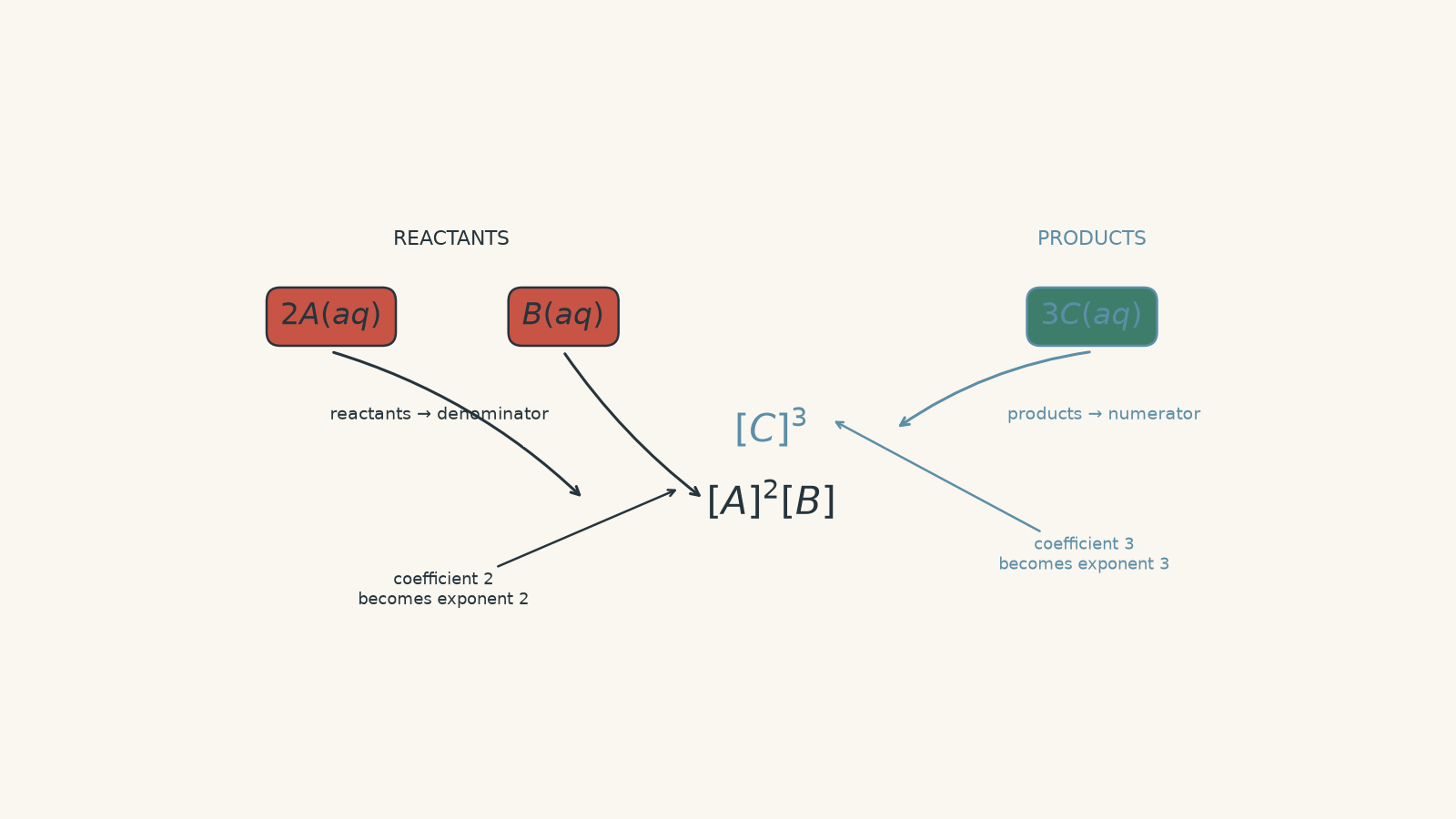
02Why coefficients become powers
Suppose the equation contains \(2A\).
In the equilibrium expression, that gives
\[ [A]^2 \]
not
\[ 2[A] \]
A useful way to picture this is as repeated slots in the reaction bookkeeping. Two \(A\) slots become two factors of concentration:
\[ [A][A]=[A]^2 \]
Three \(C\) slots similarly give
\[ [C][C][C]=[C]^3 \]
The analogy has a limit. It does not mean three \(C\) particles must literally gather together in a single microscopic reaction step. Real reactions can occur through several elementary steps. The equilibrium expression comes from the overall balanced equilibrium equation.
So for
\[ \ce{2A(aq) + B(aq) <=> 3C(aq)} \]
the expression is
\[ K_{\mathrm{eq}}=\frac{[C]^3}{[A]^2[B]} \]
There are no 2s or 3s multiplying the concentrations.
03A reliable method for writing the expression
Start with the balanced equation. If the equation is wrong, the equilibrium expression will be wrong as well.
Then translate it using this pattern:
| Part of the equation | What happens in \(K_{\mathrm{eq}}\) |
|---|---|
| Product | Goes in the numerator |
| Reactant | Goes in the denominator |
| Coefficient of 1 | Power of 1, usually not written |
| Coefficient of 2 | Square the concentration |
| Coefficient of 3 | Cube the concentration |
| Aqueous species, \(\ce{(aq)}\) | Normally included |
| Pure solid, \(\ce{(s)}\) | Omitted |
| Pure liquid, \(\ce{(l)}\) | Omitted |
That last point creates a common trap in aqueous chemistry.
Consider
\[ \ce{H2PO4^-(aq) + H2O(l) <=> H3O^+(aq) + HPO4^2-(aq)} \]
You might expect every substance in the equation to appear in \(K_{\mathrm{eq}}\). But pure liquid water is omitted, so
\[ K_{\mathrm{eq}} = \frac{[\mathrm{H_{3}O}^{+}][\mathrm{HPO_{4}}^{2-}]} {[\mathrm{H_{2}PO_{4}}^{-}]} \]
The concentration of a pure liquid is effectively incorporated into the constant.
For the focused case where every reacting species is aqueous, there is no such omission: every aqueous reactant and product in the equilibrium equation appears.
Worked example: Calculate \(K_{\mathrm{eq}}\) from equilibrium concentrations
For the equilibrium
\[ \ce{Fe^3+(aq) + SCN^-(aq) <=> FeSCN^2+(aq)} \]
the equilibrium concentrations are:
\[ [\mathrm{Fe}^{3+}]=0.0200\ \mathrm{mol\,L^{-1}} \]
\[ [\mathrm{SCN}^{-}]=0.0100\ \mathrm{mol\,L^{-1}} \]
\[ [\mathrm{FeSCN}^{2+}]=0.0400\ \mathrm{mol\,L^{-1}} \]
Write the equilibrium expression and calculate \(K_{\mathrm{eq}}\).
Step 1
All coefficients are 1, so every concentration has a power of 1:
\[ K_{\mathrm{eq}} = \frac{[\mathrm{FeSCN}^{2+}]} {[\mathrm{Fe}^{3+}][\mathrm{SCN}^{-}]} \]
Step 2
All concentration values are in \(\mathrm{mol\,L^{-1}}\):
\[ K_{\mathrm{eq}} = \frac{0.0400} {(0.0200)(0.0100)} = 200 \]
So
\[ K_{\mathrm{eq}}=2.00\times10^2 \]
Step 3
The value is much greater than 1. For this reaction as written, the equilibrium position favours products.
That does not mean there are no reactants remaining. It means the equilibrium concentration relationship produces a relatively large product-to-reactant ratio.
04Stoichiometry matters twice
Things become more interesting when coefficients are greater than 1.
Consider
\[ \ce{2Fe^3+(aq) + Sn^2+(aq) <=> 2Fe^2+(aq) + Sn^4+(aq)} \]
The expression is
\[ K_{\mathrm{eq}} = \frac{[\mathrm{Fe}^{2+}]^2[\mathrm{Sn}^{4+}]} {[\mathrm{Fe}^{3+}]^2[\mathrm{Sn}^{2+}]} \]
Notice what the coefficient 2 does. It becomes a square in \(K_{\mathrm{eq}}\).
If you also need to calculate equilibrium concentrations from a change in concentration, that same coefficient controls the stoichiometric change. This is where students often use the coefficient correctly once, but not twice.
Worked example: Find equilibrium concentrations before calculating \(K_{\mathrm{eq}}\)
For
\[ \ce{2Fe^3+(aq) + Sn^2+(aq) <=> 2Fe^2+(aq) + Sn^4+(aq)} \]
a solution initially has
\[ [\mathrm{Fe}^{3+}]=0.100\ \mathrm{mol\,L^{-1}} \]
and
\[ [\mathrm{Sn}^{2+}]=0.0600\ \mathrm{mol\,L^{-1}} \]
with no \(\mathrm{Fe}^{2+}\) or \(\mathrm{Sn}^{4+}\) initially present.
At equilibrium,
\[ [\mathrm{Sn}^{4+}]=0.0200\ \mathrm{mol\,L^{-1}} \]
Calculate \(K_{\mathrm{eq}}\).
Step 1
\[ K_{\mathrm{eq}} = \frac{[\mathrm{Fe}^{2+}]^2[\mathrm{Sn}^{4+}]} {[\mathrm{Fe}^{3+}]^2[\mathrm{Sn}^{2+}]} \]
Step 2
The equilibrium contains \(0.0200\ \mathrm{mol\,L^{-1}}\) of \(\mathrm{Sn}^{4+}\), so \(0.0200\ \mathrm{mol\,L^{-1}}\) has formed.
From the stoichiometric ratio
\[ \ce{2Fe^3+ : 1Sn^2+ : 2Fe^2+ : 1Sn^4+} \]
forming \(0.0200\ \mathrm{mol\,L^{-1}}\) of \(\mathrm{Sn}^{4+}\) means:
- \(0.0400\ \mathrm{mol\,L^{-1}}\) of \(\mathrm{Fe}^{3+}\) is consumed.
- \(0.0200\ \mathrm{mol\,L^{-1}}\) of \(\mathrm{Sn}^{2+}\) is consumed.
- \(0.0400\ \mathrm{mol\,L^{-1}}\) of \(\mathrm{Fe}^{2+}\) is formed.
The concentrations therefore become:
| Species | Initial \(\mathrm{mol\,L^{-1}}\) | Change \(\mathrm{mol\,L^{-1}}\) | Equilibrium \(\mathrm{mol\,L^{-1}}\) |
|---|---|---|---|
| \(\mathrm{Fe}^{3+}\) | 0.100 | \(-0.0400\) | 0.0600 |
| \(\mathrm{Sn}^{2+}\) | 0.0600 | \(-0.0200\) | 0.0400 |
| \(\mathrm{Fe}^{2+}\) | 0 | \(+0.0400\) | 0.0400 |
| \(\mathrm{Sn}^{4+}\) | 0 | \(+0.0200\) | 0.0200 |
Step 3
\[ K_{\mathrm{eq}} = \frac{(0.0400)^2(0.0200)} {(0.0600)^2(0.0400)} = \frac{3.20\times10^{-5}} {1.44\times10^{-4}} = 0.222 \]
So
\[ K_{\mathrm{eq}}=0.222 \]
Step 4
Because \(K_{\mathrm{eq}}<1\), the equilibrium position favours the reactant side for the equation as written.
The important detail is that the coefficient 2 appeared twice in our reasoning. It controlled the concentration change, and it became an exponent in the equilibrium expression.
05The most tempting mistakes
One mistake is to write
\[ \frac{2[A]}{3[B]} \]
because the equation contains coefficients 2 and 3. Coefficients do not multiply concentration terms in an equilibrium expression. They become exponents.
Another is to substitute the concentrations you started with. \(K_{\mathrm{eq}}\) describes the equilibrium mixture, so initial concentrations cannot be substituted unless they happen to be unchanged.
A third is to assume equilibrium means equal concentrations. It does not. Equilibrium means equal forward and reverse reaction rates. The concentrations become constant, but they can be very different from one another.
There is also a more subtle mistake: treating \(K_{\mathrm{eq}}\) as a property of the chemical substances alone.
It is a property of the reaction equation as written, at a particular temperature.
06What happens if the equation is rewritten?
Suppose
\[ \ce{A(aq) <=> B(aq)} \]
has
\[ K_{\mathrm{eq}}=\frac{[B]}{[A]} \]
Reverse the equation:
\[ \ce{B(aq) <=> A(aq)} \]
The new constant is
\[ K_{\mathrm{reverse}} = \frac{[A]}{[B]} = \frac{1}{K_{\mathrm{eq}}} \]
Now double every coefficient:
\[ \ce{2A(aq) <=> 2B(aq)} \]
The new expression is
\[ K_{\mathrm{new}} = \frac{[B]^2}{[A]^2} = \left(\frac{[B]}{[A]}\right)^2 = K_{\mathrm{eq}}^2 \]
More generally, if every coefficient in an equilibrium equation is multiplied by a factor \(n\),
\[ K_{\mathrm{new}}=(K_{\mathrm{old}})^n \]
If all coefficients are divided by \(n\),
\[ K_{\mathrm{new}}=(K_{\mathrm{old}})^{1/n} \]
This follows directly from the powers in the equilibrium expression. It is not a separate rule you need to memorise blindly.
07Questions and solutions
Question 1
For the homogeneous equilibrium
\[ \ce{Fe^3+(aq) + SCN^-(aq) <=> FeSCN^2+(aq)} \]
the equilibrium concentrations are
\[ [\mathrm{Fe}^{3+}]=0.0300\ \mathrm{mol\,L^{-1}} \]
\[ [\mathrm{SCN}^{-}]=0.0200\ \mathrm{mol\,L^{-1}} \]
and
\[ [\mathrm{FeSCN}^{2+}]=0.0150\ \mathrm{mol\,L^{-1}} \]
Write the equilibrium expression and calculate \(K_{\mathrm{eq}}\).
Solution 1
The equilibrium expression is
\[ K_{\mathrm{eq}} = \frac{[\mathrm{FeSCN}^{2+}]} {[\mathrm{Fe}^{3+}][\mathrm{SCN}^{-}]} \]
and the equilibrium constant is \(25.0\).
Products belong in the numerator and reactants in the denominator. Every coefficient is 1, so no written exponents are needed.
Substituting the equilibrium concentrations,
\[ K_{\mathrm{eq}} = \frac{0.0150} {(0.0300)(0.0200)} = \frac{0.0150}{6.00\times10^{-4}} = 25.0 \]
The tempting mistake is to compare the three concentrations directly and decide that equilibrium should mean they are equal. They do not need to be equal. Their relationship only needs to satisfy the equilibrium expression.
Question 2
Consider
\[ \ce{[Co(H2O)6]^2+(aq) + 4Cl^-(aq) <=> [CoCl4]^2-(aq) + 6H2O(l)} \]
At equilibrium,
\[ [\ce{[Co(H2O)6]^2+}]=0.150\ \mathrm{mol\,L^{-1}} \]
\[ [\mathrm{Cl}^{-}]=0.800\ \mathrm{mol\,L^{-1}} \]
and
\[ [\ce{[CoCl4]^2-}]=0.0600\ \mathrm{mol\,L^{-1}} \]
Write the correct equilibrium expression, calculate \(K_{\mathrm{eq}}\), and explain why the coefficient 6 on water does not produce a \(6[\ce{H2O}]\) term.
Solution 2
The correct expression is
\[ K_{\mathrm{eq}} = \frac{[\ce{[CoCl4]^2-}]} {[\ce{[Co(H2O)6]^2+}][\mathrm{Cl}^{-}]^4} \]
and \(K_{\mathrm{eq}}\approx0.977\).
Substituting the equilibrium concentrations,
\[ K_{\mathrm{eq}} = \frac{0.0600} {(0.150)(0.800)^4} \]
Since
\[ (0.800)^4=0.4096 \]
we obtain
\[ K_{\mathrm{eq}} = \frac{0.0600}{(0.150)(0.4096)} = \frac{0.0600}{0.06144} = 0.977 \]
The \(\mathrm{Cl}^{-}\) coefficient of 4 becomes the exponent 4. It does not become \(4[\mathrm{Cl}^{-}]\).
The water term is omitted entirely because \(\ce{H2O(l)}\) is a pure liquid. Its effective concentration is incorporated into the equilibrium constant.
The tempting route is to assume that every coefficient must visibly appear somewhere in the final expression. That is not true when the species itself is excluded from the equilibrium expression.
Question 3
A homogeneous aqueous equilibrium is represented by
\[ \ce{A(aq) + 2B(aq) <=> C(aq)} \]
Initially,
\[ [A]=0.200\ \mathrm{mol\,L^{-1}},\qquad [B]=0.300\ \mathrm{mol\,L^{-1}},\qquad [C]=0 \]
At equilibrium,
\[ [C]=0.0800\ \mathrm{mol\,L^{-1}} \]
Calculate \(K_{\mathrm{eq}}\).
Solution 3
The equilibrium concentrations are
\[ [A]=0.120\ \mathrm{mol\,L^{-1}},\qquad [B]=0.140\ \mathrm{mol\,L^{-1}},\qquad [C]=0.0800\ \mathrm{mol\,L^{-1}} \]
which gives
\[ K_{\mathrm{eq}}=34.0 \]
The expression is
\[ K_{\mathrm{eq}}=\frac{[C]}{[A][B]^2} \]
Since \(0.0800\ \mathrm{mol\,L^{-1}}\) of \(C\) forms, the equation
\[ \ce{A + 2B <=> C} \]
shows that \(0.0800\ \mathrm{mol\,L^{-1}}\) of \(A\) and twice as much \(B\) are consumed.
Therefore,
\[ [A]_{\mathrm{eq}} = 0.200-0.0800 = 0.120\ \mathrm{mol\,L^{-1}} \]
and
\[ [B]_{\mathrm{eq}} = 0.300-2(0.0800) = 0.140\ \mathrm{mol\,L^{-1}} \]
Now substitute:
\[ K_{\mathrm{eq}} = \frac{0.0800} {(0.120)(0.140)^2} \]
\[ K_{\mathrm{eq}} = \frac{0.0800} {(0.120)(0.0196)} = \frac{0.0800}{0.002352} = 34.0 \]
A tempting error is to subtract \(0.0800\ \mathrm{mol\,L^{-1}}\) from both reactants. The coefficient 2 is the constraint that stops us doing that: two units of \(B\) are consumed for every one unit of \(C\) produced.
That same coefficient also causes \([B]\) to be squared in \(K_{\mathrm{eq}}\).
Question 4
An unknown homogeneous equilibrium has the form
\[ \ce{A(aq) + nB(aq) <=> C(aq)} \]
where \(n\) is a positive whole-number stoichiometric coefficient.
Two independently prepared mixtures reach equilibrium at the same temperature.
| Mixture | \([A]\) \(\mathrm{mol\,L^{-1}}\) | \([B]\) \(\mathrm{mol\,L^{-1}}\) | \([C]\) \(\mathrm{mol\,L^{-1}}\) |
|---|---|---|---|
| 1 | 0.100 | 0.200 | 0.0400 |
| 2 | 0.200 | 0.100 | 0.0200 |
Deduce \(n\) and \(K_{\mathrm{eq}}\).
A student argues that this is impossible because equilibrium concentrations do not occur in stoichiometric ratios. Explain why that argument does not prevent \(n\) from being determined here.
Solution 4
The coefficient is \(n=2\), and \(K_{\mathrm{eq}}=10.0\).
The student is correct about one thing: you cannot simply inspect one set of equilibrium concentrations and treat their ratio as the reaction’s stoichiometric ratio.
The extra constraint is that both mixtures describe the same reaction at the same temperature. They must therefore give the same \(K_{\mathrm{eq}}\).
For
\[ \ce{A + nB <=> C} \]
the equilibrium expression is
\[ K_{\mathrm{eq}} = \frac{[C]}{[A][B]^n} \]
For mixture 1,
\[ K_{\mathrm{eq}} = \frac{0.0400} {(0.100)(0.200)^n} = \frac{0.400}{(0.200)^n} \]
For mixture 2,
\[ K_{\mathrm{eq}} = \frac{0.0200} {(0.200)(0.100)^n} = \frac{0.100}{(0.100)^n} \]
These must be equal:
\[ \frac{0.400}{(0.200)^n} = \frac{0.100}{(0.100)^n} \]
Rearranging,
\[ 4 = \left(\frac{0.200}{0.100}\right)^n = 2^n \]
Therefore,
\[ n=2 \]
Now use either mixture:
\[ K_{\mathrm{eq}} = \frac{0.0400} {(0.100)(0.200)^2} \]
\[ K_{\mathrm{eq}} = \frac{0.0400}{0.00400} = 10.0 \]
The tempting route was to search for the coefficient in the raw concentration ratios. That does not work because equilibrium concentrations depend on starting conditions as well as stoichiometry.
The coefficient becomes recoverable only because changing \(n\) changes the equilibrium expression, while the requirement that both experiments produce the same \(K_{\mathrm{eq}}\) gives us a second constraint.
Question 5
At a particular temperature, Equation I is
\[ \ce{2A(aq) + B(aq) <=> 2C(aq)} \]
with
\[ K_{\mathrm{I}}=9.00 \]
One equilibrium mixture has
\[ [A]=0.200\ \mathrm{mol\,L^{-1}},\qquad [B]=0.250\ \mathrm{mol\,L^{-1}},\qquad [C]=0.300\ \mathrm{mol\,L^{-1}} \]
The same chemical equilibrium is then written as Equation II:
\[ \ce{C(aq) <=> A(aq) + 1/2B(aq)} \]
Without first using the concentration data, determine \(K_{\mathrm{II}}\).
Then verify your result using the equilibrium concentrations.
A student objects: “Equation I has \(K>1\), so products are favoured. Equation II has \(K<1\), so reactants are favoured. Those statements contradict each other.”
Resolve the apparent contradiction.
Solution 5
\[ K_{\mathrm{II}}=\frac{1}{3} \]
and there is no contradiction. Both equilibrium constants describe exactly the same physical mixture using differently written reaction equations.
Start with Equation I:
\[ \ce{2A + B <=> 2C} \]
and
\[ K_{\mathrm{I}}=9.00 \]
First divide every coefficient by 2:
\[ \ce{A + 1/2B <=> C} \]
Dividing all coefficients by 2 takes the square root of the equilibrium constant:
\[ K=\sqrt{9.00}=3.00 \]
Equation II reverses this equation:
\[ \ce{C <=> A + 1/2B} \]
Reversing an equilibrium takes the reciprocal of \(K\):
\[ K_{\mathrm{II}} = \frac{1}{3.00} = \frac{1}{3} \]
Now verify it from the measured concentrations.
For Equation II,
\[ K_{\mathrm{II}} = \frac{[A][B]^{1/2}}{[C]} \]
so
\[ K_{\mathrm{II}} = \frac{(0.200)(0.250)^{1/2}} {0.300} \]
Since
\[ (0.250)^{1/2}=0.500 \]
we obtain
\[ K_{\mathrm{II}} = \frac{(0.200)(0.500)} {0.300} = \frac{0.100}{0.300} = \frac{1}{3} \]
Now for the apparent contradiction.
Equation I has \(K>1\), which favours its product side. Its product side contains \(C\).
Equation II has \(K<1\), which favours its reactant side. Its reactant side also contains \(C\).
Both statements therefore point towards the same physical side of the equilibrium.
The trap is thinking that “products are favoured” is a permanent property of the chemicals. Product and reactant are labels created by the direction in which you choose to write the equation.
The deeper rule is that an equilibrium constant belongs to a particular balanced equation at a particular temperature. Change the equation, and you can change the numerical value of \(K_{\mathrm{eq}}\) without changing the physical equilibrium mixture at all.
08What this lets you do next
Once you can write an equilibrium expression reliably, the next useful idea is the reaction quotient, \(Q\).
\(Q\) uses the same concentration expression as \(K_{\mathrm{eq}}\), but the concentrations do not have to be equilibrium concentrations. Comparing \(Q\) with \(K_{\mathrm{eq}}\) then tells you which way the reaction must move:
\[ Q<K_{\mathrm{eq}} \]
means the forward reaction is favoured,
\[ Q>K_{\mathrm{eq}} \]
means the reverse reaction is favoured, and
\[ Q=K_{\mathrm{eq}} \]
means the system is at equilibrium.
So the skill developed here – translating a balanced equation into the correct concentration expression – is the piece you need before you can decide not just where an equilibrium sits, but which direction a disturbed system will move.