
How to Combine Equilibrium Constants for Added Reactions
Suppose you know the equilibrium constants for two reactions, but an exam question asks you to calculate the constant for a third reaction formed by adding them together.
Suppose you know the equilibrium constants for two reactions, but an exam question asks you to calculate the constant for a third reaction formed by adding them together.
Do you add the equilibrium constants as well?
No. When you add equilibrium equations, you multiply their equilibrium constants. However, you must first account for any reactions that have been reversed or had their coefficients changed.
For example, consider two equilibria at the same temperature:
\[ \ce{A(aq) + B(aq) <=> C(aq)} \]
\[ K_{c,1}=2.0\ \mathrm{L\,mol^{-1}} \]
and
\[ \ce{C(aq) + D(aq) <=> E(aq)} \]
\[ K_{c,2}=3.0\ \mathrm{L\,mol^{-1}} \]
Adding the equations gives:
\[ \ce{A(aq) + B(aq) + D(aq) <=> E(aq)} \]
The overall equilibrium constant is:
\[ K_{c,\mathrm{overall}}=K_{c,1}\times K_{c,2} \]
\[ =2.0\times3.0 \]
\[ \boxed{K_{c,\mathrm{overall}}=6.0\ \mathrm{L^2\,mol^{-2}}} \]
The important detail is that C appears on both sides of the combined equation, so it cancels.
There are three rules you need to understand:
- Adding reaction equations means multiplying their equilibrium constants.
- Reversing a reaction means taking the reciprocal of its equilibrium constant.
- Multiplying every coefficient in a reaction by \(n\) means raising its equilibrium constant to the power of \(n\).
Let’s work through why these rules work, how to apply them, and where students commonly lose marks.
01Why do we multiply equilibrium constants?
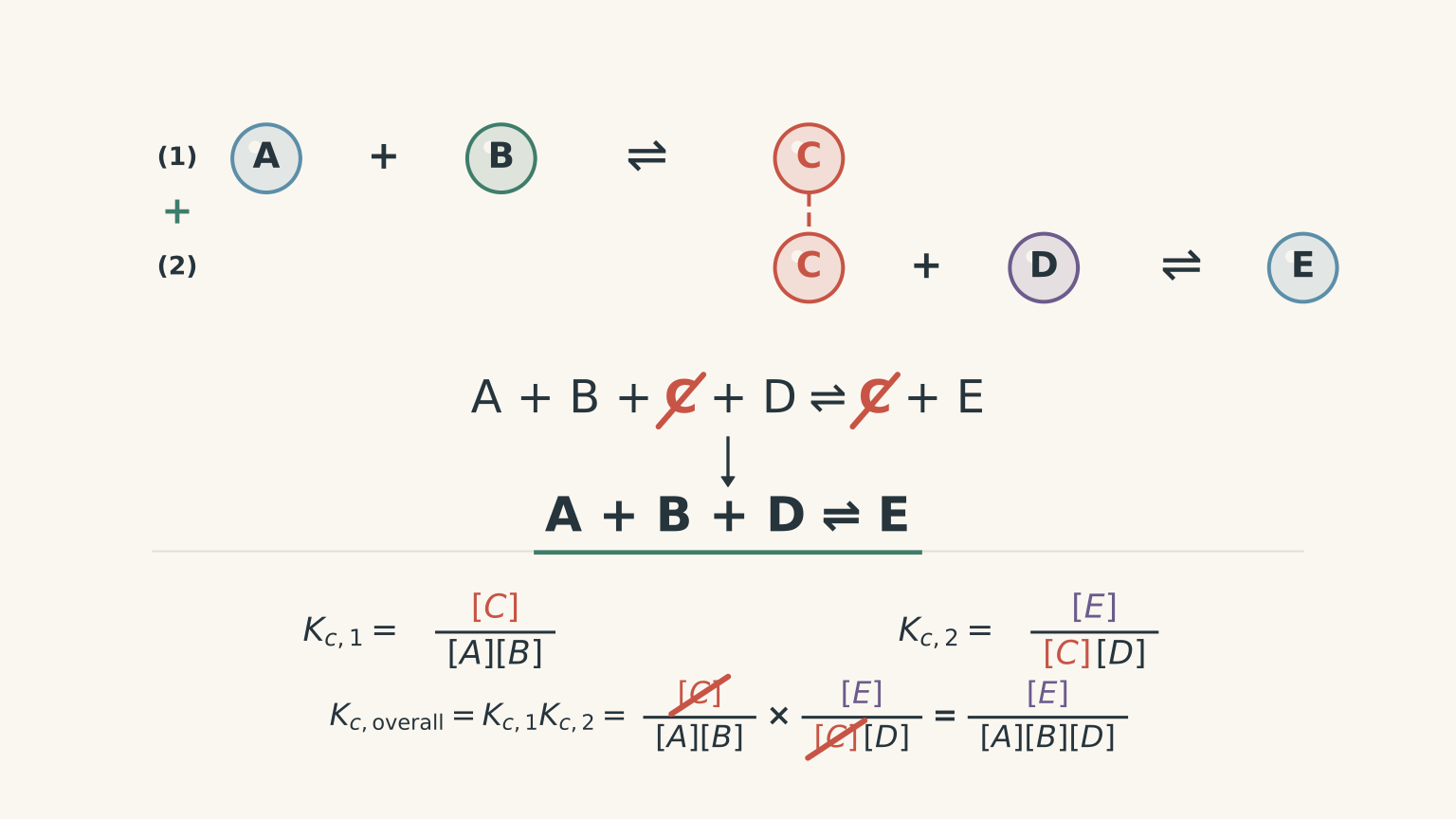
Start with the two reactions:
\[ \ce{A + B <=> C} \tag{1} \]
\[ \ce{C + D <=> E} \tag{2} \]
Imagine that the first reaction produces C, which then participates in the second reaction.
C is an intermediate: it is produced in one reaction and consumed in another.
Think of it like a relay race. The first runner passes the baton to the second runner. When you describe the entire race, the baton is not an additional starting or finishing item.
The analogy has a limit. Molecules are continuously reacting in both directions at equilibrium. C does not need to disappear from the actual mixture. It simply cancels when we write the overall reaction.
Adding the two equations:
\[ \begin{aligned} \ce{A + B} &\ce{<=> C}\\ \ce{C + D} &\ce{<=> E} \end{aligned} \]
Before cancelling anything:
\[ \ce{A + B + C + D <=> C + E} \]
Cancel C from both sides:
\[ \boxed{\ce{A + B + D <=> E}} \]
Due to technical limitations, this figure may display incorrectly or contain inaccuracies. Please check key details against your course materials.
Now consider the equilibrium expressions.
For reaction (1):
\[ K_{c,1}=\frac{[C]}{[A][B]} \]
For reaction (2):
\[ K_{c,2}=\frac{[E]}{[C][D]} \]
Multiplying these expressions:
\[ K_{c,1}K_{c,2} = \frac{[C]}{[A][B]} \times \frac{[E]}{[C][D]} \]
The concentration of C appears once in the numerator and once in the denominator. It cancels.
We are left with:
\[ K_{c,1}K_{c,2} = \frac{[E]}{[A][B][D]} \]
This is exactly the equilibrium expression for the combined reaction.
Therefore:
\[ \boxed{K_{c,\mathrm{overall}}=K_{c,1}K_{c,2}} \]
This is not an extra rule to memorise without explanation. It follows directly from multiplying the equilibrium expressions.
If you need a refresher on constructing those expressions from balanced equations, see Equilibrium Expressions for Homogeneous Reactions | HSC Chemistry.
02The three rules for manipulating equilibrium constants
Before combining reactions, you need to make sure each equation is written in the correct direction and with the correct coefficients.
Rule 1: Reversing a reaction means taking the reciprocal
Suppose:
\[ \ce{A <=> B} \]
has an equilibrium constant:
\[ K_c=5.0 \]
If we reverse the reaction:
\[ \ce{B <=> A} \]
the new equilibrium expression becomes:
\[ K_{c,\mathrm{reverse}}=\frac{[A]}{[B]} \]
The original expression was:
\[ K_c=\frac{[B]}{[A]} \]
The new expression is its reciprocal:
\[ \boxed{K_{c,\mathrm{reverse}}=\frac{1}{K_c}} \]
Therefore:
\[ K_{c,\mathrm{reverse}}=\frac{1}{5.0} \]
\[ \boxed{K_{c,\mathrm{reverse}}=0.20} \]
Notice that we do not make the equilibrium constant negative.
Equilibrium constants are positive. Reversing the reaction gives the reciprocal, not the negative.
Rule 2: Multiplying every coefficient means raising K to a power
Consider:
\[ \ce{A <=> B} \]
with:
\[ K_c=3.0 \]
Now multiply every coefficient by 2:
\[ \ce{2A <=> 2B} \]
The new equilibrium expression is:
\[ K_{c,\mathrm{new}}=\frac{[B]^2}{[A]^2} \]
Rearranging:
\[ K_{c,\mathrm{new}} = \left(\frac{[B]}{[A]}\right)^2 \]
Therefore:
\[ \boxed{K_{c,\mathrm{new}}=K_c^2} \]
Substituting:
\[ K_{c,\mathrm{new}}=3.0^2 \]
\[ \boxed{K_{c,\mathrm{new}}=9.0} \]
If you halve every coefficient, you take the square root instead.
More generally:
\[ \boxed{K_{\mathrm{new}}=K_{\mathrm{old}}^n} \]
where \(n\) is the factor by which every reaction coefficient is multiplied.
Rule 3: Adding reactions means multiplying their adjusted constants
Once every reaction has the correct direction and coefficients, add the equations and cancel any species appearing on both sides.
Then multiply the adjusted equilibrium constants.
For example, if:
\[ \ce{A <=> B} \qquad K_1=4.0 \]
and:
\[ \ce{B <=> C} \qquad K_2=2.0 \]
the combined reaction is:
\[ \ce{A <=> C} \]
and:
\[ K_{\mathrm{overall}}=4.0\times2.0 \]
\[ \boxed{K_{\mathrm{overall}}=8.0} \]
Here is a useful summary.
| Change to the reaction | Change to the equilibrium constant |
|---|---|
| Reverse the reaction | \(1/K\) |
| Multiply coefficients by 2 | \(K^2\) |
| Multiply coefficients by 3 | \(K^3\) |
| Divide coefficients by 2 | \(\sqrt K\) |
| Add two reactions | \(K_1\times K_2\) |
| Add three reactions | \(K_1\times K_2\times K_3\) |
The order of operations is important. Adjust each equilibrium constant to match its modified equation before multiplying the constants together.
03Why temperature matters when combining constants
There is one condition that students sometimes overlook.
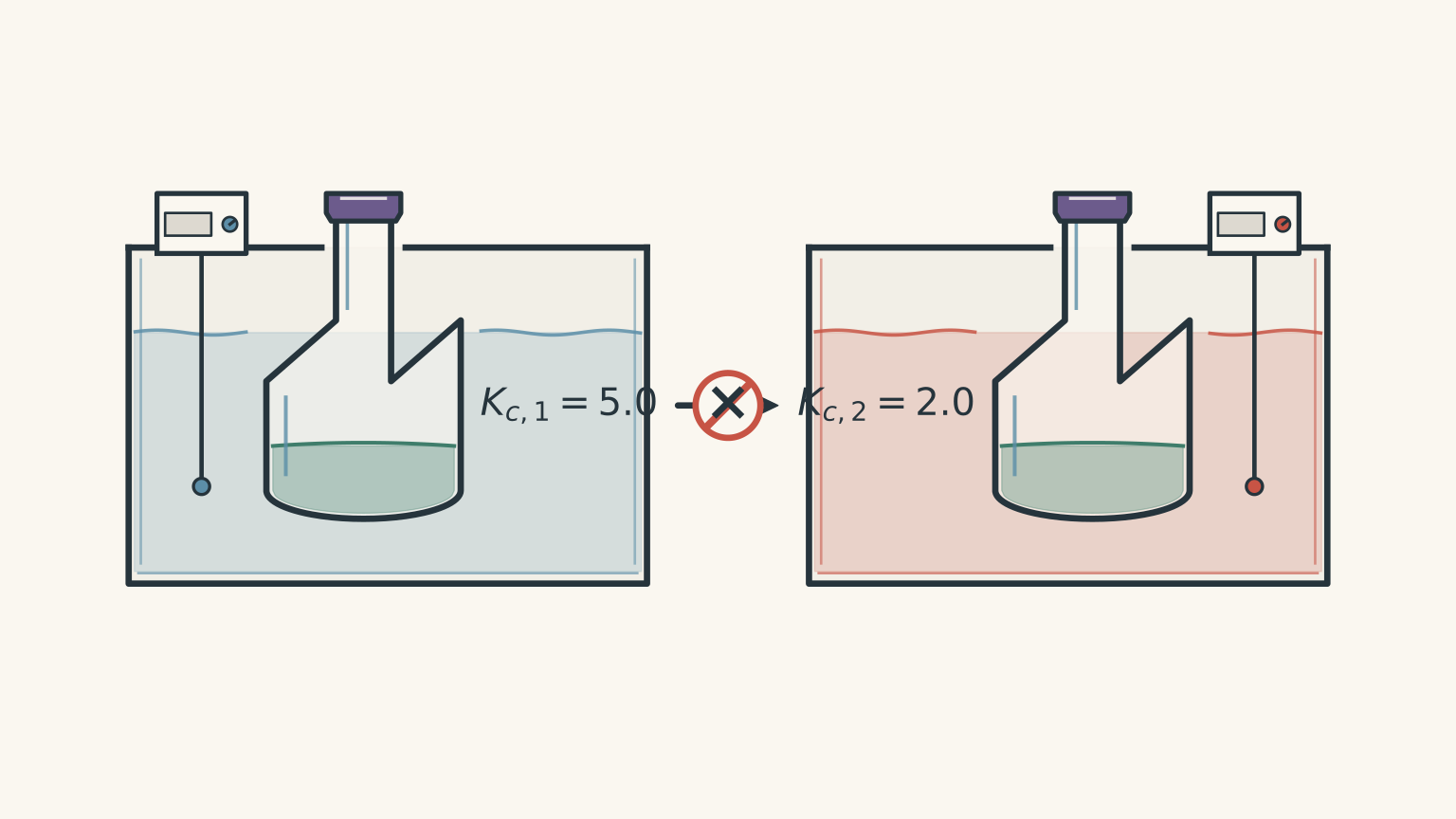
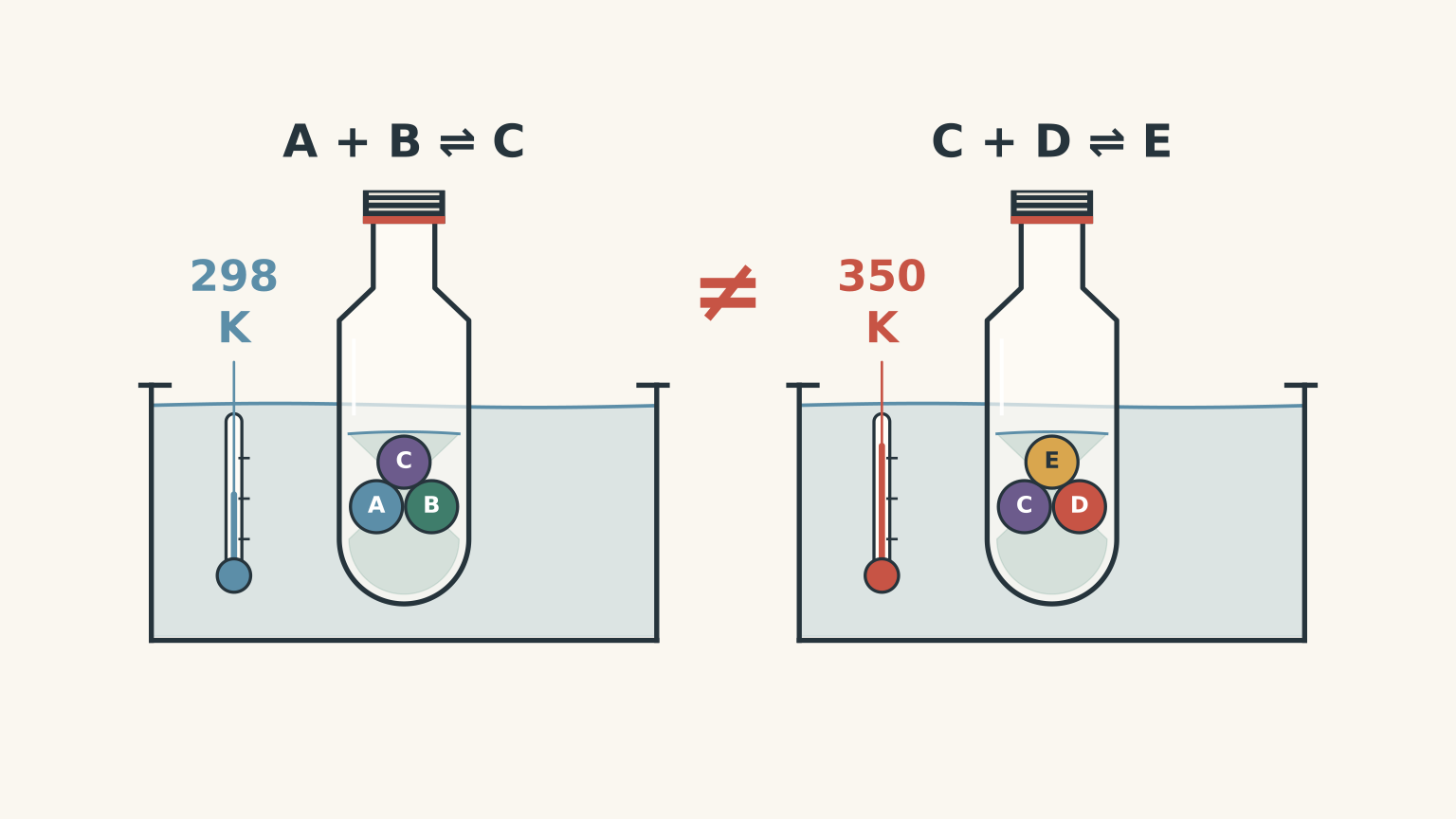
All equilibrium constants being combined must refer to the same temperature.
An equilibrium constant is temperature-dependent. Changing the temperature can change the value of K, even when the chemical equation stays exactly the same.
Suppose you are given:
\[ K_{c,1}=5.0 \qquad \text{at }298\ \mathrm{K} \]
and:
\[ K_{c,2}=2.0 \qquad \text{at }350\ \mathrm{K} \]
It might seem reasonable to multiply them:
\[ 5.0\times2.0=10.0 \]
But this is not a valid combined equilibrium constant.
The two values describe equilibria at different temperatures. You cannot directly combine them.
To calculate the overall constant at 298 K, for example, you would need the second reaction’s equilibrium constant at 298 K as well.
If the question does not provide enough information to obtain both constants at a common temperature, you cannot calculate the overall constant.
Due to technical limitations, this figure may display incorrectly or contain inaccuracies. Please check key details against your course materials.
There is another consistency check worth remembering.
- Combine \(K_c\) values with other \(K_c\) values.
- Combine \(K_p\) values with other \(K_p\) values.
- Do not directly multiply a \(K_c\) value by a \(K_p\) value.
For concentration-based equilibrium expressions, the formal units of \(K_c\) depend on the reaction stoichiometry. These units multiply along with the constants and should match the expression for the overall reaction.
Strictly, thermodynamic equilibrium constants are dimensionless because they use activities rather than raw concentrations. The reaction-manipulation rules are the same in either treatment.
04How could we test this experimentally?
The mathematical relationship is useful, but it also gives us a prediction that could be checked experimentally.
Imagine two reversible reactions:
\[ \ce{A(aq) + B(aq) <=> C(aq)} \]
\[ \ce{C(aq) + D(aq) <=> E(aq)} \]
We want to investigate whether the equilibrium constant for the combined reaction is the product of the two individual constants.
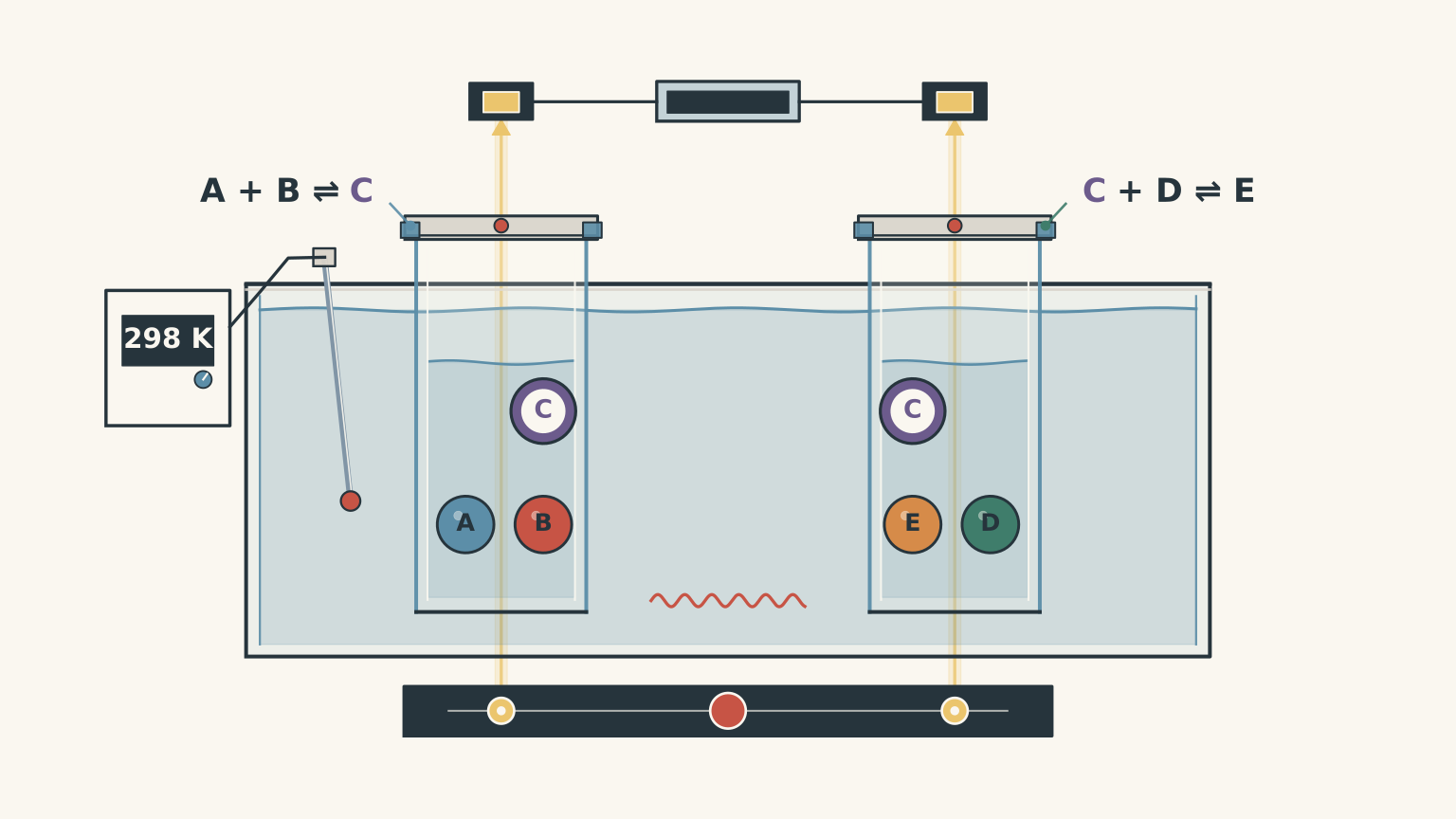
The apparatus
Prepare two sealed, transparent reaction vessels.
- Vessel 1 contains A, B, and C.
- Vessel 2 contains C, D, and E.
Place both vessels side by side in the same temperature-controlled water bath, maintained at 298 K.
Suppose the species have distinguishable optical signals. A light source directs a beam through each vessel, and a detector measures the transmitted light. Calibrated measurements allow the equilibrium concentrations to be determined.
A temperature probe monitors the bath, and the vessels remain sealed to avoid disturbing their equilibrium mixtures.
Due to technical limitations, this figure may display incorrectly or contain inaccuracies. Please check key details against your course materials.
What should we predict?
If both reactions are at equilibrium at the same temperature, their calculated equilibrium constants should combine according to:
\[ K_{c,\mathrm{overall}}=K_{c,1}K_{c,2} \]
Let’s use some illustrative measurements.
In vessel 1, suppose the measured equilibrium concentrations are:
| Species | Equilibrium concentration |
|---|---|
| A | \(0.20\ \mathrm{mol\,L^{-1}}\) |
| B | \(0.10\ \mathrm{mol\,L^{-1}}\) |
| C | \(0.040\ \mathrm{mol\,L^{-1}}\) |
The first equilibrium constant is:
\[ K_{c,1}=\frac{[C]}{[A][B]} \]
\[ =\frac{0.040}{0.20\times0.10} \]
\[ \boxed{K_{c,1}=2.0\ \mathrm{L\,mol^{-1}}} \]
In vessel 2, suppose the measurements are:
| Species | Equilibrium concentration |
|---|---|
| C | \(0.10\ \mathrm{mol\,L^{-1}}\) |
| D | \(0.20\ \mathrm{mol\,L^{-1}}\) |
| E | \(0.060\ \mathrm{mol\,L^{-1}}\) |
The second equilibrium constant is:
\[ K_{c,2}=\frac{[E]}{[C][D]} \]
\[ =\frac{0.060}{0.10\times0.20} \]
\[ \boxed{K_{c,2}=3.0\ \mathrm{L\,mol^{-1}}} \]
The predicted overall constant is therefore:
\[ K_{c,\mathrm{overall}}=2.0\times3.0 \]
\[ \boxed{K_{c,\mathrm{overall}}=6.0\ \mathrm{L^2\,mol^{-2}}} \]
The concentrations of C do not need to be identical in the two vessels. The equilibrium constants are calculated separately, and the shared species cancels algebraically when the expressions are multiplied.
What could go wrong with the original design?
A tempting first design would be to leave the two vessels on separate laboratory benches and compare their colours once the readings appear stable.
There are two problems.
First, the vessels might be at different temperatures. Their equilibrium constants would then refer to different conditions.
Second, colour intensity alone does not necessarily give all the equilibrium concentrations. A strong colour does not automatically mean a large percentage of reactant has converted.
The revised design addresses both problems:
- Keep both vessels in the same controlled-temperature bath.
- Use calibrated measurements to determine concentrations rather than comparing colour by eye.
- Keep the vessels sealed and measure without disturbing the equilibria.
- Repeat with different starting mixtures to check whether the calculated constants remain consistent at the same temperature.
If the measurements consistently produce the predicted relationship within experimental uncertainty, they support the mathematical model.
This experiment would test the equilibrium relationship. It would not, by itself, prove that the two reactions occur through a particular microscopic mechanism.
05Worked examples
The first example demonstrates straightforward addition. The second combines reversing, scaling, and cancelling reactions.
Worked example: Combining two consecutive gas equilibria
At 700 K, consider the following two equilibrium reactions:
\[ \ce{CO(g) + H2O(g) <=> CO2(g) + H2(g)} \]
\[ K_{c,1}=2.0 \]
and:
\[ \ce{H2(g) + I2(g) <=> 2HI(g)} \]
\[ K_{c,2}=3.0 \]
The numerical constants are illustrative, not reported experimental measurements.
Calculate the equilibrium constant for:
\[ \ce{CO(g) + H2O(g) + I2(g) <=> CO2(g) + 2HI(g)} \]
Step 1
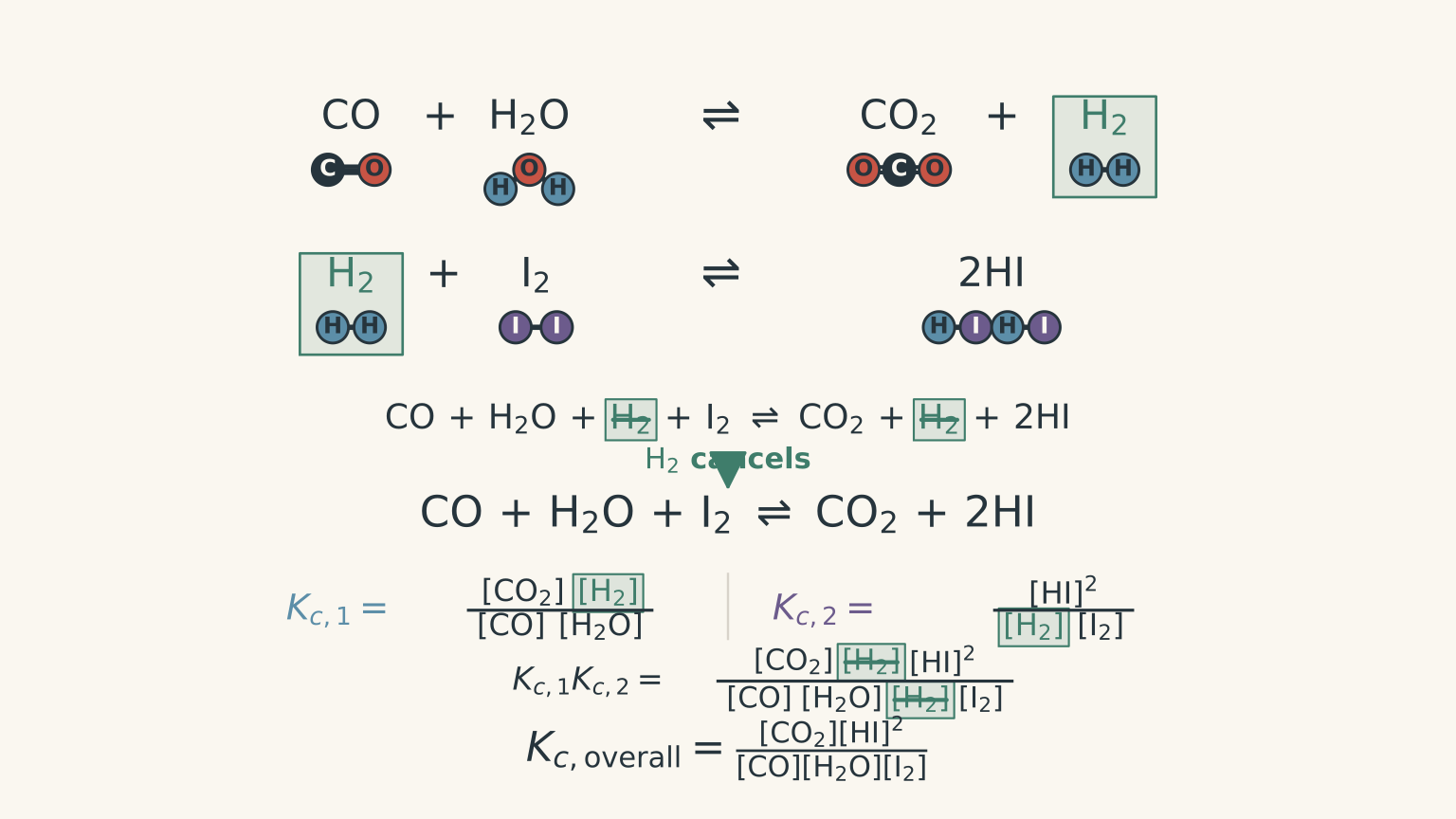
\[ \begin{aligned} \ce{CO + H2O} &\ce{<=> CO2 + H2}\\ \ce{H2 + I2} &\ce{<=> 2HI} \end{aligned} \]
Combining the left and right sides gives:
\[ \ce{CO + H2O + H2 + I2 <=> CO2 + H2 + 2HI} \]
Step 2
Hydrogen gas, \(\ce{H2}\), appears on both sides, so it cancels.
The resulting equation is:
\[ \ce{CO + H2O + I2 <=> CO2 + 2HI} \]
This matches the required overall reaction.
Step 3
Both reactions are already written in the correct direction, and their coefficients do not need changing.
Therefore:
\[ K_{c,\mathrm{overall}}=K_{c,1}K_{c,2} \]
\[ =2.0\times3.0 \]
\[ \boxed{K_{c,\mathrm{overall}}=6.0} \]
Step 4
For the first reaction:
\[ K_{c,1}= \frac{[\ce{CO2}][\ce{H2}]} {[\ce{CO}][\ce{H2O}]} \]
For the second reaction:
\[ K_{c,2}= \frac{[\ce{HI}]^2} {[\ce{H2}][\ce{I2}]} \]
Multiplying:
\[ K_{c,1}K_{c,2} = \frac{[\ce{CO2}][\ce{H2}][\ce{HI}]^2} {[\ce{CO}][\ce{H2O}][\ce{H2}][\ce{I2}]} \]
Cancel \([\ce{H2}]\):
\[ K_{c,\mathrm{overall}} = \frac{[\ce{CO2}][\ce{HI}]^2} {[\ce{CO}][\ce{H2O}][\ce{I2}]} \]
This is precisely the equilibrium expression for the combined reaction.
Due to technical limitations, this figure may display incorrectly or contain inaccuracies. Please check key details against your course materials.
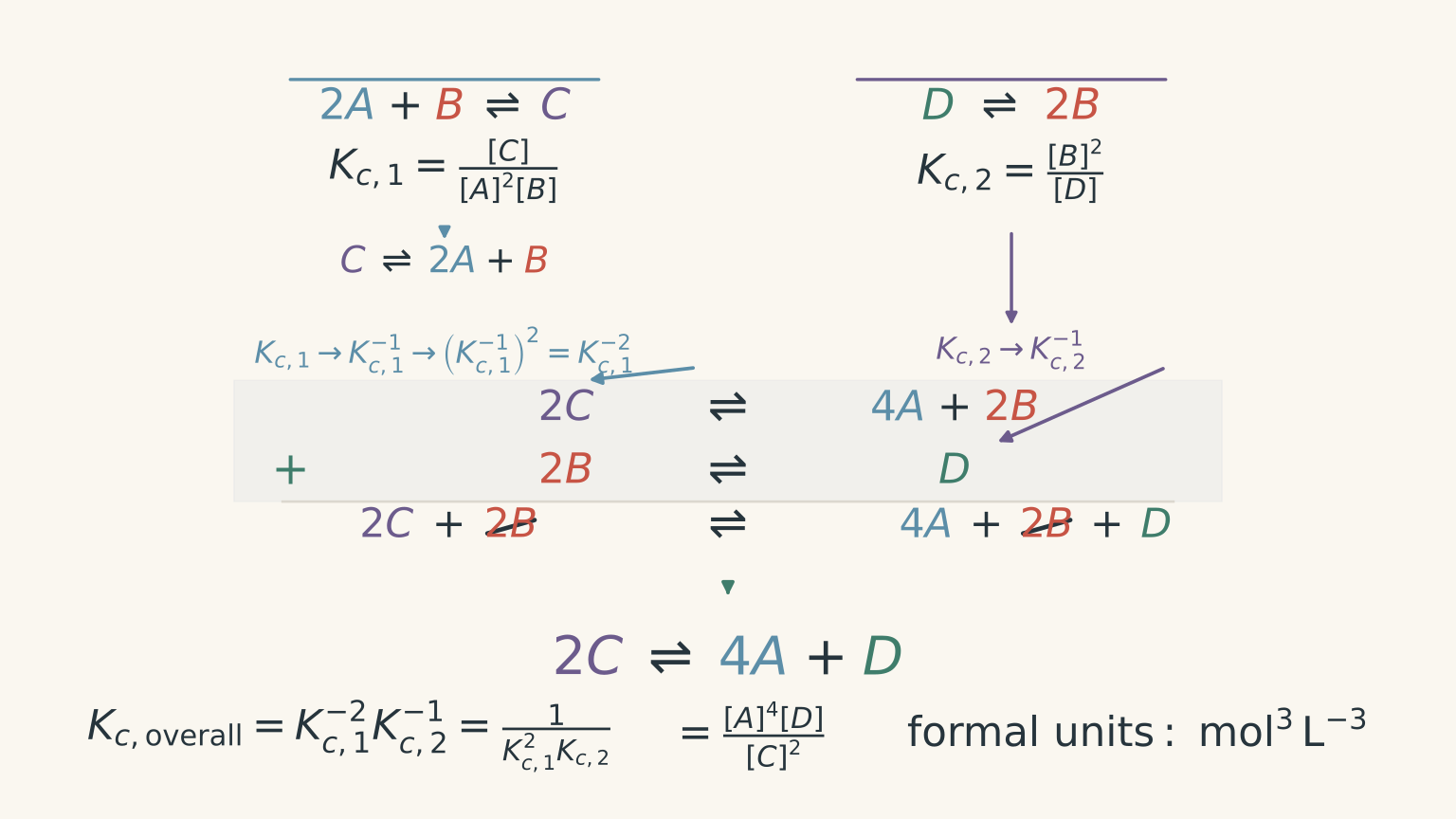
Worked example: Reversing and doubling reactions before combining
Consider two equilibria at the same temperature:
\[ \ce{2A(aq) + B(aq) <=> C(aq)} \]
\[ K_{c,1}=4.0\ \mathrm{L^2\,mol^{-2}} \]
and:
\[ \ce{D(aq) <=> 2B(aq)} \]
\[ K_{c,2}=0.50\ \mathrm{mol\,L^{-1}} \]
Calculate the equilibrium constant for:
\[ \ce{2C(aq) <=> 4A(aq) + D(aq)} \]
All numerical constants are illustrative.
Step 1
The target reaction has C on the left and A on the right.
Therefore, reverse the first equation:
\[ \ce{C <=> 2A + B} \]
Its equilibrium constant becomes:
\[ K'_{c,1}=\frac{1}{K_{c,1}} \]
\[ =\frac{1}{4.0} \]
\[ K'_{c,1}=0.25\ \mathrm{mol^2\,L^{-2}} \]
Step 2
The target contains two C molecules and four A molecules, so multiply every coefficient in the reversed equation by 2:
\[ \ce{2C <=> 4A + 2B} \]
The new equilibrium constant is:
\[ K''_{c,1}=(K'_{c,1})^2 \]
\[ =0.25^2 \]
\[ K''_{c,1}=0.0625\ \mathrm{mol^4\,L^{-4}} \]
Step 3
The second equation is:
\[ \ce{D <=> 2B} \]
We need B on the left so that it can cancel the \(2B\) on the right of the first modified equation.
Reverse it:
\[ \ce{2B <=> D} \]
Its new equilibrium constant is:
\[ K'_{c,2}=\frac{1}{K_{c,2}} \]
\[ =\frac{1}{0.50} \]
\[ K'_{c,2}=2.0\ \mathrm{L\,mol^{-1}} \]
Step 4
\[ \ce{2C <=> 4A + 2B} \]
\[ \ce{2B <=> D} \]
Combining:
\[ \ce{2C + 2B <=> 4A + 2B + D} \]
Cancel \(2B\):
\[ \boxed{\ce{2C <=> 4A + D}} \]
This matches the required reaction.
Step 5
\[ K_{c,\mathrm{overall}} = K''_{c,1}\times K'_{c,2} \]
\[ =0.0625\times2.0 \]
\[ \boxed{K_{c,\mathrm{overall}}=0.125\ \mathrm{mol^3\,L^{-3}}} \]
Notice how many operations were involved:
- The first reaction was reversed.
- Its coefficients were doubled.
- The second reaction was reversed.
- The equations were added.
- The shared species was cancelled.
- The adjusted constants were multiplied.
The final units also match the overall equilibrium expression:
\[ K_{c,\mathrm{overall}} = \frac{[A]^4[D]}{[C]^2} \]
The numerator contains five concentration factors, and the denominator contains two. The resulting formal units are \(\mathrm{mol^3\,L^{-3}}\).
Due to technical limitations, this figure may display incorrectly or contain inaccuracies. Please check key details against your course materials.
06What does the size of the combined equilibrium constant tell you?
Once you have calculated the overall equilibrium constant, you can interpret its magnitude.
For the reaction as written:
- A large equilibrium constant suggests that products are favoured.
- A small equilibrium constant suggests that reactants are favoured.
- A value around 1 suggests that neither side is strongly favoured.
However, be careful with what this actually tells you.
A large equilibrium constant does not mean that every reactant will be completely consumed. The equilibrium position also depends on the reaction stoichiometry and the quantities of substances initially present.
For example, a reaction might strongly favour products but still leave a substantial amount of one reactant because that reactant was initially present in large excess.
Also, reversing the reaction changes the equilibrium constant to its reciprocal. A reaction that strongly favours products in one direction strongly favours reactants when written in the opposite direction.
For a more detailed example of why significant reactant can remain even when \(K_{\mathrm{eq}}\) is very large, see Can Significant Reactants Remain When Keq Is Very Large?.
07Questions and solutions
Question 1
Two equilibrium reactions occur at 298 K:
\[ \ce{M(aq) <=> N(aq)} \]
\[ K_{c,1}=2.5 \]
and:
\[ \ce{N(aq) <=> P(aq)} \]
\[ K_{c,2}=4.0 \]
Calculate the equilibrium constant for:
\[ \ce{M(aq) <=> P(aq)} \]
Solution 1
The overall equilibrium constant is \(10.0\).
Both reactions are already written in the correct direction, and their coefficients do not need changing.
Adding the equations:
\[ \ce{M <=> N} \]
\[ \ce{N <=> P} \]
The intermediate N cancels:
\[ \ce{M <=> P} \]
Multiply the equilibrium constants:
\[ K_{c,\mathrm{overall}}=K_{c,1}K_{c,2} \]
\[ =2.5\times4.0 \]
\[ \boxed{K_{c,\mathrm{overall}}=10.0} \]
The combined reaction favours the formation of P relative to M under the usual interpretation of the equilibrium constant.
Question 2
At 298 K, the following equilibria have been established:
\[ \ce{X(aq) + Y(aq) <=> Z(aq)} \]
\[ K_{c,1}=3.0 \]
and:
\[ \ce{Z(aq) <=> W(aq)} \]
\[ K_{c,2}=4.0 \]
Calculate the equilibrium constant for:
\[ \ce{2W(aq) <=> 2X(aq) + 2Y(aq)} \]
Solution 2
The required equilibrium constant is:
\[ \boxed{K_{c,\mathrm{overall}}=\frac{1}{144}} \]
The important detail is that the target equation is the reverse of the combined reaction, with every coefficient doubled.
First, add the original equations:
\[ \ce{X + Y <=> Z} \]
\[ \ce{Z <=> W} \]
Cancel Z:
\[ \ce{X + Y <=> W} \]
The equilibrium constant for this combined reaction is:
\[ K_c=3.0\times4.0=12.0 \]
Now reverse the combined equation:
\[ \ce{W <=> X + Y} \]
Its equilibrium constant becomes:
\[ K'_c=\frac{1}{12.0} \]
Finally, double every coefficient:
\[ \ce{2W <=> 2X + 2Y} \]
Therefore, square the adjusted constant:
\[ K_{c,\mathrm{overall}}=(K'_c)^2 \]
\[ =\left(\frac{1}{12.0}\right)^2 \]
\[ \boxed{K_{c,\mathrm{overall}}=\frac{1}{144}} \]
A common mistake is to double the reciprocal instead of squaring it. Changing the reaction coefficients changes the powers in the equilibrium expression, not the constant by simple multiplication.
Question 3
Two reactions are being combined to produce the overall reaction:
\[ \ce{A(aq) + B(aq) + D(aq) <=> E(aq)} \]
The following information is provided:
| Reaction | Equilibrium constant | Temperature |
|---|---|---|
| \(\ce{A + B <=> C}\) | \(5.0\) | 298 K |
| \(\ce{C + D <=> E}\) | \(2.0\) | 350 K |
A student calculates:
\[ K_{c,\mathrm{overall}}=5.0\times2.0=10.0 \]
Explain why the student’s calculation is invalid and identify the additional information required.
Due to technical limitations, this figure may display incorrectly or contain inaccuracies. Please check key details against your course materials.
Solution 3
The student’s calculation is invalid because the two equilibrium constants were measured at different temperatures.
Although the reaction equations can be added algebraically, the corresponding equilibrium constants cannot be multiplied directly when they refer to different temperatures.
The first constant describes the reaction at 298 K:
\[ K_{c,1}(298\ \mathrm{K})=5.0 \]
The second describes the reaction at 350 K:
\[ K_{c,2}(350\ \mathrm{K})=2.0 \]
To calculate the overall equilibrium constant at 298 K, we need:
\[ K_{c,\mathrm{overall}}(298\ \mathrm{K}) = K_{c,1}(298\ \mathrm{K}) \times K_{c,2}(298\ \mathrm{K}) \]
The second reaction’s equilibrium constant at 298 K has not been provided.
Alternatively, we could calculate the overall constant at 350 K if we knew the first reaction’s equilibrium constant at 350 K.
Without additional information to obtain the missing value, the overall equilibrium constant cannot be determined.
The tempting approach is to focus only on the reaction equations and forget that K depends on temperature. Always check the temperature before combining constants.
Question 4
Four equilibria are measured at 400 K. All reactions involve aqueous species.
\[ \ce{A(aq) <=> B(aq)} \qquad K_{c,1}=3.0 \]
\[ \ce{B(aq) <=> C(aq)} \qquad K_{c,2}=2.0 \]
\[ \ce{A(aq) <=> D(aq)} \qquad K_{c,3}=4.0 \]
\[ \ce{D(aq) <=> C(aq)} \qquad K_{c,4}=1.0 \]
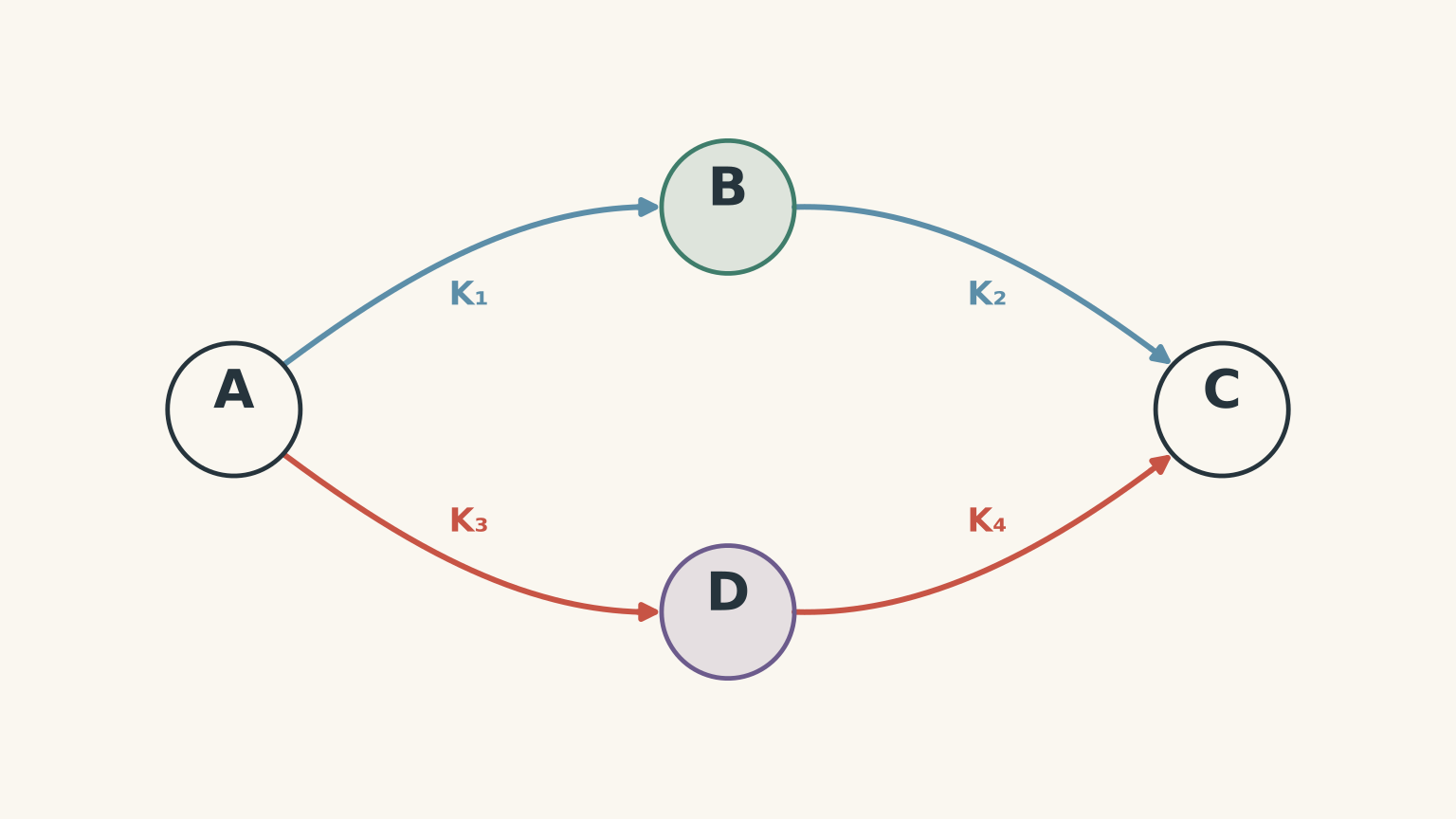
There are two possible routes for converting A into C:
- Route 1: A converts into B, then B converts into C.
- Route 2: A converts into D, then D converts into C.
Calculate the equilibrium constant for \(\ce{A(aq) <=> C(aq)}\) using each route.
Can all four supplied equilibrium constants be correct simultaneously? Explain your reasoning.
Due to technical limitations, this figure may display incorrectly or contain inaccuracies. Please check key details against your course materials.
Solution 4
No, all four equilibrium constants cannot be correct simultaneously.
The two pathways produce the same overall reaction at the same temperature. Therefore, they must produce the same equilibrium constant.
First, consider Route 1.
Add:
\[ \ce{A <=> B} \]
\[ \ce{B <=> C} \]
B cancels, leaving:
\[ \ce{A <=> C} \]
The equilibrium constant is:
\[ K_{c,\mathrm{route\ 1}}=K_{c,1}K_{c,2} \]
\[ =3.0\times2.0 \]
\[ \boxed{K_{c,\mathrm{route\ 1}}=6.0} \]
Now consider Route 2.
Add:
\[ \ce{A <=> D} \]
\[ \ce{D <=> C} \]
D cancels, again leaving:
\[ \ce{A <=> C} \]
The equilibrium constant is:
\[ K_{c,\mathrm{route\ 2}}=K_{c,3}K_{c,4} \]
\[ =4.0\times1.0 \]
\[ \boxed{K_{c,\mathrm{route\ 2}}=4.0} \]
We now have two different equilibrium constants for exactly the same reaction at the same temperature:
\[ 6.0\ne4.0 \]
This is impossible for a thermodynamically consistent set of equilibrium constants.
At least one of the supplied constants, reaction equations, or experimental assignments must be incorrect.
Importantly, we cannot determine which measurement is wrong from the information given.
Averaging the two values to obtain 5.0 would not solve the problem. It would simply create another unsupported value.
The key principle is that the equilibrium constant belongs to the reaction as written at a particular temperature. It cannot depend on which sequence of intermediate reactions we use to construct that same overall equation.
Question 5
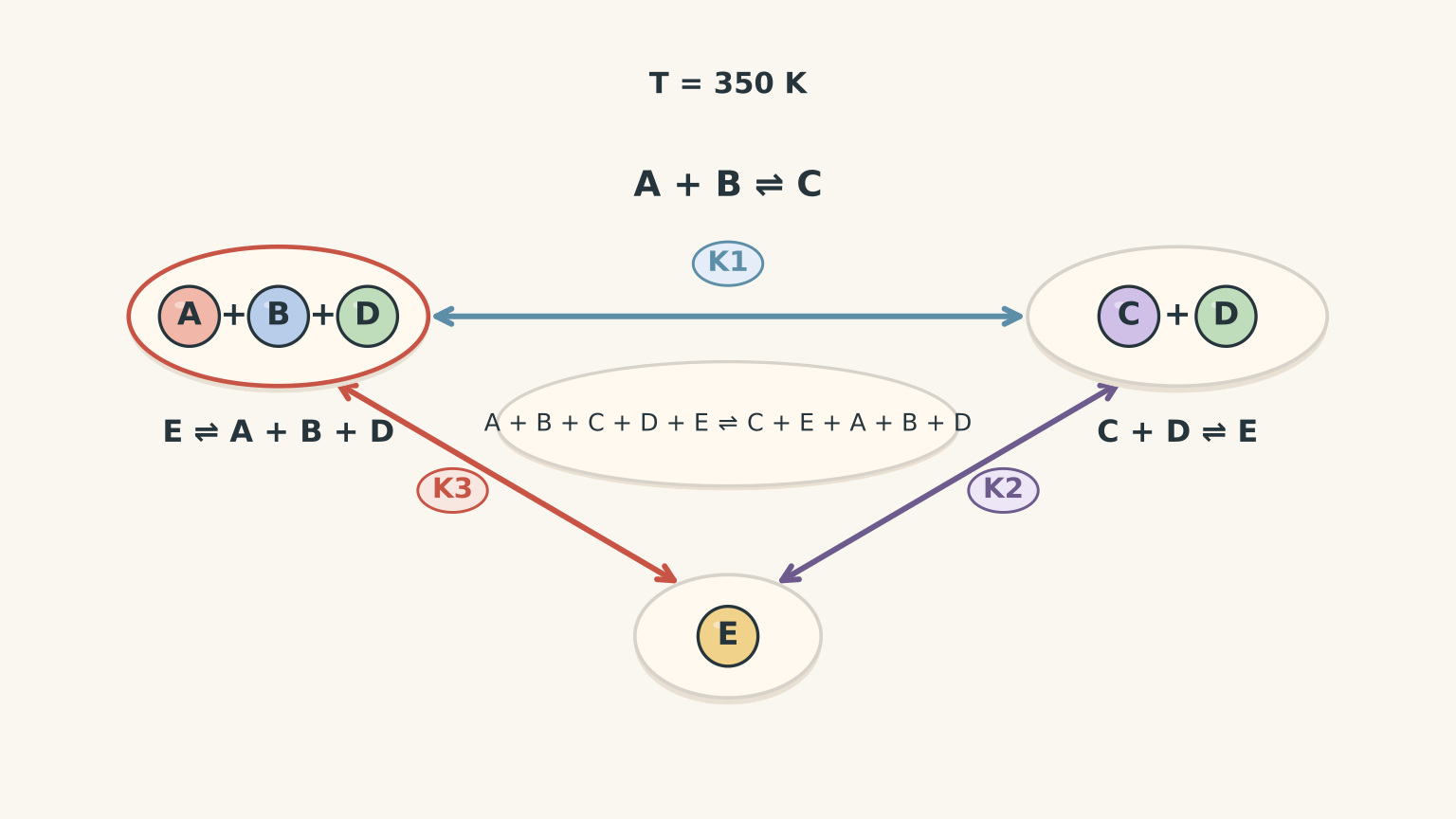
Consider three reversible reactions at 350 K:
\[ \ce{A(aq) + B(aq) <=> C(aq)} \]
\[ K_{c,1}=4.0\ \mathrm{L\,mol^{-1}} \]
\[ \ce{C(aq) + D(aq) <=> E(aq)} \]
\[ K_{c,2}=2.5\ \mathrm{L\,mol^{-1}} \]
A third measurement is being investigated:
\[ \ce{E(aq) <=> A(aq) + B(aq) + D(aq)} \]
A laboratory group reports:
\[ K_{c,3}=0.20\ \mathrm{mol^2\,L^{-2}} \]
Assume that the first two equilibrium constants have been independently validated and that all three reactions are intended to describe the same temperature and concentration convention.
At a particular instant, a mixture contains:
\[ [A]=0.20\ \mathrm{mol\,L^{-1}} \]
\[ [B]=0.10\ \mathrm{mol\,L^{-1}} \]
\[ [D]=0.50\ \mathrm{mol\,L^{-1}} \]
\[ [E]=0.020\ \mathrm{mol\,L^{-1}} \]
The concentration of C has not been measured.
Answer the following:
(a) Calculate the equilibrium constant for the overall reaction obtained by adding the first two equations.
(b) Determine the value that \(K_{c,3}\) must have for all three reactions to be thermodynamically consistent. Is the laboratory group’s result possible?
(c) Calculate the reaction quotient for the overall reaction using the instantaneous concentrations. Predict which direction the overall reaction will proceed.
(d) Does the magnitude of the overall equilibrium constant prove that the reaction will consume almost all of A, B, and D? Explain.
Due to technical limitations, this figure may display incorrectly or contain inaccuracies. Please check key details against your course materials.
Solution 5
The overall equilibrium constant is:
\[ \boxed{K_{c,\mathrm{overall}}=10.0\ \mathrm{L^2\,mol^{-2}}} \]
The reported third equilibrium constant is inconsistent with the first two, and the instantaneous mixture has a net tendency to form E.
This question combines reaction addition, reciprocal constants, consistency between reaction pathways, and reaction quotients.
Part (a): Calculate the overall equilibrium constant.
First, add the two validated reactions:
\[ \ce{A + B <=> C} \]
\[ \ce{C + D <=> E} \]
C appears on both sides, so it cancels:
\[ \boxed{\ce{A + B + D <=> E}} \]
The overall equilibrium constant is:
\[ K_{c,\mathrm{overall}}=K_{c,1}K_{c,2} \]
Substitute:
\[ =4.0\times2.5 \]
Therefore:
\[ \boxed{K_{c,\mathrm{overall}}=10.0\ \mathrm{L^2\,mol^{-2}}} \]
Part (b): Check the third equilibrium constant.
Notice that the third reaction is the exact reverse of the combined reaction:
\[ \ce{A + B + D <=> E} \]
becomes:
\[ \ce{E <=> A + B + D} \]
Reversing a reaction requires taking the reciprocal of its equilibrium constant.
Therefore:
\[ K_{c,3}=\frac{1}{K_{c,\mathrm{overall}}} \]
\[ =\frac{1}{10.0} \]
\[ \boxed{K_{c,3}=0.10\ \mathrm{mol^2\,L^{-2}}} \]
The laboratory group reported:
\[ K_{c,3}=0.20\ \mathrm{mol^2\,L^{-2}} \]
This is twice the value required for consistency.
We can also check the complete reaction cycle.
Adding all three reactions cancels every species:
\[ \ce{A+B+C+D+E <=> C+E+A+B+D} \]
There is no net chemical reaction.
Consequently, the product of the three equilibrium constants must equal 1:
\[ K_{c,1}K_{c,2}K_{c,3}=1 \]
Using the reported measurement:
\[ 4.0\times2.5\times0.20=2.0 \]
But the required result is 1, not 2.
Therefore, the third measurement is incompatible with the first two validated constants.
This is an important consistency test. When a series of reaction equations forms a closed cycle with no net reaction, the product of their appropriately adjusted equilibrium constants must be 1.
Part (c): Calculate the reaction quotient and predict the direction.
The reaction quotient, Q, describes the current composition of a mixture. Unlike K, it changes as the concentrations change.
For the overall reaction:
\[ \ce{A + B + D <=> E} \]
the reaction quotient is:
\[ Q_c=\frac{[E]}{[A][B][D]} \]
Notice that C does not appear. It cancelled when we combined the original reactions.
Substitute the instantaneous concentrations:
\[ Q_c= \frac{0.020} {0.20\times0.10\times0.50} \]
Calculate the denominator:
\[ 0.20\times0.10\times0.50=0.010 \]
Therefore:
\[ Q_c=\frac{0.020}{0.010} \]
\[ \boxed{Q_c=2.0\ \mathrm{L^2\,mol^{-2}}} \]
Now compare Q with the validated equilibrium constant:
\[ Q_c=2.0 \]
\[ K_c=10.0 \]
Since:
\[ Q_c<K_c \]
the overall reaction has a net tendency to proceed forwards, towards the formation of E.
The mixture currently contains a smaller product-to-reactant concentration ratio than required at equilibrium.
Part (d): Interpret the magnitude carefully.
No. A relatively large equilibrium constant does not guarantee that almost all reactants will be consumed.
The value:
\[ K_{c,\mathrm{overall}}=10.0\ \mathrm{L^2\,mol^{-2}} \]
describes the equilibrium relationship for the overall reaction. It does not specify a percentage conversion.
The comparison \(Q_c<K_c\) tells us the direction of the net change from the current mixture. It does not tell us exactly what the final concentrations will be.
To calculate those concentrations, we would need additional information about the initial quantities and the stoichiometric changes as the reaction proceeds.
This distinction is important: combining equilibrium constants tells you the equilibrium relationship for a new reaction, while comparing Q with K tells you which direction a particular mixture needs to move to reach equilibrium.
Once you can combine equilibrium constants reliably, the next useful skill is calculating the reaction quotient for a mixture that has not yet reached equilibrium. Together, these methods let you determine both the equilibrium position and the direction in which a chemical system will shift.