
Why Equilibrium Constants Depend on the Balanced Reaction as Written
Learn why changing the coefficients or direction of a balanced equilibrium equation changes its numerical Kc. Explore worked calculations, experimental evidence, and how to interpret equilibrium constants without confusing mathematical changes with changes to the actual equilibrium.
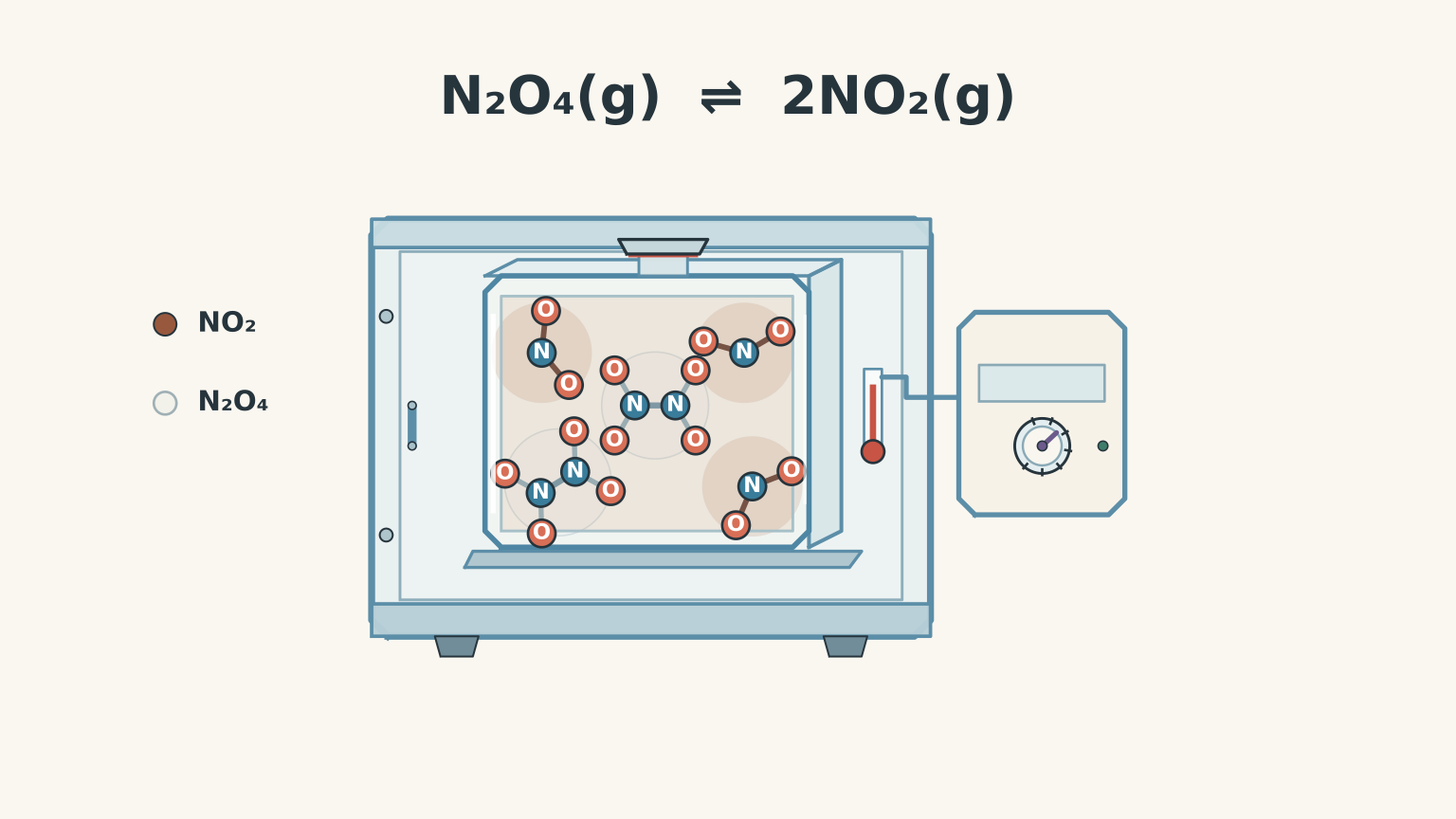
A sealed flask contains an equilibrium mixture of nitrogen dioxide and dinitrogen tetroxide:
\[ \ce{N2O4(g) <=> 2NO2(g)} \]
A student doubles every coefficient and writes the same reaction as:
\[ \ce{2N2O4(g) <=> 4NO2(g)} \]
The gas mixture hasn’t changed. So should its equilibrium constant stay the same?
No. Doubling every coefficient squares the equilibrium constant. The physical equilibrium is identical, but the mathematical expression used to describe it has changed.
This happens because the coefficients in a balanced equilibrium equation become powers in its equilibrium expression. At a fixed temperature, multiplying every coefficient by \(n\) raises the original equilibrium constant to the power \(n\).
Understanding why this happens will help you avoid a particularly confusing HSC Chemistry mistake: interpreting different numerical equilibrium constants as evidence that the same chemical system has different equilibrium positions.
Due to technical limitations, this figure may display incorrectly or contain inaccuracies. Please check key details against your course materials.
01Why does changing the balanced equation change Kc?
Start with the general homogeneous equilibrium:
\[ \ce{aA(aq) + bB(aq) <=> cC(aq) + dD(aq)} \]
Its concentration equilibrium expression is:
\[ K_c=\frac{[C]^c[D]^d}{[A]^a[B]^b} \]
Here:
- \(K_c\) is the concentration equilibrium constant.
- Square brackets represent equilibrium concentrations in \(\mathrm{mol\,L^{-1}}\).
- \(a\), \(b\), \(c\), and \(d\) are the stoichiometric coefficients in the balanced equation.
Products appear in the numerator, reactants appear in the denominator, and each coefficient becomes an exponent.
If you need to refresh how these expressions are constructed, see Equilibrium Expressions for Homogeneous Reactions | HSC Chemistry.
The coefficients determine the powers
Return to the nitrogen dioxide equilibrium:
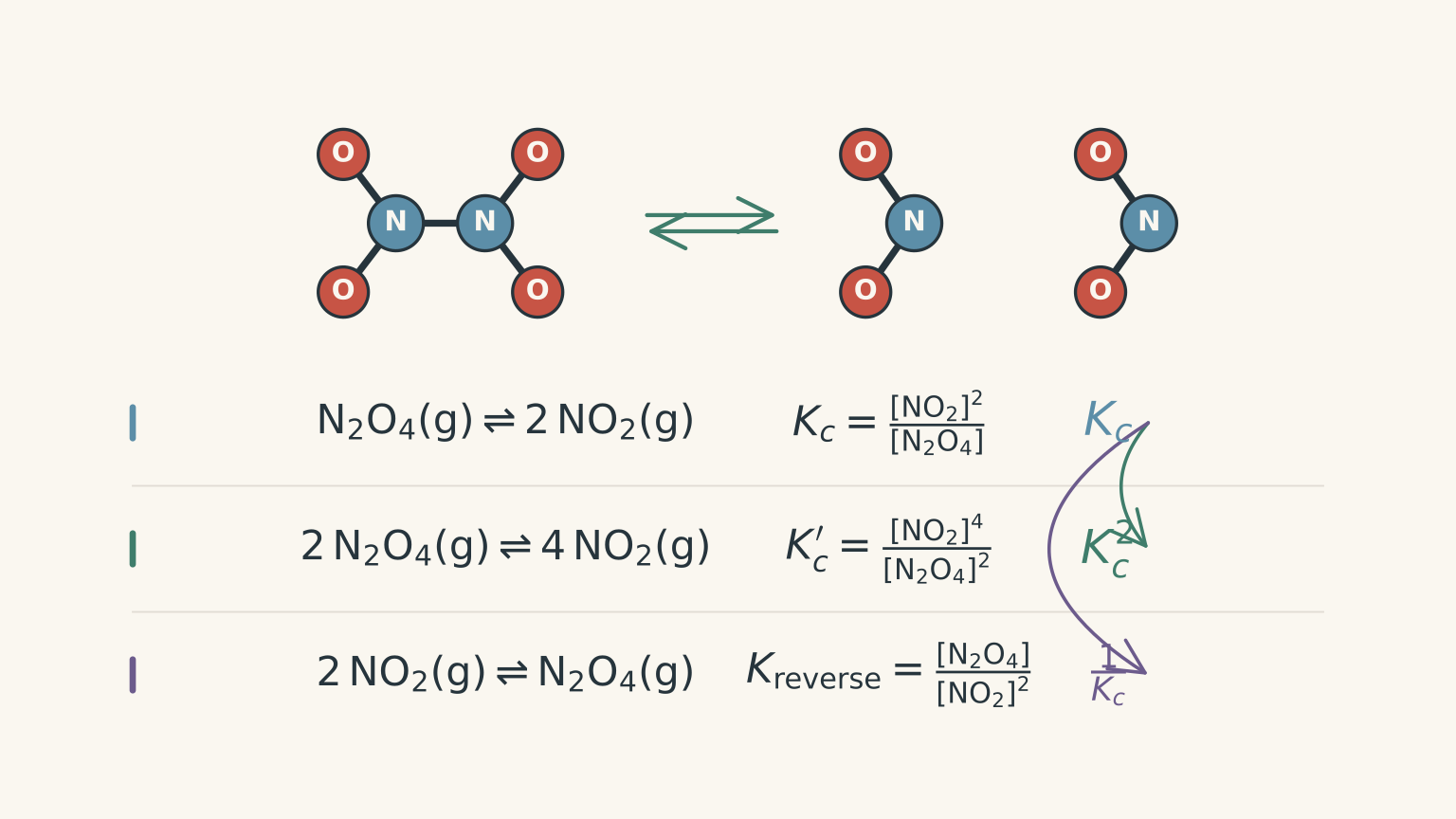
\[ \ce{N2O4(g) <=> 2NO2(g)} \]
Its equilibrium expression is:
\[ K_c=\frac{[\ce{NO2}]^2}{[\ce{N2O4}]} \]
Notice that the coefficient 2 becomes a square.
It does not become \(2[\ce{NO2}]\).
Now double every coefficient:
\[ \ce{2N2O4(g) <=> 4NO2(g)} \]
The new equilibrium expression is:
\[ K'_c=\frac{[\ce{NO2}]^4}{[\ce{N2O4}]^2} \]
Rearrange this expression:
\[ \begin{aligned} K'_c &=\left( \frac{[\ce{NO2}]^2}{[\ce{N2O4}]} \right)^2\\ &=K_c^2 \end{aligned} \]
Therefore:
\[ \boxed{K'_c=K_c^2} \]
The important point is that every concentration factor in the original expression is now included twice.
The chemical system has not changed. We have simply changed the way its overall reaction is represented.
Due to technical limitations, this figure may display incorrectly or contain inaccuracies. Please check key details against your course materials.
What happens when you rewrite an equation?
There are three important transformations.
| Change to the balanced equation | Change to the equilibrium constant |
|---|---|
| Reverse the reaction | \(K_{\mathrm{new}}=\frac{1}{K_{\mathrm{old}}}\) |
| Multiply every coefficient by \(n\) | \(K_{\mathrm{new}}=K_{\mathrm{old}}^n\) |
| Divide every coefficient by \(n\) | \(K_{\mathrm{new}}=K_{\mathrm{old}}^{1/n}\) |
Let’s understand each one.
1. Reversing the reaction
Consider:
\[ \ce{A <=> B} \]
Its equilibrium expression is:
\[ K_c=\frac{[B]}{[A]} \]
Reverse the equation:
\[ \ce{B <=> A} \]
The new expression becomes:
\[ K_{c,\mathrm{reverse}}=\frac{[A]}{[B]} \]
The numerator and denominator have swapped, so:
\[ \boxed{K_{c,\mathrm{reverse}}=\frac{1}{K_c}} \]
Reversing the reaction takes the reciprocal of the equilibrium constant. It does not make the constant negative.
2. Multiplying every coefficient
Suppose:
\[ \ce{A <=> B} \]
has \(K_c=4.0\).
Doubling the equation gives:
\[ \ce{2A <=> 2B} \]
The new expression is:
\[ K'_c=\frac{[B]^2}{[A]^2} \]
Therefore:
\[ K'_c=\left(\frac{[B]}{[A]}\right)^2 \]
\[ \boxed{K'_c=4.0^2=16.0} \]
3. Dividing every coefficient
Suppose the original equation is:
\[ \ce{2A <=> 2B} \]
Dividing every coefficient by 2 gives:
\[ \ce{A <=> B} \]
The equilibrium constant becomes:
\[ \boxed{K_{\mathrm{new}}=\sqrt{K_{\mathrm{old}}}} \]
The square root is simply the reverse mathematical operation of squaring.
Remember that these transformations require every coefficient to be multiplied or divided by the same factor. Changing only one coefficient does not give an alternative representation of the same balanced reaction.
02An experiment that separates the chemistry from the notation
Why should we believe that changing the equation changes the numerical constant but not the actual equilibrium?
We can investigate this using the equilibrium between \(\ce{N2O4}\) and \(\ce{NO2}\).
This is a useful system because nitrogen dioxide is brown, while dinitrogen tetroxide is nearly colourless. We can use the colour of the mixture to investigate how much nitrogen dioxide is present.
The measurement problem
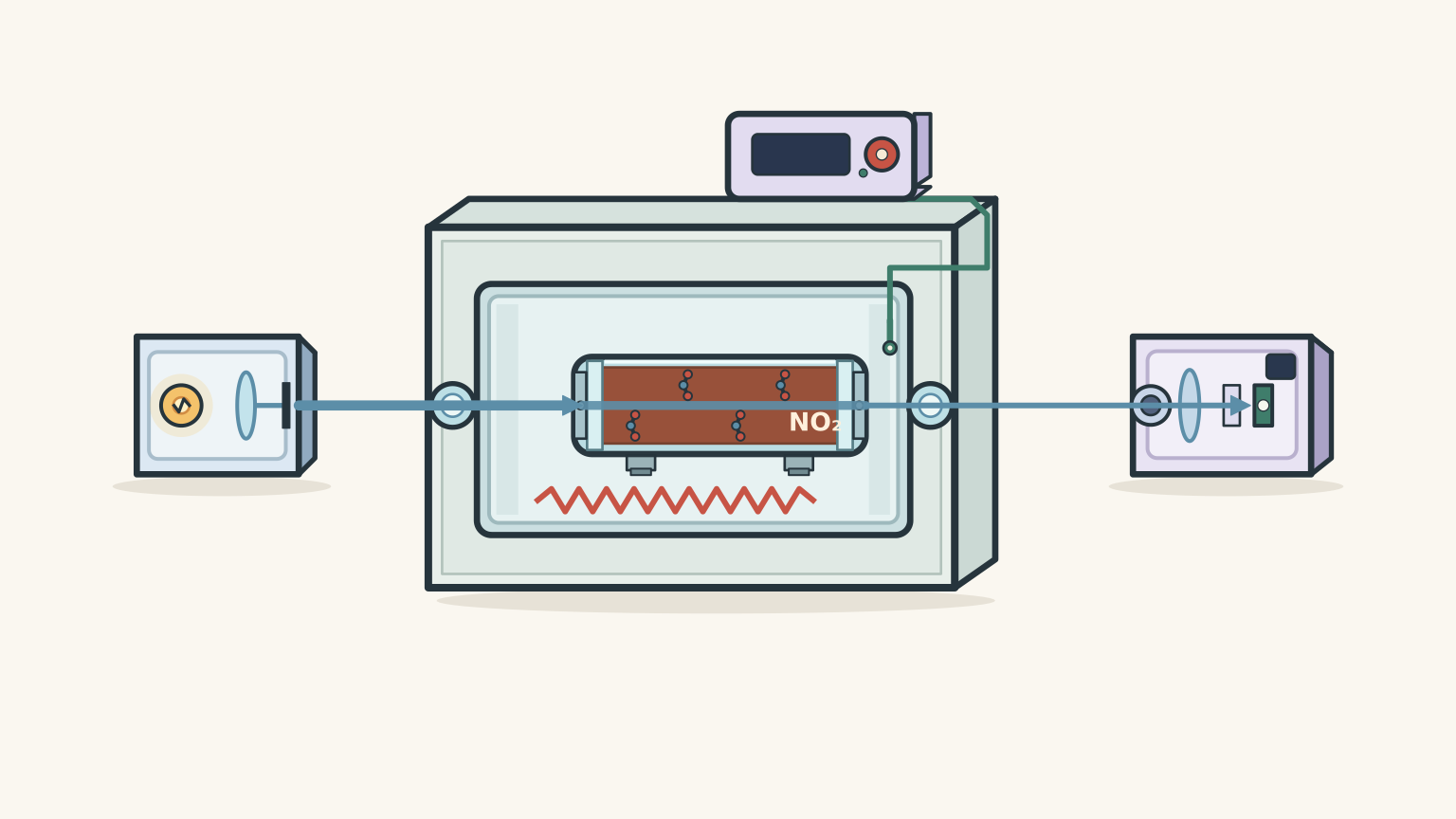
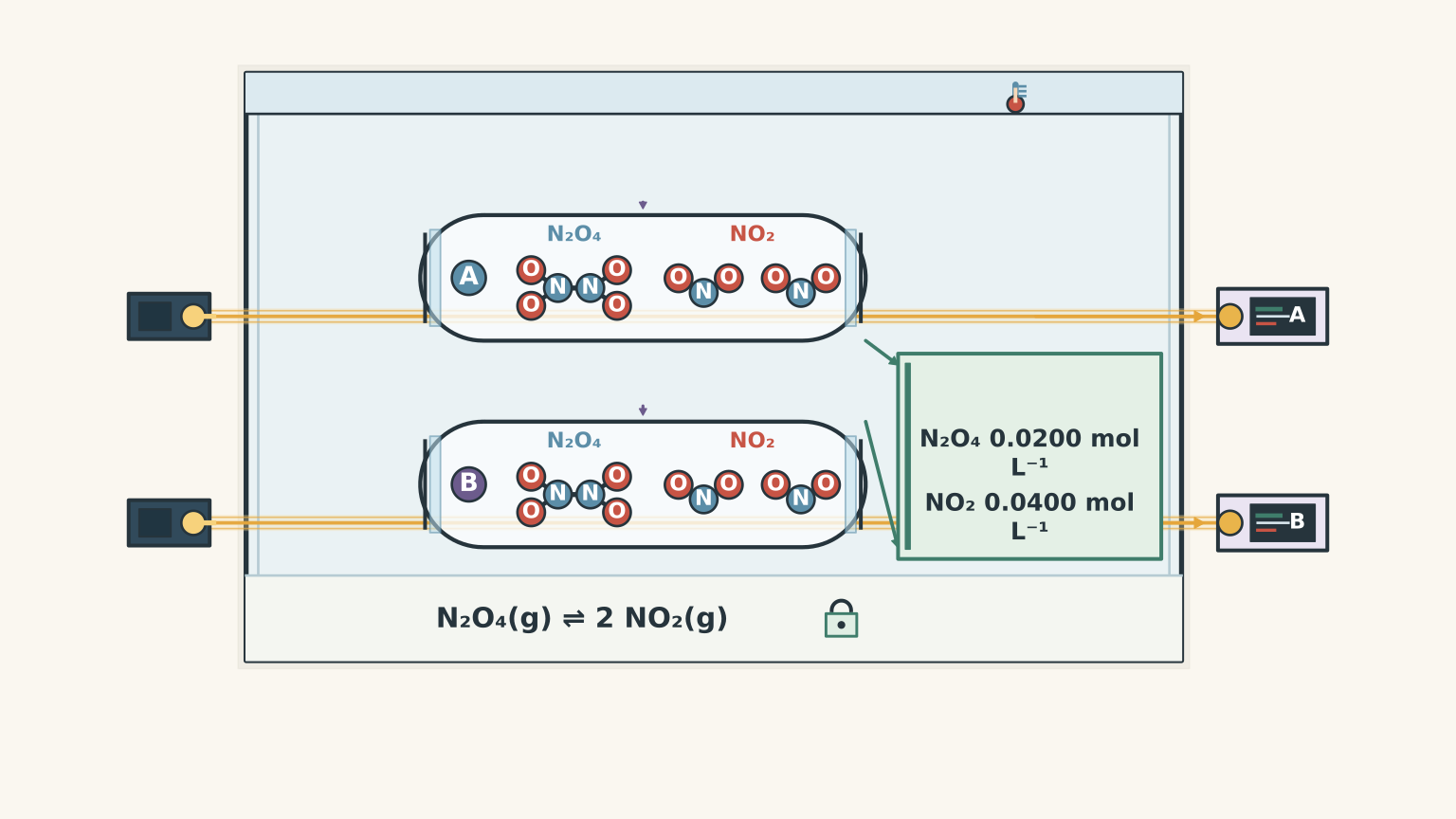
Imagine preparing a sealed gas cell containing a known concentration of \(\ce{N2O4}\).
The cell is placed inside a temperature-controlled enclosure. A light source sends a beam through the cell, and a detector on the opposite side measures how much light is absorbed by the brown nitrogen dioxide.
A calibration curve relates the measured absorbance to the concentration of \(\ce{NO2}\).
Due to technical limitations, this figure may display incorrectly or contain inaccuracies. Please check key details against your course materials.
What should this experiment show?
As \(\ce{N2O4}\) dissociates, the concentration of brown \(\ce{NO2}\) increases. Eventually, the absorbance reaches a steady value, consistent with the mixture reaching equilibrium.
However, a stable colour alone is not enough to calculate \(K_c\).
There are two problems:
- Visual colour comparisons are not precise concentration measurements. Lighting conditions and the distance light travels through the sample can affect the apparent colour.
- Measuring \(\ce{NO2}\) does not automatically tell us how much colourless \(\ce{N2O4}\) remains.
We need a more complete measurement.
Improving the experiment
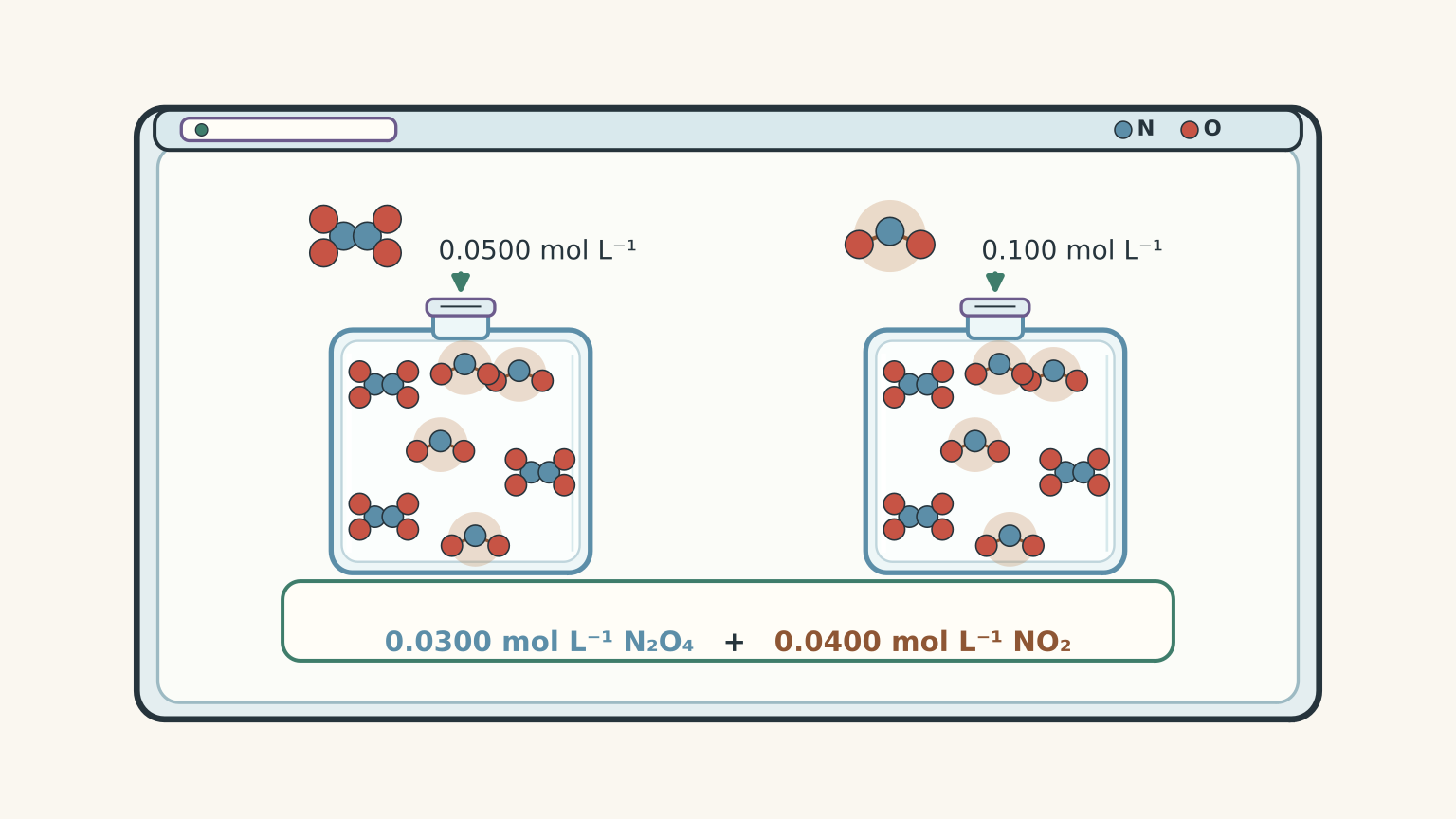
A better design uses two identical sealed cells, each with the same total amount of nitrogen-containing material per unit volume.
- Cell A initially contains only \(\ce{N2O4}\).
- Cell B initially contains only \(\ce{NO2}\).
Both cells are held at the same temperature and volume. We use calibrated absorbance measurements to determine the equilibrium concentration of \(\ce{NO2}\).
The remaining \(\ce{N2O4}\) concentration can then be calculated using conservation of nitrogen atoms.
For every mole of \(\ce{N2O4}\) that dissociates, two moles of \(\ce{NO2}\) form.
Therefore, the total concentration of nitrogen dioxide equivalents is:
\[ C_{\mathrm{total}} = [\ce{N2O4}] +\frac{1}{2}[\ce{NO2}] \]
Suppose the initial conditions are:
| Measurement | Cell A | Cell B |
|---|---|---|
| Initial \([\ce{N2O4}]\) | 0.0500 M | 0 |
| Initial \([\ce{NO2}]\) | 0 | 0.100 M |
| Total nitrogen dioxide equivalents | 0.0500 M | 0.0500 M |
The following equilibrium measurements are illustrative, not reported experimental data.
Both cells reach the same final concentrations:
| Equilibrium measurement | Cell A | Cell B |
|---|---|---|
| \([\ce{N2O4}]\) | 0.0300 M | 0.0300 M |
| \([\ce{NO2}]\) | 0.0400 M | 0.0400 M |
Due to technical limitations, this figure may display incorrectly or contain inaccuracies. Please check key details against your course materials.
This result is consistent with both starting mixtures reaching the same equilibrium composition.
The important observation is that the physical mixture has one composition, regardless of whether we initially supplied the reactant or the product.
We can now calculate the equilibrium constant for that mixture.
Worked example: Calculate Kc from an equilibrium measurement
A sealed vessel initially contains \(0.0500\ \mathrm{mol\,L^{-1}}\) of \(\ce{N2O4}\) and no \(\ce{NO2}\).
At equilibrium, a calibrated spectrophotometer measurement gives:
\[ [\ce{NO2}]=0.0400\ \mathrm{mol\,L^{-1}} \]
Calculate the equilibrium concentration of \(\ce{N2O4}\) and \(K_c\) for:
\[ \ce{N2O4(g) <=> 2NO2(g)} \]
Then calculate the equilibrium constant for the doubled equation.
Step 1
The reaction produces two moles of \(\ce{NO2}\) for every mole of \(\ce{N2O4}\) consumed.
Therefore:
\[ \Delta[\ce{N2O4}] =-\frac{0.0400}{2} =-0.0200\ \mathrm{mol\,L^{-1}} \]
Step 2
\[ \begin{aligned} [\ce{N2O4}]_{\mathrm{eq}} &=0.0500-0.0200\\ &=0.0300\ \mathrm{mol\,L^{-1}} \end{aligned} \]
Step 3
For the original equation:
\[ K_c=\frac{[\ce{NO2}]^2}{[\ce{N2O4}]} \]
Substitute the equilibrium concentrations:
\[ \begin{aligned} K_c &=\frac{(0.0400)^2}{0.0300}\\ &=\frac{0.001600}{0.0300}\\ &=0.0533 \end{aligned} \]
Therefore:
\[ \boxed{K_c=0.0533\ \mathrm{mol\,L^{-1}}} \]
Step 4
The doubled equation is:
\[ \ce{2N2O4(g) <=> 4NO2(g)} \]
Every coefficient has doubled, so the new equilibrium constant is the square of the original:
\[ \begin{aligned} K'_c&=K_c^2\\ &=(0.0533)^2\\ &=0.00284 \end{aligned} \]
Therefore:
\[ \boxed{K'_c=0.00284\ (\mathrm{mol\,L^{-1}})^2} \]
The equilibrium mixture has not changed at all.
Only the equation used to calculate the constant has changed.
This is the central distinction: an equilibrium constant belongs to a particular balanced equation at a particular temperature, not simply to the chemical substances involved.
03Why you must interpret the magnitude of Kc carefully
Here is a particularly tempting mistake.
The original reaction has:
\[ K_c=0.0533 \]
The doubled reaction has:
\[ K'_c=0.00284 \]
A student might conclude that the doubled reaction is much more strongly reactant-favoured because its equilibrium constant is smaller.
That conclusion is incorrect.
Both constants describe exactly the same equilibrium mixture. The second expression simply squares every concentration factor in the first expression.
There is another useful comparison.
Reverse the original equation:
\[ \ce{2NO2(g) <=> N2O4(g)} \]
The equilibrium constant becomes:
\[ K_{c,\mathrm{reverse}}=\frac{1}{0.0533} \]
\[ \boxed{K_{c,\mathrm{reverse}}=18.75\ \mathrm{L\,mol^{-1}}} \]
We now have three different numerical values:
| Balanced equation | Equilibrium constant |
|---|---|
| \(\ce{N2O4 <=> 2NO2}\) | 0.0533 |
| \(\ce{2N2O4 <=> 4NO2}\) | 0.00284 |
| \(\ce{2NO2 <=> N2O4}\) | 18.75 |
Yet all three describe the same physical equilibrium.
Does a large Kc always mean there is more product?
Not necessarily.
An equilibrium constant is not simply the ratio of the total product concentration to the total reactant concentration.
It is a mathematical relationship involving concentrations raised to the powers specified by the balanced equation.
In our example:
\[ [\ce{NO2}]=0.0400\ \mathrm{mol\,L^{-1}} \]
while:
\[ [\ce{N2O4}]=0.0300\ \mathrm{mol\,L^{-1}} \]
The product concentration is actually greater than the reactant concentration, even though the calculated \(K_c\) is less than 1.
There is no contradiction. The expression contains the square of the nitrogen dioxide concentration, and the concentration quotient has apparent units.
The familiar shortcut that \(K_c>1\) indicates products are favoured and \(K_c<1\) indicates reactants are favoured is useful only when interpreted in the context of a fixed reaction expression and concentration convention.
Keep these distinctions in mind:
- \(K_c\) is not a percentage yield.
- \(K_c\) does not directly tell you the percentage of reactant consumed.
- You cannot rank different equation representations by comparing their numerical \(K_c\) values.
- Changing the direction or scale of the equation changes the numerical constant without changing the physical equilibrium.
One further detail about units: the HSC-style concentration quotient used here can have apparent units that depend on the powers in the expression. For example, the original nitrogen dioxide equilibrium has units of \(\mathrm{mol\,L^{-1}}\), while its doubled version has units of \((\mathrm{mol\,L^{-1}})^2\).
In strict thermodynamic treatments, equilibrium constants are dimensionless because they are defined using activities relative to standard states. For standard HSC concentration calculations, follow the concentration convention specified in the question and retain any requested units consistently.
04Temperature changes K for a different reason
So far, we have assumed that temperature stays constant.
This assumption matters.
For a particular balanced equation, the equilibrium constant is fixed at a given temperature. Changing the initial concentrations or the amount of reactant does not change \(K_c\), provided the temperature remains constant.
Changing temperature is different.
For example, suppose:
\[ \ce{A(g) <=> B(g)} \]
has an equilibrium constant of \(K_c=5.0\) at \(300\ \mathrm{K}\).
At \(400\ \mathrm{K}\), the same balanced equation may have a completely different equilibrium constant.
You cannot assume that the value remains 5.0.
There are therefore two separate reasons you might encounter different equilibrium constants:
- The balanced equation has been rewritten, changing the mathematical expression.
- The temperature has changed, altering the actual equilibrium relationship.
Do not confuse these two effects.
When reversing or scaling a reaction, the equilibrium constants being related must refer to the same temperature.
Worked example: Reverse and halve an equilibrium equation
At \(400\ \mathrm{K}\), the reaction:
\[ \ce{2P(g) + Q(g) <=> 3R(g)} \]
has an equilibrium constant:
\[ K_c=0.160 \]
Calculate the equilibrium constant for:
\[ \ce{3/2R(g) <=> P(g) + 1/2Q(g)} \]
Step 1
First, divide every coefficient in the original equation by 2:
\[ \ce{P(g) + 1/2Q(g) <=> 3/2R(g)} \]
The equilibrium constant must therefore be square-rooted:
\[ \begin{aligned} K'_c&=\sqrt{K_c}\\ &=\sqrt{0.160}\\ &=0.400 \end{aligned} \]
Step 2
The target equation is the reverse of the equation we have just obtained.
Reversing the reaction requires taking the reciprocal:
\[ K''_c=\frac{1}{K'_c} \]
\[ K''_c=\frac{1}{0.400} \]
Therefore:
\[ \boxed{K''_c=2.50} \]
The final equilibrium constant is 2.50.
The tempting mistake is to take the reciprocal of 0.160 immediately, or to square it. Neither accounts for both transformations.
The correct sequence is to halve the coefficients first, then reverse the equation.
All calculations refer to \(400\ \mathrm{K}\). If the original constant had been measured at a different temperature, this calculation would not be valid.
05Questions and solutions
The following questions move from straightforward equation scaling to more involved situations where the equation, temperature, and reaction direction must all be considered together.
Question 1
At \(450\ \mathrm{K}\), the equilibrium:
\[ \ce{H2(g) + I2(g) <=> 2HI(g)} \]
has an equilibrium constant of:
\[ K_c=49.0 \]
Calculate the equilibrium constant for:
\[ \ce{2H2(g) + 2I2(g) <=> 4HI(g)} \]
Explain whether the physical equilibrium mixture changes.
Solution 1
The new equilibrium constant is \(2401\), and the physical equilibrium mixture remains unchanged.
Every coefficient in the original equation has been multiplied by 2.
Therefore:
\[ K'_c=K_c^2 \]
Substituting:
\[ \begin{aligned} K'_c&=(49.0)^2\\ &=2401 \end{aligned} \]
Hence:
\[ \boxed{K'_c=2.40\times10^3} \]
The equation has been scaled, not chemically altered.
The equilibrium expression now contains twice as many concentration factors, so its numerical value is squared.
The original and doubled equations describe the same equilibrium mixture at \(450\ \mathrm{K}\).
Question 2
At \(320\ \mathrm{K}\), the following equilibrium has:
\[ \ce{2A(aq) + B(aq) <=> 3C(aq)} \]
with:
\[ K_c=27.0 \]
Determine the equilibrium constant for:
\[ \ce{C(aq) <=> 2/3A(aq) + 1/3B(aq)} \]
Show each transformation and explain why the final value is not negative.
Solution 2
The equilibrium constant for the target equation is:
\[ \boxed{K'_c=\frac{1}{3}} \]
The target equation involves two transformations.
Step 1: Divide every coefficient in the original equation by 3.
\[ \ce{2/3A + 1/3B <=> C} \]
Dividing all coefficients by 3 means taking the cube root of the original equilibrium constant:
\[ K_1=(27.0)^{1/3} \]
\[ K_1=3.00 \]
Step 2: Reverse the equation.
The target equation is:
\[ \ce{C <=> 2/3A + 1/3B} \]
Reversing the reaction means taking the reciprocal:
\[ K'_c=\frac{1}{K_1} \]
\[ K'_c=\frac{1}{3.00} \]
Therefore:
\[ \boxed{K'_c=0.333} \]
The equilibrium constant remains positive.
Reversing an equation does not make its equilibrium constant negative. It changes the numerator and denominator of the equilibrium expression, producing a reciprocal.
The important detail is that both transformations must be included.
Question 3
At \(350\ \mathrm{K}\), an equilibrium mixture contains:
\[ [\ce{D}]=0.100\ \mathrm{mol\,L^{-1}} \]
\[ [\ce{E}]=0.1581\ \mathrm{mol\,L^{-1}} \]
Three sources report the following equilibrium constants:
| Source | Balanced equation | Reported \(K_c\) |
|---|---|---|
| I | \(\ce{D(g) <=> 2E(g)}\) | \(0.250\ \mathrm{mol\,L^{-1}}\) |
| II | \(\ce{2D(g) <=> 4E(g)}\) | \(0.0625\ (\mathrm{mol\,L^{-1}})^2\) |
| III | \(\ce{2E(g) <=> D(g)}\) | \(4.00\ \mathrm{L\,mol^{-1}}\) |
A student claims that these values cannot all be correct because the three sources report different equilibrium constants.
Determine whether the three results are consistent with the same physical equilibrium mixture. Justify your answer using the equilibrium expressions.
Solution 3
All three reported values are consistent with the same physical equilibrium mixture.
The difference comes from scaling and reversing the balanced equation.
Step 1: Check Source I.
For:
\[ \ce{D(g) <=> 2E(g)} \]
the equilibrium expression is:
\[ K_{c,1}=\frac{[\ce{E}]^2}{[\ce{D}]} \]
Substituting:
\[ \begin{aligned} K_{c,1} &=\frac{(0.1581)^2}{0.100}\\ &\approx0.250 \end{aligned} \]
Source I is correct.
Step 2: Check Source II.
Source II has doubled every coefficient.
Therefore:
\[ K_{c,2}=K_{c,1}^2 \]
\[ K_{c,2}=(0.250)^2 \]
\[ \boxed{K_{c,2}=0.0625} \]
This agrees with Source II.
Step 3: Check Source III.
Source III has reversed the original equation.
Therefore:
\[ K_{c,3}=\frac{1}{K_{c,1}} \]
\[ K_{c,3}=\frac{1}{0.250} \]
\[ \boxed{K_{c,3}=4.00} \]
This agrees with Source III.
The tempting assumption is that one chemical equilibrium must have one numerical equilibrium constant, regardless of how its equation is written.
That is incorrect.
Each value belongs to its particular balanced equation. All three describe the same physical mixture at the same temperature.
Question 4
Two identical sealed gas cells are maintained at the same temperature and constant volume.
They contain the equilibrium system:
\[ \ce{N2O4(g) <=> 2NO2(g)} \]
Their initial concentrations are:
| Substance | Cell A | Cell B |
|---|---|---|
| \(\ce{N2O4}\) | \(0.0400\ \mathrm{mol\,L^{-1}}\) | \(0\) |
| \(\ce{NO2}\) | \(0\) | \(0.0800\ \mathrm{mol\,L^{-1}}\) |
After equilibrium is established, calibrated spectrophotometer measurements show that both cells contain:
\[ [\ce{NO2}]=0.0400\ \mathrm{mol\,L^{-1}} \]
Assume that no other reactions occur and no gas escapes.
(a) Calculate the equilibrium concentration of \(\ce{N2O4}\) in each cell.
(b) Calculate \(K_c\) for the forward reaction.
(c) Explain why both cells can reach the same equilibrium composition despite starting with different substances.
(d) Explain why comparing the brown colour of the cells by eye would not be sufficient to establish their equilibrium constants.
Due to technical limitations, this figure may display incorrectly or contain inaccuracies. Please check key details against your course materials.
Solution 4
Both cells reach:
\[ [\ce{N2O4}]_{\mathrm{eq}}=0.0200\ \mathrm{mol\,L^{-1}} \]
and:
\[ \boxed{K_c=0.0800\ \mathrm{mol\,L^{-1}}} \]
(a) Calculate the equilibrium concentration of \(\ce{N2O4}\).
The balanced equation tells us that two moles of \(\ce{NO2}\) form for every mole of \(\ce{N2O4}\) consumed.
For Cell A, the initial concentration of \(\ce{N2O4}\) is \(0.0400\ \mathrm{mol\,L^{-1}}\).
The equilibrium concentration of \(\ce{NO2}\) is \(0.0400\ \mathrm{mol\,L^{-1}}\).
Therefore, the amount of \(\ce{N2O4}\) consumed is:
\[ \frac{0.0400}{2}=0.0200\ \mathrm{mol\,L^{-1}} \]
The remaining concentration is:
\[ [\ce{N2O4}]_{\mathrm{eq}} =0.0400-0.0200 \]
\[ =0.0200\ \mathrm{mol\,L^{-1}} \]
For Cell B, the initial concentration of \(\ce{NO2}\) is \(0.0800\ \mathrm{mol\,L^{-1}}\).
The reaction proceeds in the reverse direction, consuming \(0.0400\ \mathrm{mol\,L^{-1}}\) of \(\ce{NO2}\) and forming:
\[ \frac{0.0400}{2} =0.0200\ \mathrm{mol\,L^{-1}} \]
of \(\ce{N2O4}\).
Therefore, both cells reach the same final concentrations.
(b) Calculate the equilibrium constant.
The equilibrium expression is:
\[ K_c=\frac{[\ce{NO2}]^2}{[\ce{N2O4}]} \]
Substitute the equilibrium concentrations:
\[ \begin{aligned} K_c &=\frac{(0.0400)^2}{0.0200}\\ &=\frac{0.001600}{0.0200}\\ &=0.0800 \end{aligned} \]
Therefore:
\[ \boxed{K_c=0.0800\ \mathrm{mol\,L^{-1}}} \]
(c) Explain why the cells reach the same equilibrium composition.
Both cells contain the same total concentration of nitrogen atoms per unit volume.
Expressed in terms of \(\ce{N2O4}\) equivalents:
\[ C_{\mathrm{total}} = [\ce{N2O4}] +\frac{1}{2}[\ce{NO2}] \]
For Cell A:
\[ C_{\mathrm{total}}=0.0400 \]
For Cell B:
\[ C_{\mathrm{total}}=\frac{0.0800}{2}=0.0400 \]
Both cells also have the same temperature and volume.
Consequently, they have the same conserved material and the same equilibrium conditions. They can reach the same final composition even though their starting mixtures are different.
(d) Explain the limitation of visual colour comparisons.
Visual colour comparisons do not provide sufficiently accurate concentration measurements.
The apparent colour depends on factors such as light intensity and the distance light travels through the sample.
More importantly, colour primarily indicates the amount of \(\ce{NO2}\). It does not independently establish the concentration of colourless \(\ce{N2O4}\).
A calibrated absorbance measurement, combined with the known initial amounts and stoichiometric relationships, provides the additional information needed to calculate \(K_c\).
Question 5
At \(350\ \mathrm{K}\), the equilibrium:
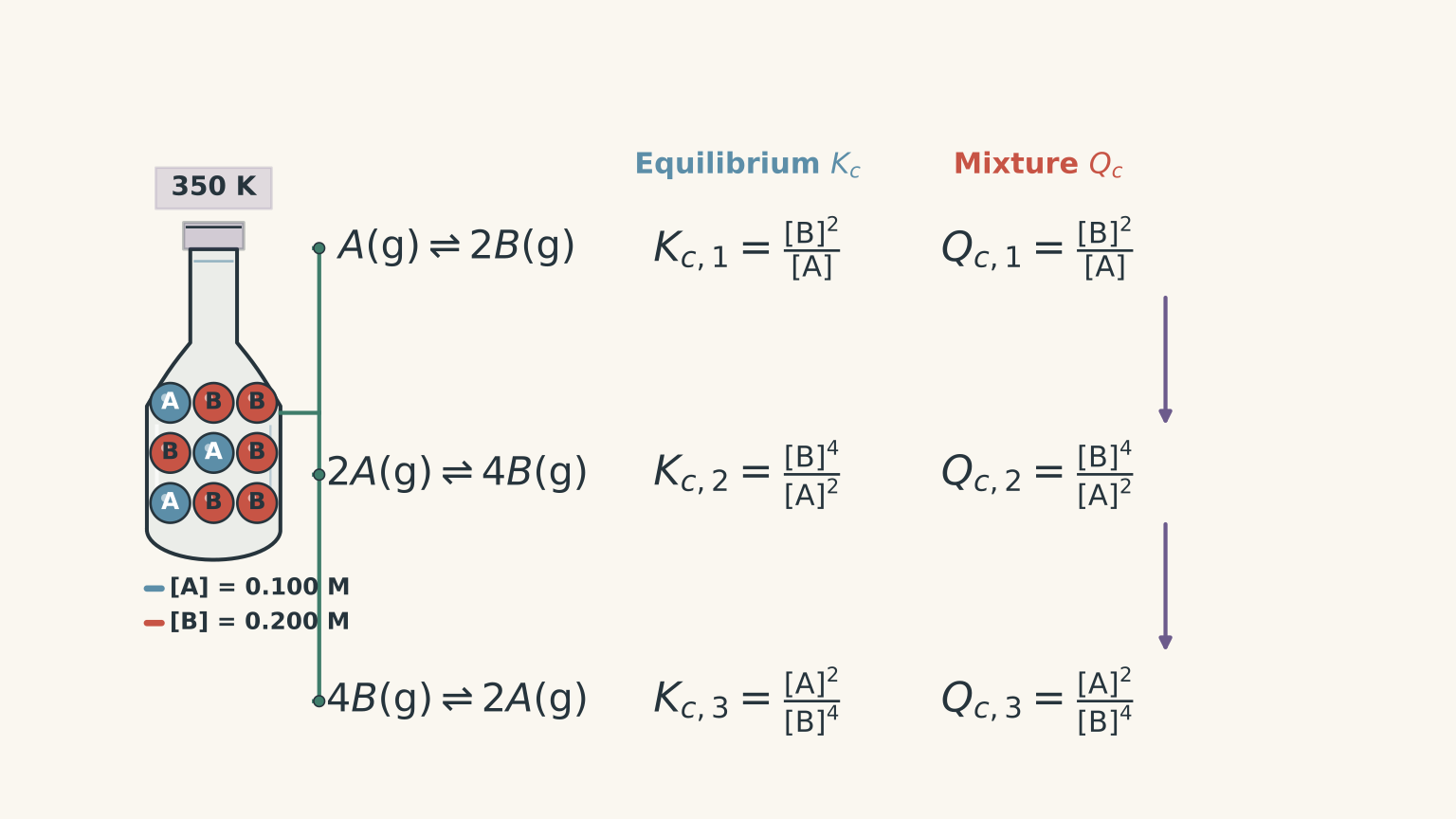
\[ \ce{A(g) <=> 2B(g)} \]
has:
\[ K_c=0.250\ \mathrm{mol\,L^{-1}} \]
A disturbed mixture at the same temperature contains:
\[ [\ce{A}]=0.100\ \mathrm{mol\,L^{-1}} \]
\[ [\ce{B}]=0.200\ \mathrm{mol\,L^{-1}} \]
Three students describe the system using different balanced equations:
- Student 1 uses \(\ce{A(g) <=> 2B(g)}\).
- Student 2 doubles the equation to \(\ce{2A(g) <=> 4B(g)}\).
- Student 3 reverses Student 2’s equation to \(\ce{4B(g) <=> 2A(g)}\).
They obtain three different equilibrium constants.
(a) Calculate the equilibrium constant for each representation.
(b) Calculate the reaction quotient, \(Q_c\), for each representation using the supplied concentrations.
(c) Determine the direction in which the physical reaction proceeds. Explain why all three representations must predict the same physical change, despite their different equilibrium constants.
(d) A fourth student rapidly warms the original mixture to \(400\ \mathrm{K}\) in a fixed-volume vessel. Immediately after heating, the concentrations have not yet changed. Can the student use the original \(K_c=0.250\) to determine the reaction direction at \(400\ \mathrm{K}\)? Explain what additional information is required.
Due to technical limitations, this figure may display incorrectly or contain inaccuracies. Please check key details against your course materials.
Solution 5
All three representations predict the same physical change: the reaction proceeds towards the formation of \(\ce{A}\), consuming \(\ce{B}\).
The key is to transform both \(K_c\) and \(Q_c\) consistently whenever the balanced equation changes.
(a) Calculate the three equilibrium constants.
For Student 1:
\[ \ce{A(g) <=> 2B(g)} \]
The original constant is:
\[ \boxed{K_{c,1}=0.250\ \mathrm{mol\,L^{-1}}} \]
Student 2 doubles every coefficient.
Therefore:
\[ K_{c,2}=K_{c,1}^2 \]
\[ K_{c,2}=(0.250)^2 \]
\[ \boxed{K_{c,2}=0.0625\ (\mathrm{mol\,L^{-1}})^2} \]
Student 3 reverses Student 2’s equation.
Therefore:
\[ K_{c,3}=\frac{1}{K_{c,2}} \]
\[ K_{c,3}=\frac{1}{0.0625} \]
\[ \boxed{K_{c,3}=16.0\ (\mathrm{mol\,L^{-1}})^{-2}} \]
(b) Calculate the reaction quotient for each equation.
The reaction quotient, \(Q_c\), uses the same mathematical expression as \(K_c\), but the concentrations do not have to be equilibrium concentrations.
For Student 1:
\[ Q_{c,1}=\frac{[\ce{B}]^2}{[\ce{A}]} \]
Substituting:
\[ \begin{aligned} Q_{c,1} &=\frac{(0.200)^2}{0.100}\\ &=0.400\ \mathrm{mol\,L^{-1}} \end{aligned} \]
For Student 2:
\[ Q_{c,2}=\frac{[\ce{B}]^4}{[\ce{A}]^2} \]
Notice that this is the square of Student 1’s reaction quotient:
\[ Q_{c,2}=Q_{c,1}^2 \]
\[ Q_{c,2}=(0.400)^2 \]
\[ \boxed{Q_{c,2}=0.160\ (\mathrm{mol\,L^{-1}})^2} \]
For Student 3:
\[ Q_{c,3}=\frac{[\ce{A}]^2}{[\ce{B}]^4} \]
This is the reciprocal of Student 2’s quotient:
\[ Q_{c,3}=\frac{1}{0.160} \]
\[ \boxed{Q_{c,3}=6.25\ (\mathrm{mol\,L^{-1}})^{-2}} \]
(c) Determine the reaction direction.
Compare \(Q_c\) with \(K_c\) for each representation.
| Student | \(Q_c\) | \(K_c\) | Comparison |
|---|---|---|---|
| 1 | 0.400 | 0.250 | \(Q_c>K_c\) |
| 2 | 0.160 | 0.0625 | \(Q_c>K_c\) |
| 3 | 6.25 | 16.0 | \(Q_c<K_c\) |
For Students 1 and 2, the reaction proceeds in the reverse direction.
Their equations have \(\ce{A}\) on the reactant side, so the reverse reaction produces more \(\ce{A}\).
For Student 3, the reaction proceeds in the forward direction.
However, Student 3 has reversed the equation. Its forward reaction also produces \(\ce{A}\).
All three students therefore predict exactly the same physical change.
The tempting mistake is to look at Student 2’s small equilibrium constant and conclude that the mixture must move towards reactants, without checking the matching reaction quotient.
The correct comparison is always between \(Q_c\) and \(K_c\) for the same balanced equation.
This works because scaling the equation raises both \(Q_c\) and \(K_c\) to the same power. Reversing the equation takes the reciprocal of both.
The relationship between the reaction quotient and equilibrium constant is preserved.
(d) Explain what happens when the temperature changes.
No. The student cannot use \(K_c=0.250\) at \(350\ \mathrm{K}\) to determine the reaction direction at \(400\ \mathrm{K}\).
Immediately after heating, the concentrations remain unchanged because the vessel has fixed volume and the composition has not yet had time to respond.
Therefore, the original reaction quotient is initially:
\[ Q_c=0.400\ \mathrm{mol\,L^{-1}} \]
However, the equilibrium constant may have changed when the temperature increased.
The student needs the equilibrium constant for the original reaction at \(400\ \mathrm{K}\).
Once that value is known, it can be compared with the new reaction quotient to determine the direction of the reaction.
This is an important distinction: rewriting an equation changes the mathematical form of its equilibrium constant, while changing temperature can change the actual equilibrium constant for that reaction.
06What to do next
Once you know why \(K_c\) depends on the balanced equation, the next useful skill is comparing the reaction quotient with the equilibrium constant.
Remember to construct both expressions from exactly the same balanced equation and use an equilibrium constant measured at the current temperature.
That is how you can reliably determine whether a disturbed system moves forwards or backwards.
For the next step, see How to Decide Reaction Direction When Q Is Smaller Than Keq.