
Balanced Equations for Acid Reactions in HSC Chemistry
Learn how to predict products and balance equations for acids reacting with bases, carbonates, and reactive metals. Includes worked examples, common mistakes, and challenging HSC-style questions.
Put dilute hydrochloric acid into three separate beakers containing sodium hydroxide, calcium carbonate, and magnesium. All three reactions use the same acid, but only two produce a gas. One gives carbon dioxide, one gives hydrogen, and one gives no gas at all.
Before reading on, predict which is which. More importantly, could you write the products without memorising three unrelated equations?
That is the real skill. Balancing comes second. First, you need to work out what substances should exist on the right-hand side.
01Start with the reaction pattern
For the common HSC acid reactions in this guide, there are three useful patterns:
| Reactants | Main products |
|---|---|
| acid + metal hydroxide or metal oxide | salt + water |
| acid + carbonate | salt + water + carbon dioxide |
| acid + reactive metal | salt + hydrogen gas |
So our three beakers behave differently:
- hydrochloric acid + sodium hydroxide produces sodium chloride and water
- hydrochloric acid + calcium carbonate produces calcium chloride, water, and carbon dioxide
- hydrochloric acid + magnesium produces magnesium chloride and hydrogen gas
The acid doesn’t determine the whole reaction. The other reactant matters just as much.
Think of the acid as arriving with two parts: hydrogen ions that do the reacting, and a negative ion that usually ends up inside the salt. Hydrochloric acid brings chloride ions, \(\mathrm{Cl}^{-}\). Sulfuric acid brings sulfate ions, \(\ce{SO4^2-}\). Nitric acid brings nitrate ions, \(\ce{NO3^-}\).
That picture is simplified, but it gives you a reliable first move: identify the reaction type, then build the salt.
02Step 1: work out the salt
A salt is an ionic compound. In these reactions, it is usually made from:
- the positive ion supplied by the metal, base, or carbonate
- the negative ion associated with the acid
For example, suppose magnesium reacts with hydrochloric acid.
Magnesium forms \(\mathrm{Mg}^{2+}\), while hydrochloric acid supplies \(\mathrm{Cl}^{-}\). A neutral compound therefore needs two chloride ions for each magnesium ion:
\[ \ce{Mg^2+ + 2Cl^- -> MgCl2} \]
So the salt is \(\ce{MgCl2}\), not \(\ce{MgCl}\).
This is one of the places where students lose marks before balancing even begins. Balancing an equation cannot repair a chemically incorrect formula.
The acid tells you the negative ion
For the common acids:
| Acid | Formula | Ion that appears in the salt |
|---|---|---|
| hydrochloric acid | \(\ce{HCl}\) | chloride, \(\mathrm{Cl}^{-}\) |
| nitric acid | \(\ce{HNO3}\) | nitrate, \(\ce{NO3^-}\) |
| sulfuric acid | \(\ce{H2SO4}\) | sulfate, \(\ce{SO4^2-}\) |
Suppose aluminium reacts with sulfuric acid. Aluminium forms \(\mathrm{Al}^{3+}\), and sulfate is \(\ce{SO4^2-}\).
You need the total positive and negative charges to cancel. The smallest common charge is six:
- two \(\mathrm{Al}^{3+}\) ions give \(+6\)
- three \(\ce{SO4^2-}\) ions give \(-6\)
So the salt formula is \(\ce{Al2(SO4)3}\).
Notice that none of this involved balancing an equation yet. We were only constructing a valid compound.
03Step 2: choose the correct products
Once the salt is known, the other products come from the reaction type.
Acid + hydroxide or metal oxide
For common metal hydroxides:
\[ \ce{acid + metal hydroxide -> salt + water} \]
For example:
\[ \ce{HCl + NaOH -> NaCl + H2O} \]
The same broad result occurs when an acid reacts with a basic metal oxide:
\[ \ce{2HCl + CuO -> CuCl2 + H2O} \]
At the particle level, the important process is that hydrogen ions from the acid combine with hydroxide ions to form water:
\[ \ce{H+ + OH^- -> H2O} \]
For a metal oxide, proton transfer ultimately converts the oxide-containing base into water as well.
A useful mental picture is two groups changing partners. The metal ion leaves the basic reactant and ends up paired with the acid’s negative ion. Meanwhile, the acidic hydrogen becomes part of water.
Like a slightly awkward school formal where everyone swaps partners, the analogy is useful for keeping track of ions. But it breaks down if you imagine ions literally moving around as fixed couples. In solution, dissolved ions are surrounded by water molecules and are not attached in permanent pairs.
A precision point about the word “base”
The pattern “acid + base → salt + water” works well for common metal hydroxides and metal oxides.
It is not a universal definition of every acid-base reaction. For example, ammonia can accept a proton from hydrochloric acid:
\[ \ce{NH3 + HCl -> NH4Cl} \]
No water is formed.
So when you use the “salt + water” pattern, check what kind of base you have rather than treating the word base as a magic product-generating rule.
04Acid + carbonate: why carbon dioxide appears
Now suppose hydrochloric acid is added to calcium carbonate.
A student might predict:
Acid plus a base-like substance should just give salt and water.
That is close, but incomplete. Carbonate contains \(\ce{CO3^2-}\), and when carbonate reacts with acid, carbon dioxide is also formed.
The useful overall pattern is:
\[ \ce{acid + carbonate -> salt + water + carbon dioxide} \]
For calcium carbonate and hydrochloric acid, first construct the salt.
Calcium forms \(\mathrm{Ca}^{2+}\), while hydrochloric acid supplies \(\mathrm{Cl}^{-}\), so the salt is \(\ce{CaCl2}\).
The unbalanced equation is therefore:
\[ \ce{HCl + CaCO3 -> CaCl2 + H2O + CO2} \]
Now balance it:
\[ \ce{2HCl + CaCO3 -> CaCl2 + H2O + CO2} \]
Why do both water and carbon dioxide appear?
At the ionic level, carbonate reacts with hydrogen ions:
\[ \ce{CO3^2- + 2H+ -> H2CO3} \]
Carbonic acid, \(\ce{H2CO3}\), is unstable under these conditions and can be represented as decomposing to:
\[ \ce{H2CO3 -> H2O + CO2} \]
Combining those steps gives the net ionic equation:
\[ \ce{CO3^2- + 2H+ -> H2O + CO2} \]
That explains the fizzing. The bubbles are carbon dioxide leaving the reaction mixture.
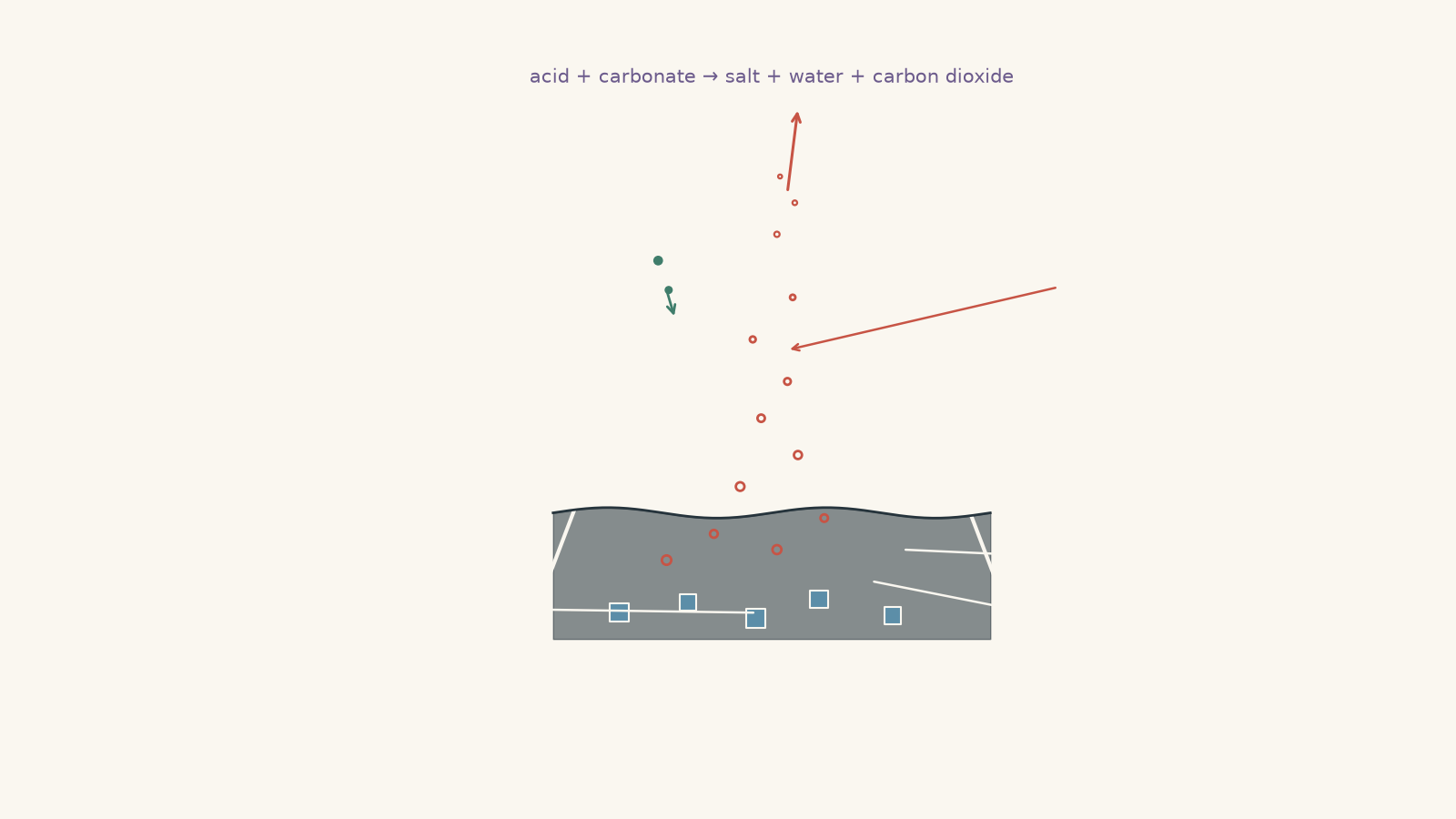
Worked example: sulfuric acid reacting with potassium carbonate
Write a balanced equation, including states, for aqueous sulfuric acid reacting completely with aqueous potassium carbonate.
Step 1
This is acid + carbonate, so the products are salt + water + carbon dioxide.
Step 2
Potassium forms \(\mathrm{K}^{+}\). Sulfuric acid supplies sulfate, \(\ce{SO4^2-}\). Two potassium ions are needed for each sulfate ion, so the salt is \(\ce{K2SO4}\).
We can now write:
\[ \ce{H2SO4 + K2CO3 -> K2SO4 + H2O + CO2} \]
Step 3
Left side:
- H: 2
- K: 2
- S: 1
- C: 1
- O: 7 in total
Right side has the same numbers already.
So every coefficient is \(1\).
Step 4
\[ \ce{H2SO4(aq) + K2CO3(aq) -> K2SO4(aq) + H2O(l) + CO2(g)} \]
The \(1:1\) coefficient ratio means one mole of sulfuric acid reacts with one mole of potassium carbonate in this equation. The reaction releases carbon dioxide gas, so bubbling would be expected.
05Acid + metal: where the hydrogen gas comes from
Now consider magnesium placed into dilute hydrochloric acid.
The reaction pattern is:
\[ \ce{acid + reactive metal -> salt + hydrogen} \]
Magnesium forms \(\mathrm{Mg}^{2+}\), so the salt with chloride is \(\ce{MgCl2}\).
Start with:
\[ \ce{Mg + HCl -> MgCl2 + H2} \]
There are two chloride atoms on the right but only one on the left. Put a coefficient of 2 before \(\ce{HCl}\):
\[ \ce{Mg + 2HCl -> MgCl2 + H2} \]
The two hydrogen atoms from two \(\ce{HCl}\) units account for one molecule of \(\ce{H2}\).
At the particle level, magnesium atoms lose electrons:
\[ \ce{Mg -> Mg^2+ + 2e^-} \]
Hydrogen ions gain those electrons:
\[ \ce{2H+ + 2e^- -> H2} \]
So this is also a redox reaction. The metal is oxidised, while hydrogen ions are reduced.
This gives you a useful check. If your equation says an ordinary reactive metal plus dilute hydrochloric acid produces oxygen gas, something has gone wrong. There is no sensible electron-transfer pathway in the usual reaction model to give that product.
The metal must actually react
Do not apply “metal + acid → salt + hydrogen” blindly.
Whether a metal reacts depends on its reactivity and on the acid involved. For the standard HSC pattern using common dilute non-oxidising acids such as hydrochloric acid, metals sufficiently reactive to reduce \(\mathrm{H}^{+}\) can release hydrogen.
Copper, for example, does not react with dilute hydrochloric acid in the simple way magnesium does.
There are also important exceptions involving oxidising acids such as nitric acid. The simple hydrogen-gas rule should not be treated as universal chemistry.
06Balancing means changing coefficients, never formulas
Suppose you have:
\[ \ce{H2SO4 + NaOH -> Na2SO4 + H2O} \]
There is one sodium atom on the left and two on the right.
A tempting bad fix would be to turn \(\ce{NaOH}\) into something like \(\ce{Na2OH}\). But that changes the substance itself.
Subscripts belong to chemical formulas. They tell you what a substance is.
Coefficients tell you how many formula units or molecules participate. Those are what you change when balancing.
The correct equation is:
\[ \ce{H2SO4 + 2NaOH -> Na2SO4 + 2H2O} \]
Check every element:
| Element | Left | Right |
|---|---|---|
| H | 4 | 4 |
| S | 1 | 1 |
| O | 6 | 6 |
| Na | 2 | 2 |
Balanced.
A useful habit is to leave hydrogen and oxygen until fairly late when they appear in several compounds. First balance distinctive atoms or intact polyatomic ions that remain unchanged, such as sulfate.
07A reliable method for these equations
When you meet an unfamiliar acid reaction, work in this order:
- Identify whether the other reactant is a hydroxide or oxide, a carbonate, or a reactive metal.
- Predict the product pattern.
- Construct the salt using ion charges.
- Write correct formulas for every reactant and product.
- Balance using coefficients only.
- Check every element.
- Add states if the question requires them.
- Ask whether the products make chemical sense.
That last check matters. A perfectly balanced equation can still describe the wrong chemistry.
For example,
\[ \ce{2HCl + Mg -> MgCl2 + H2} \]
is balanced and chemically sensible.
But
\[ \ce{2HCl + Mg -> MgCl2 + 2H} \]
also has the same number of atoms on both sides, yet it incorrectly represents the expected hydrogen product as isolated hydrogen atoms rather than \(\ce{H2}\).
Balancing is necessary. It is not enough by itself.
Worked example: aluminium reacting with sulfuric acid
Write a balanced equation for aluminium reacting with dilute sulfuric acid to form aluminium sulfate and hydrogen gas.
Step 1
This is acid + reactive metal, so the products are a salt and hydrogen gas.
Step 2
Aluminium forms \(\mathrm{Al}^{3+}\), while sulfate is \(\ce{SO4^2-}\). To make a neutral compound:
\[ 2(+3) + 3(-2) = 0 \]
So the salt formula is \(\ce{Al2(SO4)3}\).
Write the unbalanced equation:
\[ \ce{Al + H2SO4 -> Al2(SO4)3 + H2} \]
Step 3
The product contains two aluminium atoms, so use \(2\ce{Al}\).
It also contains three sulfate groups. Because sulfate remains intact, use \(3\ce{H2SO4}\):
\[ \ce{2Al + 3H2SO4 -> Al2(SO4)3 + H2} \]
Step 4
Three \(\ce{H2SO4}\) units contain six hydrogen atoms. That produces three \(\ce{H2}\) molecules:
\[ \ce{2Al + 3H2SO4 -> Al2(SO4)3 + 3H2} \]
Step 5
Left and right both contain:
- 2 Al atoms
- 3 S atoms
- 12 O atoms
- 6 H atoms
With suitable states for the intended reaction model:
\[ \ce{2Al(s) + 3H2SO4(aq) -> Al2(SO4)3(aq) + 3H2(g)} \]
The coefficients tell us that two moles of aluminium correspond stoichiometrically to three moles of hydrogen gas.
Notice the efficient move: sulfate was treated as one intact group while balancing because it appears unchanged on both sides.
08From equations to quantities
Once an equation is balanced, its coefficients become mole ratios.
Take:
\[ \ce{Mg + 2HCl -> MgCl2 + H2} \]
The coefficients mean:
- \(1\) mol Mg reacts with \(2\) mol HCl
- \(1\) mol Mg produces \(1\) mol \(\ce{H2}\)
If \(0.0500\) mol of magnesium reacts completely with excess hydrochloric acid, then:
\[ n(\ce{H2}) = 0.0500\text{ mol} \]
where \(n\) means amount of substance in moles.
This is why product prediction and equation balancing have to be secure before stoichiometry. If the equation is wrong, every mole ratio you use afterwards is wrong too.
09The most tempting mistakes
Mistake 1: balancing before fixing the formulas
If calcium chloride is incorrectly written as \(\ce{CaCl}\), no choice of coefficients makes that a correct formula for calcium chloride.
First construct compounds from charges. Then balance.
Mistake 2: forgetting carbon dioxide in carbonate reactions
Acid + carbonate does not stop at salt + water.
For example:
\[ \ce{2HNO3 + CaCO3 -> Ca(NO3)2 + H2O + CO2} \]
The carbonate carbon has to go somewhere. In this reaction, it ends up in carbon dioxide.
Mistake 3: thinking every acid has one acidic hydrogen
Hydrochloric acid is \(\ce{HCl}\), but sulfuric acid is \(\ce{H2SO4}\).
That changes the coefficients needed in many neutralisation equations.
For example:
\[ \ce{HCl + NaOH -> NaCl + H2O} \]
but:
\[ \ce{H2SO4 + 2NaOH -> Na2SO4 + 2H2O} \]
One mole of sulfuric acid can supply two moles of \(\mathrm{H}^{+}\) when both acidic protons are neutralised.
Mistake 4: assuming coefficients must all be different
There is nothing suspicious about several coefficients being \(1\).
For example:
\[ \ce{H2SO4 + K2CO3 -> K2SO4 + H2O + CO2} \]
is already balanced with an implied coefficient of \(1\) for every substance.
Mistake 5: cancelling atoms instead of understanding species
In a chemical equation, you conserve atoms, but the substances matter too.
You cannot look at \(\ce{H2O}\) and \(\ce{CO2}\), notice that both contain oxygen, and “cancel” oxygen atoms across the equation. Chemical equations are not algebraic fractions.
10Questions and solutions
Question 1
Write a balanced chemical equation, including states, for aqueous nitric acid reacting completely with aqueous potassium hydroxide.
Solution 1
The balanced equation is:
\[ \ce{HNO3(aq) + KOH(aq) -> KNO3(aq) + H2O(l)} \]
This is an acid + metal hydroxide reaction, so the products are salt + water.
Nitric acid supplies nitrate, \(\ce{NO3^-}\), while potassium hydroxide supplies \(\mathrm{K}^{+}\). These charges combine \(1:1\), giving \(\ce{KNO3}\).
The equation is already balanced:
- K: \(1\) on each side
- N: \(1\) on each side
- H: \(2\) on each side
- O: \(4\) on each side
The tempting mistake is to add coefficients simply because a neutralisation equation “looks too easy”. Coefficients are determined by atom conservation, not by how complicated the reaction seems.
Question 2
A student writes the following equation for the reaction between hydrochloric acid and calcium carbonate:
\[ \ce{HCl + CaCO3 -> CaCl2 + H2CO3} \]
They claim that it is acceptable because acid + carbonate initially forms carbonic acid.
Explain what is useful about the student’s reasoning, what is incomplete about the equation as a representation of the observed reaction, and write the balanced overall equation.
Solution 2
The student’s carbonic-acid idea is a useful intermediate model, but the correct overall equation is:
\[ \ce{2HCl(aq) + CaCO3(s) -> CaCl2(aq) + H2O(l) + CO2(g)} \]
Their reasoning contains an important idea: hydrogen ions can protonate carbonate, and \(\ce{H2CO3}\) can be used as an intermediate representation.
However, carbonic acid does not remain as the final product under the usual reaction conditions. It is represented as forming water and carbon dioxide:
\[ \ce{H2CO3 -> H2O + CO2} \]
The student’s equation is also not balanced as written. The product \(\ce{CaCl2}\) contains two chloride ions, so two \(\ce{HCl}\) units are required.
The full reasoning is therefore:
\[ \ce{2HCl + CaCO3 -> CaCl2 + H2CO3} \]
followed conceptually by:
\[ \ce{H2CO3 -> H2O + CO2} \]
giving the overall equation:
\[ \ce{2HCl + CaCO3 -> CaCl2 + H2O + CO2} \]
The tempting route is to stop once every atom seems to have found a plausible compound. The missing constraint is that an equation should represent the chemical change actually being described. The observed gas evolution tells us that carbon dioxide belongs in the overall products.
Question 3
A \(0.240\text{ mol}\) sample of sodium hydroxide reacts completely with sulfuric acid according to:
\[ \ce{H2SO4 + 2NaOH -> Na2SO4 + 2H2O} \]
Calculate:
a. the amount, in moles, of sulfuric acid required
b. the amount, in moles, of water formed
Then explain why using a \(1:1\) mole ratio between sulfuric acid and sodium hydroxide would be chemically wrong.
Solution 3
The reaction requires \(0.120\text{ mol}\) of \(\ce{H2SO4}\) and forms \(0.240\text{ mol}\) of \(\ce{H2O}\).
The balanced equation is:
\[ \ce{H2SO4 + 2NaOH -> Na2SO4 + 2H2O} \]
For part a, the mole ratio is:
\[ 1\text{ mol }\ce{H2SO4}:2\text{ mol }\ce{NaOH} \]
So:
\[ n(\ce{H2SO4}) =0.240\text{ mol}\times\frac{1}{2} =0.120\text{ mol} \]
For part b, the ratio of \(\ce{NaOH}\) to \(\ce{H2O}\) is \(2:2\), or \(1:1\):
\[ n(\ce{H2O}) =0.240\text{ mol}\times\frac{2}{2} =0.240\text{ mol} \]
The tempting \(1:1\) idea comes from treating every acid as though one formula unit supplies only one acidic hydrogen. Sulfuric acid has the formula \(\ce{H2SO4}\), and complete neutralisation in this equation requires two hydroxide ions per sulfuric acid molecule:
\[ \ce{2H+ + 2OH^- -> 2H2O} \]
The equation’s coefficients therefore reflect the actual proton-to-hydroxide requirement.
Question 4
Three unlabelled white solids are known to be \(\ce{MgO}\), \(\ce{MgCO3}\), and \(\ce{Mg}\). Equal amounts of each are placed separately into excess dilute hydrochloric acid.
A student argues:
“They all contain magnesium, so they should all produce the same products. Only the reaction rates should differ.”
For each solid:
a. write the balanced equation with hydrochloric acid
b. state whether a gas is produced and identify it
c. explain why having the same element, magnesium, does not force the reactions to have the same products
Solution 4
The three substances all form magnesium chloride, but their other products are different because magnesium is present in three chemically different forms.
For magnesium oxide:
\[ \ce{MgO(s) + 2HCl(aq) -> MgCl2(aq) + H2O(l)} \]
No gas is produced. Magnesium oxide is a basic oxide, so the reaction gives salt + water.
For magnesium carbonate:
\[ \ce{MgCO3(s) + 2HCl(aq) -> MgCl2(aq) + H2O(l) + CO2(g)} \]
Carbon dioxide gas is produced. The carbonate ion reacts with hydrogen ions and ultimately forms water and carbon dioxide.
For magnesium metal:
\[ \ce{Mg(s) + 2HCl(aq) -> MgCl2(aq) + H2(g)} \]
Hydrogen gas is produced. Here magnesium atoms are oxidised:
\[ \ce{Mg -> Mg^2+ + 2e^-} \]
while hydrogen ions are reduced:
\[ \ce{2H+ + 2e^- -> H2} \]
The student’s tempting argument focuses only on the element magnesium. The missing constraint is that chemical behaviour depends on the complete reactant, including the form and oxidation state in which an element is present.
In \(\ce{MgO}\) and \(\ce{MgCO3}\), magnesium is already present as \(\mathrm{Mg}^{2+}\). It does not need to lose electrons to become the ion in \(\ce{MgCl2}\).
In magnesium metal, however, Mg begins in oxidation state \(0\) and must become \(\mathrm{Mg}^{2+}\). That requires electron transfer, which allows \(\mathrm{H}^{+}\) to be reduced to \(\ce{H2}\).
So the same final salt does not imply the same reaction pathway or the same additional products.
Question 5
A student is given two colourless solutions, X and Y.
- X contains exactly \(0.100\text{ mol}\) of \(\ce{HCl}\).
- Y contains exactly \(0.0500\text{ mol}\) of \(\ce{H2SO4}\).
Assume both acids react completely in the reactions below.
The student says:
“X contains twice as many moles of acid as Y, so X must always react with twice as much material.”
Test this claim for each of the following cases.
a. What amount of \(\ce{NaOH}\) can each solution neutralise?
b. What amount of \(\ce{CaCO3}\) can each solution react with completely?
c. If excess magnesium is added instead, what amount of \(\ce{H2}\) can each solution produce under the simple acid-metal model used in this guide?
d. Explain the deeper reason the student’s comparison based only on “moles of acid” fails.
Solution 5
X and Y can react with the same amount of \(\ce{NaOH}\), the same amount of \(\ce{CaCO3}\), and can produce the same amount of \(\ce{H2}\) in the stated model, even though X contains twice as many moles of acid molecules.
For part a, first consider hydrochloric acid:
\[ \ce{HCl + NaOH -> NaCl + H2O} \]
The ratio is \(1:1\), so:
\[ n(\ce{NaOH})=0.100\text{ mol} \]
For sulfuric acid:
\[ \ce{H2SO4 + 2NaOH -> Na2SO4 + 2H2O} \]
The ratio is \(1:2\), so:
\[ n(\ce{NaOH}) =0.0500\text{ mol}\times 2 =0.100\text{ mol} \]
Both neutralise \(0.100\text{ mol}\) of \(\ce{NaOH}\).
For part b:
\[ \ce{2HCl + CaCO3 -> CaCl2 + H2O + CO2} \]
Therefore:
\[ n(\ce{CaCO3}) =0.100\text{ mol}\times\frac{1}{2} =0.0500\text{ mol} \]
For sulfuric acid:
\[ \ce{H2SO4 + CaCO3 -> CaSO4 + H2O + CO2} \]
Using the stoichiometry of the equation:
\[ n(\ce{CaCO3}) =0.0500\text{ mol} \]
So both acid samples have stoichiometric capacity for \(0.0500\text{ mol}\) of calcium carbonate.
For part c, magnesium reacts with hydrochloric acid according to:
\[ \ce{Mg + 2HCl -> MgCl2 + H2} \]
Thus:
\[ n(\ce{H2}) =0.100\text{ mol}\times\frac{1}{2} =0.0500\text{ mol} \]
For sulfuric acid:
\[ \ce{Mg + H2SO4 -> MgSO4 + H2} \]
Therefore:
\[ n(\ce{H2})=0.0500\text{ mol} \]
Again, the amounts are equal.
The tempting route is to compare \(0.100\) and \(0.0500\) and stop. That treats “one mole of acid” as a fixed unit of reacting capacity.
It is not.
What matters in these particular reactions is how many reactive hydrogen ions the acid can provide according to the balanced equation. In the complete-reaction models used here:
- \(0.100\text{ mol}\) of \(\ce{HCl}\) corresponds to \(0.100\text{ mol}\) of acidic hydrogen
- \(0.0500\text{ mol}\) of \(\ce{H2SO4}\) can correspond stoichiometrically to \(0.100\text{ mol}\) of acidic hydrogen
So the two samples have the same acid-equivalent capacity for these reactions.
This is the conceptual hinge: coefficients do not merely tidy an equation so that atom counts match. They encode how the chemical identities of the reactants control the amounts that can react.
That is also the next useful step beyond equation writing. Once you can predict the correct products and balance the reaction confidently, the same coefficients let you solve limiting-reagent, titration, gas-volume, and other stoichiometric problems without relying on memorised ratios.