
Precipitation Reactions and Net Ionic Equations for HSC Chemistry
Learn how to predict insoluble products, identify spectator ions, and write balanced net ionic equations for HSC Chemistry precipitation reactions.
You mix two clear, colourless solutions. A second later, the beaker turns cloudy and a solid appears. Nothing was solid before mixing, so where did the solid come from?
Suppose one solution contains lead(II) ions and nitrate ions, while the other contains potassium ions and iodide ions. Before reading on, predict what happens when they meet. Do all four ions simply stay dissolved, or can one new combination leave the solution?
The key idea is that some combinations of ions are soluble in water, while others are not very soluble. If oppositely charged ions form a sufficiently insoluble ionic compound, they gather into a solid crystal. That solid is called a precipitate.
Once you can identify that insoluble combination, precipitation questions become much more mechanical: predict the product, balance the equation, split the soluble ionic substances into ions, then remove the spectators.
01What is actually inside an aqueous ionic solution?
Start with something familiar such as sodium chloride, \(\ce{NaCl}\).
Solid sodium chloride contains \(\mathrm{Na}^{+}\) and \(\mathrm{Cl}^{-}\) ions held in an ionic lattice. When enough of it dissolves in water, those ions separate and become surrounded by water molecules:
\[
\ce{NaCl(aq) -> Na+(aq) + Cl-(aq)}
\]
The \((aq)\) state means aqueous, or dissolved in water.
The same idea applies to potassium iodide:
\[
\ce{KI(aq) -> K+(aq) + I-(aq)}
\]
So a beaker labelled “\(\ce{KI(aq)}\)” shouldn’t be pictured as lots of intact \(\ce{KI}\) units floating around. It contains mobile \(\mathrm{K}^{+}\) and \(\mathrm{I}^{-}\) ions.
That matters when two ionic solutions are mixed.
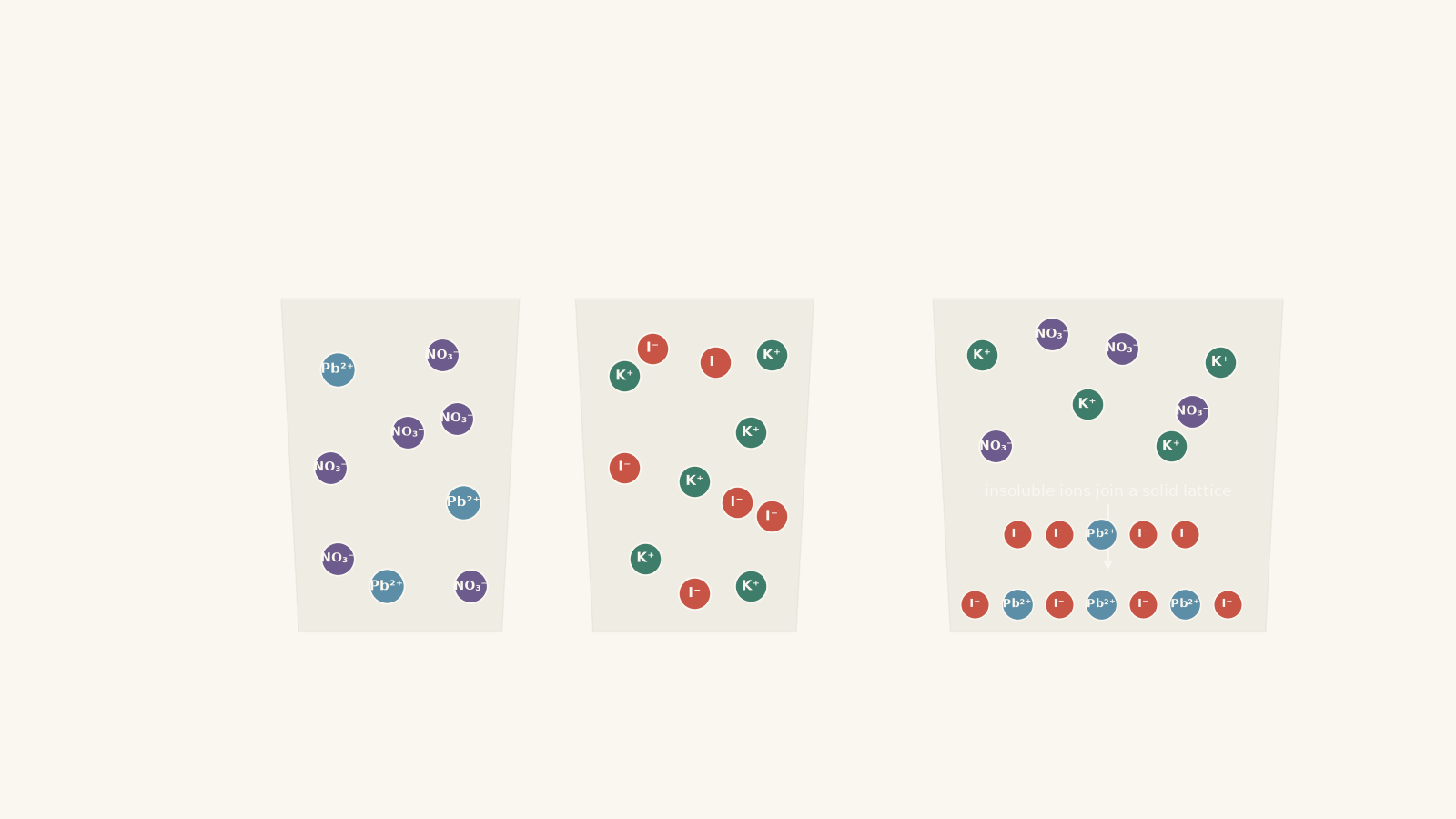
You can loosely picture the ions as people at a party. Everyone is moving around independently rather than arriving permanently attached to one partner. After two groups mix, one particular positive-negative pairing might become so stable as a solid that those ions effectively leave the party together.
The analogy stops there. Ions don’t “choose” partners, and insolubility comes from the balance of interactions between the ions, their crystal lattice, and water. For HSC precipitation questions, solubility rules give us a practical way to predict the result without calculating all those interactions.
02The basic precipitation decision
Consider mixing aqueous lead(II) nitrate and potassium iodide:
\[
\ce{Pb(NO3)2(aq) + KI(aq)}
\]
The dissolved ions are:
- \(\mathrm{Pb}^{2+}\)
- \(\ce{NO3-}\)
- \(\mathrm{K}^{+}\)
- \(\mathrm{I}^{-}\)
A common way to predict products is to imagine the positive ions changing negative partners.
The possible new combinations are:
- \(\mathrm{Pb}^{2+}\) with \(\mathrm{I}^{-}\)
- \(\mathrm{K}^{+}\) with \(\ce{NO3-}\)
Charge neutrality gives the formulas:
\[
\ce{PbI2}
\]
and
\[
\ce{KNO3}
\]
Now comes the important question: which, if either, is insoluble?
Potassium compounds and nitrates are soluble, so \(\ce{KNO3}\) stays aqueous. Lead(II) iodide is poorly soluble, so it forms a solid:
\[
\ce{PbI2(s)}
\]
That is the precipitate.
The balanced equation is:
\[
\ce{Pb(NO3)2(aq) + 2KI(aq) -> PbI2(s) + 2KNO3(aq)}
\]
The reaction isn’t happening because compounds have a mysterious need to “swap partners”. That language is just useful bookkeeping. The actual driving event is the removal of \(\mathrm{Pb}^{2+}\) and \(\mathrm{I}^{-}\) ions from solution as solid \(\ce{PbI2}\).
03Solubility rules you need to use
You don’t need to memorise the solubility of every ionic compound separately. Patterns do most of the work.
A supplied solubility table should always take priority if a question gives you one. Otherwise, these high-value patterns are useful for HSC-level problems.
| Type of ionic compound | General behaviour in water | Important idea |
|---|---|---|
| Group 1 metal salts | Soluble | Compounds containing \(\mathrm{Li}^{+}\), \(\mathrm{Na}^{+}\), \(\mathrm{K}^{+}\), and other Group 1 ions generally remain aqueous |
| Ammonium salts | Soluble | Compounds containing \(\ce{NH4+}\) generally remain aqueous |
| Nitrates | Soluble | Compounds containing \(\ce{NO3-}\) generally remain aqueous |
| Chlorides, bromides, and iodides | Usually soluble | Important exceptions include compounds of ions such as \(\mathrm{Ag}^{+}\) and \(\mathrm{Pb}^{2+}\) |
| Sulfates | Usually soluble | Some metal sulfates, including \(\ce{BaSO4}\) and \(\ce{PbSO4}\), are poorly soluble |
| Carbonates | Usually insoluble | Group 1 and ammonium carbonates are important soluble exceptions |
| Phosphates | Usually insoluble | Group 1 and ammonium phosphates are important soluble exceptions |
| Hydroxides | Usually insoluble | Group 1 hydroxides are soluble, with some other hydroxides having appreciable or limited solubility |
Notice that the words are usually and generally, not “always”. Solubility is really a continuum. Even a compound described as insoluble normally has a tiny amount dissolved.
In an HSC precipitation question, however, the useful decision is usually simpler: does the solubility information tell you to write the substance as \((aq)\) or as a precipitate, \((s)\)?
04A reliable method for predicting a precipitate
When two aqueous ionic compounds are mixed, use this sequence.
- Write the ions present in each solution.
- Form the possible new ionic combinations.
- Make each product electrically neutral.
- Use solubility rules to decide the state of each product.
- If no insoluble product forms, there may be no precipitation reaction.
- Balance the full equation before writing the ionic equation.
That third step causes a lot of avoidable errors.
For example, \(\mathrm{Fe}^{3+}\) and \(\ce{OH-}\) don’t form \(\ce{FeOH}\). One \(\mathrm{Fe}^{3+}\) needs three \(\ce{OH-}\) ions so the total charge is zero:
\[
\ce{Fe(OH)3}
\]
The formula comes from charge, not from simply placing one ion beside another.
If equation balancing itself is the difficult part, it helps to revisit how reactions conserve atoms in Rearrangement of Atoms in Reactions: HSC Chemistry Guide.
Worked example: Will silver chloride precipitate?
Aqueous silver nitrate is mixed with aqueous sodium chloride. Predict whether a precipitate forms, and write the balanced molecular equation.
Step 1
Silver nitrate contains \(\mathrm{Ag}^{+}\) and \(\ce{NO3-}\).
Sodium chloride contains \(\mathrm{Na}^{+}\) and \(\mathrm{Cl}^{-}\).
Step 2
Exchanging the negative ions gives \(\ce{AgCl}\) and \(\ce{NaNO3}\).
Step 3
Nitrates and sodium salts are soluble, so:
\[
\ce{NaNO3(aq)}
\]
Silver chloride is poorly soluble, so:
\[
\ce{AgCl(s)}
\]
Step 4
\[
\ce{AgNO3(aq) + NaCl(aq) -> AgCl(s) + NaNO3(aq)}
\]
The equation is already balanced.
A solid \(\ce{AgCl}\) precipitate forms because dissolved \(\mathrm{Ag}^{+}\) and \(\mathrm{Cl}^{-}\) ions combine into an insoluble ionic lattice.
05From a molecular equation to a net ionic equation
The molecular equation is useful, but it includes ions that haven’t actually undergone a chemical change.
For the silver chloride reaction:
\[
\ce{AgNO3(aq) + NaCl(aq) -> AgCl(s) + NaNO3(aq)}
\]
Remember what the aqueous substances really contain.
Silver nitrate is dissolved as ions:
\[
\ce{Ag+(aq) + NO3-(aq)}
\]
Sodium chloride is dissolved as:
\[
\ce{Na+(aq) + Cl-(aq)}
\]
Sodium nitrate on the product side is also aqueous, so it is still present as separate ions.
The complete ionic equation is therefore:
\[
\ce{Ag+(aq) + NO3-(aq) + Na+(aq) + Cl-(aq) -> AgCl(s) + Na+(aq) + NO3-(aq)}
\]
Now look for species that appear unchanged on both sides.
Both \(\mathrm{Na}^{+}\) and \(\ce{NO3-}\) are present before and after the reaction. These are spectator ions.
Cancel them:
\[
\ce{Ag+(aq) + Cl-(aq) -> AgCl(s)}
\]
This is the net ionic equation.
It shows only the chemical change responsible for precipitation.
06What should be split into ions?
A useful rule is:
Split soluble aqueous ionic substances. Do not split precipitates.
For example:
\[
\ce{Na2CO3(aq)}
\]
becomes:
\[
\ce{2Na+(aq) + CO3^2-(aq)}
\]
But:
\[
\ce{CaCO3(s)}
\]
stays as:
\[
\ce{CaCO3(s)}
\]
If you split the precipitate back into aqueous ions, you undo the very process the equation is supposed to describe.
This is why state symbols are not decoration. They tell you whether a substance should be treated as dissolved particles or as a separate solid phase.
07Worked example: Precipitating iron(III) hydroxide
Aqueous iron(III) chloride is mixed with aqueous sodium hydroxide. Predict the precipitate and write the molecular, complete ionic, and net ionic equations.
Step 1
The ions are:
\[
\ce{Fe^3+, Cl-, Na+, OH-}
\]
The exchanged products are iron(III) hydroxide and sodium chloride.
Because \(\mathrm{Fe}^{3+}\) has charge \(+3\) and \(\ce{OH-}\) has charge \(-1\), three hydroxide ions are needed:
\[
\ce{Fe(OH)3}
\]
Step 2
Sodium chloride is soluble.
Iron(III) hydroxide is poorly soluble, so it forms \(\ce{Fe(OH)3(s)}\).
Step 3
\[
\ce{FeCl3(aq) + 3NaOH(aq) -> Fe(OH)3(s) + 3NaCl(aq)}
\]
Three hydroxide ions are needed for every one iron(III) ion. The coefficients reflect the same charge relationship that produced the formula \(\ce{Fe(OH)3}\).
Step 4
Split every soluble aqueous ionic substance:
\[
\ce{Fe^3+(aq) + 3Cl-(aq) + 3Na+(aq) + 3OH-(aq) -> Fe(OH)3(s) + 3Na+(aq) + 3Cl-(aq)}
\]
Step 5
The \(\mathrm{Na}^{+}\) and \(\mathrm{Cl}^{-}\) ions are unchanged:
\[
\ce{Fe^3+(aq) + 3OH-(aq) -> Fe(OH)3(s)}
\]
This net ionic equation says something more useful than the full equation. Any suitable soluble source of \(\mathrm{Fe}^{3+}\) mixed with a suitable soluble source of \(\ce{OH-}\) can produce the same precipitation process.
08The tempting mistake: assuming every ion exchange is a reaction
Suppose aqueous potassium nitrate and sodium chloride are mixed.
A student might write:
\[
\ce{KNO3(aq) + NaCl(aq) -> KCl(aq) + NaNO3(aq)}
\]
The equation balances, so it looks respectable.
But predict what a particle-level view would show. Before mixing, you have \(\mathrm{K}^{+}\), \(\ce{NO3-}\), \(\mathrm{Na}^{+}\), and \(\mathrm{Cl}^{-}\) ions moving through water. After mixing, all four species are still dissolved.
Nothing has actually changed chemically.
Both possible products are soluble. There is no precipitate, gas, weak electrolyte, or other driving process removing ions from solution.
The complete ionic “equation” would be:
\[
\ce{K+(aq) + NO3-(aq) + Na+(aq) + Cl-(aq) -> K+(aq) + Cl-(aq) + Na+(aq) + NO3-(aq)}
\]
Every species cancels.
So there is no net ionic equation for a precipitation reaction, because there is no precipitation reaction.
“Double displacement” is therefore not a guarantee that a reaction occurs. It is a possible pattern for arranging products. Solubility determines whether precipitation actually drives a change.
09Four checks before you trust a net ionic equation
A correct net ionic equation should pass four tests.
| Check | What to ask |
|---|---|
| Atoms | Is the number of each atom the same on both sides? |
| Charge | Is the total charge the same on both sides? |
| States | Are dissolved species marked \((aq)\) and the precipitate marked \((s)\)? |
| Spectators | Have all unchanged ions been cancelled, and only unchanged ions? |
For example:
\[
\ce{Pb^2+(aq) + I-(aq) -> PbI2(s)}
\]
fails the charge and atom checks. The left side has a total charge of \(+1\), and only one iodide ion.
The correct equation is:
\[
\ce{Pb^2+(aq) + 2I-(aq) -> PbI2(s)}
\]
The left side now has total charge \(0\), matching the neutral solid on the right, and there are two iodine atoms on each side.
10Questions and solutions
Question 1
Aqueous magnesium chloride is mixed with aqueous sodium carbonate.
Predict whether a precipitate forms. Name the precipitate, and write the net ionic equation.
Solution 1
Magnesium carbonate precipitates, and the net ionic equation is \(\ce{Mg^2+(aq) + CO3^2-(aq) -> MgCO3(s)}\).
The ions initially present are \(\mathrm{Mg}^{2+}\), \(\mathrm{Cl}^{-}\), \(\mathrm{Na}^{+}\), and \(\ce{CO3^2-}\).
Exchanging partners gives magnesium carbonate and sodium chloride:
\[
\ce{MgCl2(aq) + Na2CO3(aq) -> MgCO3(s) + 2NaCl(aq)}
\]
Most carbonates are poorly soluble unless associated with ions such as Group 1 cations or ammonium. \(\ce{MgCO3}\) therefore precipitates.
The complete ionic equation is:
\[
\ce{Mg^2+(aq) + 2Cl-(aq) + 2Na+(aq) + CO3^2-(aq) -> MgCO3(s) + 2Na+(aq) + 2Cl-(aq)}
\]
Cancelling \(\mathrm{Na}^{+}\) and \(\mathrm{Cl}^{-}\) gives:
\[
\ce{Mg^2+(aq) + CO3^2-(aq) -> MgCO3(s)}
\]
The equal and opposite \(2+\) and \(2-\) charges also explain why the precipitate has a \(1:1\) formula.
Question 2
A student mixes aqueous ammonium nitrate and aqueous potassium chloride and predicts that solid ammonium chloride will form because the ions have “swapped partners”.
Is the prediction correct? Explain using solubility and the particle-level picture.
Solution 2
No precipitate forms, so the student’s prediction is incorrect.
The possible products are ammonium chloride and potassium nitrate:
\[
\ce{NH4NO3(aq) + KCl(aq) -> NH4Cl(aq) + KNO3(aq)}
\]
Ammonium salts are soluble, potassium salts are soluble, and nitrates are soluble. Both proposed products therefore remain aqueous.
At the particle level, the solution contains the same four dissolved ion species before and after mixing:
\[
\ce{NH4+, NO3-, K+, Cl-}
\]
There is no insoluble product removing ions from solution. The tempting misconception is treating “ion exchange” as proof that a reaction has occurred. It isn’t. The solubility check is what decides whether precipitation happens.
Question 3
Aqueous aluminium sulfate, \(\ce{Al2(SO4)3}\), is mixed with aqueous barium nitrate, \(\ce{Ba(NO3)2}\).
Write:
- the balanced molecular equation,
- the complete ionic equation, and
- the net ionic equation.
Solution 3
Barium sulfate precipitates, and the net ionic change is \(\ce{Ba^2+(aq) + SO4^2-(aq) -> BaSO4(s)}\).
The exchanged products are \(\ce{BaSO4}\) and \(\ce{Al(NO3)3}\). Barium sulfate is poorly soluble, while nitrates are soluble.
The balanced molecular equation is:
\[
\ce{Al2(SO4)3(aq) + 3Ba(NO3)2(aq) -> 3BaSO4(s) + 2Al(NO3)3(aq)}
\]
Now split the soluble aqueous ionic substances:
\[
\ce{2Al^3+(aq) + 3SO4^2-(aq) + 3Ba^2+(aq) + 6NO3-(aq) -> 3BaSO4(s) + 2Al^3+(aq) + 6NO3-(aq)}
\]
The \(\mathrm{Al}^{3+}\) and \(\ce{NO3-}\) ions are spectators, so they cancel:
\[
\ce{3Ba^2+(aq) + 3SO4^2-(aq) -> 3BaSO4(s)}
\]
Net ionic equations should be written using the simplest whole-number coefficients, giving:
\[
\ce{Ba^2+(aq) + SO4^2-(aq) -> BaSO4(s)}
\]
The factor of three in the molecular equation came from balancing the full compounds. It isn’t part of the simplest description of one precipitation event.
Question 4
A student predicts that mixing aqueous lead(II) nitrate and aqueous sodium chloride produces \(\ce{PbCl(s)}\), then writes:
\[
\ce{Pb^2+(aq) + Cl-(aq) -> PbCl(s)}
\]
Identify the error and write the correct precipitate formula and net ionic equation.
Solution 4
The precipitate is \(\ce{PbCl2(s)}\), and the correct net ionic equation is \(\ce{Pb^2+(aq) + 2Cl-(aq) -> PbCl2(s)}\).
The student’s main error is constructing the product formula without balancing ionic charge.
A lead(II) ion has charge \(+2\):
\[
\mathrm{Pb}^{2+}
\]
A chloride ion has charge \(-1\):
\[
\mathrm{Cl}^{-}
\]
Two chloride ions are therefore required to make a neutral ionic compound:
\[
(+2) + 2(-1) = 0
\]
So the precipitate is:
\[
\ce{PbCl2(s)}
\]
The correct net ionic equation is:
\[
\ce{Pb^2+(aq) + 2Cl-(aq) -> PbCl2(s)}
\]
This equation conserves both atoms and charge. The incorrect version had a total charge of \(+1\) on the left and also contained the wrong number of chloride ions.
Question 5
Three unlabelled aqueous solutions are known to be calcium chloride, sodium carbonate, and potassium nitrate.
The observations are:
- mixing A with B produces a precipitate,
- mixing A with C produces no precipitate,
- mixing B with C produces no precipitate.
Identify solution C. Can you determine which of A and B is calcium chloride and which is sodium carbonate using only these observations? Write the net ionic equation for the precipitation reaction.
Solution 5
Solution C must be potassium nitrate, but the observations do not tell us whether A is calcium chloride and B is sodium carbonate or the other way around. The precipitation reaction is \(\ce{Ca^2+(aq) + CO3^2-(aq) -> CaCO3(s)}\).
Calcium chloride and sodium carbonate react because calcium carbonate is poorly soluble:
\[
\ce{CaCl2(aq) + Na2CO3(aq) -> CaCO3(s) + 2NaCl(aq)}
\]
Potassium nitrate does not produce a precipitate with either of the other solutions because potassium salts and nitrates remain soluble.
Therefore, the only pair that can give the observed precipitate is calcium chloride plus sodium carbonate. Since A and B are the precipitating pair, C must be potassium nitrate.
However, the evidence is symmetrical. It tells us that A and B are the two reacting solutions, but gives no observation that distinguishes which one contains \(\mathrm{Ca}^{2+}\) and which contains \(\ce{CO3^2-}\).
The net ionic equation is:
\[
\ce{Ca^2+(aq) + CO3^2-(aq) -> CaCO3(s)}
\]
The difficult part here is not writing the equation. It is refusing to claim more than the evidence allows.
Question 6
A student is given aqueous silver nitrate and aqueous sodium phosphate.
They reason that silver has charge \(+1\), phosphate has charge \(3-\), and therefore write the precipitate as \(\ce{AgPO4}\).
Predict the correct precipitate, write the balanced molecular equation, and give the net ionic equation.
Solution 6
The correct precipitate is silver phosphate, \(\ce{Ag3PO4(s)}\), and the net ionic equation is \(\ce{3Ag+(aq) + PO4^3-(aq) -> Ag3PO4(s)}\).
The student’s proposed formula \(\ce{AgPO4}\) is not electrically neutral. One \(\mathrm{Ag}^{+}\) contributes \(+1\), while one \(\ce{PO4^3-}\) contributes \(-3\), giving a net charge of \(-2\).
Three silver ions are needed for each phosphate ion:
\[
3(+1) + (-3) = 0
\]
So the neutral precipitate is:
\[
\ce{Ag3PO4(s)}
\]
The molecular equation is:
\[
\ce{3AgNO3(aq) + Na3PO4(aq) -> Ag3PO4(s) + 3NaNO3(aq)}
\]
Splitting the aqueous substances gives:
\[
\ce{3Ag+(aq) + 3NO3-(aq) + 3Na+(aq) + PO4^3-(aq) -> Ag3PO4(s) + 3Na+(aq) + 3NO3-(aq)}
\]
After cancelling the spectator ions, \(\mathrm{Na}^{+}\) and \(\ce{NO3-}\), the net ionic equation is:
\[
\ce{3Ag+(aq) + PO4^3-(aq) -> Ag3PO4(s)}
\]
This question exposes a useful habit: don’t guess an ionic formula from the names of the ions. Make the total charge zero first, then balance the reaction.
11What this idea leads to next
Once you can predict precipitates, the next step is to use them as evidence.
If adding a known ion creates a characteristic insoluble compound, that reaction can help identify an unknown ion. The same net ionic equation works regardless of which soluble salts originally supplied the reacting ions.
Precipitation also leads into a more precise idea: “insoluble” doesn’t mean literally zero particles dissolve. At equilibrium, a small amount of an ionic solid can remain dissolved, and the balance between dissolved ions and solid can be described quantitatively.
For now, the useful HSC decision is simpler: identify the ions, build charge-neutral products, check their solubility, and write the net ionic equation around the species that actually change.