
Acid-Base Titration of an Unknown: HSC Chemistry Guide
Learn how to determine an unknown acid or base concentration from titration data using moles, stoichiometric ratios, dilution, and equivalence points.
A bottle contains hydrochloric acid, but its concentration label has fallen off. You can measure 25.00 mL of the acid, but that only tells you its volume. You need its concentration.
Suppose you slowly add sodium hydroxide of known concentration until the acid is exactly neutralised. If it takes 18.60 mL of sodium hydroxide, what has that volume actually told you?
Before reading on, make a prediction: can you simply say that 25.00 mL of acid contains the same number of moles as 18.60 mL of base?
Sometimes. Not always.
That is the central idea of titration calculations. The measured volumes get you to moles, but the balanced chemical equation decides how the moles of acid and base are related.
01What a titration is really measuring
Picture two groups meeting at a very strict party.
One group is the acid. The other is the base. They react in a fixed ratio determined by the chemical equation. When exactly enough of one group has arrived to react with all of the other, you have reached the equivalence point.
That is what an acid-base titration is trying to locate.
For a simple strong acid and strong base:
\[
\ce{HCl(aq) + NaOH(aq) -> NaCl(aq) + H2O(l)}
\]
The coefficients are 1:1. One mole of \(\ce{HCl}\) reacts with one mole of \(\ce{NaOH}\).
For sulfuric acid and sodium hydroxide:
\[
\ce{H2SO4(aq) + 2NaOH(aq) -> Na2SO4(aq) + 2H2O(l)}
\]
Now the ratio is 1:2. One mole of \(\ce{H2SO4}\) reacts with two moles of \(\ce{NaOH}\).
So equal moles at equivalence are not a universal rule. The balanced equation is the rule.
The party analogy is useful because it makes the matching process easy to picture. It breaks down because ions are not choosing partners one at a time, and an acid-base reaction occurs through collisions and proton transfer throughout the solution.
02The four-step titration calculation
Almost every HSC titration calculation can be organised into four moves:
- Write the balanced equation.
- Calculate the moles of the solution with known concentration.
- Use the mole ratio to find the moles of the unknown.
- Use those moles and the unknown solution’s volume to calculate its concentration.
The two equations you need most often are:
\[
n = cV
\]
and
\[
c = \frac{n}{V}
\]
where:
- \(n\) is amount in moles, measured in mol
- \(c\) is concentration, measured in \(\mathrm{mol\,L^{-1}}\)
- \(V\) is volume, measured in L
The dangerous detail is the unit of volume. Titration volumes are usually recorded in mL, but \(n=cV\) requires litres.
So:
\[
18.60\text{ mL} = 0.01860\text{ L}
\]
A reliable conversion is to divide the number of millilitres by 1000.
03Why the balanced equation comes first
Students sometimes memorise a shortcut such as:
\[
c_\text{acid}V_\text{acid}=c_\text{base}V_\text{base}
\]
That works only when the acid and base react in a 1:1 mole ratio.
It works for:
\[
\ce{HCl + NaOH -> NaCl + H2O}
\]
but not for:
\[
\ce{H2SO4 + 2NaOH -> Na2SO4 + 2H2O}
\]
The safer method is to work through moles every time. It takes only one extra line and prevents a very common stoichiometric error.
Worked example: Find the concentration of hydrochloric acid
A 25.00 mL sample of hydrochloric acid is titrated with \(0.1500\ \mathrm{mol\,L^{-1}}\) sodium hydroxide. The mean concordant titre is 18.60 mL. Calculate the concentration of the hydrochloric acid.
The reaction is:
\[
\ce{HCl(aq) + NaOH(aq) -> NaCl(aq) + H2O(l)}
\]
Step 1
The sodium hydroxide concentration is known, and its titre is measured.
\[
\begin{aligned}
n(\ce{NaOH}) &= cV\\
&=(0.1500)(0.01860)\\
&=2.790\times10^{-3}\text{ mol}
\end{aligned}
\]
Step 2
From the balanced equation:
\[
\ce{HCl}:\ce{NaOH}=1:1
\]
Therefore:
\[
n(\ce{HCl})=2.790\times10^{-3}\text{ mol}
\]
Step 3
The acid volume is 25.00 mL, or \(0.02500\) L.
\[
\begin{aligned}
c(\ce{HCl})&=\frac{n}{V}\\
&=\frac{2.790\times10^{-3}}{0.02500}\\
&=0.1116\ \mathrm{mol\,L^{-1}}
\end{aligned}
\]
The hydrochloric acid concentration is therefore \(0.1116\ \mathrm{mol\,L^{-1}}\).
The result means that each litre of this acid solution would contain 0.1116 mol of \(\ce{HCl}\).
04Equivalence point and endpoint are not quite the same thing
There is an important experimental distinction hiding inside the calculation.
The equivalence point is the theoretical point where acid and base have reacted in the exact stoichiometric ratio.
The endpoint is the experimentally observed point used to stop the titration. With an indicator, this is usually a colour change.
Ideally, the endpoint occurs very close to the equivalence point.
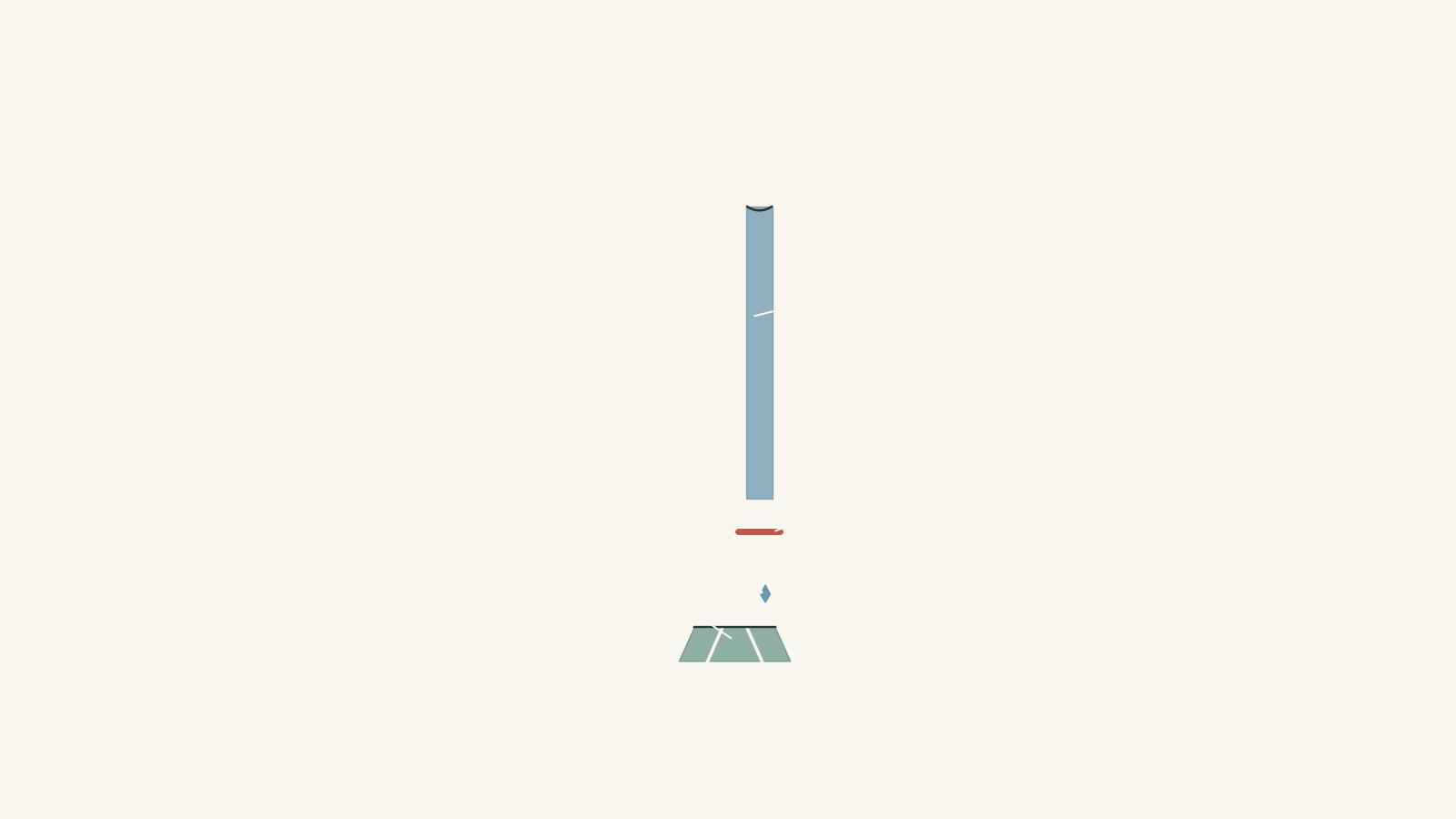
Imagine the equivalence point occurs at 20.00 mL, but you keep adding titrant until 20.80 mL because you are waiting for a dramatic colour change. Your calculation will treat 20.80 mL as though it were the required stoichiometric volume.
It was not.
You have overshot the endpoint, so your calculated concentration will be affected.
The direction of the error depends on which solution is unknown. You should reason from the calculation rather than memorising a sentence about whether the answer goes “up” or “down”.
05What actually goes in the burette?
In a standard titration, one solution has a known concentration and the other has an unknown concentration.
The solution delivered from the burette is called the titrant. Its volume is found from the difference between the initial and final burette readings.
The solution being analysed is often called the analyte.
For example:
- analyte: 25.00 mL of unknown \(\ce{HCl}\)
- titrant: \(0.1000\ \mathrm{mol\,L^{-1}}\) \(\ce{NaOH}\)
- titre: volume of \(\ce{NaOH}\) required to reach the endpoint
The calculation does not fundamentally depend on which one is acid and which one is base. What matters is knowing the concentration of one solution, measuring the reacting volumes, and applying the correct mole ratio.
06A 1:2 reaction changes everything
Now predict this one.
A 20.00 mL sulfuric acid sample requires 30.00 mL of \(0.1000\ \mathrm{mol\,L^{-1}}\) sodium hydroxide. Is the sulfuric acid concentration \(0.1500\ \mathrm{mol\,L^{-1}}\)?
That result comes from treating the reaction as 1:1:
\[
c_\text{acid}V_\text{acid}=c_\text{base}V_\text{base}
\]
But sulfuric acid can supply two acidic protons per formula unit in its complete reaction with sodium hydroxide.
The balanced equation is:
\[
\ce{H2SO4(aq) + 2NaOH(aq) -> Na2SO4(aq) + 2H2O(l)}
\]
So twice as many moles of \(\ce{NaOH}\) are required as moles of \(\ce{H2SO4}\).
Worked example: Titrating sulfuric acid
A 20.00 mL sample of sulfuric acid is titrated with \(0.1000\ \mathrm{mol\,L^{-1}}\) sodium hydroxide. The mean titre is 30.00 mL. Calculate the sulfuric acid concentration.
Step 1
\[
\begin{aligned}
n(\ce{NaOH})&=cV\\
&=(0.1000)(0.03000)\\
&=3.000\times10^{-3}\text{ mol}
\end{aligned}
\]
Step 2
From:
\[
\ce{H2SO4 + 2NaOH -> Na2SO4 + 2H2O}
\]
the ratio is:
\[
\ce{H2SO4}:\ce{NaOH}=1:2
\]
Therefore:
\[
n(\ce{H2SO4})=\frac{3.000\times10^{-3}}{2}
=1.500\times10^{-3}\text{ mol}
\]
Step 3
\[
\begin{aligned}
c(\ce{H2SO4})
&=\frac{1.500\times10^{-3}}{0.02000}\\
&=0.07500\ \mathrm{mol\,L^{-1}}
\end{aligned}
\]
The sulfuric acid concentration is \(0.07500\ \mathrm{mol\,L^{-1}}\).
The tempting \(0.1500\ \mathrm{mol\,L^{-1}}\) result is exactly twice too large because it ignores the 1:2 reaction ratio.
07A compact method for any stoichiometric ratio
Suppose the reaction is written generally as:
\[
aA+bB\rightarrow\text{products}
\]
where \(a\) and \(b\) are the stoichiometric coefficients.
At equivalence:
\[
\frac{n(A)}{a}=\frac{n(B)}{b}
\]
Because \(n=cV\):
\[
\frac{c_AV_A}{a}=\frac{c_BV_B}{b}
\]
This equation is valid when the reaction represented by the balanced equation goes to completion and the measured endpoint corresponds appropriately to that reaction.
It can save time, but only if you understand where it came from. If ratios make you hesitate, calculate moles explicitly instead.
08Weak does not mean “partly reacts”
Suppose ethanoic acid is titrated with sodium hydroxide:
\[
\ce{CH3COOH(aq) + OH^-(aq) -> CH3COO^-(aq) + H2O(l)}
\]
A student might reason:
“Ethanoic acid is weak, so only some of it is ionised. Therefore only the ionised part reacts with the hydroxide.”
That sounds plausible, but it is wrong.
As \(\mathrm{H}^{+}\) is removed by \(\ce{OH^-}\), more ethanoic acid ionises. The equilibrium shifts, allowing more acid molecules to donate protons. During a suitable titration, the acid can therefore react stoichiometrically with the strong base.
The important distinction is this:
- acid strength describes the extent of ionisation at equilibrium
- acid concentration describes how much acid is present per litre
A dilute strong acid can have a lower concentration than a concentrated weak acid.
For a monoprotic weak acid such as ethanoic acid, one mole of acid still reacts with one mole of hydroxide ions during complete neutralisation.
The titration curve will differ from that of a strong acid, especially in pH before equivalence and at the equivalence point, but the mole relationship still comes from the balanced reaction.
If you are using a pH probe rather than a visual indicator, the shape of the curve can help locate equivalence more directly. The related digital probes for acid-base analysis guide develops that idea further.
09Concordant titres: which readings should you use?
Real titrations do not usually give identical titres.
Suppose you obtain:
| Trial | Titre |
|---|---|
| Rough | 24.80 mL |
| 1 | 24.32 mL |
| 2 | 24.28 mL |
| 3 | 24.30 mL |
You would normally calculate the mean using the concordant titres rather than automatically averaging every number collected.
Here, Trials 1, 2, and 3 agree closely:
\[
\begin{aligned}
\text{mean titre}
&=\frac{24.32+24.28+24.30}{3}\\
&=24.30\text{ mL}
\end{aligned}
\]
The rough titre has a different purpose. It helps you locate the approximate endpoint so later titrations can be performed more carefully.
Blindly averaging all four values would make the apparent precision worse, not better.
The exact criterion your class uses for “concordant” should match the experimental procedure you have been taught. The important chemical idea is that repeated consistent measurements provide a better estimate of the true titre than an obvious rough or anomalous result.
10Dilution does not change the number of moles in the aliquot
Here is another common trap.
You pipette 25.00 mL of acid into a conical flask. Then you add 50 mL of distilled water before titrating it.
Have you changed the amount of base required to neutralise the acid?
No.
You have changed the acid’s concentration inside the flask, but not the number of moles of acid originally delivered by the pipette.
If the aliquot contained \(2.50\times10^{-3}\) mol of acid before adding water, it still contains \(2.50\times10^{-3}\) mol afterwards.
Water spreads those acid particles through a larger volume. It does not create or destroy them.
That is why adding distilled water to the conical flask does not alter the stoichiometric titre, assuming no acid or base is introduced with the water.
11When dilution must be included
There is a different situation where dilution matters a lot.
Suppose an original acid sample is too concentrated to titrate conveniently. You take 10.00 mL of it, dilute that to 250.0 mL in a volumetric flask, and then titrate a 25.00 mL aliquot of the diluted solution.
Now the titration determines the concentration of the diluted solution.
You then need to work backwards to the original concentration.
For a dilution:
\[
c_1V_1=c_2V_2
\]
where:
- \(c_1\) is the concentration before dilution
- \(V_1\) is the volume taken before dilution
- \(c_2\) is the concentration after dilution
- \(V_2\) is the total volume after dilution
This equation works because the number of moles of solute transferred into the volumetric flask is unchanged by adding water.
Worked example: Titration after dilution
A 10.00 mL sample of an unknown hydrochloric acid solution is diluted to 250.0 mL in a volumetric flask. A 25.00 mL aliquot of the diluted acid requires 20.40 mL of \(0.1000\ \mathrm{mol\,L^{-1}}\) sodium hydroxide for neutralisation.
Calculate the concentration of the original hydrochloric acid.
The reaction is:
\[
\ce{HCl(aq) + NaOH(aq) -> NaCl(aq) + H2O(l)}
\]
Step 1
\[
\begin{aligned}
n(\ce{NaOH})
&=(0.1000)(0.02040)\\
&=2.040\times10^{-3}\text{ mol}
\end{aligned}
\]
Step 2
The ratio is 1:1, so:
\[
n(\ce{HCl})=2.040\times10^{-3}\text{ mol}
\]
Step 3
\[
\begin{aligned}
c_\text{diluted}
&=\frac{2.040\times10^{-3}}{0.02500}\\
&=0.08160\ \mathrm{mol\,L^{-1}}
\end{aligned}
\]
Step 4
Using \(c_1V_1=c_2V_2\):
\[
\begin{aligned}
c_\text{original}(0.01000)
&=(0.08160)(0.2500)\\
c_\text{original}
&=2.040\ \mathrm{mol\,L^{-1}}
\end{aligned}
\]
The original hydrochloric acid concentration was \(2.040\ \mathrm{mol\,L^{-1}}\).
The large final value makes sense. Only 10.00 mL of the original solution was spread through 250.0 mL, so the titrated solution was 25 times more dilute than the original.
12A decision rule that prevents most errors
When you see titration data, do not immediately multiply every number on the page.
Ask these questions in order:
| Question | Why it matters |
|---|---|
| What reaction occurs? | Determines the stoichiometric ratio |
| Which concentration is known? | Identifies where \(n=cV\) can be used directly |
| Which volume reacted at equivalence? | Gives the reacting amount of the known solution |
| What mole ratio connects the substances? | Converts known moles into unknown moles |
| What volume contains those unknown moles? | Needed to calculate concentration |
| Was there an earlier dilution? | May require converting back to the original sample |
This order matters. It separates the chemistry from the arithmetic.
13Common mistakes and why they fail
Using millilitres in \(n=cV\)
If you calculate
\[
n=(0.100)(25.0)
\]
you have treated 25.0 mL as though it were 25.0 L.
Use:
\[
25.0\text{ mL}=0.0250\text{ L}
\]
instead.
Assuming acid moles equal base moles
They are equal only for a 1:1 reaction.
For:
\[
\ce{H2SO4 + 2NaOH -> Na2SO4 + 2H2O}
\]
the sodium hydroxide amount is twice the sulfuric acid amount at equivalence.
Using the burette’s final reading as the titre
The titre is:
\[
V_\text{titre}=V_\text{final}-V_\text{initial}
\]
If the burette begins at 1.15 mL and ends at 23.70 mL, the titre is:
\[
23.70-1.15=22.55\text{ mL}
\]
not 23.70 mL.
Thinking added distilled water changes the titre
Adding water directly to the conical flask changes concentration but not the number of moles of analyte already present.
The equivalence condition is controlled by moles.
Treating endpoint and equivalence point as identical by definition
They are related, but they are not the same concept.
Equivalence is stoichiometric. Endpoint is observed experimentally.
A good indicator is chosen so its colour change occurs close to the equivalence point.
14Questions and solutions
Question 1
A 25.00 mL sample of nitric acid is titrated with \(0.1200\ \mathrm{mol\,L^{-1}}\) potassium hydroxide. The mean titre is 21.35 mL.
Calculate the concentration of the nitric acid.
Solution 1
The nitric acid concentration is \(0.1025\ \mathrm{mol\,L^{-1}}\).
The reaction is:
\[
\ce{HNO3(aq) + KOH(aq) -> KNO3(aq) + H2O(l)}
\]
This is a 1:1 reaction.
First calculate the amount of \(\ce{KOH}\):
\[
\begin{aligned}
n(\ce{KOH})
&=cV\\
&=(0.1200)(0.02135)\\
&=2.562\times10^{-3}\text{ mol}
\end{aligned}
\]
Therefore:
\[
n(\ce{HNO3})=2.562\times10^{-3}\text{ mol}
\]
The acid occupies 25.00 mL, or \(0.02500\) L:
\[
\begin{aligned}
c(\ce{HNO3})
&=\frac{n}{V}\\
&=\frac{2.562\times10^{-3}}{0.02500}\\
&=0.10248\ \mathrm{mol\,L^{-1}}
\end{aligned}
\]
To four significant figures:
\[
c(\ce{HNO3})=0.1025\ \mathrm{mol\,L^{-1}}
\]
The tempting mistake is to use 21.35 directly in \(n=cV\). That volume must first be converted from mL to L.
Question 2
A 20.00 mL sample of phosphoric acid, \(\ce{H3PO4}\), is titrated under conditions where all three acidic protons are neutralised by sodium hydroxide.
The reaction is:
\[
\ce{H3PO4(aq) + 3NaOH(aq) -> Na3PO4(aq) + 3H2O(l)}
\]
The following titres are recorded using \(0.1500\ \mathrm{mol\,L^{-1}}\) sodium hydroxide:
| Trial | Titre |
|---|---|
| Rough | 28.60 mL |
| 1 | 27.82 mL |
| 2 | 27.76 mL |
| 3 | 27.80 mL |
Use the concordant titres to calculate the concentration of the phosphoric acid.
Solution 2
The phosphoric acid concentration is \(0.06948\ \mathrm{mol\,L^{-1}}\).
Trials 1, 2, and 3 are closely grouped, so their mean is:
\[
\begin{aligned}
V_\text{mean}
&=\frac{27.82+27.76+27.80}{3}\\
&=27.793\ldots\text{ mL}\\
&\approx27.79\text{ mL}
\end{aligned}
\]
The rough titre should not automatically be included because its purpose is to locate the approximate endpoint.
The moles of sodium hydroxide are:
\[
\begin{aligned}
n(\ce{NaOH})
&=(0.1500)(0.02779)\\
&=4.1685\times10^{-3}\text{ mol}
\end{aligned}
\]
The equation gives:
\[
\ce{H3PO4}:\ce{NaOH}=1:3
\]
so:
\[
\begin{aligned}
n(\ce{H3PO4})
&=\frac{4.1685\times10^{-3}}{3}\\
&=1.3895\times10^{-3}\text{ mol}
\end{aligned}
\]
The acid volume is \(0.02000\) L:
\[
\begin{aligned}
c(\ce{H3PO4})
&=\frac{1.3895\times10^{-3}}{0.02000}\\
&=0.069475\ \mathrm{mol\,L^{-1}}
\end{aligned}
\]
Therefore:
\[
c(\ce{H3PO4})=0.06948\ \mathrm{mol\,L^{-1}}
\]
The tempting route is to assume the acid and base have equal moles. That would ignore the 1:3 stoichiometric ratio and make the acid concentration three times too large.
Question 3
A student determines the concentration of an unknown ethanoic acid solution using \(0.1000\ \mathrm{mol\,L^{-1}}\) sodium hydroxide.
A 25.00 mL aliquot of the acid requires 18.40 mL of sodium hydroxide.
The student then repeats the titration but, after pipetting another 25.00 mL aliquot into the conical flask, adds 75 mL of distilled water before adding indicator and titrating.
Assuming the added water contains no reacting contaminants:
- Predict the second titre.
- Calculate the ethanoic acid concentration.
- Explain why adding the water does or does not affect the titre.
Solution 3
The second titre is still 18.40 mL, and the ethanoic acid concentration is \(0.07360\ \mathrm{mol\,L^{-1}}\).
The neutralisation reaction is:
\[
\ce{CH3COOH(aq) + NaOH(aq) -> CH3COONa(aq) + H2O(l)}
\]
The ratio is 1:1.
For the first titration:
\[
\begin{aligned}
n(\ce{NaOH})
&=(0.1000)(0.01840)\\
&=1.840\times10^{-3}\text{ mol}
\end{aligned}
\]
Therefore the original 25.00 mL acid aliquot contains:
\[
n(\ce{CH3COOH})=1.840\times10^{-3}\text{ mol}
\]
Its concentration is:
\[
\begin{aligned}
c(\ce{CH3COOH})
&=\frac{1.840\times10^{-3}}{0.02500}\\
&=0.07360\ \mathrm{mol\,L^{-1}}
\end{aligned}
\]
For the second titration, adding 75 mL of distilled water increases the total volume in the flask, so the acid becomes more dilute. However, the number of moles of ethanoic acid remains \(1.840\times10^{-3}\) mol.
The same number of moles of \(\ce{NaOH}\) is therefore required:
\[
V(\ce{NaOH})
=\frac{1.840\times10^{-3}}{0.1000}
=0.01840\text{ L}
=18.40\text{ mL}
\]
The tempting prediction is that dilution must reduce the titre because the acid concentration in the flask has fallen. The missing constraint is that equivalence depends on the amount of acid, not its concentration after extra water has been added. The pipette delivered the same moles of acid in both trials.
Question 4
An unknown diprotic acid is represented as \(\ce{H2A}\). Under the titration conditions, both acidic protons react completely with sodium hydroxide:
\[
\ce{H2A(aq) + 2NaOH(aq) -> Na2A(aq) + 2H2O(l)}
\]
A student prepares a diluted solution by transferring 20.00 mL of the original acid into a 250.0 mL volumetric flask and making it up to the mark with distilled water.
A 25.00 mL aliquot of the diluted solution requires 16.00 mL of \(0.1250\ \mathrm{mol\,L^{-1}}\) \(\ce{NaOH}\).
Another student claims:
“The original acid concentration is \(0.0800\ \mathrm{mol\,L^{-1}}\), because the titrated aliquot contains \(0.00200\) mol of acid.”
Determine the original acid concentration and identify exactly where the student’s reasoning fails.
Solution 4
The original \(\ce{H2A}\) concentration is \(0.5000\ \mathrm{mol\,L^{-1}}\), and the student’s first error is treating the 1:2 reaction as though it were 1:1.
The sodium hydroxide amount in the titre is:
\[
\begin{aligned}
n(\ce{NaOH})
&=(0.1250)(0.01600)\\
&=2.000\times10^{-3}\text{ mol}
\end{aligned}
\]
But the equation is:
\[
\ce{H2A + 2NaOH -> Na2A + 2H2O}
\]
so:
\[
n(\ce{H2A})
=\frac{2.000\times10^{-3}}{2}
=1.000\times10^{-3}\text{ mol}
\]
Those moles are present in a 25.00 mL aliquot of the diluted solution. Therefore:
\[
\begin{aligned}
c_\text{diluted}
&=\frac{1.000\times10^{-3}}{0.02500}\\
&=0.04000\ \mathrm{mol\,L^{-1}}
\end{aligned}
\]
Now reverse the dilution.
The original 20.00 mL sample was diluted to 250.0 mL:
\[
c_\text{original}V_\text{original}
=c_\text{diluted}V_\text{diluted}
\]
so:
\[
\begin{aligned}
c_\text{original}(0.02000)
&=(0.04000)(0.2500)\\
c_\text{original}
&=0.5000\ \mathrm{mol\,L^{-1}}
\end{aligned}
\]
There are actually two linked traps here.
First, \(2.000\times10^{-3}\) mol is the amount of \(\ce{NaOH}\), not the amount of \(\ce{H2A}\). Because the reaction ratio is 1:2, the acid amount is half as large.
Second, even after finding \(0.04000\ \mathrm{mol\,L^{-1}}\), that value describes the diluted solution, not the original sample. The original solution was \(250.0/20.00=12.50\) times more concentrated.
The problem therefore tests two different conservation ideas: reaction stoichiometry controls the mole ratio during neutralisation, while conservation of solute controls the dilution calculation.
Question 5
A laboratory has an unknown solution that is known to contain either:
- hydrochloric acid, \(\ce{HCl}\), or
- sulfuric acid, \(\ce{H2SO4}\).
A technician pipettes 25.00 mL of the unknown solution and finds that exactly 20.00 mL of \(0.1000\ \mathrm{mol\,L^{-1}}\) sodium hydroxide is required to reach the appropriate equivalence point.
A student argues:
“The titration data are enough to calculate the acid concentration, so they must also tell us which acid was in the bottle.”
Using only the information given:
- Determine the concentration the solution would have if it were \(\ce{HCl}\).
- Determine the concentration it would have if it were \(\ce{H2SO4}\).
- Decide whether the titration result alone identifies which acid was present.
- Explain what additional type of evidence would be required to distinguish the two possibilities.
Solution 5
The titration result alone does not identify the acid. It is consistent with either \(0.08000\ \mathrm{mol\,L^{-1}}\) \(\ce{HCl}\) or \(0.04000\ \mathrm{mol\,L^{-1}}\) \(\ce{H2SO4}\).
First calculate the sodium hydroxide amount:
\[
\begin{aligned}
n(\ce{NaOH})
&=(0.1000)(0.02000)\\
&=2.000\times10^{-3}\text{ mol}
\end{aligned}
\]
If the acid is hydrochloric acid:
\[
\ce{HCl + NaOH -> NaCl + H2O}
\]
The ratio is 1:1, so:
\[
n(\ce{HCl})=2.000\times10^{-3}\text{ mol}
\]
Therefore:
\[
\begin{aligned}
c(\ce{HCl})
&=\frac{2.000\times10^{-3}}{0.02500}\\
&=0.08000\ \mathrm{mol\,L^{-1}}
\end{aligned}
\]
If the acid is sulfuric acid:
\[
\ce{H2SO4 + 2NaOH -> Na2SO4 + 2H2O}
\]
The ratio is 1:2, so:
\[
n(\ce{H2SO4})
=\frac{2.000\times10^{-3}}{2}
=1.000\times10^{-3}\text{ mol}
\]
Therefore:
\[
\begin{aligned}
c(\ce{H2SO4})
&=\frac{1.000\times10^{-3}}{0.02500}\\
&=0.04000\ \mathrm{mol\,L^{-1}}
\end{aligned}
\]
Both possibilities require exactly \(2.000\times10^{-3}\) mol of \(\ce{OH^-}\) to neutralise a 25.00 mL aliquot.
That is the hinge in the problem. A titration can determine an acid’s neutralising capacity very precisely without necessarily revealing its identity.
The tempting reasoning is that one precise experimental result must correspond to one precise chemical composition. But the same observed titre can arise from different combinations of concentration and reaction stoichiometry.
To distinguish the acids, you need an additional observation that depends on chemical identity rather than only total neutralisation capacity. For example, an appropriate qualitative test for sulfate ions could provide independent evidence for \(\ce{H2SO4}\). A suitable set of observations from an acid-base titration curve may also provide extra information in some systems, but any proposed identification method must actually produce a distinguishable prediction for the two candidates.
This is a broader lesson in chemical analysis: one measurement may constrain the answer without uniquely determining it. Industrial acid-base analysis therefore relies not just on careful titration arithmetic but on choosing measurements that answer the particular chemical question being asked. The industrial acid-base analysis and titration guide develops that next step.