
HSC Chemistry: Carboxylic Acids, Amines and Amides Explained
Learn how intermolecular and intramolecular bonding affects the properties of carboxylic acids, amines, and amides. This guide explains trends in boiling point, solubility, and structure using HSC Chemistry examples.
A student is given three organic compounds with similar-looking structures:
- butanoic acid, \( \ce{CH3CH2CH2COOH} \)
- butan-1-amine, \( \ce{CH3CH2CH2CH2NH2} \)
- butanamide, \( \ce{CH3CH2CH2CONH2} \)
They all have four carbon atoms, so you might expect their boiling points to be fairly similar. After all, their molecules are roughly the same size.
But the data does not follow that prediction. Some of these compounds boil at much higher temperatures than others.
Why?
The answer comes from looking beyond the carbon chain. The functional group changes the intermolecular forces between molecules, and those forces control properties such as boiling point, solubility, and physical state.

01The first model: molecules “stick” to each other
Imagine molecules as tiny objects moving around in a liquid. To turn that liquid into a gas, each molecule needs enough energy to escape the attractions holding it near its neighbours.
A molecule with stronger attractions needs more energy to separate. That means it usually has a higher boiling point.
Before we add the chemistry terms, predict this:
A molecule has a hydrogen atom attached to an electronegative atom, such as oxygen or nitrogen. Will it probably have stronger attractions than a molecule with only carbon and hydrogen?
Yes. The hydrogen can become slightly positive, while the oxygen or nitrogen becomes slightly negative. This creates a stronger attraction between nearby molecules.
However, this is only the first layer. Not every molecule containing oxygen or nitrogen behaves the same way. The shape of the molecule and the number of bonding sites also matter.
02Intermolecular forces: the attraction between molecules
Intermolecular forces are attractions between separate molecules. They are not the same as covalent bonds, which hold atoms together inside a molecule.
The main intermolecular forces relevant to these HSC Chemistry organic families are:
| Intermolecular force | What causes it | Relative strength |
|---|---|---|
| London dispersion forces | Temporary uneven electron distributions | Weakest |
| Dipole-dipole forces | Attraction between polar molecules | Moderate |
| Hydrogen bonding | Strong attraction involving H bonded to O, N, or F | Strong |
All molecules experience London dispersion forces. Larger molecules usually have stronger dispersion forces because they have more electrons that can temporarily shift.
Polar molecules also have permanent partial charges, creating dipole-dipole attractions.
Hydrogen bonding is a particularly strong type of dipole-dipole attraction. It occurs when hydrogen is directly bonded to a very electronegative atom, usually oxygen or nitrogen.

03Homologous series: the pattern within a family
A homologous series is a group of organic compounds with:
- the same functional group,
- similar chemical properties,
- a gradual change in physical properties as the carbon chain length changes.
For example, carboxylic acids all contain the functional group:
\[ \ce{-COOH} \]
Amines contain:
\[ \ce{-NH2} \]
and amides contain:
\[ \ce{-CONH2} \]
Within one homologous series, increasing the carbon chain length usually increases boiling point.
Why?
A longer carbon chain has more electrons and a larger surface area. This increases London dispersion forces between molecules.
A simple model works here: longer molecules are like longer pieces of rope that can touch each other in more places. More contact means more attraction.
But the analogy has limits. Molecules are not actually sticky ropes, and boiling point is not controlled by size alone. The functional group can completely change the strength of attraction.
04Carboxylic acids: strong hydrogen bonding and dimer formation
Carboxylic acids contain the carboxyl functional group:
\[ \ce{-COOH} \]
The important feature is that they contain both:
- a polar carbonyl group, \( \ce{C=O} \)
- a hydroxyl group, \( \ce{-OH} \)
The hydroxyl hydrogen can form hydrogen bonds with the oxygen atom of another molecule.
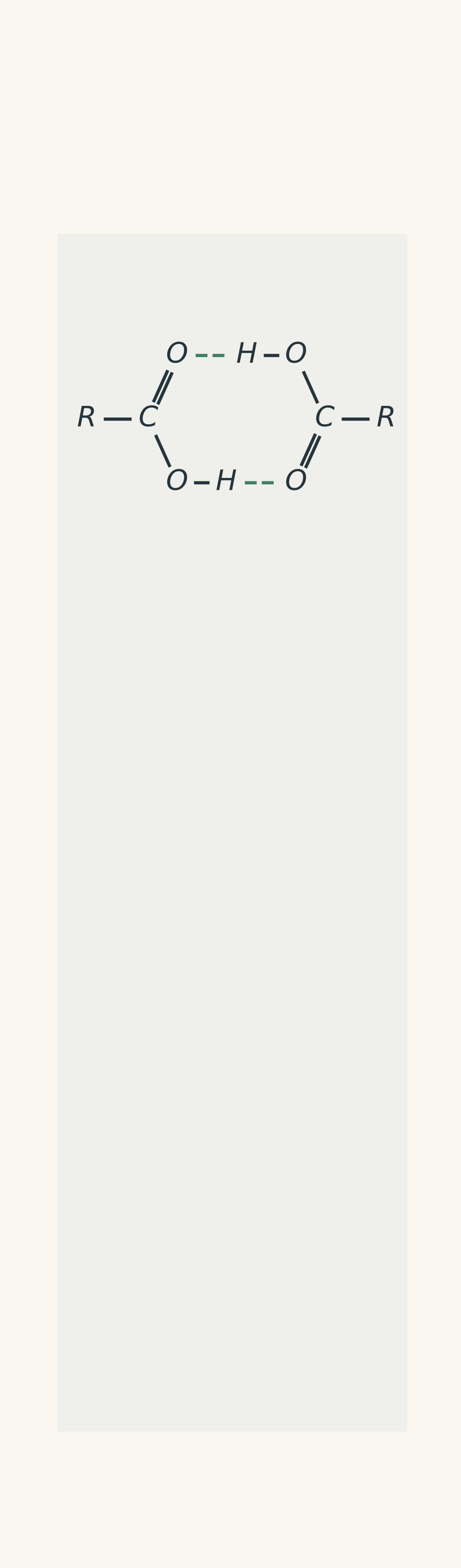
Two carboxylic acid molecules often pair together to form a hydrogen-bonded dimer.
A student might predict:
“Carboxylic acids have one oxygen-containing group, so they should behave similarly to alcohols.”
That prediction makes sense, but it misses something important. Carboxylic acids can form especially stable pairs because each molecule can both donate and accept hydrogen bonds.
This is why carboxylic acids often have higher boiling points than similarly sized alcohols.
05Amines: hydrogen bonding, but weaker than carboxylic acids
Amines contain nitrogen, which can form hydrogen bonds when the nitrogen has a hydrogen attached.
For a primary amine:
\[ \ce{R-NH2} \]
the molecule can donate hydrogen bonds through its N-H bonds and accept hydrogen bonds using the lone pair on nitrogen.
However, nitrogen is less electronegative than oxygen. The N-H bond is less polar than an O-H bond.
This means amines usually have weaker hydrogen bonding than carboxylic acids.

06Amides: the strongest interactions in this group
Amides contain:
\[ \ce{-CONH2} \]
They have both:
- a carbonyl oxygen that accepts hydrogen bonds,
- N-H bonds that can donate hydrogen bonds.
This allows extensive hydrogen bonding between amide molecules.
The carbonyl group also makes the molecule strongly polar.
As a result, amides often have very high boiling points compared with compounds of similar molecular mass.
A useful trend for many similarly sized molecules is:
\[ \text{amide} > \text{carboxylic acid} > \text{amine} > \text{hydrocarbon} \]
for boiling point.
The exact order depends on molecular structure, but the reason is always the same: stronger intermolecular attraction requires more energy to separate molecules.
07Intramolecular bonding: when a molecule bonds with itself
So far, we have discussed intermolecular forces: forces between molecules.
Intramolecular bonding refers to interactions within one molecule.
For carboxylic acids, amines, and amides, the most important intramolecular idea is that a molecule’s shape can affect its ability to interact with other molecules.
For example, if a molecule folds so that a hydrogen bond forms within itself, fewer sites may be available to bond with neighbouring molecules.
This can reduce intermolecular attraction.
Think of it like two people trying to hold hands in a crowded room. If someone’s own arm is wrapped around themselves, there is less ability to connect with others.
The analogy breaks down because molecules are not consciously folding or choosing positions. Their behaviour comes from energy and electron arrangements.
In most simple HSC examples involving carboxylic acids, amines, and amides, the major focus is intermolecular bonding rather than complex intramolecular effects.
08Solubility trends: why some dissolve in water
Water is polar, so substances that can form strong interactions with water are more likely to dissolve.
Carboxylic acids, amines, and amides can interact with water through hydrogen bonding.

However, the carbon chain also matters.
A longer hydrocarbon chain is non-polar and does not interact strongly with water.
This creates a competition:
- the functional group attracts water,
- the carbon chain avoids water.
As the carbon chain becomes longer, the non-polar section becomes more important, and solubility usually decreases.
This same balance between polar and non-polar regions explains how soaps and detergents work through micelles. You can explore that connection in How Detergents Clean: Structure, Micelles and Soap Comparison.
09Worked example: Comparing boiling points
Which compound would be expected to have the highest boiling point: butane, butan-1-amine, or butanamide?
Step 1
Butane only has London dispersion forces.
Butan-1-amine can form hydrogen bonds because it contains N-H bonds.
Butanamide can form hydrogen bonds through both the N-H bonds and the carbonyl oxygen.
Step 2
Butanamide has the greatest ability to form strong hydrogen-bond networks.
Step 3
Butanamide has the highest expected boiling point.
The reason is not simply that it contains more atoms. It is because its functional group creates stronger intermolecular attractions.
10Worked example: Explaining a trend in a homologous series
The boiling points of methanoic acid, ethanoic acid, and propanoic acid increase as the carbon chain becomes longer. Explain why.
Step 1
All three compounds contain the carboxylic acid functional group, so they can all form hydrogen bonds and dimers.
Step 2
The carbon chain increases from one carbon atom to three carbon atoms.
Step 3
The larger molecules contain more electrons and have greater surface area, increasing London dispersion forces.
Step 4
Propanoic acid has the highest boiling point because it has the strongest overall intermolecular attractions.
The hydrogen bonding is important, but the increasing carbon chain adds extra dispersion forces.
11A quick decision method for HSC questions
When you see a question about physical properties of organic compounds:
- Find the functional group.
- Identify the strongest intermolecular force possible.
- Compare the number and strength of those interactions.
- Consider carbon chain length.
- Explain the property using energy needed to overcome attractions.
Avoid the common mistake of saying:
“Bigger molecule = higher boiling point.”
That is only partly true. A smaller molecule with much stronger intermolecular forces can easily have a higher boiling point.
For related organic reactions and connecting structures to transformations, see Organic Acids and Bases: HSC Chemistry Structures and Reactions and How to Construct Organic Synthesis Pathways for HSC Chemistry.
12Questions and solutions
Question 1
Propanoic acid and propane both contain three carbon atoms. Explain why propanoic acid has a higher boiling point than propane.
Solution 1
Propanoic acid has a higher boiling point because it can form hydrogen bonds, while propane only experiences London dispersion forces.
Propanoic acid contains the carboxyl group, \( \ce{-COOH} \), which allows molecules to form strong attractions through hydrogen bonding. Propane is non-polar and has no hydrogen bonding sites.
More energy is therefore required to separate propanoic acid molecules, so propanoic acid has the higher boiling point.
Question 2
An unknown compound has four carbon atoms and contains an amide functional group. A student predicts it will have a lower boiling point than a four-carbon amine because the amide has a larger structure that “gets in the way” of bonding. Evaluate this prediction.
Solution 2
The prediction is incorrect because the amide has stronger intermolecular attractions than the amine.
Although both compounds contain nitrogen, the amide has a carbonyl oxygen as well as N-H bonds. This allows the amide molecules to form stronger and more extensive hydrogen bonding networks.
The larger structure does not reduce the overall attraction. The key factor is the strength of the intermolecular forces, not simply whether the molecule is slightly larger.
Question 3
Three compounds have similar molar masses:
- butanoic acid
- butan-1-amine
- butanamide
Predict their expected boiling point order and explain your reasoning.
Solution 3
The expected boiling point order from highest to lowest is:
\[ \text{butanamide} > \text{butanoic acid} > \text{butan-1-amine} \]
Butanamide has the strongest hydrogen bonding because it contains both N-H hydrogen bond donors and a carbonyl oxygen acceptor.
Butanoic acid can form strong hydrogen-bonded dimers, giving it stronger attractions than the amine.
Butan-1-amine can hydrogen bond, but the N-H bond is less polar than the O-H bond in carboxylic acids, so its intermolecular attractions are generally weaker.
Question 4
A chemist compares pentanoic acid and propanoic acid. Both can form hydrogen-bonded dimers. Explain why pentanoic acid has a higher boiling point.
Solution 4
Pentanoic acid has a higher boiling point because its longer carbon chain creates stronger London dispersion forces.
A tempting answer is that both acids form dimers, so their boiling points should be the same. However, hydrogen bonding is not the only intermolecular force present.
Pentanoic acid has more electrons and a larger surface area than propanoic acid. This increases dispersion forces between molecules, so more energy is needed to separate them.
Question 5
A student is given two compounds:
Compound A: \( \ce{CH3CH2CH2CONH2} \)
Compound B: \( \ce{CH3CH2CH2CH2NH2} \)
The student argues:
“Compound B has more hydrogen atoms attached to nitrogen, so it should form more hydrogen bonds and have the higher boiling point.”
Determine which compound has the higher boiling point and explain why the student’s reasoning fails.
Solution 5
Compound A, butanamide, has the higher boiling point because its carbonyl group creates a much stronger hydrogen-bonding network.
The student’s reasoning focuses only on the number of N-H bonds, which seems reasonable because hydrogen bonds require hydrogen attached to nitrogen or oxygen. However, hydrogen bonding depends on the entire molecular structure.
Butanamide has:
- N-H bonds that donate hydrogen bonds,
- a carbonyl oxygen that accepts hydrogen bonds,
- a highly polar amide group.
The carbonyl oxygen creates strong attraction between neighbouring molecules, allowing a connected network of interactions.
Butan-1-amine can form hydrogen bonds, but it lacks the strongly polar carbonyl group. Therefore, the additional interaction type in the amide outweighs the student’s focus on counting N-H bonds.
The next step is using these structure-property relationships to predict reactions. Once you can look at a functional group and predict its intermolecular behaviour, organic synthesis pathways become much easier to reason through.