
Condensation Polymerisation: Nylon and Polyester Explained for HSC Chemistry
Learn how condensation polymerisation forms nylon and polyesters, and how their structures create different properties and uses. Includes HSC-style examples and practice questions.
A plastic bottle, a rain jacket, and a piece of sports clothing can all be made from polymers, but they behave very differently. A nylon climbing rope can be strong and tough, while a polyester shirt can be light, wrinkle-resistant, and easy to wash. Why?
A first guess might be that stronger materials simply have longer polymer chains. That helps, but it is not the whole story. The arrangement of the atoms and the way the chains connect are what give a polymer its properties.
Condensation polymerisation is one way chemists build these large molecules. It explains why materials such as nylon and polyesters have the structures they do, and why their uses are so different.
Nylon and polyester: structure helps determine properties
| Climbing rope — nylon-6,6 | [-NH-(CH₂)₆-NH-C(=O)-(CH₂)₄-C(=O)-]ₙ Representative nylon-6,6 polyamide; many climbing ropes use nylon/polyamide fibres. 12 C atoms and two amide links (–CONH–) per repeat unit; interchain hydrogen bonding contributes to strength and toughness. |
|---|---|
| Sports shirt — polyester PET | [-O-CH₂-CH₂-O-C(=O)-C₆H₄-C(=O)-]ₙ PET is a polyester widely used for textile fibres. 10 C atoms and two ester links (–COO–) per repeat unit; fibre properties depend strongly on drawing, orientation and fabric structure. |
| Plastic bottle — PET | [-O-CH₂-CH₂-O-C(=O)-C₆H₄-C(=O)-]ₙ PET is also widely used for plastic bottles. The repeat unit is the same as in PET polyester fibre; processing, molecular orientation and bottle structure produce different properties. |
01Building a polymer: joining small molecules together
Imagine you are making a long necklace. You start with many small beads and connect them one after another. A polymer works in a similar way.
The small molecules that join together are called monomers. When many monomers link together, they form a polymer, which is a very large molecule made from repeating units.
The simplest model is:
\[ \text{monomers} \rightarrow \text{polymer} \]
But there is an important detail. Not all monomers connect in the same way.
Some polymerisation reactions simply add monomers together. This is called addition polymerisation. Other reactions remove a small molecule as the monomers join. This is condensation polymerisation.
Before looking at the chemistry, predict this:
If two molecules join together and a small molecule is released, what should happen to the total mass of the final polymer compared with the original monomers?
The polymer should have a lower mass than the starting materials combined, because some atoms have left as a small molecule. In many HSC examples, that small molecule is water.
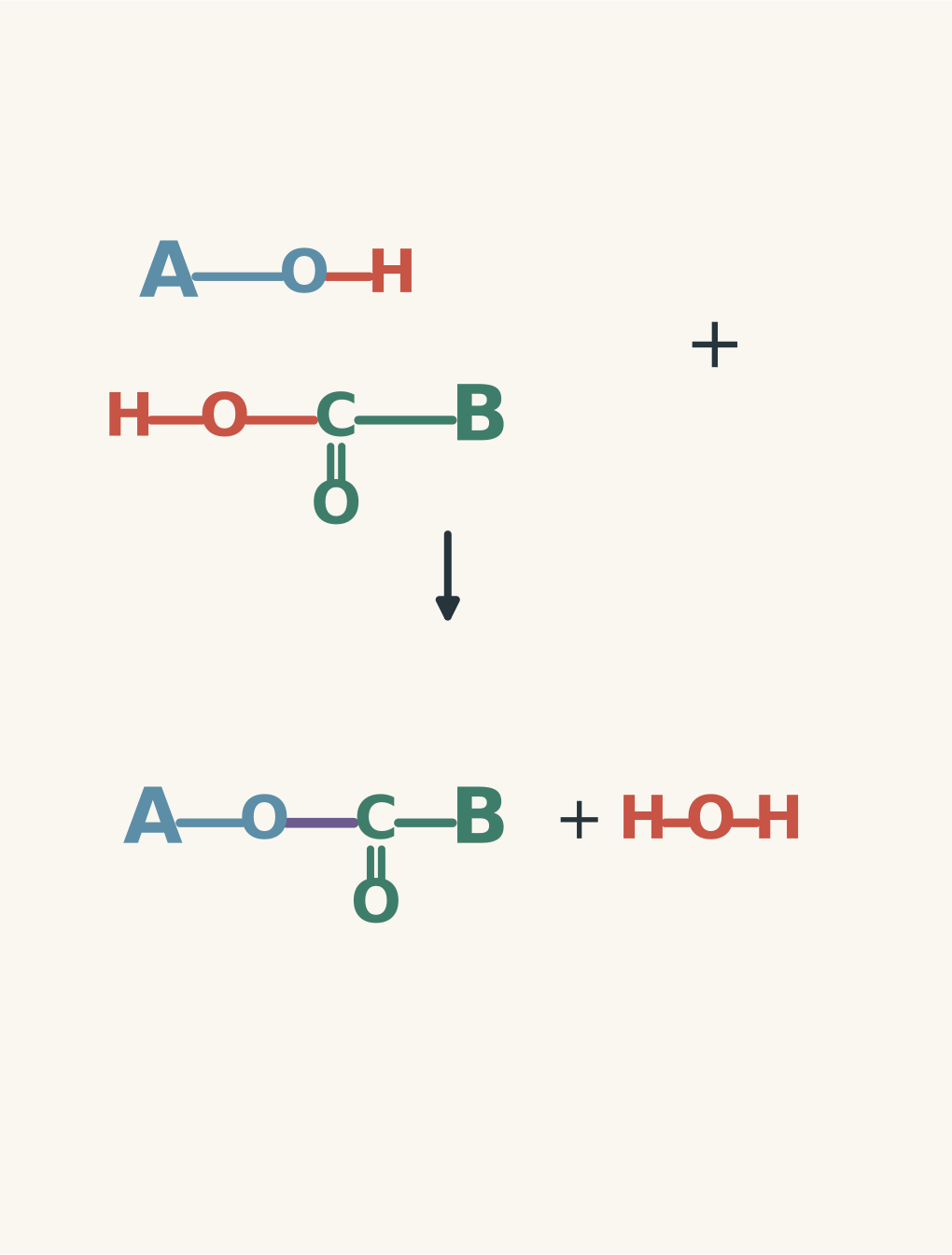
02The basic idea of condensation polymerisation
Condensation polymerisation occurs when monomers with reactive functional groups join together and release a small molecule.
For nylon and many polyesters, the small molecule released is water.
A simplified pattern is:
\[ \text{monomer A} + \text{monomer B} \rightarrow \text{polymer} + \text{small molecule} \]
The important feature is that the monomers need suitable functional groups at their ends so they can continue reacting.
A useful analogy is two people trying to hold hands in a long chain. If everyone has only one hand available, the chain stops quickly. If everyone has two hands, the chain can keep growing.
This analogy helps explain why monomer structure matters. The “hands” are the reactive functional groups.
However, the analogy is not exact. Real polymer chains are not held together by hands or intention. They are connected by chemical bonds formed through reactions between atoms.
03Nylon: a polyamide polymer
Nylon is a type of polymer called a polyamide.
The name gives a clue:
- poly means many
- amide refers to the amide functional group
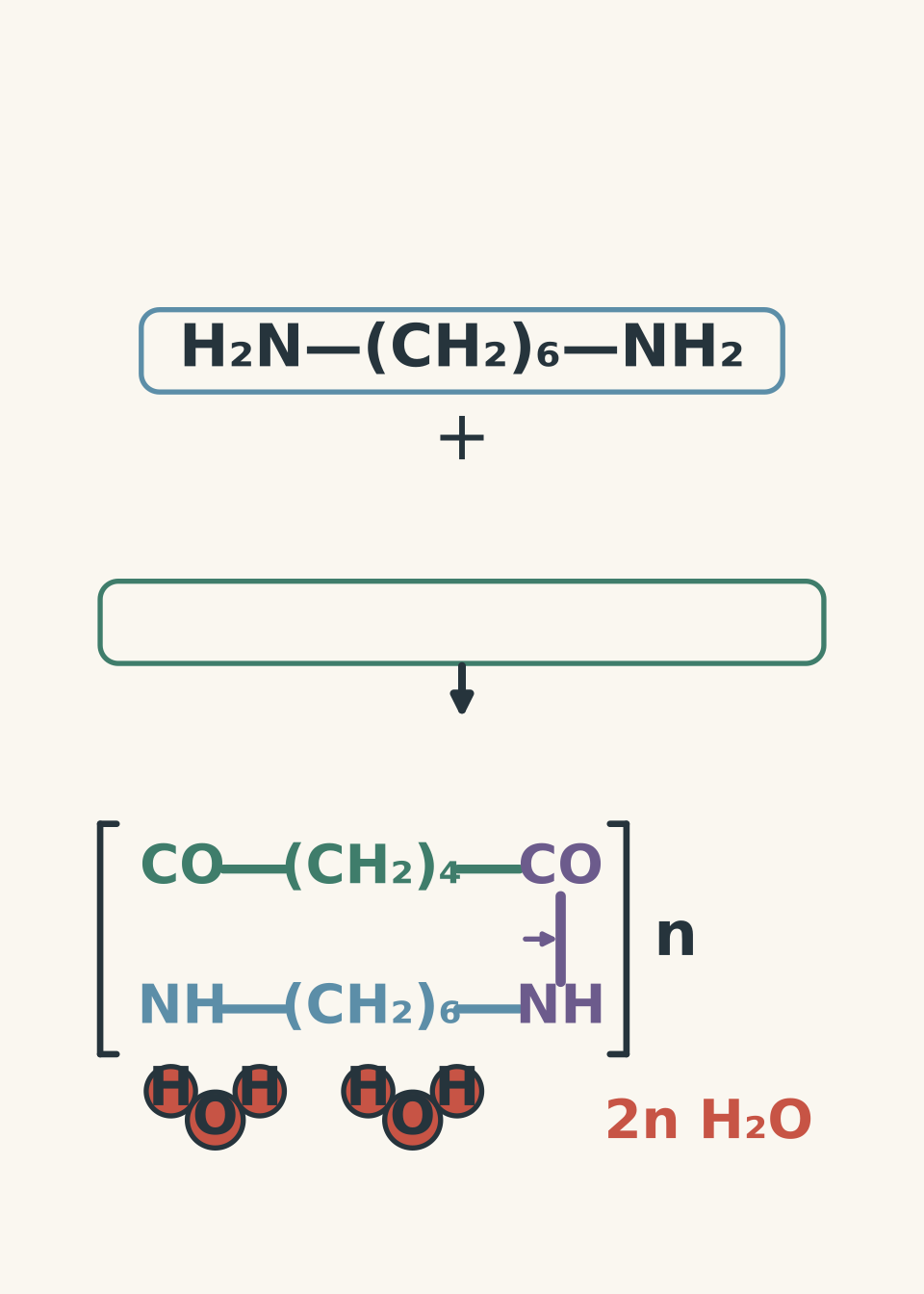
A common nylon used in HSC chemistry discussions is nylon-6,6. It forms from two monomers:
- hexane-1,6-diamine, which contains two amine groups
- hexanedioic acid (adipic acid), which contains two carboxylic acid groups
The reactive groups are:
\[ \ce{-NH2} \]
and
\[ \ce{-COOH} \]
When they react, an amide link forms:
\[ \ce{-CO-NH-} \]
Water is removed during the reaction.
A simplified reaction is:
\[ \ce{n H2N-(CH2)6-NH2 + n HOOC-(CH2)4-COOH -> [-NH-(CH2)6-NH-CO-(CH2)4-CO-]_{n} + 2nH2O} \]
The repeating unit inside the brackets is what appears many times in the nylon chain.
04Polyester: a polymer with ester links
Polyesters form when monomers containing:
- hydroxyl groups \(\ce{-OH}\)
- carboxylic acid groups \(\ce{-COOH}\)
react together.
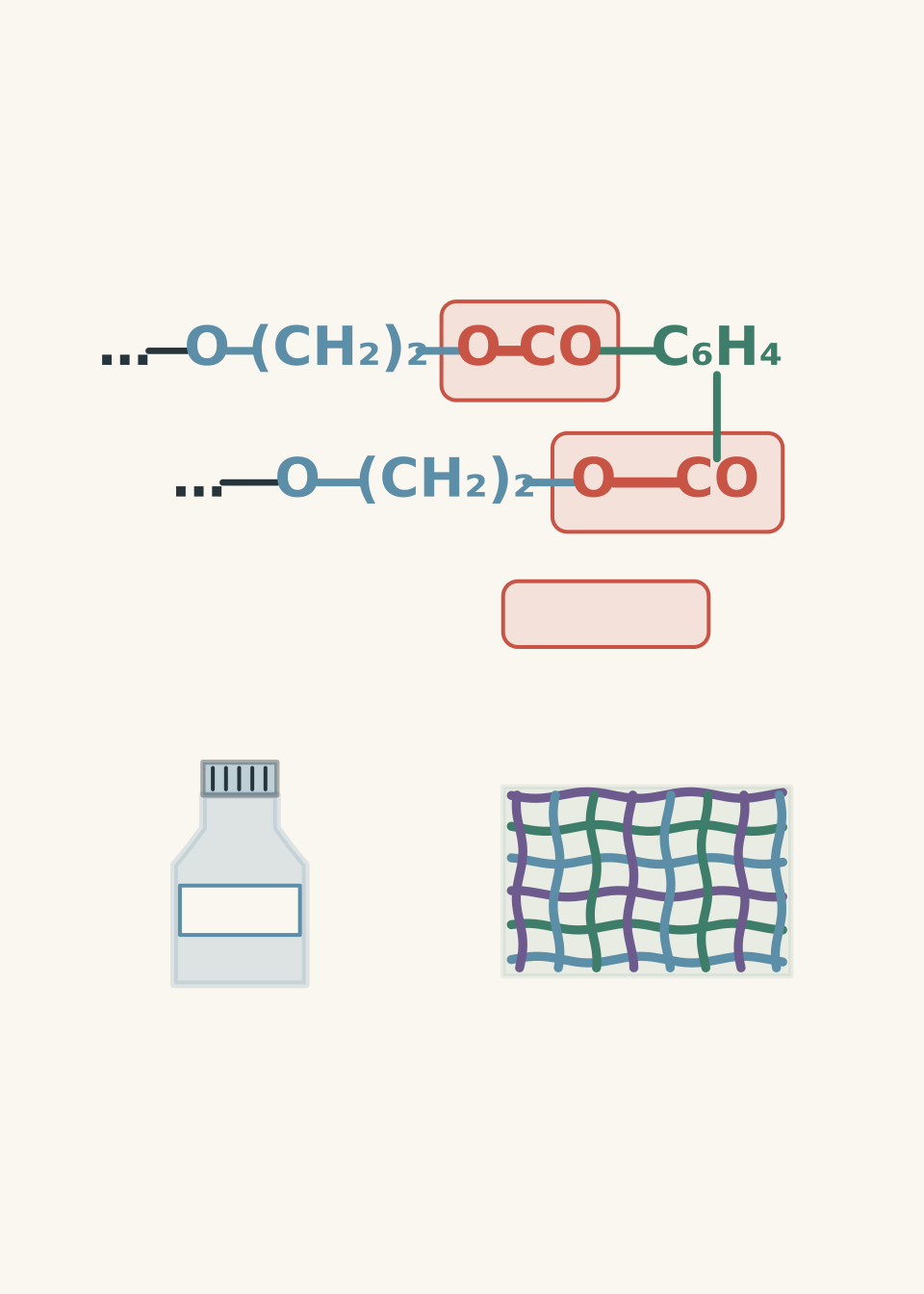
A common polyester is PET (polyethylene terephthalate), used in many drink bottles and fabrics.
PET forms from:
- ethane-1,2-diol
- benzene-1,4-dicarboxylic acid (terephthalic acid)
The link formed is an ester link:
\[ \ce{-COO-} \]
The general reaction is:
\[ \ce{n HO-CH2-CH2-OH + n HOOC-C6H4-COOH -> [-O-CH2-CH2-O-CO-C6H4-CO-]_{n} + 2nH2O} \]
The \(\ce{C6H4}\) part represents the benzene ring with two positions attached to the rest of the structure.
05Why nylon and polyester have different properties
The polymer chain controls how the material behaves.
| Feature | Nylon | Polyester |
|---|---|---|
| Link between monomers | Amide link | Ester link |
| Main intermolecular attraction | Strong hydrogen bonding from amide groups | Dipole interactions and some hydrogen bonding |
| Typical properties | Strong, tough, abrasion resistant | Lightweight, durable, wrinkle resistant |
| Common uses | Ropes, fishing lines, textiles | Clothing fibres, bottles, packaging |
A tempting prediction is:
“Because nylon has stronger intermolecular forces, it must always be the better material.”
That sounds reasonable, but it misses the purpose of a material. A stronger fibre is not automatically better for every job. A drink bottle needs transparency, rigidity, and chemical stability. A rope needs toughness and resistance to stretching.
Chemists choose polymers based on the properties needed.
06Worked example: Identifying condensation polymerisation
A student is given two monomers:
\[ \ce{HO-CH2-CH2-OH} \]
and
\[ \ce{HOOC-C6H4-COOH} \]
Determine the type of polymerisation and the link formed in the polymer.
Step 1
The first monomer contains hydroxyl groups \(\ce{-OH}\). The second contains carboxylic acid groups \(\ce{-COOH}\).
Step 2
A hydroxyl group and a carboxylic acid group can react to form an ester link and remove water.
Step 3
Because water is removed, this is condensation polymerisation.
Step 4
The link formed is an ester link:
\[ \ce{-COO-} \]
The polymer is therefore a polyester.
07Worked example: Comparing nylon and polyester structures
A polymer sample contains repeating amide links. Explain whether it is more likely to be nylon or polyester and predict one property.
Step 1
The repeating unit contains:
\[ \ce{-CO-NH-} \]
This is an amide link.
Step 2
Polyamides, including nylon, contain amide links. Polyesters contain ester links.
Step 3
The amide groups can form strong hydrogen bonding between chains. This increases the attraction between polymer chains.
Step 4
The material is likely to have high strength and toughness, which suits uses such as fibres, ropes, and engineering materials.
The sample is most likely nylon.
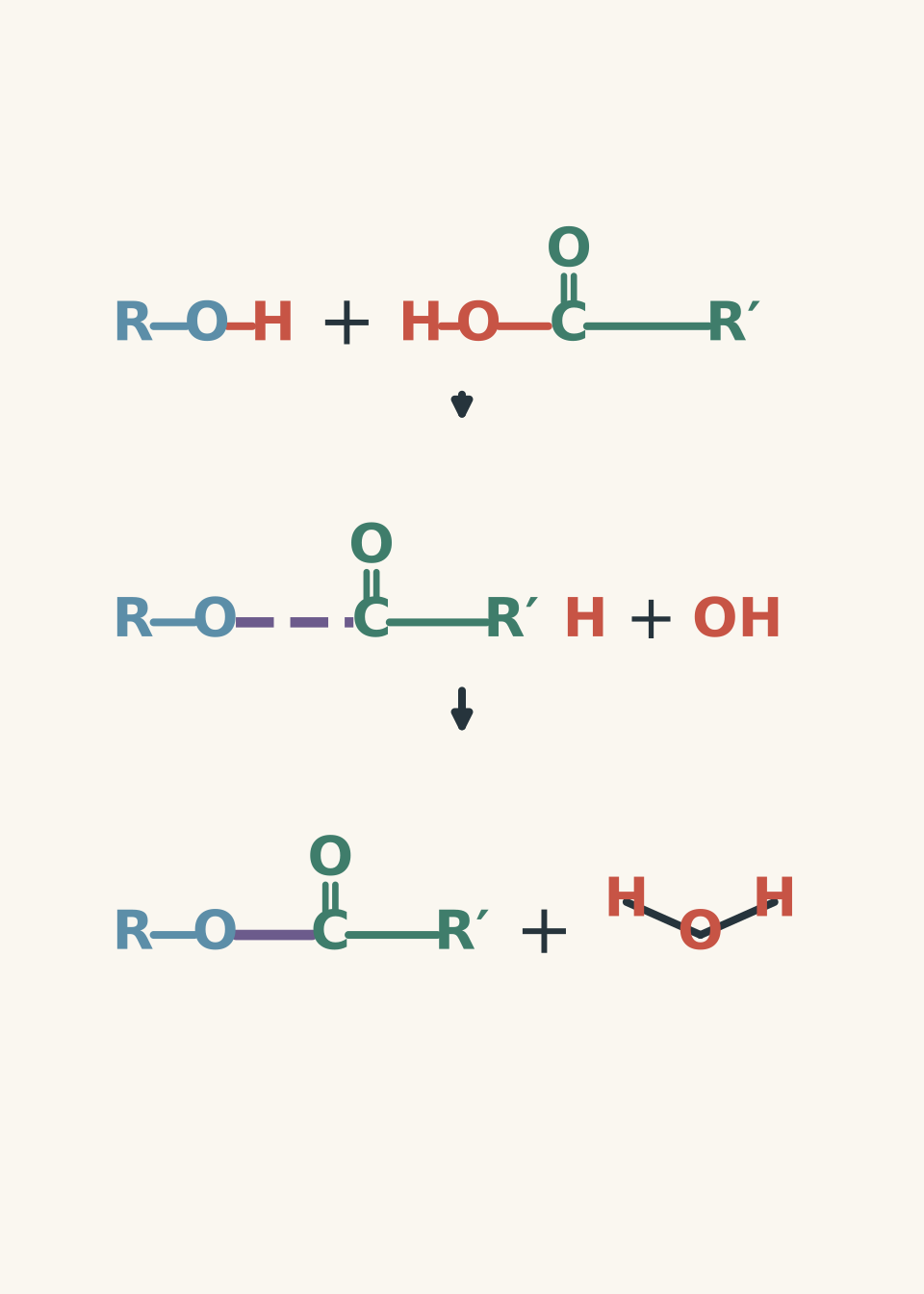
08A closer look: why removing water matters
Students sometimes memorise “condensation means water comes out” and stop there. The better question is: why does the reaction continue?
When monomers react, the atoms rearrange to create new bonds. The water molecule contains atoms that are removed from the reacting functional groups, leaving the remaining atoms able to connect into a long chain.
The polymer is not formed because water is removed like a drying process. The removal of water is a consequence of forming new covalent bonds.
This distinction matters because the reaction is controlled by the structure of the monomers.
09Common misconceptions
“All polymers are made by addition polymerisation”
False. Polymers can form by different mechanisms. Nylon and many polyesters are examples of condensation polymers.
“The strongest polymer always has the strongest bonds”
Not exactly. The bonds within a polymer chain are covalent bonds, but the forces between chains also strongly affect properties.
A polymer with flexible chains may behave differently from one with rigid sections, even if both contain strong covalent bonds.
“The monomer structure disappears completely”
The monomers do not remain as separate molecules, but their structure is still visible in the repeating unit. The arrangement of atoms from the monomers determines the polymer’s properties.
10Questions and solutions
Question 1
A polymer is formed from a diol and a dicarboxylic acid. During the reaction, water is produced.
Identify the type of polymerisation and the link formed.
Solution 1
The polymerisation is condensation polymerisation, and the link formed is an ester link.
A diol contains two hydroxyl groups \(\ce{-OH}\), and a dicarboxylic acid contains two carboxylic acid groups \(\ce{-COOH}\). These functional groups react to form ester bonds:
\[ \ce{-COO-} \]
Water is released during this reaction, which identifies it as condensation polymerisation.
Question 2
A manufacturer needs a fibre for a fishing line. They require high strength and resistance to abrasion. They are choosing between nylon and polyester.
Which polymer is the better choice? Explain using structure and intermolecular forces.
Solution 2
Nylon is the better choice because its amide links allow stronger intermolecular attractions between polymer chains.
Nylon contains:
\[ \ce{-CO-NH-} \]
groups. The \(\ce{-NH}\) and \(\ce{C=O}\) parts allow hydrogen bonding between chains, increasing the attraction between molecules.
This makes nylon fibres strong and resistant to wear, which suits fishing lines. Polyester can also be durable, but its ester links generally provide different intermolecular interactions and are less suited to this particular requirement.
Question 3
A student says:
“PET bottles and polyester clothing are different materials, so they cannot be made from the same type of polymer.”
Evaluate this statement.
Solution 3
The statement is incorrect because the same polymer type can be used in different forms with different properties.
PET is a polyester. It can be processed into rigid bottles or drawn into fibres for clothing.
The difference comes from how the polymer is processed, including factors such as chain arrangement, crystallinity, and manufacturing conditions.
The chemical identity of the repeating unit remains polyester, but the final structure of the material changes its properties.
Question 4
A chemist designs a new condensation polymer. The monomers have only one reactive functional group each.
Predict whether the chemist can form a long polymer chain. Explain your reasoning.
Solution 4
The chemist is unlikely to form a long chain because the monomers do not have enough reactive groups to continue linking.
For a long condensation polymer, monomers usually need two reactive sites so that each monomer can connect to two neighbours.
A monomer with only one reactive group can usually attach at one point and then stop the chain growing. The key constraint is the number of possible connections each monomer can make.
Question 5
A student compares nylon and polyester and argues:
“Nylon must always absorb more energy before breaking because it has stronger intermolecular forces. Therefore, nylon is always the tougher material.”
Evaluate this reasoning.
Solution 5
The reasoning is incomplete because intermolecular force strength alone does not determine toughness.
Nylon’s amide links do create strong hydrogen bonding, which can increase strength. However, toughness depends on several interacting factors, including chain flexibility, chain alignment, crystallinity, and how the material deforms before breaking.
A polymer with weaker intermolecular forces may still be better for a particular application if its chains can move and absorb energy effectively.
The tempting mistake is treating one structural feature as the only factor controlling a material property. Polymer behaviour comes from the entire arrangement of the molecules, not one bond type in isolation.
Understanding how structure creates properties is the key idea behind choosing materials. This same structure-property relationship appears again when studying biomolecules, materials chemistry, and how chemists design polymers for specific purposes.