
Collision Theory and Chemical Equilibrium: HSC Chemistry
Learn how collision theory explains forward and reverse reaction rates in dynamic equilibrium. Includes worked examples, common misconceptions, and challenging HSC-style questions.
Imagine a sealed flask containing reactants that can turn into products and products that can turn back into reactants. After a while, the measured concentrations stop changing. What would you predict has happened inside the flask: have the reactions stopped, or are both reactions still running?
The second answer is the important one. At chemical equilibrium, particles are still colliding and reacting. The forward and reverse reactions continue, but they occur at the same rate. The visible result is no overall change.
That makes chemical equilibrium a collision-theory problem as much as an equilibrium problem.
01Start with the two competing reactions
Consider the reversible reaction
\[
\ce{2NO2(g) <=> N2O4(g)}
\]
Nitrogen dioxide, \(\ce{NO2}\), can combine to form \(\ce{N2O4}\). At the same time, \(\ce{N2O4}\) molecules can break apart to reform \(\ce{NO2}\).
So there are always two processes to think about:
- forward: \(\ce{2NO2 -> N2O4}\)
- reverse: \(\ce{N2O4 -> 2NO2}\)
If reversible reactions themselves need a refresh, see Reversible Chemical Reactions: HSC Chemistry Guide.
Suppose we begin with lots of \(\ce{NO2}\) and no \(\ce{N2O4}\). Predict the two reaction rates at the instant the experiment begins.
The forward rate is relatively high because there are many \(\ce{NO2}\) particles available to collide. The reverse rate is initially zero because there is no \(\ce{N2O4}\) yet.
But the situation immediately starts changing.
As \(\ce{N2O4}\) forms:
- the concentration of \(\ce{NO2}\) falls, so successful forward collisions become less frequent,
- the concentration of \(\ce{N2O4}\) rises, so reverse reactions become more frequent.
Eventually, the two rates become equal.
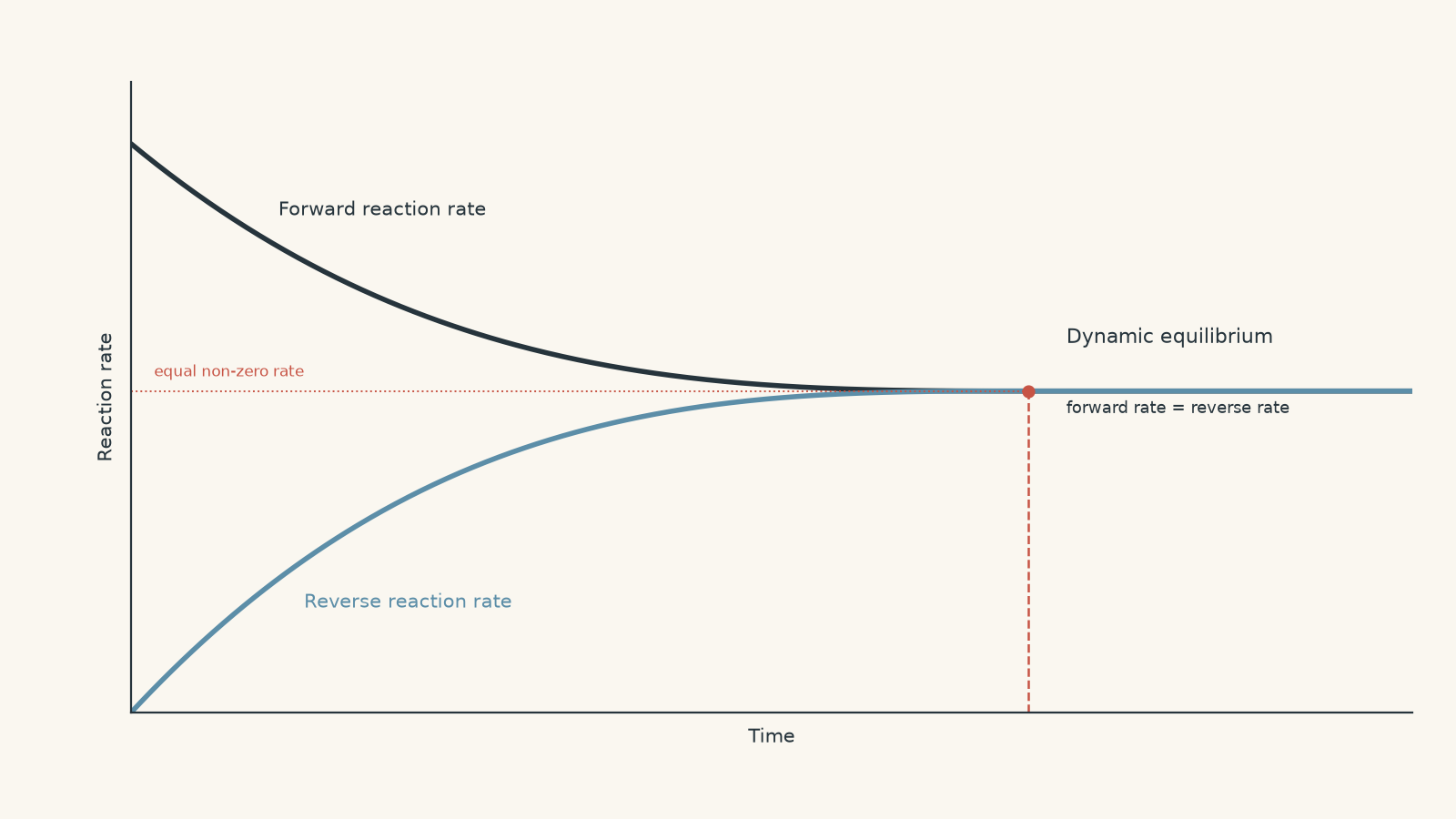
That equality of rates is the heart of dynamic equilibrium.
02What collision theory contributes
Collision theory says that reacting particles generally need to meet certain conditions before a collision produces a reaction.
For a collision to be effective, the particles need:
- enough energy to overcome the activation energy, \(E_a\), and
- a suitable orientation for bonds to break and form.
Not every collision succeeds.
Imagine two people trying to high-five while running through a crowded corridor. Simply crashing into each other isn’t enough. They have to meet in roughly the right way, and with the movement needed to complete the action.
For molecules, the details are obviously rather less social. The useful part of the analogy is that the number of encounters is not the same as the number of successful reactions. It breaks down because molecules do not decide how to collide, and molecular reactions involve energy distributions, electron arrangements, and bond changes.
Concentration affects collision frequency
If you increase the concentration of a reactant, there are more reactant particles in the same volume.
That usually means more collisions per second between the particles needed for the reaction. If the other conditions are unchanged, the reaction rate increases.
For a reversible reaction, you must apply that reasoning separately to the forward and reverse processes.
Increasing the concentration of a reactant tends to increase the forward rate immediately.
Increasing the concentration of a product tends to increase the reverse rate immediately.
That word immediately matters. The other rate may change later because the composition of the mixture then starts changing.
Temperature affects the energy of collisions
Increasing temperature does more than make particles collide slightly more often.
More importantly, it changes the distribution of particle energies. A larger fraction of collisions have enough energy to overcome the activation energy.
Both the forward and reverse reactions speed up when temperature increases. However, they do not necessarily speed up by the same amount because the two directions generally have different activation energies.
That difference is why temperature can change the equilibrium position.
03Equilibrium does not mean equal concentrations
This is one of the easiest mistakes to make.
At equilibrium,
\[
r_{\text{forward}} = r_{\text{reverse}}
\]
where \(r_{\text{forward}}\) is the forward reaction rate and \(r_{\text{reverse}}\) is the reverse reaction rate.
It does not follow that
\[
[\text{reactants}] = [\text{products}]
\]
A system could be at equilibrium with far more reactant than product, or far more product than reactant. What matters is that the microscopic processes changing those concentrations balance each other.
Think of two escalators running between two floors. If 20 people per minute go upstairs and 20 people per minute go downstairs, the number of people on each floor can stay constant. That does not mean the two floors contain the same number of people.
The analogy breaks if you push it too far: chemical reaction rates depend on molecular collisions and energy, not commuters. But it captures the distinction between equal rates and equal amounts.
Worked example: Find the net rate of change
For a reversible reaction
\[
\ce{A <=> B}
\]
the forward reaction is occurring at \(0.080\ \text{mol L}^{-1}\text{s}^{-1}\), while the reverse reaction is occurring at \(0.030\ \text{mol L}^{-1}\text{s}^{-1}\).
Calculate the net rate at which \(\ce{B}\) is being formed. Later, both rates become \(0.050\ \text{mol L}^{-1}\text{s}^{-1}\). Explain what this tells you.
Step 1
The forward reaction forms \(\ce{B}\), while the reverse reaction removes it.
Step 2
\[
\begin{aligned}
r_{\text{net}} &= r_{\text{forward}}-r_{\text{reverse}}\\
&=0.080-0.030\\
&=0.050\ \text{mol L}^{-1}\text{s}^{-1}
\end{aligned}
\]
So \(\ce{B}\) is initially being produced overall at
\[
0.050\ \text{mol L}^{-1}\text{s}^{-1}.
\]
Step 3
\[
\begin{aligned}
r_{\text{net}} &=0.050-0.050\\
&=0\ \text{mol L}^{-1}\text{s}^{-1}
\end{aligned}
\]
There is now no net change in the concentration of \(\ce{B}\).
The important point is that neither reaction rate is zero. Both reactions are still occurring at \(0.050\ \text{mol L}^{-1}\text{s}^{-1}\). This is dynamic equilibrium, not a stopped reaction.
For a closer treatment of that distinction, see Static vs Dynamic Equilibrium in HSC Chemistry.
04How a system approaches equilibrium
Suppose a reversible system initially contains mainly reactants.
At first:
\[
r_{\text{forward}} > r_{\text{reverse}}
\]
so products accumulate.
As products accumulate, the reverse reaction gets faster. At the same time, using up reactants usually makes the forward reaction slower.
Eventually,
\[
r_{\text{forward}}=r_{\text{reverse}}.
\]
From then on, the concentrations remain constant provided the external conditions remain unchanged.
Notice what collision theory has given us. We do not need to imagine that the reaction somehow detects equilibrium and switches itself off. Equilibrium emerges because the changing concentrations alter the frequencies of the forward and reverse processes until their rates match.
05What happens when equilibrium is disturbed?
Once a system is at equilibrium, changing its conditions can make the two rates unequal again.
The useful question is not simply, “Which way will equilibrium shift?”
Ask this first:
What happens to the forward and reverse rates immediately after the disturbance?
That gives you a molecular explanation for the shift.
| Disturbance | Immediate collision-theory effect |
|---|---|
| Add a reactant | Forward reaction usually speeds up immediately |
| Add a product | Reverse reaction usually speeds up immediately |
| Remove a reactant | Forward reaction usually slows immediately |
| Remove a product | Reverse reaction usually slows immediately |
| Increase temperature | Both directions speed up, but not necessarily equally |
| Add a catalyst | Both directions speed up; equilibrium composition is unchanged at the same temperature |
| Increase gas concentration by compression | Collision frequencies increase; which direction gains more depends on the reaction |
The system then changes composition until the forward and reverse rates become equal again.
This is the rate-based explanation behind many results that are often memorised using Le Chatelier’s principle.
06Changing concentration: follow the rates
Consider
\[
\ce{A(aq) + B(aq) <=> C(aq)}
\]
Suppose the system is already at equilibrium, so
\[
r_{\text{forward}}=r_{\text{reverse}}.
\]
Now extra \(\ce{A}\) is added.
Immediately after mixing, there are more \(\ce{A}\) particles available to encounter \(\ce{B}\). Forward effective collisions therefore occur more frequently.
So, initially,
\[
r_{\text{forward}}>r_{\text{reverse}}.
\]
More \(\ce{C}\) forms.
As that happens:
- \([\ce{A}]\) and \([\ce{B}]\) decrease from their newly disturbed values,
- \([\ce{C}]\) increases,
- the forward rate falls,
- the reverse rate rises.
Eventually, the rates become equal again.
The new equilibrium contains a different set of concentrations, but once again there is no net macroscopic change.
07Compression is more subtle than “more collisions”
For gaseous equilibria, decreasing the volume puts the same number of particles into less space.
Collision frequencies increase.
A tempting prediction is therefore: “Both reactions speed up, so nothing else should happen.”
Sometimes that prediction is right. Sometimes it is wrong.
You have to ask how strongly each direction responds.
Worked example: Predict the effect of compression from reaction rates
Consider
\[
\ce{2NO2(g) <=> N2O4(g)}
\]
Assume, for this example, that the forward and reverse processes behave as elementary steps, so
\[
r_{\text{forward}}=k_f[\ce{NO2}]^2
\]
and
\[
r_{\text{reverse}}=k_r[\ce{N2O4}]
\]
where \(k_f\) and \(k_r\) are rate constants.
At equilibrium, both rates are
\[
0.020\ \text{mol L}^{-1}\text{s}^{-1}.
\]
The volume of the vessel is suddenly halved at constant temperature. Determine the forward and reverse rates immediately after compression, and predict the initial direction of net reaction.
Step 1
Halving the volume while keeping the number of moles unchanged doubles every gas concentration.
Therefore,
\[
[\ce{NO2}]_{\text{new}}=2[\ce{NO2}]_{\text{old}}
\]
and
\[
[\ce{N2O4}]_{\text{new}}=2[\ce{N2O4}]_{\text{old}}.
\]
Step 2
The forward rate depends on \([\ce{NO2}]^2\):
\[
r_{\text{forward,new}}
=k_f(2[\ce{NO2}])^2.
\]
Therefore,
\[
r_{\text{forward,new}}=4r_{\text{forward,old}}.
\]
So
\[
\begin{aligned}
r_{\text{forward,new}}
&=4(0.020)\\
&=0.080\ \text{mol L}^{-1}\text{s}^{-1}.
\end{aligned}
\]
Step 3
The reverse rate is directly proportional to \([\ce{N2O4}]\):
\[
r_{\text{reverse,new}}
=k_r(2[\ce{N2O4}]).
\]
Therefore,
\[
\begin{aligned}
r_{\text{reverse,new}}
&=2(0.020)\\
&=0.040\ \text{mol L}^{-1}\text{s}^{-1}.
\end{aligned}
\]
Step 4
Immediately after compression,
\[
0.080>0.040.
\]
The net reaction is therefore forward.
The initial net rate is
\[
\begin{aligned}
r_{\text{net}}
&=0.080-0.040\\
&=0.040\ \text{mol L}^{-1}\text{s}^{-1}.
\end{aligned}
\]
So \(\ce{N2O4}\) begins to form overall.
The key idea is not merely that compression causes more collisions. It increases both rates, but the forward reaction responds more strongly in this model.
One warning: you cannot normally read a rate law directly from a balanced chemical equation. We were allowed to use these relationships because the question explicitly stated that the processes behave as elementary steps.
08Temperature changes collision energies
Now imagine an equilibrium mixture being heated.
Particles move faster on average, and the energy distribution changes. More collisions exceed the activation energy.
So both reaction rates increase.
Would equilibrium therefore be unaffected?
Not necessarily.
The forward and reverse reactions have different activation energies. A temperature change can therefore alter one rate more strongly than the other.
For an exothermic forward reaction,
\[
\ce{Reactants <=> Products + heat}
\]
the reverse direction has the larger activation energy on the usual energy-profile model. Heating tends to increase the reverse rate proportionally more, so the system moves towards reactants until the rates become equal again.
For an endothermic forward reaction, heating favours the forward direction instead.
Collision theory therefore provides a microscopic explanation for why changing temperature can change equilibrium composition.
It also explains why temperature is different from simply changing concentration. Concentration mainly changes how often suitable particles meet. Temperature changes the energy distribution of those collisions and the rate constants themselves.
09Why a catalyst does not shift equilibrium
Suppose a catalyst is added to a system already at equilibrium.
A common prediction is that the equilibrium should move towards products because “a catalyst makes the reaction faster”.
But which reaction?
In a reversible system, the catalyst provides an alternative pathway with lower activation energy for both directions.
The forward reaction becomes faster.
The reverse reaction also becomes faster.
At the same temperature, a catalyst does not change the equilibrium constant and does not change the equilibrium composition.
If the system starts away from equilibrium, a catalyst allows it to reach equilibrium faster. If it is already at equilibrium, the microscopic forward and reverse reactions both become faster while remaining balanced.
That is a strange but useful picture: the mixture can be reacting more rapidly at the particle level while its measured concentrations stay exactly the same.
10The distinction that ties everything together
Three different quantities are easy to blur together:
| Quantity | What it tells you |
|---|---|
| Forward rate | How quickly reactants are being converted towards products |
| Reverse rate | How quickly products are being converted towards reactants |
| Net rate | Difference between the forward and reverse rates |
At equilibrium,
\[
r_{\text{net}}=0
\]
because
\[
r_{\text{forward}}=r_{\text{reverse}}.
\]
But
\[
r_{\text{forward}}\neq 0
\]
and
\[
r_{\text{reverse}}\neq 0.
\]
That single distinction explains why equilibrium is called dynamic.
It also explains why a disturbance can cause a shift. The disturbance first changes one or both microscopic rates. Once the rates are unequal, the composition changes. That changing composition then alters the rates again until equality is restored.
11Questions and solutions
Question 1
A closed vessel contains the equilibrium
\[
\ce{H2(g) + I2(g) <=> 2HI(g)}.
\]
At equilibrium, the forward reaction rate is \(1.8\times10^{-3}\ \text{mol L}^{-1}\text{s}^{-1}\).
State the reverse reaction rate and the net reaction rate. Explain why the concentrations remain constant even though reactions continue.
Solution 1
The reverse rate is \(1.8\times10^{-3}\ \text{mol L}^{-1}\text{s}^{-1}\), and the net rate is \(0\ \text{mol L}^{-1}\text{s}^{-1}\).
At equilibrium,
\[
r_{\text{forward}}=r_{\text{reverse}}.
\]
Therefore,
\[
\begin{aligned}
r_{\text{net}}
&=r_{\text{forward}}-r_{\text{reverse}}\\
&=1.8\times10^{-3}-1.8\times10^{-3}\\
&=0\ \text{mol L}^{-1}\text{s}^{-1}.
\end{aligned}
\]
Reactants are still being converted into products, but products are being converted back into reactants at the same rate. There is therefore no net concentration change.
The tempting mistake is to say that the reaction has stopped because the concentrations are constant. Constant concentration is evidence of balanced rates, not zero rates.
Question 2
The system
\[
\ce{A(aq) + B(aq) <=> C(aq)}
\]
is at equilibrium in a closed flask at constant temperature.
A quantity of \(\ce{A}\) is added without significantly changing the total volume.
Describe, in order:
- what happens to the forward and reverse rates immediately after the addition,
- how the concentrations then begin to change, and
- how a new equilibrium is established.
Solution 2
The forward rate increases immediately, while the reverse rate does not initially increase for the same reason; the system then forms more \(\ce{C}\) until the forward and reverse rates become equal again.
Adding \(\ce{A}\) increases \([\ce{A}]\). There are now more \(\ce{A}\) particles available to collide with \(\ce{B}\), so effective forward collisions become more frequent.
Immediately after the addition,
\[
r_{\text{forward}}>r_{\text{reverse}}.
\]
The net reaction therefore proceeds towards \(\ce{C}\).
As the forward reaction occurs:
- \([\ce{A}]\) begins to fall from its disturbed value,
- \([\ce{B}]\) falls,
- \([\ce{C}]\) rises.
The rising concentration of \(\ce{C}\) increases the frequency of the reverse process, while the consumption of \(\ce{A}\) and \(\ce{B}\) reduces the forward rate.
Eventually,
\[
r_{\text{forward}}=r_{\text{reverse}}
\]
again.
The tempting route is to say simply, “Adding a reactant shifts equilibrium right.” That prediction is correct here, but it skips the mechanism. Collision theory explains the shift: the addition first makes the forward rate larger than the reverse rate.
Question 3
For a reversible reaction
\[
\ce{A <=> B},
\]
the forward rate at one instant is \(6.5\times10^{-4}\ \text{mol L}^{-1}\text{s}^{-1}\), while the reverse rate is \(2.0\times10^{-4}\ \text{mol L}^{-1}\text{s}^{-1}\).
- Calculate the net rate of formation of \(\ce{B}\).
- Later, a catalyst is added after the system has reached equilibrium. Explain what happens to the forward rate, reverse rate, net rate, and equilibrium composition.
Solution 3
The net rate of formation of \(\ce{B}\) is \(4.5\times10^{-4}\ \text{mol L}^{-1}\text{s}^{-1}\); once the system is at equilibrium, adding a catalyst increases both microscopic reaction rates but leaves the net rate at zero and does not change the equilibrium composition.
For part 1,
\[
\begin{aligned}
r_{\text{net}}
&=r_{\text{forward}}-r_{\text{reverse}}\\
&=6.5\times10^{-4}-2.0\times10^{-4}\\
&=4.5\times10^{-4}\ \text{mol L}^{-1}\text{s}^{-1}.
\end{aligned}
\]
The positive result means that \(\ce{B}\) is being produced overall.
For part 2, the catalyst lowers the activation energy of an alternative pathway for both directions.
So:
- \(r_{\text{forward}}\) increases,
- \(r_{\text{reverse}}\) increases,
- the two rates remain equal at equilibrium,
- \(r_{\text{net}}=0\),
- the equilibrium concentrations do not change.
The tempting misconception is that a catalyst “pushes” the system towards products. A catalyst changes how quickly equilibrium is reached, not the equilibrium composition at a fixed temperature.
Question 4
Consider the gaseous equilibrium
\[
\ce{A(g) + B(g) <=> 2C(g)}.
\]
Assume both directions behave as elementary reactions, so
\[
r_{\text{forward}}=k_f[\ce{A}][\ce{B}]
\]
and
\[
r_{\text{reverse}}=k_r[\ce{C}]^2.
\]
The system is initially at equilibrium, with each rate equal to \(0.012\ \text{mol L}^{-1}\text{s}^{-1}\).
The vessel is suddenly compressed to half its original volume at constant temperature.
Calculate the forward and reverse rates immediately after compression. Does the reaction initially proceed forwards, backwards, or neither?
Solution 4
Both rates become \(0.048\ \text{mol L}^{-1}\text{s}^{-1}\), so there is no initial net reaction and the system remains at equilibrium despite the faster microscopic reactions.
Halving the volume doubles every concentration:
\[
[\ce{A}]_{\text{new}}=2[\ce{A}]_{\text{old}},
\]
\[
[\ce{B}]_{\text{new}}=2[\ce{B}]_{\text{old}},
\]
and
\[
[\ce{C}]_{\text{new}}=2[\ce{C}]_{\text{old}}.
\]
For the forward reaction,
\[
\begin{aligned}
r_{\text{forward,new}}
&=k_f(2[\ce{A}])(2[\ce{B}])\\
&=4k_f[\ce{A}][\ce{B}]\\
&=4(0.012)\\
&=0.048\ \text{mol L}^{-1}\text{s}^{-1}.
\end{aligned}
\]
For the reverse reaction,
\[
\begin{aligned}
r_{\text{reverse,new}}
&=k_r(2[\ce{C}])^2\\
&=4k_r[\ce{C}]^2\\
&=4(0.012)\\
&=0.048\ \text{mol L}^{-1}\text{s}^{-1}.
\end{aligned}
\]
Therefore,
\[
\begin{aligned}
r_{\text{net}}
&=0.048-0.048\\
&=0\ \text{mol L}^{-1}\text{s}^{-1}.
\end{aligned}
\]
The surprising part is that compression has definitely affected the reactions: both are now occurring four times faster. Yet it has not disturbed their equality.
A tempting argument is that increased pressure must shift a gaseous equilibrium. That is not a general rule. Here, each side contains the same total number of gaseous particles in the balanced equation, and both elementary rates respond by the same factor.
The system remains dynamically active, just more rapidly active.
Question 5
A gaseous system follows the elementary reversible reaction
\[
\ce{A(g) + B(g) <=> 2C(g)}.
\]
It is initially at equilibrium at temperature \(T_1\), with
\[
r_{\text{forward}}=r_{\text{reverse}}=0.010\ \text{mol L}^{-1}\text{s}^{-1}.
\]
The volume is suddenly halved and, at the same instant, the temperature is increased to \(T_2\).
Halving the volume doubles all concentrations. At \(T_2\), compared with \(T_1\), the forward rate constant is three times larger while the reverse rate constant is six times larger.
- Calculate the forward and reverse rates immediately after both changes.
- State the initial direction of net reaction.
- A student argues that because the reaction has two moles of gas on each side, changing the volume cannot disturb equilibrium, so the system must still be at equilibrium. Explain exactly where this reasoning fails.
Solution 5
The forward rate immediately becomes \(0.120\ \text{mol L}^{-1}\text{s}^{-1}\), the reverse rate becomes \(0.240\ \text{mol L}^{-1}\text{s}^{-1}\), and the system initially reacts in the reverse direction. The student’s volume argument is incomplete because the simultaneous temperature change affects the two rate constants by different factors.
Start with the compression.
Because the volume is halved,
\[
[\ce{A}],\ [\ce{B}],\ \text{and }[\ce{C}]
\]
all double.
Since
\[
r_{\text{forward}}=k_f[\ce{A}][\ce{B}],
\]
doubling both reactant concentrations would, at the original temperature, multiply the forward rate by
\[
2\times2=4.
\]
The temperature change also makes \(k_f\) three times larger.
Therefore,
\[
\begin{aligned}
r_{\text{forward,new}}
&=0.010\times4\times3\\
&=0.120\ \text{mol L}^{-1}\text{s}^{-1}.
\end{aligned}
\]
For the reverse reaction,
\[
r_{\text{reverse}}=k_r[\ce{C}]^2.
\]
Doubling \([\ce{C}]\) multiplies the concentration factor by
\[
2^2=4.
\]
The higher temperature makes \(k_r\) six times larger.
Therefore,
\[
\begin{aligned}
r_{\text{reverse,new}}
&=0.010\times4\times6\\
&=0.240\ \text{mol L}^{-1}\text{s}^{-1}.
\end{aligned}
\]
The immediate net rate in the forward direction is
\[
\begin{aligned}
r_{\text{net}}
&=0.120-0.240\\
&=-0.120\ \text{mol L}^{-1}\text{s}^{-1}.
\end{aligned}
\]
The negative sign means the net reaction is reverse: \(\ce{C}\) is being converted overall into \(\ce{A}\) and \(\ce{B}\).
The student’s claim contains one correct idea. If the temperature had remained at \(T_1\), compression would multiply both rates by the same factor of four:
\[
0.010\times4=0.040\ \text{mol L}^{-1}\text{s}^{-1}
\]
for each direction.
So compression alone would not break the equality of rates in this particular reaction.
But temperature was changed as well.
At \(T_2\), the rate constants do not change equally:
\[
k_f\rightarrow3k_f
\]
while
\[
k_r\rightarrow6k_r.
\]
That destroys the equality between the forward and reverse rates.
The fair trap is treating “the same number of gas moles on each side” as a universal reason the system cannot shift. It only tells you something about the effect of changing pressure or volume at fixed temperature. Temperature changes the kinetic energy distribution, rate constants, and equilibrium constant, so it must be considered separately.
Once you can follow an equilibrium this way, Le Chatelier’s principle stops being a collection of directions to memorise. The next step is to connect these rate changes to the reaction quotient \(Q\) and equilibrium constant \(K\): collision theory explains how the system moves, while \(Q\) and \(K\) let you determine which direction it must move after a disturbance.