
Intermolecular Bonding in Alcohols: HSC Chemistry Explained
Understand how hydrogen bonding, dipole-dipole attractions, and London dispersion forces explain alcohol boiling points and water solubility. Includes worked examples, misconceptions, and challenging HSC-style questions with solutions.
At room temperature, ethanol is a liquid, but dimethyl ether is a gas. That is odd at first glance because both have the molecular formula \(\ce{C2H6O}\), so they have the same molar mass and the same numbers of each type of atom.
Before going further, predict which one should have the higher boiling point. If you only looked at molecular formula, you might expect them to be similar. In reality, ethanol boils at about \(78^\circ\text{C}\), while dimethyl ether boils at about \(-25^\circ\text{C}\).
The difference is not in how many atoms they contain. It is in how those atoms are connected, and therefore how neighbouring molecules can attract each other.
01The important distinction: bonds within molecules and forces between molecules
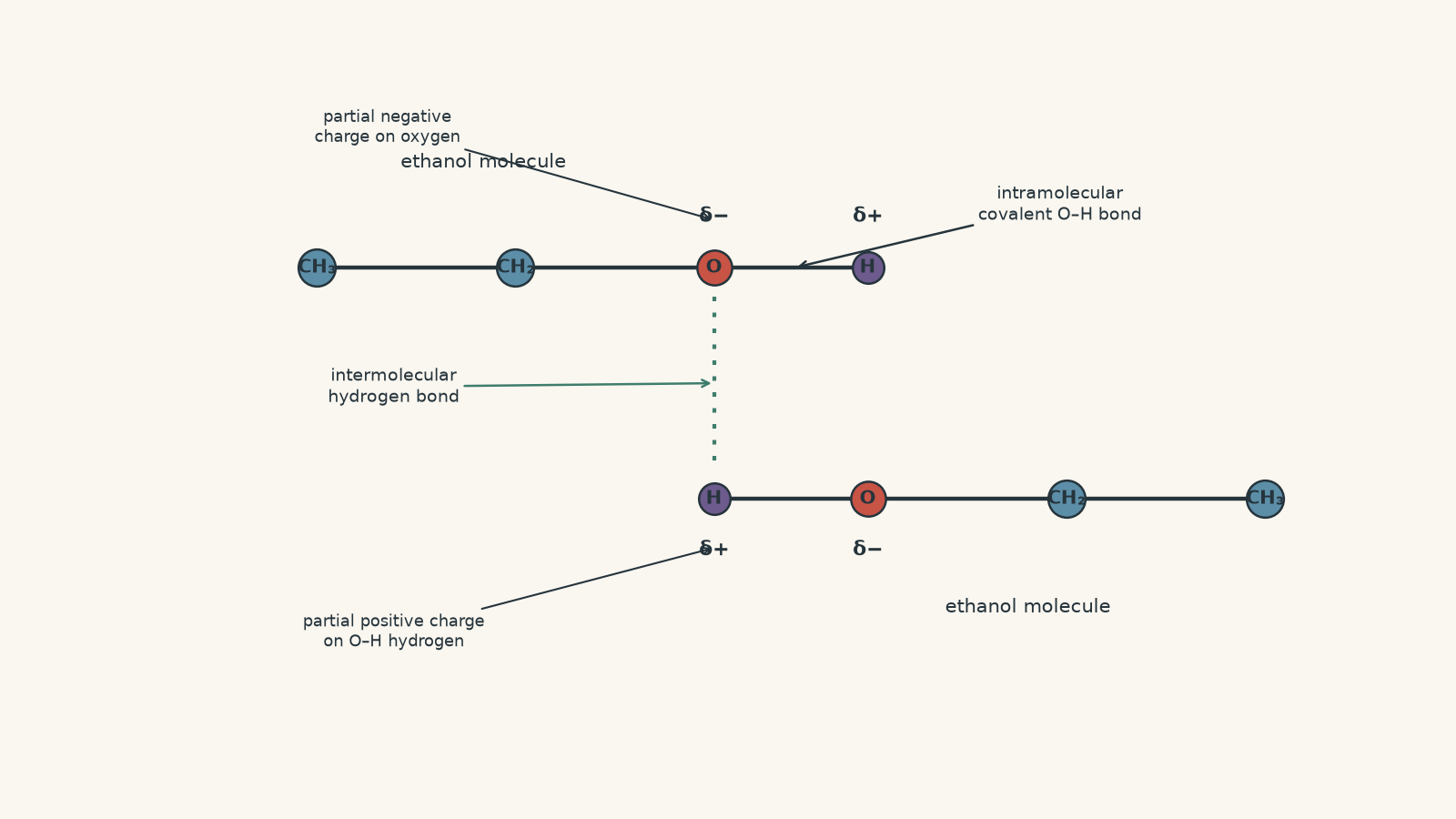
An ethanol molecule has the structure \(\ce{CH3CH2OH}\). Inside one ethanol molecule, the atoms are joined by covalent bonds:
- \(\ce{C-C}\)
- \(\ce{C-H}\)
- \(\ce{C-O}\)
- \(\ce{O-H}\)
These are intramolecular bonds. The prefix intra- means within.
Separate ethanol molecules also attract each other. These attractions are intermolecular forces. The prefix inter- means between.
That distinction matters whenever a liquid boils. Boiling ethanol does not normally break its \(\ce{O-H}\) or \(\ce{C-O}\) covalent bonds. It gives molecules enough energy to overcome the attractions holding different ethanol molecules near one another.
02Why alcohol molecules can hydrogen bond
Oxygen is considerably more electronegative than hydrogen. In an \(\ce{O-H}\) covalent bond, the shared electrons spend more time near oxygen.
So the bond is polar:
\[ \ce{O^{\delta-}-H^{\delta+}} \]
The symbol \(\delta-\) means a partial negative charge, while \(\delta+\) means a partial positive charge.
The oxygen atom also has lone pairs of electrons. This creates a particularly strong attraction between:
- the partially positive hydrogen attached to oxygen in one molecule, and
- a lone pair on the oxygen atom of another molecule.
That attraction is a hydrogen bond.
A simple way to picture an alcohol molecule is as someone at a party with one hand that can reach out and another place where somebody else can grab on. The \(\ce{O-H}\) group allows alcohol molecules to build a temporary network rather than behaving as completely independent particles.
The analogy has limits. Molecules do not deliberately choose partners, and hydrogen bonds constantly form and break because the molecules are moving. They are electrostatic attractions, not little physical hooks.
03Alcohols have more than one intermolecular force
A common mistake is to write, “Alcohols have hydrogen bonding,” and stop there.
Hydrogen bonding is important, but it is not the only intermolecular attraction present.
| Intermolecular force | Why it occurs in alcohols | Useful comparison |
|---|---|---|
| London dispersion forces | Temporary fluctuations in electron distribution create temporary dipoles | Present in every molecule |
| Dipole-dipole attractions | The \(\ce{C-O}\) and especially \(\ce{O-H}\) bonds make the molecule polar | Present between polar molecules |
| Hydrogen bonding | An \(\ce{O-H}\) hydrogen is attracted to a lone pair on another oxygen | Particularly important in alcohols |
All three act at the same time.
This gives you an important exam rule: do not imagine molecules choosing one intermolecular force and turning the others off. Calling hydrogen bonding the strongest type present does not make London dispersion forces disappear.
04Why alcohols have unusually high boiling points
To boil a liquid, its molecules need enough energy to separate from one another and enter the gas phase.
Compare ethanol, \(\ce{CH3CH2OH}\), with ethane, \(\ce{CH3CH3}\).
Ethane has London dispersion forces. Ethanol also has dispersion forces, but it has permanent dipole-dipole attractions and, most importantly, intermolecular hydrogen bonding.
More energy is therefore needed to separate ethanol molecules.
This is why alcohols generally have much higher boiling points than similar-sized hydrocarbons.
Notice what we are not saying. We are not saying that the covalent \(\ce{O-H}\) bond has to be broken when ethanol boils. The ethanol molecules remain ethanol molecules.
Worked example: Why does ethanol boil much higher than dimethyl ether?
Ethanol, \(\ce{CH3CH2OH}\), and dimethyl ether, \(\ce{CH3OCH3}\), both have the molecular formula \(\ce{C2H6O}\). Explain why ethanol has a much higher boiling point.
Step 1
The molecules have the same molecular formula and almost identical molar masses. Their London dispersion forces are therefore broadly comparable, although molecular shape also has an effect.
Step 2
Both contain \(\ce{C-O}\) bonds, so both molecules are polar and can experience dipole-dipole attractions.
That alone does not explain the large difference.
Step 3
Ethanol contains an \(\ce{O-H}\) bond. Its partially positive hydrogen can hydrogen bond to a lone pair on another ethanol molecule.
Dimethyl ether has oxygen lone pairs, but no hydrogen atom bonded directly to oxygen. It cannot donate a hydrogen bond to another dimethyl ether molecule.
Step 4
Separating ethanol molecules requires overcoming a network that includes hydrogen bonding. Separating dimethyl ether molecules does not.
Therefore ethanol requires substantially more energy to boil and has the higher boiling point.
The useful lesson is that molecular formula alone does not determine physical properties. Structure controls which intermolecular attractions can form.
05What changes as the alcohol chain becomes longer?
Now compare the straight-chain primary alcohols:
\[ \ce{CH3OH,\ CH3CH2OH,\ CH3CH2CH2OH,\ CH3CH2CH2CH2OH} \]
These are methanol, ethanol, propan-1-ol, and butan-1-ol.
They belong to the same homologous series. Each successive member differs by one \(\ce{CH2}\) unit.
Here is the interesting part. Every molecule still contains one \(\ce{-OH}\) group, so all four can hydrogen bond. Yet their boiling points keep increasing.
Before reading the explanation, predict why. Are the hydrogen bonds becoming dramatically stronger as the carbon chain grows?
No. That is the tempting but incomplete explanation.
The growing carbon chain strengthens London dispersion forces
As the molecule gains carbon and hydrogen atoms:
- it contains more electrons,
- its electron cloud becomes more polarisable,
- there is more molecular surface over which neighbouring molecules can interact, and
- London dispersion attractions become stronger overall.
The ability of one \(\ce{-OH}\) group to hydrogen bond is still present, but the dispersion contribution becomes progressively larger as the hydrocarbon part grows.
For the first few straight-chain alcohols, the boiling-point trend is approximately:
\[ \ce{methanol < ethanol < propan-1-ol < butan-1-ol} \]
Their boiling points are roughly \(65^\circ\text{C}\), \(78^\circ\text{C}\), \(97^\circ\text{C}\), and \(118^\circ\text{C}\), respectively.
So the correct explanation is not “larger alcohols have hydrogen bonding”.
They all have hydrogen bonding.
The useful comparison is that larger alcohols have stronger overall intermolecular attractions, particularly because London dispersion forces increase with molecular size.
Worked example: Predict two trends down the alcohol homologous series
Predict how boiling point and water solubility change from methanol to butan-1-ol, and explain both trends.
Step 1
Each molecule has one \(\ce{-OH}\) group. Each can form hydrogen bonds with other alcohol molecules and with water molecules.
Step 2
Each successive alcohol gains a \(\ce{CH2}\) unit. The non-polar hydrocarbon part of the molecule becomes larger.
Step 3
Larger molecules have more electrons and stronger London dispersion forces.
The boiling point therefore increases:
\[ \ce{methanol < ethanol < propan-1-ol < butan-1-ol} \]
More energy is needed to separate the molecules into the gas phase.
Step 4
The \(\ce{-OH}\) group can hydrogen bond strongly with water, which favours mixing.
But the hydrocarbon chain cannot hydrogen bond with water. As that non-polar region grows, one \(\ce{-OH}\) group represents a smaller fraction of the whole molecule.
Water solubility therefore decreases as the carbon chain becomes longer.
Step 5
Longer alcohols can have stronger overall attractions to other alcohol molecules while simultaneously becoming less compatible with water.
Boiling point asks, “How difficult is it to separate alcohol molecules from one another?”
Solubility asks a different question: “Is replacing alcohol-alcohol and water-water interactions with alcohol-water interactions favourable enough for the substances to mix?”
Those are not the same test.
06Why small alcohols dissolve so well in water
Water forms an extensive hydrogen-bonding network.
When methanol or ethanol is added, its \(\ce{-OH}\) group can participate in that network:
\[ \ce{alcohol-O-H \bond{...} O-water} \]
and
\[ \ce{water-O-H \bond{...} O-alcohol} \]
So an alcohol molecule can both donate and accept hydrogen bonds.
For short-chain alcohols, the polar \(\ce{-OH}\) group has a large influence on the behaviour of the entire molecule. Methanol, ethanol, and propan-1-ol mix very readily with water.
As the chain gets longer, the non-polar alkyl group becomes more important. One \(\ce{-OH}\) group is now trying to make a much larger molecule interact favourably with water.
You can picture it as a group getting larger while still possessing only one invitation to the water party. That single invitation matters a lot when the group is tiny. It becomes less impressive when another four or five carbons have tagged along.
Again, the analogy is only a picture. Solubility is determined by the combined energetic and entropic consequences of breaking existing interactions and forming new ones.
07Boiling point and water solubility can move in opposite directions
This is one of the most useful ideas to get straight.
Suppose we move from ethanol to butan-1-ol.
The larger molecule has stronger London dispersion forces, so its boiling point is higher.
But its larger non-polar region makes favourable interaction with water less dominant, so its water solubility is lower.
There is no contradiction.
“Stronger intermolecular forces” does not automatically mean “more soluble”.
Solubility depends on the relative attractions among all particles involved:
- solute-solute attractions,
- solvent-solvent attractions, and
- solute-solvent attractions.
For alcohols dissolving in water, the third category includes hydrogen bonding between alcohol and water. But the effect of the growing non-polar carbon chain cannot be ignored.
08What does branching change?
Chain length is not the only structural feature that matters.
Consider two alcohols with the same molecular formula. If one is more highly branched, it is usually more compact.
A compact molecule generally has less effective surface contact with neighbouring molecules than a long, relatively unbranched molecule. This can weaken London dispersion attractions.
As a result, among similar alcohol isomers, increased branching often lowers boiling point.
This is a more precise rule than saying “higher molar mass means higher boiling point”. Molar mass is useful when structures are otherwise comparable. Shape matters too.
Hydrogen bonding can also be influenced by how accessible the \(\ce{-OH}\) group is. A heavily crowded \(\ce{-OH}\) group may form an intermolecular network less effectively than an exposed one.
So for isomers, you sometimes need to consider both:
- dispersion forces and molecular shape, and
- how easily molecules can approach one another around the \(\ce{-OH}\) group.
09A reliable way to compare alcohol properties
When an HSC question asks you to compare boiling points, volatility, or solubility, use the structure rather than memorising isolated values.
For boiling point:
- Check whether hydrogen bonding is possible.
- Check for permanent molecular dipoles.
- Compare molecular size and number of electrons.
- Compare shape and surface contact if the substances are isomers.
- Discuss the overall intermolecular attractions, not just the single strongest category.
For water solubility:
- Identify groups that can hydrogen bond with water.
- Compare the size of the polar region with the non-polar hydrocarbon region.
- Remember that a longer carbon chain generally lowers the water solubility of a monohydric alcohol.
- Do not use boiling point alone to predict solubility.
That last point catches a lot of otherwise reasonable answers.
10Tempting misconceptions
| Tempting idea | What is wrong with it? | Better statement |
|---|---|---|
| “The \(\ce{O-H}\) bond is a hydrogen bond.” | The \(\ce{O-H}\) bond within one alcohol molecule is covalent. | Hydrogen bonding is an attraction between suitable groups on different molecules. |
| “Boiling breaks the alcohol’s covalent bonds.” | Ordinary boiling separates molecules without decomposing them. | Boiling mainly overcomes intermolecular attractions. |
| “Only hydrogen bonds matter in alcohols.” | London dispersion and dipole-dipole forces are also present. | Alcohol properties result from the combined intermolecular attractions. |
| “Longer alcohols have higher boiling points because their hydrogen bonds are stronger.” | Every member still has a similar \(\ce{-OH}\) group. | The major systematic change down the series is increasing London dispersion attraction. |
| “Stronger intermolecular forces always mean greater water solubility.” | Solubility depends on interactions between solute and solvent as well as interactions within each pure substance. | A longer alcohol can have a higher boiling point but a lower water solubility. |
11Questions and solutions
Question 1
Methanol has a much higher boiling point than methane.
Explain this difference using intermolecular forces.
Solution 1
Methanol has the higher boiling point because its molecules experience hydrogen bonding, dipole-dipole attractions, and London dispersion forces, while methane molecules experience only London dispersion forces.
Methanol contains a polar \(\ce{O-H}\) bond. The partially positive hydrogen of one methanol molecule can form a hydrogen bond with a lone pair on the oxygen atom of another methanol molecule.
Methane, \(\ce{CH4}\), is non-polar and cannot hydrogen bond.
More energy is therefore required to separate methanol molecules into the gas phase.
A tempting answer is simply “methanol contains stronger bonds”. That wording is too vague and may suggest that covalent bonds are being broken. The important comparison is between the intermolecular attractions of the two substances.
Question 2
The boiling points of four straight-chain alcohols are shown below.
| Alcohol | Formula | Boiling point |
|---|---|---|
| Methanol | \(\ce{CH3OH}\) | \(64.7^\circ\text{C}\) |
| Ethanol | \(\ce{C2H5OH}\) | \(78.4^\circ\text{C}\) |
| Propan-1-ol | \(\ce{C3H7OH}\) | \(97.2^\circ\text{C}\) |
| Butan-1-ol | \(\ce{C4H9OH}\) | \(117.7^\circ\text{C}\) |
Calculate the average increase in boiling point for each additional carbon atom from methanol to butan-1-ol. Then explain why the boiling point rises even though every molecule contains only one \(\ce{-OH}\) group.
Solution 2
The average boiling-point increase is approximately \(17.7^\circ\text{C}\) per additional carbon atom, and the rise is mainly explained by increasing London dispersion forces rather than progressively stronger hydrogen bonds.
From methanol to butan-1-ol, three carbon atoms are added overall.
The total boiling-point increase is:
\[ 117.7 - 64.7 = 53.0^\circ\text{C} \]
There are three successive additions of a carbon-containing \(\ce{CH2}\) unit, so:
\[ \frac{53.0^\circ\text{C}}{3}=17.7^\circ\text{C} \]
per added carbon atom on average.
Each member of the series can hydrogen bond because each contains one \(\ce{-OH}\) group. As the chain length increases, however, the molecules contain more electrons and larger, more polarisable electron clouds. London dispersion attractions therefore become stronger.
More energy must be supplied to separate the molecules, so boiling point increases.
The tempting route is to attribute the entire trend to hydrogen bonding. That misses the feature that is actually changing systematically: the size of the hydrocarbon chain. The calculated \(17.7^\circ\text{C}\) is only an average across these compounds, not a rule that every added carbon must raise the boiling point by exactly that amount.
Question 3
Ethanol, \(\ce{CH3CH2OH}\), and dimethyl ether, \(\ce{CH3OCH3}\), both have a molar mass of about \(46.1\text{ g mol}^{-1}\).
Ethanol boils at about \(78^\circ\text{C}\), while dimethyl ether boils at about \(-25^\circ\text{C}\).
Explain why their boiling points are so different. Your answer must refer to molecular structure rather than merely stating that ethanol has “stronger forces”.
Solution 3
Ethanol has the much higher boiling point because its structure allows neighbouring ethanol molecules to form intermolecular hydrogen bonds, whereas dimethyl ether molecules cannot hydrogen bond to each other in the same way.
Both molecules contain oxygen and are polar. Both therefore experience dipole-dipole attractions as well as London dispersion forces.
The crucial structural difference is the \(\ce{O-H}\) bond.
In ethanol, the hydrogen attached directly to oxygen carries a partial positive charge. It can interact strongly with an oxygen lone pair on a neighbouring ethanol molecule.
Dimethyl ether has an oxygen atom with lone pairs, so it can accept a hydrogen bond from a suitable molecule. However, it has no hydrogen bonded directly to oxygen. In a pure sample, dimethyl ether molecules therefore cannot provide the required hydrogen-bond donor to one another.
Because the two compounds have almost the same molar mass, molecular size alone cannot explain a boiling-point difference of more than \(100^\circ\text{C}\).
The tempting argument is, “Both contain oxygen, so both hydrogen bond.” Merely containing an oxygen atom is not enough. For strong intermolecular hydrogen bonding between identical molecules, a molecule needs an appropriately bonded hydrogen as well as an electronegative atom with a lone pair.
Question 4
Consider the following experimental data.
| Substance | Main structural feature | Boiling point |
|---|---|---|
| Butan-1-ol | Four-carbon chain with one \(\ce{-OH}\) group | \(118^\circ\text{C}\) |
| Ethoxyethane | Four carbons and one ether oxygen, but no \(\ce{O-H}\) bond | \(35^\circ\text{C}\) |
| Pentane | Five-carbon hydrocarbon | \(36^\circ\text{C}\) |
A student argues:
Ethoxyethane is polar, while pentane is non-polar. Therefore ethoxyethane must have a much higher boiling point than pentane.
Explain why the data do not support that reasoning, and then account for all three boiling points.
Solution 4
The student’s rule is incomplete: the type of intermolecular force present does not by itself determine boiling point, and the measured data show that ethoxyethane and pentane have very similar boiling points despite ethoxyethane being polar.
Butan-1-ol has the highest boiling point because it can form intermolecular hydrogen bonds through its \(\ce{-OH}\) group. It also experiences dipole-dipole and London dispersion attractions. Considerable energy is therefore required to separate its molecules.
Ethoxyethane is polar, so it experiences dipole-dipole attractions as well as London dispersion forces. However, it has no \(\ce{O-H}\) bond and cannot form a hydrogen-bonded network in a pure sample.
Pentane is non-polar, so its intermolecular attractions are classified as London dispersion forces. However, pentane is a reasonably large molecule with five carbon atoms. Its electron cloud is quite polarisable, and its London dispersion attractions are significant.
The key observation is:
\[ 35^\circ\text{C}\approx36^\circ\text{C} \]
So the extra dipole-dipole attraction in ethoxyethane does not produce a large boiling-point advantage over pentane. Molecular size, shape, electron-cloud polarisability, and all intermolecular attractions must be considered together.
The tempting route is to memorise a ladder such as “hydrogen bonding \(>\) dipole-dipole \(>\) dispersion” and use it as an automatic boiling-point ranking. That ladder describes typical interaction strengths under comparable conditions. It does not mean that every polar molecule must boil above every non-polar molecule regardless of size and shape.
Question 5
As a straight-chain monohydric alcohol becomes longer, its boiling point generally increases while its solubility in water generally decreases.
A student says these observations contradict each other:
A longer alcohol must have stronger intermolecular forces because its boiling point is higher. If its intermolecular forces are stronger, water should attract it more strongly too, so its solubility should increase.
Evaluate this reasoning by tracking the interactions that must be broken and formed during both boiling and dissolving. Then predict how adding a second \(\ce{-OH}\) group to a four-carbon alcohol would be expected to affect its boiling point and water solubility, assuming the carbon skeleton is otherwise similar.
Solution 5
There is no contradiction: increasing chain length strengthens alcohol-alcohol dispersion attractions and raises boiling point, while at the same time making one \(\ce{-OH}\) group less able to dominate the molecule’s interaction with water. Adding a second \(\ce{-OH}\) group would generally raise the boiling point and increase water solubility.
For boiling, begin with a pure alcohol.
The liquid contains alcohol molecules attracting one another through:
- hydrogen bonding,
- dipole-dipole attractions, and
- London dispersion forces.
As the carbon chain becomes longer, the number of electrons and the size of the polarisable electron cloud increase. Alcohol-alcohol London dispersion attractions therefore become stronger.
To vaporise the liquid, these intermolecular attractions must be overcome. This explains the increasing boiling point.
Dissolving in water involves a different change.
Initially, there are:
- alcohol-alcohol interactions in the alcohol, and
- strong water-water hydrogen bonds in the water.
For mixing to occur, some of these interactions must be disrupted and replaced with alcohol-water interactions.
The alcohol’s \(\ce{-OH}\) group can form favourable hydrogen bonds with water. However, the growing hydrocarbon chain cannot form equivalent hydrogen bonds. As the carbon chain becomes larger while the molecule still contains only one \(\ce{-OH}\) group, the non-polar portion becomes increasingly important.
The result is therefore:
\[ \text{longer carbon chain} \rightarrow \begin{cases} \text{stronger overall alcohol-alcohol attractions} \\ \text{higher boiling point} \\ \text{lower relative compatibility with water} \\ \text{lower water solubility} \end{cases} \]
The student’s mistake is treating “intermolecular forces” as one universal quantity. Boiling depends mainly on how difficult it is to separate molecules of the pure liquid. Solubility depends on whether interactions between unlike particles are favourable enough compared with the interactions present before mixing.
Now add a second \(\ce{-OH}\) group to a similar four-carbon skeleton.
The molecule gains an additional site capable of hydrogen bonding. In a pure sample, this allows stronger and more extensive intermolecular hydrogen bonding, so more energy would generally be required for vaporisation. Its boiling point should therefore increase.
In water, the extra \(\ce{-OH}\) group provides another strongly polar region capable of forming hydrogen bonds with water. The polar contribution is now much larger relative to the same four-carbon skeleton, so water solubility should also increase.
This is the useful hinge: changing the carbon chain and changing the number of \(\ce{-OH}\) groups do different things. A longer carbon chain strengthens dispersion forces while making a single polar group proportionally less important. Adding another \(\ce{-OH}\) group instead increases the molecule’s capacity for hydrogen bonding.
That distinction becomes important when you move from simple physical-property trends to predicting the behaviour of alcohol isomers, polyhydroxy compounds, and organic molecules containing several different functional groups.