
Safe Handling and Disposal of Organic Substances for HSC Chemistry
Learn how to store, handle, and dispose of organic substances safely in HSC Chemistry, with clear reasoning, worked examples, and challenging practice questions.
You finish an organic chemistry experiment and are left with four clear liquids: some unused ethanol, a small amount of product, an organic solvent used for washing, and the liquid left in the reaction flask. They all look harmless.
Would you pour them into the same waste bottle?
You shouldn’t. Two colourless liquids can require completely different storage, handling, and disposal procedures. One might be highly flammable, another might produce harmful vapour, and a third might react dangerously with something already in a waste container.
The useful skill isn’t memorising one rule for every organic chemical. It is learning how to move from chemical identity → hazard → exposure risk → control → disposal route.
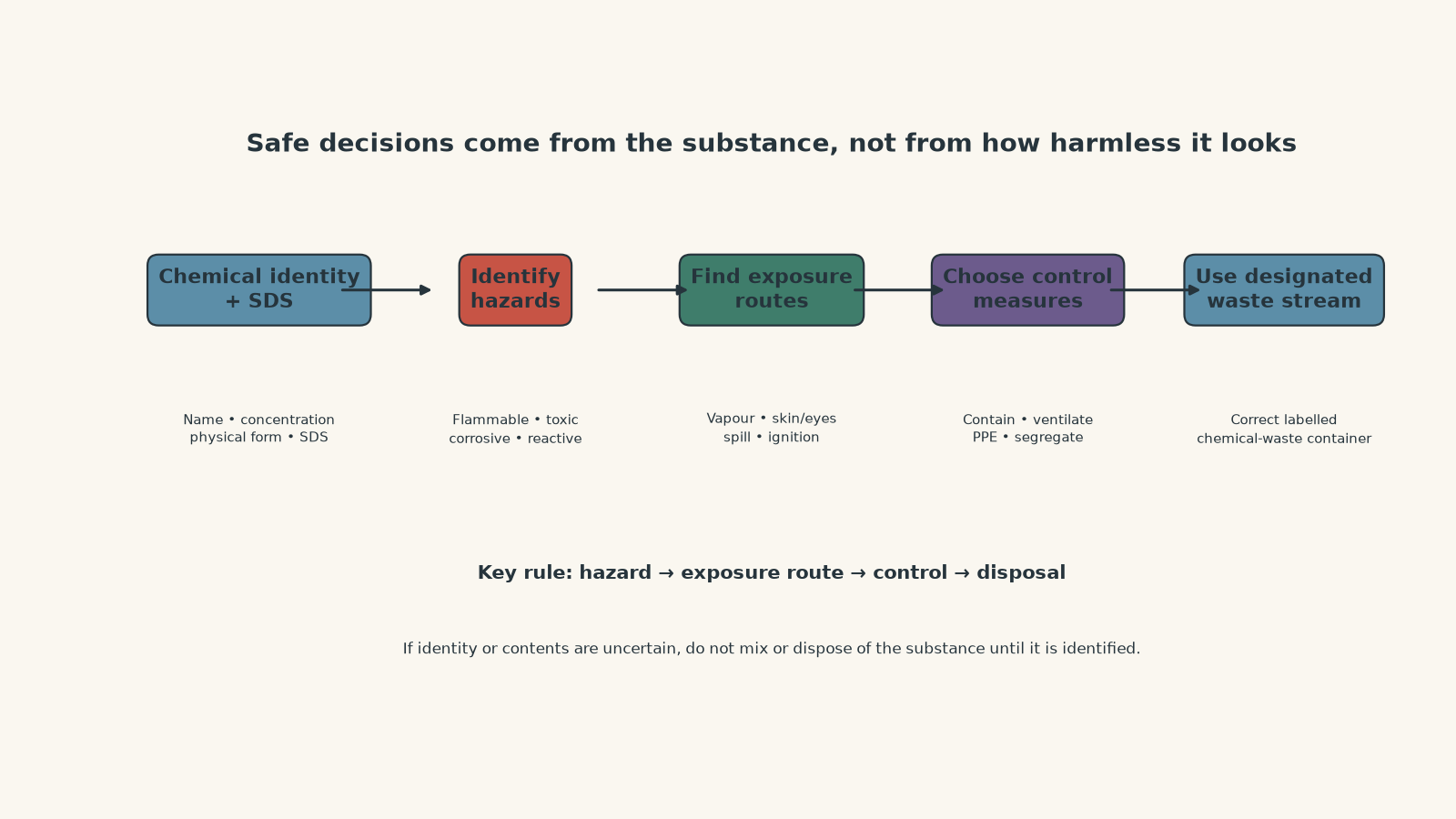
01The decision you make before touching the chemical
Before using an unfamiliar organic substance, answer four questions:
| Question | What you are looking for |
|---|---|
| What is the substance? | Correct label, concentration, and physical form |
| What can it do? | Flammability, toxicity, corrosiveness, environmental hazard, or dangerous reactions |
| How could I be exposed? | Breathing vapour, skin or eye contact, swallowing, fire, or a spill |
| What happens when I finish? | The designated waste container or other disposal procedure |
Most of that information comes from the container label, the experimental procedure, and the substance’s safety data sheet, or SDS.
An SDS contains information such as the substance’s hazards, required protective equipment, safe storage conditions, first-aid measures, spill procedures, and disposal considerations.
There is an important distinction here.
A hazard is something the substance is capable of doing. A flammable solvent, for example, can ignite.
A risk depends on the situation. A sealed bottle of that solvent stored correctly has a different risk from an open beaker of the same solvent sitting beside an ignition source.
So good laboratory safety is not simply:
dangerous chemical = wear more PPE
It is about controlling the actual ways the hazard could cause harm.
02Storing organic substances safely
Suppose a laboratory has bottles of ethanol, cyclohexene, and another organic solvent on a shelf.
A student might think the neatest system is alphabetical order. Chemically, that is the wrong priority.
Substances that could react dangerously if their containers leaked should be kept apart. Storage is based primarily on chemical compatibility and hazard, not on how convenient the labels are to sort.
It’s a little like organising a very awkward dinner party. Two guests may be perfectly calm on opposite sides of the room, but putting them together at the same tiny table could create trouble. The analogy ends there: unlike human drama, chemical incompatibility can be predicted from known chemical properties.
Keep flammable substances away from ignition sources
Many common organic liquids are flammable. Examples include ethanol, propanone, ethyl ethanoate, and many hydrocarbons.
A flammable liquid does not need to be physically touching a flame before a fire can start. The liquid can evaporate, producing vapour that mixes with air. If that vapour reaches an ignition source, it may ignite.
That means flammable organic substances should be:
- stored in the appropriate designated storage, such as a flammable-liquids cabinet where required
- kept away from flames, sparks, hot surfaces, and other ignition sources
- kept in properly closed containers
- stored only in the quantities needed for the laboratory
- segregated from incompatible substances, particularly strong oxidising agents.
The important idea is that the hazard may come from the vapour, not just the visible liquid.
Keep volatile substances tightly closed
A volatile substance evaporates readily.
Imagine leaving two identical containers open. One contains water and the other contains a volatile organic solvent. After a short time, the solvent may have produced a much larger concentration of vapour in the surrounding air.
Predict what happens if you simply move the open solvent from one side of the bench to the other.
Almost nothing useful. The source of the vapour is still open.
The better control is to close the container and, where required, work in a fume cupboard so vapour is removed from the breathing zone.
Keep the correct label on the container
Every stored substance must remain clearly identifiable.
A proper laboratory label may include the chemical name, concentration where relevant, hazard information, and other required details.
Never rely on memory such as, “I’m pretty sure that flask contains ethanol.”
Colour and smell are not reliable identification methods either. Many organic substances are colourless, and deliberately sniffing an unknown chemical creates unnecessary exposure.
Use suitable containers and secondary containment
The container itself must be compatible with its contents and properly sealed.
Where a leak would create a significant hazard, secondary containment can provide another barrier. A tray beneath compatible bottles, for example, can stop a small leak spreading across a shelf.
This does not mean every chemical can now share the same tray. Secondary containment does not make incompatible substances compatible.
03Handling organic substances safely
Storage controls the chemical while you are not using it. Handling is where exposure becomes much more likely because bottles are being opened, liquids transferred, reactions heated, and products collected.
Start with the smallest practical quantity
A useful laboratory principle is to use only the amount required for the experiment.
If 10 mL is enough, bringing 500 mL to the bench creates extra hazard without improving the chemistry.
Less material usually means:
- less vapour
- a smaller possible spill
- less fuel available in a fire
- less waste requiring disposal.
This is a risk reduction measure, not an excuse to ignore the substance’s hazards.
Control vapour at its source
For organic substances that release hazardous or irritating vapours, a fume cupboard may be required.
A fume cupboard is not simply a cupboard where unpleasant chemicals are hidden. Air is drawn through the working area and away from the user, reducing inhalation exposure when it is operated correctly.
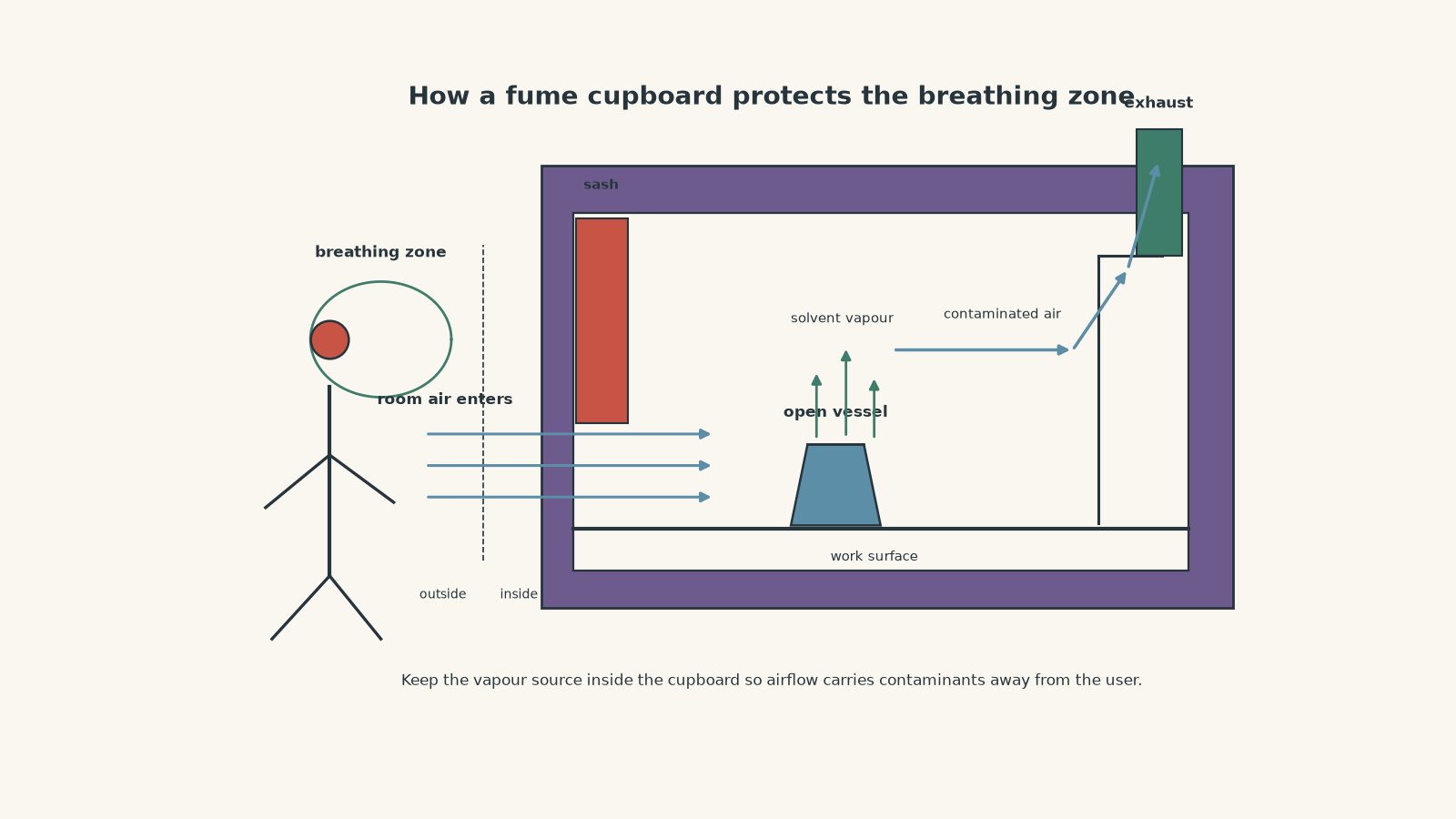
The mental model is simple: stop the vapour travelling from the chemical to your lungs.
The precise control required depends on the substance and procedure, so the SDS and laboratory instructions matter.
Keep flammable vapours away from ignition sources
Suppose you need to warm a mixture containing a flammable organic solvent.
Would a Bunsen burner be a sensible heat source?
No. The danger is not just the liquid catching fire where you can see it. Flammable vapour can travel away from the container and ignite.
Where heating is required, the prescribed non-flame heating method should be used.
Prevent skin and eye exposure
Appropriate laboratory PPE commonly includes safety glasses, a laboratory coat, enclosed shoes, and suitable gloves where the procedure requires them.
But gloves are not magical chemical force fields.
Different glove materials resist different substances for different lengths of time. A contaminated glove can also spread a chemical onto a phone, door handle, face, or notebook.
This is why PPE sits alongside good handling techniques rather than replacing them.
Keep containers stable. Use proper transfer equipment. Never pipette by mouth. Close bottles after use, and deal with spills using the procedure specified for that chemical.
Do not return unused chemical to the stock bottle
Imagine pouring 20 mL of solvent from a stock bottle, then discovering you only needed 15 mL.
It seems less wasteful to pour the remaining 5 mL back.
Don’t.
Once a substance has left its original stock container, contamination may have occurred. Returning it can contaminate the entire stock supply.
Use the laboratory’s instructed procedure for the excess instead.
04Worked example: handling a volatile, flammable product
A student prepares cyclohexene and needs to collect a small liquid sample. Cyclohexene is volatile and flammable. Explain the main precautions required while collecting and temporarily storing the sample.
Step 1
Cyclohexene can evaporate readily and its vapour can form a flammable mixture with air. The important risks are therefore vapour exposure and ignition.
Step 2
Only the required amount should be handled, and the collection vessel should be kept closed whenever practical. If the procedure or SDS requires a fume cupboard, the transfer should occur there.
This targets the exposure route rather than relying only on PPE.
Step 3
Cyclohexene should be kept away from flames, sparks, and hot surfaces. A naked flame should not be used near the substance.
Step 4
The student should follow the laboratory procedure for safety glasses, laboratory clothing, enclosed footwear, and suitable gloves.
Step 5
The sample should be clearly labelled, sealed, and placed in the designated storage location for the experiment.
The key point is that “flammable liquid” translates into several specific decisions: minimise vapour, prevent ignition, prevent exposure, and store the sample securely.
05Disposal is part of the experiment
A common mistake is to think the experiment finishes when the observations are recorded.
Chemically, it doesn’t.
The substances left in the flask, separating funnel, filter paper, washings, pipettes, and sample containers still have the same hazards they had during the experiment.
Disposal therefore needs to be planned before the practical begins.
06Never assume an organic liquid can go down the sink
For an organic substance, “it’s only a little bit” is not a disposal method.
Unless the laboratory’s approved procedure specifically allows sink disposal, organic chemical waste should go into its designated waste stream.
There are several reasons.
An organic substance may be:
- toxic to aquatic organisms
- volatile
- flammable
- poorly soluble in water
- persistent in the environment
- capable of reacting with substances already in the drain or waste system.
Dilution can reduce concentration, but it does not automatically make disposal appropriate.
If 1 mL of solvent is added to 100 mL of water, the solvent has not stopped existing. Its identity still matters.
07Keep incompatible wastes apart
This is where disposal becomes more than choosing between “sink” and “bin”.
Waste containers may contain mixtures of chemicals. Adding another substance can create a new reaction hazard.
Never combine waste simply because everything involved is a liquid or because everything is “organic”.
Instead, use the designated and correctly labelled waste container specified by the laboratory.
Some laboratories, for example, keep halogenated organic solvent waste separate from non-halogenated organic solvent waste. If that system is used, a solvent containing chlorine, bromine, or another halogen must not simply be added to the non-halogenated solvent container.
The exact waste streams depend on the laboratory, so students should follow the experimental instructions, waste labels, and SDS information rather than inventing a disposal method.
08Solid waste can still contain organic chemicals
A paper towel used to absorb an organic solvent spill is not suddenly ordinary paper waste.
Neither is contaminated filter paper, drying agent, disposable pipette, or glove.
If a solid material has been contaminated with hazardous organic chemicals, it may need to go into designated contaminated-solid waste.
Again, the chemical contamination determines the disposal route.
09Do not dispose of solvents by deliberately evaporating them
Another tempting idea is:
If the solvent evaporates anyway, why not leave it in a fume cupboard until it disappears?
Because transferring the chemical from liquid waste into the atmosphere is not proper disposal.
A fume cupboard is an exposure-control device. It is not a waste-treatment system.
The solvent should instead be collected according to the laboratory’s chemical-waste procedure.
10Label waste properly
A waste bottle labelled only “organic waste” may not provide enough information for safe handling.
The person eventually managing that waste needs to know what is present and what hazards could arise.
Laboratory waste containers should therefore be used and labelled according to the site’s procedure. Waste should not be added to an unlabelled container or one whose contents are uncertain.
If you do not know what is inside a waste container, the correct response is not to guess.
11Worked example: choosing between two organic waste streams
A school laboratory provides two clearly labelled liquid-waste containers:
- non-halogenated organic solvent waste
- halogenated organic solvent waste.
After an experiment, a student has one portion containing ethyl ethanoate and ethanol, and a separate portion containing dichloromethane. Where should each portion go?
Step 1
Ethyl ethanoate and ethanol are organic substances that do not contain halogen atoms.
Dichloromethane has the formula \(\ce{CH2Cl2}\), so it contains chlorine.
Step 2
The ethyl ethanoate and ethanol portion goes into the designated non-halogenated organic solvent waste.
The dichloromethane portion goes into the designated halogenated organic solvent waste.
Step 3
The two portions should not first be mixed together and then disposed of. Once halogenated solvent has been added to a mixture, the entire mixture may need to be managed as halogenated waste under that laboratory’s procedure.
Step 4
If either portion also contained another reagent, such as an acid or reactive substance, the student should not assume these two waste streams remain appropriate. The actual reaction mixture and laboratory instructions must be checked.
This is an important exam habit as well as a laboratory habit: use all the information given. “Organic liquid” is usually not specific enough to decide how something should be disposed of.
12A compact way to choose the right control
You do not need to memorise hundreds of disconnected safety rules.
Connect the property to the mechanism of harm.
| Property or hazard | Why it matters | Typical control |
|---|---|---|
| Volatile | Vapour enters the air | Keep containers closed and use ventilation or a fume cupboard where required |
| Flammable | Vapour may ignite | Remove ignition sources and use appropriate flammable-liquid storage |
| Toxic or harmful | Exposure can damage health | Minimise exposure and use specified engineering controls and PPE |
| Corrosive | Can damage tissue and materials | Prevent splashes and contact; use specified PPE and suitable containers |
| Environmentally hazardous | Disposal can harm ecosystems | Use the designated chemical-waste stream |
| Reactive or incompatible | Mixing may produce heat, gas, fire, or other hazards | Segregate from incompatible substances |
| Unknown | Hazards cannot be assessed reliably | Do not use, mix, or dispose of it until it is identified |
That last row is easy to underestimate.
An unknown chemical should be treated as a problem to identify, not a puzzle to solve by smelling it, mixing it with something, or pouring it into the closest waste bottle.
13The most tempting misconception: “organic” means relatively safe
In chemistry, organic usually refers to carbon-containing compounds with particular structural features. It does not mean natural, environmentally friendly, or harmless.
Ethanol, cyclohexene, dichloromethane, and many other organic substances have very different hazards.
Even closely related molecules can behave differently.
So you cannot make a safety decision from the word “organic” alone. You need the identity, concentration, physical properties, and hazards of the actual substance.
There is a second version of the same misconception:
It’s diluted now, so it must be safe.
Dilution changes concentration. It does not erase flammability, toxicity, environmental concerns, or incompatibility automatically.
Safe disposal is determined by the actual waste and the approved procedure, not by how harmless the mixture looks.
14Questions and solutions
Question 1
A student needs 15 mL of propanone for an experiment. Propanone is volatile and highly flammable.
State three appropriate precautions when the propanone is being handled, and explain the reason for each.
Solution 1
The student should minimise vapour exposure, keep the propanone away from ignition sources, and keep the container closed whenever practical.
First, only the required quantity should be handled and appropriate ventilation should be used according to the laboratory procedure. Propanone is volatile, so an open container can rapidly release vapour into the air.
Second, flames, sparks, and hot ignition sources should be kept away. The danger is not limited to the visible liquid: propanone vapour can form a flammable mixture with air.
Third, the container should be closed after dispensing the required amount. This reduces evaporation and therefore reduces both inhalation exposure and the amount of flammable vapour present.
Appropriate PPE should also be worn as specified by the procedure.
A tempting answer is simply “wear gloves and safety glasses”. Those may be required, but they do not control the major flammability hazard or stop vapour forming.
Question 2
At the end of an experiment, a student has 8 mL of an organic solvent left in a measuring cylinder. The student says:
There is hardly any there. I’ll add plenty of water and pour it down the sink.
Explain why the student’s reasoning is not sufficient to justify this disposal method.
Solution 2
Diluting the solvent does not by itself make sink disposal acceptable.
Adding water lowers the solvent’s concentration, but the solvent is still present. Its chemical identity and hazards have not disappeared.
Depending on the substance, the mixture could still create environmental, toxic, volatile, or flammability concerns. Some organic liquids are also poorly soluble in water, so adding water may simply create two liquid layers rather than producing a genuinely dilute solution.
The correct procedure is to identify the solvent and use the disposal method specified by the laboratory instructions, waste system, and relevant safety information.
The tempting route is to treat concentration as the only variable controlling safety. Concentration matters, but disposal also depends on chemical identity, environmental hazard, compatibility, and the waste system receiving it.
Question 3
A laboratory has a bottle labelled “non-halogenated organic solvent waste”. A student has a waste mixture containing mostly ethanol but also a small amount of dichloromethane, \(\ce{CH2Cl2}\).
Another student argues:
There is so little dichloromethane that the ethanol should decide which waste bottle we use.
The laboratory maintains separate halogenated and non-halogenated solvent waste streams. Evaluate the argument and state what the student should do.
Solution 3
The mixture should not be placed in the non-halogenated waste stream merely because ethanol is the largest component.
Dichloromethane contains chlorine, so the waste contains a halogenated organic solvent. Under the waste system described in the question, it must be managed according to the laboratory’s requirements for waste containing halogenated solvent.
The student should follow the designated halogenated-waste procedure rather than judging the mixture from its largest component alone.
The tempting reasoning is:
\[
\text{mostly ethanol} \Rightarrow \text{treat it as ethanol waste}
\]
but waste classification is not necessarily determined by the majority component. A relatively small amount of another substance can change the appropriate waste stream or create an incompatibility.
This is why chemicals should be segregated correctly before they become mixed whenever the procedure allows it.
Question 4
Two groups are using the same flammable organic solvent.
Group A has 250 mL in a sealed, labelled bottle in the designated storage area.
Group B has only 10 mL, but it is in a wide open beaker beside equipment that can produce sparks.
A student claims that Group A must represent the greater laboratory risk because it contains 25 times as much solvent.
Assess the claim.
Solution 4
The amount of solvent alone is not enough to determine which situation has the greater immediate risk; Group B has controls missing that make ignition much more plausible.
Group A has a larger quantity, so the possible consequences of a major release or fire could be more severe. Quantity therefore matters.
However, its solvent is sealed, labelled, and in designated storage. These controls greatly reduce vapour release and contact with ignition sources during normal storage.
Group B has much less liquid, but the wide open surface increases evaporation. The nearby spark-producing equipment provides a possible ignition source.
The risk therefore depends on both the hazard and the circumstances:
\[
\text{risk} \neq \text{quantity alone}
\]
A useful qualitative model is:
\[
\text{risk depends on likelihood of harm and severity of the consequence}
\]
Group A may contain more potential fuel, but Group B has created a much more direct pathway from liquid to vapour to ignition.
The tempting route is to compare only the numbers, \(250\text{ mL}\) and \(10\text{ mL}\). That ignores the physical mechanism causing the danger. Good risk assessment asks what can actually happen to the substance in each situation.
Question 5
An esterification practical produces an organic product dissolved in an organic solvent. The mixture has also been in contact with an acidic reaction mixture.
A student separates the upper organic layer and notices that it looks clear and neutral. The student proposes this rule:
Anything that ends up in the organic layer can go into the organic solvent waste. Anything in the aqueous layer can go down the sink.
The laboratory instructions instead require the separated organic material to go into a designated organic waste container and the acidic aqueous residue to go into a designated chemical-waste container.
Explain why the student’s phase-based rule fails, even though liquid-liquid separation is itself based on useful chemical properties.
Solution 5
Whether a substance forms an organic or aqueous layer does not determine whether it is safe to dispose of in a particular way.
Liquid-liquid separation is controlled mainly by properties such as polarity, intermolecular forces, and density. Disposal requires a different set of information: chemical identity, concentration, hazard, compatibility, and the laboratory’s waste procedure.
The organic layer may contain several substances rather than pure product. These can include organic solvent, unreacted organic reagents, product, and small amounts of material carried across during separation. Its clear appearance provides almost no useful safety information.
The aqueous layer is equally important. Calling it “aqueous” means water is a major part of that phase. It does not mean the solution is harmless. In this question, the aqueous residue is acidic, so its composition still requires controlled chemical-waste disposal.
The tempting model is:
\[
\text{organic layer} \rightarrow \text{organic waste}
\]
and
\[
\text{aqueous layer} \rightarrow \text{sink}
\]
The first statement might happen to agree with the specified procedure in this experiment, but the reasoning is still incomplete. The second statement is explicitly wrong.
The deeper rule is:
\[
\text{physical phase does not determine disposal route}
\]
Phase separation tells you where substances preferentially distribute. It does not perform a safety assessment.
This matters because the same layer can change composition from one experiment to another. An aqueous layer could be close to neutral water in one procedure and contain acid, base, dissolved organic material, or hazardous ions in another.
The correct decision is therefore to follow the designated waste procedure for the actual contents of each layer. The surprising part is that a separation method can work perfectly while still telling you almost nothing, by itself, about safe disposal.
Once you can connect a substance’s identity to its hazard, exposure route, control measures, and waste stream, practical safety stops being a list of arbitrary rules. The same reasoning becomes useful when planning organic synthesis experiments: choosing a solvent, deciding whether heating is appropriate, designing a separation, and working out what must happen to every substance after the reaction is finished.