
Open and closed equilibrium systems: HSC Chemistry guide
Learn how system boundaries affect chemical equilibrium and why closed systems are needed for sustained dynamic equilibrium. Includes explanations and HSC-style practice.
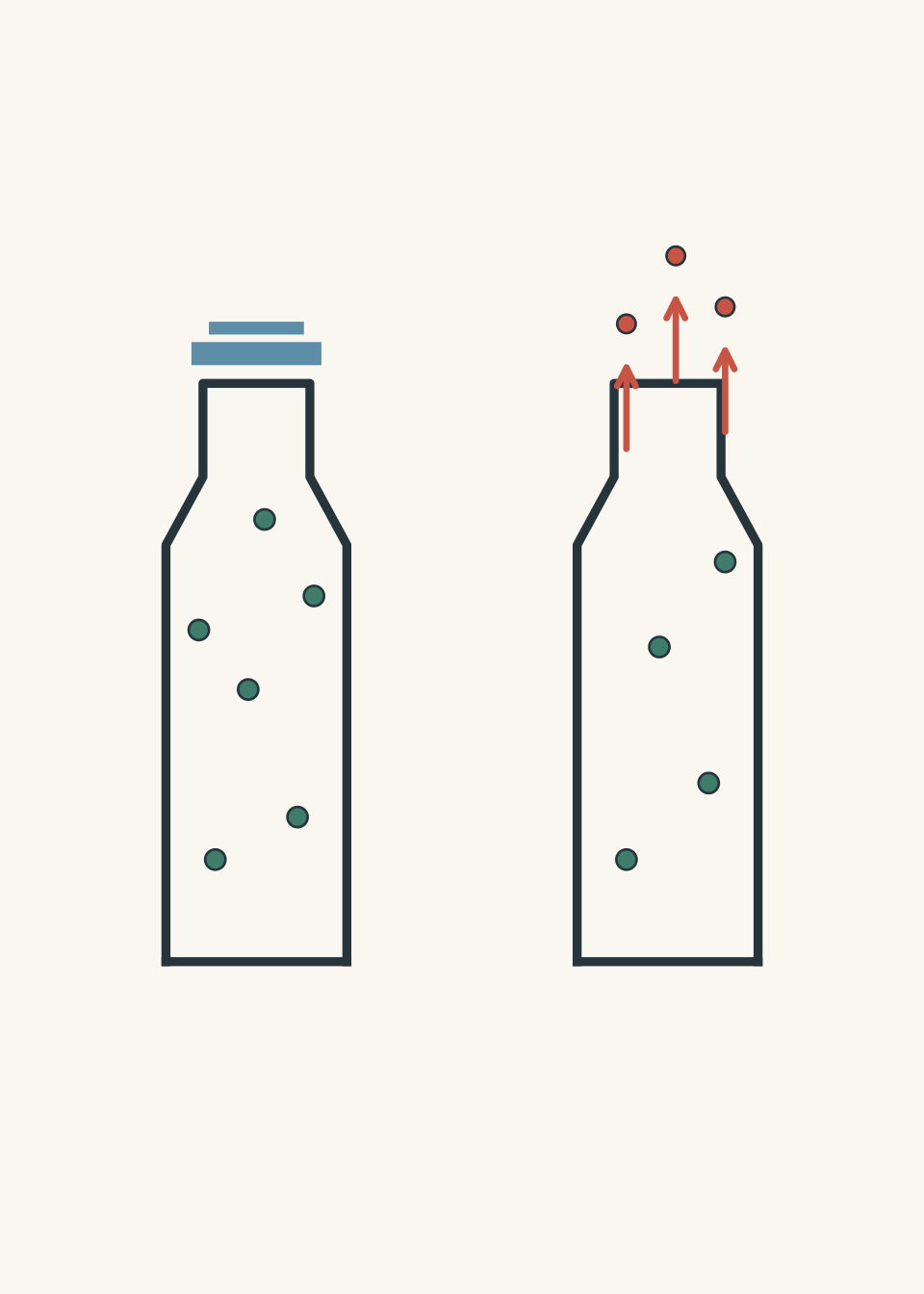
A student heats a sealed flask containing a reversible reaction. After a while, the concentrations of reactants and products stop changing. The student removes the stopper, expecting the reaction to continue behaving the same way.
It does not.
Why? The reaction itself has not changed. The molecules are still colliding, bonds are still breaking and forming, and the forward and reverse reactions are still possible. The problem is the boundary of the system.
Before a chemical system can reach a sustained equilibrium, we need to know what is allowed to enter and leave.
01Why does the system boundary matter?
Imagine a reversible reaction happening inside a container:
\[ \ce{A <=> B} \]
At the start, there are many particles of A and very few particles of B.
What would you predict happens next?
Most students predict that A will keep changing into B until all the A is gone. That prediction makes sense because we often see reactions go in one obvious direction, like a piece of magnesium reacting with acid.
However, a reversible reaction behaves differently. As B forms, B particles can collide and change back into A. Eventually, the forward reaction and reverse reaction occur at the same rate.
This state is called dynamic equilibrium.
You can read more about the particle-level explanation in Collision Theory and Chemical Equilibrium: HSC Chemistry.
But there is a condition hidden inside that explanation: the particles involved must remain available to react.
That is where open and closed systems become important.
02Building the first model: a chemical reaction as a room of people
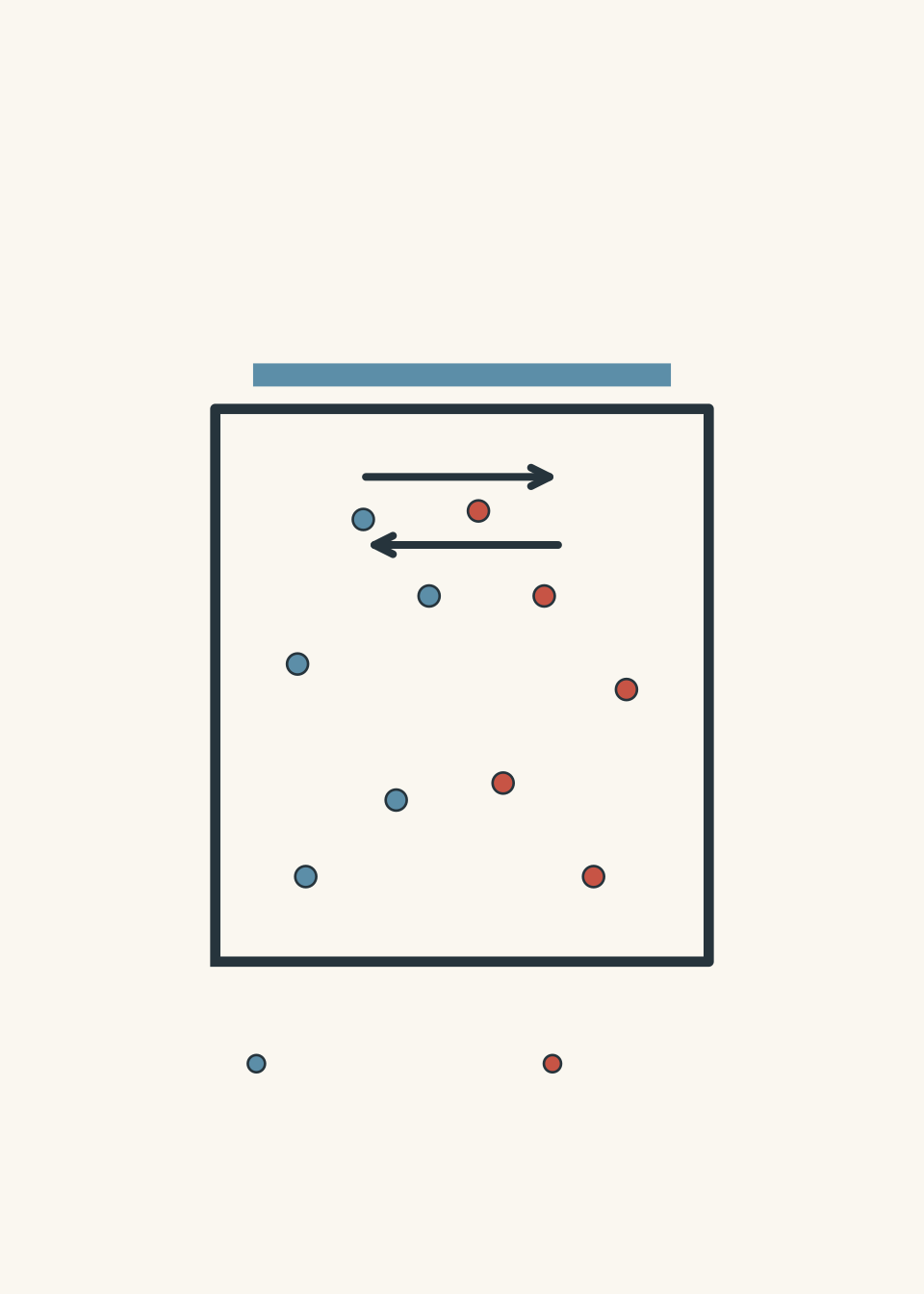
Picture a room where two groups of people are swapping seats.
At first, only the people on the left side are moving, so lots of changes happen. Over time, people move in both directions. Eventually, the number of people swapping left-to-right each minute matches the number swapping right-to-left each minute.
The room has reached a balance.
Now imagine someone opens a door and people start leaving the room.
The swapping inside the room might still happen, but the overall balance cannot be maintained because the number of people inside is changing.
A chemical system works in a similar way.
- The “room” is the reaction system.
- The “people” are the chemical species.
- The “door” is the system boundary.
The analogy helps us picture why matter leaving or entering can disrupt equilibrium. However, real molecules are not choosing where to go, and equilibrium depends on reaction rates and concentrations, not human behaviour.
03Open systems and closed systems
A system is the part of the universe we choose to study. In chemistry, this usually means the reaction mixture and its container.
The key question is:
What can cross the boundary?
Open system
An open system allows both matter and energy to enter or leave.
Examples:
- A beaker of boiling water.
- A combustion reaction in an open flame.
- A reaction mixture with gases escaping into the atmosphere.
In an open system, particles can leave. This changes the amounts of reactants and products, so the reaction conditions are constantly shifting.
For example:
\[ \ce{CaCO3(s) -> CaO(s) + CO2(g)} \]
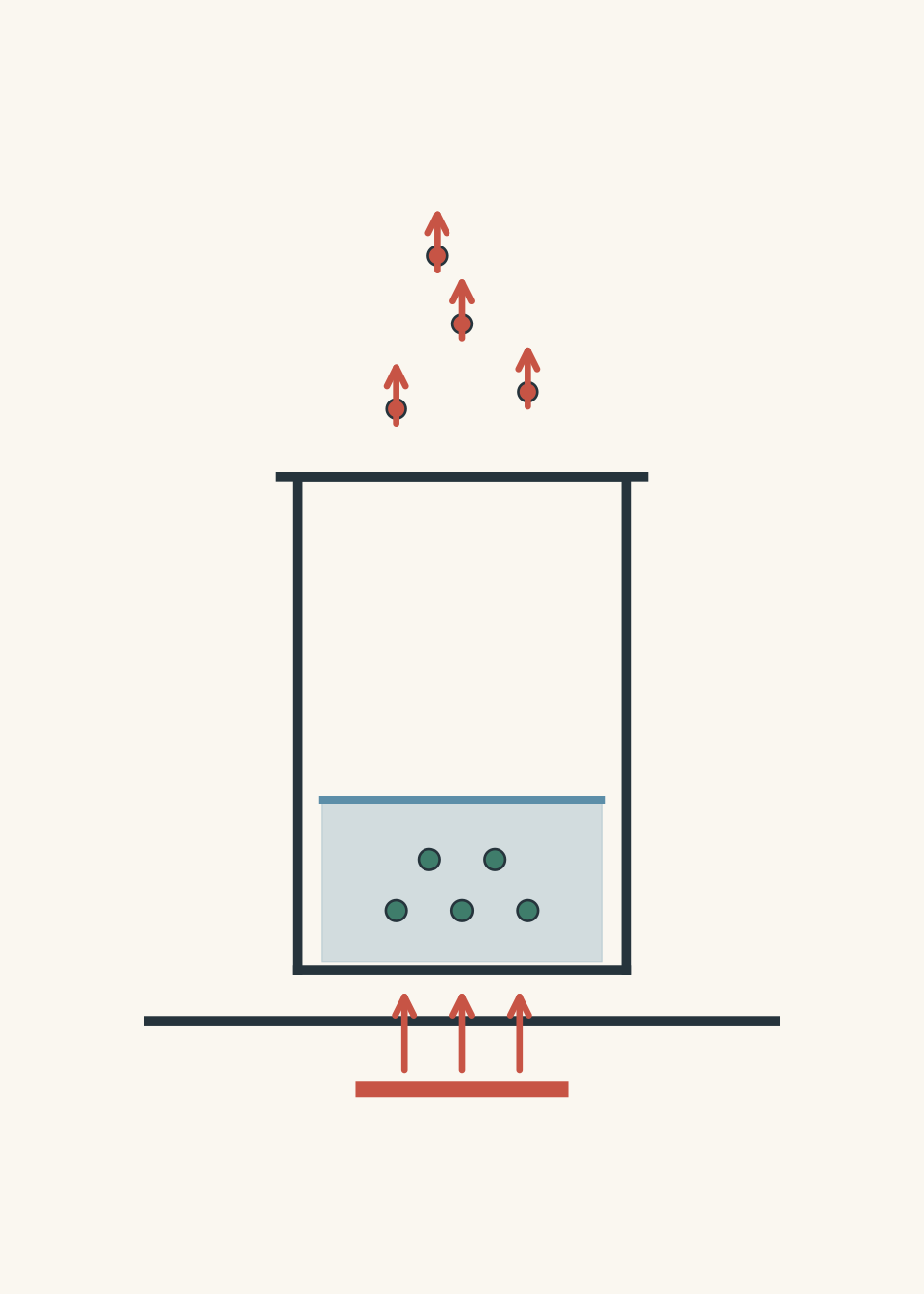
If calcium carbonate is heated in an open container, carbon dioxide gas escapes. Removing a product encourages more calcium carbonate to decompose.
The system is not able to settle into a stable equilibrium because one of the products is continuously removed.
Closed system
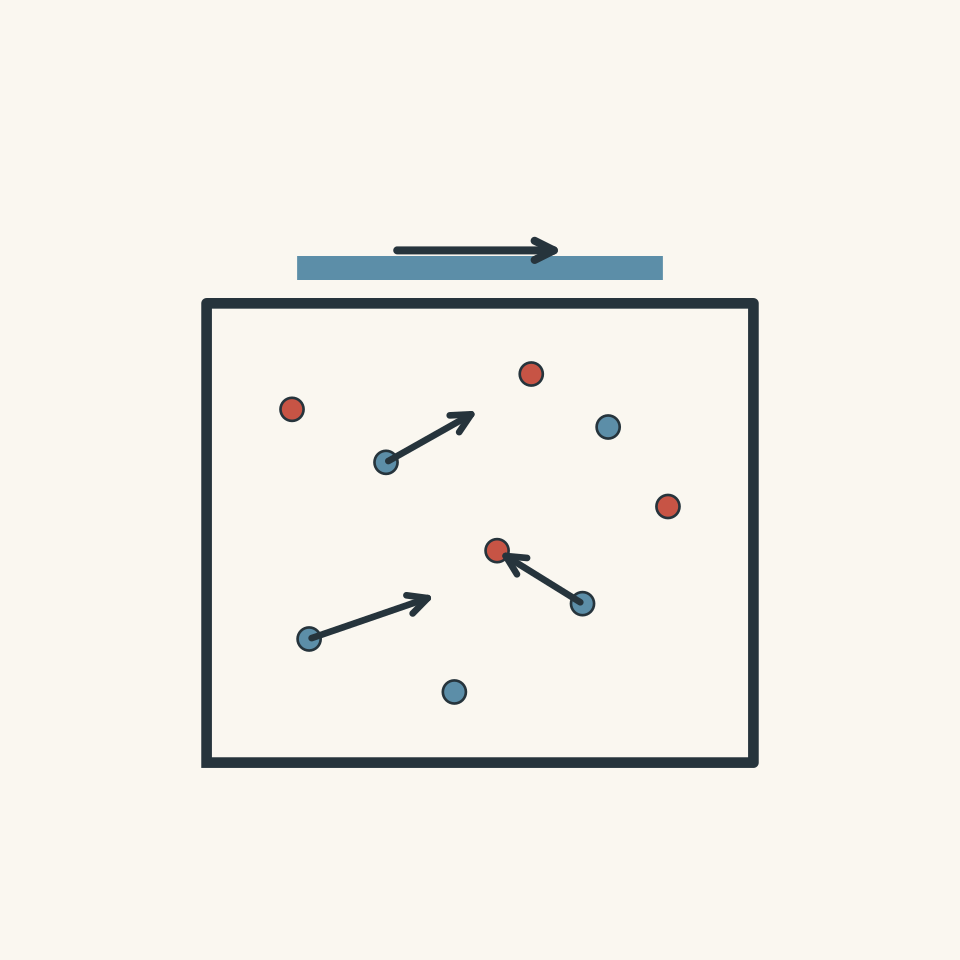
A closed system allows energy to enter or leave, but matter cannot.
A sealed flask is a common example.
The particles stay inside, so reactants and products can continue reacting in both directions.
For a reversible reaction:
\[ \ce{A + B <=> C + D} \]
a closed system allows:
- A and B to form C and D.
- C and D to reform A and B.
- Concentrations to settle into constant values.
The system may still exchange heat with the surroundings, but the chemical substances remain trapped.
This is the type of system required for sustained chemical equilibrium.
Is a closed system always at equilibrium?
No.
This is a common trap.
A closed system is necessary for equilibrium, but it is not enough by itself.
A reaction also needs:
- a reversible reaction,
- enough time for the forward and reverse reactions to occur,
- suitable conditions such as temperature and concentration.
A sealed container holding a one-way reaction does not suddenly become an equilibrium system.
04The first explanation is useful, but incomplete
A simple rule is:
Closed systems can reach equilibrium. Open systems usually cannot maintain equilibrium because matter can enter or leave.
This is a useful HSC shortcut, but it needs refinement.
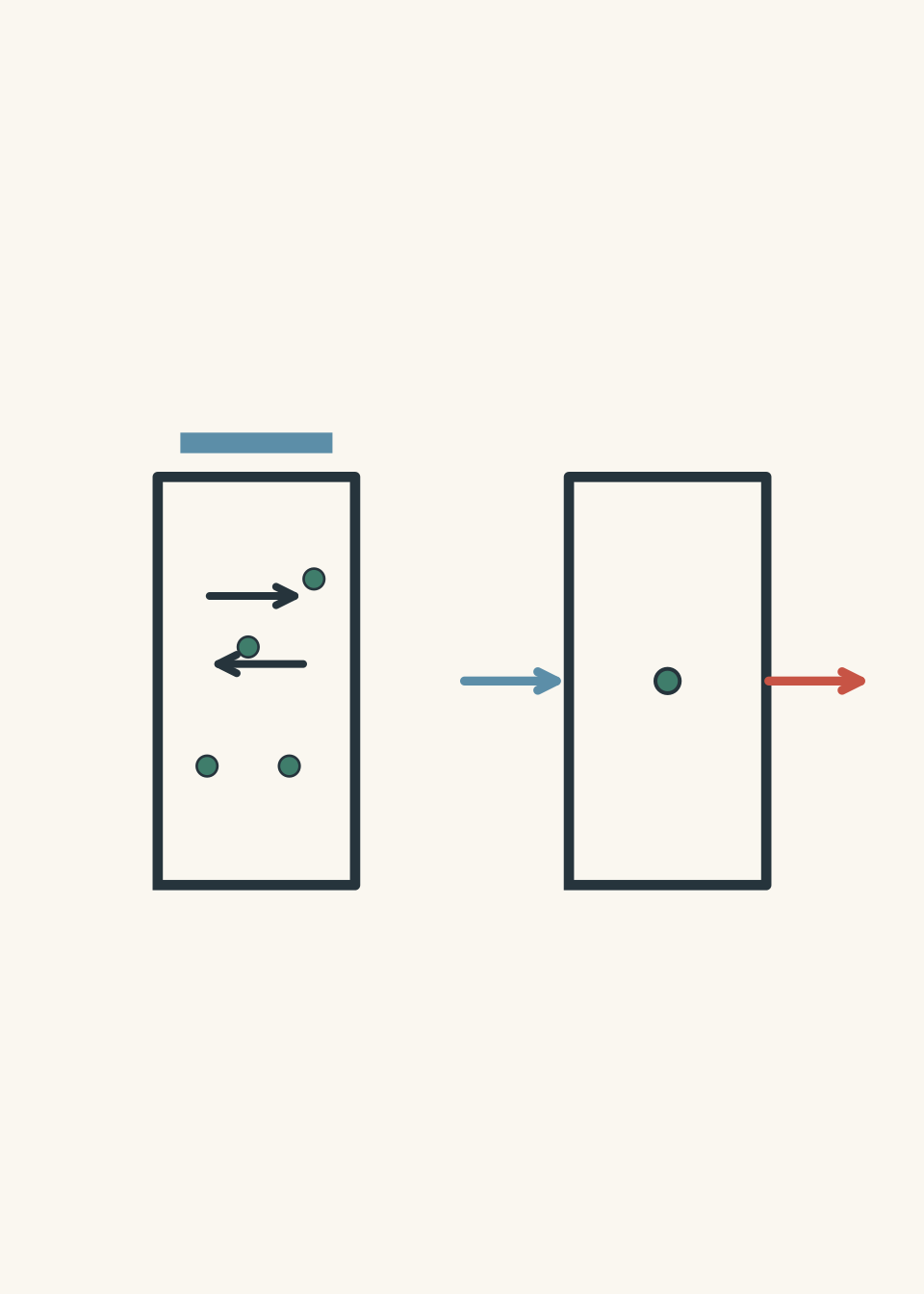
Some open systems can appear steady for a period of time because the rate of material entering matches the rate leaving. These are called steady-state systems.
For example, living organisms maintain steady conditions by constantly exchanging matter and energy with their surroundings.
However, this is not the same as chemical equilibrium.
In equilibrium:
- forward and reverse reactions continue,
- their rates are equal,
- concentrations remain constant.
In a steady-state system:
- substances may be continuously entering and leaving,
- concentrations may remain constant because inputs and outputs balance.
The numbers can look similar, but the mechanism is different.
05Why open systems struggle to maintain equilibrium
Consider the reaction:
\[ \ce{N2(g) + 3H2(g) <=> 2NH3(g)} \]
inside a sealed container.
Ammonia forms. Some ammonia molecules collide and break apart again. Eventually, the rates balance.
Now imagine the ammonia is constantly removed from the container.
What happens?
The system responds by producing more ammonia because the reverse reaction has fewer product molecules available. The reaction keeps shifting, but equilibrium is never maintained because the composition is continually changed.
This is why industrial chemical processes carefully control system boundaries.
The Haber process, for example, is carried out in controlled equipment where gases are contained and conditions are adjusted to manage equilibrium.
06Worked example: deciding whether equilibrium is possible
A chemist places a mixture of nitrogen gas and hydrogen gas in a sealed container. The mixture reacts to form ammonia. The container is kept at a constant temperature.
Can the system establish dynamic equilibrium?
Step 1
The container is sealed, so no reactant or product molecules can escape.
Step 2
The reaction is:
\[ \ce{N2(g) + 3H2(g) <=> 2NH3(g)} \]
Ammonia can form, and ammonia can decompose back into nitrogen and hydrogen.
Step 3
The system is closed and the reaction is reversible, so the forward and reverse reactions can continue until their rates become equal.
Conclusion: Yes, dynamic equilibrium can be established because the reaction occurs in a closed system and both directions remain possible.
The important idea is not that the reaction “stops”. The molecules are still reacting.
07Worked example: why removing a product prevents equilibrium
A student heats calcium carbonate in two different containers.
Container A is sealed.
Container B is open, allowing carbon dioxide gas to escape.
The reaction is:
\[ \ce{CaCO3(s) <=> CaO(s) + CO2(g)} \]
Explain which container can maintain equilibrium.
Step 1
Container A does not allow matter to leave. Container B allows carbon dioxide gas to escape.
Step 2
In Container B, the product concentration decreases because carbon dioxide leaves.
Step 3
Removing a product causes the system to favour the forward reaction, producing more carbon dioxide. Because carbon dioxide continues leaving, the reaction conditions never remain constant.
Conclusion: Container A can maintain equilibrium because it is closed. Container B cannot maintain equilibrium because matter leaves and continuously changes the reaction mixture.
08Common misconception: “Closed means nothing can change”
This sounds reasonable, but it is wrong.
A closed system is not a frozen system.
Students sometimes imagine a sealed container as a place where nothing happens because nothing enters or leaves. In reality, molecules inside the container can still collide and react.
The word “closed” only describes the boundary.
It tells us that matter cannot cross the boundary. It does not tell us that particles stop moving.
09Questions and solutions
Question 1
A reversible reaction is placed in a sealed flask. After several hours, the concentrations of reactants and products remain constant.
Explain whether the reaction has stopped.
Solution 1
The reaction has not stopped; it has reached dynamic equilibrium. The constant concentrations mean the forward and reverse reactions are occurring at equal rates.
The common mistake is to assume that no visible change means no particles are reacting. In reality, particles continue colliding and reacting in both directions. The reason the concentrations stay constant is that the amount formed by one reaction matches the amount consumed by the other.
Question 2
A student claims that an open system cannot ever have constant concentrations because equilibrium is impossible.
Evaluate this claim using the difference between equilibrium and steady state.
Solution 2
The claim is partly incorrect because an open system can have constant concentrations, but this does not necessarily mean equilibrium has been reached.
In an open system, matter can enter and leave. If the rate of input matches the rate of output, the concentration may stay constant. This is a steady-state condition.
Equilibrium is different because it requires the forward and reverse reaction rates to be equal within the system. An open system generally cannot maintain this because matter crossing the boundary changes the reaction mixture.
Question 3
A sealed container contains the reaction:
\[ \ce{H2(g) + I2(g) <=> 2HI(g)} \]
A student says, “Because the container is sealed, equilibrium must eventually happen.”
Explain why this statement is incomplete.
Solution 3
A sealed container allows equilibrium to happen, but it does not guarantee it.
The reaction must also be reversible under the conditions used. If the reaction can proceed in both directions and enough time is provided, the system can reach dynamic equilibrium.
The tempting reasoning is that a closed boundary is the only requirement. The missing constraint is that equilibrium depends on both the boundary and the chemistry of the reaction itself.
Question 4
A reaction mixture is at equilibrium in a sealed container. A valve is opened briefly, allowing some product gas to escape, and then the valve is closed again.
Predict what happens after the valve is closed.
Solution 4
The system will shift to produce more of the lost product before a new equilibrium is established.
When the product escapes, its concentration decreases. The forward reaction now occurs faster than the reverse reaction because there are fewer product particles available to react backwards.
After the valve closes, the system is once again closed, so it can move towards a new equilibrium. The important point is that the original equilibrium was destroyed when matter left the system.
Question 5
A student compares two systems.
System A: A sealed flask containing a reversible reaction.
System B: A living cell that continuously takes in nutrients and releases waste but keeps internal concentrations within a narrow range.
The student says both systems are examples of equilibrium because the concentrations are stable.
Explain why the student’s conclusion is incorrect.
Solution 5
System A can reach dynamic equilibrium, while System B is better described as a steady-state system.
In System A, the concentrations remain constant because the forward and reverse reaction rates become equal and no matter enters or leaves.
In System B, concentrations remain controlled because the cell constantly exchanges matter with its surroundings. Inputs, chemical reactions, and outputs are balanced, but the system is not closed.
The trap is focusing only on the observation that “the concentration stays the same”. The mechanism producing that stability is what determines whether it is equilibrium or steady state.
10Where this idea leads next
Understanding system boundaries makes later equilibrium concepts much easier. When conditions change, such as concentration, pressure, or temperature, you need to know whether the system can respond internally or whether material is being added or removed.
That is the foundation for using equilibrium principles to predict chemical changes, including the ideas explored in Reversible Chemical Reactions: HSC Chemistry Guide and Static vs Dynamic Equilibrium in HSC Chemistry.