
Oxidation numbers in redox reactions: HSC Chemistry Guide
Learn how to assign oxidation numbers and use changes in oxidation state to identify oxidation and reduction in redox reactions. Includes worked examples and HSC-style practice questions.
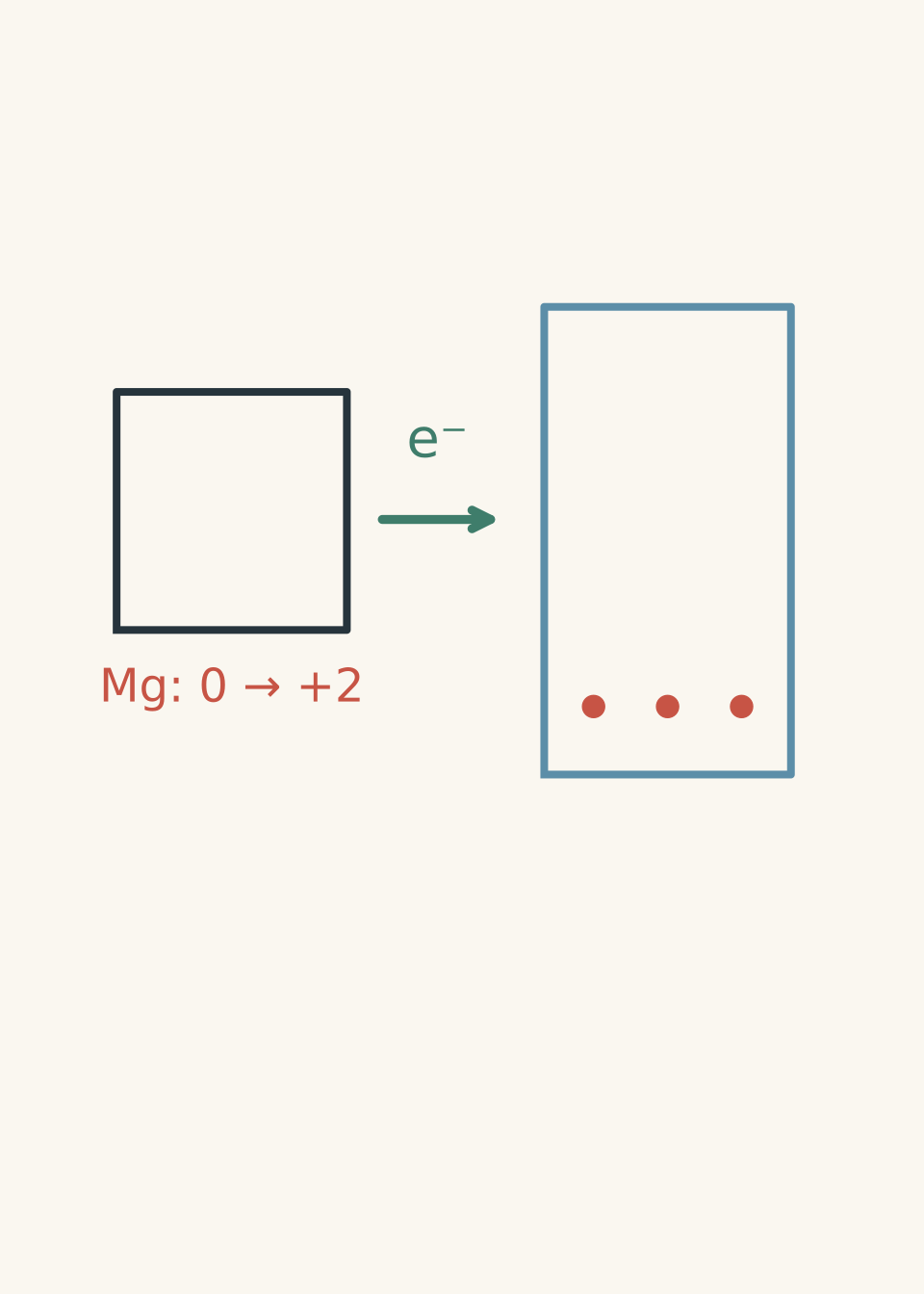
When magnesium ribbon is placed into copper(II) sulfate solution, something strange happens. The blue solution fades, a reddish-brown solid appears, and the magnesium seems to disappear.
You can explain this by saying magnesium atoms lose electrons and copper ions gain them. But what if the equation becomes more complicated?
For example:
\[ \ce{2Fe^2+ + Cl2 -> 2Fe^3+ + 2Cl^-} \]
Which substance lost electrons? Which gained them? How can you tell quickly?
Oxidation numbers give you a bookkeeping system for tracking electron movement when reactions are not obvious. They do not show the exact location of every electron in a molecule, but they help you identify what has been oxidised and what has been reduced.
01The problem oxidation numbers solve
Imagine you are watching two people swap items, but the exchange happens so quickly that you cannot see who handed what to whom. You could track the change in each person’s wallet instead.
Oxidation numbers work in a similar way. They track the “electron ownership” of atoms before and after a reaction.
A positive change in oxidation number usually means an atom has lost electrons.
A negative change usually means an atom has gained electrons.
Before using the formal rules, make a prediction:
If an atom’s oxidation number goes from \(+2\) to \(+3\), has it gained or lost electrons?
It has lost electrons. The atom has become more positive because electrons, which are negatively charged, have been removed.
If an atom’s oxidation number goes from \(+3\) to \(+1\), what happened?
It gained electrons. Adding negative charge makes the oxidation number decrease.
This gives the key rule:
| Change in oxidation number | What happened | Process |
|---|---|---|
| Oxidation number increases | Electrons lost | Oxidation |
| Oxidation number decreases | Electrons gained | Reduction |
A useful memory trick is:
OIL RIG
Oxidation Is Loss (of electrons)
Reduction Is Gain (of electrons)
This links directly to the electron-transfer ideas used in oxidation and reduction by electron transfer.
02Building the idea: what is an oxidation number?
An oxidation number is the charge an atom would appear to have if all bonding electrons were assigned to the more electronegative atom.
That sounds abstract, so start with a simple picture.
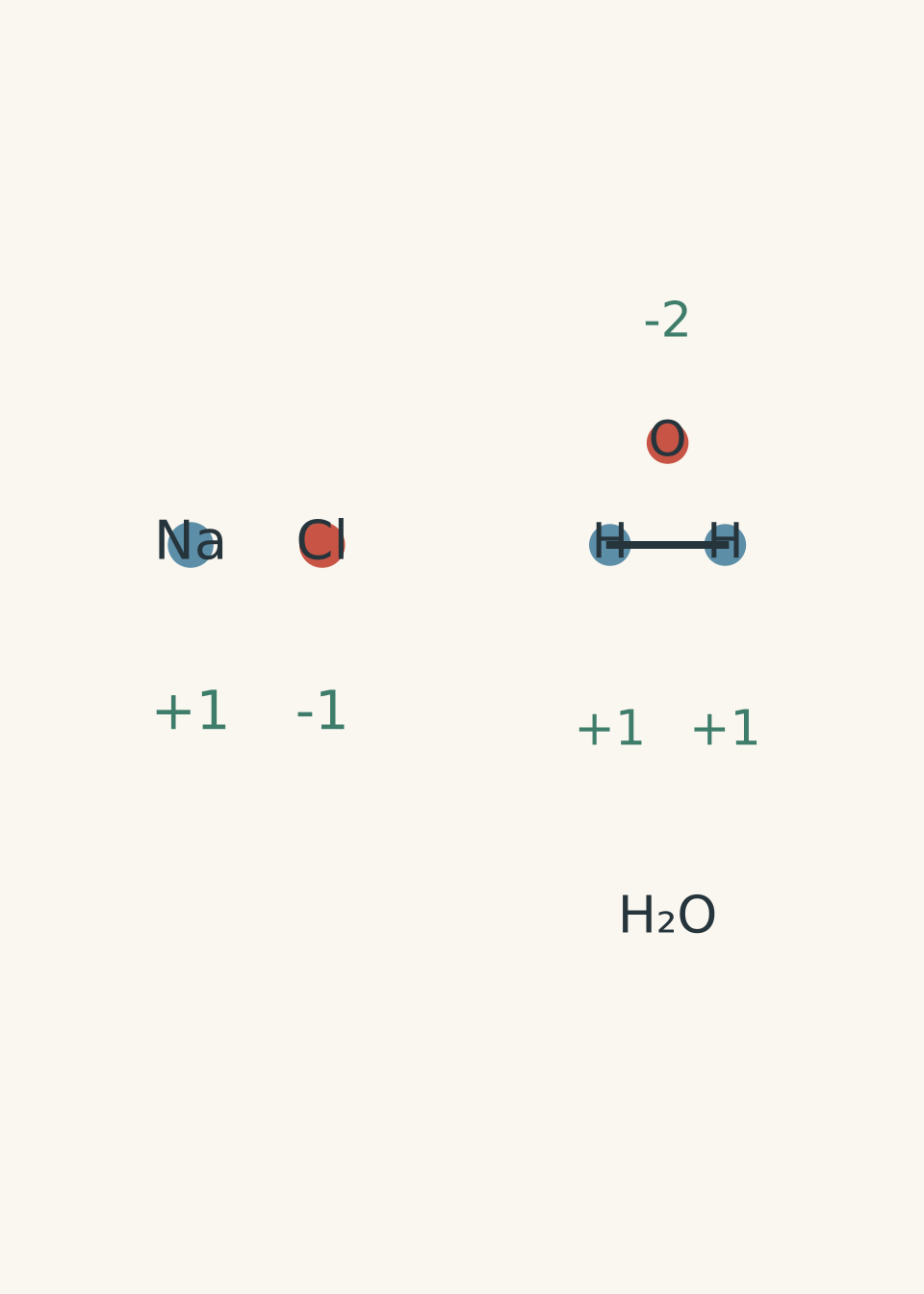
In sodium chloride, sodium is less electronegative than chlorine. We imagine sodium gives its electron completely to chlorine:
\[ \ce{NaCl -> Na+ + Cl^-} \]
So:
- sodium has oxidation number \(+1\)
- chlorine has oxidation number \(-1\)
The real structure is more complicated because sodium chloride is an ionic lattice, but the oxidation numbers provide a useful model.
For covalent molecules, the atoms are not actually transferring whole electrons. The oxidation number is a way of pretending they do so that we can track changes.
03The oxidation number rules you need for HSC Chemistry
Most questions can be solved using a small set of rules.
Rule 1: Elements by themselves have oxidation number zero
Any pure element has an oxidation number of zero.
Examples:
\[ \ce{O2}, \ce{H2}, \ce{Fe}, \ce{Cl2} \]
All atoms in these substances have oxidation number:
\[ 0 \]
Rule 2: Monatomic ions have the same oxidation number as their charge
Examples:
\[ \mathrm{Na}^{+} = +1 \]
\[ \mathrm{Mg}^{2+} = +2 \]
\[ \mathrm{Cl}^{-} = -1 \]
Rule 3: Oxygen is usually \(-2\)
Examples:
\[ \ce{H2O} \]
Oxygen is \(-2\).
\[ 2(+1)+(-2)=0 \]
The total oxidation number of a neutral compound must equal zero.
There are exceptions, such as peroxides, where oxygen is \(-1\), but these are usually identified by the formula.
Rule 4: Hydrogen is usually \(+1\)
Examples:
\[ \ce{HCl} \]
Hydrogen is \(+1\), chlorine is \(-1\).
A common exception is metal hydrides such as \(\ce{NaH}\), where hydrogen is \(-1\).
Rule 5: The sum of oxidation numbers equals the overall charge
For a neutral compound:
\[ \text{sum of oxidation numbers}=0 \]
For an ion:
\[ \text{sum of oxidation numbers}=\text{charge of ion} \]
This rule is the one you use to find unknown oxidation numbers.
04Finding an unknown oxidation number
Suppose you are asked for the oxidation number of sulfur in \(\ce{SO4^2-}\).
Do not guess. Build an equation.
There is one sulfur atom. Oxygen is usually \(-2\). The total charge is \(-2\).
Let sulfur be \(x\):
\[ x+4(-2)=-2 \]
\[ x-8=-2 \]
\[ x=+6 \]
So sulfur has oxidation number \(+6\).
Notice something important: sulfur is not actually carrying a \(+6\) charge in the sulfate ion. This is a bookkeeping number used to track electron changes.
05Worked example: Finding oxidation numbers in a compound
Worked example: Find the oxidation number of nitrogen in \(\ce{NO3^-}\)
Step 1
Oxygen is usually \(-2\). There are three oxygen atoms.
The total charge of the nitrate ion is \(-1\).
Step 2
\[ x+3(-2)=-1 \]
Step 3
\[ x-6=-1 \]
\[ x=+5 \]
Step 4
Nitrogen has an oxidation number of \(+5\) in nitrate.
This means nitrogen is in a relatively oxidised state because it has effectively lost electron ownership compared with elemental nitrogen.
06Using oxidation numbers to identify redox reactions
Now we can return to the original problem: finding what is oxidised and reduced.
Consider:
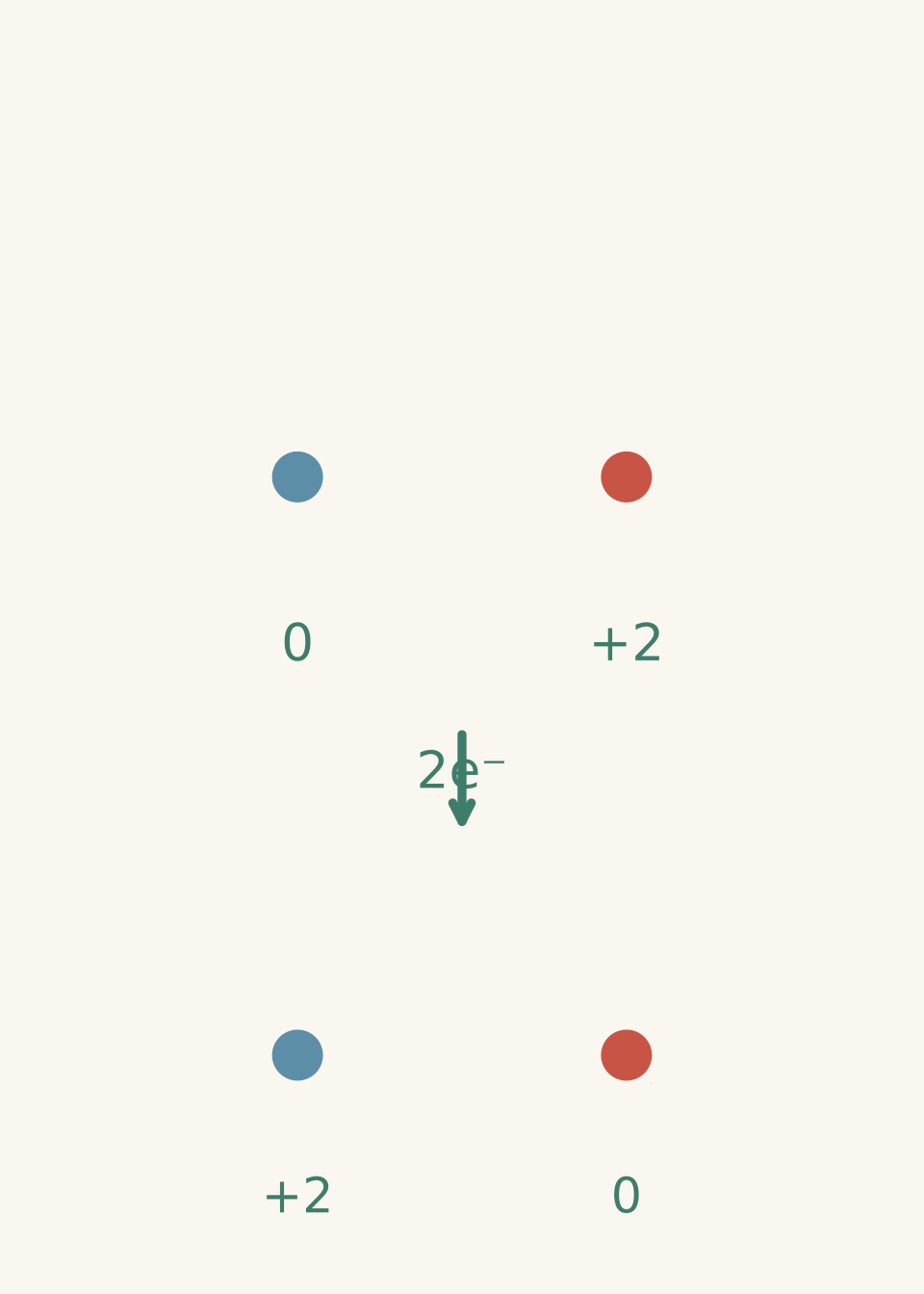
\[ \ce{Zn + CuSO4 -> ZnSO4 + Cu} \]
First, identify oxidation numbers.
Before the reaction:
- zinc metal: \(0\)
- copper in \(\ce{CuSO4}\): \(+2\)
After the reaction:
- zinc in \(\ce{ZnSO4}\): \(+2\)
- copper metal: \(0\)
Zinc changes:
\[ 0 \rightarrow +2 \]
Its oxidation number increases, so zinc is oxidised.
Copper changes:
\[ +2 \rightarrow 0 \]
Its oxidation number decreases, so copper is reduced.
The sulfate ion does not change. It is a spectator ion.
07Worked example: Identifying oxidation and reduction
Worked example: Identify the oxidised and reduced substances in \(\ce{2Mg + O2 -> 2MgO}\)
Step 1
Magnesium is an element, so:
\[ \ce{Mg}=0 \]
Oxygen gas is also an element:
\[ \ce{O2}=0 \]
Step 2
In \(\ce{MgO}\), oxygen is usually \(-2\).
Because magnesium oxide is neutral:
\[ \ce{Mg}=+2 \]
Step 3
Magnesium:
\[ 0\rightarrow +2 \]
The oxidation number increases, so magnesium is oxidised.
Oxygen:
\[ 0\rightarrow -2 \]
The oxidation number decreases, so oxygen is reduced.
Step 4
Magnesium loses electrons. Oxygen gains electrons.
The equation can also be understood through half-equations:
\[ \ce{Mg -> Mg^2+ + 2e^-} \]
\[ \ce{O2 + 4e^- -> 2O^2-} \]
Two magnesium atoms provide the electrons needed for one oxygen molecule.
08The most common trap: assuming the more reactive element is always reduced
Students often make this prediction:
“Metals lose electrons, so the metal must always be oxidised.”
That is often true in simple displacement reactions, such as magnesium reacting with copper ions. But the rule is not “metal equals oxidation”.
The rule is based on the oxidation number change.
For example:
\[ \ce{Cu^2+ + 2e^- -> Cu} \]
Copper ions are reduced because their oxidation number changes:
\[ +2\rightarrow0 \]
The same element can be oxidised in one reaction and reduced in another depending on what it is reacting with.
This is why oxidation numbers are more reliable than memorising patterns.
09Applying oxidation numbers to metal reactions
Oxidation numbers are especially useful when comparing metal reactions.
For example, in:
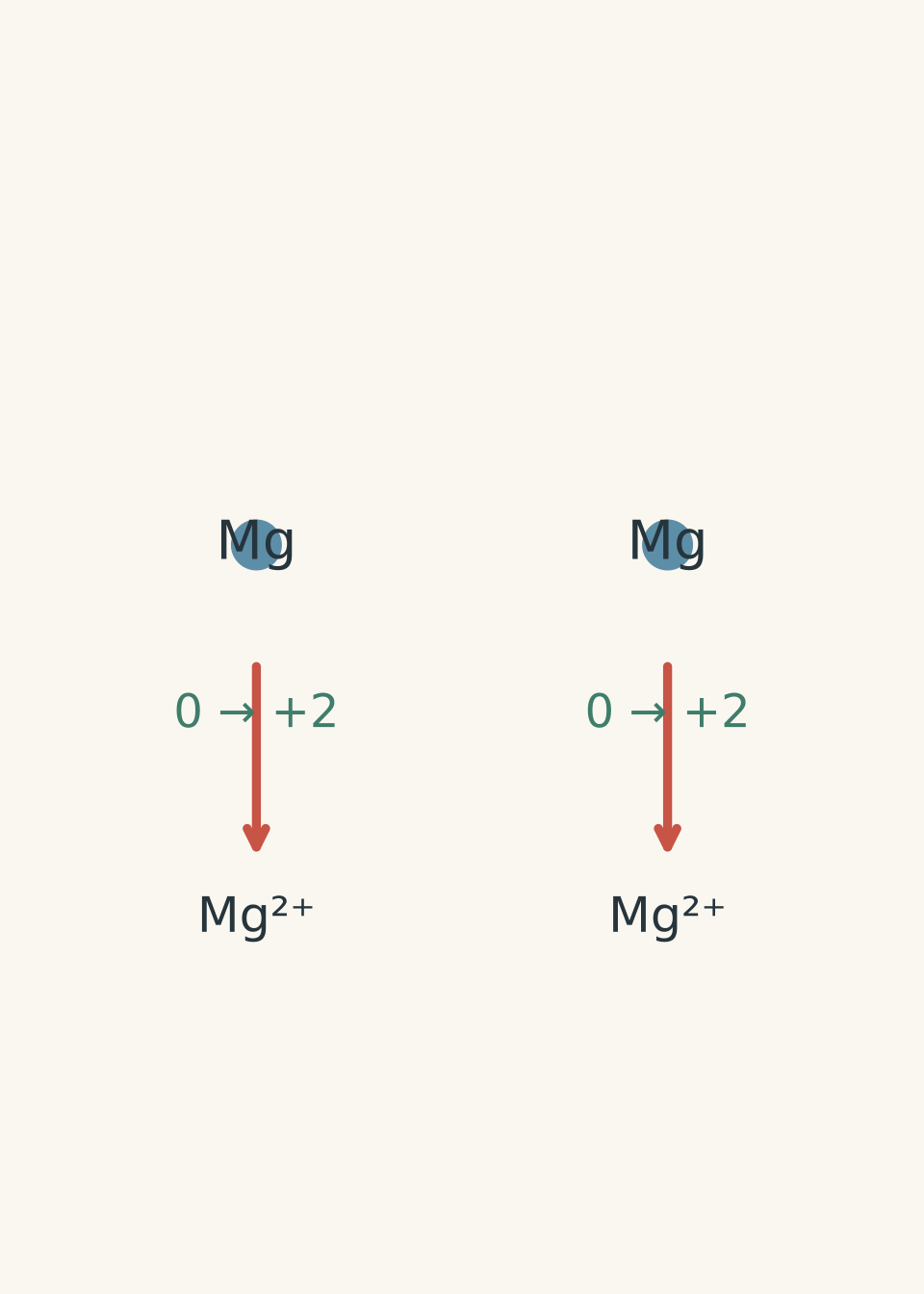
\[ \ce{Mg + 2HCl -> MgCl2 + H2} \]
Magnesium changes:
\[ 0\rightarrow+2 \]
Hydrogen changes:
\[ +1\rightarrow0 \]
Magnesium is oxidised and hydrogen ions are reduced.
This connects with ideas about metal reactivity, including reactions of metals with dilute acids and reactions of metals with oxygen.
10A reliable exam method
When a redox question appears, use this sequence:
- Write oxidation numbers above the important atoms.
- Compare the oxidation numbers before and after.
- Find which atoms increased and which decreased.
- Increased oxidation number = oxidised.
- Decreased oxidation number = reduced.
- Check that electrons lost and electrons gained make sense.
The method feels slower at first, but it prevents common mistakes.
11Questions and solutions
Question 1
For the reaction:
\[ \ce{2Na + Cl2 -> 2NaCl} \]
Identify the substance oxidised and the substance reduced.
Solution 1
Sodium is oxidised and chlorine is reduced.
Sodium starts as an element:
\[ \ce{Na}=0 \]
In \(\ce{NaCl}\), sodium becomes:
\[ \ce{Na}=+1 \]
Its oxidation number increases, so sodium loses electrons and is oxidised.
Chlorine starts as:
\[ \ce{Cl2}=0 \]
In \(\ce{NaCl}\), chlorine becomes:
\[ \mathrm{Cl}^{-}=-1 \]
Its oxidation number decreases, so chlorine gains electrons and is reduced.
The tempting mistake is to look only at sodium being a metal and stop there. The correct decision comes from the oxidation number changes.
Question 2
Determine the oxidation number of chromium in \(\ce{Cr2O7^2-}\).
Solution 2
Chromium has oxidation number \(+6\).
Oxygen is usually \(-2\). Let chromium be \(x\).
\[ 2x+7(-2)=-2 \]
\[ 2x-14=-2 \]
\[ 2x=12 \]
\[ x=+6 \]
Each chromium atom in dichromate has oxidation number \(+6\).
The key constraint is that the total oxidation numbers must equal the charge of the ion, not zero, because \(\ce{Cr2O7^2-}\) is charged.
Question 3
In the reaction:
\[ \ce{Fe2O3 + 3CO -> 2Fe + 3CO2} \]
Identify what is oxidised and what is reduced.
Solution 3
Carbon monoxide is oxidised, and iron(III) oxide is reduced.
In \(\ce{Fe2O3}\), oxygen is \(-2\):
\[ 2x+3(-2)=0 \]
\[ 2x=6 \]
\[ x=+3 \]
Iron changes:
\[ +3\rightarrow0 \]
so iron is reduced.
In \(\ce{CO}\), oxygen is \(-2\), so carbon must be:
\[ +2 \]
In \(\ce{CO2}\), oxygen contributes \(-4\), so carbon is:
\[ +4 \]
Carbon changes:
\[ +2\rightarrow+4 \]
so carbon monoxide is oxidised.
A common trap is to focus on iron metal appearing at the end and assume the iron-containing substance must be oxidised. The oxidation number shows the opposite.
Question 4
A student claims:
“Because oxygen is usually \(-2\), oxygen is always the substance that is reduced in a redox reaction.”
Evaluate this claim using the reaction:
\[ \ce{2H2O2 -> 2H2O + O2} \]
Solution 4
The claim is incorrect because oxygen can be both oxidised and reduced in the same reaction.
In hydrogen peroxide, oxygen is not \(-2\). Let its oxidation number be \(x\):
\[ 2(+1)+2x=0 \]
\[ 2x=-2 \]
\[ x=-1 \]
In water:
\[ \ce{O}=-2 \]
Oxygen changes:
\[ -1\rightarrow-2 \]
so some oxygen is reduced.
In oxygen gas:
\[ \ce{O2}=0 \]
Oxygen changes:
\[ -1\rightarrow0 \]
so some oxygen is oxidised.
This reaction is a special type of redox reaction called disproportionation, where the same element is both oxidised and reduced.
The tempting route is applying the oxygen rule without checking the starting substance. The actual rule is that oxygen is usually \(-2\), not always.
Question 5
A reaction occurs:
\[ \ce{2FeCl2 + Cl2 -> 2FeCl3} \]
A student argues:
“Chlorine is the stronger oxidising agent because it changes from \(\ce{Cl2}\) to chloride ions, so it must be gaining electrons and being oxidised.”
Decide whether the argument is correct.
Solution 5
The argument is incorrect. Chlorine is the oxidising agent and is reduced.
In \(\ce{Cl2}\):
\[ \ce{Cl}=0 \]
In chloride ions:
\[ \mathrm{Cl}^{-}=-1 \]
The change is:
\[ 0\rightarrow-1 \]
Chlorine gains electrons, so chlorine is reduced.
Now check iron.
In \(\ce{FeCl2}\), chloride is \(-1\), so iron is:
\[ +2 \]
In \(\ce{FeCl3}\), iron is:
\[ +3 \]
The change is:
\[ +2\rightarrow+3 \]
Iron loses electrons, so iron is oxidised.
The subtle point is that the substance causing another substance to oxidise is itself reduced. An oxidising agent does not get oxidised; it accepts electrons.
Understanding oxidation numbers gives you a way to move from simply spotting redox reactions to balancing them with half-equations and predicting how electrochemical cells behave. The next step is using these electron changes to build and balance full redox equations.