
Catalysts and Energy Profiles: HSC Chemistry Explained
Learn how catalysts provide an alternative reaction pathway with lower activation energy while leaving the overall enthalpy change unchanged. Includes worked examples, multistep profiles, and challenging HSC-style questions.
Two samples of hydrogen peroxide can start with the same amount of \(\ce{H2O2}\), yet one can decompose much faster when a catalyst is present:
\[ \ce{2H2O2(aq) -> 2H2O(l) + O2(g)} \]
Suppose the same amount reacts in each sample. Predict what the catalyst changes on an energy profile. Does it make the products lower in energy, so the reaction has further to “fall”? Or does it change something about the route between reactants and products?
It changes the route. The reactants and products are still the same chemical states, so their enthalpy difference is unchanged. The catalyst gives the reaction another pathway with a lower activation-energy barrier.
That one distinction explains almost everything you need to know about catalysts on HSC energy profiles.
01What the catalyst actually changes
Picture a reaction as a trip from one side of a mountain range to the other.
The reactants are your starting town. The products are your destination. An uncatalysed reaction might require climbing a very high mountain pass. A catalyst is like discovering a lower pass through the same range.
You still leave from the same town and finish at the same destination. The difference in altitude between them has not changed. You just don’t need to climb as high along the way.
On an energy profile:
- the reactant energy stays the same,
- the product energy stays the same,
- the uncatalysed pathway has a higher energy barrier,
- the catalysed pathway has a lower energy barrier, and
- the overall enthalpy change, \(\Delta H\), stays the same.
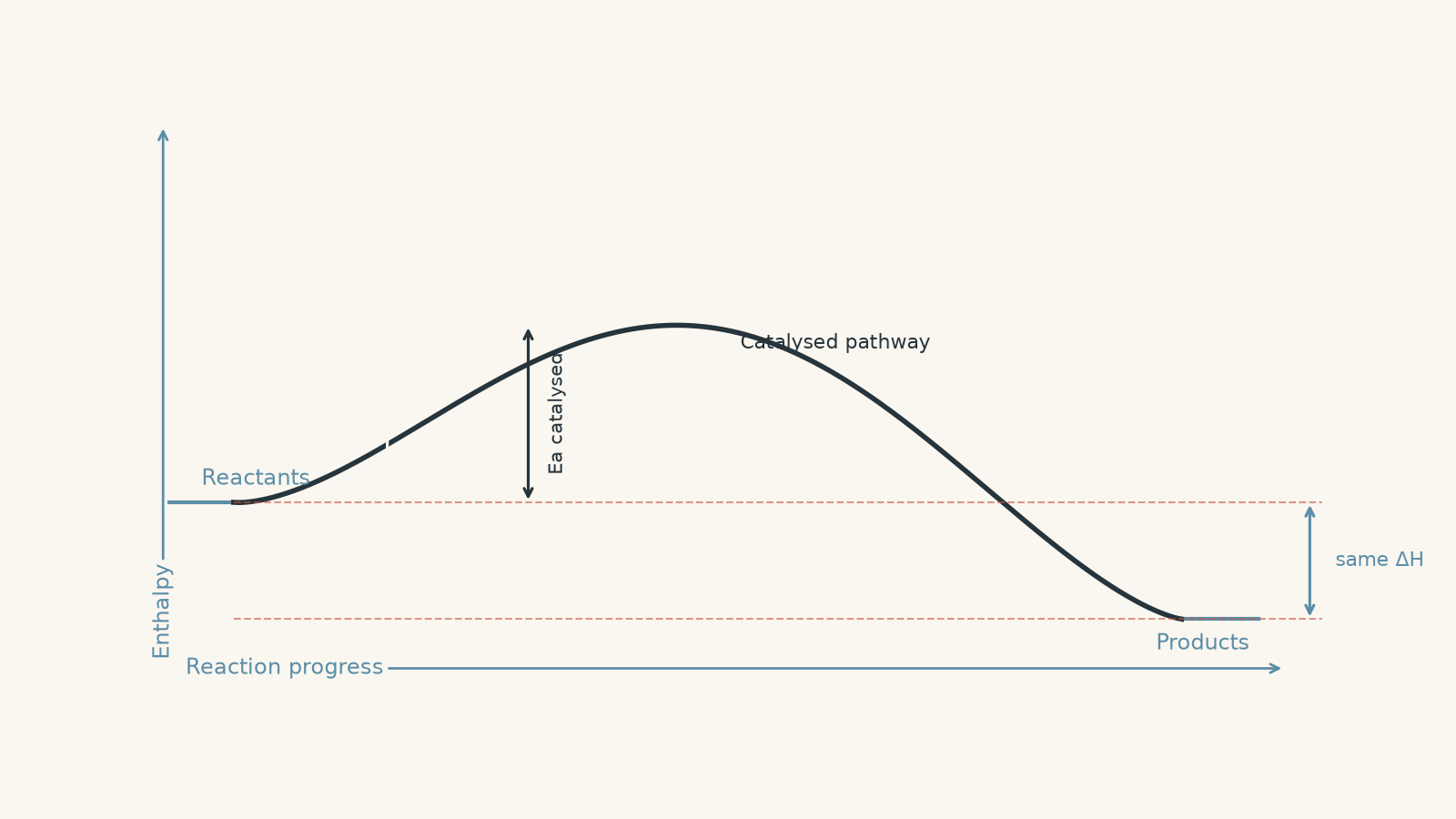
The mountain analogy is useful, but it has limits. Molecules are not literally travelling along a geometric track. The reaction pathway represents a sequence of molecular changes, including bonds stretching, bonds breaking, bonds forming, and sometimes temporary intermediates.
A catalyst can participate in those steps. The important condition is that it is regenerated by the end of the overall process.
02Reading an energy profile properly
The vertical axis represents enthalpy, or sometimes more generally potential energy. The horizontal axis is reaction progress.
Reaction progress is not time. A point halfway across the graph does not mean the reaction is halfway through its duration.
For a simple one-step diagram, the highest point represents the transition state: a very unstable arrangement that must be reached before the reaction can continue towards products.
The activation energy, \(E_a\), is the energy difference between the starting state and that transition state.
If \(H_R\) is the enthalpy of the reactants and \(H^\ddagger\) is the enthalpy of the transition state, the forward activation energy is
\[ E_{a,\mathrm{f}} = H^\ddagger-H_R \]
For the reverse reaction, starting from the products,
\[ E_{a,\mathrm{r}} = H^\ddagger-H_P \]
where \(H_P\) is the enthalpy of the products.
The overall enthalpy change is different:
\[ \Delta H = H_P-H_R \]
So activation energy asks, “How high must the reaction climb?”
Enthalpy change asks, “How much higher or lower are the products than the reactants?”
Those are different questions.
If you need a refresh on the sign and meaning of \(\Delta H\), see Endothermic and Exothermic Reactions for HSC Chemistry.
A useful relationship
For a simple energy profile with one transition state,
\[ E_{a,\mathrm{f}}-E_{a,\mathrm{r}}=\Delta H \]
You can see why by subtracting the two activation-energy equations:
\[ \begin{aligned} E_{a,\mathrm{f}}-E_{a,\mathrm{r}} &=(H^\ddagger-H_R)-(H^\ddagger-H_P)\\ &=H_P-H_R\\ &=\Delta H \end{aligned} \]
Notice what disappears: \(H^\ddagger\).
That is a big clue. Moving the transition state up or down changes both activation energies, but it does not change the enthalpy difference between the endpoints.
03Why lowering activation energy speeds the reaction up
Imagine a room full of people trying to jump over a wall. At a given moment, some have enough energy to clear it, while many do not.
Lower the wall, and suddenly a much larger fraction can get over.
A catalyst does something similar. It does not increase the average kinetic energy of the molecules. At the same temperature, the molecular energy distribution is not magically shifted upwards.
Instead, the required energy threshold is reduced.
More collisions can therefore follow a successful reaction pathway.
This corrects a common prediction: “The catalyst speeds particles up.”
It doesn’t. Raising the temperature increases average kinetic energy. Adding a catalyst provides a pathway requiring less activation energy. Those are different mechanisms for increasing reaction rate.
A real catalyst may also hold reactants in useful orientations, weaken particular bonds, or form temporary intermediates. “Lower barrier” is the energy-profile summary of those molecular effects.
04The catalyst does not change \(\Delta H\)
Suppose an exothermic reaction has reactants at \(80\ \mathrm{kJ\,mol^{-1}}\) and products at \(30\ \mathrm{kJ\,mol^{-1}}\).
Then
\[ \Delta H=30-80=-50\ \mathrm{kJ\,mol^{-1}} \]
Now imagine the uncatalysed pathway peaks at \(170\ \mathrm{kJ\,mol^{-1}}\), while the catalysed pathway peaks at only \(125\ \mathrm{kJ\,mol^{-1}}\).
The catalyst has substantially lowered the barrier.
But the endpoints are still \(80\) and \(30\ \mathrm{kJ\,mol^{-1}}\).
Therefore,
\[ \Delta H=-50\ \mathrm{kJ\,mol^{-1}} \]
with or without the catalyst.
A lower peak does not mean “more exothermic”. Exothermicity depends on the vertical separation between reactants and products, not the height of the hill between them.
Worked example: Reading a catalysed energy profile
An exothermic reaction has reactants at \(65\ \mathrm{kJ\,mol^{-1}}\) and products at \(15\ \mathrm{kJ\,mol^{-1}}\). The uncatalysed pathway reaches \(145\ \mathrm{kJ\,mol^{-1}}\), while the catalysed pathway reaches \(105\ \mathrm{kJ\,mol^{-1}}\).
Calculate the reaction enthalpy, the forward activation energy for each pathway, and the catalysed reverse activation energy.
Step 1
\[ \Delta H=H_P-H_R=15-65=-50\ \mathrm{kJ\,mol^{-1}} \]
The negative sign means the reaction is exothermic.
Step 2
\[ E_{a,\mathrm{f,uncat}}=145-65=80\ \mathrm{kJ\,mol^{-1}} \]
The uncatalysed reaction must climb \(80\ \mathrm{kJ\,mol^{-1}}\) above the reactants.
Step 3
\[ E_{a,\mathrm{f,cat}}=105-65=40\ \mathrm{kJ\,mol^{-1}} \]
The catalyst has reduced the forward barrier by
\[ 80-40=40\ \mathrm{kJ\,mol^{-1}} \]
Step 4
\[ E_{a,\mathrm{r,cat}}=105-15=90\ \mathrm{kJ\,mol^{-1}} \]
So the catalyst provides a forward activation energy of \(40\ \mathrm{kJ\,mol^{-1}}\) and a reverse activation energy of \(90\ \mathrm{kJ\,mol^{-1}}\).
That difference is exactly consistent with the reaction enthalpy:
\[ 40-90=-50\ \mathrm{kJ\,mol^{-1}} \]
The reaction has become kinetically easier, but its thermochemistry has not changed.
05A catalyst also helps the reverse reaction
This can feel strange at first.
If a catalyst is being used because we want products, why would it also make it easier for the products to turn back into reactants?
Because the alternative pathway works in both directions.
A mountain pass does not disappear because you start walking from the other side.
For a simple one-transition-state profile, lowering the transition state lowers both the forward and reverse activation energies.
Suppose an uncatalysed pathway has
\[ E_{a,\mathrm{f}}=130\ \mathrm{kJ\,mol^{-1}} \]
and
\[ E_{a,\mathrm{r}}=160\ \mathrm{kJ\,mol^{-1}} \]
Then
\[ \Delta H=130-160=-30\ \mathrm{kJ\,mol^{-1}} \]
If a catalyst lowers the forward activation energy to \(75\ \mathrm{kJ\,mol^{-1}}\), the barrier has fallen by \(55\ \mathrm{kJ\,mol^{-1}}\).
For the same simple profile, the reverse activation energy also falls by \(55\ \mathrm{kJ\,mol^{-1}}\):
\[ E_{a,\mathrm{r,cat}}=160-55=105\ \mathrm{kJ\,mol^{-1}} \]
And again,
\[ 75-105=-30\ \mathrm{kJ\,mol^{-1}} \]
The value of \(\Delta H\) has survived untouched.
This is also why a catalyst does not change the equilibrium position at a fixed temperature. It changes how quickly equilibrium is approached, not the thermodynamic relationship between reactants and products.
Worked example: Reconstructing a missing activation energy
For a reversible reaction, the catalysed forward activation energy is \(72\ \mathrm{kJ\,mol^{-1}}\) and the catalysed reverse activation energy is \(102\ \mathrm{kJ\,mol^{-1}}\). The uncatalysed forward activation energy is \(128\ \mathrm{kJ\,mol^{-1}}\).
Calculate \(\Delta H\), the uncatalysed reverse activation energy, and the reduction in activation energy produced by the catalyst.
Step 1
\[ \begin{aligned} \Delta H &=E_{a,\mathrm{f}}-E_{a,\mathrm{r}}\\ &=72-102\\ &=-30\ \mathrm{kJ\,mol^{-1}} \end{aligned} \]
The reaction is exothermic by \(30\ \mathrm{kJ\,mol^{-1}}\).
Step 2
\[ -30=128-E_{a,\mathrm{r,uncat}} \]
Therefore,
\[ E_{a,\mathrm{r,uncat}}=158\ \mathrm{kJ\,mol^{-1}} \]
Step 3
\[ 128-72=56\ \mathrm{kJ\,mol^{-1}} \]
The catalyst lowers the forward activation energy by \(56\ \mathrm{kJ\,mol^{-1}}\).
Step 4
\[ 158-102=56\ \mathrm{kJ\,mol^{-1}} \]
The reverse barrier has also fallen by \(56\ \mathrm{kJ\,mol^{-1}}\).
The numbers are not two separate coincidences. They are forced by the unchanged reactant and product energies.
06Real catalysed pathways can have more than one step
The neat single-hump picture is useful, but it is a model.
A real catalyst often changes the reaction mechanism. Instead of one difficult molecular rearrangement, the reaction may proceed through several easier steps.
That can produce an energy profile with several peaks and valleys.
- Each peak represents a transition state.
- A valley between reactants and products can represent an intermediate.
- Each elementary step has its own activation-energy barrier.
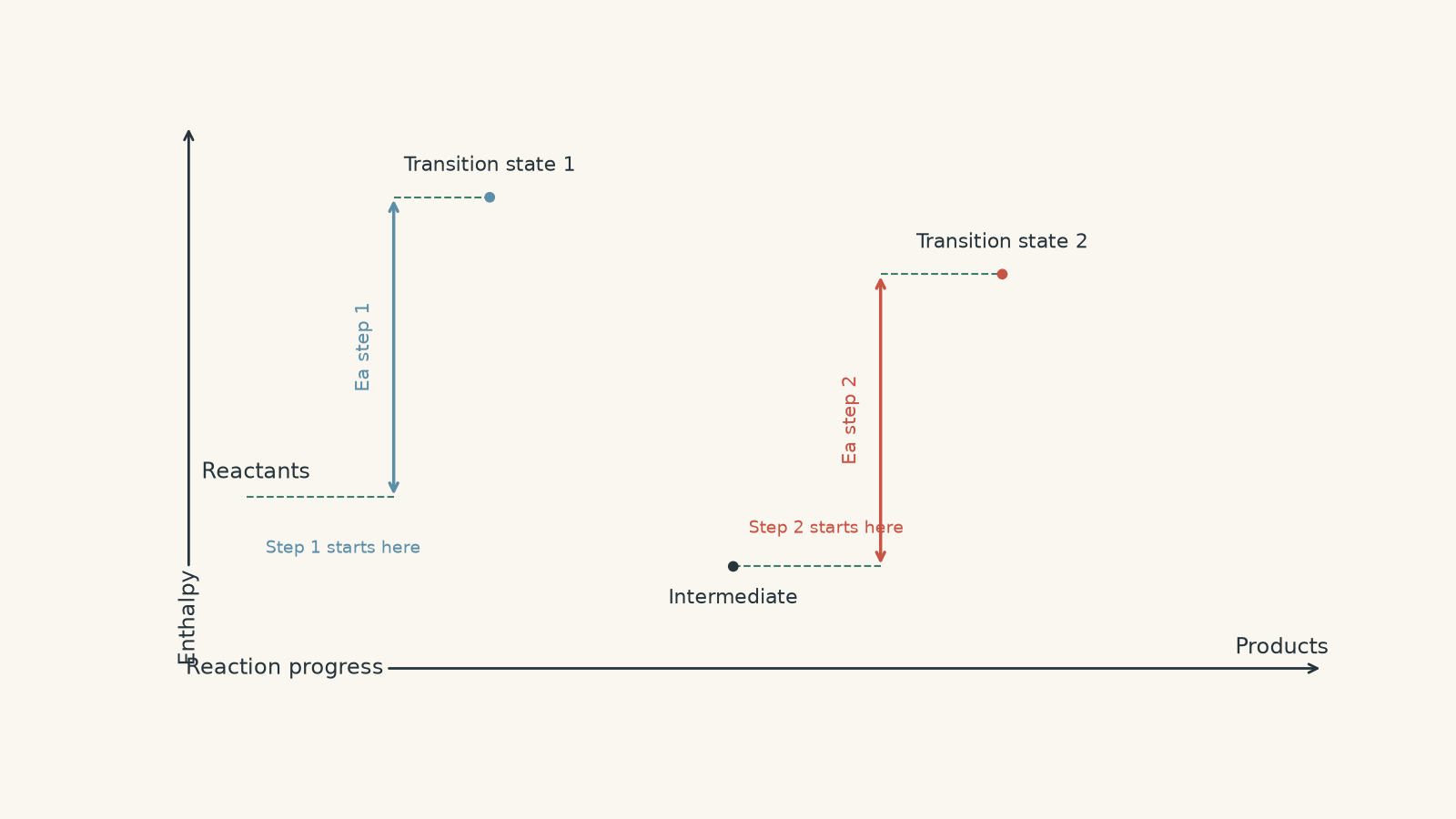
Here is the subtle part: the activation energy of a later step is measured from the intermediate immediately before it, not necessarily from the original reactants.
Suppose an intermediate sits at \(-30\ \mathrm{kJ\,mol^{-1}}\), and the next transition state is at \(+35\ \mathrm{kJ\,mol^{-1}}\).
That step requires
\[ E_a=35-(-30)=65\ \mathrm{kJ\,mol^{-1}} \]
even though the transition state is only \(35\ \mathrm{kJ\,mol^{-1}}\) above the original zero level.
So for a multistep mechanism, simply spotting the highest point on the page and subtracting the original reactant energy can hide important information about the individual steps.
At HSC level, the central idea remains the same: the catalyst supplies an alternative mechanism with lower kinetically important barriers while returning to its original state by the end.
07The four most tempting mistakes
| Tempting statement | What is wrong with it? |
|---|---|
| “The catalyst makes the reaction more exothermic.” | A catalyst does not change the reactant or product enthalpies, so \(\Delta H\) is unchanged. |
| “The catalyst gives particles extra kinetic energy.” | Temperature controls the kinetic-energy distribution. A catalyst lowers the energy requirement for a successful pathway. |
| “The lower curve must mean the products are lower.” | The relevant change is the height of the barrier. The product level stays fixed for the same reaction. |
| “A catalyst only lowers the forward activation energy.” | The alternative pathway can also be followed in reverse. A catalyst speeds both directions of a reversible reaction. |
One more trap is worth keeping in your head: a catalyst may be chemically involved during the mechanism. “Catalysts do not react” is too crude.
A catalyst can react temporarily.
The better statement is that a catalyst is regenerated overall.
That distinction becomes important in the final problem below.
08Questions and solutions
Question 1
A reaction has the following energy levels:
- reactants: \(40\ \mathrm{kJ\,mol^{-1}}\)
- products: \(10\ \mathrm{kJ\,mol^{-1}}\)
- uncatalysed transition state: \(120\ \mathrm{kJ\,mol^{-1}}\)
- catalysed transition state: \(75\ \mathrm{kJ\,mol^{-1}}\)
Calculate:
a. \(\Delta H\)
b. the uncatalysed forward activation energy
c. the catalysed forward activation energy
d. the catalysed reverse activation energy
State one quantity that the catalyst changes and one that it does not change.
Solution 1
The reaction has \(\Delta H=-30\ \mathrm{kJ\,mol^{-1}}\), an uncatalysed forward activation energy of \(80\ \mathrm{kJ\,mol^{-1}}\), a catalysed forward activation energy of \(35\ \mathrm{kJ\,mol^{-1}}\), and a catalysed reverse activation energy of \(65\ \mathrm{kJ\,mol^{-1}}\).
For the reaction enthalpy,
\[ \Delta H=H_P-H_R=10-40=-30\ \mathrm{kJ\,mol^{-1}} \]
For the uncatalysed forward reaction,
\[ E_{a,\mathrm{f,uncat}}=120-40=80\ \mathrm{kJ\,mol^{-1}} \]
For the catalysed forward reaction,
\[ E_{a,\mathrm{f,cat}}=75-40=35\ \mathrm{kJ\,mol^{-1}} \]
For the catalysed reverse reaction, the starting point is the products:
\[ E_{a,\mathrm{r,cat}}=75-10=65\ \mathrm{kJ\,mol^{-1}} \]
The catalyst changes the activation energy but does not change \(\Delta H\).
The tempting error is to calculate the reverse barrier from the reactant level again. Activation energy is always measured from the starting state for the direction being considered.
Question 2
For a reversible reaction, the uncatalysed activation energies are
\[ E_{a,\mathrm{f}}=148\ \mathrm{kJ\,mol^{-1}} \]
and
\[ E_{a,\mathrm{r}}=96\ \mathrm{kJ\,mol^{-1}} \]
A catalyst lowers the forward activation energy to \(88\ \mathrm{kJ\,mol^{-1}}\).
a. Calculate \(\Delta H\).
b. Assuming a simple single-transition-state energy profile, calculate the catalysed reverse activation energy.
c. A student argues that the very low reverse activation energy means the catalyst will shift equilibrium towards the reactants. Explain the error.
Solution 2
The reaction has \(\Delta H=+52\ \mathrm{kJ\,mol^{-1}}\), the catalysed reverse activation energy is \(36\ \mathrm{kJ\,mol^{-1}}\), and the catalyst does not shift the equilibrium position at constant temperature.
First,
\[ \begin{aligned} \Delta H &=E_{a,\mathrm{f}}-E_{a,\mathrm{r}}\\ &=148-96\\ &=+52\ \mathrm{kJ\,mol^{-1}} \end{aligned} \]
So the forward reaction is endothermic.
The catalyst lowers the forward barrier by
\[ 148-88=60\ \mathrm{kJ\,mol^{-1}} \]
For the same simple pathway, the reverse barrier must also fall by \(60\ \mathrm{kJ\,mol^{-1}}\):
\[ E_{a,\mathrm{r,cat}}=96-60=36\ \mathrm{kJ\,mol^{-1}} \]
We can check using
\[ \Delta H=E_{a,\mathrm{f}}-E_{a,\mathrm{r}} \]
so
\[ 52=88-E_{a,\mathrm{r,cat}} \]
which again gives
\[ E_{a,\mathrm{r,cat}}=36\ \mathrm{kJ\,mol^{-1}} \]
The tempting argument focuses only on the small reverse barrier. But the forward barrier has also been reduced.
More importantly, the catalyst has not altered the energies of the reactants or products. It therefore has not changed the thermodynamic equilibrium condition at that temperature. It changes how rapidly the system approaches equilibrium, not where that equilibrium lies.
Question 3
An uncatalysed reaction has the following simple energy profile:
- reactants: \(0\ \mathrm{kJ\,mol^{-1}}\)
- transition state: \(105\ \mathrm{kJ\,mol^{-1}}\)
- products: \(-25\ \mathrm{kJ\,mol^{-1}}\)
A catalysed mechanism instead follows this sequence:
- reactants: \(0\ \mathrm{kJ\,mol^{-1}}\)
- first transition state: \(50\ \mathrm{kJ\,mol^{-1}}\)
- intermediate: \(-30\ \mathrm{kJ\,mol^{-1}}\)
- second transition state: \(35\ \mathrm{kJ\,mol^{-1}}\)
- products: \(-25\ \mathrm{kJ\,mol^{-1}}\)
a. Calculate \(\Delta H\).
b. Calculate the forward activation energy of each catalysed step.
c. A student says, “The highest point on the catalysed curve is \(50\ \mathrm{kJ\,mol^{-1}}\), so every activation barrier in the catalysed mechanism must be at most \(50\ \mathrm{kJ\,mol^{-1}}\).” Explain why this is wrong.
d. Calculate the local activation barriers for the reverse direction of the two catalysed steps.
Solution 3
The overall reaction has \(\Delta H=-25\ \mathrm{kJ\,mol^{-1}}\); the two forward catalysed barriers are \(50\) and \(65\ \mathrm{kJ\,mol^{-1}}\), so the second step actually has the larger local barrier even though its transition state is lower on the page.
The overall enthalpy change is
\[ \Delta H=-25-0=-25\ \mathrm{kJ\,mol^{-1}} \]
For the first catalysed step,
\[ E_{a,1}=50-0=50\ \mathrm{kJ\,mol^{-1}} \]
For the second step, the starting state is the intermediate at \(-30\ \mathrm{kJ\,mol^{-1}}\):
\[ E_{a,2}=35-(-30)=65\ \mathrm{kJ\,mol^{-1}} \]
This is the important constraint the student’s argument misses. A transition state’s absolute height on the graph is not, by itself, the activation energy of every step involving it. Each elementary barrier is measured from the state immediately before that step.
For the reverse direction, the first reverse step begins at the products and climbs to the second transition state:
\[ E_{a,\mathrm{reverse\,step\,1}}=35-(-25)=60\ \mathrm{kJ\,mol^{-1}} \]
The next reverse step begins at the intermediate and climbs to the first transition state:
\[ E_{a,\mathrm{reverse\,step\,2}}=50-(-30)=80\ \mathrm{kJ\,mol^{-1}} \]
So the reverse local barriers are \(60\) and \(80\ \mathrm{kJ\,mol^{-1}}\).
The tempting route was to use the original reactant level as the reference for every peak. That works for a simple one-step profile, but not for calculating the barrier of each step in a multistep mechanism.
It would also be unsafe to claim that the entire multistep mechanism has one exact activation energy just by reading the highest absolute peak. Which step controls an observed rate depends on the mechanism and kinetics. The HSC-level conclusion you can safely make from the profile is that the catalyst has replaced the original single large barrier with a sequence of smaller local barriers.
Question 4
A reversible reaction \(\ce{A <=> B}\) has a catalysed simple energy profile with
\[ E_{a,\mathrm{f}}=60\ \mathrm{kJ\,mol^{-1}} \]
and
\[ E_{a,\mathrm{r}}=100\ \mathrm{kJ\,mol^{-1}} \]
Without the catalyst, the activation energies are
\[ E_{a,\mathrm{f}}=110\ \mathrm{kJ\,mol^{-1}} \]
and
\[ E_{a,\mathrm{r}}=150\ \mathrm{kJ\,mol^{-1}} \]
A closed system containing \(\ce{A}\), \(\ce{B}\), and the catalyst has already reached equilibrium at constant temperature.
The catalyst is then removed without changing the temperature or the amounts of \(\ce{A}\) and \(\ce{B}\). Later, some extra \(\ce{A}\) is added.
a. Immediately after the catalyst is removed, is there a net shift towards \(\ce{A}\), a net shift towards \(\ce{B}\), or no net shift?
b. After extra \(\ce{A}\) is added, what is the initial net direction of reaction?
c. For that new total composition, would the final equilibrium composition depend on whether the catalyst had remained in the vessel?
Explain using the energy-profile information rather than simply quoting a memorised rule.
Solution 4
Removing the catalyst from a system already at equilibrium causes no net shift; adding extra \(\ce{A}\) later produces an initial net reaction towards \(\ce{B}\); and the final equilibrium composition at the same temperature does not depend on whether the catalyst is present.
First notice that both energy profiles imply the same reaction enthalpy.
For the catalysed pathway,
\[ \Delta H=60-100=-40\ \mathrm{kJ\,mol^{-1}} \]
For the uncatalysed pathway,
\[ \Delta H=110-150=-40\ \mathrm{kJ\,mol^{-1}} \]
So removing the catalyst raises the kinetic barriers but changes neither the reactant-product energy difference nor the equilibrium thermodynamics.
Before removal, the system is already at equilibrium. The forward and reverse reactions are still occurring, but there is no net composition change.
Removing the catalyst makes both directions kinetically more difficult. It does not suddenly provide a thermodynamic preference for one side. Therefore there is no net shift immediately after removal.
The tempting prediction is that increasing the reverse activation energy from \(100\) to \(150\ \mathrm{kJ\,mol^{-1}}\) will push the system towards \(\ce{B}\). But the forward barrier simultaneously rises from \(60\) to \(110\ \mathrm{kJ\,mol^{-1}}\). The entire alternative pathway has been removed.
When extra \(\ce{A}\) is added, the system is no longer at its previous equilibrium composition. There is then a net forward tendency, so \(\ce{B}\) is formed until the new equilibrium state is reached.
Without the catalyst, that adjustment occurs more slowly. With the catalyst, it occurs more quickly.
The final equilibrium composition is the same in either case, provided temperature and the overall amounts of substances are otherwise the same. The catalyst controls the route and rate, not the equilibrium endpoint.
Question 5
A reaction
\[ \ce{A -> B} \]
has an enthalpy change of
\[ \Delta H=-48\ \mathrm{kJ\,mol^{-1}} \]
A substance \(\ce{C}\) is proposed as a catalyst.
During a rapid first stage, the observed process is
\[ \ce{A + C -> B + C^{*}} \]
and releases \(63\ \mathrm{kJ\,mol^{-1}}\).
The species \(\ce{C^{*}}\) is a modified form of the proposed catalyst. Converting it back to \(\ce{C}\) requires \(15\ \mathrm{kJ\,mol^{-1}}\):
\[ \ce{C^{*} -> C} \]
a. Calculate the enthalpy change for the complete sequence in which \(\ce{C}\) is regenerated.
b. A student claims that the catalyst has changed the reaction enthalpy from \(-48\) to \(-63\ \mathrm{kJ\,mol^{-1}}\). Explain precisely why that conclusion is wrong.
c. Suppose \(\ce{C^{*}}\) could not be converted back to \(\ce{C}\) under the reaction conditions. Could \(\ce{C}\) still be described as a catalyst for the completed process? Explain.
Solution 5
The complete sequence has \(\Delta H=-48\ \mathrm{kJ\,mol^{-1}}\); the apparent \(-63\ \mathrm{kJ\,mol^{-1}}\) belongs to a different final state, and if \(\ce{C^{*}}\) cannot regenerate to \(\ce{C}\), then \(\ce{C}\) has not acted as a catalyst over the completed process.
For the first stage,
\[ \Delta H_1=-63\ \mathrm{kJ\,mol^{-1}} \]
Regeneration requires energy:
\[ \Delta H_2=+15\ \mathrm{kJ\,mol^{-1}} \]
Adding the stages gives
\[ \begin{aligned} \Delta H_{\mathrm{overall}} &=\Delta H_1+\Delta H_2\\ &=-63+15\\ &=-48\ \mathrm{kJ\,mol^{-1}} \end{aligned} \]
That matches the enthalpy change for
\[ \ce{A -> B} \]
exactly.
The student’s mistake is subtle. They are comparing two processes with different endpoints.
The uncatalysed reaction compares \(\ce{A}\) with \(\ce{B}\).
The \(-63\ \mathrm{kJ\,mol^{-1}}\) stage compares \(\ce{A + C}\) with \(\ce{B + C^{*}}\).
Those are not the same initial and final states because \(\ce{C^{*}}\) is not yet the original catalyst \(\ce{C}\).
Once the regeneration step is included, \(\ce{C}\) appears on both sides of the complete sequence and cancels:
\[ \begin{aligned} \ce{A + C &-> B + C^{*}}\\ \ce{C^{*} &-> C} \end{aligned} \]
giving the net reaction
\[ \ce{A -> B} \]
with
\[ \Delta H=-48\ \mathrm{kJ\,mol^{-1}} \]
If \(\ce{C^{*}}\) cannot return to \(\ce{C}\), then \(\ce{C}\) is being converted into another species rather than being regenerated. Calling it a catalyst for the complete process would therefore be incorrect.
This is the deeper reason the statement “a catalyst does not change \(\Delta H\)” works. It is not a mysterious special rule about catalysts. Enthalpy is a state function. Once the genuine catalyst has completed its cycle and returned to its original state, the initial and final chemical states of the overall reaction are unchanged.
09What this idea lets you do next
An energy profile separates two questions that are easy to mix up:
- Is the reaction energetically favourable in terms of its starting and finishing states?
- How difficult is the pathway between those states?
\(\Delta H\) helps describe the first question. Activation energy helps with the second.
A catalyst changes the second without changing the first.
That distinction becomes especially useful when you move into reversible reactions and equilibrium. A reaction can have a thermodynamically preferred direction and still be extremely slow because its activation barrier is large. A catalyst can make equilibrium arrive much sooner without changing where that equilibrium lies.
It also prepares you for reaction mechanisms. Once an energy profile develops several peaks and intermediates, the useful question is no longer just “How high is the curve?” but “What state does each step begin from, what barrier must that step cross, and is the catalyst returned at the end?”