
Mass Changes from Stoichiometric Equations: HSC Chemistry
Learn how to calculate reactant and product masses from balanced chemical equations using moles, molar mass, and mole ratios. Includes worked examples and progressively harder HSC-style practice.
A balanced equation might say
\[ \ce{2Mg + O2 -> 2MgO} \]
and you might be tempted to read it as “2 grams of magnesium reacts with 1 gram of oxygen”. That would make the arithmetic easy. It would also be wrong.
Before reading on, predict this: if 24.3 g of magnesium reacts completely, will it form less than 24.3 g, exactly 24.3 g, or more than 24.3 g of magnesium oxide?
It forms more than 24.3 g. The magnesium atoms have not disappeared. Oxygen atoms have joined them, so the product contains the mass of both elements.
The balanced equation tells us exactly how much oxygen joins the magnesium, but there is one important catch: chemical equations compare particles and moles, not grams.
That idea is the key to every mass-to-mass stoichiometry problem.
01The basic problem: equations speak in moles, questions often speak in grams
Suppose a question tells you the mass of one substance and asks for the mass of another substance in the same reaction.
You cannot usually jump directly from one mass to the other.
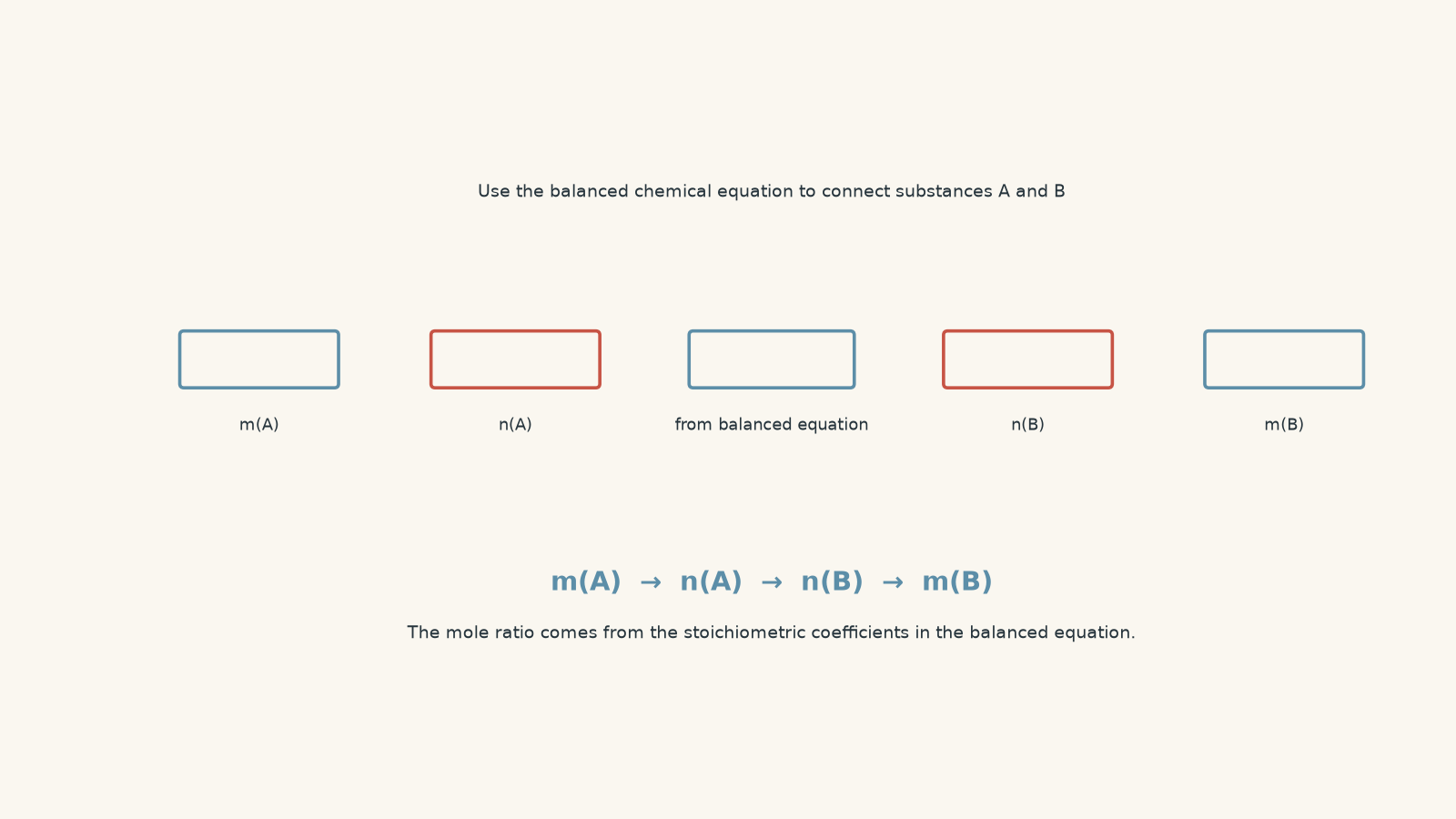
Instead, use this pathway:
\[ \text{mass} \rightarrow \text{moles} \rightarrow \text{moles} \rightarrow \text{mass} \]
The middle step comes from the balanced chemical equation.
A useful way to picture this is as changing trains. Grams are one train line, while the balanced equation runs on the mole line. You have to change from grams to moles before the equation can take you anywhere useful. Then you change back to grams at the end.
The analogy has a limit. Moles are not just a convenient mathematical station. A mole represents a definite number of particles, \(6.022 \times 10^{23}\). The equation works in moles because its coefficients describe ratios between numbers of particles.
02Refresh: converting between mass and moles
The equation you need is
\[ n = \frac{m}{M} \]
where:
- \(n\) is the amount of substance in moles, measured in mol
- \(m\) is the mass, measured in g
- \(M\) is the molar mass, measured in g mol\(^{-1}\)
Rearranging gives
\[ m = nM \]
Molar mass tells you the mass of one mole of a substance.
For example, magnesium has a molar mass of approximately \(24.3\text{ g mol}^{-1}\). So:
\[ 24.3\text{ g Mg} = 1.00\text{ mol Mg} \]
For a compound, add the atomic masses of all atoms in its formula.
For magnesium oxide, \(\ce{MgO}\):
\[ M(\ce{MgO}) = 24.3 + 16.0 = 40.3\text{ g mol}^{-1} \]
03What the coefficients actually mean
Return to:
\[ \ce{2Mg + O2 -> 2MgO} \]
The coefficients give the ratio
\[ 2\text{ mol Mg} : 1\text{ mol }\ce{O2} : 2\text{ mol MgO} \]
You can simplify part of that relationship:
\[ 1\text{ mol Mg} : 1\text{ mol MgO} \]
So if 1.00 mol of magnesium reacts completely, it produces 1.00 mol of magnesium oxide.
But look at the masses:
\[ 1.00\text{ mol Mg} = 24.3\text{ g} \]
while
\[ 1.00\text{ mol MgO} = 40.3\text{ g} \]
The mole ratio is \(1:1\), but the mass ratio is not \(1:1\).
That is why coefficients should not be treated as mass ratios.
Worked example: What mass of magnesium oxide forms?
24.3 g of magnesium reacts completely with excess oxygen according to
\[ \ce{2Mg + O2 -> 2MgO} \]
Calculate the mass of magnesium oxide produced.
Step 1
The molar mass of magnesium is \(24.3\text{ g mol}^{-1}\).
\[ n(\ce{Mg}) = \frac{m}{M} = \frac{24.3\text{ g}}{24.3\text{ g mol}^{-1}} = 1.00\text{ mol} \]
Step 2
From
\[ \ce{2Mg + O2 -> 2MgO} \]
the mole ratio is
\[ 2\text{ mol Mg} : 2\text{ mol MgO} \]
so
\[ n(\ce{MgO}) = 1.00\text{ mol} \]
Step 3
\[ M(\ce{MgO}) = 24.3 + 16.0 = 40.3\text{ g mol}^{-1} \]
Therefore,
\[ m(\ce{MgO}) = nM = (1.00\text{ mol})(40.3\text{ g mol}^{-1}) = 40.3\text{ g} \]
So 40.3 g of magnesium oxide forms.
This also resolves our opening prediction. The product has a greater mass than the starting magnesium because oxygen has become part of the solid product.
04A reliable mass-to-mass method
For most HSC mass stoichiometry problems, use the same four moves:
- Write or check the balanced equation.
- Convert the given mass to moles.
- Use the coefficient ratio to find moles of the required substance.
- Convert those moles to the required mass.
The important part is not memorising four boxes. It is knowing why the mole conversion sits in the middle.
The equation relates particles. Moles count particles. Grams do not.
05The mole-ratio step is where many errors happen
Consider:
\[ \ce{2KClO3 -> 2KCl + 3O2} \]
Suppose you have found that \(0.40\) mol of \(\ce{KClO3}\) decomposes.
How many moles of \(\ce{O2}\) form?
A common mistake is to copy the \(0.40\) mol straight across. But the equation does not give a \(1:1\) relationship.
The coefficients say
\[ 2\text{ mol }\ce{KClO3} : 3\text{ mol }\ce{O2} \]
so
\[ n(\ce{O2}) = 0.40 \times \frac{3}{2} = 0.60\text{ mol} \]
A useful habit is to write the conversion factor with the substance you want on top:
\[ 0.40\text{ mol }\ce{KClO3} \times \frac{3\text{ mol }\ce{O2}}{2\text{ mol }\ce{KClO3}} \]
The \(\ce{KClO3}\) units conceptually cancel, leaving moles of \(\ce{O2}\).
06Worked example: Mass lost when calcium carbonate decomposes
Calcium carbonate decomposes when heated:
\[ \ce{CaCO3 -> CaO + CO2} \]
A sample contains 25.0 g of pure calcium carbonate and is heated until decomposition is complete. Calculate the mass of carbon dioxide released and the mass of calcium oxide remaining.
Step 1
Using approximate atomic masses \(\ce{Ca} = 40.1\), \(\ce{C} = 12.0\), and \(\ce{O} = 16.0\):
\[ M(\ce{CaCO3}) = 40.1 + 12.0 + 3(16.0) = 100.1\text{ g mol}^{-1} \]
Step 2
\[ n(\ce{CaCO3}) = \frac{25.0\text{ g}}{100.1\text{ g mol}^{-1}} = 0.2498\text{ mol} \]
Step 3
The equation
\[ \ce{CaCO3 -> CaO + CO2} \]
has a mole ratio of
\[ 1:1:1 \]
Therefore:
\[ n(\ce{CO2}) = 0.2498\text{ mol} \]
and
\[ n(\ce{CaO}) = 0.2498\text{ mol} \]
Step 4
\[ M(\ce{CO2}) = 12.0 + 2(16.0) = 44.0\text{ g mol}^{-1} \]
\[ m(\ce{CO2}) = (0.2498\text{ mol})(44.0\text{ g mol}^{-1}) = 10.99\text{ g} \]
So the mass of carbon dioxide released is approximately
\[ \boxed{11.0\text{ g}} \]
Step 5
\[ M(\ce{CaO}) = 40.1 + 16.0 = 56.1\text{ g mol}^{-1} \]
\[ m(\ce{CaO}) = (0.2498\text{ mol})(56.1\text{ g mol}^{-1}) = 14.02\text{ g} \]
So approximately
\[ \boxed{14.0\text{ g}} \]
of calcium oxide remains.
Notice something useful:
\[ 14.0\text{ g} + 11.0\text{ g} = 25.0\text{ g} \]
Mass has been conserved.
If you measured only the solid on a balance after heating, however, its mass would appear to have fallen from 25.0 g to about 14.0 g because the carbon dioxide escaped into the surroundings.
That distinction matters whenever a reaction involves gases.
07Does mass actually disappear during a reaction?
Imagine heating calcium carbonate in an open crucible. The solid becomes lighter.
It is tempting to say, “mass was lost during the reaction”.
More precisely, mass left the measured system as carbon dioxide gas.
For the complete chemical system:
\[ \text{total mass of reactants} = \text{total mass of products} \]
provided you account for every substance.
This is the law of conservation of mass.
The apparent contradiction comes from choosing different system boundaries. If your “system” is just the material sitting inside the crucible at the end, escaping gas is no longer included in the measurement.
In a sealed container, the total measured mass before and after the reaction should remain the same, assuming nothing enters or leaves.
08The most tempting misconception: coefficients are not masses
Take this equation:
\[ \ce{2H2 + O2 -> 2H2O} \]
The coefficients are \(2:1:2\).
Does that mean:
\[ 2\text{ g }\ce{H2} + 1\text{ g }\ce{O2} \rightarrow 2\text{ g }\ce{H2O}? \]
No.
Convert the coefficients to mole quantities first.
Two moles of hydrogen gas have mass
\[ 2(2.0) = 4.0\text{ g} \]
One mole of oxygen gas has mass
\[ 1(32.0) = 32.0\text{ g} \]
Two moles of water have mass
\[ 2(18.0) = 36.0\text{ g} \]
So the mass relationship is approximately
\[ 4.0\text{ g }\ce{H2} + 32.0\text{ g }\ce{O2} \rightarrow 36.0\text{ g }\ce{H2O} \]
Now conservation of mass is visible:
\[ 4.0 + 32.0 = 36.0 \]
The equation coefficients tell you how many moles react, while molar masses tell you how heavy those moles are.
09When the simple method needs one extra question
So far, each example has either supplied one reactant or stated that another reactant is in excess.
But suppose a question gives you the masses of two reactants.
You cannot automatically choose either one and run the calculation.
First ask:
Which reactant runs out first?
That substance is the limiting reactant. Once it is completely consumed, the reaction stops. Any other reactant left over is in excess.
For example:
\[ \ce{2H2 + O2 -> 2H2O} \]
Suppose a container has 2.0 mol of \(\ce{H2}\) and 2.0 mol of \(\ce{O2}\).
Which runs out first?
The equation requires only 1.0 mol of \(\ce{O2}\) for every 2.0 mol of \(\ce{H2}\). Therefore, the 2.0 mol of hydrogen reacts with 1.0 mol of oxygen. Hydrogen is used up, while 1.0 mol of oxygen remains.
So the largest possible amount of product must be calculated from the hydrogen, not from all the oxygen available.
This becomes important when mass-to-mass stoichiometry develops into limiting-reagent and theoretical-yield calculations.
10A quick way to check whether your answer makes sense
A calculator can produce a beautifully formatted wrong answer, so do a physical check.
Ask:
- Is the equation balanced?
- Did I convert mass to moles before using coefficients?
- Did I use the coefficient ratio in the correct direction?
- Did I use the molar mass of the correct substance?
- If a product gained atoms from another reactant, should its mass be greater than the mass of my starting sample?
- If a gas escaped, have I distinguished the mass of the remaining material from the mass of the whole system?
- If two reactant quantities were supplied, did I check which reactant limits the reaction?
Those checks catch most mass-stoichiometry errors before they cost you several marks.
11Questions and solutions
Question 1
Iron reacts with sulfur according to:
\[ \ce{Fe + S -> FeS} \]
Calculate the mass of iron sulfide formed when 5.60 g of iron reacts completely with excess sulfur.
Use \(M(\ce{Fe}) = 55.8\text{ g mol}^{-1}\) and \(M(\ce{FeS}) = 87.9\text{ g mol}^{-1}\).
Solution 1
The mass of iron sulfide formed is 8.82 g.
The balanced equation gives a \(1:1\) mole ratio between \(\ce{Fe}\) and \(\ce{FeS}\).
First convert iron to moles:
\[ n(\ce{Fe}) = \frac{5.60\text{ g}}{55.8\text{ g mol}^{-1}} = 0.1004\text{ mol} \]
Therefore:
\[ n(\ce{FeS}) = 0.1004\text{ mol} \]
Now convert the iron sulfide to mass:
\[ m(\ce{FeS}) = (0.1004\text{ mol})(87.9\text{ g mol}^{-1}) = 8.82\text{ g} \]
The product is heavier than the original iron because sulfur has joined the iron atoms.
Question 2
Hydrogen peroxide decomposes according to:
\[ \ce{2H2O2 -> 2H2O + O2} \]
A sample containing 13.6 g of pure hydrogen peroxide decomposes completely. Calculate the mass of oxygen gas produced.
Use \(M(\ce{H2O2}) = 34.0\text{ g mol}^{-1}\) and \(M(\ce{O2}) = 32.0\text{ g mol}^{-1}\).
Solution 2
The reaction produces 6.40 g of oxygen gas.
First find the amount of hydrogen peroxide:
\[ n(\ce{H2O2}) = \frac{13.6\text{ g}}{34.0\text{ g mol}^{-1}} = 0.400\text{ mol} \]
The balanced equation gives:
\[ 2\text{ mol }\ce{H2O2} : 1\text{ mol }\ce{O2} \]
Therefore:
\[ n(\ce{O2}) = 0.400\text{ mol} \times \frac{1}{2} = 0.200\text{ mol} \]
Now convert to mass:
\[ m(\ce{O2}) = (0.200\text{ mol})(32.0\text{ g mol}^{-1}) = 6.40\text{ g} \]
The trap is treating the reaction as \(1:1\). The coefficients show that two moles of hydrogen peroxide are required for every one mole of oxygen produced.
Question 3
Aluminium reacts with oxygen according to:
\[ \ce{4Al + 3O2 -> 2Al2O3} \]
A 10.8 g sample of aluminium reacts completely with excess oxygen.
Calculate:
a. the amount of aluminium used, in moles
b. the amount of aluminium oxide formed, in moles
c. the mass of aluminium oxide produced
Use \(M(\ce{Al}) = 27.0\text{ g mol}^{-1}\) and \(M(\ce{Al2O3}) = 102.0\text{ g mol}^{-1}\).
Solution 3
The sample contains 0.400 mol of aluminium, produces 0.200 mol of aluminium oxide, and forms 20.4 g of \(\ce{Al2O3}\).
For part a:
\[ n(\ce{Al}) = \frac{10.8\text{ g}}{27.0\text{ g mol}^{-1}} = 0.400\text{ mol} \]
For part b, the equation gives:
\[ 4\text{ mol Al} : 2\text{ mol }\ce{Al2O3} \]
Therefore:
\[ n(\ce{Al2O3}) = 0.400 \times \frac{2}{4} = 0.200\text{ mol} \]
For part c:
\[ m(\ce{Al2O3}) = (0.200\text{ mol})(102.0\text{ g mol}^{-1}) = 20.4\text{ g} \]
The product has almost twice the mass of the original aluminium because oxygen from the surrounding supply has been incorporated into the aluminium oxide.
Question 4
Copper(II) carbonate decomposes on heating:
\[ \ce{CuCO3 -> CuO + CO2} \]
A student heats 12.4 g of pure \(\ce{CuCO3}\) in an open container until the reaction is complete.
Use:
\[ M(\ce{CuCO3}) = 123.5\text{ g mol}^{-1} \]
\[ M(\ce{CuO}) = 79.5\text{ g mol}^{-1} \]
The student says:
“The law of conservation of mass must have failed because the material left in the container weighs less than 12.4 g.”
Calculate the expected mass remaining in the container and explain whether the student’s conclusion is correct.
Solution 4
Approximately 7.98 g of solid remains, and the student’s conclusion is incorrect because the missing measured mass has left the open container as carbon dioxide gas.
First calculate the amount of copper(II) carbonate:
\[ n(\ce{CuCO3}) = \frac{12.4\text{ g}}{123.5\text{ g mol}^{-1}} = 0.1004\text{ mol} \]
The balanced equation gives a \(1:1\) ratio between \(\ce{CuCO3}\) and \(\ce{CuO}\), so:
\[ n(\ce{CuO}) = 0.1004\text{ mol} \]
The mass of copper(II) oxide is:
\[ m(\ce{CuO}) = (0.1004\text{ mol})(79.5\text{ g mol}^{-1}) = 7.98\text{ g} \]
So the apparent mass decrease is:
\[ 12.4 - 7.98 = 4.42\text{ g} \]
That mass has not been destroyed. It is associated with the \(\ce{CO2}\) that escaped from the open container.
The student’s mistake is treating “the solid remaining on the balance” as though it were the entire reacting system. Conservation of mass applies when all reactants and products are included.
Question 5
Methane burns according to:
\[ \ce{CH4 + 2O2 -> CO2 + 2H2O} \]
A student has 8.00 g of methane and 24.0 g of oxygen gas.
The student calculates the mass of carbon dioxide from the methane alone and claims that all 8.00 g of methane will react.
Determine whether this is valid and calculate the mass of carbon dioxide that can actually form.
Use \(M(\ce{CH4}) = 16.0\text{ g mol}^{-1}\), \(M(\ce{O2}) = 32.0\text{ g mol}^{-1}\), and \(M(\ce{CO2}) = 44.0\text{ g mol}^{-1}\).
Solution 5
The student’s method is not valid. Oxygen is the limiting reactant, so only 16.5 g of carbon dioxide can form.
First calculate the amount of each reactant.
For methane:
\[ n(\ce{CH4}) = \frac{8.00\text{ g}}{16.0\text{ g mol}^{-1}} = 0.500\text{ mol} \]
For oxygen:
\[ n(\ce{O2}) = \frac{24.0\text{ g}}{32.0\text{ g mol}^{-1}} = 0.750\text{ mol} \]
The equation requires:
\[ 1\text{ mol }\ce{CH4} : 2\text{ mol }\ce{O2} \]
To react all \(0.500\) mol of methane would require:
\[ 0.500 \times 2 = 1.00\text{ mol }\ce{O2} \]
Only \(0.750\) mol of oxygen is available, so oxygen runs out first.
Use the limiting reactant to calculate product.
From the balanced equation:
\[ 2\text{ mol }\ce{O2} : 1\text{ mol }\ce{CO2} \]
Therefore:
\[ n(\ce{CO2}) = 0.750 \times \frac{1}{2} = 0.375\text{ mol} \]
Then:
\[ m(\ce{CO2}) = (0.375\text{ mol})(44.0\text{ g mol}^{-1}) = 16.5\text{ g} \]
The trap is assuming that a supplied reactant mass must be completely consumed. When quantities of multiple reactants are given, you need to determine which one limits the reaction before calculating the product mass.
Question 6
A metal \(X\) forms an oxide according to:
\[ \ce{4X + 3O2 -> 2X2O3} \]
A 5.40 g sample of \(X\) reacts completely with oxygen and produces 10.20 g of \(\ce{X2O3}\).
Without being given the molar mass of \(X\), determine the approximate molar mass of the metal.
Solution 6
The molar mass of the metal is approximately \(27.0\text{ g mol}^{-1}\).
The product gained mass because oxygen was added to the original metal.
The mass of oxygen incorporated is:
\[ m(\ce{O2}) = 10.20 - 5.40 = 4.80\text{ g} \]
Convert this oxygen to moles:
\[ n(\ce{O2}) = \frac{4.80\text{ g}}{32.0\text{ g mol}^{-1}} = 0.150\text{ mol} \]
From the equation:
\[ \ce{4X + 3O2 -> 2X2O3} \]
the mole ratio is:
\[ 3\text{ mol }\ce{O2} : 4\text{ mol }X \]
Therefore:
\[ n(X) = 0.150 \times \frac{4}{3} = 0.200\text{ mol} \]
The 5.40 g metal sample therefore contains \(0.200\) mol.
Using
\[ M = \frac{m}{n} \]
gives:
\[ M(X) = \frac{5.40\text{ g}}{0.200\text{ mol}} = 27.0\text{ g mol}^{-1} \]
The harder step here is noticing that the increase in mass tells you how much oxygen reacted. Once that is recognised, the same stoichiometric logic works in reverse.
12What this method unlocks next
Mass-to-mass stoichiometry is really a mole-ratio problem with mass conversions attached to both ends.
Once that structure is clear,
\[ \text{mass} \rightarrow \text{moles} \rightarrow \text{mole ratio} \rightarrow \text{moles} \rightarrow \text{mass} \]
you can extend the same reasoning to harder HSC problems involving limiting reactants, theoretical yield, percentage yield, solution concentrations, gas volumes, and experimental analysis.
The calculation format changes slightly in each case. The central idea does not: the balanced equation tells you how amounts of substances are connected, and moles are the bridge that lets you use that relationship.