
Bonding and Physical Properties: HSC Chemistry Guide
Learn how structure and bonding explain melting point, boiling point, conductivity, hardness, brittleness, and solubility in HSC Chemistry.
Diamond and graphite are both made entirely from carbon atoms. Yet diamond is extremely hard and does not conduct electricity, while graphite is soft enough to leave a mark on paper and conducts electricity.
Predict this before reading on: if the atoms are identical, what must be different?
It cannot be the element itself. The difference is how the atoms are arranged and bonded. That is the central idea of this topic. A chemical formula tells you what particles are present. Structure and bonding tell you how those particles behave.
Once you can look at a structure and ask, “What has to move, separate, or break for this property to occur?”, melting point, boiling point, conductivity, hardness, brittleness, and solubility become much easier to predict.
01The two questions behind almost every property
Before worrying about individual properties, ask two questions:
- What particles make up the substance, and how are they held together?
- What has to move or separate for the property I am explaining?
The first question identifies the structure. The second stops you from making one of the most common mistakes in bonding questions: talking about the strongest bond in a substance even when that bond is not the one involved in the process.
For example, water contains strong covalent bonds between oxygen and hydrogen. But when water boils, those covalent bonds do not normally break. The water molecules separate from one another while remaining \(\ce{H2O}\) molecules.
That difference is crucial.
Four structures you need to recognise
For most HSC bonding questions, you can organise substances into four broad structural types.
| Structure | What the substance contains | Main attraction holding the structure together | Typical physical behaviour |
|---|---|---|---|
| Simple molecular | Separate molecules | Intermolecular forces between molecules | Usually relatively low melting and boiling points, often soft, usually poor electrical conductors |
| Ionic lattice | Positive and negative ions in a repeating lattice | Electrostatic attraction between oppositely charged ions | Usually high melting point, hard and brittle, conducts when molten or when mobile ions are present in solution |
| Metallic lattice | Positive metal ion cores surrounded by delocalised electrons | Attraction between positive ion cores and delocalised electrons | Conductive, usually malleable and ductile, often moderate to high melting points |
| Covalent network | Atoms joined into a continuous network | Covalent bonds throughout the structure | Usually very high melting points, often very hard, generally poor conductors, with important exceptions such as graphite |
A lattice is a regular repeating arrangement of particles extending through a solid.
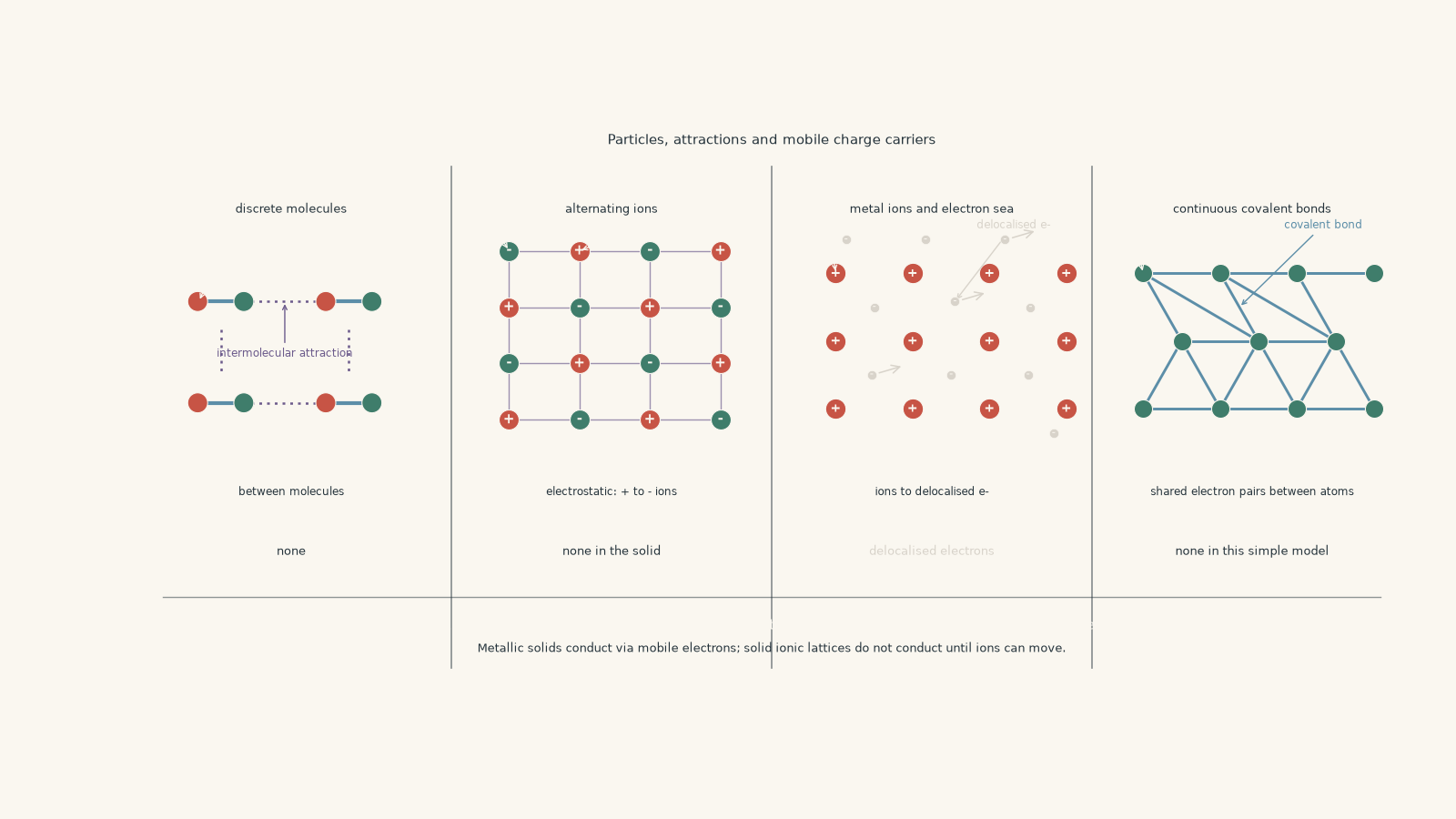
These categories are useful, but they are not magic labels. Two substances in the same category can still have very different properties. Once you have identified the structural type, you need to compare the strength of the relevant attractions.
02Melting and boiling: what actually has to separate?
Imagine a molecular solid as a crowded party full of couples. Each couple represents one molecule. The atoms inside a molecule are the two people holding onto each other. The attractions between neighbouring molecules are the weaker interactions between different couples.
Melting the substance is more like getting everyone to stop standing in fixed positions. Boiling requires the molecules to move far apart. You usually do not need every couple to break up.
That is the useful part of the analogy. It breaks down because intermolecular forces are electrostatic interactions, not social preferences, and real molecules are in constant motion.
Molecular substances
In a simple molecular substance, the covalent bonds inside each molecule are usually much stronger than the intermolecular forces between molecules.
During melting or boiling:
- molecules gain kinetic energy
- intermolecular attractions are overcome
- the molecules move more freely or separate
- the covalent bonds within each molecule generally remain intact
So the melting and boiling points of molecular substances depend mainly on the strength of their intermolecular forces, not on the strength of their covalent bonds.
This gives you an important rule:
For a molecular substance, ask how strongly one molecule attracts another.
The main intermolecular forces considered in HSC Chemistry include dispersion forces, dipole-dipole interactions, and hydrogen bonding.
Dispersion forces occur between all atoms and molecules. They generally become stronger as the electron cloud becomes larger and more easily distorted.
Dipole-dipole interactions occur between polar molecules.
Hydrogen bonding is a particularly strong intermolecular attraction that occurs when hydrogen is bonded to highly electronegative atoms such as nitrogen, oxygen, or fluorine, and is attracted to an appropriate lone pair on a nearby molecule.
Worked example: Which molecular substance boils more easily?
Consider \(\ce{H2O}\) and \(\ce{H2S}\). Both are small covalent molecules. Which should have the higher boiling point, and why?
Step 1
Boiling separates molecules from one another. We therefore compare intermolecular forces, rather than the covalent bonds inside each molecule.
Step 2
Both substances have dispersion forces. Both molecules are polar, so dipole-dipole attractions also occur.
However, \(\ce{H2O}\) can form strong hydrogen bonds between its molecules because hydrogen is directly bonded to oxygen.
\(\ce{H2S}\) does not form comparably strong hydrogen bonding under the usual HSC model.
Step 3
More energy is required to separate \(\ce{H2O}\) molecules because their intermolecular attractions are stronger.
Therefore, water has the higher boiling point.
The important explanation is not simply “water has hydrogen bonding”. It is that hydrogen bonding makes the intermolecular attraction stronger, so more thermal energy is required to separate the molecules into the gas phase.
03Why ionic substances tend to have high melting points
An ionic solid does not contain neat little \(\ce{NaCl}\) molecules sitting next to one another. It contains a giant three-dimensional arrangement of positive and negative ions.
In sodium chloride, for example, \(\mathrm{Na}^{+}\) ions are surrounded by \(\mathrm{Cl}^{-}\) ions, and vice versa.
Opposite charges attract. To melt the crystal, enough of these strong electrostatic attractions must be overcome for ions to move out of their fixed lattice positions.
That usually requires much more energy than separating molecules held together only by intermolecular forces.
Not all ionic compounds have the same melting point
Calling something “ionic” is only the first layer of the explanation.
Electrostatic attraction becomes stronger when:
- the ionic charges are larger
- the distance between oppositely charged ions is smaller
You do not need advanced electrostatics to use this idea. A \(2+\) ion attracts a \(2-\) ion more strongly than a \(1+\) ion attracts a \(1-\) ion, all else being comparable. Smaller ions can also approach each other more closely.
Worked example: Why does magnesium oxide melt at a higher temperature than sodium chloride?
Both \(\ce{MgO}\) and \(\ce{NaCl}\) form ionic lattices. Explain why \(\ce{MgO}\) has the stronger lattice attractions and therefore the higher melting point.
Step 1
Melting requires ions to move away from their fixed lattice positions. We therefore compare the electrostatic attractions between ions.
Step 2
In \(\ce{NaCl}\), the ions are \(\mathrm{Na}^{+}\) and \(\mathrm{Cl}^{-}\).
In \(\ce{MgO}\), the ions are \(\mathrm{Mg}^{2+}\) and \(\mathrm{O}^{2-}\).
The charges in magnesium oxide have greater magnitude.
Step 3
\(\mathrm{Mg}^{2+}\) and \(\mathrm{O}^{2-}\) are also relatively small ions, allowing opposite charges to be held close together.
Step 4
The stronger electrostatic attractions in the \(\ce{MgO}\) lattice require more energy to overcome.
Therefore, \(\ce{MgO}\) has a higher melting point than \(\ce{NaCl}\).
Notice the reasoning chain:
larger ionic charges and short ion separation -> stronger electrostatic attraction -> more energy needed to disrupt the lattice -> higher melting point
That chain is much stronger than writing only “MgO has stronger ionic bonds”.
04Covalent networks: when melting really does require breaking covalent bonds
Now compare a molecular substance with diamond.
Diamond does not consist of individual carbon molecules. Each carbon atom is covalently bonded to other carbon atoms in a continuous three-dimensional network.
There is no weak intermolecular layer that can simply be overcome while leaving separate molecules intact.
To seriously disrupt the structure, many strong covalent bonds must be broken.
That is why giant covalent structures generally have very high melting points.
Silicon dioxide, \(\ce{SiO2}\), is another important example. Although its formula may look as though it describes a tiny three-atom molecule, solid silicon dioxide forms an extended covalent network.
The formula \(\ce{SiO2}\) tells you the ratio of silicon atoms to oxygen atoms. It does not mean the solid consists of independent \(\ce{SiO2}\) molecules.
05Melting point is not a direct measurement of “bond strength”
A tempting prediction is:
Strong covalent bonds mean a high melting point.
Sometimes that produces the right answer. Often it does not.
Methane, \(\ce{CH4}\), contains strong covalent carbon-hydrogen bonds, but it has a very low melting and boiling point. Why? Because melting or boiling methane does not require those carbon-hydrogen bonds to break. Only the much weaker attractions between methane molecules must be overcome.
Diamond is different. Its covalent bonds connect the entire crystal. Disrupting the structure means disrupting covalent bonds.
So the better question is never just:
“How strong are the bonds?”
Ask:
“Which attractions must actually be overcome during this process?”
06Strength, hardness, and brittleness are different ideas
Words such as strong, hard, and brittle are easy to blur together.
They describe different behaviour.
Hardness is resistance to scratching or indentation.
Strength broadly describes resistance to deformation or failure under a particular type of force.
Brittleness means the material tends to fracture rather than deform substantially.
Malleability means a material can be shaped into sheets.
Ductility means it can be drawn into wires.
A material can therefore be hard and brittle at the same time.
Why ionic solids are hard but brittle
In an ionic crystal, oppositely charged ions strongly attract one another. This creates a rigid lattice, which helps make many ionic solids hard.
Now imagine applying enough force to shift one layer of ions relative to another.
Before the shift, positive ions sit near negative ions.
After a particular shift, positive ions may become aligned with other positive ions, while negative ions become aligned with negative ions.
Like charges repel.
This strong repulsion can split the lattice along a plane.
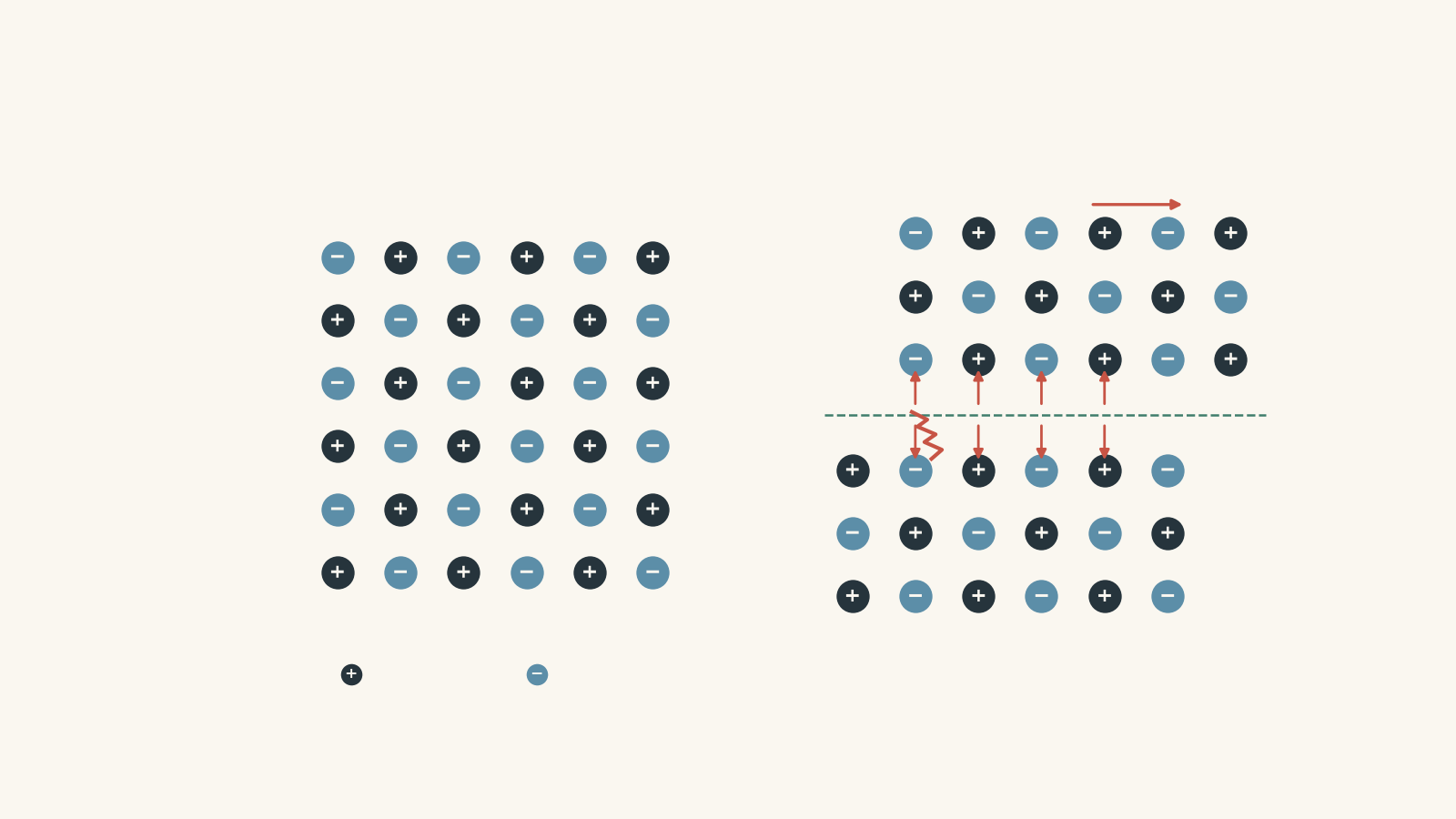
So an ionic solid is not brittle because ionic attraction is weak. Quite the opposite. The crystal fractures because shifting the rigid arrangement can suddenly produce powerful repulsions between like charges.
07Why metals can bend instead of shattering
The standard metallic bonding model contains positive metal ion cores surrounded by delocalised electrons.
A delocalised electron is not confined to a single bond between two particular atoms. It can move through the metallic structure.
The electrostatic attraction between the positive ion cores and the delocalised electrons holds the metal together.
Now push one layer of metal atoms relative to another.
Unlike an ionic lattice, this shift does not necessarily place two fixed arrays of equal charges directly against each other with no way to maintain attraction. The delocalised electrons can continue attracting the positive metal ion cores after the layers move.
This helps explain why many metals are malleable and ductile rather than brittle.
The school model is useful, but remember that real metallic bonding is described more precisely using quantum models of electronic structure. For HSC property explanations, the delocalised-electron model gives the key physical reasoning.
08Electrical conductivity: stop looking for “bonds”
For conductivity, change the question completely.
Do not begin with:
“Are the bonds strong?”
Ask:
“Are there charged particles that can move through the substance?”
Electrical current requires mobile charge carriers.
That could mean:
- mobile electrons
- mobile positive or negative ions
A substance can contain charged particles and still fail to conduct if those particles cannot move.
Metals
Metals conduct electricity in the solid and liquid states because they contain mobile delocalised electrons.
The positive ion cores do not have to travel through the wire. The mobile electrons carry charge through the metallic structure.
Ionic solids
Here is a very common mistake:
Ionic substances conduct electricity because they contain ions.
That statement is incomplete.
A solid piece of sodium chloride certainly contains ions, but the ions are locked into fixed lattice positions. They cannot move freely through the crystal.
Therefore, solid sodium chloride does not conduct electricity effectively.
When an ionic compound melts, the lattice is disrupted. The ions become mobile.
Now both positive and negative ions can move through the liquid and carry charge, so the molten ionic compound conducts.
If an ionic substance dissolves in water, its ions may also become free to move through the solution. Such a solution can conduct electricity.
The decision rule is:
ions present + ions mobile = ionic conduction
Molecular substances
Most simple molecular substances have no mobile ions and no freely moving electrons, so they are poor electrical conductors.
This remains true even if the bonds inside their molecules are polar.
A polar molecule contains an uneven distribution of charge. That is not the same thing as containing freely moving charged particles.
Some molecular substances can react with water to form ions, so their aqueous solutions may conduct. In that case, the charge carriers are the ions in the solution.
Covalent networks and the graphite exception
Most covalent network solids do not conduct electricity because their electrons are localised in covalent bonds.
Diamond is a good example. Each carbon uses its outer electrons in the bonding network, leaving no suitable mobile charge carriers.
Graphite is different.
Each carbon atom in graphite bonds to three neighbouring carbon atoms in flat sheets. This leaves electrons that are delocalised across each sheet.
Those electrons can move and carry charge.
Therefore, graphite conducts electricity even though it is a covalent network substance.
This is why memorising “covalent means no conductivity” is dangerous. Structure matters more than the label.
09Diamond and graphite: same atoms, different properties
We can now return to the opening puzzle.
Diamond
In diamond:
- each carbon is covalently bonded to four other carbon atoms
- the bonds form a three-dimensional network
- strong covalent bonds extend in all directions
- there are no appropriate mobile delocalised electrons for electrical conduction
This helps explain why diamond is extremely hard and does not conduct electricity under ordinary conditions.
Graphite
In graphite:
- each carbon is covalently bonded to three other carbon atoms
- the atoms form flat covalent sheets
- strong covalent bonds act within each sheet
- much weaker attractions act between the sheets
- delocalised electrons can move through the sheets
The weak attraction between sheets allows them to slide over one another relatively easily. This makes graphite soft compared with diamond.
The delocalised electrons explain its electrical conductivity.
This is a powerful reminder: the identity of the atoms alone does not determine a material’s properties. Their arrangement and bonding matter.
10Solubility also comes back to particle interactions
Solubility is sometimes reduced to the phrase “like dissolves like”.
That is a useful shortcut, but it is not the full explanation.
For something to dissolve, existing attractions must be disrupted and new attractions must form between solute and solvent particles.
Ionic substances in water
Water is polar. The oxygen end of a water molecule is partially negative, while the hydrogen end is partially positive.
Near a positive ion, water molecules orient so that their partially negative oxygen ends face the ion.
Near a negative ion, the partially positive hydrogen ends can face the ion.
These ion-dipole attractions can help stabilise separated ions in solution.
For an ionic solid to dissolve substantially, these new interactions must compete successfully with the attractions holding the ionic lattice together.
This is why you should not write, “all ionic compounds dissolve in water”. They do not.
Polar and non-polar molecular substances
Polar solutes often dissolve well in polar solvents when favourable attractions can form between them.
Non-polar molecular substances often dissolve better in non-polar solvents, where dispersion forces can provide compatible interactions.
Again, the real principle is not that molecules recognise others of their own “type”. It is an energy competition involving the attractions that must be disrupted and the new attractions that form.
Covalent networks
Giant covalent substances are generally insoluble in ordinary solvents because dissolving them would require extensive disruption of strong covalent bonds throughout the network.
Ordinary solute-solvent attractions are usually not sufficient to achieve this.
11A practical decision method for HSC questions
When you are given a physical property and asked to explain it using bonding, work through this sequence.
First, identify the structure. Is it simple molecular, ionic, metallic, or covalent network?
Second, identify the particles. Molecules? Ions? Metal ion cores and delocalised electrons? Covalently bonded atoms?
Third, ask what must happen for the property to appear.
For melting or boiling, particles must become less constrained or separate.
For conduction, charge must move.
For bending, layers or atoms must change position without the entire material failing.
For dissolving, existing attractions must be replaced by favourable solute-solvent interactions.
Fourth, name the relevant attraction or mobile particle.
Only now should you use terms such as ionic attraction, hydrogen bonding, dispersion forces, covalent bonding, or delocalised electrons.
Finally, connect the microscopic change to the observed property.
A strong answer has a chain of reasoning, not just a list of chemistry vocabulary.
For example:
The compound has a high melting point because oppositely charged ions experience strong electrostatic attractions throughout the ionic lattice. A large amount of thermal energy is required for the ions to move out of their fixed lattice positions.
That explains the property.
This does not:
It has strong bonds, so its melting point is high.
The second statement never identifies the particles, the bond type, or what melting requires.
12Using property data to infer structure
Sometimes the question runs in reverse. You are given properties and must work out the likely bonding.
Suppose an unknown solid has these properties:
- high melting point
- hard and brittle
- does not conduct electricity as a solid
- conducts electricity when molten
What would you predict before reading on?
The strongest clue is not the high melting point. Several structural types can produce a high melting point.
The strongest clue is the change in conductivity after melting.
A good model is an ionic lattice:
- strong electrostatic attractions explain the high melting point
- fixed ions explain the lack of solid-state conductivity
- mobile ions in the liquid explain molten conductivity
- lattice shifts producing like-charge repulsion explain brittleness
Several separate observations are explained by one structural model.
That is exactly what a useful scientific model should do.
Worked example: Identify two unknown solids
Two unknown substances have the following properties.
Substance P has a high melting point, is brittle, does not conduct as a solid, and conducts when molten.
Substance Q has a high melting point, conducts electricity as a solid, and can be hammered into a sheet without shattering.
Identify the most likely bonding type in each substance and explain your choices.
Step 1
A high melting point suggests strong attractions, but does not uniquely identify the structure.
The crucial evidence is conductivity. P does not conduct as a solid but does conduct when molten.
That behaviour is characteristic of an ionic lattice because the ions are fixed in the solid but mobile in the liquid.
Its brittleness is also consistent with an ionic crystal.
Therefore, P is most likely ionic.
Step 2
Q conducts electricity while still solid. It must therefore contain mobile charge carriers in its solid structure.
Its ability to be hammered into a sheet shows that it is malleable.
Electrical conductivity plus malleability strongly supports metallic bonding, with delocalised electrons carrying charge and maintaining attraction as layers of metal atoms shift.
Therefore, Q is most likely metallic.
Step 3
Both substances have high melting points.
Melting point alone was not enough. The combination of conductivity and mechanical behaviour gave the much stronger evidence.
13Common traps to remove from your answers
“Ionic compounds conduct electricity”
Only when their ions can move.
A solid ionic lattice generally does not conduct. A molten ionic compound can conduct, and an aqueous solution can conduct if mobile ions are present.
“Covalent substances have low melting points”
Simple molecular substances often do.
Covalent network substances generally have very high melting points because covalent bonds extend through the structure.
“Strong covalent bonds give molecules high boiling points”
Boiling a molecular substance usually does not break its covalent bonds.
Compare the intermolecular forces between molecules.
“High melting point means ionic”
No. Ionic substances can have high melting points, but so can covalent network solids and many metals.
You need additional evidence.
“A substance is polar, so it conducts electricity”
Polarity means charge is distributed unevenly within a molecule.
Conductivity requires mobile charged particles. A neutral polar molecule is not automatically a mobile ion.
“Hard means not brittle”
A material can resist scratching yet fracture rather than deform.
Many ionic crystals are both hard and brittle.
14Questions and solutions
Question 1
A substance consists of small, separate molecules. It has a low boiling point and does not conduct electricity as either a liquid or a solid.
Explain how its structure accounts for both observations.
Solution 1
The substance has a low boiling point because only relatively weak intermolecular attractions need to be overcome, and it does not conduct because it lacks mobile charged particles.
The covalent bonds inside each molecule can be strong, but boiling does not normally require those bonds to break. Energy is mainly required to separate one molecule from another by overcoming intermolecular forces.
Its lack of electrical conductivity follows from a different requirement. Electrical conduction needs mobile charged particles. Separate neutral molecules generally provide neither mobile ions nor delocalised electrons.
The main trap is treating boiling point and conductivity as though they are controlled by the same feature. They are not. Boiling depends on attractions between particles, while conductivity depends on mobile charge carriers.
Question 2
A student is given two solids.
Solid A is malleable and conducts electricity.
Solid B is hard and brittle. It does not conduct as a solid but does conduct after melting.
Identify the most likely bonding in A and B, and explain each choice.
Solution 2
Solid A is most likely metallic, while Solid B is most likely ionic.
In Solid A, mobile delocalised electrons explain electrical conductivity. Metallic bonding also allows layers of metal ion cores to shift while attraction to the delocalised electrons remains, explaining malleability.
Solid B fits an ionic lattice. In the solid, its ions are locked into fixed positions, so they cannot carry charge through the material. After melting, the ions become mobile, allowing the liquid to conduct.
Its brittleness is also consistent with an ionic lattice because shifting lattice layers can place like charges near one another. The resulting repulsion can fracture the crystal.
Question 3
Diamond and graphite are both pure carbon.
Explain why graphite conducts electricity and is relatively soft, while diamond does not conduct electricity and is extremely hard.
Solution 3
Graphite conducts and is relatively soft because it contains mobile delocalised electrons within layered sheets, while diamond is hard and non-conductive because it forms a rigid three-dimensional covalent network without suitable mobile charge carriers.
In graphite, each carbon atom forms three covalent bonds within a sheet. Electrons are delocalised through the sheets and can carry electrical charge. The sheets are held to neighbouring sheets by much weaker attractions than the covalent bonds inside each sheet, so the layers can slide past one another relatively easily.
In diamond, each carbon atom forms four covalent bonds in a three-dimensional network. Strong covalent bonds extend throughout the structure, making deformation difficult and producing extreme hardness. Its bonding arrangement does not provide the same mobile delocalised electrons as graphite, so diamond is not an electrical conductor under ordinary conditions.
The trap is assuming that substances made from the same element must have the same properties. Different structures of the same element can behave very differently.
Question 4
A student says:
“Silicon dioxide has formula \(\ce{SiO2}\), so it must consist of small molecules. Its melting point should therefore be low.”
Evaluate the student’s reasoning.
Solution 4
The reasoning is incorrect because solid silicon dioxide is a covalent network, not a collection of small \(\ce{SiO2}\) molecules.
The formula \(\ce{SiO2}\) gives the ratio of silicon atoms to oxygen atoms in the structure. It does not prove that independent three-atom molecules exist.
In solid silicon dioxide, atoms are connected through an extended network of strong covalent bonds. Disrupting this structure requires the breaking of many covalent bonds, which requires substantial energy. Silicon dioxide therefore has a high melting point.
The misconception comes from treating every chemical formula as a molecular formula. For ionic lattices and covalent networks, a formula commonly represents a simplest ratio rather than the boundaries of one separate particle.
Question 5
An unknown solid has a very high melting point. It is hard, does not conduct electricity as a solid, and is insoluble in water.
A student concludes that it must be a covalent network solid.
Is that conclusion justified? Explain what alternative structure could still fit the observations and identify one additional property that would help distinguish the possibilities.
Solution 5
No. The evidence is consistent with a covalent network, but it does not uniquely prove that structure. An insoluble ionic solid could also fit the observations.
A covalent network could explain the high melting point because strong covalent bonds extend throughout the structure. It would also usually explain the lack of electrical conductivity and poor solubility.
However, some ionic compounds are only slightly soluble or effectively insoluble in water. An ionic lattice can also have a high melting point, and its ions cannot move while the material is solid, so it would not conduct in that state.
A useful extra test would be electrical conductivity after melting, if the substance could safely be melted. A molten ionic substance should conduct because its ions become mobile. A typical covalent network substance would not suddenly gain mobile ions merely by melting.
The hidden assumption in the student’s argument is that an ionic substance must dissolve in water. That is not true.
Question 6
Two molecular liquids, X and Y, have similar molecular masses. X is polar and Y is non-polar.
A student predicts that X must have the higher boiling point because polar molecules experience dipole-dipole attractions.
Is that prediction guaranteed to be correct?
Solution 6
No. Polarity can increase intermolecular attraction, but it does not guarantee the higher boiling point because the total intermolecular attraction depends on more than one factor.
Both X and Y experience dispersion forces. X may additionally experience dipole-dipole attractions because it is polar.
However, the strength of dispersion forces depends on factors such as the size and polarisability of the electron cloud and how effectively molecules can contact one another. Molecular shape can therefore affect the total intermolecular attraction.
The correct approach is to compare all important intermolecular forces, rather than using a rule that “polar always means higher boiling point”.
If X and Y were otherwise very similar in size, shape, and polarisability, the additional dipole-dipole attraction in X would support a prediction of a higher boiling point. Without those extra assumptions, the conclusion is not guaranteed.
The trap is turning a useful trend into an absolute rule.
Question 7
A new solid material has these observed properties:
- it has a very high melting point
- it conducts electricity as a solid
- it is not malleable
- its atoms form strong covalent bonds in extended sheets
- adjacent sheets are much more weakly attracted to one another
A student argues that the electrical conductivity proves the material must be metallic.
Explain why that conclusion fails. Then predict how the material is likely to behave when a force acts parallel to its sheets compared with a force that attempts to break bonds within a sheet.
Solution 7
The material does not have to be metallic. Its properties are consistent with a layered covalent network containing delocalised electrons, similar in principle to graphite.
Electrical conductivity proves that mobile charge carriers exist. It does not, by itself, prove metallic bonding. If electrons are delocalised through covalently bonded sheets, they can carry charge while the overall structure remains covalent.
The material should be much easier to deform by sliding adjacent sheets past one another than by breaking the structure within a sheet. The forces between sheets are relatively weak, so less energy is required to overcome them.
By contrast, deformation that requires covalent bonds inside a sheet to break should be much more difficult because those bonds are strong.
The deeper lesson is that a property should be traced to a specific structural feature. Conductivity tells you that charge can move. It does not automatically tell you why that charge is mobile or what bonding type must be present.
15What this idea lets you do next
Structure and bonding give you a way to turn microscopic models into macroscopic predictions.
When you meet a new substance, you can now ask:
- what particles make up the structure
- what holds those particles together
- which particles can move
- which attractions must be overcome
- how the arrangement changes when the substance melts, bends, dissolves, or conducts
The next useful step is to make those comparisons more precise. For molecular substances, that means using molecular polarity, hydrogen bonding, dispersion forces, molecular size, and shape to explain trends in melting and boiling points. For ionic substances, it means connecting ionic charge and ionic radius to the strength of lattice attraction.
The property is the observation. Structure and bonding are the explanation.