
Hess’s Law Energy Cycles: HSC Chemistry Calculations Explained
Learn how to construct Hess's Law energy cycles and calculate unknown enthalpy changes by combining reaction pathways. Includes worked examples and practice questions for HSC Chemistry students.
A chemist wants to know the energy change for making a substance, but the reaction is too dangerous or difficult to measure directly. What can they do?
Imagine trying to measure the height of a mountain. You could climb straight up, but if the path is blocked, you could still find the height difference by walking along several smaller paths. The final height change is the same.
Chemical reactions work in a similar way. A reaction can happen through different pathways, but the total energy change only depends on the starting chemicals and the final chemicals.
Before we name the rule, make a prediction:
A student burns carbon directly to make carbon dioxide:
\[ \ce{C(s) + O2(g) -> CO2(g)} \]
They measure an enthalpy change of \(-394\ \mathrm{kJ\,mol^{-1}}\).
Another student first makes carbon monoxide:
\[ \ce{C(s) + 1/2O2(g) -> CO(g)} \]
and then burns the carbon monoxide:
\[ \ce{CO(g) + 1/2O2(g) -> CO2(g)} \]
Would the total energy change be different because the reaction took two steps instead of one?
It might seem like it should be different. After all, the atoms followed a different route. But the answer is no. The total enthalpy change is the same because enthalpy depends on the initial and final states, not the pathway taken.
This idea is the foundation of Hess’s Law.
01The basic idea behind Hess’s Law
Hess’s Law states:
The total enthalpy change for a chemical reaction is the same, regardless of the pathway taken.
In simpler words:
If two reaction pathways start and finish at the same substances, their energy changes must add to the same overall value.
Think of a friend moving house. If they walk directly from their old house to their new house, or they stop at a café and a park first, the final change in location is identical. The stops change the journey, but not the overall displacement.
The analogy works for energy too:
- The old house = reactants
- The new house = products
- The route taken = reaction pathway
- The change in location = enthalpy change
The analogy breaks down because moving through different places does not involve chemical bonds being broken and formed. Chemical reactions involve energy transfers at the particle level. The “route” idea is only useful for understanding why the final energy change stays fixed.
02Why chemists need Hess’s Law
Many enthalpy changes cannot be measured directly.
For example, finding the enthalpy change for forming carbon monoxide from carbon and oxygen is difficult because carbon tends to continue reacting to form carbon dioxide.
Instead, chemists can use reactions that are easier to measure and combine them to create the reaction they want.
This is an energy accounting system. If you add reactions together, you add their enthalpy changes too.
The key rule is:
- Reverse a reaction → change the sign of \( \Delta H \)
- Multiply a reaction → multiply \( \Delta H \) by the same number
- Add reactions together → add their \( \Delta H \) values

03Building an energy cycle
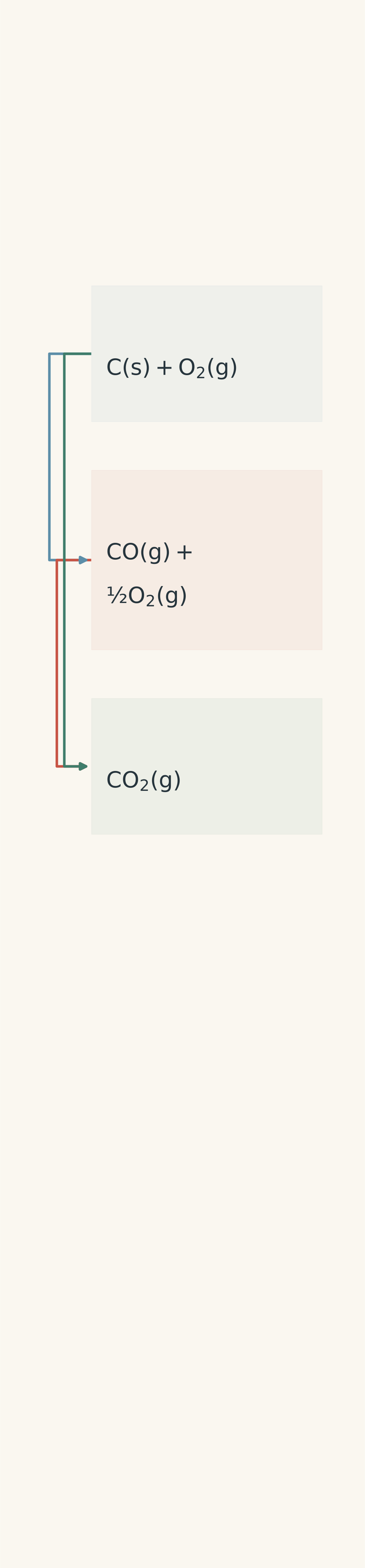
An energy cycle is a diagram that connects different pathways between the same substances.
For example:
\[ \ce{C(s) + O2(g) -> CO2(g)} \]
can happen directly, or through carbon monoxide:
\[ \ce{C(s) + 1/2O2(g) -> CO(g)} \]
followed by:
\[ \ce{CO(g) + 1/2O2(g) -> CO2(g)} \]
The cycle looks like this:

The direct route and the stepped route must have the same total enthalpy change.
So:
\[ \Delta H_1 = \Delta H_2 + \Delta H_3 \]
If two values are known, the third can be calculated.
04A reliable method for Hess’s Law questions
When solving an HSC Chemistry Hess’s Law problem, avoid guessing which numbers to add. Use a process.
Step 1: Write the target equation
Identify exactly what reaction you need to find.
The target equation is your destination.
Step 2: Compare the given reactions to the target
Ask:
- Are the reactants and products in the correct places?
- Do I need to reverse a reaction?
- Do I need to multiply a reaction?
Step 3: Adjust the equations
Any change to the chemical equation must also happen to \( \Delta H \).
For example:
\[ \ce{A -> B} \qquad \Delta H = -50\ \mathrm{kJ} \]
Reversing it:
\[ \ce{B -> A} \qquad \Delta H = +50\ \mathrm{kJ} \]
The energy change has the opposite sign because the reaction direction has changed.
Step 4: Add the equations
Cancel substances that appear on both sides.
The remaining equation should match the target reaction.
Step 5: Check the sign
A common mistake is getting the correct number with the wrong sign.
Remember:
- Negative \( \Delta H \) means heat is released.
- Positive \( \Delta H \) means heat is absorbed.
For more practice with reaction energy calculations, see the related guide on Bond Enthalpy and Conservation of Energy in HSC Chemistry.
05Worked example: Finding an unknown enthalpy using an energy cycle
Question
Carbon reacts with oxygen to form carbon dioxide:
\[ \ce{C(s) + O2(g) -> CO2(g)} \]
\[ \Delta H = -394\ \mathrm{kJ\,mol^{-1}} \]
Carbon monoxide reacts with oxygen to form carbon dioxide:
\[ \ce{CO(g) + 1/2O2(g) -> CO2(g)} \]
\[ \Delta H = -283\ \mathrm{kJ\,mol^{-1}} \]
Calculate the enthalpy change for:
\[ \ce{C(s) + 1/2O2(g) -> CO(g)} \]
Step 1
The unknown reaction makes carbon monoxide. The known reactions include a direct pathway to carbon dioxide, so the carbon monoxide step must fit between carbon and carbon dioxide.
The cycle is:
\[ \ce{C(s) + O2(g) -> CO2(g)} \]
and:
\[ \ce{C(s) + 1/2O2(g) -> CO(g) -> CO2(g)} \]
Step 2
The direct pathway must equal the two-step pathway:
\[ -394 = \Delta H_{\ce{C -> CO}} + (-283) \]
Step 3
\[ \Delta H_{\ce{C -> CO}} = -394 + 283 \]
\[ \Delta H_{\ce{C -> CO}} = -111\ \mathrm{kJ\,mol^{-1}} \]
Step 4
The formation of carbon monoxide releases \(111\ \mathrm{kJ}\) of energy per mole. It is less exothermic than forming carbon dioxide because carbon monoxide still contains chemical energy that can be released when it reacts further with oxygen.
06Worked example: Combining multiple reactions
Question
Calculate the enthalpy change for:
\[ \ce{N2(g) + 2O2(g) -> 2NO2(g)} \]
given:
\[ \ce{N2(g) + O2(g) -> 2NO(g)} \]
\[ \Delta H = +180\ \mathrm{kJ} \]
and:
\[ \ce{2NO(g) + O2(g) -> 2NO2(g)} \]
\[ \Delta H = -114\ \mathrm{kJ} \]
Step 1
The first reaction produces \( \ce{NO} \), and the second reaction uses \( \ce{NO} \). The intermediate substance cancels, so no reversing or multiplying is needed.
Step 2
\[ \Delta H = (+180) + (-114) \]
\[ \Delta H = +66\ \mathrm{kJ} \]
Step 3
The overall reaction absorbs \(66\ \mathrm{kJ}\) when two moles of nitrogen dioxide are formed. The first reaction requires more energy than the second releases.
07The most common Hess’s Law mistake
A tempting approach is to look only at the numbers and try to “make them fit”.
For example, a student might see:
\[ -500\ \mathrm{kJ} \]
and:
\[ +200\ \mathrm{kJ} \]
and immediately subtract them.
Sometimes that gives the right answer by accident. The problem is that Hess’s Law is not a number puzzle. It is an equation puzzle.
The chemical species must match first.
A reaction can only be added to another reaction if the substances cancel correctly. The atoms must be conserved, and the final equation must be the exact target reaction.
08Hess’s Law and bond energy
Hess’s Law is closely connected to the idea that chemical energy comes from bonds being broken and formed.
Breaking bonds requires energy.
Forming bonds releases energy.
The total energy change depends on the balance between these two processes.
This is why bond enthalpies can also be used to estimate reaction enthalpies:
\[ \Delta H = \text{energy required to break bonds} - \text{energy released forming bonds} \]
You can explore this connection further in Hess’s Law with Bond Energies: Estimate Reaction Enthalpy.
09Questions and solutions
Question 1
Using the following data, calculate the enthalpy change for:
\[ \ce{S(s) + O2(g) -> SO2(g)} \]
Given:
\[ \ce{S(s) + 3/2O2(g) -> SO3(g)} \]
\[ \Delta H = -396\ \mathrm{kJ} \]
\[ \ce{SO2(g) + 1/2O2(g) -> SO3(g)} \]
\[ \Delta H = -99\ \mathrm{kJ} \]
Solution 1
The enthalpy change is \(-297\ \mathrm{kJ\,mol^{-1}}\).
The target reaction produces \( \ce{SO2} \), but the first given reaction produces \( \ce{SO3} \). The second reaction can be reversed:
\[ \ce{SO3(g) -> SO2(g) + 1/2O2(g)} \]
Reversing changes the sign:
\[ \Delta H = +99\ \mathrm{kJ} \]
Now add:
\[ -396 + 99 = -297\ \mathrm{kJ} \]
The negative value shows that forming sulfur dioxide is exothermic.
Question 2
Given:
\[ \ce{2C(s) + O2(g) -> 2CO(g)} \]
\[ \Delta H = -221\ \mathrm{kJ} \]
and:
\[ \ce{2CO(g) + O2(g) -> 2CO2(g)} \]
\[ \Delta H = -566\ \mathrm{kJ} \]
Calculate the enthalpy change for:
\[ \ce{2C(s) + 2O2(g) -> 2CO2(g)} \]
Explain why simply choosing the more negative value would be incorrect.
Solution 2
The enthalpy change is \(-787\ \mathrm{kJ}\).
The tempting mistake is to choose \(-566\ \mathrm{kJ}\) because it is the larger energy release. However, that reaction only starts with carbon monoxide, not carbon. The first reaction is needed to create the carbon monoxide intermediate.
Add both reactions:
\[ -221 + (-566) = -787\ \mathrm{kJ} \]
The intermediate \( \ce{CO} \) cancels, leaving the required overall reaction.
Question 3
A student claims that reversing a reaction does not change \( \Delta H \) because “the same bonds are involved”.
Consider:
\[ \ce{H2(g) + 1/2O2(g) -> H2O(l)} \]
\[ \Delta H = -286\ \mathrm{kJ} \]
Use Hess’s Law to find the enthalpy change for:
\[ \ce{H2O(l) -> H2(g) + 1/2O2(g)} \]
Explain the student’s error.
Solution 3
The enthalpy change is \(+286\ \mathrm{kJ}\).
The student’s reasoning ignores the direction of energy transfer. The same bonds are involved, but the process is reversed.
Reversing a reaction changes the sign:
\[ \Delta H_{\text{reverse}} = -(-286) \]
\[ \Delta H_{\text{reverse}} = +286\ \mathrm{kJ} \]
The reverse reaction absorbs energy because it must undo the stable bonds formed in water.
Question 4
A reaction has two possible pathways:
Pathway A:
\[ \ce{A -> D} \]
\[ \Delta H = -120\ \mathrm{kJ} \]
Pathway B:
\[ \ce{A -> B} \]
\[ \Delta H = +80\ \mathrm{kJ} \]
followed by:
\[ \ce{B -> C} \]
\[ \Delta H = x \]
followed by:
\[ \ce{C -> D} \]
\[ \Delta H = -40\ \mathrm{kJ} \]
A student argues that \(x\) must be negative because the overall reaction releases energy. Determine \(x\) and explain why the argument fails.
Solution 4
The value of \(x\) is \(-160\ \mathrm{kJ}\).
The student has noticed that the overall reaction is exothermic but has ignored the fact that one pathway step can absorb energy while the total pathway still releases energy.
By Hess’s Law:
\[ -120 = 80 + x - 40 \]
Simplify:
\[ -120 = 40 + x \]
Therefore:
\[ x = -160\ \mathrm{kJ} \]
The middle step is strongly exothermic. The positive first step does not prevent the full pathway from releasing energy because all steps contribute to the total.
Question 5
A chemist studies the formation of a compound \(X\). They know:
\[ \ce{Elements -> X} \]
has an unknown enthalpy change.
They measure these reactions:
\[ \ce{Elements -> Y} \]
\[ \Delta H = -500\ \mathrm{kJ} \]
and:
\[ \ce{X -> Y} \]
\[ \Delta H = -200\ \mathrm{kJ} \]
A student says the formation of \(X\) must be \(-700\ \mathrm{kJ}\) because both reactions release energy.
Is the student correct?
Solution 5
The formation enthalpy of \(X\) is \(-300\ \mathrm{kJ}\), so the student is incorrect.
The trap is treating both values as energy releases that should be added. The direction of the second reaction matters.
The energy cycle is:
\[ \ce{Elements -> X -> Y} \]
The total pathway equals the direct pathway:
\[ \Delta H_{\ce{Elements -> X}} + (-200) = -500 \]
Rearranging:
\[ \Delta H_{\ce{Elements -> X}} = -500 + 200 \]
\[ \Delta H_{\ce{Elements -> X}} = -300\ \mathrm{kJ} \]
The second reaction describes energy released when \(X\) changes into \(Y\). To find the formation of \(X\), that step must effectively be undone.
Hess’s Law is useful because it lets you move between reactions that cannot be measured directly. Once you are comfortable building these energy pathways, the next step is using them with more complex systems such as combustion reactions, biological energy cycles, and bond enthalpy estimates.