
Industrial Chemical Synthesis: Scaling Up and Real-World Uses
Learn how chemical synthesis is scaled from laboratory reactions to industrial production, and how yield, safety, cost, and processing affect real-world applications.
A reaction works beautifully in a 1 L flask: the temperature is easy to control, stirring is effective, and the chemist gets an 80% yield. Now the target is 400 kg, so the obvious move is to multiply every chemical amount. Would the plant still get 80%?
Not necessarily. The stoichiometry scales directly, but heat transfer, mixing, separation, safety, cost, and waste do not automatically scale with the amount of chemical.
Scale-up: 1 L → 100 L → 10,000 L
| 1 L laboratory reactor | c = n/V Feed concentration: same Mixing: relatively easy → Heat removal: relatively easy → |
|---|---|
| 100 L pilot vessel | Feed concentration: unchanged Mixing: more difficult → Heat removal: more demanding → |
| 10,000 L industrial reactor | Feed concentration: unchanged Mixing: greatest challenge Heat removal: greatest challenge |
That is the central idea of industrial chemical synthesis: you are not just making the same reaction in a bigger container. You are designing a process that can make the desired product reliably at a much larger scale.
01Why scaling up changes the problem
Picture stirring a cup of soup. A few seconds of stirring can make the temperature and concentration fairly uniform. Now imagine the same soup in a huge tank. Stirring the surface does not guarantee that every part of the tank changes at the same time.
A reactor has the same basic problem, except the consequences can be much more serious. A small temperature or concentration difference can change the reaction rate, produce unwanted side reactions, or make heat removal difficult.
The soup analogy breaks down because a chemical reaction can also generate or consume heat while changing the substances in the vessel. That is why industrial scale-up needs more than larger quantities.
Stoichiometry is the easy part
If concentration is kept constant, increasing the reactor volume increases the number of moles in the same proportion.
\[ c=\frac{n}{V} \]
Here, \(c\) is concentration in mol L\(^{-1}\), \(n\) is amount in mol, and \(V\) is volume in L.
So, if a process moves from 10 L to 1000 L while keeping the same concentration, the amount of each dissolved reactant increases by a factor of 100.
That part is straightforward.
The harder question is whether the same reaction conditions actually occur throughout the larger reactor.
Mixing becomes harder
In a small vessel, stirring can quickly distribute reactants and heat. In a large vessel, the same nominal stirring speed does not guarantee the same mixing.
A reagent added at one point might briefly create a region of very high concentration. A solid catalyst might not be dispersed evenly. Gas bubbles might not contact enough liquid. A viscous mixture can take much longer to circulate.
These local differences matter because reaction rate depends on conditions such as concentration and temperature.
So a student might predict:
“If the lab reaction used 60 °C and gave a high yield, the industrial reactor can just be set to 60 °C.”
The problem is that the temperature displayed by one sensor does not prove that the whole reactor is at 60 °C. A large reactor can contain hotter and cooler regions.
Heat transfer is a major scale-up problem
For an exothermic reaction, heat is generated throughout the reacting material but is usually removed through reactor walls, cooling coils, or an external heat exchanger.
Here is the important scaling pattern:
- volume increases with the cube of a vessel’s linear size;
- surface area increases with the square of its linear size.
So if every linear dimension is multiplied by 10, the volume increases by 1000, but the surface area increases by only 100.
Why heat removal becomes harder during scale-up
| Small reactor | Reference: V ×1, wall area ×1 Heat generated throughout the reacting volume Heat removed through the walls |
|---|---|
| Large reactor: 10× linear size | V ×1000; wall area ×100 Same volumetric heat generation → total heat ×1000 Same wall heat flux → removal capacity ×100 Heat generation grows faster than cooling area |
That means the amount of reaction occurring per unit of cooling area can increase as the reactor becomes larger.
If an exothermic reaction gets hotter, its reaction rate may increase. That can generate heat even faster, creating a dangerous feedback. It can also increase side reactions and reduce product quality.
Endothermic reactions have the opposite issue: a large reactor may struggle to deliver heat uniformly, producing cold regions where the reaction proceeds too slowly.
Mass transfer can change too
Mass transfer is the movement of a substance between different phases or regions.
For example:
- a gas such as hydrogen must dissolve into a liquid;
- a solid reactant must dissolve into a solvent;
- two liquids may need to mix before they react;
- a product may need to move out of one phase before another reaction occurs.
At industrial scale, poor mixing can make these transfers slower.
This is particularly important for reactions involving gases, catalysts, or several phases. A laboratory reaction that appears instantaneous may become limited by mixing or mass transfer in a larger vessel.
Separation is part of synthesis
The reaction is only one stage of an industrial process.
Industrial chemical synthesis process
- Feed preparation
Measure and prepare starting materials
- Reaction
Convert starting materials into products
- Separation
Unreacted feed ↺ reaction
Separate product from unreacted feed
- Purification
Remove remaining impurities
- Formulation / blending
Adjust the final product composition
- Quality control
Check the product against specifications
After the reaction, the desired product may be mixed with:
- unreacted starting materials;
- solvents;
- catalysts;
- water;
- side products;
- salts or other waste substances.
A laboratory chemist might use chromatography to obtain a very pure sample. That does not automatically make chromatography the best choice for tonnes of product. Industrial processes generally favour separation methods that can handle large quantities efficiently, such as distillation, filtration, extraction, or crystallisation, depending on the substances involved.
For a high-value pharmaceutical, a more expensive purification step may be justified because the product is valuable and purity requirements are strict. For a bulk cleaning chemical or fuel, the same separation cost may be unacceptable.
Safety and economics also change
A larger process contains more material. If the material is flammable, toxic, corrosive, or pressurised, the consequences of a failure can be much greater.
Industrial plants therefore need systems for temperature control, pressure control, emergency shutdown, containment, ventilation, and waste treatment.
There can also be an economic advantage to scale. Large plants can spread fixed costs such as equipment and infrastructure over more product. This can reduce the cost per kilogram.
But bigger is not automatically cheaper. If scaling up causes lower yield, expensive waste treatment, difficult purification, or safety problems, the supposed economy of scale can disappear.
02From laboratory reaction to industrial process
Scale-up is usually treated as a progression rather than one enormous jump.
| Stage | Main purpose |
|---|---|
| Laboratory scale | Show that the chemistry works and establish useful conditions |
| Pilot scale | Test mixing, heat transfer, separation, control, yield, and safety at an intermediate scale |
| Commercial scale | Produce the required quantity consistently, safely, and economically |
A pilot process is not simply a bigger laboratory experiment. It is where engineers can discover problems that are invisible in a small flask.
For example, a reaction might have excellent laboratory yield but produce an unacceptable amount of side product at pilot scale because the larger reactor develops temperature gradients.
Batch and continuous processing
Scale-up also involves choosing how material moves through the process.
| Process | Strength | Limitation |
|---|---|---|
| Batch | Flexible and useful when products or conditions change between campaigns | Filling, emptying, cleaning, and restarting take time |
| Continuous | High throughput and steady operating conditions | Requires careful control and is less flexible for some processes |
Pharmaceutical synthesis often uses batch processing because individual steps can require different conditions and careful purification. Large-volume chemical and fuel processes are often well suited to continuous operation because enormous quantities need to be processed steadily.
Neither method is automatically superior. The choice depends on the chemistry, product, scale, safety requirements, and economics.
03How synthesis is applied to different products
The word synthesis needs some care here.
Synthesis means using chemical reactions to form new substances. Formulation means combining ingredients in controlled proportions to create a product with particular properties. Refining can involve separating and converting components of a feedstock, while blending combines streams to meet a specification.
A consumer product may involve several of these processes.
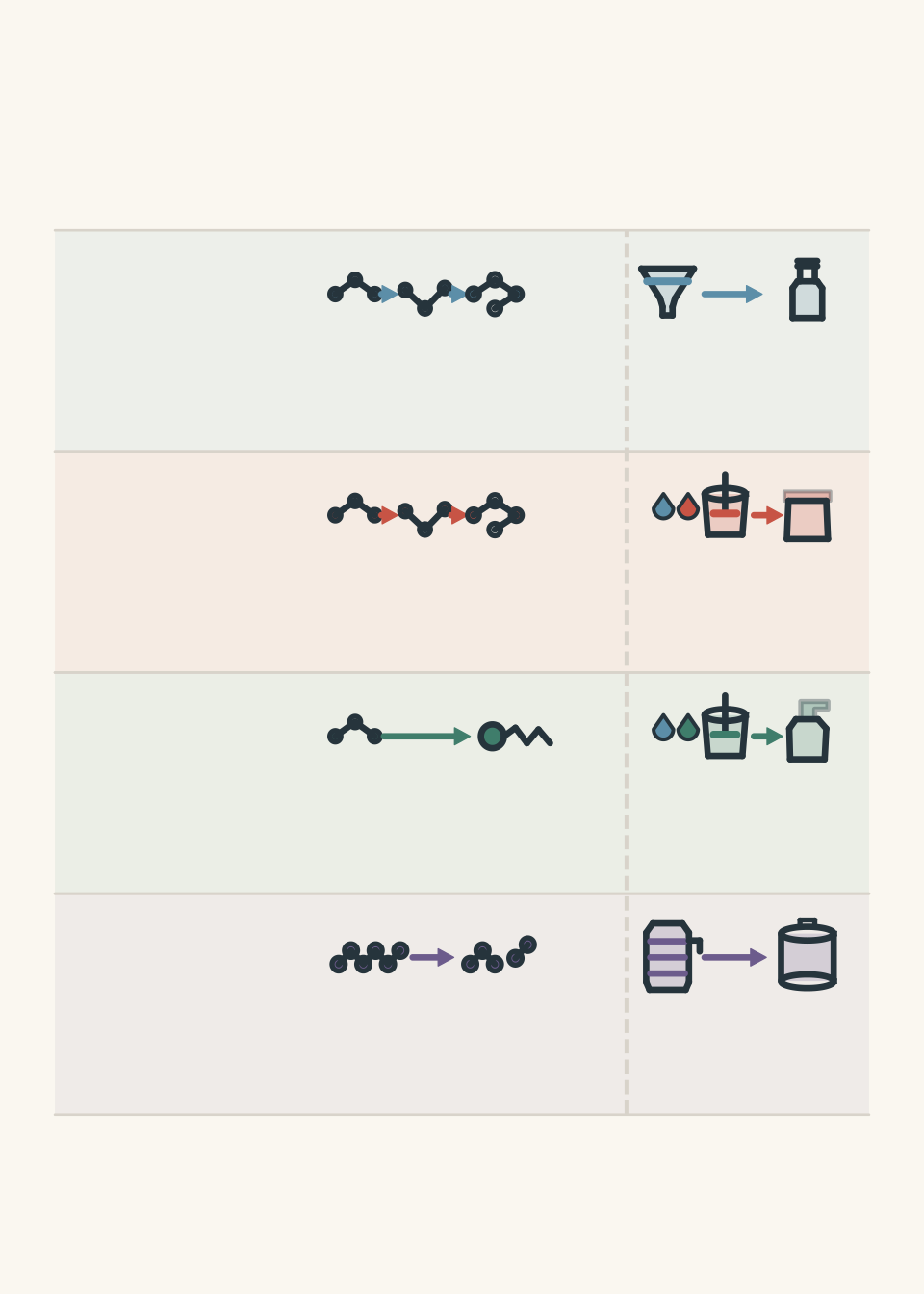
Pharmaceuticals
Pharmaceutical manufacturing can involve several chemical reactions to make an active pharmaceutical ingredient, or API.
The synthesis may look like:
\[ \text{starting material} \rightarrow \text{intermediate} \rightarrow \text{intermediate} \rightarrow \text{API} \]
Each step can require its own reaction conditions and purification.
Purity is especially important because unwanted substances in a pharmaceutical can affect safety and performance. This means an industrial pharmaceutical synthesis is judged on much more than percentage yield.
A route with a slightly lower yield might still be preferable if it:
- uses safer reactants;
- produces fewer difficult impurities;
- requires fewer purification steps;
- uses cheaper or more available raw materials;
- produces less waste;
- operates at easier temperatures and pressures.
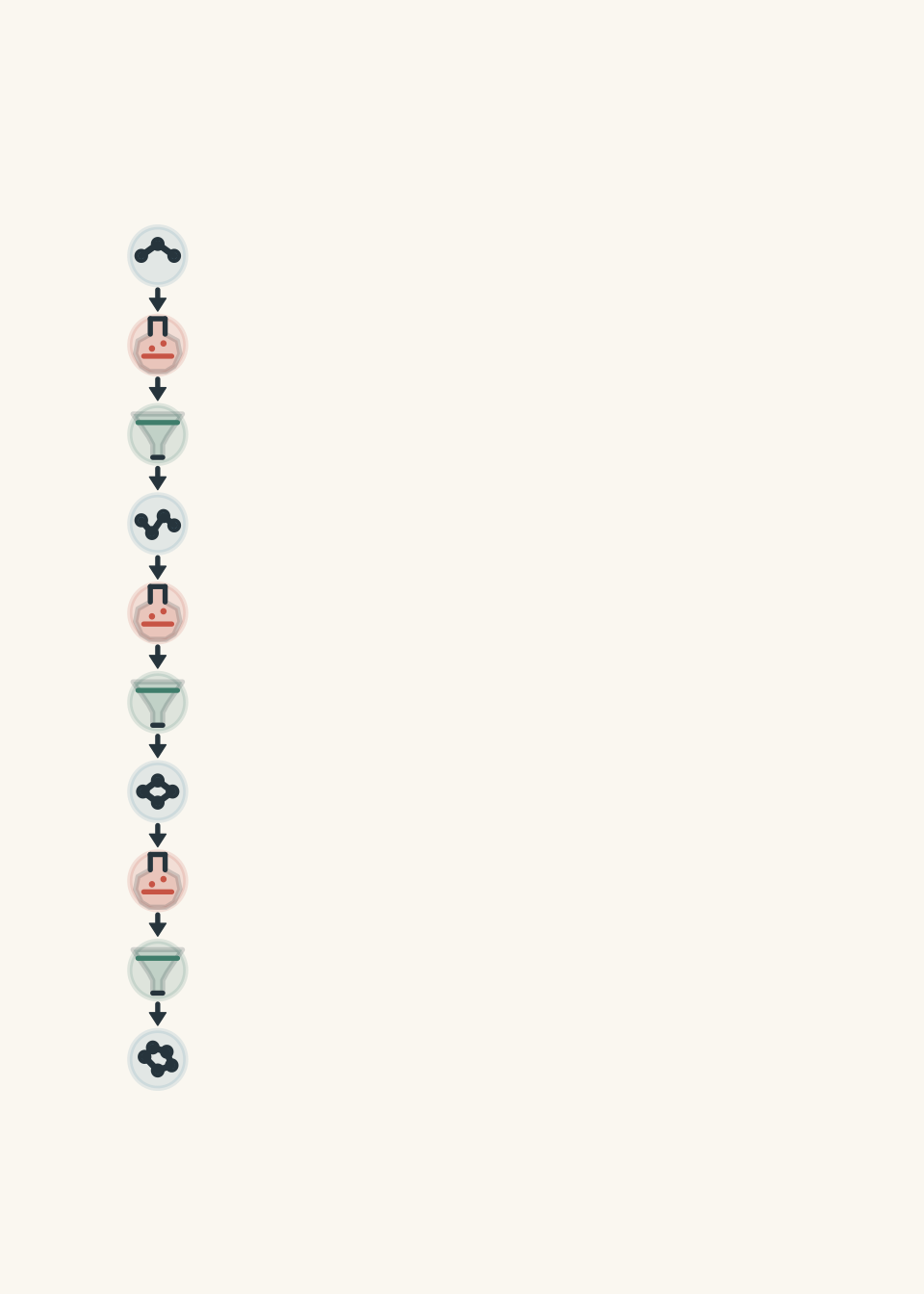
There is another important point: yields compound in a multi-step synthesis.
Worked example: three reaction steps to make an API
A pharmaceutical API is made by three consecutive 1:1 reactions. The isolated yield of each step is 92%, 85%, and 90%. A plant begins with 500 mol of the starting material. The API has a molar mass of 220 g mol\(^{-1}\). Calculate the amount and mass of API produced.
Step 1
\[ 500\times0.92=460\text{ mol} \]
So 460 mol enters the second step.
Step 2
\[ 460\times0.85=391\text{ mol} \]
So 391 mol enters the third step.
Step 3
\[ 391\times0.90=351.9\text{ mol} \]
The final amount is 351.9 mol.
Step 4
\[ m=nM \]
\[ m=(351.9)(220) =77418\text{ g} =77.4\text{ kg} \]
The plant produces 77.4 kg of API.
The overall yield is:
\[ 0.92\times0.85\times0.90 =0.7038 \]
So the overall yield is 70.38%.
The trap is averaging the three yields. You cannot do that. Material lost at the first step is no longer available for the later steps, so the yields multiply.
If the plant instead needs 100 kg of API, first convert the target mass into moles:
\[ n=\frac{100000}{220} =454.5\text{ mol} \]
Then work backwards through the overall yield:
\[ n_{\text{start}} = \frac{454.5}{0.7038} =645.8\text{ mol} \]
So about 646 mol of starting material would be required under the stated assumptions.
This is why a high yield at every individual step is valuable in a multi-step pharmaceutical synthesis.
Cosmetics
Cosmetic products demonstrate the difference between synthesis and formulation particularly clearly.
Chemical synthesis can produce ingredients such as surfactants, fragrance molecules, preservatives, or other functional ingredients. The final cosmetic then combines these ingredients with materials such as water, oils, emulsifiers, and other components.
The industrial challenge is therefore not just:
“Can we make the molecule?”
It is also:
“Can we make the same ingredient consistently, then formulate it so the final product has the required properties?”
Mixing and temperature control can affect viscosity, texture, particle size, and stability. Small changes that are irrelevant to a pure laboratory sample can become noticeable in a consumer product.
For cosmetics, consistent quality and formulation performance can therefore be as important as reaction yield.
Cleaning products
Cleaning products commonly rely on chemically produced ingredients such as surfactants, solvents, builders, enzymes, or oxidising agents.
For example, sodium hypochlorite can be produced by the reaction:
\[ \ce{Cl2 + 2NaOH -> NaCl + NaClO + H2O} \]
The sodium hypochlorite is then used as an active ingredient in formulated products such as bleach.
At large scale, the process must control reaction conditions, safely handle corrosive or hazardous substances, and produce the required concentration consistently.
Cleaning chemicals are often produced in much larger quantities than pharmaceuticals, so the economics become particularly important. A process that requires excessive energy, expensive purification, or large quantities of waste treatment may not be commercially attractive even if its chemistry works well.
Fuels
Fuels require another important distinction.
Petrol and diesel obtained from crude oil are mainly refined mixtures, rather than substances synthesised from scratch. Other fuels, however, can be produced through chemical synthesis or chemical conversion.
Examples include:
- biodiesel, produced by transesterification of fats or oils with an alcohol;
- synthetic hydrocarbons produced from feedstocks such as synthesis gas using catalytic processes.
At fuel scale, enormous quantities must be processed. Throughput, energy consumption, catalyst performance, heat transfer, separation, and recycling of unreacted material can strongly affect the feasibility of the process.
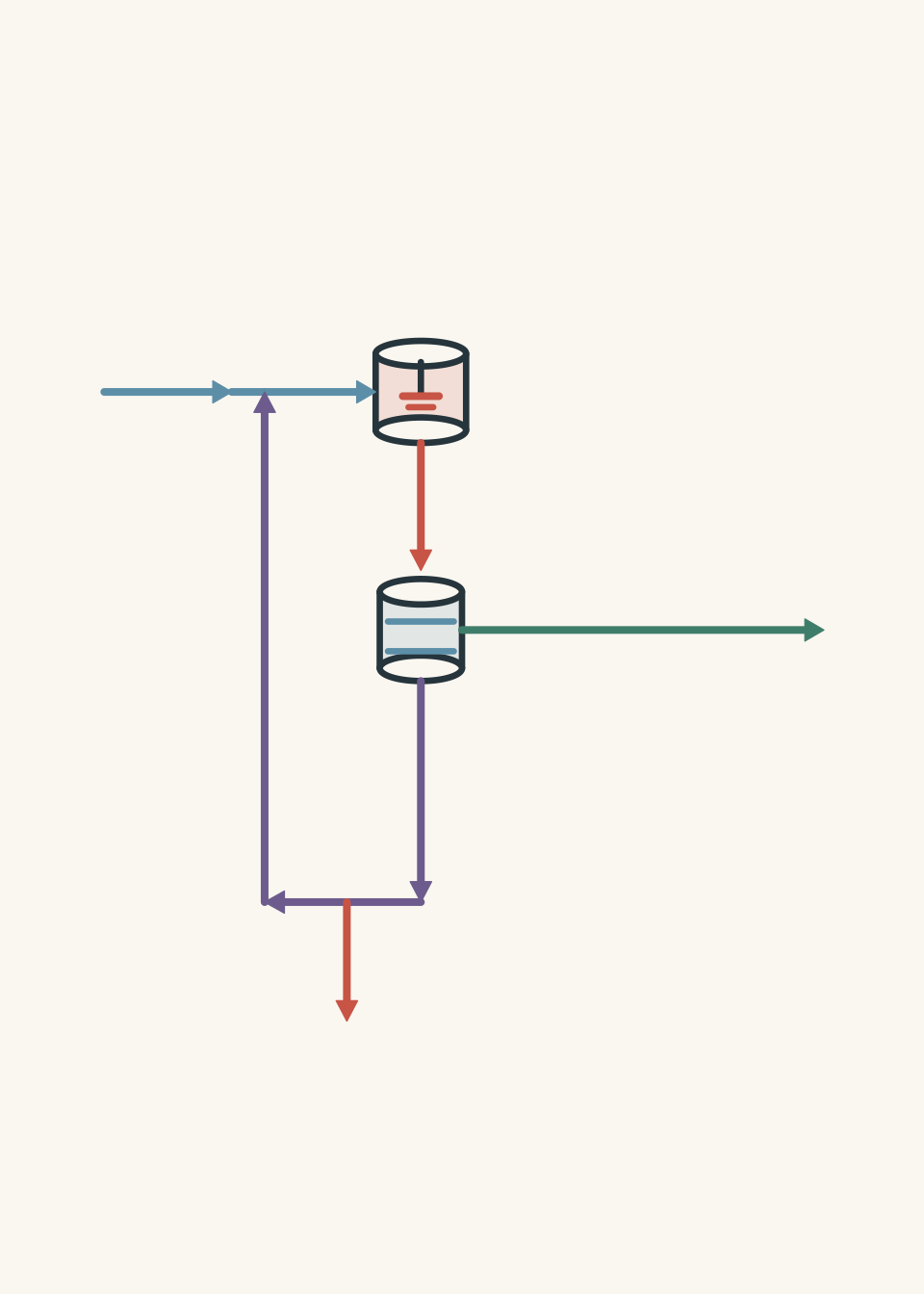
A fuel process therefore cannot be judged by yield alone. If achieving a slightly higher conversion requires much more energy or creates difficult side products, the lower-conversion route may be preferable if unreacted feed can be efficiently recycled.
04Yield is not the only number that matters
Three terms are easy to mix up.
| Quantity | What it tells you |
|---|---|
| Conversion | How much of a reactant has been consumed |
| Selectivity | How much of the converted material forms the desired product rather than side products |
| Percentage yield | How much desired product is actually obtained compared with the theoretical amount |
Imagine that 95% of a reactant disappears. That sounds excellent.
But if much of the converted material becomes unwanted products, the desired-product yield can still be poor.
A good industrial synthesis aims for useful conversion and good selectivity and yield.
Worked example: scaling a single reaction
An industrial process makes a cosmetic ingredient according to the simplified reaction \(\ce{A + B -> P}\). Reactant B is in excess. Reactant A has a molar mass of 100 g mol\(^{-1}\), and product P has a molar mass of 150 g mol\(^{-1}\). A commercial batch uses 400 kg of A. The reaction is 1:1 and has an 80% yield. What mass of P is actually obtained?
Step 1
\[ 400\text{ kg}=400000\text{ g} \]
\[ n(A)=\frac{400000}{100} =4000\text{ mol} \]
Step 2
The theoretical amount of P is therefore 4000 mol.
Step 3
\[ m(P)=4000\times150 =600000\text{ g} =600\text{ kg} \]
So the theoretical yield is 600 kg.
Step 4
\[ m_{\text{actual}} =600\times0.80 =480\text{ kg} \]
The actual product is 480 kg.
This calculation assumes the industrial process really achieves the same 80% yield. That assumption is exactly what scale-up has to test. The equation tells you what would happen if the process performance stayed constant; it does not prove that the performance will stay constant.
05How to assess an industrial synthesis
When an HSC Chemistry question asks you to assess an industrial synthesis, do not simply list advantages and disadvantages.
Build a chain of reasoning.
| Factor | Question to ask |
|---|---|
| Chemistry | Does the reaction make the desired substance with useful yield and selectivity? |
| Scale-up | Can the larger reactor maintain suitable mixing, temperature, pressure, and mass transfer? |
| Separation | Can the product be isolated and purified efficiently? |
| Quality | Can the required purity and consistency be maintained? |
| Safety | Can hazards be controlled at the larger inventory and operating conditions? |
| Economics | Are raw materials, energy, equipment, labour, and waste treatment affordable? |
| Environmental and social effects | What happens to emissions, waste, resource use, workers, and surrounding communities? |
The factors are not always equally important.
If one route has a 95% yield but cannot safely remove the heat produced, its high yield does not make it the better industrial route. Safety is a constraint, not just another point to add to a pros-and-cons list.
Likewise, a route with a lower yield may be attractive if it uses cheap feedstocks, mild conditions, efficient recycling, and simple purification.
For a broader method for choosing between possible routes, see How to Design a Feasible Chemical Synthesis for HSC Chemistry.
The environmental, social, and economic side of that decision is explored further in Environmental, Social and Economic Trade-offs in Chemical Synthesis.
06Common traps
“A bigger reactor is just a bigger flask.”
No. Mixing, heat transfer, mass transfer, and safety change with scale.“The same set temperature means the same conditions.”
No. A temperature sensor measures one location. Large reactors can develop temperature gradients.“High conversion means high yield.”
No. Side reactions can consume converted reactant without producing the desired substance.“The final product is the substance made in the reaction.”
Not necessarily. Synthesis, separation, purification, formulation, refining, and blending can all be separate stages.“The highest yield is always the best industrial route.”
No. Safety, purification, energy use, cost, waste, and environmental impact can change the judgement.
07Questions and solutions
Question 1
An industrial process makes a cleaning-product ingredient according to the simplified reaction \(\ce{A + B -> P}\). B is in excess. A has a molar mass of 100 g mol\(^{-1}\), and P has a molar mass of 150 g mol\(^{-1}\). A batch uses 400 kg of A. The reaction is 1:1 and has an 80% yield.
Calculate the mass of P obtained.
Solution 1
The mass of P obtained is 480 kg.
First convert the 400 kg of A to grams and then to moles:
\[ 400\text{ kg}=400000\text{ g} \]
\[ n(A)=\frac{400000}{100} =4000\text{ mol} \]
The reaction is 1:1, so the theoretical amount of P is 4000 mol.
\[ m(P)_{\text{theoretical}} =4000\times150 =600000\text{ g} =600\text{ kg} \]
Apply the 80% yield:
\[ m(P)_{\text{actual}} =600\times0.80 =480\text{ kg} \]
So 480 kg of P is produced.
The important industrial assumption is that the 80% yield remains achievable at this scale. The calculation does not establish that; mixing, heat transfer, and purification still need to be demonstrated.
Question 2
A pharmaceutical API is produced through three consecutive 1:1 reactions. The isolated yield of each step is 92%, 85%, and 90%.
A plant begins with 500 mol of the starting material.
(a) Calculate the amount of final API produced.
(b) Calculate the overall percentage yield.
(c) The API has a molar mass of 220 g mol\(^{-1}\). How many moles of starting material are required to produce 100 kg of API, assuming the same yields?
Solution 2
The process produces 351.9 mol of API, has an overall yield of 70.38%, and requires about 646 mol of starting material to produce 100 kg of API.
For the first step:
\[ 500\times0.92=460\text{ mol} \]
For the second step:
\[ 460\times0.85=391\text{ mol} \]
For the third step:
\[ 391\times0.90=351.9\text{ mol} \]
Therefore:
\[ n_{\text{API}}=351.9\text{ mol} \]
The overall yield is the product of the individual yields:
\[ 0.92\times0.85\times0.90 =0.7038 \]
\[ \text{overall yield}=70.38\% \]
For 100 kg of API, first find the required final amount:
\[ n_{\text{API}} =\frac{100000}{220} =454.5\text{ mol} \]
Now account for the 70.38% overall yield:
\[ n_{\text{start}} = \frac{454.5}{0.7038} =645.8\text{ mol} \]
So about 646 mol of starting material is required.
The tempting mistake is to treat the three yields separately or average them. The exact constraint is that material lost at an earlier step cannot enter a later step, so the yields compound.
Question 3
A 1.0 L laboratory reactor and a geometrically similar 1000 L reactor use the same reactant concentration. An exothermic reaction releases 50 kJ of heat per litre over 10 minutes.
The 1.0 L reactor has 0.10 m² of heat-transfer area. Assume the 1000 L reactor has 100 times this area.
(a) Calculate the total heat released in each reactor.
(b) Calculate the average heat released per square metre of heat-transfer area in each reactor.
(c) Explain why the larger reactor can be harder to control thermally even though both reactors have the same temperature set-point.
(d) Identify one mixing problem that could reduce the yield in the larger reactor.
Solution 3
The 1000 L reactor releases 1000 times as much total heat but only has 100 times as much heat-transfer area, so its average heat load per square metre is ten times greater. It can therefore be harder to cool, while mixing can create local concentration or temperature differences.
For the 1.0 L reactor:
\[ Q=50\text{ kJ L}^{-1}\times1.0\text{ L} =50\text{ kJ} \]
For the 1000 L reactor:
\[ Q=50\times1000 =50000\text{ kJ} \]
So the total heat releases are 50 kJ and 50,000 kJ.
The small reactor has 0.10 m² of heat-transfer area:
\[ \frac{50}{0.10} =500\text{ kJ m}^{-2} \]
The large reactor has:
\[ 0.10\times100=10\text{ m}^2 \]
Therefore:
\[ \frac{50000}{10} =5000\text{ kJ m}^{-2} \]
The large reactor therefore has an average heat release of 5000 kJ m\(^{-2}\), compared with 500 kJ m\(^{-2}\) for the small reactor.
The tempting prediction is that the same set temperature means the reactors behave identically. It does not. The large reactor generates much more heat relative to the available heat-transfer area. If heat cannot be removed quickly enough, the actual temperature can rise, particularly in local regions.
A mixing problem could occur when a reactant is added at one location. It may create a region with unusually high concentration, causing a locally faster reaction and potentially more side products. Poor circulation could also leave cooler regions where the reaction is too slow.
Question 4
Two routes are being considered for producing a synthetic fuel intermediate from the same feed.
- Route A: 95% conversion in one pass, with no recycle.
- Route B: 70% conversion in the first pass. Of the unreacted feed, 80% is separated and recycled once. The remaining 20% is purged. In the second pass, the recycled material again has 70% conversion.
Start with 1000 mol of feed. Assume there are no side products and that one mole of converted feed produces one mole of desired product.
(a) Calculate the amount of desired product from Route A.
(b) Calculate the amount of desired product from Route B.
(c) Which route gives more desired product from the original 1000 mol?
(d) Explain why Route B could still be attractive industrially.
Solution 4
Route A produces 950 mol, while Route B produces 868 mol from the original 1000 mol. Route A therefore gives more product under these assumptions, but Route B could still be preferable if its lower single-pass conversion allows safer, cheaper, or more selective operating conditions.
For Route A:
\[ 1000\times0.95 =950\text{ mol} \]
So Route A produces 950 mol.
For Route B, the first pass produces:
\[ 1000\times0.70 =700\text{ mol} \]
That leaves:
\[ 1000-700 =300\text{ mol} \]
unreacted.
Of this, 80% is recycled:
\[ 300\times0.80 =240\text{ mol} \]
The second pass converts 70% of this recycled material:
\[ 240\times0.70 =168\text{ mol} \]
Therefore total desired product is:
\[ 700+168 =868\text{ mol} \]
So Route B produces 868 mol, compared with 950 mol for Route A.
The tempting route is to choose Route A immediately because its conversion is higher. But conversion alone does not decide an industrial process.
Route B might operate at a lower temperature or pressure, reduce side reactions, protect a catalyst, or require less severe operating conditions. Recycling allows some unreacted feed to be used again rather than discarded.
The trade-off is that recycle is not free. The plant needs separation equipment, pumps, energy, control systems, and often a purge stream to prevent unwanted substances from accumulating. Route B is attractive only if those extra costs and impacts are outweighed by its other advantages.
Question 5
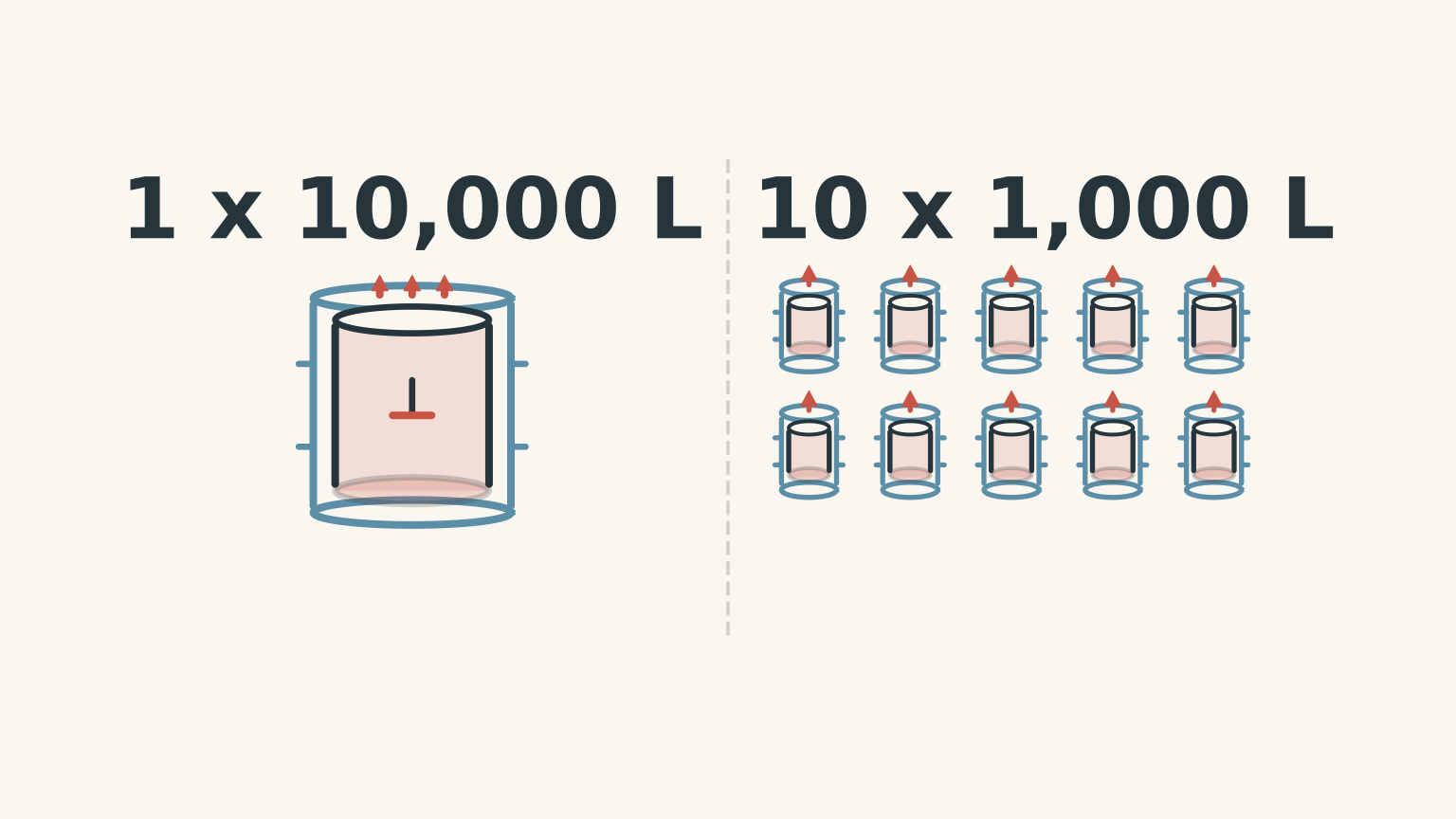
Two industrial designs are being considered for producing a pharmaceutical intermediate. Both process the same total volume of feed, at the same concentration.
- Route A: one 10,000 L reactor with a 94% yield.
- Route B: ten 1000 L reactors operating at the same time, each with a 90% yield.
The reaction releases 100 kJ of heat per litre of feed, uniformly over 10 minutes.
The available cooling capacity is:
- Route A: 0.95 MW for the whole reactor.
- Route B: 0.20 MW for each 1000 L reactor.
The theoretical product amount is 0.50 kg per litre of feed.
Assume the stated cooling capacity is continuously available for the full 10-minute heat-release period, and ignore other thermal loads.
(a) Calculate the average heat-release rate for Route A.
(b) Calculate the average heat-release rate for each reactor in Route B.
(c) Determine whether each design can remove the reaction heat quickly enough.
(d) Calculate the actual product mass from each design.
(e) Which design should be selected under the stated constraints? Explain why the higher-yield route is not automatically the better industrial choice.
Solution 5
Route B should be selected under the stated constraints because it meets the cooling requirement, whereas Route A does not. Route A has the higher yield and would make more product, but its stated cooling system cannot remove the reaction heat quickly enough.
For Route A, the total heat released is:
\[ 100\text{ kJ L}^{-1}\times10000\text{ L} =1000000\text{ kJ} \]
Ten minutes is 600 s, so the average heat-release rate is:
\[ \frac{1000000}{600} =1666.7\text{ kJ s}^{-1} \]
Since 1 kJ s\(^{-1}\) is 1 kW:
\[ 1666.7\text{ kW} =1.67\text{ MW} \]
Route A therefore generates heat at about 1.67 MW, but its cooling capacity is only 0.95 MW.
So Route A cannot remove heat as quickly as it is generated under the stated assumptions.
For Route B, each 1000 L reactor releases:
\[ 100\times1000 =100000\text{ kJ} \]
over 600 s:
\[ \frac{100000}{600} =166.7\text{ kW} \]
Each reactor therefore generates about 0.167 MW, while its cooling capacity is 0.20 MW.
So each Route B reactor can remove heat slightly faster than it is generated.
Now compare product output.
Route A has a theoretical product amount of:
\[ 10000\times0.50 =5000\text{ kg} \]
At 94% yield:
\[ 5000\times0.94 =4700\text{ kg} \]
Route A would produce 4700 kg if its thermal problem were solved.
Route B also processes 10,000 L in total:
\[ 10\times1000=10000\text{ L} \]
Its theoretical product amount is therefore also 5000 kg.
At 90% yield:
\[ 5000\times0.90 =4500\text{ kg} \]
Route B produces 4500 kg, which is 200 kg less than Route A.
This is the hinge in the problem. A student may confidently choose Route A because 94% is greater than 90%. That comparison ignores a harder constraint: Route A cannot safely remove the reaction heat under the stated design.
Route B sacrifices 4 percentage points of yield but keeps the process within its cooling capacity. Splitting the process into smaller reactors also changes the surface-area-to-volume relationship, making heat removal easier under the assumptions given.
That does not mean ten small reactors are always better. They require more equipment, control systems, maintenance, and potentially more operating cost. If Route A were redesigned with enough cooling capacity, its higher yield could make it economically attractive.
The industrial judgement therefore comes from the interaction between factors, not from choosing the largest number in the question.
Once you can treat synthesis as a combination of reaction chemistry, scale-up, separation, safety, economics, and environmental impact, you are ready for the next step: designing a feasible synthesis route and deciding which trade-offs are acceptable.