
Precipitation Tests for Aqueous Ions: HSC Chemistry Guide
Learn how precipitation reactions identify ions in aqueous solutions. Understand solubility rules, observations, controls, and ionic equations for HSC Chemistry.
A crime scene chemist is given three clear solutions with no labels. They all look like water. A student might think: “If there is nothing visible, there is nothing useful to observe.”
But add the right reagent, and one solution suddenly forms a cloudy solid, another changes colour, and the third stays clear. That small change can reveal which ions are present.

Precipitation tests are a way of identifying ions in aqueous solutions by forcing dissolved ions to form an insoluble compound. The key idea is not just “a solid appeared”. The useful chemistry comes from predicting why that solid formed, what ions caused it, and whether the test result is reliable.
01Start with the particle picture
Imagine a beaker of sodium chloride solution.
You cannot see the sodium ions or chloride ions because they are spread throughout the water as separate particles.
\[ \ce{NaCl(aq) -> Na+(aq) + Cl-(aq)} \]
The ions are still there, even though the solution looks completely clear.
Now imagine adding silver nitrate solution. What should happen?
A common prediction is: “Two clear solutions are mixing, so nothing dramatic should happen.”
That prediction feels reasonable because many ionic compounds dissolve in water. However, some combinations of ions form compounds that are not soluble. When this happens, the ions join together into a solid crystal.
The reaction is:
\[ \ce{Ag+(aq) + Cl-(aq) -> AgCl(s)} \]
The white solid silver chloride is called a precipitate.
A precipitate is an insoluble ionic compound that forms from ions in an aqueous solution.
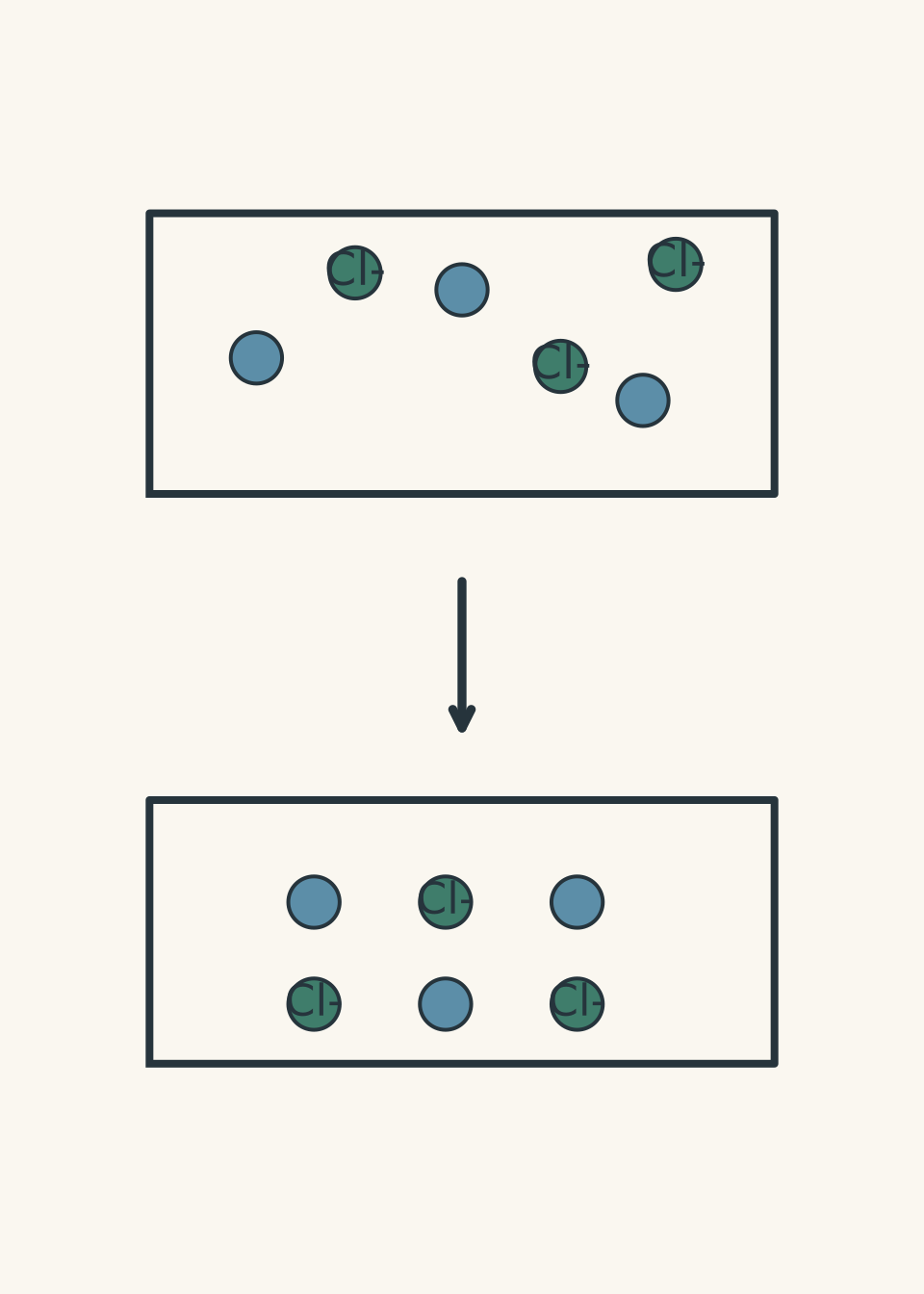
The important observation is not the silver ion itself. The test works because the chloride ion has been removed from solution and locked into a visible solid.
02What a precipitation test is actually testing
A precipitation test follows a simple pattern:
- Start with an unknown aqueous solution.
- Add a reagent containing a known ion.
- Observe whether an insoluble compound forms.
- Use the observation to identify the unknown ion.
The reagent is chosen because it reacts selectively with certain ions.
For example, to test for chloride ions, a chemist adds silver nitrate:
\[ \ce{AgNO3(aq) -> Ag+(aq) + NO3-(aq)} \]
The nitrate ions do not participate. They are spectator ions.
The useful reaction is:
\[ \ce{Ag+(aq) + Cl-(aq) -> AgCl(s)} \]
This is called the net ionic equation because it only includes the particles that actually change.

The first model is useful, but it is incomplete. Saying “mix two chemicals and look for a solid” misses the reasoning chemists use.
A better model asks:
- Which ions are present?
- Which new combinations could form?
- Is the possible product soluble or insoluble?
- Could another ion have caused the same observation?
03Solubility rules: predicting the precipitate
Chemists use solubility rules to predict which ionic compounds will form precipitates.
You do not need to memorise every possible compound. HSC questions usually focus on common patterns.
| Ion being tested | Reagent added | Positive observation | Precipitate formed |
|---|---|---|---|
| Chloride, \( \mathrm{Cl}^{-} \) | Silver nitrate, \( \ce{AgNO3} \) | White precipitate | \( \ce{AgCl} \) |
| Bromide, \( \mathrm{Br}^{-} \) | Silver nitrate, \( \ce{AgNO3} \) | Cream precipitate | \( \ce{AgBr} \) |
| Iodide, \( \mathrm{I}^{-} \) | Silver nitrate, \( \ce{AgNO3} \) | Yellow precipitate | \( \ce{AgI} \) |
| Sulfate, \( \ce{SO4^2-} \) | Barium nitrate, \( \ce{Ba(NO3)2} \) | White precipitate | \( \ce{BaSO4} \) |
| Carbonate, \( \ce{CO3^2-} \) | Calcium nitrate, \( \ce{Ca(NO3)2} \) | White precipitate | \( \ce{CaCO3} \) |
A student might predict that any white precipitate identifies one specific ion. That is a trap.
White precipitates are common. For example, both \( \ce{AgCl} \) and \( \ce{BaSO4} \) are white solids. The reagent added and the possible ions in the original solution are what make the evidence useful.
04Why controls matter
Suppose a student adds silver nitrate to an unknown solution and sees a cloudy mixture.
Can they immediately conclude chloride ions are present?
Not yet.
The cloudiness could come from contamination, an impure reagent, or another substance already present in the test tube.
A control test checks that the observation comes from the intended reaction.
A useful control would be adding silver nitrate to distilled water under the same conditions. If no precipitate forms in the control, the reagent itself is unlikely to be causing the result.

A good qualitative analysis conclusion links:
Observation → chemical reaction → identified ion
For example:
“The formation of a white precipitate after adding silver nitrate suggests chloride ions were present because \( \mathrm{Ag}^{+} \) reacts with \( \mathrm{Cl}^{-} \) to form insoluble \( \ce{AgCl} \).”
The word “suggests” matters. A precipitation test provides evidence, but the strength of that evidence depends on the method and controls.
05Worked example: Identify an unknown halide ion
A student adds silver nitrate solution to an unknown aqueous solution. A pale yellow precipitate forms.
Identify the most likely ion present and write the net ionic equation.
Step 1
Silver nitrate provides \( \mathrm{Ag}^{+} \) ions, which react with halide ions.
Step 2
A pale yellow precipitate matches silver iodide, \( \ce{AgI} \).
Therefore, the unknown solution most likely contains iodide ions, \( \mathrm{I}^{-} \).
Step 3
\[ \ce{Ag+(aq) + I-(aq) -> AgI(s)} \]
The solid \( \ce{AgI} \) is the precipitate responsible for the observation.
06Worked example: Use observations to distinguish ions
Two unknown solutions contain either chloride ions or sulfate ions. A student performs two tests:
- Test 1: Add silver nitrate. Solution A forms a white precipitate.
- Test 2: Add barium nitrate. Solution A forms no precipitate.
Determine the most likely ion in Solution A.
Step 1
Silver nitrate produces \( \mathrm{Ag}^{+} \), which forms a precipitate with chloride:
\[ \ce{Ag+(aq) + Cl-(aq) -> AgCl(s)} \]
The white precipitate suggests chloride may be present.
Step 2
Barium nitrate produces \( \mathrm{Ba}^{2+} \). Sulfate ions would form insoluble barium sulfate:
\[ \ce{Ba^2+(aq) + SO4^2-(aq) -> BaSO4(s)} \]
No precipitate means sulfate ions are unlikely.
Step 3
Solution A most likely contains chloride ions because it reacts with silver nitrate but not barium nitrate.
The second test does not prove chloride alone, but it removes a competing explanation.
07The limitation of precipitation tests
Precipitation tests are powerful because they are simple, but they are not perfect.
A test may fail because:
- the ion concentration is too low to produce a visible precipitate,
- another ion produces a similar observation,
- the reagent is contaminated,
- the observation is interpreted incorrectly.
This is why chemists often combine methods. For example, precipitation tests can be used alongside instrumental techniques such as Atomic Absorption Spectroscopy or colour-based measurements such as Colourimetry.
A precipitation test answers a focused question: “Does this solution contain an ion that forms this insoluble compound?”
It does not automatically answer: “How much of that ion is present?”
That second question belongs to quantitative analysis.
08Common misconception: the precipitate is not the ion you started with
A frequent mistake is writing:
\[ \ce{Cl-(aq) -> Cl(s)} \]
when testing chloride ions.
The chloride ion does not turn into solid chloride. Instead, it combines with another ion from the reagent.
The correct idea is:
\[ \ce{Ag+(aq) + Cl-(aq) -> AgCl(s)} \]
The precipitate contains both ions.
Think of it like two people joining a team. If you are trying to find one person at a party, you might recognise them because they always pair up with someone wearing a specific shirt. The person did not become the shirt; the combination is what you observe. The analogy breaks because ions do not choose partners, they react according to charge and solubility rules.
09Applying precipitation tests to unknown samples
In an HSC-style investigation, the strongest answers usually follow a logical chain:
- State the reagent added.
- State the observation.
- Identify the precipitate.
- Write the ionic equation.
- Explain why the observation supports the conclusion.
- Mention limitations or controls if the question asks about reliability.
For example:
“Adding barium nitrate produced a white precipitate. This indicates sulfate ions may be present because \( \mathrm{Ba}^{2+} \) reacts with \( \ce{SO4^2-} \) to form insoluble \( \ce{BaSO4} \). A control sample would help confirm that the precipitate was not caused by contamination.”
10Questions and solutions
Question 1
A student adds silver nitrate solution to an unknown solution. A white precipitate forms.
Identify one possible ion present and write the net ionic equation.
Solution 1
The solution may contain chloride ions, \( \mathrm{Cl}^{-} \), because silver ions form a white precipitate of silver chloride.
The net ionic equation is:
\[ \ce{Ag+(aq) + Cl-(aq) -> AgCl(s)} \]
The silver ions from the reagent combine with chloride ions from the unknown solution. The formation of solid \( \ce{AgCl} \) is the evidence used to suggest chloride is present.
Question 2
A student tests an unknown solution for sulfate ions by adding barium nitrate. A white precipitate forms. Explain why this observation supports the presence of sulfate ions, and identify one reason the conclusion is not absolutely certain.
Solution 2
The white precipitate supports the presence of sulfate ions because barium ions react with sulfate ions to form insoluble barium sulfate.
\[ \ce{Ba^2+(aq) + SO4^2-(aq) -> BaSO4(s)} \]
The conclusion is not absolutely certain because another source of contamination could also produce a precipitate, or the sample could contain other ions that interfere with the test. A control test would increase confidence in the result.
Question 3
A student has an unknown solution containing either chloride ions or nitrate ions. They add silver nitrate and observe no precipitate.
Explain what this result tells the student.
Solution 3
The result suggests that chloride ions are unlikely to be present at a detectable concentration, so the solution is more likely to contain nitrate ions.
The tempting mistake is to say “no precipitate means no ions are present”. That is incorrect because nitrate ions remain dissolved, and some ions simply do not form insoluble compounds with the reagent. The test only provides evidence about ions that can react with \( \mathrm{Ag}^{+} \).
Question 4
A student receives an unknown solution. They perform two tests:
- Adding silver nitrate produces a cream precipitate.
- Adding barium nitrate produces no precipitate.
Identify the most likely ion and explain the reasoning.
Solution 4
The most likely ion is bromide, \( \mathrm{Br}^{-} \).
Silver nitrate forms different coloured silver halide precipitates:
\[ \ce{Ag+(aq) + Br-(aq) -> AgBr(s)} \]
The cream precipitate matches \( \ce{AgBr} \).
The barium nitrate result is also useful because sulfate ions would have produced a white precipitate of \( \ce{BaSO4} \):
\[ \ce{Ba^2+(aq) + SO4^2-(aq) -> BaSO4(s)} \]
The absence of this precipitate removes sulfate as a likely explanation.
Question 5
A chemist is given a colourless solution containing either chloride ions, iodide ions, or nitrate ions. They perform the following procedure:
- Add silver nitrate and observe a yellow precipitate.
- Add distilled water instead of the unknown solution to a separate sample of silver nitrate and observe no change.
- Add excess silver nitrate to the original sample, but the amount of yellow solid does not increase.
Explain the conclusion the chemist can make, including why the third observation is useful.
Solution 5
The solution contains iodide ions, and the yellow precipitate is silver iodide, \( \ce{AgI} \).
The first observation supports iodide because:
\[ \ce{Ag+(aq) + I-(aq) -> AgI(s)} \]
Silver chloride would form a white precipitate, while nitrate ions would not form a precipitate with silver ions.
The control using distilled water strengthens the conclusion because it shows the silver nitrate reagent alone does not create the yellow solid. The observation comes from the unknown solution.
The third observation is important because it tests whether iodide ions are the limiting reactant. Once all available iodide ions have reacted, adding more \( \mathrm{Ag}^{+} \) cannot create more \( \ce{AgI} \). The solid amount staying constant supports the idea that the precipitate formed from a finite amount of iodide in the sample.
A strong student might first think that “more reagent should always mean more product”. That would be true if the reacting ion from the unknown was unlimited. The constraint is that the iodide ions are already used up.
Precipitation tests are the starting point for a broader skill in chemistry: using observations as evidence, then deciding how much confidence that evidence deserves. The next step is moving from identifying what ions are present to measuring how much of a substance is in a sample, which is where techniques like gravimetric analysis and precipitation titrations become useful.