
Enthalpy of Photosynthesis: Energy Cycles for HSC Chemistry
Learn how to analyse the enthalpy change of photosynthesis using combustion data, formation enthalpies, Hess's Law, and energy conservation.
Burn one mole of glucose completely and you get about \(2803\ \text{kJ}\) of energy released as the products form carbon dioxide and liquid water. Now imagine rebuilding that glucose from the same carbon dioxide and water.
Predict the sign first. If combustion is exothermic, what must the enthalpy change be for the overall reverse process?
It must be positive. Rebuilding glucose requires the system to move back up the same enthalpy difference. That simple idea is the key to analysing the enthalpy of photosynthesis.
01Photosynthesis moves the chemical system uphill
For HSC energetics, we can represent the overall change in photosynthesis as
\[ \ce{6CO2(g) + 6H2O(l) -> C6H12O6(s) + 6O2(g)} \]
This equation is a simplified net description. A plant does not take six carbon dioxide molecules, smash them directly into six water molecules, and pop out glucose in one step. Real photosynthesis involves many reactions and intermediates.
But enthalpy is a state function. That means the total enthalpy change depends on the initial and final states, not on the pathway taken between them.
Picture two shelves. Carbon dioxide and water are on the lower shelf. Glucose and oxygen are on the higher shelf. Photosynthesis needs an energy input to lift the chemical system upwards.
Combustion goes the other way:
\[ \ce{C6H12O6(s) + 6O2(g) -> 6CO2(g) + 6H2O(l)} \]
For one mole of glucose,
\[ \Delta H^\circ_\text{combustion} \approx -2803\ \text{kJ mol}^{-1} \]
So reversing the equation reverses the sign:
\[ \Delta H^\circ_\text{photosynthesis} \approx +2803\ \text{kJ mol}^{-1} \]
Here, the unit means about \(2803\ \text{kJ}\) of enthalpy increase for every mole of glucose formed according to the equation as written.
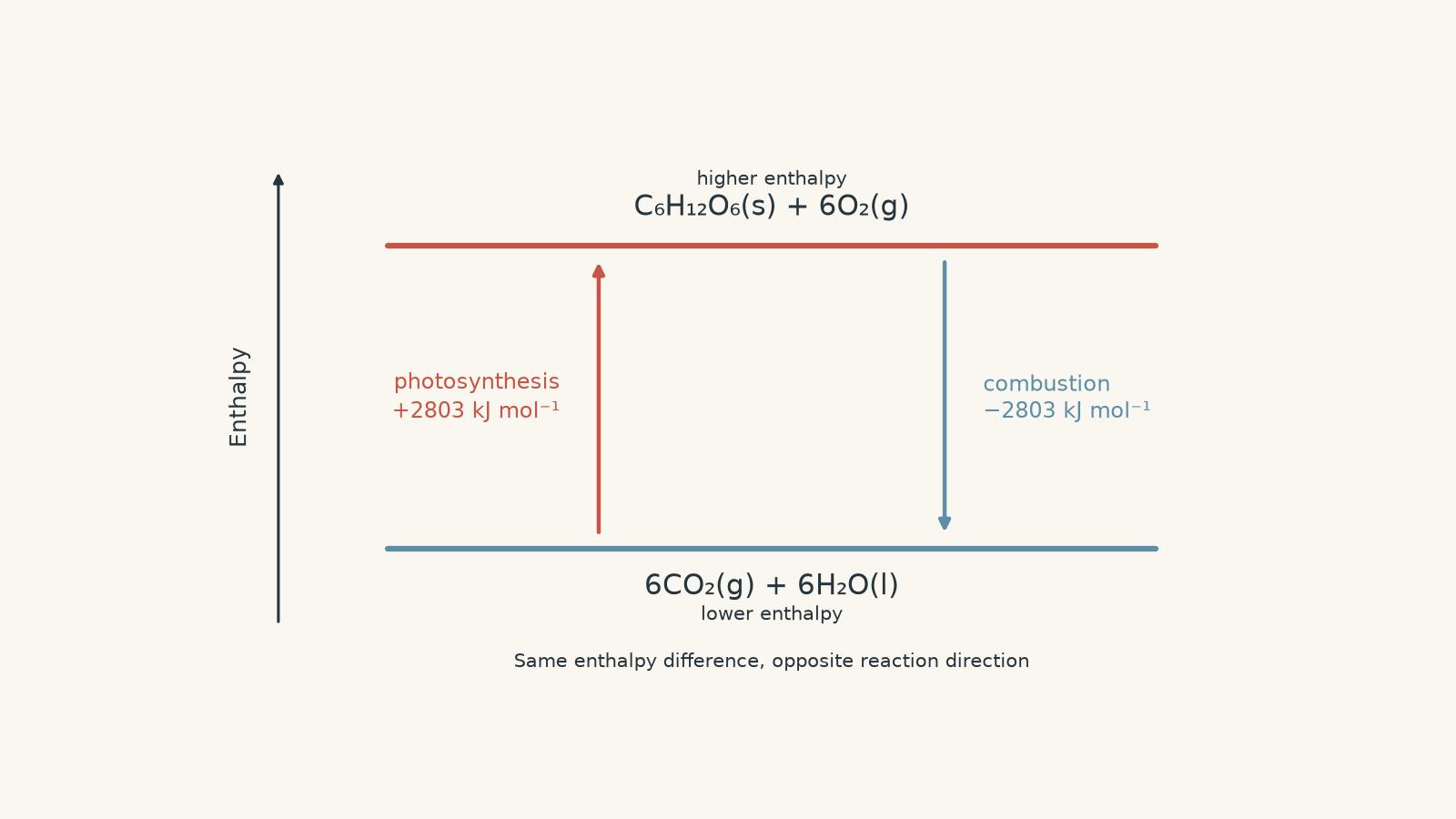
A battery is a useful analogy. Charging it requires energy input. Discharging it can return energy. Photosynthesis is like charging the chemical system, while combustion is like discharging it.
The analogy has a limit: glucose is not literally a battery containing a fixed packet of \(2803\ \text{kJ}\). Enthalpy always compares one set of chemical states with another.
02Why Hess’s Law works here
Hess’s Law follows directly from conservation of energy. If you travel from the same starting chemicals to the same final chemicals, the total enthalpy change must be the same regardless of the route.
That gives three rules worth having ready:
| What you do to an equation | What happens to \(\Delta H\) |
|---|---|
| Reverse the equation | Reverse the sign of \(\Delta H\) |
| Multiply all coefficients by \(n\) | Multiply \(\Delta H\) by \(n\) |
| Add chemical equations | Add their \(\Delta H\) values |
| Change a physical state | Account for the enthalpy of that state change |
The last row is easy to overlook. \(\ce{H2O(l)}\) and \(\ce{H2O(g)}\) are not energetically identical, even though they contain the same molecules.
If manipulating several thermochemical equations still feels slippery, the same logic is developed further in Hess’s Law for stepped reactions.
Worked example: Find photosynthesis enthalpy from combustion
The complete combustion of glucose is
\[ \ce{C6H12O6(s) + 6O2(g) -> 6CO2(g) + 6H2O(l)} \]
with \(\Delta H^\circ = -2803\ \text{kJ mol}^{-1}\). Calculate the enthalpy change for producing \(0.250\ \text{mol}\) of glucose by the reverse overall reaction.
Step 1
\[ \ce{6CO2(g) + 6H2O(l) -> C6H12O6(s) + 6O2(g)} \]
Reversing the reaction reverses the sign:
\[ \Delta H^\circ = +2803\ \text{kJ mol}^{-1} \]
Step 2
\[ \Delta H = 0.250\ \text{mol}\times 2803\ \text{kJ mol}^{-1} = 700.75\ \text{kJ} \]
To suitable significant figures,
\[ \Delta H \approx +701\ \text{kJ} \]
Step 3
Forming \(0.250\ \text{mol}\) of glucose from carbon dioxide and liquid water raises the enthalpy of the chemical system by about \(701\ \text{kJ}\).
The positive sign matters. Photosynthesis is endothermic for this overall reaction.
03Calculating photosynthesis enthalpy from formation data
Reversing combustion is convenient, but it is not the only route. We can also use standard enthalpies of formation.
For any reaction,
\[ \Delta H^\circ_\text{reaction} = \sum \Delta H^\circ_f(\text{products}) - \sum \Delta H^\circ_f(\text{reactants}) \]
where \(\Delta H^\circ_f\) is the standard enthalpy of formation of one mole of a substance from its elements in their standard states.
Notice the order: products minus reactants.
For photosynthesis,
\[ \ce{6CO2(g) + 6H2O(l) -> C6H12O6(s) + 6O2(g)} \]
suppose the data are:
| Substance | \(\Delta H^\circ_f\) (\(\text{kJ mol}^{-1}\)) |
|---|---|
| \(\ce{CO2(g)}\) | \(-393.5\) |
| \(\ce{H2O(l)}\) | \(-285.8\) |
| \(\ce{C6H12O6(s)}\) | \(-1273.3\) |
| \(\ce{O2(g)}\) | \(0\) |
Why is \(\Delta H^\circ_f\) for \(\ce{O2(g)}\) zero? Not because oxygen has “no energy”. It is zero because oxygen gas is an element in its standard state, and standard enthalpies of formation use those elemental standard states as the reference level.
Worked example: Use formation enthalpies and find the energy for 36.0 g of glucose
Using the table above, calculate the standard enthalpy change for photosynthesis, then calculate the enthalpy increase when \(36.0\ \text{g}\) of glucose is produced.
Step 1
\[ \begin{aligned} \sum \Delta H^\circ_f(\text{products}) &= (-1273.3)+6(0)\\ &=-1273.3\ \text{kJ mol}^{-1} \end{aligned} \]
Step 2
\[ \begin{aligned} \sum \Delta H^\circ_f(\text{reactants}) &= 6(-393.5)+6(-285.8)\\ &=-2361.0-1714.8\\ &=-4075.8\ \text{kJ mol}^{-1} \end{aligned} \]
Step 3
\[ \begin{aligned} \Delta H^\circ &=-1273.3-(-4075.8)\\ &=+2802.5\ \text{kJ mol}^{-1} \end{aligned} \]
So the calculated value is approximately
\[ \Delta H^\circ_\text{photosynthesis}=+2.80\times10^3\ \text{kJ mol}^{-1} \]
The small difference from a quoted \(+2803\ \text{kJ mol}^{-1}\) simply reflects rounding in the thermochemical data.
Step 4
The molar mass of \(\ce{C6H12O6}\) is approximately \(180.16\ \text{g mol}^{-1}\).
\[ n=\frac{36.0\ \text{g}}{180.16\ \text{g mol}^{-1}} =0.1998\ \text{mol} \]
Step 5
\[ \begin{aligned} \Delta H &=(0.1998\ \text{mol})(2802.5\ \text{kJ mol}^{-1})\\ &\approx +560\ \text{kJ} \end{aligned} \]
Producing \(36.0\ \text{g}\) of glucose therefore increases the enthalpy of the chemical system by about \(560\ \text{kJ}\).
04The tempting bond-energy mistake
A common explanation goes like this:
Photosynthesis needs energy because bonds have to be broken.
That is incomplete enough to become misleading.
Breaking any chemical bond requires energy. Forming a bond releases energy. Every reaction involves both processes.
For an approximate bond-enthalpy calculation,
\[ \Delta H \approx \sum E(\text{bonds broken}) - \sum E(\text{bonds formed}) \]
Photosynthesis is endothermic because, overall, more energy is required for the bond-breaking and rearrangement side of the accounting than is released when the new bonds form.
The reverse happens during glucose combustion. Forming the very stable bonds in \(\ce{CO2}\) and \(\ce{H2O}\) releases more energy than is required to break the bonds in glucose and oxygen.
So avoid saying that glucose is “high energy because its bonds are weak” or that “breaking glucose bonds releases energy”. Bond breaking itself never releases energy.
For a fuller treatment of that distinction, see Bond Enthalpy and Conservation of Energy in HSC Chemistry.
05What the \(+2803\ \text{kJ mol}^{-1}\) actually tells you
It tells you the enthalpy difference between specified reactants and products.
It does not tell you:
- how many individual reaction steps photosynthesis uses,
- how much light a real leaf must absorb,
- what fraction of incoming sunlight becomes chemical energy,
- how quickly glucose forms, or
- the detailed biological mechanism.
Suppose a photosynthetic system absorbs \(3500\ \text{kJ}\) of radiation while forming one mole of glucose under conditions where the chemical enthalpy increase is \(2803\ \text{kJ}\).
That does not make \(\Delta H=+3500\ \text{kJ mol}^{-1}\). The reaction enthalpy is still fixed by the chemical states. The remaining energy must be accounted for elsewhere, such as energy transferred to the surroundings.
This distinction is the difference between the energy supplied to a real process and the enthalpy change of the chemical reaction.
06Physical states can change the answer
Consider these two equations:
\[ \ce{6CO2(g) + 6H2O(l) -> C6H12O6(s) + 6O2(g)} \]
and
\[ \ce{6CO2(g) + 6H2O(g) -> C6H12O6(s) + 6O2(g)} \]
They have the same chemical formulas, but they are not the same thermochemical equation.
Water vapour has a higher enthalpy than liquid water. If the reactant already begins as vapour, part of the required “uphill” energy has effectively been supplied before the reaction starts.
So photosynthesis from gaseous water has a smaller positive enthalpy change than photosynthesis from liquid water.
This is why physical-state symbols are not decoration in a thermochemical equation. They are part of the data.
07Questions and solutions
Question 1
The standard enthalpy of combustion of glucose is \( -2803\ \text{kJ mol}^{-1}\).
Calculate:
a. the standard enthalpy change for
\[ \ce{6CO2(g) + 6H2O(l) -> C6H12O6(s) + 6O2(g)} \]
b. the enthalpy change when \(0.400\ \text{mol}\) of glucose is formed.
Solution 1
The answers are \(+2803\ \text{kJ mol}^{-1}\) for the reaction and \(+1121\ \text{kJ}\) for \(0.400\ \text{mol}\) of glucose.
Combustion is
\[ \ce{C6H12O6(s) + 6O2(g) -> 6CO2(g) + 6H2O(l)} \]
with
\[ \Delta H^\circ=-2803\ \text{kJ mol}^{-1} \]
The photosynthesis equation is exactly the reverse overall chemical change, with the same physical states. Reversing a thermochemical equation reverses the sign:
\[ \Delta H^\circ_\text{photosynthesis}=+2803\ \text{kJ mol}^{-1} \]
For \(0.400\ \text{mol}\),
\[ \begin{aligned} \Delta H &=(0.400\ \text{mol})(2803\ \text{kJ mol}^{-1})\\ &=+1121.2\ \text{kJ}\\ &\approx+1121\ \text{kJ} \end{aligned} \]
The tempting mistake is to keep the negative sign because combustion data were supplied. The sign belongs to the direction of the equation, not permanently to the substances involved.
Question 2
Use the following standard enthalpies of formation:
| Substance | \(\Delta H^\circ_f\) (\(\text{kJ mol}^{-1}\)) |
|---|---|
| \(\ce{CO2(g)}\) | \(-393.5\) |
| \(\ce{H2O(g)}\) | \(-241.8\) |
| \(\ce{C6H12O6(s)}\) | \(-1273.3\) |
| \(\ce{O2(g)}\) | \(0\) |
Calculate \(\Delta H^\circ\) for
\[ \ce{6CO2(g) + 6H2O(g) -> C6H12O6(s) + 6O2(g)} \]
Liquid water has \(\Delta H^\circ_f=-285.8\ \text{kJ mol}^{-1}\). Explain why the answer differs from photosynthesis starting with liquid water.
Solution 2
The enthalpy change using gaseous water is \(+2538.5\ \text{kJ mol}^{-1}\), which is \(264.0\ \text{kJ mol}^{-1}\) smaller than the value using liquid water.
For the products,
\[ \sum\Delta H^\circ_f = -1273.3+6(0) = -1273.3\ \text{kJ mol}^{-1} \]
For the reactants,
\[ \begin{aligned} \sum\Delta H^\circ_f &=6(-393.5)+6(-241.8)\\ &=-2361.0-1450.8\\ &=-3811.8\ \text{kJ mol}^{-1} \end{aligned} \]
Therefore,
\[ \begin{aligned} \Delta H^\circ &=-1273.3-(-3811.8)\\ &=+2538.5\ \text{kJ mol}^{-1} \end{aligned} \]
Using liquid water instead gives approximately \(+2802.5\ \text{kJ mol}^{-1}\).
The difference is
\[ 2802.5-2538.5=264.0\ \text{kJ mol}^{-1} \]
This also equals the energy associated with converting six moles of liquid water into water vapour:
\[ 6[(-241.8)-(-285.8)] = 6(44.0) = 264.0\ \text{kJ} \]
Gaseous water begins at a higher enthalpy than liquid water, so less additional energy is required to reach the same products.
A tempting route is to ignore the state symbols because both substances are simply “water”. Thermochemically, that loses a real energy difference.
Question 3
A photosynthetic apparatus forms exactly \(1.00\ \text{mol}\) of glucose from carbon dioxide and liquid water under conditions where
\[ \Delta H=+2803\ \text{kJ} \]
During the process, the apparatus absorbs \(3200\ \text{kJ}\) of radiation.
Assume that:
- the initial and final temperatures are the same,
- there is no electrical or mechanical energy output apart from ordinary pressure-volume work, and
- no energy remains stored in the apparatus itself.
Determine the net heat transferred between the reacting system and its surroundings, and explain why the \(3200\ \text{kJ}\) radiation input does not become the reaction enthalpy.
Solution 3
The reacting system must transfer \(397\ \text{kJ}\) of heat to the surroundings, so the heat transfer into the system is \(q=-397\ \text{kJ}\).
The chemical system finishes \(2803\ \text{kJ}\) higher in enthalpy than it began. Radiation supplies \(3200\ \text{kJ}\).
With the stated assumptions, energy conservation requires
\[ \Delta H=E_\text{radiation}+q \]
where \(q\) is positive when heat enters the reacting system.
Substituting,
\[ \begin{aligned} 2803\ \text{kJ} &=3200\ \text{kJ}+q\\ q&=-397\ \text{kJ} \end{aligned} \]
So \(397\ \text{kJ}\) must leave as heat.
The tempting conclusion is that absorbing \(3200\ \text{kJ}\) means \(\Delta H=+3200\ \text{kJ}\). That confuses energy supplied to the apparatus with the enthalpy difference between the chemical reactants and products.
If the same initial and final chemical states are reached, the reaction enthalpy remains \(+2803\ \text{kJ}\), regardless of the particular energy-transfer pathway.
Question 4
Consider the following three reactions.
Photosynthesis:
\[ \ce{6CO2(g) + 6H2O(l) -> C6H12O6(s) + 6O2(g)} \]
\[ \Delta H^\circ=+2803\ \text{kJ mol}^{-1} \]
Fermentation:
\[ \ce{C6H12O6(s) -> 2C2H5OH(l) + 2CO2(g)} \]
\[ \Delta H^\circ=x \]
Combustion of ethanol:
\[ \ce{C2H5OH(l) + 3O2(g) -> 2CO2(g) + 3H2O(l)} \]
\[ \Delta H^\circ=-1367\ \text{kJ mol}^{-1} \]
Use an energy cycle to determine \(x\). Then explain what the result shows about how much of glucose’s chemical energy remains in the ethanol after fermentation.
Solution 4
The fermentation enthalpy is approximately \(-69\ \text{kJ mol}^{-1}\), and most of the energy available from oxidising glucose remains in the ethanol rather than being released during fermentation.
Begin with one photosynthesis reaction:
\[ \ce{6CO2 + 6H2O -> C6H12O6 + 6O2} \]
Add fermentation:
\[ \ce{C6H12O6 -> 2C2H5OH + 2CO2} \]
Then add two ethanol-combustion reactions:
\[ \ce{2C2H5OH + 6O2 -> 4CO2 + 6H2O} \]
Adding all three stages cancels glucose, ethanol, oxygen, carbon dioxide, and water completely. The net chemical change is therefore zero.
A closed Hess cycle must have total enthalpy change zero:
\[ 2803+x+2(-1367)=0 \]
So
\[ \begin{aligned} 2803+x-2734&=0\\ x&=-69\ \text{kJ mol}^{-1} \end{aligned} \]
Fermentation therefore releases only about \(69\ \text{kJ}\) per mole of glucose in this cycle.
Meanwhile, the two moles of ethanol produced can still release
\[ 2(1367)=2734\ \text{kJ} \]
when completely combusted.
The tempting idea is that converting glucose into a different substance must use up most of the original chemical-energy difference. It does not. Hess’s Law shows where the remaining energetic potential has gone: it is still associated with the ethanol-plus-oxygen system relative to carbon dioxide and water.
Question 5
Two idealised devices each produce exactly \(1.00\ \text{mol}\) of solid glucose according to
\[ \ce{6CO2(g) + 6H2O(l) -> C6H12O6(s) + 6O2(g)} \]
under the same initial and final conditions.
For this reaction,
\[ \Delta H=+2803\ \text{kJ} \]
Device A absorbs \(3500\ \text{kJ}\) of radiation and releases \(697\ \text{kJ}\) of heat to its surroundings.
Device B absorbs only \(2500\ \text{kJ}\) of radiation but also absorbs \(303\ \text{kJ}\) of heat from its surroundings.
A student argues that Device A has \(\Delta H=+3500\ \text{kJ}\), while Device B has \(\Delta H=+2500\ \text{kJ}\), because those are their light inputs.
Another student argues that Device B cannot carry out the reaction because \(2500\ \text{kJ}<2803\ \text{kJ}\).
Assume there is no other relevant work or stored energy. Analyse both claims. Then state what would be wrong with a third device that absorbed only \(2500\ \text{kJ}\) of radiation, exchanged no heat, and still claimed to reach exactly the same final chemical state.
Solution 5
Both devices have the same reaction enthalpy, \(+2803\ \text{kJ}\). Device B is energetically possible under the stated accounting because the missing \(303\ \text{kJ}\) enters as heat. A third device receiving only \(2500\ \text{kJ}\) in total could not reach the stated final chemical state without another energy source or a change to the stated conditions.
For Device A, take energy entering the chemical system as positive.
It absorbs \(3500\ \text{kJ}\) of radiation but releases \(697\ \text{kJ}\) as heat:
\[ \begin{aligned} \text{net energy input} &=3500-697\\ &=2803\ \text{kJ} \end{aligned} \]
This matches
\[ \Delta H=+2803\ \text{kJ} \]
For Device B,
\[ \begin{aligned} \text{net energy input} &=2500+303\\ &=2803\ \text{kJ} \end{aligned} \]
Again,
\[ \Delta H=+2803\ \text{kJ} \]
The first student’s mistake is treating the amount of radiation absorbed as though it defines the reaction enthalpy. It does not. Reaction enthalpy is fixed by the initial and final thermodynamic states.
The second student’s argument is more plausible. \(2500\ \text{kJ}\) of radiation alone would indeed be insufficient under the stated energy balance. But Device B does not receive radiation alone. It receives another \(303\ \text{kJ}\) as heat, bringing its total energy input to \(2803\ \text{kJ}\).
For the proposed third device,
\[ E_\text{in}=2500\ \text{kJ} \]
but the required enthalpy increase is
\[ \Delta H=2803\ \text{kJ} \]
leaving a shortfall of
\[ 2803-2500=303\ \text{kJ} \]
With no heat input, no other energy transfer, and identical initial and final chemical states, that claim would violate energy conservation.
The key hinge is that “endothermic” does not specify where the required energy must come from. It specifies the enthalpy difference between the states. Radiation, heat, or another allowed energy transfer may contribute to crossing that difference.
08What this lets you analyse next
Once you can treat photosynthesis as an energy cycle, several apparently different problems become the same piece of reasoning.
You can reverse combustion data to find synthesis enthalpies, combine intermediate reactions using Hess’s Law, test whether thermochemical data are internally consistent, and recognise when a changed physical state means you are no longer comparing the same reaction.
The next useful step is to connect this exact Hess’s Law treatment with approximate bond-enthalpy calculations. Both obey conservation of energy, but bond enthalpies use averaged bond data, while formation and combustion enthalpies refer to complete substances in specified states. Knowing which model you are using is what keeps an energy calculation chemically meaningful.