
Entropy and Enthalpy Changes: HSC Chemistry Explained
Learn how enthalpy and entropy differ, how to predict entropy changes from balanced equations, and when gas counting is not enough.
Suppose nitrogen and hydrogen gases react to form ammonia:
\[
\ce{N2(g) + 3H2(g) -> 2NH3(g)}
\]
The reaction releases heat. A very tempting prediction is: “Energy is being released, so entropy must increase.”
Before going further, look only at the balanced equation. Four moles of gas become two moles of gas. Would you expect the reacting chemicals to have more possible arrangements afterwards, or fewer?
Fewer. The entropy of the system decreases, even though the reaction is exothermic.
That apparent contradiction is exactly why enthalpy and entropy need separate names. They answer different questions.
01Enthalpy and entropy measure different things
For a chemical reaction, enthalpy asks about energy transfer.
Entropy asks about how many microscopic arrangements of matter and energy are available to the system.
Those ideas are related when we eventually consider whether a reaction is thermodynamically spontaneous, but they are not interchangeable.
Enthalpy: has the system gained or lost energy as heat?
Enthalpy is represented by \(H\). For a reaction, we usually care about the enthalpy change:
\[
\Delta H = H_{\text{products}} – H_{\text{reactants}}
\]
Under the usual constant-pressure conditions used in chemistry, \(\Delta H\) corresponds to the heat absorbed or released by the system.
- \(\Delta H < 0\): the reaction is exothermic. The system releases heat.
- \(\Delta H > 0\): the reaction is endothermic. The system absorbs heat.
For example, if
\[
\Delta H^\circ = -92.4\text{ kJ mol}^{-1}
\]
the negative sign tells you that the reaction releases 92.4 kJ of heat per mole of reaction as written.
It says nothing by itself about whether entropy increases or decreases.
Entropy: how many microscopic arrangements are available?
Entropy is represented by \(S\).
Imagine a school formal with an extremely strict seating plan. Every student has one assigned seat. Now imagine the seating plan disappears and everyone can move around the hall. There are suddenly far more possible arrangements of the same people.
Open the doors to an entire oval and the number of possible arrangements becomes larger again.
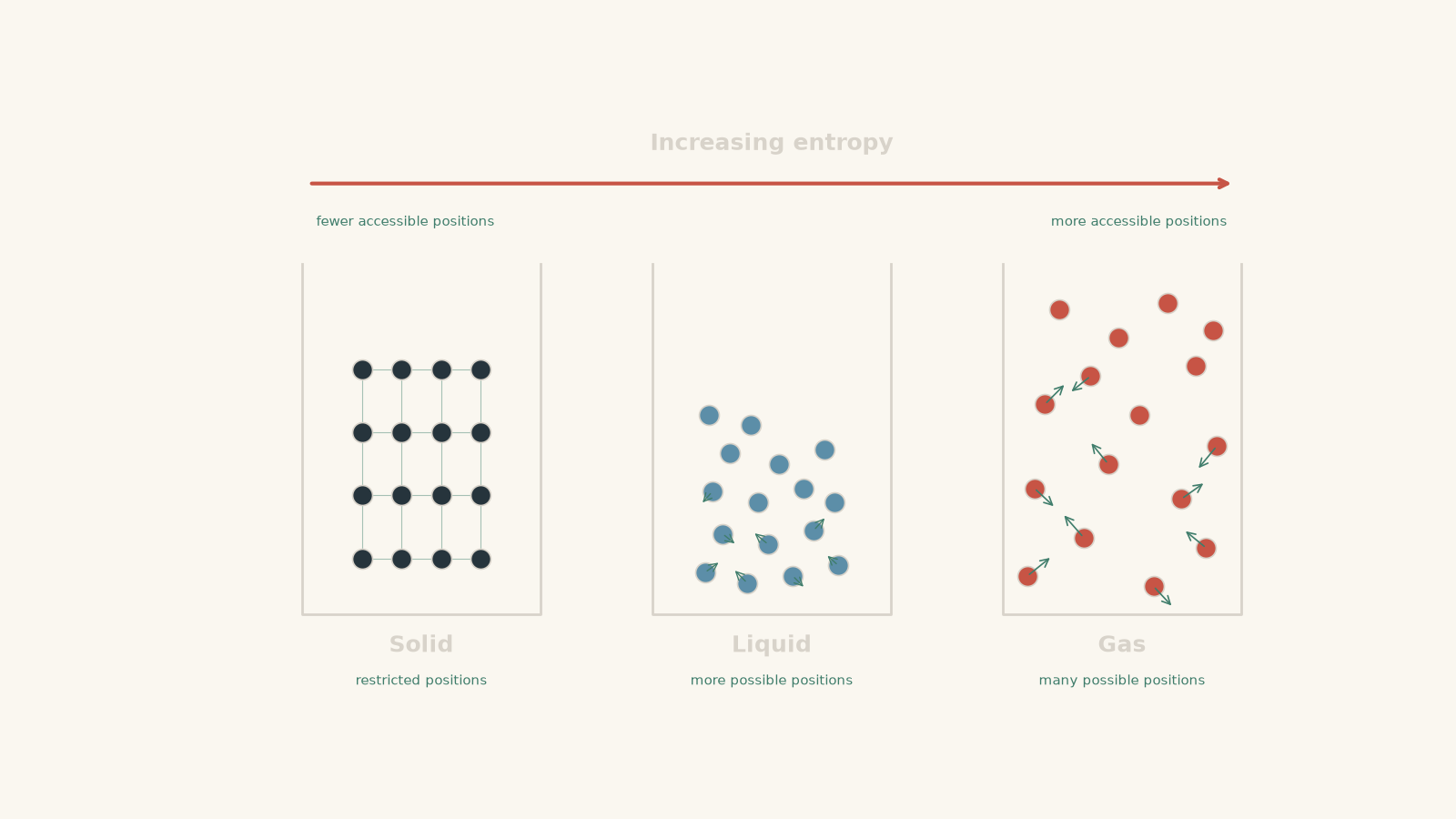
That is roughly the idea behind entropy. A system has higher entropy when its particles and energy can be arranged among more accessible microscopic possibilities.
The analogy has limits. Molecules do much more than occupy positions. They can translate, rotate, vibrate, and distribute energy in different ways. Entropy includes all of those possibilities, not just where particles happen to be.
For a reaction,
\[
\Delta S = S_{\text{products}} – S_{\text{reactants}}
\]
so:
- \(\Delta S > 0\): entropy increases
- \(\Delta S < 0\): entropy decreases
Standard molar entropy, \(S^\circ\), is normally measured in \(\text{J mol}^{-1}\text{ K}^{-1}\).
Reaction entropy, \(\Delta S^\circ\), is also normally reported in \(\text{J mol}^{-1}\text{ K}^{-1}\), referring to the reaction as written.
02How to predict an entropy change from an equation
You usually don’t need entropy data to make a first prediction.
Instead, read the balanced equation as a description of what is happening to the particles.
The strongest clue is usually the gaseous substances.
Start by counting moles of gas
Gas particles have enormous freedom to move through their container. Changing the amount of gas therefore tends to produce a much larger entropy effect than changing the number of particles in a solid.
Calculate
\[
\Delta n_{\text{gas}}
=
\sum n_{\text{gas, products}}
–
\sum n_{\text{gas, reactants}}
\]
where \(n_{\text{gas}}\) means the stoichiometric amount of gaseous substances in the balanced equation.
If \(\Delta n_{\text{gas}} > 0\), entropy will usually increase.
If \(\Delta n_{\text{gas}} < 0\), entropy will usually decrease.
For example,
\[
\ce{CaCO3(s) -> CaO(s) + CO2(g)}
\]
creates a gas where there was no gas before.
That is a strong reason to predict
\[
\Delta S > 0
\]
By contrast,
\[
\ce{2NO2(g) -> N2O4(g)}
\]
takes two moles of gas and forms one mole of gas, so
\[
\Delta S < 0
\]
is the sensible prediction.
Then look for changes of state
For the same substance under comparable conditions, the broad pattern is
\[
S_{\text{solid}} < S_{\text{liquid}} < S_{\text{gas}}
\]
A solid’s particles are confined to relatively restricted positions. A liquid gives them more freedom. A gas gives them dramatically more translational freedom.
So these processes generally increase entropy:
\[
\ce{solid -> liquid -> gas}
\]
and the reverse processes decrease it:
\[
\ce{gas -> liquid -> solid}
\]
This is why vaporisation has a positive entropy change and condensation has a negative entropy change.
Then consider how many independent particles are available
If no major gas or phase change settles the question, consider whether particles are being combined or separated.
Dissociation and mixing often increase the number of accessible arrangements. Association often reduces it.
But this clue is weaker than the gas rule.
For example, dissolving an ionic solid may give ions more freedom to move, but water molecules can also become organised around those ions. You should not treat “more dissolved particles” as an absolute law that guarantees \(\Delta S > 0\).
A useful decision order is:
| What changes? | Typical entropy prediction |
|---|---|
| More moles of gas | Strongly suggests \(\Delta S > 0\) |
| Fewer moles of gas | Strongly suggests \(\Delta S < 0\) |
| Solid or liquid becomes gas | \(\Delta S > 0\) |
| Gas condenses or forms a solid | \(\Delta S < 0\) |
| Solid melts | \(\Delta S > 0\) |
| Liquid freezes | \(\Delta S < 0\) |
| Particles mix or separate into more independent species | Often increases entropy |
| Gas moles and phases barely change | Equation alone may not be enough |
That final row matters.
The balanced equation gives you a model for predicting entropy. It is not a magic particle-counting formula.
Worked example: Does making ammonia increase entropy?
For the reaction
\[
\ce{N2(g) + 3H2(g) -> 2NH3(g)}
\]
the standard enthalpy change is \(\Delta H^\circ = -92.4\text{ kJ mol}^{-1}\).
Use the following standard molar entropies to predict and then calculate \(\Delta S^\circ\):
| Substance | \(S^\circ\) (\(\text{J mol}^{-1}\text{ K}^{-1}\)) |
|---|---|
| \(\ce{N2(g)}\) | 191.5 |
| \(\ce{H2(g)}\) | 130.7 |
| \(\ce{NH3(g)}\) | 192.8 |
Step 1
The reactants contain
\[
1 + 3 = 4\text{ mol gas}
\]
while the products contain
\[
2\text{ mol gas}
\]
Therefore,
\[
\Delta n_{\text{gas}} = 2 – 4 = -2
\]
The amount of gas decreases substantially, so we predict \(\Delta S^\circ < 0\).
Step 2
\[
S^\circ_{\text{products}}
=
2(192.8)
=
385.6\text{ J mol}^{-1}\text{ K}^{-1}
\]
Step 3
\[
\begin{aligned}
S^\circ_{\text{reactants}}
&=191.5+3(130.7)\\
&=583.6\text{ J mol}^{-1}\text{ K}^{-1}
\end{aligned}
\]
Step 4
\[
\begin{aligned}
\Delta S^\circ
&=S^\circ_{\text{products}}-S^\circ_{\text{reactants}}\\
&=385.6-583.6\\
&=-198.0\text{ J mol}^{-1}\text{ K}^{-1}
\end{aligned}
\]
The negative result agrees with our particle model.
So for this reaction,
\[
\Delta H^\circ < 0
\qquad\text{and}\qquad
\Delta S^\circ < 0
\]
The reaction releases heat, but the reacting system has fewer accessible microscopic arrangements.
There is no contradiction. Enthalpy and entropy are measuring different things.
03Why “entropy means disorder” can get you into trouble
“Entropy is disorder” is useful for about thirty seconds.
Then it starts causing problems.
A bedroom can look messy without having a thermodynamic entropy you can judge by eye. Chemistry is not measuring untidiness.
The deeper idea is the number of microscopic ways the particles and their energy can be arranged while producing the same overall state.
This explains why gases usually have high entropy. A gas particle can occupy an enormous range of positions and have many possible translational energy states.
It also explains why heating a substance usually increases its entropy. At a higher temperature, more energy distributions become accessible even if the substance has not changed phase.
So use “disorder” only as an initial picture. In an exam explanation, ideas such as greater particle freedom, greater energy dispersal, and more accessible microscopic arrangements are more precise.
04When gas counting is not enough
Now consider this reaction:
\[
\ce{CO(g) + H2O(g) -> CO2(g) + H2(g)}
\]
Predict \(\Delta S^\circ\) using gas moles alone.
There are two moles of gas on each side.
So is \(\Delta S^\circ = 0\)?
No. Equal gas moles mean the shortcut has stopped helping. They do not prove that the entropies are equal.
Different substances have different molecular structures, masses, bonding, rotational motions, and vibrational motions. Their standard molar entropies are therefore different.
When data are provided, use them.
For a general reaction,
\[
\Delta S^\circ
=
\sum nS^\circ_{\text{products}}
–
\sum nS^\circ_{\text{reactants}}
\]
where \(n\) is the stoichiometric coefficient and \(S^\circ\) is the standard molar entropy of each substance.
Worked example: Equal gas moles, but not zero entropy change
For
\[
\ce{CO(g) + H2O(g) -> CO2(g) + H2(g)}
\]
the standard enthalpy change is approximately
\[
\Delta H^\circ = -41.2\text{ kJ mol}^{-1}
\]
Use:
| Substance | \(S^\circ\) (\(\text{J mol}^{-1}\text{ K}^{-1}\)) |
|---|---|
| \(\ce{CO(g)}\) | 197.7 |
| \(\ce{H2O(g)}\) | 188.8 |
| \(\ce{CO2(g)}\) | 213.7 |
| \(\ce{H2(g)}\) | 130.7 |
Step 1
There are two moles of gas on each side:
\[
\Delta n_{\text{gas}} = 2 – 2 = 0
\]
So gas counting alone cannot determine the sign of \(\Delta S^\circ\).
That does not mean the entropy change is zero.
Step 2
\[
\begin{aligned}
S^\circ_{\text{products}}
&=213.7+130.7\\
&=344.4\text{ J mol}^{-1}\text{ K}^{-1}
\end{aligned}
\]
Step 3
\[
\begin{aligned}
S^\circ_{\text{reactants}}
&=197.7+188.8\\
&=386.5\text{ J mol}^{-1}\text{ K}^{-1}
\end{aligned}
\]
Step 4
\[
\begin{aligned}
\Delta S^\circ
&=344.4-386.5\\
&=-42.1\text{ J mol}^{-1}\text{ K}^{-1}
\end{aligned}
\]
The entropy decreases despite there being the same number of gaseous moles on both sides.
Again,
\[
\Delta H^\circ < 0
\qquad\text{and}\qquad
\Delta S^\circ < 0
\]
but those two negative signs come from different physical ideas.
05Enthalpy and entropy do not have to point the same way
All four sign combinations are possible.
| \(\Delta H\) | \(\Delta S\) | Example of the physical situation |
|---|---|---|
| Negative | Positive | Heat is released while particle freedom increases |
| Negative | Negative | Heat is released while particle freedom decreases |
| Positive | Positive | Energy is absorbed while particle freedom increases |
| Positive | Negative | Energy is absorbed while particle freedom decreases |
For example, thermal decomposition of calcium carbonate,
\[
\ce{CaCO3(s) -> CaO(s) + CO2(g)}
\]
requires energy, so \(\Delta H > 0\), but creates a gas, strongly favouring \(\Delta S > 0\).
Formation of ammonia,
\[
\ce{N2(g) + 3H2(g) -> 2NH3(g)}
\]
has \(\Delta H < 0\) and \(\Delta S < 0\).
Formation of ozone from oxygen,
\[
\ce{3O2(g) -> 2O3(g)}
\]
requires energy and reduces the number of gas particles, giving the opposite combination: \(\Delta H > 0\) and \(\Delta S < 0\).
There is no rule saying an exothermic reaction must increase entropy, or an endothermic reaction must decrease it.
06The system and the surroundings are not the same thing
This is the source of one particularly convincing mistake.
A student might say:
An exothermic reaction releases energy into the surroundings, spreading that energy out. Doesn’t that mean entropy increases?
The surroundings can indeed gain entropy when they receive heat.
But when you calculate \(\Delta S^\circ\) from standard molar entropy data for a chemical equation, you are calculating the entropy change of the reaction system.
Those are different quantities.
For ammonia formation, the system loses entropy because four moles of gas become two.
At the same time, because the reaction is exothermic, heat is transferred to the surroundings. That heat transfer tends to increase the surroundings’ entropy.
So these two statements can both be true:
- the system’s entropy decreases;
- the surroundings’ entropy increases.
Keeping the boundary clear prevents a lot of thermodynamics from turning into soup.
07Five entropy traps worth catching
First, exothermic does not mean \(\Delta S > 0\). The sign of \(\Delta H\) does not determine the sign of \(\Delta S\).
Second, don’t simply count the number of substances written on each side. In
\[
\ce{CaCO3(s) -> CaO(s) + CO2(g)}
\]
the important point is not merely “one substance becomes two”. It is that a gas is produced.
Third, \(\Delta n_{\text{gas}} = 0\) does not mean \(\Delta S = 0\). It means the strongest shortcut has become inconclusive.
Fourth, standard molar entropy \(S^\circ\) is not treated like standard enthalpy of formation. An element in its standard state can have
\[
\Delta H_f^\circ = 0
\]
by definition, while its \(S^\circ\) at 298 K is not zero.
Finally, a spontaneous reaction is not necessarily fast. Thermodynamics describes whether a change is energetically favourable under specified conditions. Reaction rate belongs to kinetics.
08Where enthalpy and entropy finally meet
Why bother keeping \(\Delta H\) and \(\Delta S\) separate?
Because whether a reaction is thermodynamically spontaneous depends on both.
The HSC relationship is
\[
\Delta G^\circ = \Delta H^\circ – T\Delta S^\circ
\]
where:
- \(\Delta G^\circ\) is the standard Gibbs free energy change, usually in \(\text{kJ mol}^{-1}\)
- \(\Delta H^\circ\) is the standard enthalpy change in \(\text{kJ mol}^{-1}\)
- \(T\) is absolute temperature in kelvin, \(\text{K}\)
- \(\Delta S^\circ\) is the standard entropy change
If \(\Delta H^\circ\) is in \(\text{kJ mol}^{-1}\), remember to convert \(\Delta S^\circ\) from \(\text{J mol}^{-1}\text{ K}^{-1}\) to \(\text{kJ mol}^{-1}\text{ K}^{-1}\) before substituting.
For the standard HSC treatment:
- \(\Delta G^\circ < 0\): thermodynamically spontaneous under standard conditions
- \(\Delta G^\circ > 0\): thermodynamically non-spontaneous under standard conditions
- \(\Delta G^\circ = 0\): the boundary between the two
This equation is also why temperature matters. The entropy contribution is multiplied by \(T\), while the enthalpy term is not.
09Questions and solutions
Question 1
Consider the decomposition:
\[
\ce{CaCO3(s) -> CaO(s) + CO2(g)}
\]
The reaction has \(\Delta H^\circ = +178\text{ kJ mol}^{-1}\).
Predict the signs of \(\Delta H^\circ\) and \(\Delta S^\circ\), and explain what each sign means physically.
Solution 1
The reaction has \(\Delta H^\circ > 0\) and is expected to have \(\Delta S^\circ > 0\).
The positive enthalpy change is given directly:
\[
\Delta H^\circ = +178\text{ kJ mol}^{-1}
\]
so the reaction is endothermic. The reacting system absorbs energy as heat under constant-pressure conditions.
For entropy, the reactant is entirely solid, while the products include gaseous \(\ce{CO2}\).
The gaseous product has far greater freedom of movement and many more accessible microscopic arrangements than particles confined to solids. The production of gas therefore strongly indicates
\[
\Delta S^\circ > 0
\]
A tempting shortcut is to say entropy increases because “one substance becomes two”. That happens to give the correct direction here, but it is not the real reason. The important change is the formation of a gas.
Question 2
Sulfur dioxide is oxidised according to
\[
\ce{2SO2(g) + O2(g) -> 2SO3(g)}
\]
The standard enthalpy change is \(-198\text{ kJ mol}^{-1}\).
Use the following data to:
a. predict the sign of \(\Delta S^\circ\) before calculating it
b. calculate \(\Delta S^\circ\)
c. explain why the signs of \(\Delta H^\circ\) and \(\Delta S^\circ\) are not contradictory.
| Substance | \(S^\circ\) (\(\text{J mol}^{-1}\text{ K}^{-1}\)) |
|---|---|
| \(\ce{SO2(g)}\) | 248.2 |
| \(\ce{O2(g)}\) | 205.0 |
| \(\ce{SO3(g)}\) | 256.8 |
Solution 2
The entropy decreases, with \(\Delta S^\circ = -187.8\text{ J mol}^{-1}\text{ K}^{-1}\), while the reaction is exothermic because \(\Delta H^\circ < 0\).
First make the prediction.
The reactants contain
\[
2 + 1 = 3\text{ mol gas}
\]
and the products contain
\[
2\text{ mol gas}
\]
Therefore,
\[
\Delta n_{\text{gas}} = 2 – 3 = -1
\]
so we predict \(\Delta S^\circ < 0\).
Now calculate it:
\[
\Delta S^\circ
=
\sum nS^\circ_{\text{products}}
–
\sum nS^\circ_{\text{reactants}}
\]
Products:
\[
2(256.8) = 513.6\text{ J mol}^{-1}\text{ K}^{-1}
\]
Reactants:
\[
\begin{aligned}
2(248.2)+205.0
&=496.4+205.0\\
&=701.4\text{ J mol}^{-1}\text{ K}^{-1}
\end{aligned}
\]
Therefore,
\[
\begin{aligned}
\Delta S^\circ
&=513.6-701.4\\
&=-187.8\text{ J mol}^{-1}\text{ K}^{-1}
\end{aligned}
\]
The numerical result agrees with the original prediction.
Meanwhile,
\[
\Delta H^\circ = -198\text{ kJ mol}^{-1}
\]
means the system releases heat.
There is no requirement for \(\Delta H^\circ\) and \(\Delta S^\circ\) to have the same sign. Enthalpy describes energy transfer, while entropy describes the availability of microscopic arrangements.
Question 3
A student considers
\[
\ce{2H2(g) + O2(g) -> 2H2O(l)}
\]
and argues:
“Because the reaction is strongly exothermic, lots of energy spreads out, so the entropy of the reacting system must increase.”
The standard enthalpy change is
\[
\Delta H^\circ = -571.6\text{ kJ mol}^{-1}
\]
and the standard molar entropies are:
| Substance | \(S^\circ\) (\(\text{J mol}^{-1}\text{ K}^{-1}\)) |
|---|---|
| \(\ce{H2(g)}\) | 130.7 |
| \(\ce{O2(g)}\) | 205.2 |
| \(\ce{H2O(l)}\) | 69.9 |
Evaluate the student’s claim. Calculate \(\Delta S^\circ\) and explain what they have confused.
Solution 3
The student’s claim is incorrect: the reacting system has \(\Delta S^\circ = -326.8\text{ J mol}^{-1}\text{ K}^{-1}\), even though the reaction is strongly exothermic.
The balanced equation already gives a strong prediction.
Three moles of gas,
\[
2\ce{H2(g)}+\ce{O2(g)}
\]
are converted into liquid water. Losing all of that gas-phase freedom should produce a large entropy decrease.
Calculate the product entropy:
\[
2(69.9) = 139.8\text{ J mol}^{-1}\text{ K}^{-1}
\]
Calculate the reactant entropy:
\[
\begin{aligned}
2(130.7)+205.2
&=261.4+205.2\\
&=466.6\text{ J mol}^{-1}\text{ K}^{-1}
\end{aligned}
\]
Therefore,
\[
\begin{aligned}
\Delta S^\circ
&=139.8-466.6\\
&=-326.8\text{ J mol}^{-1}\text{ K}^{-1}
\end{aligned}
\]
The negative result is large because gaseous particles are being converted into a liquid.
The student has mixed up the system and surroundings.
Because
\[
\Delta H^\circ = -571.6\text{ kJ mol}^{-1}
\]
the system releases heat to its surroundings. That transfer can increase the entropy of the surroundings.
But \(\Delta S^\circ\) calculated from the substances in the equation refers to the reacting system. Its entropy falls.
The tempting idea is reasonable because released energy really does become dispersed outside the system. The error is attaching that observation to the wrong entropy change.
Question 4
For the equilibrium
\[
\ce{2NO2(g) <=> N2O4(g)}
\]
assume
\[
\Delta H^\circ = -57.2\text{ kJ mol}^{-1}
\]
and
\[
\Delta S^\circ = -175.8\text{ J mol}^{-1}\text{ K}^{-1}
\]
remain approximately constant across the temperature range considered.
a. Explain why the sign of \(\Delta S^\circ\) is sensible from the balanced equation.
b. Calculate the temperature at which \(\Delta G^\circ = 0\).
c. Calculate \(\Delta G^\circ\) at 250 K and 400 K.
d. Explain why increasing temperature eventually changes the thermodynamic direction favoured by the reaction.
Solution 4
The forward reaction has \(\Delta S^\circ < 0\), reaches \(\Delta G^\circ = 0\) at approximately \(325\text{ K}\), is thermodynamically spontaneous under standard conditions at 250 K, and is non-spontaneous under standard conditions at 400 K.
For part a, two moles of gas become one mole of gas:
\[
\Delta n_{\text{gas}} = 1 – 2 = -1
\]
so a decrease in entropy is expected. The particles have fewer gas-phase arrangements available after dimerisation.
For the Gibbs free energy calculations, first convert entropy into \(\text{kJ mol}^{-1}\text{ K}^{-1}\):
\[
-175.8\text{ J mol}^{-1}\text{ K}^{-1}
=
-0.1758\text{ kJ mol}^{-1}\text{ K}^{-1}
\]
At the crossover,
\[
\Delta G^\circ = \Delta H^\circ – T\Delta S^\circ = 0
\]
so
\[
T = \frac{\Delta H^\circ}{\Delta S^\circ}
\]
Substituting:
\[
\begin{aligned}
T
&=\frac{-57.2}{-0.1758}\\
&=325.4\text{ K}
\end{aligned}
\]
Therefore, the crossover temperature is approximately
\[
T = 325\text{ K}
\]
At 250 K:
\[
\begin{aligned}
\Delta G^\circ
&=-57.2-250(-0.1758)\\
&=-57.2+43.95\\
&=-13.25\text{ kJ mol}^{-1}
\end{aligned}
\]
Since \(\Delta G^\circ < 0\), the forward reaction is thermodynamically spontaneous under standard conditions at 250 K.
At 400 K:
\[
\begin{aligned}
\Delta G^\circ
&=-57.2-400(-0.1758)\\
&=-57.2+70.32\\
&=+13.12\text{ kJ mol}^{-1}
\end{aligned}
\]
Since \(\Delta G^\circ > 0\), the forward reaction is thermodynamically non-spontaneous under standard conditions at 400 K.
The tempting prediction is that an exothermic reaction should simply remain favourable as temperature rises. That ignores the entropy term.
Here,
\[
\Delta S^\circ < 0
\]
so
\[
-T\Delta S^\circ
\]
is positive. As \(T\) increases, this positive contribution grows and increasingly opposes the negative enthalpy term.
At low temperature, the favourable negative \(\Delta H^\circ\) dominates. At sufficiently high temperature, the entropy penalty dominates instead.
Question 5
A hypothetical reaction occurs through two steps:
\[
\ce{A(s) -> B(g)}
\]
with
\[
\Delta H_1^\circ = +90\text{ kJ mol}^{-1}
\]
and
\[
\Delta S_1^\circ = +180\text{ J mol}^{-1}\text{ K}^{-1}
\]
followed by
\[
\ce{B(g) + C(g) -> D(g)}
\]
with
\[
\Delta H_2^\circ = -60\text{ kJ mol}^{-1}
\]
and
\[
\Delta S_2^\circ = -130\text{ J mol}^{-1}\text{ K}^{-1}
\]
The intermediate \(\ce{B(g)}\) does not appear in the overall reaction.
a. Write the overall reaction and calculate its \(\Delta H^\circ\) and \(\Delta S^\circ\).
b. A student says the overall entropy change must be zero because there is one mole of gas on each side. Explain the flaw.
c. Assuming \(\Delta H^\circ\) and \(\Delta S^\circ\) are constant, find the temperature at which \(\Delta G^\circ = 0\). Determine the sign of \(\Delta G^\circ\) at 500 K and 800 K.
d. The overall reaction is reversed. State the new signs of \(\Delta H^\circ\) and \(\Delta S^\circ\), and determine the temperature range in which the reversed reaction is thermodynamically spontaneous under standard conditions.
e. Instead of reversing it, the original balanced equation is doubled. Explain what happens to \(\Delta H^\circ\), \(\Delta S^\circ\), \(\Delta G^\circ\), and the crossover temperature.
Solution 5
The overall reaction is \(\ce{A(s) + C(g) -> D(g)}\), with \(\Delta H^\circ = +30\text{ kJ mol}^{-1}\) and \(\Delta S^\circ = +50\text{ J mol}^{-1}\text{ K}^{-1}\); it becomes thermodynamically spontaneous above \(600\text{ K}\). Reversing it reverses both thermodynamic signs and makes it spontaneous below \(600\text{ K}\). Doubling the equation doubles \(\Delta H^\circ\), \(\Delta S^\circ\), and \(\Delta G^\circ\), but does not change the crossover temperature.
First add the two steps:
\[
\ce{A(s) -> B(g)}
\]
\[
\ce{B(g) + C(g) -> D(g)}
\]
The intermediate \(\ce{B(g)}\) appears on opposite sides and cancels, giving
\[
\ce{A(s) + C(g) -> D(g)}
\]
Both enthalpy and entropy are state functions, so their changes can be added across the steps.
For enthalpy:
\[
\begin{aligned}
\Delta H^\circ
&=\Delta H_1^\circ+\Delta H_2^\circ\\
&=90+(-60)\\
&=+30\text{ kJ mol}^{-1}
\end{aligned}
\]
For entropy:
\[
\begin{aligned}
\Delta S^\circ
&=\Delta S_1^\circ+\Delta S_2^\circ\\
&=180+(-130)\\
&=+50\text{ J mol}^{-1}\text{ K}^{-1}
\end{aligned}
\]
So the overall reaction is endothermic and has increasing entropy.
For part b, the student’s gas count is correct:
\[
\Delta n_{\text{gas}} = 1 – 1 = 0
\]
Their conclusion is not.
Equal gas moles mean that the gas-count shortcut cannot predict the sign. It does not mean the entropy change equals zero.
The overall reaction also consumes a solid, and the actual substances on each side have different standard molar entropies. The step data show that the net entropy change is
\[
+50\text{ J mol}^{-1}\text{ K}^{-1}
\]
The exact constraint that defeats the shortcut is that entropy depends on the actual accessible microstates of the substances, not only on the number of gas coefficients.
For part c, convert the entropy change:
\[
50\text{ J mol}^{-1}\text{ K}^{-1}
=
0.050\text{ kJ mol}^{-1}\text{ K}^{-1}
\]
At the crossover,
\[
0 = \Delta H^\circ – T\Delta S^\circ
\]
so
\[
\begin{aligned}
T
&=\frac{30}{0.050}\\
&=600\text{ K}
\end{aligned}
\]
At 500 K:
\[
\begin{aligned}
\Delta G^\circ
&=30-500(0.050)\\
&=30-25\\
&=+5\text{ kJ mol}^{-1}
\end{aligned}
\]
so the reaction is thermodynamically non-spontaneous under standard conditions.
At 800 K:
\[
\begin{aligned}
\Delta G^\circ
&=30-800(0.050)\\
&=30-40\\
&=-10\text{ kJ mol}^{-1}
\end{aligned}
\]
so the reaction is thermodynamically spontaneous under standard conditions.
This is a reaction with both
\[
\Delta H^\circ > 0
\qquad\text{and}\qquad
\Delta S^\circ > 0
\]
At low temperature, the positive enthalpy term dominates. At high temperature, the increasingly negative value of \(-T\Delta S^\circ\) becomes large enough to overcome it.
For part d, reversing a reaction reverses the signs of all reaction changes:
\[
\Delta H^\circ = -30\text{ kJ mol}^{-1}
\]
and
\[
\Delta S^\circ = -50\text{ J mol}^{-1}\text{ K}^{-1}
\]
For the reverse reaction,
\[
\Delta G^\circ = -30 – T(-0.050)
\]
or
\[
\Delta G^\circ = -30 + 0.050T
\]
The crossover remains at 600 K.
Below 600 K,
\[
\Delta G^\circ < 0
\]
so the reverse reaction is thermodynamically spontaneous under standard conditions.
Above 600 K,
\[
\Delta G^\circ > 0
\]
so it is non-spontaneous under standard conditions.
For part e, doubling the original equation doubles the amount of chemical change being described.
Therefore,
\[
\Delta H^\circ = +60\text{ kJ mol}^{-1}
\]
and
\[
\Delta S^\circ = +100\text{ J mol}^{-1}\text{ K}^{-1}
\]
At any chosen temperature, \(\Delta G^\circ\) also doubles because
\[
\Delta G^\circ = \Delta H^\circ – T\Delta S^\circ
\]
and both terms have doubled.
But the crossover temperature is
\[
T = \frac{\Delta H^\circ}{\Delta S^\circ}
\]
so doubling both numerator and denominator changes nothing:
\[
T
=
\frac{60}{0.100}
=
600\text{ K}
\]
That is the final trap. Thermodynamic quantities such as \(\Delta H^\circ\), \(\Delta S^\circ\), and \(\Delta G^\circ\) scale when you multiply a chemical equation. The physical temperature at which the enthalpy and entropy contributions balance does not.
10What this lets you understand next
Once you can keep enthalpy and entropy separate, Gibbs free energy stops looking like a formula to memorise.
\(\Delta H\) tells you about the energetic cost or benefit of the reaction. \(\Delta S\) tells you how the number and distribution of accessible microscopic arrangements change. Temperature decides how heavily that entropy change contributes through \(T\Delta S\).
That gives you the next useful question: not merely “does entropy increase?”, but under what temperatures will enthalpy or entropy dominate the thermodynamic direction of a reaction?
That is the bridge from entropy predictions to Gibbs free energy, reaction spontaneity, and eventually chemical equilibrium.