
Aboriginal Acid-Base Analysis in HSC Chemistry
Learn how alkaline plant ashes can affect weak-base equilibria, and how to analyse these practices respectfully using HSC acid-base chemistry.
Two bowls contain ash made from different plants. They look almost identical. Yet when each is mixed with the same plant material, one produces a much stronger chemical effect than the other.
What would you predict: if both are “ash”, should they behave about the same?
They should not. Ash is not one pure substance. Its composition depends on the plant, the part burned, the soil it grew in, and how combustion occurred. Different ashes can therefore have very different acid-base behaviour. That simple fact helps us understand one documented Central Australian example of Aboriginal chemical knowledge: the careful selection of particular plant ashes to alter the behaviour of compounds in bush tobacco.
The useful HSC question is not, “Did people historically measure pH with modern equipment?” They did not need to. The better question is: how can careful observation, comparison, and material selection reveal useful acid-base behaviour without a numerical pH scale?
01What does “acid-base analysis” mean in this context?
In HSC Chemistry, acid-base analysis often makes you think of burettes, indicators, titration curves, and pH probes. Those are modern quantitative techniques.
Analysis can also be qualitative. If different materials are repeatedly compared, their effects are observed, and particular materials are selected because they produce a reliable result, chemical information is being gathered and used.
This distinction matters when discussing Aboriginal and Torres Strait Islander knowledge.
Aboriginal and Torres Strait Islander Peoples are not one cultural group with one shared set of chemical practices. Knowledge is connected to particular Peoples, Country, language, and Community. A well-documented Central Australian example should therefore be described as a Central Australian Aboriginal example, not presented as something done identically across Australia or the Torres Strait.
NESA also emphasises that Cultural Knowledge and Indigenous Cultural and Intellectual Property should be treated respectfully, and that local protocols can differ between Communities. NSW Curriculum
For the HSC acid-base topic, the important scientific move is to connect an observed material property to an acid-base model without pretending that the modern model replaces, or completely explains, the cultural knowledge.
02The core example: why add plant ash?
Researchers working with senior Aboriginal women from Ngaanyatjarra, Pitjantjatjara, and Yankunytjatjara language groups have documented the use of particular plant ashes with forms of bush tobacco, often referred to in English-language literature as pituri or mingkulpa. The terminology, plants, preparation, and practices vary by region. Rural and Remote Health
The important chemistry is this:
- bush tobacco contains nicotine, an alkaloid
- nicotine behaves as a weak base
- selected plant ash can be strongly alkaline
- adding alkaline ash raises the pH of the mixture
- changing the pH changes the proportion of nicotine present in its protonated and unprotonated forms
Published measurements illustrate how large that pH change can be. In one study, an aqueous sample of Nicotiana gossei was about pH 5.5, while preferred wood ashes were strongly alkaline. Mixtures containing the ash had substantially higher pH. Rural and Remote Health
That does not mean Aboriginal people historically assigned the mixture a number such as “pH 10.5”. The pH scale is a modern scientific representation. The practical knowledge was demonstrated through material selection, preparation, observation, and repeated outcomes.
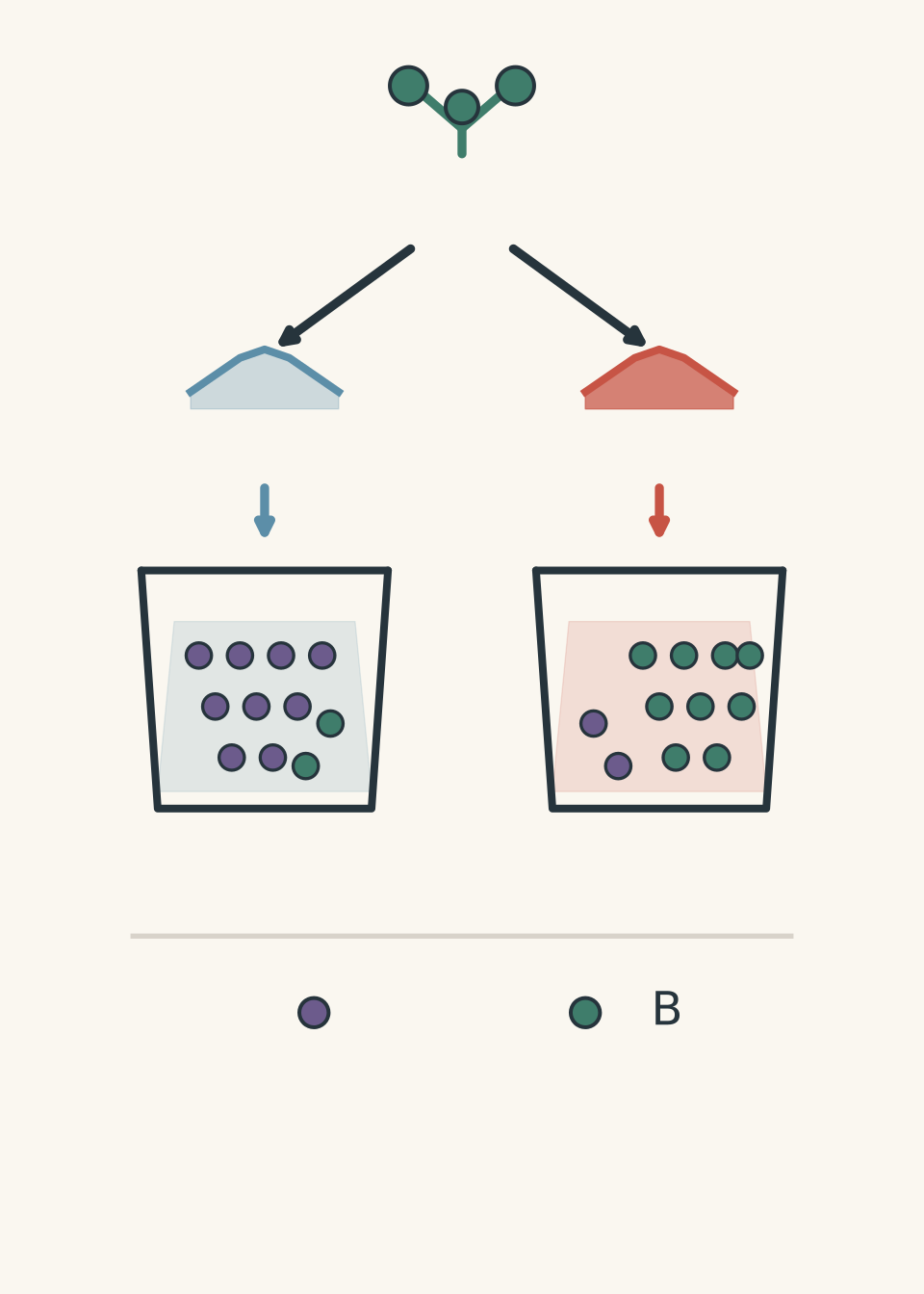
03Why does pH change the behaviour of a weak base?
Picture a weak-base molecule as someone deciding whether to carry a backpack.
The molecule without the backpack is \(B\). The protonated form, carrying \(\mathrm{H}^{+}\), is \(BH^+\).
In acidic conditions, plenty of protons are available, so more molecules end up in the protonated \(BH^+\) form. In more alkaline conditions, fewer protons are available, so the balance shifts towards \(B\).
The analogy breaks because molecules are not choosing anything. Their proportions are controlled by a reversible chemical equilibrium.
For a generic weak base \(B\), its conjugate acid behaves according to:
\[
\ce{BH+ + H2O <=> B + H3O+}
\]
If the pH rises, the concentration of \(\ce{H3O+}\) falls. Le Châtelier’s principle therefore predicts that the equilibrium favours formation of more \(B\).
This is the important link:
raising pH does not create more total alkaloid. It changes the form in which the alkaloid exists.
For nicotine specifically, the unprotonated, or free-base, form can pass through biological membranes more readily than the protonated form. Research on Central Australian bush tobacco use has connected alkaline ash with this change in nicotine form and absorption. Springer
This is a chemistry case study, not a recommendation to use bush tobacco. Nicotine is pharmacologically active and addictive.
04From the mental model to \(K_a\) and \(\mathrm{p}K_a\)
You can make the equilibrium idea quantitative.
For the conjugate acid \(BH^+\),
\[
K_a=\frac{[B][\ce{H3O+}]}{[BH^+]}
\]
where:
- \(K_a\) is the acid dissociation constant of \(BH^+\)
- \([B]\) is the concentration of unprotonated weak base
- \([BH^+]\) is the concentration of protonated weak base
- \([\ce{H3O+}]\) is the hydronium ion concentration, in \(\mathrm{mol\,L^{-1}}\)
Using \(\mathrm{p}K_a=-\log_{10}K_a\), the same relationship can be rearranged into:
\[
\mathrm{pH}=\mathrm{p}K_a+\log_{10}\left(\frac{[B]}{[BH^+]}\right)
\]
The equation looks more intimidating than the idea.
If:
- \(\mathrm{pH}<\mathrm{p}K_a\), the protonated form \(BH^+\) dominates
- \(\mathrm{pH}=\mathrm{p}K_a\), the two forms have equal concentrations
- \(\mathrm{pH}>\mathrm{p}K_a\), the unprotonated form \(B\) dominates
If you need to refresh why \(\mathrm{p}K_a\) measures acid strength, see Ka, pKa and Acid Strength: HSC Chemistry Guide.
Worked example: What is the pH of an alkaline ash extract?
A laboratory investigation of a plant-ash extract finds that its hydroxide ion concentration is \(2.5\times10^{-3}\ \mathrm{mol\,L^{-1}}\) at \(25^\circ\mathrm{C}\). Calculate its pH.
Step 1
\[
\mathrm{pOH}=-\log_{10}[\ce{OH-}]
=-\log_{10}(2.5\times10^{-3})
=2.60
\]
Step 2
\[
\mathrm{pH}+\mathrm{pOH}=14.00
\]
Therefore,
\[
\mathrm{pH}=14.00-2.60=11.40
\]
The extract has a pH of 11.40, so it is strongly alkaline.
The result tells us about the solution’s acid-base condition. It does not tell us exactly which substances in the ash caused that alkalinity. Real plant ash can contain a mixture of soluble and insoluble inorganic compounds.
That distinction is easy to miss in HSC answers: pH is a measurement of a solution, not the identity of the chemical causing that pH.
05A five-unit pH change is much bigger than it looks
Suppose a student says, “Going from pH 6 to pH 11 is only a change of five units.”
That wording hides the important part. The pH scale is logarithmic.
A change of one pH unit represents a tenfold change in \([\ce{H3O+}]\). A change of five pH units represents:
\[
10^5=100\,000
\]
times the difference in hydronium ion concentration.
This is why relatively small-looking movements on a pH scale can produce major changes in weak-acid or weak-base equilibria.
Worked example: How strongly does pH change the form of a weak base?
A hypothetical plant alkaloid behaves as a weak base \(B\). Its conjugate acid \(BH^+\) has \(\mathrm{p}K_a=8.0\).
Compare the ratio \([B]/[BH^+]\) at pH 6.0 and pH 10.0.
Step 1
\[
\mathrm{pH}=\mathrm{p}K_a+\log_{10}\left(\frac{[B]}{[BH^+]}\right)
\]
Substituting:
\[
6.0=8.0+\log_{10}\left(\frac{[B]}{[BH^+]}\right)
\]
Therefore,
\[
\log_{10}\left(\frac{[B]}{[BH^+]}\right)=-2.0
\]
so
\[
\frac{[B]}{[BH^+]}=10^{-2}=0.010
\]
At pH 6.0, there is about one \(B\) molecule for every 100 \(BH^+\) ions.
Step 2
\[
10.0=8.0+\log_{10}\left(\frac{[B]}{[BH^+]}\right)
\]
Therefore,
\[
\frac{[B]}{[BH^+]}=10^2=100
\]
At pH 10.0, there are about 100 \(B\) molecules for every one \(BH^+\) ion.
Step 3
The ratio has changed from \(0.010\) to \(100\):
\[
\frac{100}{0.010}=10\,000
\]
So a four-unit increase in pH produces a 10,000-fold increase in the ratio of unprotonated to protonated weak base for this model substance.
That is the chemistry behind the observation that changing alkalinity can change a plant alkaloid’s behaviour dramatically without changing the total amount of alkaloid present.
06Why careful material selection counts as chemical knowledge
Imagine you have five ashes from five plant species.
A modern school laboratory might:
- prepare equal-mass aqueous extracts,
- calibrate a pH probe,
- measure each pH,
- titrate each extract with acid,
- compare their neutralising capacities.
A traditional knowledge system does not need to follow those laboratory steps to establish that different materials give different outcomes.
Repeated observations can establish relationships such as:
- this material gives the required effect more reliably than that one
- ash from particular plant sources behaves differently
- preparation changes the result
- an unsuitable material does not produce the same outcome
- particular materials should therefore be selected for particular purposes
That is empirical knowledge: conclusions are grounded in observation and experience.
The modern laboratory can then provide an additional description using ideas such as pH, equilibrium, concentration, and molecular form.
Neither description should be lazily substituted for the other.
07pH and “base strength” are not the same thing
Here is the most tempting HSC mistake in this topic:
The ash with the highest pH must contain the strongest base.
Not necessarily.
Four ideas need to stay separate:
| Idea | What it tells you |
|---|---|
| pH | The hydronium ion concentration of the solution at that moment |
| Base strength | How extensively a base accepts protons or reacts with water |
| Concentration | How much dissolved substance is present per unit volume |
| Neutralising capacity | How much acid the sample can consume before its pH changes substantially |
A dilute solution of a strong base and a concentrated solution of a weaker base can sometimes have similar pH values.
Two ash extracts can also begin at the same pH but respond very differently when acid is added.
That is why one pH reading is useful but incomplete.
If you want to see how modern instrumentation adds quantitative evidence to this kind of investigation, Digital Probes for Acid-Base Analysis in HSC Chemistry develops that method.
08A useful modern comparison experiment
Suppose two publicly sourced plant materials are being studied in a school chemistry investigation. The experiment is not attempting to reproduce restricted Cultural Practice. It simply compares the acid-base behaviour of the materials.
Both ash extracts initially measure pH 11.2.
A student concludes, “They are chemically equivalent.”
Now add \(0.50\ \mathrm{mmol}\) of hydrochloric acid to equal volumes.
- Sample A falls to pH 7.8.
- Sample B remains at pH 10.4.
The initial pH values were identical, but Sample B had a much greater ability to consume added acid while remaining alkaline.
That might arise from differences in the amounts, identities, or solubilities of alkaline compounds present.
So the better analysis uses more than one measurement.
This is a powerful connection to the HSC concept of buffers and titration curves: the starting pH tells you where a system is now, while its response to added acid tells you something about what is present and how much chemical change the system can resist.
09Don’t turn every First Nations chemical practice into acid-base chemistry
Another common mistake is starting with the syllabus heading “acids and bases” and then forcing every Aboriginal or Torres Strait Islander practice into that category.
For example, Kaytetye women have publicly shared knowledge about producing a soapy lather from green seedpods of elkerte, a wattle, through the Science in First Language project. Questacon
The foam is associated with compounds called saponins. Their cleaning behaviour is mainly explained by molecular polarity and their ability to interact with both water and non-polar substances, not simply by saying “soap is basic”.
So if an exam asks about acid-base analysis, do not write:
“Aboriginal people made bush soap, therefore they used bases.”
That skips the actual chemistry.
A stronger HSC response identifies a practice for which acid-base behaviour is genuinely relevant, explains the evidence, and then applies the appropriate chemical model.
10How to write about this respectfully in an HSC response
You do not need a long cultural essay. You do need precise language.
A useful structure is:
- identify the specific documented practice and, where known, the Community or region
- describe the observed material choice or treatment
- explain the relevant acid-base chemistry
- distinguish the traditional observation from the modern scientific measurement
- avoid claiming that one example represents all Aboriginal and Torres Strait Islander Peoples
For example:
In documented Central Australian Aboriginal practices, selected alkaline plant ashes are mixed with bush tobacco. Modern chemical analysis shows that increasing pH shifts a weak-base alkaloid towards its unprotonated form. The traditional selection of particular ash sources demonstrates empirical knowledge of materials and their reproducible effects, although the practice did not depend on modern numerical pH measurements.
That is much stronger than saying, “Indigenous Australians discovered pH.”
The second statement imposes a modern scientific term on a different knowledge system and makes a historical claim you have not established.
11Questions and solutions
Question 1
A laboratory-prepared extract of a plant ash has a pH of 10.5 at \(25^\circ\mathrm{C}\).
Calculate:
a. the pOH
b. the hydroxide ion concentration, \([\ce{OH-}]\)
State whether the extract is acidic, neutral, or alkaline.
Solution 1
The extract has a pOH of \(3.5\), an \([\ce{OH-}]\) of \(3.2\times10^{-4}\ \mathrm{mol\,L^{-1}}\), and is alkaline.
At \(25^\circ\mathrm{C}\),
\[
\mathrm{pH}+\mathrm{pOH}=14.00
\]
so
\[
\mathrm{pOH}=14.00-10.5=3.5
\]
Now use:
\[
\mathrm{pOH}=-\log_{10}[\ce{OH-}]
\]
Therefore,
\[
[\ce{OH-}]=10^{-3.5}
=3.16\times10^{-4}\ \mathrm{mol\,L^{-1}}
\]
To two significant figures,
\[
[\ce{OH-}]=3.2\times10^{-4}\ \mathrm{mol\,L^{-1}}
\]
Because its pH is greater than 7 at \(25^\circ\mathrm{C}\), the solution is alkaline.
The tempting mistake is to describe pH 10.5 as meaning the ash itself has “a pH of 10.5”. Strictly, the measured aqueous extract has that pH. Dry ash does not have a pH until its acid-base behaviour is considered in a solution or other suitable medium.
Question 2
A student investigates two plant-ash extracts.
| Extract | Initial pH | pH after equal volumes receive \(0.40\ \mathrm{mmol}\) HCl |
|---|---|---|
| X | 11.4 | 7.3 |
| Y | 11.1 | 10.2 |
The student says, “Extract X is the better alkaline material because it started at the higher pH.”
Evaluate the student’s conclusion.
Solution 2
The conclusion is not supported; Extract Y shows the greater ability to maintain alkaline conditions after acid is added.
Extract X does have the slightly higher initial pH:
\[
11.4>11.1
\]
but initial pH is only one property of the solution.
After the same amount of hydrochloric acid is added, X falls to pH 7.3, while Y remains at pH 10.2. This shows that Y can consume considerably more added \(\mathrm{H}^{+}\) without losing its alkaline condition.
The governing acid-base reaction can be represented generally as:
\[
\ce{B + H+ -> BH+}
\]
where \(B\) represents an alkaline species capable of accepting a proton.
The student’s tempting route is to equate higher initial pH with “more base”. That feels reasonable because pH does measure the acid-base state of a solution. However, pH does not directly measure the total amount of proton-accepting material present.
Extract X could contain a small amount of a highly effective dissolved base, while Extract Y could contain a larger reservoir of alkaline substances.
The data therefore support the conclusion that Y has greater neutralising capacity under these conditions, even though X begins at the higher pH.
Question 3
A weak-base alkaloid \(B\) has a conjugate acid \(BH^+\) with \(\mathrm{p}K_a=8.5\).
Two mixtures have pH values of 7.5 and 9.5.
a. Calculate \([B]/[BH^+]\) in each mixture.
b. Determine how many times larger this ratio is at pH 9.5.
c. Explain why simply saying “the higher-pH mixture contains more alkaloid” is incorrect.
Solution 3
The ratios are \(0.10\) at pH 7.5 and \(10\) at pH 9.5, so the unprotonated-to-protonated ratio is 100 times larger in the higher-pH mixture; this does not mean the total amount of alkaloid has increased.
Use:
\[
\mathrm{pH}=\mathrm{p}K_a+\log_{10}\left(\frac{[B]}{[BH^+]}\right)
\]
At pH 7.5:
\[
7.5=8.5+\log_{10}\left(\frac{[B]}{[BH^+]}\right)
\]
so
\[
\log_{10}\left(\frac{[B]}{[BH^+]}\right)=-1
\]
and therefore
\[
\frac{[B]}{[BH^+]}=10^{-1}=0.10
\]
At pH 9.5:
\[
9.5=8.5+\log_{10}\left(\frac{[B]}{[BH^+]}\right)
\]
so
\[
\frac{[B]}{[BH^+]}=10^1=10
\]
The factor change is:
\[
\frac{10}{0.10}=100
\]
The higher-pH mixture therefore has a 100-times-greater ratio of unprotonated \(B\) to protonated \(BH^+\).
The tempting mistake is to interpret that equilibrium shift as production of extra alkaloid. The acid-base reaction changes its chemical form:
\[
\ce{BH+ <=> B + H+}
\]
It does not create additional alkaloid molecules. Assuming none has been added, removed, or destroyed, the total concentration
\[
[B]+[BH^+]
\]
remains the same.
Question 4
Two alkaline extracts, A and B, both initially have pH 10.8.
A student gradually adds equal amounts of a weak acid to each.
After \(0.20\ \mathrm{mmol}\) of acid:
- A has pH 9.9
- B has pH 10.6
After a total of \(0.60\ \mathrm{mmol}\):
- A has pH 6.8
- B has pH 9.4
The student proposes two explanations:
- B must contain a stronger base than A.
- B contains a greater amount of acid-reactive material, or a mixture that resists pH change more effectively.
Which explanation is supported by the data? Could the data alone prove the chemical identity of the substances present?
Solution 4
Explanation 2 is supported, but the data do not prove the chemical identities or intrinsic base strengths of the substances present.
Both extracts begin at the same pH, so their initial hydronium ion concentrations are the same:
\[
[\ce{H3O+}]=10^{-10.8}\ \mathrm{mol\,L^{-1}}
\]
Yet their responses to added weak acid are very different.
B remains at pH 10.6 after \(0.20\ \mathrm{mmol}\) is added and at pH 9.4 after \(0.60\ \mathrm{mmol}\). A undergoes a much larger change and ultimately falls below neutral pH.
The evidence therefore shows that B has a greater capacity to oppose the added acid under the experimental conditions.
Several chemical explanations could produce that pattern:
- B may contain a larger concentration of basic substances
- B may contain several acid-reactive species
- B may contain a conjugate acid-base pair producing buffer-like behaviour
- differences in solubility could make additional basic material available as acid is added
The attractive but incorrect shortcut is:
“B coped with more acid, so its base must have the larger \(K_b\).”
Base strength and amount are different variables. A large quantity of a weaker base can neutralise more acid than a tiny quantity of a stronger base.
The pH data also cannot identify a substance uniquely. To establish chemical identity, further analytical evidence would be required.
This is exactly why modern acid-base analysis commonly combines measurements such as pH, titration behaviour, conductivity, and independent compositional analysis rather than relying on a single number.
Question 5
Researchers analyse two ash extracts, P and Q.
| Observation | P | Q |
|---|---|---|
| Initial pH | 11.6 | 11.6 |
| HCl required to reach pH 8.0 | \(1.40\ \mathrm{mmol}\) | \(0.35\ \mathrm{mmol}\) |
| Final pH after mixing equal volumes with the same mildly acidic plant extract | 10.4 | 8.3 |
Historical and Community-derived evidence independently shows that Q, not P, was the material selected for a particular Cultural Practice.
A student argues:
“Chemistry proves the selection was irrational. P is more alkaline, so P is objectively the better ash.”
Evaluate this claim. Your response must use both the chemical evidence and the limits of what the experiment can establish.
Solution 5
The student’s claim is invalid: the experiment shows that P maintains alkaline conditions more strongly in this particular laboratory test, but it does not establish that P was “better” for the Cultural Practice or that the selection of Q was irrational.
Chemically, the initial pH values alone do not distinguish the extracts:
\[
\mathrm{pH_P}=\mathrm{pH_Q}=11.6
\]
The titration data do distinguish them.
P requires:
\[
1.40\ \mathrm{mmol}
\]
of HCl to fall to pH 8.0, compared with only:
\[
0.35\ \mathrm{mmol}
\]
for Q.
Therefore P consumes:
\[
\frac{1.40}{0.35}=4.0
\]
times as much HCl before reaching pH 8.0.
The mixing experiment agrees with this evidence. P produces a final mixture at pH 10.4, while Q gives pH 8.3. Under these defined conditions, P has the greater capacity to maintain a high pH.
That is the part chemistry can establish.
The trap comes in the next step. The student assumes that the Cultural purpose must have been “maximise pH”.
Nothing in the data establishes that.
Material selection could depend on properties not measured in this experiment, including:
- the required pH rather than the maximum possible pH
- concentrations of particular ions
- taste or other sensory properties
- toxicity
- availability on Country
- physical behaviour during preparation
- interactions with other compounds
- appropriate Cultural rules governing collection or use
There is also no evidence that the historical criterion was equivalent to the modern variable “millimoles of HCl needed to reach pH 8.0”.
So the strongest conclusion is narrower:
P shows greater alkaline capacity in the laboratory conditions tested. The evidence does not justify ranking P as culturally or practically superior to Q.
The student’s confident answer fails because it quietly changes the question. It moves from the measurable statement “Which extract resists added acid more strongly?” to the much broader statement “Which material is best for a Cultural Practice?”
Those are not equivalent.
Good scientific analysis requires both measurement and restraint. A chemical model should explain what the evidence can support, while making clear where the evidence stops.
12What this lets you understand next
The big idea here is not just that some plant ashes are alkaline. It is that a material’s usefulness depends on how its chemistry behaves under changing conditions.
That leads directly into titration curves, buffer capacity, and instrumental acid-base analysis. A single pH reading is a snapshot. Watching how pH changes as acid or base is added gives you much more information about the substances present and the chemical equilibria controlling the system.
It also gives you a better way to approach the Aboriginal and Torres Strait Islander Peoples component of HSC Chemistry: start with a specific, responsibly documented practice, identify the observable chemical behaviour, use modern acid-base theory to explain what that behaviour tells us, and do not claim the model tells us more about Cultural Knowledge than the evidence allows.