
Acid-Base Extraction: How Protonation Separates Compounds
Learn how protonation changes the solubility of organic compounds and allows them to be separated using acid-base extraction. Explore Brønsted-Lowry theory, pH, pKa, partition coefficients, and worked examples.
A mixture contains an organic amine and a neutral hydrocarbon, both dissolved in the same organic solvent. You want to separate them without distilling the mixture or relying on their boiling points.
You add an aqueous acid and mix the two liquids. After they settle, the amine is now mostly in the water layer, while the hydrocarbon remains in the organic layer.
Nothing has been filtered out. No new solid has formed. Instead, a proton transfer has changed the amine’s electrical charge, and that has changed which liquid it prefers to dissolve in.
This is the central idea behind acid-base extraction.
This is an extension beyond the required NSW HSC Chemistry syllabus. It builds on the Year 12 acid-base reactions content in the 2025 syllabus, but the use of protonation to control the separation of organic compounds is additional material. The syllabus is a useful starting point, not an assessment requirement for this extension.
01Why do we need a broader acid-base theory?
Before understanding the extraction, we need to be precise about what an acid and a base actually do.
In Year 12 Chemistry, you encounter the Arrhenius model. An Arrhenius acid increases the concentration of hydrogen ions, conventionally represented as H⁺, in aqueous solution. An Arrhenius base increases the concentration of hydroxide ions, OH⁻, in aqueous solution.
This works well for familiar reactions. For example:
\[ \ce{HCl(aq) + NaOH(aq) -> NaCl(aq) + H2O(l)} \]
The acid supplies hydrogen ions, the base supplies hydroxide ions, and these ions combine to form water.
The net ionic equation is:
\[ \ce{H+(aq) + OH-(aq) -> H2O(l)} \]
The model gives us a useful explanation of neutralisation. However, it has a limitation: it defines acids and bases through what they produce in water.
Consider ammonia reacting with hydrogen chloride:
\[ \ce{NH3(g) + HCl(g) -> NH4Cl(s)} \]
Predict which substance is acting as the base. Ammonia does not contain hydroxide ions. There is also no aqueous solution in this reaction.
The Arrhenius model does not describe this reaction naturally as a hydroxide-based neutralisation. Yet ammonia clearly behaves as a base: it accepts a hydrogen ion from hydrogen chloride.
The problem is not that the Arrhenius model is wrong. Its usefulness is restricted by its focus on aqueous solutions and the production of H⁺ or OH⁻.
We need a definition that focuses on the actual chemical event: the transfer of a proton.
02The Brønsted-Lowry model: follow the proton
In 1923, Johannes Brønsted and Thomas Lowry independently developed a broader acid-base theory.
Under the Brønsted-Lowry model:
- An acid is a proton donor.
- A base is a proton acceptor.
A proton is a hydrogen ion, H⁺. In this context, the model asks what happens to the proton during a reaction, rather than requiring the reaction to produce hydroxide ions.
Return to ammonia and hydrogen chloride:
\[ \ce{NH3 + HCl -> NH4+ + Cl-} \]
Hydrogen chloride donates a proton, so it is the acid. Ammonia accepts that proton, so it is the base.
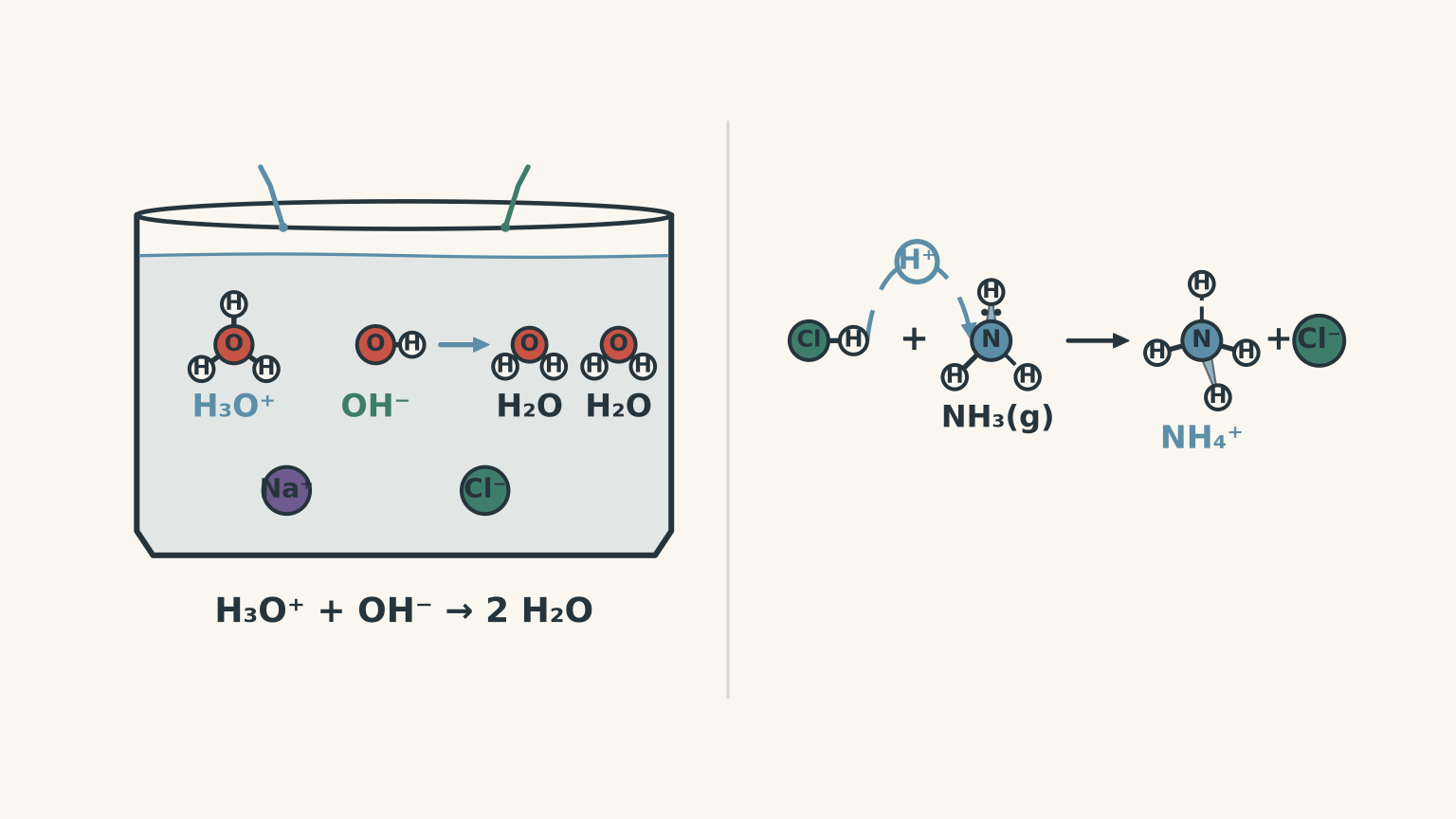
Due to technical limitations, this figure may display incorrectly or contain inaccuracies. Please check key details against your course materials.
The important change is that acid-base behaviour is no longer restricted to reactions involving hydroxide ions in water. Proton transfer can occur in other solvents and even between gases.
Conjugate acid-base pairs
When a base accepts a proton, it becomes a new species that can potentially donate that proton again. This is called its conjugate acid.
Likewise, when an acid donates a proton, the species left behind is its conjugate base.
For example:
\[ \ce{NH3 + H2O <=> NH4+ + OH-} \]
The pairs are:
| Base or acid | Conjugate partner |
|---|---|
| NH₃ (base) | NH₄⁺ (conjugate acid) |
| H₂O (acid) | OH⁻ (conjugate base) |
Water acts as the acid here because it donates a proton to ammonia. This is an important point: water is not automatically the acid in every reaction. Its role depends on which way the proton is transferred.
This ability to act as either an acid or a base is called amphiprotic behaviour.
For a more detailed foundation in the original model, see Arrhenius Acid-Base Theory for HSC Chemistry.
03From proton transfer to separation
Now we can return to the organic mixture.
An organic compound may contain a functional group that can accept or donate a proton. If proton transfer changes the compound from a neutral molecule into an ion, its interactions with surrounding solvents can change substantially.
Consider an amine, represented by the symbol B.
The nitrogen atom in an amine has a lone pair of electrons. This lone pair can accept a proton from an acid.
\[ \ce{B + H3O+ <=> BH+ + H2O} \]
Here:
- B represents the neutral amine.
- H₃O⁺ is the hydronium ion, which donates a proton.
- BH⁺ is the protonated amine.
- H₂O is formed when hydronium loses a proton.
The amine has become positively charged.
Why does the charge change where the molecule dissolves?
Imagine two liquids that do not mix:
- An organic solvent, which forms one liquid layer.
- Water, which forms a separate liquid layer.
A neutral organic molecule with a substantial non-polar region may dissolve more readily in the organic solvent than in water.
When the amine accepts a proton, however, it becomes an ion. Water molecules can orient their partially negative oxygen atoms towards the positively charged amine.
These attractive ion-dipole interactions help stabilise the charged species in the aqueous layer.
The neutral and charged forms therefore have different preferences:
| Form of the amine | Charge | Favoured environment, in the usual extraction model |
|---|---|---|
| B | Neutral | Organic layer |
| BH⁺ | Positive | Aqueous layer |
This is a change in phase distribution, not a change in the compound’s carbon skeleton.
The molecule has not been destroyed. Its protonation state has changed, and the new ionic form is much more compatible with water.
There is one important qualification. Charge does not guarantee that a compound will dissolve exclusively in water. Molecular size, non-polar regions, solvent choice, ion pairing, and other interactions also matter. The table describes a useful model for choosing an extraction strategy, not an absolute rule.
What happens in a separatory funnel?
A liquid-liquid extraction uses two liquids that do not mix. One is usually water, and the other is an organic solvent.
When the mixture settles, the liquids form two layers. The denser liquid sits underneath the less dense liquid.
The position of the layers depends on the solvent. Water is not automatically the bottom layer.
Consider a mixture of aniline and naphthalene dissolved in an organic solvent. Aniline is an organic amine, while naphthalene is a neutral hydrocarbon.
When the mixture contacts aqueous hydrochloric acid, aniline accepts a proton:
\[ \ce{C6H5NH2 + H3O+ <=> C6H5NH3+ + H2O} \]
The product, \(\ce{C6H5NH3+}\), is the anilinium ion. Chloride ions from the hydrochloric acid remain in solution as counterions.
The two organic compounds now behave differently:
- Anilinium ions are strongly favoured in the aqueous layer.
- Neutral naphthalene remains predominantly in the organic layer.
The two substances can now be separated by separating the liquid layers.
This is the practical advantage of acid-base extraction. Instead of finding two compounds with dramatically different boiling points, we exploit a difference in their acid-base behaviour.
The University of Sydney’s introductory chemistry laboratory material uses this same principle to explain the separation of aromatic amines, carboxylic acids, and neutral compounds.
Can we get the original amine back?
Yes. Protonation is reversible.
Suppose the aqueous layer contains the protonated amine, \(\ce{BH+}\). A sufficiently basic solution can remove its proton:
\[ \ce{BH+ + OH- -> B + H2O} \]
The neutral amine, B, is regenerated.
If B is sufficiently soluble in an appropriate organic solvent, it can then be transferred into a fresh organic phase.
This second process reverses the original separation:
- Acid converts the neutral amine into its charged form.
- The charged form preferentially enters the aqueous phase.
- Base removes the proton.
- The regenerated neutral amine can preferentially enter an organic phase.
Notice that the compound’s carbon framework has not changed. The process changes its protonation state, not its identity as an organic compound.
The amine also does not have to form a solid. Its protonated salt can remain dissolved in water.
04How pH controls the separation
We have established that protonation changes an amine’s preference for a solvent. The next question is how to control the extent of protonation.
The answer is pH.
Consider the equilibrium:
\[ \ce{BH+ + H2O <=> B + H3O+} \]
Here, \(\ce{BH+}\) acts as an acid because it can donate a proton to water. Its conjugate base is B.
The acid dissociation constant is:
\[ K_a=\frac{[B][H_3O^+]}{[BH^+]} \]
The square brackets represent equilibrium concentrations. \(K_a\) measures the extent to which the protonated amine donates its proton.
We commonly express acid strength using:
\[ pK_a=-\log_{10}K_a \]
A smaller \(pK_a\) indicates a stronger acid.
For an amine, we are interested in the \(pK_a\) of its conjugate acid, \(\ce{BH+}\), rather than treating the neutral amine as though it were the acid.
The relationship between pH and pKa
The Henderson-Hasselbalch equation connects pH, pKa, and the relative concentrations of the two forms:
\[ pH=pK_a+\log_{10} \left(\frac{[B]}{[BH^+]}\right) \]
For this aqueous equilibrium, pH is the measured acidity scale, approximated in dilute solutions by the negative logarithm of the hydronium ion concentration.
Rearranging gives:
\[ \frac{[BH^+]}{[B]}=10^{pK_a-pH} \]
This equation gives us a useful prediction.
| Relationship | Predominant form | Expected behaviour |
|---|---|---|
| pH well below pKa | BH+ | More strongly favoured in water |
| pH = pKa | Equal amounts of B and BH+ | Mixed distribution |
| pH well above pKa | B | Neutral form is restored |
At exactly pH = pKa, the concentrations of B and BH+ are equal.
A difference of one pH unit corresponds to a concentration ratio of 10:1. A difference of two units corresponds to 100:1.
This gives us a useful extraction strategy:
- To protonate an amine, choose an aqueous pH comfortably below the pKa of its conjugate acid.
- To regenerate the neutral amine, raise the pH comfortably above that pKa.
The further the pH moves from the pKa, the more strongly one form is favoured.
Why the choice of amine matters
Not all amines have the same basicity.
For example, the conjugate acid of aniline has a pKa of approximately 4.6. The conjugate acids of many simple alkylamines have pKa values around 10-11.
Why the difference?
In aniline, the nitrogen lone pair interacts with the delocalised electrons of the benzene ring. This makes the lone pair less available to accept a proton.
Alkylamines generally have more available nitrogen lone pairs, so they are stronger bases.
This difference can be extremely useful when separating mixtures containing more than one amine.
The relevant pKa values are tabulated in university organic chemistry materials, including the Penn State discussion of amine basicity.
05The important refinement: protonation is not the whole story
There is a tempting assumption that can cause problems:
If an organic compound is charged, it must be in water. If it is neutral, it must be in the organic solvent.
This is a useful first approximation, but it is not an exact rule.
A molecule’s phase distribution depends on two separate things:
- How much of the compound is protonated.
- How strongly each chemical form interacts with the two solvents.
The second factor is described using a partition coefficient.
Partition coefficient
For a neutral amine B, define its partition coefficient, P, as:
\[ P=\frac{[B]_{\mathrm{org}}}{[B]_{\mathrm{aq}}} \]
Here:
- \([B]_{\mathrm{org}}\) is the equilibrium concentration of neutral B in the organic phase.
- \([B]_{\mathrm{aq}}\) is the equilibrium concentration of neutral B in the aqueous phase.
- P is the partition coefficient for the neutral form under the specified solvent and temperature conditions.
A large P means the neutral compound strongly favours the organic phase.
A small P means it favours the aqueous phase.
Importantly, P describes the neutral form. It does not account for protonation.
Distribution ratio
During acid-base extraction, the compound can exist in two forms in water:
\[ \ce{B <=> BH+} \]
We therefore need to compare the total concentration of the compound in each phase.
The distribution ratio, D, is:
\[ D=\frac{[B]_{\mathrm{org}}} {[B]_{\mathrm{aq}}+[BH^+]_{\mathrm{aq}}} \]
Unlike P, D accounts for both neutral and protonated forms in the aqueous layer.
Using the Henderson-Hasselbalch relationship, we obtain:
\[ \boxed{D=\frac{P}{1+10^{pK_a-pH}}} \]
This equation is an extension of the simpler HSC acid-base model. You do not need advanced equilibrium mathematics to understand its meaning.
- At low pH, the denominator becomes large. D decreases, favouring the aqueous phase.
- At high pH, the denominator approaches one. D approaches P, so the neutral molecule’s original solvent preference becomes dominant.
The important point is that pH changes the distribution ratio, even though the partition coefficient of the neutral form remains fixed under the same conditions.
Why phase volumes also matter
Even if we know D, we cannot automatically determine the percentage of compound in each layer without considering their volumes.
Let:
- \(V_{\mathrm{org}}\) be the volume of the organic phase.
- \(V_{\mathrm{aq}}\) be the volume of the aqueous phase.
- D be the organic-to-aqueous concentration ratio.
The fraction of the total compound in the organic phase is:
\[ f_{\mathrm{org}}= \frac{D V_{\mathrm{org}}} {D V_{\mathrm{org}}+V_{\mathrm{aq}}} \]
The fraction in the aqueous phase is:
\[ f_{\mathrm{aq}}= \frac{V_{\mathrm{aq}}} {D V_{\mathrm{org}}+V_{\mathrm{aq}}} \]
These fractions add to one.
This introduces another potential trap: a concentration ratio is not automatically an amount ratio. If one layer has a much larger volume, it can contain more of the compound even when its concentration is lower.
The distinction between partition coefficients and distribution ratios is also developed in Chemistry LibreTexts’ treatment of liquid-liquid extraction.
06Worked examples
Worked example: How much of an amine is protonated?
A weak organic base B has a conjugate acid with a pKa of 8.0. The aqueous phase has a pH of 6.0.
Calculate the ratio of protonated to neutral amine, and determine the percentage of amine that is protonated.
Step 1
\[ pK_a=8.0,\qquad pH=6.0 \]
We are given the pKa of \(\ce{BH+}\), which is exactly the value needed.
Step 2
\[ \frac{[BH^+]}{[B]}=10^{pK_a-pH} \]
Substitute:
\[ \frac{[BH^+]}{[B]} =10^{8.0-6.0} =10^2=100 \]
There are 100 parts protonated amine for every one part neutral amine.
Step 3
There are 101 total parts:
\[ \begin{aligned} \text{Fraction protonated} &=\frac{100}{101}\\ &=0.9901 \end{aligned} \]
Therefore:
\[ \text{Percentage protonated}=99.0\% \]
Answer: Approximately 99.0% of the amine is protonated.
This means the amine is strongly favoured in its charged form. Assuming the protonated form is preferentially soluble in water, acid extraction should transfer most of the amine towards the aqueous layer.
Notice that we have calculated the percentage protonated, not the percentage extracted. Those are related, but they are not identical.
Worked example: Does protonation guarantee transfer into water?
Aniline has a conjugate acid pKa of approximately 4.6 at 25 °C.
Suppose its neutral form has a partition coefficient of \(P=20\) between a particular organic solvent and water.
Compare its distribution between equal-volume aqueous and organic phases at:
- pH 2.0
- pH 7.0
Assume that the protonated form remains in water, only the neutral form partitions into the organic phase, and both phase volumes remain equal.
Step 1
At pH 2.0:
\[ \frac{[BH^+]}{[B]} =10^{4.6-2.0} =10^{2.6} \approx398 \]
At pH 7.0:
\[ \frac{[BH^+]}{[B]} =10^{4.6-7.0} =10^{-2.4} \approx0.00398 \]
At pH 2.0, almost all the aniline is protonated.
At pH 7.0, almost all the aniline is neutral.
Step 2
Use:
\[ D=\frac{P}{1+10^{pK_a-pH}} \]
At pH 2.0:
\[ D=\frac{20}{1+398} \]
\[ D\approx0.0501 \]
At pH 7.0:
\[ D=\frac{20}{1+0.00398} \]
\[ D\approx19.9 \]
Step 3
Because the two layers have equal volumes:
\[ f_{\mathrm{org}}=\frac{D}{D+1} \]
At pH 2.0:
\[ f_{\mathrm{org}}= \frac{0.0501}{1.0501} =0.0477 \]
Approximately 4.8% is in the organic phase.
At pH 7.0:
\[ f_{\mathrm{org}}= \frac{19.9}{20.9} =0.952 \]
Approximately 95.2% is in the organic phase.
Answer: At pH 2.0, approximately 95.2% of the aniline is in the aqueous phase. At pH 7.0, approximately 95.2% is in the organic phase.
The result shows how strongly protonation can change phase distribution.
There is also a useful subtlety here. Even though approximately 99.75% of the aniline is protonated at pH 2.0, about 4.8% of the total compound remains in the organic layer. The neutral form has such a strong preference for that solvent that its small concentration still matters.
The partition coefficient of 20 in this example is an illustrative assumption, not a measured value for every aniline-solvent combination.
07When is acid-base extraction a good separation method?
The method is most useful when the compounds have different acid-base properties and their neutral and charged forms have sufficiently different solvent preferences.
Before predicting a successful separation, consider four things:
- Functional groups: Does the target contain a group that can accept or donate a proton?
- pKa: Can the aqueous pH be adjusted to favour the desired form?
- Solubility: Does the neutral form favour the organic phase, and does the ionic form favour water?
- Selectivity: Will the other compounds remain in their original forms under the chosen conditions?
If two compounds have similar pKa values, it may be difficult to protonate one without protonating the other.
Likewise, a neutral compound that is highly water-soluble may not move into the organic phase just because it has lost its charge.
The best extraction conditions therefore depend on both acid-base equilibrium and solvent partitioning.
One final practical qualification: real laboratory extraction involves volatile solvents, corrosive acids or bases, and glass equipment that can develop pressure. These processes require appropriate laboratory supervision, ventilation, protective equipment, and approved procedures. The discussion here is about the chemical principles, not an unsupervised experimental procedure.
08Questions and solutions
Question 1
A mixture of ethylamine, \(\ce{CH3CH2NH2}\), and naphthalene is dissolved in an organic solvent.
The mixture is contacted with aqueous hydrochloric acid. Assume the ethylammonium ion is strongly favoured in water, naphthalene remains neutral, and the aqueous phase remains sufficiently acidic.
(a) Write the Brønsted-Lowry equation for the reaction between ethylamine and the acid.
(b) Identify the conjugate acid formed.
(c) Predict which layer contains each organic compound after equilibrium is established. Explain your reasoning.
Solution 1
(a) Ethylamine accepts a proton from hydronium:
\[ \ce{CH3CH2NH2 + H3O+ <=> CH3CH2NH3+ + H2O} \]
(b) The conjugate acid is the ethylammonium ion, \(\ce{CH3CH2NH3+}\).
Ethylamine is the Brønsted-Lowry base because it accepts a proton. Hydronium is the acid because it donates that proton.
(c) Ethylammonium is predominantly in the aqueous layer, while naphthalene remains predominantly in the organic layer.
The proton transfer gives ethylamine a positive charge. This makes it more compatible with water through ion-dipole interactions.
Naphthalene does not undergo the proton transfer under these conditions. It remains neutral and retains its preference for the organic solvent.
The important distinction is that the two original compounds have not been separated because of different boiling points or molecular sizes. Their acid-base behaviour has created different solubility preferences.
Question 2
A mixture contains aniline and methylamine, both initially dissolved in an organic solvent.
Their conjugate acids have the following pKa values:
| Compound | pKa of conjugate acid |
|---|---|
| Aniline | 4.6 |
| Methylamine | 10.6 |
The mixture is contacted with an aqueous buffer maintained at pH 7.0.
Assume that the neutral forms favour the organic phase and the protonated forms favour the aqueous phase.
(a) Calculate the ratio of protonated to neutral aniline.
(b) Calculate the percentage of methylamine that is protonated.
(c) Predict which amine predominantly enters the aqueous layer.
(d) Explain why the two amines behave differently, even though both contain nitrogen and have a lone pair of electrons.
Solution 2
(a) The protonated-to-neutral aniline ratio is approximately \(0.00398:1\).
Using:
\[ \frac{[BH^+]}{[B]}=10^{pK_a-pH} \]
For aniline:
\[ \begin{aligned} \frac{[BH^+]}{[B]} &=10^{4.6-7.0}\\ &=10^{-2.4}\\ &=0.00398 \end{aligned} \]
Only a small proportion of aniline is protonated.
(b) Approximately 99.975% of the methylamine is protonated.
For methylamine:
\[ \begin{aligned} \frac{[BH^+]}{[B]} &=10^{10.6-7.0}\\ &=10^{3.6}\\ &\approx3981 \end{aligned} \]
The fraction protonated is:
\[ \frac{3981}{3982}\times100 \]
\[ \approx99.975\% \]
(c) Methylamine predominantly enters the aqueous layer.
Its conjugate acid is strongly favoured at pH 7.0, so most methylamine exists as the charged methylammonium ion.
Aniline remains predominantly neutral and therefore favours the organic layer under the stated assumptions.
(d) The difference comes from the availability of the nitrogen lone pair.
In methylamine, the nitrogen lone pair is relatively available to accept a proton.
In aniline, the lone pair interacts with the delocalised electrons of the benzene ring. It is less available for protonation.
Consequently, methylamine is a stronger base than aniline.
The tempting assumption is that all amines should behave similarly because they share the same functional group. However, molecular structure affects basicity, and basicity determines the protonation equilibrium at a given pH.
This is why the conjugate acid’s pKa is so useful when planning an extraction.
Question 3
A weak organic base C has the following properties:
- pKa of its conjugate acid: 8.0
- Partition coefficient of its neutral form: \(P=10\)
- Aqueous phase pH: 6.0
A mixture initially contains 1.00 mmol of C. It is distributed between:
- 40.0 mL of organic solvent
- 60.0 mL of aqueous solution
Assume equilibrium is reached, the pH remains constant, and the protonated form is restricted to the aqueous phase.
(a) Calculate the distribution ratio, D.
(b) Calculate the amount of C in the aqueous phase after equilibrium.
(c) Calculate the amount of C remaining in the organic phase.
(d) Explain why the percentage in the aqueous layer is not necessarily equal to the percentage protonated.
Solution 3
(a) The distribution ratio is approximately 0.0990.
First, calculate the ratio of protonated to neutral C:
\[ \frac{[BH^+]}{[B]}=10^{8.0-6.0}=100 \]
Now use the distribution ratio:
\[ D=\frac{P}{1+10^{pK_a-pH}} \]
Substitute:
\[ D=\frac{10}{1+100} \]
\[ \boxed{D=0.0990} \]
This means the total concentration in the organic phase is approximately 0.0990 times the total concentration in the aqueous phase.
(b) Approximately 0.938 mmol of C is in the aqueous phase.
The fraction in the aqueous phase is:
\[ f_{\mathrm{aq}}= \frac{V_{\mathrm{aq}}} {D V_{\mathrm{org}}+V_{\mathrm{aq}}} \]
Substitute:
\[ f_{\mathrm{aq}}= \frac{60.0} {(0.0990)(40.0)+60.0} \]
\[ f_{\mathrm{aq}}= \frac{60.0}{63.96} \]
\[ f_{\mathrm{aq}}\approx0.938 \]
Therefore:
\[ n_{\mathrm{aq}}=0.938\times1.00 \]
\[ \boxed{n_{\mathrm{aq}}=0.938\text{ mmol}} \]
(c) Approximately 0.0619 mmol remains in the organic phase.
By conservation of matter:
\[ n_{\mathrm{org}}=n_{\mathrm{total}}-n_{\mathrm{aq}} \]
\[ =1.00-0.938 \]
\[ \boxed{n_{\mathrm{org}}=0.0619\text{ mmol}} \]
The results are consistent with the original 1.00 mmol of compound.
(d) The percentage protonated and the percentage extracted describe different things.
The protonation percentage describes the relative amounts of B and BH+ in the aqueous equilibrium.
The extraction percentage describes how much of the total compound is present in each liquid phase.
The neutral form has a partition coefficient of 10, so even a relatively small amount of neutral C can contribute to the organic phase.
The different phase volumes also matter. Here, the aqueous phase is larger than the organic phase, so the aqueous layer holds a greater amount of compound than its concentration ratio alone might suggest.
The key lesson is that equilibrium speciation and phase distribution must be considered together.
Question 4
An aqueous solution contains two protonated organic bases, \(\ce{B1H+}\) and \(\ce{B2H+}\).
Their conjugate acid pKa values are:
\[ pK_a(\ce{B1H+})=9.0 \]
\[ pK_a(\ce{B2H+})=5.0 \]
You want to recover B2 first while keeping B1 in the aqueous phase.
Assume that:
- Both neutral compounds favour an appropriate organic solvent.
- Both protonated forms remain in water.
- The pH can be maintained at the desired value.
- The two compounds do not react with one another.
(a) Explain why a pH of 7.0 is suitable for selectively releasing B2.
(b) Calculate the percentage of B1 that remains protonated at pH 7.0.
(c) Calculate the percentage of B2 that becomes neutral at pH 7.0.
(d) Describe how the two compounds can be recovered in separate fractions using a second pH adjustment.
(e) Explain why using a very high pH from the beginning would reduce the selectivity of the separation.
Solution 4
(a) A pH of 7.0 is suitable because it lies between the two conjugate acid pKa values.
For B1, the pH is below its pKa, so the protonated form is favoured.
For B2, the pH is above its pKa, so the neutral form is favoured.
This creates a useful separation window: B2 can become neutral and move into the organic phase while B1 remains charged in water.
(b) Approximately 99.0% of B1 remains protonated.
For B1:
\[ \frac{[B1]}{[B1H^+]}=10^{7.0-9.0} \]
\[ =0.01 \]
Therefore, the protonated fraction is:
\[ \frac{1}{1+0.01}\times100 \]
\[ \boxed{99.0\%} \]
B1 remains predominantly in its ionic form.
(c) Approximately 99.0% of B2 becomes neutral.
For B2:
\[ \frac{[B2H^+]}{[B2]}=10^{5.0-7.0} \]
\[ =0.01 \]
Therefore, the neutral fraction is:
\[ \frac{1}{1+0.01}\times100 \]
\[ \boxed{99.0\%} \]
B2 is now predominantly neutral and can favour the organic phase.
(d) The separation can be completed in two stages.
First, maintain the aqueous solution at pH 7.0 and allow neutral B2 to transfer into an organic phase. Separate that organic fraction from the aqueous solution containing predominantly B1H+.
Next, raise the pH of the remaining aqueous solution to approximately 11.0.
For B1:
\[ \frac{[B1]}{[B1H^+]}=10^{11.0-9.0}=100 \]
Therefore, approximately 99.0% of B1 is now neutral.
It can be transferred into a fresh organic phase, assuming its neutral form has a suitable partition preference.
The two compounds have now been recovered separately.
(e) A very high pH would favour the neutral forms of both compounds.
Both B1H+ and B2H+ would lose their protons to a substantial extent. Both compounds would then have similar acid-base behaviour.
The separation would lose its selectivity because the compounds would no longer have sufficiently different protonation states.
The important idea is that choosing an extraction pH is not simply about making the solution as acidic or basic as possible. It is about finding a pH that creates a useful difference between the compounds.
Question 5
Two organic bases, B1 and B2, are dissolved in the same organic solvent.
Their properties are:
| Property | B1 | B2 |
|---|---|---|
| pKa of conjugate acid | 9.0 | 5.0 |
| Neutral partition coefficient, P | 100 | 0.10 |
The partition coefficient is defined as:
\[ P=\frac{[\text{neutral form}]_{\mathrm{org}}} {[\text{neutral form}]_{\mathrm{aq}}} \]
The organic and aqueous phases have equal volumes.
Assume:
- Only the neutral form enters the organic phase appreciably.
- Both protonated forms remain in the aqueous phase.
- The pH is maintained throughout the extraction.
- There are no additional reactions, ion pairs, or changes in the compounds’ structures.
A student proposes using an aqueous buffer at pH 7.0.
Their reasoning is:
“B1 has a pKa of 9.0, so it will be almost completely protonated and should enter the aqueous layer. B2 has a pKa of 5.0, so it will be almost completely neutral and should stay in the organic layer. This should give an excellent separation.”
(a) Calculate the protonated-to-neutral ratio for each compound at pH 7.0.
(b) Calculate the distribution ratio for each compound.
(c) Determine the percentage of each compound in the organic phase at equilibrium.
(d) Evaluate the student’s proposed separation. Explain why the predicted phase distribution is different from their expectation.
(e) The desired separation is at least 90% of B1 in the aqueous phase and at least 90% of B2 in the organic phase. Prove whether any choice of pH can achieve both conditions under the stated assumptions.
(f) If the objective is simply to separate B1 and B2, rather than insisting on which compound enters which layer, identify a more suitable pH and explain the resulting separation.
Solution 5
(a) At pH 7.0, B1 has a protonated-to-neutral ratio of 100:1, while B2 has a ratio of 0.01:1.
For B1:
\[ \frac{[B1H^+]}{[B1]} =10^{9.0-7.0} =100 \]
Therefore, approximately 99.0% of B1 is protonated.
For B2:
\[ \frac{[B2H^+]}{[B2]} =10^{5.0-7.0} =0.01 \]
Therefore, approximately 99.0% of B2 is neutral.
The student’s prediction about the protonation states is correct.
However, the conclusion about the phases does not automatically follow.
(b) The distribution ratios are approximately:
\[ D_1=0.990 \]
\[ D_2=0.0990 \]
For B1:
\[ D_1=\frac{100}{1+10^{9-7}} \]
\[ =\frac{100}{101} \]
\[ \boxed{D_1=0.990} \]
For B2:
\[ D_2=\frac{0.10}{1+10^{5-7}} \]
\[ =\frac{0.10}{1.01} \]
\[ \boxed{D_2=0.0990} \]
The difference comes from their neutral partition coefficients.
B1 has a very strong preference for the organic solvent when neutral. B2, despite being neutral at pH 7.0, actually favours the aqueous phase.
(c) Approximately 49.8% of B1 and 9.0% of B2 are in the organic phase.
Since the phase volumes are equal:
\[ f_{\mathrm{org}}=\frac{D}{D+1} \]
For B1:
\[ f_{\mathrm{org},1} =\frac{0.990}{1+0.990} \]
\[ \boxed{f_{\mathrm{org},1}\approx49.8\%} \]
For B2:
\[ f_{\mathrm{org},2} =\frac{0.0990}{1+0.0990} \]
\[ \boxed{f_{\mathrm{org},2}\approx9.0\%} \]
Consequently:
| Compound | Organic phase | Aqueous phase |
|---|---|---|
| B1 | 49.8% | 50.2% |
| B2 | 9.0% | 91.0% |
(d) The proposed separation does not work as predicted.
B1 is almost completely protonated, but its small neutral fraction has a very strong preference for the organic solvent. This keeps a substantial proportion of the total B1 in that layer.
B2 is almost completely neutral, but its neutral partition coefficient is only 0.10. It favours water even without a positive charge.
The student has correctly predicted the protonation states but has incorrectly assumed that protonation alone determines phase distribution.
This is the crucial distinction between speciation and partitioning.
A compound’s charge affects its solvent preference, but its molecular structure and interactions with the solvents still matter.
(e) No pH can achieve both requested conditions.
The decisive constraint is the maximum possible organic distribution of B2.
For B2:
\[ D_2=\frac{0.10}{1+10^{5-pH}} \]
The denominator can never be less than one because the exponential term is always positive.
Therefore:
\[ D_2\leq0.10 \]
For equal-volume phases, the organic fraction is:
\[ f_{\mathrm{org},2}=\frac{D_2}{1+D_2} \]
Its maximum possible value is therefore:
\[ f_{\mathrm{org},2} \leq\frac{0.10}{1.10} \]
\[ \boxed{f_{\mathrm{org},2}\leq9.1\%} \]
Even at extremely high pH, when B2 is essentially completely neutral, no more than approximately 9.1% can enter the organic phase.
The neutral molecule itself prefers water.
This makes the requested 90% organic recovery of B2 impossible under the stated conditions.
There is no need to calculate every possible pH to establish this. The maximum partition coefficient already rules out the proposed outcome.
(f) A pH of approximately 11.0 gives a much better separation, with B1 entering the organic phase and B2 remaining predominantly aqueous.
At pH 11.0, for B1:
\[ \frac{[B1H^+]}{[B1]}=10^{9-11}=0.01 \]
B1 is approximately 99.0% neutral.
Its distribution ratio becomes:
\[ D_1=\frac{100}{1+0.01} \]
\[ D_1\approx99.0 \]
The organic fraction is:
\[ f_{\mathrm{org},1} =\frac{99.0}{100.0} \]
\[ \boxed{99.0\%} \]
For B2:
\[ \frac{[B2H^+]}{[B2]}=10^{5-11}=10^{-6} \]
B2 is also essentially neutral.
However, its distribution ratio is still approximately:
\[ D_2=\frac{0.10}{1+10^{-6}} \approx0.10 \]
Its organic fraction is therefore still only approximately 9.1%.
The resulting separation is:
| Compound | Organic phase | Aqueous phase |
|---|---|---|
| B1 | 99.0% | 1.0% |
| B2 | 9.1% | 90.9% |
The two compounds are now separated effectively, but in the opposite direction to the student’s original proposal.
The deeper lesson is that a successful extraction requires more than selecting the correct pH. You must consider the protonation equilibrium, the partition coefficient, and the relative volumes of the phases.
A neutral molecule is not automatically an organic-solvent-loving molecule. That assumption is what makes this problem difficult.
09Where to take this next
Acid-base extraction brings together two ideas that are often studied separately: acid-base equilibrium and solubility.
You can now use pKa values to predict which form of a compound will dominate, then use partition coefficients to predict where that compound will actually go.
The next useful step is learning to track several chemical species across a changing pH range. This is the foundation of Acid-Base Speciation Diagrams: Reading Species vs pH.
It also connects naturally to Acid-Base Titration of an Unknown: HSC Chemistry Guide, where equilibrium and measured pH help determine the composition of an unknown solution.
10Scientific sources and further reading
The following university and scientific resources support the acid-base theory, amine protonation, and liquid-liquid extraction models discussed in this extension.
Chemistry LibreTexts – Acid-Base and Gas-Evolution Reactions. Explains the limitations of the Arrhenius model and the development of the Brønsted-Lowry definition.
University of Sydney – Extraction of Organic Compounds. University laboratory teaching material covering protonation of organic amines, acid-base separation, and the different behaviour of neutral and charged organic compounds.
Penn State – Basicity of Amines. Explains the role of the nitrogen lone pair, differences between alkylamines and arylamines, and conjugate acid pKa values, including anilinium.
Chemistry LibreTexts – Liquid-Liquid Extractions. Develops partition coefficients, distribution ratios, extraction efficiency, and the influence of acid-base equilibria on phase distribution.