
Covalent Molecular Structures and Intermolecular Forces
Learn how discrete covalent molecules, molecular polarity, and intermolecular forces explain boiling point, volatility, conductivity, and solubility.
Boil a beaker of water and the liquid turns into a gas. Something has clearly been pulled apart. But what?
Before reading on, make a prediction: when water boils, are the strong O-H covalent bonds inside each \(\ce{H2O}\) molecule broken, or are the molecules simply pulled away from one another?
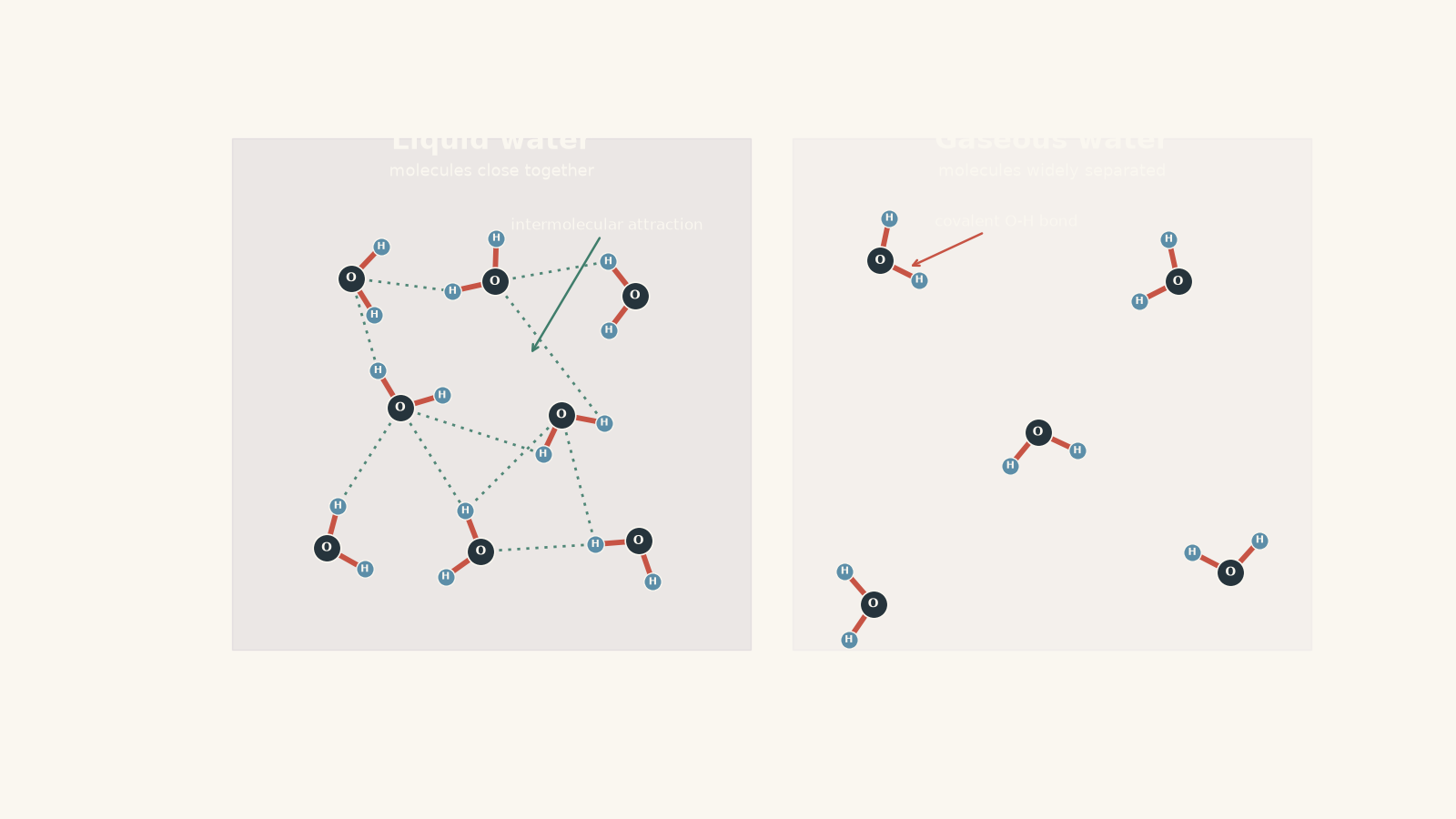
The second answer is correct. A water molecule remains \(\ce{H2O}\) as it enters the gas phase. Boiling overcomes attractions between water molecules. It does not normally break the covalent bonds within them.
That distinction is the key to understanding covalent molecular substances. Their observable properties depend on two different levels of structure: strong covalent bonds holding each molecule together, and much weaker intermolecular forces acting between separate molecules.
01What makes a substance covalent molecular?
Imagine a substance made from millions of tiny, separate packets. Each packet is a molecule.
Inside each molecule, atoms share electrons through covalent bonds. Those bonds are strong. But one molecule is not covalently bonded to every neighbouring molecule.
These separate particles are called discrete molecules.
For example, carbon dioxide consists of individual \(\ce{CO2}\) molecules:
\[ \ce{O=C=O} \]
Each carbon atom is strongly covalently bonded to two oxygen atoms within its molecule. One \(\ce{CO2}\) molecule, however, is not joined to the next \(\ce{CO2}\) molecule by another covalent bond.
The same basic idea applies to substances such as:
- \(\ce{H2O}\), water
- \(\ce{NH3}\), ammonia
- \(\ce{CH4}\), methane
- \(\ce{CO2}\), carbon dioxide
- \(\ce{I2}\), iodine
- \(\ce{CH3OH}\), methanol
This is different from a covalent network structure, where covalent bonds extend continuously through a giant structure. Diamond is an example of a covalent network substance.
That difference becomes crucial when we try to explain melting and boiling points.
02There are two kinds of attraction to keep separate
Suppose two water molecules are sitting next to each other.
Within each molecule, the oxygen and hydrogen atoms are held together by covalent bonds. Between the two molecules, there are intermolecular attractions.
It helps to think of two people holding hands while standing in a crowded train. Their grip on each other’s hands represents the covalent bond inside a molecule. The crowd pressing them towards nearby people represents intermolecular forces.
If the train empties and the pair moves away from everyone else, they don’t need to stop holding hands. In the same way, when a molecular substance boils, its molecules separate without normally breaking their internal covalent bonds.
The analogy has a limit: molecules aren’t choosing who to hold onto, and intermolecular forces come from electrostatic interactions involving charges and electron distributions. But it captures the important structural difference.
Intramolecular forces
Intramolecular means within a molecule.
In covalent molecular substances, these are mainly the covalent bonds joining the atoms.
Breaking a covalent bond changes the molecule chemically. Breaking an O-H bond in water, for example, is not simply boiling water.
Intermolecular forces
Intermolecular means between molecules.
These attractions influence physical properties such as:
- melting point
- boiling point
- volatility
- whether a substance is a solid, liquid, or gas under particular conditions
- solubility
- viscosity, in many cases
A very common mistake is to write, “Water has a high boiling point because its covalent bonds are strong.”
The covalent bonds in water certainly are strong, but they aren’t the bonds being overcome during boiling. The relevant attractions are the intermolecular forces between water molecules.
03Where do intermolecular forces come from?
Electrons and nuclei carry charge. So even when a molecule has no overall charge, its distribution of charge can create attractions with nearby molecules.
For HSC Chemistry, three important intermolecular forces are:
| Intermolecular force | Where it occurs | Main idea |
|---|---|---|
| London dispersion forces | Between all atoms and molecules | Temporary uneven electron distributions create temporary dipoles |
| Dipole-dipole forces | Between polar molecules | Permanent partial positive and negative regions attract |
| Hydrogen bonding | When suitable molecules contain H bonded to N, O, or F | An especially strong dipole-dipole attraction involving highly polar bonds |
A molecule can experience more than one type.
For example, water has London dispersion forces and hydrogen bonding. We usually focus on hydrogen bonding when explaining its unusually high boiling point because that interaction has the greatest effect in this comparison.
04London dispersion forces occur in every molecular substance
Start with a molecule such as \(\ce{I2}\).
The molecule is non-polar overall. You might therefore predict that two iodine molecules cannot attract each other.
But they do.
Electrons are constantly moving. At a particular instant, the electron cloud of one molecule can become slightly uneven. One side becomes temporarily more negative and the other temporarily more positive.
This temporary dipole can distort the electron cloud of a nearby molecule, producing an induced dipole. The two molecules then attract.
These attractions are called London dispersion forces.
They exist between all particles because every atom and molecule contains electrons.
What makes dispersion forces stronger?
As a useful general rule, dispersion forces become stronger when particles have larger, more easily distorted electron clouds.
Compare the halogens:
- \(\ce{F2}\)
- \(\ce{Cl2}\)
- \(\ce{Br2}\)
- \(\ce{I2}\)
As the molecules become larger and contain more electrons, their electron clouds become more polarisable. Their dispersion forces become stronger.
This helps explain why \(\ce{F2}\) and \(\ce{Cl2}\) are gases at room conditions, \(\ce{Br2}\) is a liquid, and \(\ce{I2}\) is a solid.
“More electrons means stronger dispersion forces” is useful, but don’t turn it into an absolute law for every comparison. Molecular shape and how closely molecules can approach one another can also matter.
05Polar molecules add dipole-dipole attractions
Now consider hydrogen chloride, \(\ce{HCl}\).
Chlorine attracts the shared bonding electrons more strongly than hydrogen. The electron density in the H-Cl bond is therefore uneven.
We describe the hydrogen as partially positive, \(\delta+\), and chlorine as partially negative, \(\delta-\).
The molecule has a permanent dipole.
Neighbouring \(\ce{HCl}\) molecules tend to orient so that a partially positive region is attracted towards a partially negative region. These attractions are called dipole-dipole forces.
Importantly, \(\ce{HCl}\) also has dispersion forces. Polar molecules don’t somehow switch dispersion forces off.
06A polar bond does not automatically make a polar molecule
This is one of the most useful distinctions in the topic.
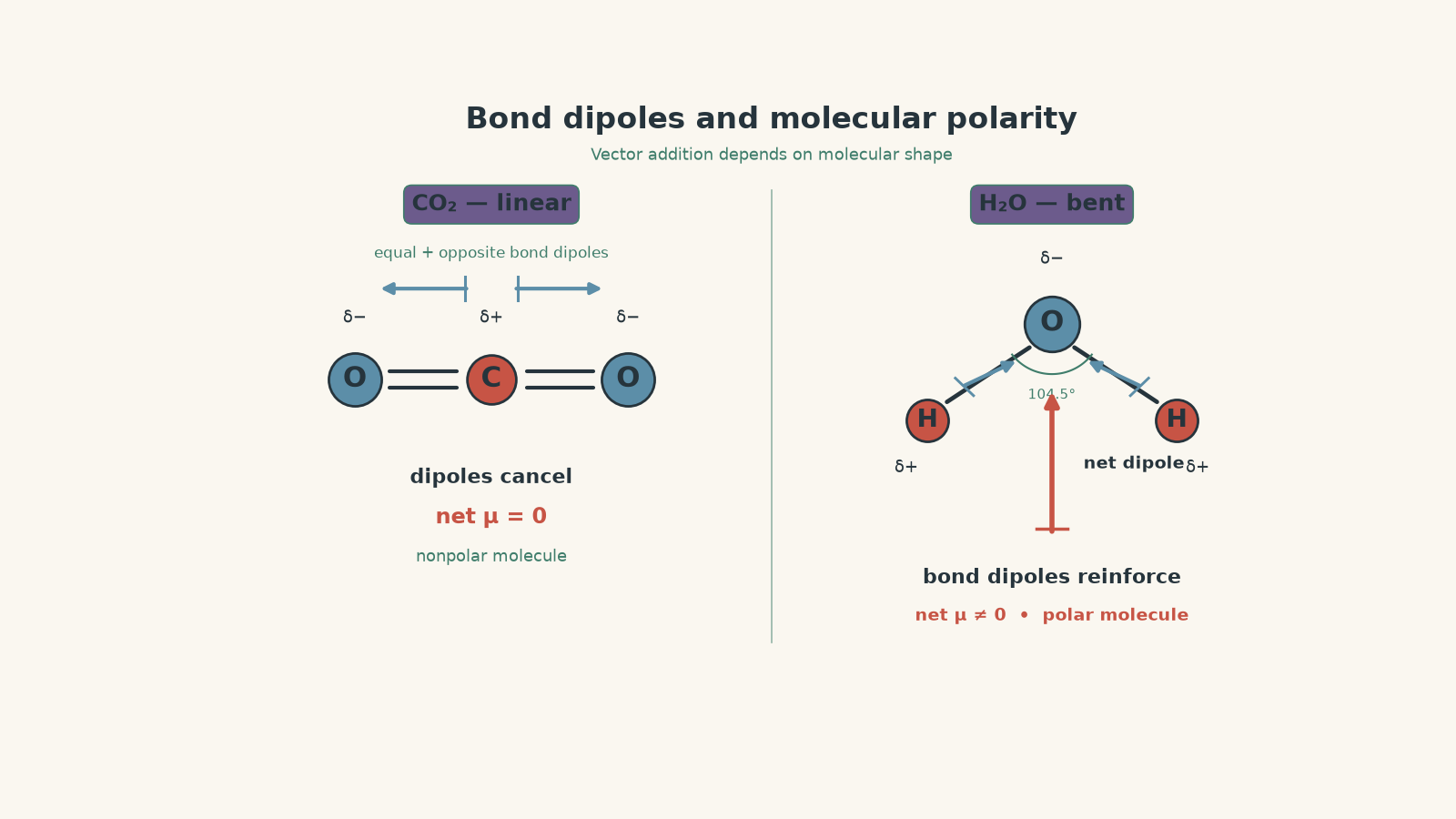
Consider carbon dioxide. Each C=O bond is polar because oxygen attracts the bonding electrons more strongly than carbon.
So, predict the overall molecule: is \(\ce{CO2}\) polar?
It is non-polar overall.
The molecule is linear:
\[ \ce{O=C=O} \]
The two bond dipoles point in opposite directions with equal magnitude. Their effects cancel.
Water is different. Its O-H bonds are also polar, but the \(\ce{H2O}\) molecule is bent. The bond dipoles do not point directly opposite each other, so they do not cancel.
Water therefore has an overall molecular dipole.
This gives you an important decision process:
- Decide whether the individual bonds are polar.
- Determine the molecular shape.
- Consider the direction of the bond dipoles.
- Decide whether those dipoles cancel.
- Use the overall molecular polarity to identify relevant intermolecular forces.
Worked example: Why is carbon dioxide non-polar?
Explain why \(\ce{CO2}\) is non-polar even though each C=O bond is polar.
Step 1
Oxygen is more electronegative than carbon, so each C=O bond has an uneven distribution of electron density.
Step 2
A \(\ce{CO2}\) molecule is linear, with a bond angle of \(180^\circ\).
Step 3
The two C=O bond dipoles have equal magnitude and point in opposite directions.
Step 4
The dipoles cancel, so the molecule has no permanent net dipole.
Therefore, \(\ce{CO2}\) is a non-polar molecule. Its molecules still attract one another through London dispersion forces.
The important lesson is that bond polarity and molecular polarity are not the same thing.
07Hydrogen bonding is a particularly strong intermolecular attraction
Water behaves strangely if you compare it with similar small molecules.
Its molar mass is only about \(18.0\ \text{g mol}^{-1}\), yet water is liquid at ordinary room temperatures. Many similarly small molecules are gases.
Why?
The O-H bonds in water are strongly polar. Oxygen carries substantial partial negative charge, while the bonded hydrogens carry partial positive charge.
A hydrogen atom bonded to oxygen in one water molecule can be strongly attracted to a lone pair on an oxygen atom of a neighbouring water molecule.
This attraction is called a hydrogen bond.
In the compounds normally considered at HSC level, hydrogen bonding occurs when hydrogen is covalently bonded directly to:
- nitrogen, N
- oxygen, O
- fluorine, F
The nearby molecule must also provide a suitable electron-rich N, O, or F region.
Be careful with the wording. A hydrogen bond is not the covalent O-H bond inside a water molecule. It is an intermolecular attraction involving different molecules.
Worked example: Methanol or dimethyl ether?
Methanol, \(\ce{CH3OH}\), and dimethyl ether, \(\ce{CH3OCH3}\), have the same molecular formula, \(\ce{C2H6O}\), and therefore the same molar mass. Methanol has the higher boiling point. Explain why.
Step 1
The molecules contain the same numbers and types of atoms, so their electron counts and molar masses are very similar. Differences in dispersion forces alone are therefore not enough to explain the large difference in boiling point.
Step 2
Both compounds contain polar C-O bonds and experience dipole-dipole attractions.
Step 3
Methanol contains an O-H bond. Its molecules can form hydrogen bonds with one another.
Dimethyl ether contains oxygen, but neither of its hydrogens is bonded directly to oxygen. Pure dimethyl ether therefore cannot form the same network of hydrogen bonds between its own molecules.
Step 4
More energy is required to separate methanol molecules because of their stronger intermolecular attractions.
Therefore, methanol has the higher boiling point.
Notice what we did not say. We did not claim that methanol’s covalent bonds must be stronger. Boiling is mainly about separating intact molecules.
08How intermolecular forces affect melting and boiling points
To melt or boil a molecular substance, its molecules must gain enough energy to overcome some of the attractions holding them near one another.
Stronger intermolecular forces usually mean more energy is required.
So, all else being reasonably comparable:
\[ \text{stronger intermolecular forces} \longrightarrow \text{higher melting or boiling point} \]
For boiling, this relationship is especially useful because molecules must become widely separated in the gas phase.
Melting points can be less predictable. The way molecules pack together in a solid crystal also matters, so two similar compounds can sometimes have melting points that don’t follow the simple trend you expected.
That is a good example of a useful first model needing one extra layer of precision.
09Stronger intermolecular forces usually mean lower volatility
A volatile liquid evaporates readily.
For a molecule to escape from a liquid into the gas phase, it must overcome attractions from surrounding molecules.
If those attractions are strong, fewer molecules have enough energy to escape at a given temperature.
So stronger intermolecular forces generally mean:
- lower volatility
- lower vapour pressure at the same temperature
- higher boiling point
These are three different observations linked to the same underlying idea.
For example, if liquid A evaporates much faster than liquid B under the same conditions, a reasonable first hypothesis is that A experiences weaker intermolecular attractions. Other variables, including temperature and exposed surface area, would need to be controlled before making a fair comparison.
10Why most molecular substances do not conduct electricity
Electrical conduction requires mobile charged particles.
A pure covalent molecular substance consists mainly of neutral molecules. Its electrons are localised within bonds and electron clouds rather than being free to travel through the substance like delocalised electrons in a metal.
So most pure molecular substances are poor electrical conductors.
But there is an important trap here.
“Made of molecules” does not mean “can never produce a conducting solution”.
Hydrogen chloride is molecular as a pure substance, but when it dissolves in water it reacts to produce ions:
\[ \ce{HCl(g) + H2O(l) -> H3O+(aq) + Cl-(aq)} \]
Those mobile aqueous ions allow the solution to conduct electricity.
So always ask what particles are actually present under the stated conditions.
11Solubility depends on interactions with the solvent
Students are often taught “like dissolves like”.
It’s useful, but it is a shortcut rather than a complete physical law.
When a substance dissolves, three broad changes matter:
- some attractions between solute particles must be disrupted
- some attractions between solvent molecules must be disrupted
- new solute-solvent attractions form
Dissolution tends to be more favourable when the new interactions compensate sufficiently for the interactions that had to be disrupted.
This is why polar molecular substances often dissolve well in polar solvents such as water.
For example, methanol mixes readily with water. Its polar O-H region can participate in hydrogen bonding with water molecules.
Non-polar molecules generally interact less strongly with water. They are often more soluble in non-polar solvents, where dispersion-force interactions are more compatible with those already present.
Don’t reduce this to “polar always dissolves in polar”. Molecular size matters too. A molecule can contain one polar group but also have a very large non-polar region, which can greatly reduce its water solubility.
12A reliable structure-to-property method
When an HSC question asks you to relate molecular structure to an observable property, avoid jumping straight from the formula to the property.
Work through the chain:
\[ \text{structure} \rightarrow \text{polarity} \rightarrow \text{intermolecular forces} \rightarrow \text{energy required} \rightarrow \text{property} \]
For a boiling-point comparison, that might become:
Molecule X contains an O-H bond and can form hydrogen bonds between its molecules. Molecule Y cannot form hydrogen bonds between its own molecules. X therefore has stronger intermolecular attractions, so more energy is required to separate its molecules into the gas phase. X consequently has the higher boiling point.
That explanation is much stronger than simply writing, “X has hydrogen bonding, so its boiling point is higher.”
The missing middle step is the physics: more energy is required to separate the molecules.
13The most tempting misconception: “strong covalent bonds mean high boiling point”
Suppose methane, \(\ce{CH4}\), is being boiled.
A student might reason that because the C-H bonds are covalent and covalent bonds are strong, methane should have a very high boiling point.
The first statement is correct. The conclusion isn’t.
During boiling, methane molecules move apart:
\[ \ce{CH4(l) -> CH4(g)} \]
The C-H covalent bonds remain intact. The phase change mainly overcomes intermolecular attractions between separate methane molecules.
Methane is small and non-polar, so its intermolecular attractions are relatively weak London dispersion forces. That is why it has a low boiling point despite having strong covalent bonds within each molecule.
Compare that with diamond. Diamond contains a continuous covalent network. To disrupt its structure, you cannot simply separate discrete molecules because there aren’t any. That difference is why molecular and network covalent substances can have dramatically different physical properties.
14Questions and solutions
Question 1
Iodine, \(\ce{I2}\), is a non-polar molecular substance. Identify the main intermolecular force between iodine molecules and explain why this force can exist even though the molecules are non-polar.
Solution 1
The main intermolecular attraction between \(\ce{I2}\) molecules is London dispersion forces.
Electrons within an iodine molecule are constantly moving. At any instant, they may be distributed unevenly, creating a temporary dipole. This temporary dipole can distort the electron cloud of a neighbouring \(\ce{I2}\) molecule and induce another dipole.
The temporary opposite partial charges attract.
The important trap is assuming that non-polar means “no intermolecular forces”. All atoms and molecules experience London dispersion forces because all contain moving electrons.
Question 2
Methane, \(\ce{CH4}\), and ethane, \(\ce{C2H6}\), are both non-polar molecules. Ethane has the higher boiling point.
Explain this difference using molecular structure and intermolecular forces.
Solution 2
Ethane has the higher boiling point because its larger electron cloud produces stronger London dispersion forces.
Both methane and ethane are non-polar, so their intermolecular attractions are dominated by dispersion forces. An ethane molecule contains more electrons and has a larger, more polarisable electron cloud than a methane molecule.
This makes temporary and induced dipoles generally stronger in ethane.
More energy is therefore required to separate ethane molecules into the gas phase, giving ethane the higher boiling point.
The trap is thinking that because both substances have the same type of intermolecular force, they must have similar boiling points. The strength of that force can still differ.
Question 3
Carbon dioxide, \(\ce{CO2}\), contains polar C=O bonds. Water, \(\ce{H2O}\), contains polar O-H bonds.
Explain why \(\ce{CO2}\) is non-polar overall while \(\ce{H2O}\) is polar, and identify the strongest type of intermolecular attraction normally emphasised for each substance.
Solution 3
\(\ce{CO2}\) is non-polar overall because its bond dipoles cancel, while \(\ce{H2O}\) is polar because its bond dipoles do not cancel.
Carbon dioxide is linear. Its two equal C=O bond dipoles point in opposite directions, so their vector sum is zero. \(\ce{CO2}\) therefore has no permanent molecular dipole, and its intermolecular attractions are dominated by London dispersion forces.
Water is bent. Its two O-H bond dipoles point at an angle rather than directly opposite one another, so they do not cancel. Water has a permanent molecular dipole.
Because hydrogen is bonded directly to oxygen, water molecules can also form hydrogen bonds with one another. Hydrogen bonding is therefore the intermolecular attraction normally emphasised when explaining water’s physical properties.
The trap is deciding molecular polarity from bond polarity alone. Molecular shape must also be considered.
Question 4
Two molecular liquids, P and Q, have similar molar masses.
P contains molecules with the structure \(\ce{CH3CH2OH}\).
Q contains molecules with the structure \(\ce{CH3OCH3}\).
A student says:
“Both compounds contain oxygen, so both should form equally strong hydrogen bonds between their own molecules.”
Evaluate the student’s reasoning and predict which liquid should have the higher boiling point.
Solution 4
The student’s reasoning is incorrect, and P, \(\ce{CH3CH2OH}\), should have the higher boiling point.
P contains an O-H bond. Its hydrogen is directly bonded to the highly electronegative oxygen atom, allowing P molecules to form hydrogen bonds with one another.
Q contains an oxygen atom with lone pairs, but its hydrogens are bonded to carbon rather than directly to oxygen. Q therefore cannot form the same type of hydrogen-bonded interactions between its own molecules.
Both substances still experience London dispersion forces, and both are polar enough to experience dipole-dipole interactions. However, P has the additional strong hydrogen-bonding interaction.
More energy is therefore required to separate P molecules during boiling, so P has the higher boiling point.
The misconception is that merely containing N, O, or F automatically gives a pure substance hydrogen bonding. The position of the hydrogen atoms matters.
Question 5
A student is given three substances:
- A consists of small non-polar discrete molecules.
- B consists of polar discrete molecules capable of hydrogen bonding.
- C consists of atoms joined by covalent bonds in a continuous three-dimensional network.
The student predicts that the order of boiling point must be:
\[ A < B < C \]
Explain why the reasoning behind the comparison of A and B is sensible, but also explain why describing C’s behaviour simply as “stronger intermolecular forces” would be incorrect.
Solution 5
The comparison \(A < B\) is reasonable if the molecular sizes are sufficiently comparable, but C must be explained using covalent network bonding, not stronger intermolecular forces.
A consists of small non-polar molecules, so its molecules are held together primarily by relatively weak London dispersion forces.
B can form hydrogen bonds between its molecules. These stronger intermolecular attractions generally require more energy to overcome, so B would usually have a higher boiling point than a comparable small non-polar molecular substance.
C is fundamentally different. It does not consist of discrete molecules held together by intermolecular attractions. Instead, covalent bonds extend throughout a continuous network.
The trap is trying to put every covalent substance on one intermolecular-force scale. Intermolecular forces describe attractions between separate molecules. In a covalent network, there are no separate molecules playing that role.
As a result, disrupting C’s structure requires overcoming extensive covalent bonding rather than merely separating intact molecules.
Question 6
Pure hydrogen chloride, \(\ce{HCl}\), is a covalent molecular substance. A student therefore predicts:
“A sample containing HCl should not conduct electricity because covalent molecular substances do not contain mobile ions.”
The prediction is correct for gaseous \(\ce{HCl}\), but an aqueous HCl solution conducts strongly.
Explain why these observations do not contradict each other.
Solution 6
There is no contradiction because the particles present change when \(\ce{HCl}\) reacts with water.
Gaseous hydrogen chloride consists mainly of neutral \(\ce{HCl}\) molecules. These do not provide mobile ions that can carry electric current.
In water, however, hydrogen chloride transfers a proton to water:
\[ \ce{HCl(g) + H2O(l) -> H3O+(aq) + Cl-(aq)} \]
The aqueous solution therefore contains mobile \(\ce{H3O+}\) and \(\mathrm{Cl}^{-}\) ions. These charged particles can move through the solution and carry electric current.
The hidden assumption in the student’s argument is that a substance must contain exactly the same particles after being dissolved as it did beforehand. That is not always true. When explaining conductivity, identify the particles actually present under the stated conditions rather than relying only on the bonding type of the original substance.
15What this lets you explain next
Once you can move confidently from molecular shape to polarity, intermolecular forces, and observable properties, several later ideas become easier.
You can explain why substances with similar formulas can have very different boiling points, why some molecular substances dissolve readily in water while others do not, and why a pure molecular substance can behave differently after reacting with a solvent.
The next useful comparison is with ionic and covalent network structures. There, the question changes from “what holds the molecules together?” to “are there actually separate molecules at all?” That structural decision is often the quickest route to explaining a substance’s melting point, conductivity, solubility, and physical state.