
Metallic Structures and Bonding: HSC Chemistry Explained
Learn how the metallic bonding model explains conductivity, malleability, ductility, melting behaviour, and alloy properties in HSC Chemistry.
You can hammer aluminium into a thin sheet, pull copper into a wire, and then use that wire to carry an electric current. Try treating a salt crystal the same way and it cracks.
So what is different inside a metal?
Picture a solid made only from rows of positive particles. Now imagine pushing one row sideways. Wouldn’t neighbouring positive charges repel each other and make the structure fall apart?
They would. The missing part of the picture is the electrons.
01Build the metallic structure first
In the HSC model, a solid metal contains a regular three-dimensional lattice of positive metal ions surrounded by delocalised electrons.
A lattice is simply a repeating arrangement of particles. Delocalised means the electrons are not attached to one particular atom or trapped in one particular bond. The outer, or valence, electrons are spread through the metallic structure.
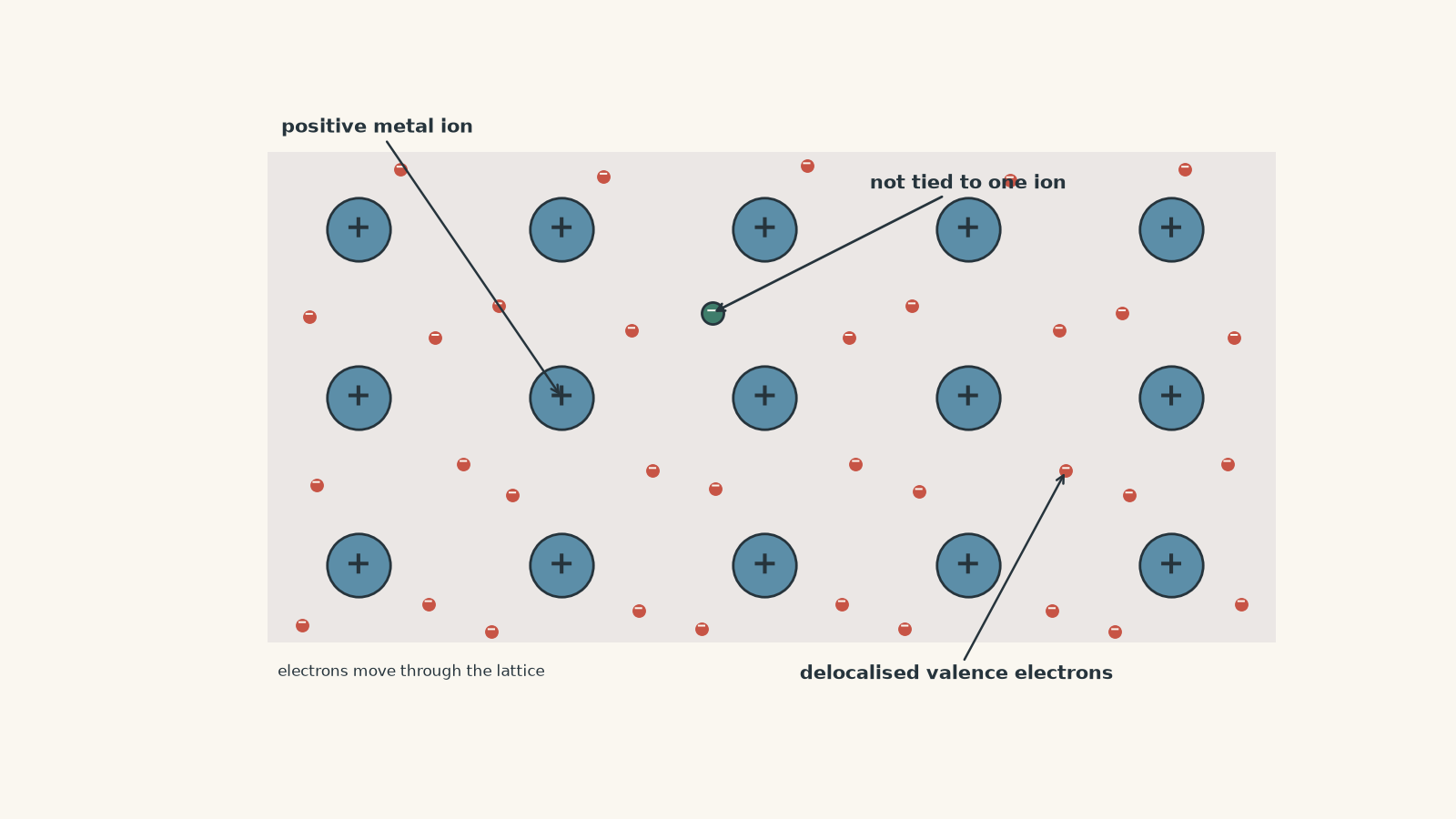
The metal stays together because opposite charges attract. The metallic bond is the electrostatic attraction between the positive metal ions and the delocalised electrons.
That gives us the central model:
\[
\text{positive metal ions} + \text{delocalised electrons} + \text{electrostatic attraction}
\]
The electrons have not escaped from the metal. They remain part of the structure, so the metal as a whole is electrically neutral.
For example, the HSC model treats magnesium metal as positive magnesium centres surrounded by its delocalised valence electrons. This does not mean isolated \(\mathrm{Mg}^{2+}\) ions are floating around inside the metal. They are part of one continuous metallic structure.
A useful, slightly silly analogy
Think of covalent bonding as a relationship where two atoms are very specifically sharing electrons with each other.
Metallic bonding is less exclusive. The valence electrons aren’t committed to one particular ion. They’re shared across the entire structure.
That helps us picture why metallic bonding is non-directional. The attraction does not depend on one particular ion being connected to one particular neighbour.
The analogy stops there. Electrons are not tiny people wandering between partners. The “sea of electrons” picture is a simplified model of electron behaviour in a metal. A more complete description uses quantum mechanics and energy bands, but the lattice and delocalised-electron model is the useful level for explaining HSC metallic properties.
02Why metals conduct electricity
Suppose you connect a copper wire across a potential difference.
Before the circuit is connected, the delocalised electrons are already moving within the metal, but there is no overall movement in one direction.
What changes when an electric field is applied?
The electrons gain a small overall drift through the structure. Because these charged particles can move through the solid, they transfer charge.
That is why solid metals conduct electricity.
The positive ions do not need to move along the wire. In a solid metal, they vibrate around their lattice positions while the delocalised electrons provide the mobile charge carriers.
A common weak explanation is:
Metals conduct because they have free electrons.
“Free” is too vague. The electrons have not escaped all forces. They remain attracted to the positive ion lattice.
A better explanation is:
Metals conduct electricity because they contain delocalised electrons that can move through the structure and carry charge when a potential difference is applied.
Worked example: Which particles carry current in magnesium?
A solid magnesium strip is connected into a circuit and conducts an electric current. Explain which particles are responsible for the current.
Step 1
Magnesium contains a lattice of positive metal ions surrounded by delocalised valence electrons.
Step 2
The positive ions remain near fixed lattice positions. The delocalised electrons can move throughout the metallic structure.
Step 3
When a potential difference is applied, the electrons develop an overall drift and transfer charge through the magnesium.
Therefore, the current in solid magnesium is carried by delocalised electrons, not by magnesium ions moving through the solid.
03Why metals can be bent without shattering
Now return to our original puzzle.
Imagine pushing one layer of positive ions sideways relative to another. If the bonding relied on fixed pairs of particles being connected in fixed directions, shifting the layers could break those connections.
Metallic bonding behaves differently.
Because the delocalised electrons extend throughout the structure, the positive ions can change position while remaining attracted to the surrounding electron density.
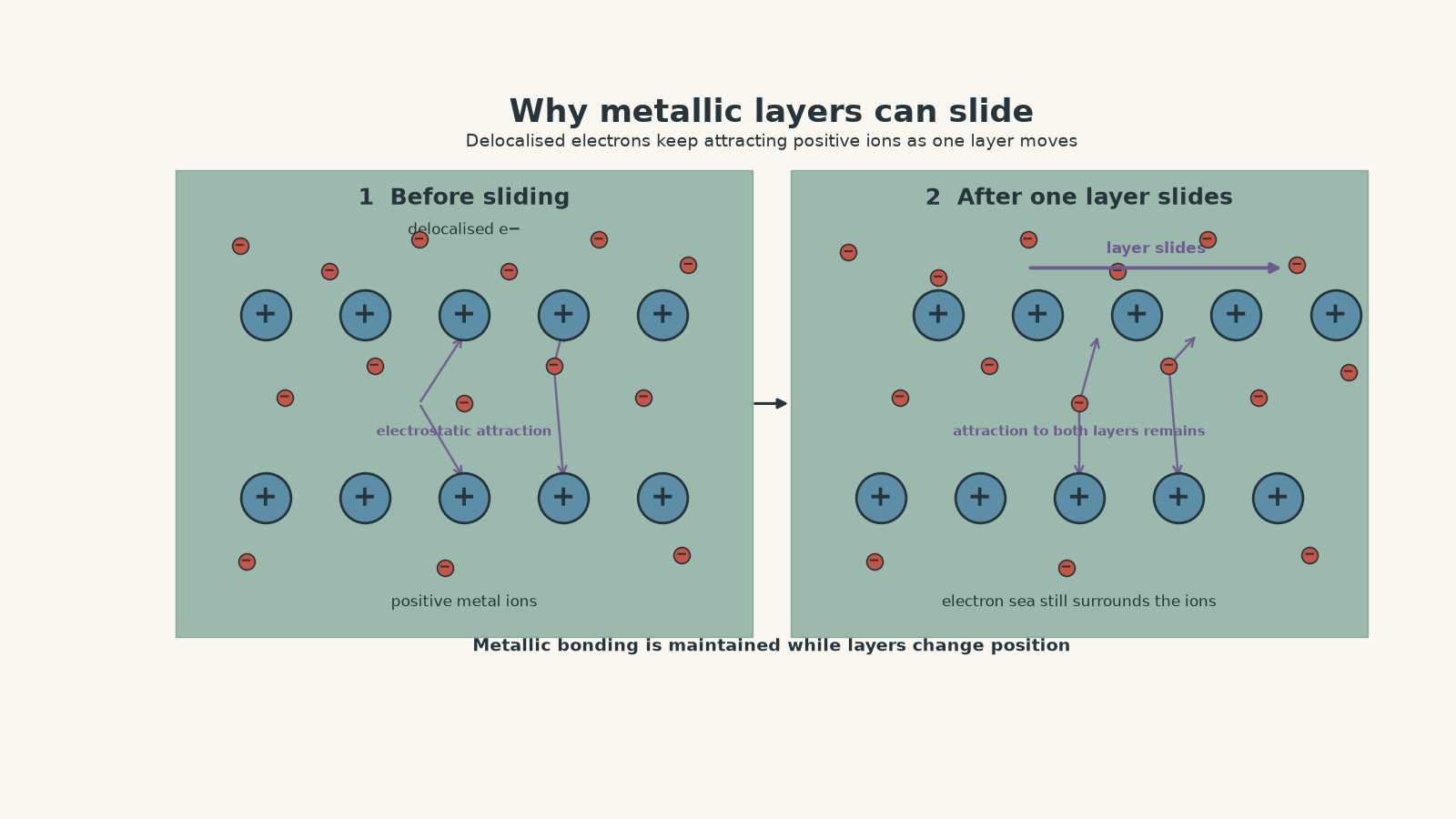
The metallic bond therefore continues to hold the structure together as layers move.
This helps explain two related properties:
- Malleability is the ability of a material to be shaped or hammered into sheets.
- Ductility is the ability of a material to be drawn into wires.
Copper being drawn into electrical wire is a familiar example of ductility. Aluminium being rolled into thin foil is an example of malleability.
Notice what the explanation is not saying. It is not saying the metal ions move around freely through a solid like particles in a liquid. The ions still occupy an organised solid structure. Under sufficient force, however, layers can shift relative to one another.
04Metallic bonding is strong, but not every metal is equally strong
It is tempting to learn the sentence “metals have strong metallic bonds” and stop there.
That causes trouble because metals vary enormously. Sodium is soft enough to cut easily, while metals such as tungsten have much higher melting points.
The strength of metallic attraction depends on how strongly the positive ions attract the delocalised electrons.
In the simple HSC model, stronger attraction is generally expected when:
- the positive metal ions have a greater charge,
- more valence electrons are contributed to the delocalised electron system, and
- the positive ions are smaller, so the attractive charges are closer together.
These factors can increase the electrostatic attraction between the ion lattice and the delocalised electrons.
Worked example: Sodium and magnesium
Sodium and magnesium are neighbouring metals in Period 3. Use the metallic bonding model to explain why magnesium has stronger metallic bonding than sodium.
Step 1
Each sodium atom contributes one valence electron to the metallic structure. Magnesium contributes two.
Magnesium therefore has more delocalised electrons available per metal atom.
Step 2
In the simplified HSC model, magnesium forms a more highly charged positive centre than sodium. Magnesium’s positive centre is also smaller.
Step 3
The greater positive charge, increased number of delocalised electrons, and shorter distance between opposite charges produce stronger electrostatic attraction in magnesium.
Step 4
More energy is required to overcome the stronger metallic attraction, so magnesium has a much higher melting point than sodium.
The useful conclusion is that metallic bond strength depends on the structure and charge distribution, not simply on whether a substance is classified as a metal.
There is a limit to this simple comparison. Real melting points also depend on crystal structure and other details of metallic bonding, so a one-factor rule should not be treated as an exact predictor for every pair of metals.
05Why metals conduct heat
Metals are also generally good thermal conductors.
Heat transfer in a metal occurs through two important parts of the structure.
First, the delocalised electrons can transfer energy rapidly through the material. Second, particles in the lattice vibrate more strongly when heated and transfer energy to neighbouring parts of the structure.
For HSC explanations, the mobile delocalised electrons are an important reason metals transfer thermal energy effectively.
This is why materials such as copper and aluminium are useful in cookware and heat-transfer equipment, although practical material choice also depends on cost, mass, corrosion resistance, and other properties.
06Why many metals are shiny
When light reaches a metal surface, its electromagnetic field interacts with the delocalised electrons.
These electrons respond to the incoming electromagnetic radiation, and much of the light is reflected from the surface. This contributes to the characteristic metallic lustre of many freshly exposed metals.
A dirty or oxidised metal surface may look dull because you may actually be looking at a layer of another substance on top of the metal.
07One model explains several properties
The useful part of the metallic bonding model is that you do not need a separate memorised story for each property.
| Property | What the metallic model explains |
|---|---|
| Electrical conductivity | Delocalised electrons can move through the structure and carry charge |
| Thermal conductivity | Mobile electrons and lattice vibrations transfer energy |
| Malleability | Layers of positive ions can shift while remaining attracted to delocalised electrons |
| Ductility | The non-directional metallic attraction can remain as the metal changes shape |
| Melting and boiling behaviour | Energy is required to overcome electrostatic attraction between positive ions and delocalised electrons |
| Lustre | Delocalised electrons interact strongly with incoming electromagnetic radiation, allowing much light to be reflected |
Be careful with the melting-point statement. Many metals have high melting points, but “all metals have high melting points” is false. Mercury is liquid at room temperature, and Group 1 metals have relatively low melting points compared with many transition metals.
08The most tempting misconception: are the electrons actually free?
Calling them a “sea of free electrons” can create the wrong picture.
A student might imagine electrons moving around completely independently, as if the positive ions have no effect on them. If that were true, there would be no reason for those electrons to remain inside the metal.
The useful distinction is:
Delocalised does not mean unbound from the metal.
The electrons are not localised around one particular atom or between one particular pair of atoms, but they are still part of the metallic structure and are attracted to the positive ions.
That attraction is the metallic bond itself.
There is another useful consequence. If an electron could leave the metal entirely, energy would generally have to be supplied. Metallic electrons are mobile within the material, not automatically free to fly away from it.
09What changes in an alloy?
Suppose a few atoms of a different element are introduced into a pure metal.
If the new atoms have a different size, the once-regular arrangement becomes distorted. Layers can no longer slide past one another as easily.
That is one reason an alloy can be harder and less easily deformed than the pure metal from which it is made.
The metallic bonding has not vanished. Delocalised electrons are still present, which is why many alloys remain electrically conductive. However, the altered lattice can make movement of layers more difficult.
This is a useful example of why microscopic structure matters. Two materials can both contain metallic bonding but have quite different mechanical properties.
10A reliable way to explain a metallic property
When an HSC question asks you to explain a property using metallic bonding, build the answer in this order:
- State the structure. Mention positive metal ions and delocalised electrons.
- Identify the relevant force or movement. For example, mobile electrons for conductivity, or non-directional electrostatic attraction for malleability.
- Connect that microscopic behaviour to the observed property.
For electrical conductivity, that might become:
The metal contains positive ions in a lattice surrounded by delocalised electrons. The electrons can move through the structure and carry charge when a potential difference is applied, so the metal conducts electricity.
For malleability, the middle step changes:
The positive ion layers can shift while remaining attracted to the surrounding delocalised electrons, so the metallic bonding can persist as the metal changes shape.
That connection between structure, particle behaviour, and observable property is what turns a description into an explanation.
11Questions and solutions
Question 1
A piece of copper conducts electricity while remaining solid. Explain how the metallic bonding model accounts for this observation.
Solution 1
Copper conducts as a solid because it contains delocalised electrons that can move through the metallic structure and carry charge.
Copper consists of positive metal ions arranged in a lattice, surrounded by delocalised valence electrons. The positive ions remain near their lattice positions, so the solid keeps its shape.
When a potential difference is applied, the delocalised electrons develop an overall drift through the metal. Because electrons are charged particles, this movement transfers charge and produces an electric current.
The key point is that electrical conduction does not require the copper ions themselves to move through the solid.
Question 2
A student says, “If the metal atoms lose their valence electrons and become positive ions, the whole piece of metal must have a positive charge.”
Explain the error.
Solution 2
The metal remains electrically neutral because the valence electrons have not left the piece of metal.
In the metallic bonding model, the valence electrons become delocalised rather than remaining associated with individual atoms. The remaining metal centres are positive, but the negatively charged delocalised electrons are still present in the same material.
The total positive and negative charge therefore balances.
The student’s mistake is treating delocalised as though it means removed completely from the metal. The electrons are shared throughout the metallic structure, not lost to the surroundings.
Question 3
A metal can be rolled into a thin sheet without breaking apart. Another student explains this by saying, “The positive ions slide because they do not attract each other.”
Evaluate this explanation and give a better one.
Solution 3
The explanation is incorrect because the metal is held together by attraction between the positive ions and the delocalised electrons, not by an absence of forces.
The positive metal ions would repel other positive ions if that were the only interaction present. However, the lattice is surrounded by negatively charged delocalised electrons.
When layers of ions shift, the electrons remain distributed through the metallic structure. The ions can therefore remain electrostatically attracted to the surrounding electron density even after their relative positions change.
This non-directional attraction allows the metal to deform without requiring a fixed set of bonds between particular pairs of particles to remain in the same positions.
That is the microscopic explanation for malleability.
Question 4
Pure metal A is relatively easy to bend. After a small amount of another element with larger atoms is added, the resulting alloy is noticeably harder to deform but still conducts electricity.
Explain both observations using particle-level reasoning.
Solution 4
The alloy is harder to deform because the differently sized atoms disrupt the regular lattice and hinder the movement of layers, while it can still conduct because delocalised electrons remain present.
In the pure metal, similarly sized metal particles form a comparatively regular structure. When a force is applied, layers can shift while metallic attraction persists.
Introducing larger atoms distorts this regular arrangement. The uneven structure makes it harder for layers to move smoothly past one another, so more force is required to deform the material.
The alloy can still conduct electricity because metallic bonding remains present and delocalised electrons can still move through the structure.
The important trap is assuming that stronger mechanical resistance must mean the electrons have become fixed. The increased hardness mainly comes from changes to the lattice and the difficulty of particle layers moving, not from removing all electron mobility.
Question 5
A student learns that a solid metal contains a regular lattice of positive ions and then observes that the same metal still conducts electricity after it melts.
They claim this disproves the metallic bonding model because the regular solid lattice no longer exists.
Is the claim correct? Explain.
Solution 5
No. Melting destroys the long-range regular solid lattice, but it does not automatically remove the mobile electrons responsible for metallic conduction.
In the solid, the positive metal centres occupy an ordered lattice and the delocalised electrons can move throughout the structure.
When the metal melts, the positive particles are no longer fixed in a regular lattice. They become mobile and disordered. However, the electrons can remain delocalised through the liquid metal, so charge can still be transported.
The student’s hidden assumption is that metallic bonding requires a perfectly fixed solid lattice. The lattice model describes the ordered structure of a solid metal, while electron delocalisation and metallic interactions can remain in the liquid state.
Question 6
Two hypothetical metals, X and Y, have the same crystal structure. Each atom of X contributes one delocalised valence electron and forms a relatively large positive centre. Each atom of Y contributes two delocalised valence electrons and forms a smaller, more highly charged positive centre.
Using only the metallic bonding model, predict which metal should require more energy to separate its particles. State one limitation of the prediction.
Solution 6
Metal Y should require more energy to separate its particles because the model predicts stronger electrostatic attraction between its positive centres and its delocalised electrons.
Y contributes more delocalised electrons per atom, giving a greater negative charge density through the metallic structure. Its positive centres are also more highly charged.
Because those positive centres are smaller, the opposite charges can also be closer together. These factors all favour stronger electrostatic attraction.
More energy should therefore be required to overcome the metallic attraction in Y, so the model would predict stronger metallic bonding and, all else being equal, a higher melting point.
The important limitation is the phrase all else being equal. Real metallic properties are also affected by crystal structure, electron configuration, and details not captured by the simple ion-lattice and electron-sea model. The model gives a chemically useful prediction, but not a universal numerical rule.
Once this model is secure, alloy properties become much easier to explain. Instead of memorising that alloys are often harder, you can ask what has happened to the lattice and whether its layers can still move easily. The same structure-property reasoning can then be used to compare metallic solids with ionic, molecular, and covalent network substances.