
Halogen Bonding: Sigma Holes and Directional Attractions
Explore how electron-deficient sigma holes allow covalently bonded halogens to attract electron-rich regions. Learn why halogen bonding is directional, what determines its strength, and how to identify it in molecular structures through worked examples and challenging questions.
An iodine atom bonded to carbon can attract a nitrogen atom carrying a lone pair of electrons. That sounds like a contradiction. Halogens are highly electronegative, so shouldn’t they be electron-rich and repel other electron-rich regions?
Not necessarily. The electron distribution around a covalently bonded halogen is uneven. One particular region can become electron-deficient and attract an electron-rich atom from another molecule. Even more interestingly, the attraction is strongly directional: the nitrogen usually approaches almost directly along the extension of the carbon-halogen bond.
This interaction is called halogen bonding.
Halogen bonding goes beyond the required Year 11 Chemistry content. The Year 11 focus area Properties and structure of matter provides the background needed to understand it, but halogen bonding itself is extension material, not a required HSC assessment point.
01Start with the electrostatic attraction you already know
In Year 11 Chemistry, you study metallic bonding using a model of positive metal ions surrounded by delocalised electrons.
The metal ions have positive charges. The delocalised electrons have negative charges. The electrostatic attraction between them holds the metallic structure together.
The important idea is that electrostatic attraction does not require two separate ions. It can also occur between regions of uneven electrical charge.
That second idea is the starting point for halogen bonding.
There is an important difference, though. Metallic bonding involves an extended lattice of positive metal ions and delocalised electrons. Halogen bonding involves a much more localised attraction between particular regions of molecules.
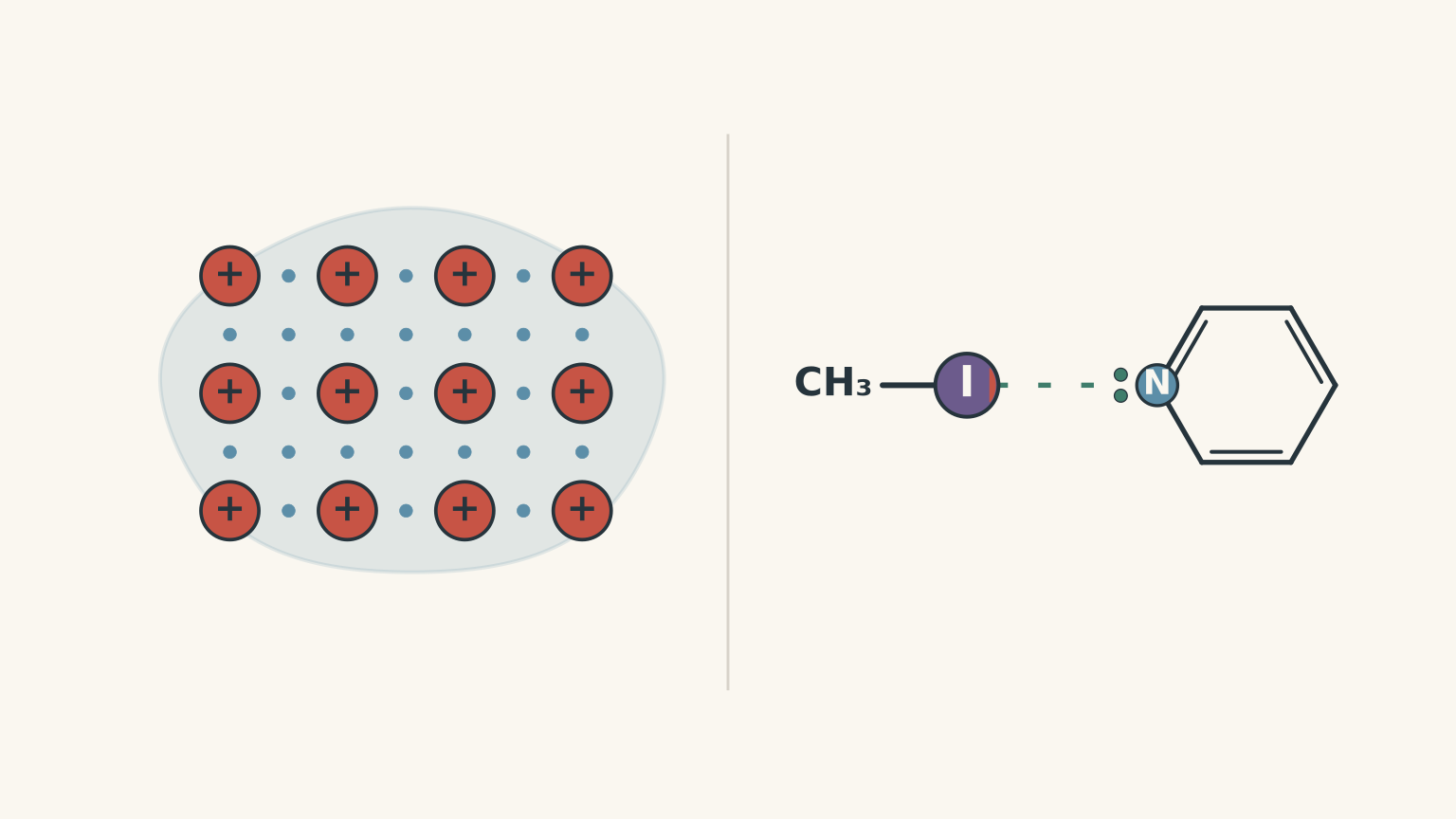
Due to technical limitations, this figure may display incorrectly or contain inaccuracies. Please check key details against your course materials.
If you need to refresh how bonding models explain physical properties, see Bonding and Physical Properties: HSC Chemistry Guide.
02The surprising electron distribution around a halogen
Consider a molecule containing a carbon-iodine bond.
The iodine atom is covalently bonded to carbon. Its electrons are not distributed evenly in every direction around the atom.
This is called an anisotropic electron distribution. Anisotropic simply means that a property changes depending on the direction in which you examine it.
In many molecules containing covalently bonded chlorine, bromine, or iodine, two distinct regions develop around the halogen:
- A region of reduced electron density at the outer end of the halogen, directly opposite the covalent bond.
- A region of relatively high electron density around the sides of the halogen.
The first region can have a positive electrostatic potential. It is called a sigma hole, written as a σ-hole.
The second region forms a belt of negative electrostatic potential around the halogen.
The term sigma hole needs a little care.
It does not mean that there is a literal empty space inside the iodine atom. Nor does it mean that the entire iodine atom carries a formal positive charge.
It describes a local region of electron deficiency and positive electrostatic potential on the surface of the halogen.
The important consequence is that an iodine atom can have a positive region on one side and negative regions around the others.
This is why a simple model that treats an entire atom as uniformly positive or negative is insufficient.
What actually forms a halogen bond?
An electron-rich region on another molecule can be attracted to the positive sigma hole.
Common electron-rich regions include:
- Lone pairs on nitrogen atoms.
- Lone pairs on oxygen atoms.
- Lone pairs on sulfur atoms.
- Negatively charged ions, such as chloride ions.
- Electron-rich π systems, such as those found in aromatic molecules.
The International Union of Pure and Applied Chemistry (IUPAC) defines a halogen bond in terms of a net attractive interaction between an electrophilic region associated with a halogen and a nucleophilic region in the same or another molecular entity.
Here, electrophilic means electron-deficient, while nucleophilic means electron-rich.
The molecule containing the halogen is called the halogen-bond donor. The electron-rich molecule or region is called the halogen-bond acceptor.
This terminology can initially seem backwards: the acceptor is usually the region supplying electron density to the interaction.
The key point is that the halogen is already covalently bonded to another atom. The halogen bond is an additional, non-covalent attraction.
03Why halogen bonding is directional
This is the feature that makes halogen bonding particularly interesting.
Consider a molecule containing a carbon-iodine bond, \(C-I\), approaching a nitrogen atom with a lone pair.
There are two possible arrangements:
- The nitrogen approaches directly along the extension of the carbon-iodine bond.
- The nitrogen approaches the side of the iodine atom.
Which arrangement should be more favourable?
The first.
The positive sigma hole lies directly along the extension of the \(C-I\) bond. The nitrogen lone pair is therefore attracted towards this specific region.
The second arrangement places the nitrogen near the negative belt surrounding iodine. This is not the favourable orientation for the usual electrophilic-halogen-to-nucleophile interaction.
Chemists describe the geometry using the angle \(R-X\cdots Y\), where:
- \(R\) is the group covalently bonded to the halogen.
- \(X\) is the halogen atom.
- \(Y\) is the electron-rich halogen-bond acceptor.
- The three dots represent the non-covalent interaction.
The angle is measured at the halogen atom, \(X\).
A typical halogen bond has an \(R-X\cdots Y\) angle approaching \(180^\circ\). Real structures can deviate from this because of other molecular interactions and crystal-packing constraints.
This directionality is a useful way to distinguish halogen bonding from less directional intermolecular attractions.
Short distances provide another clue
Halogen-bonded atoms are often closer together than their respective van der Waals radii would suggest.
A van der Waals radius is an approximate measure of how closely an atom can approach another atom without forming a conventional covalent bond.
For a potential halogen bond, chemists can compare the observed distance with the sum of the two van der Waals radii.
A useful screening calculation is:
\[ d_{\mathrm{norm}}= \frac{d(X\cdots Y)} {r_{\mathrm{vdW}}(X)+r_{\mathrm{vdW}}(Y)} \]
Here:
- \(d_{\mathrm{norm}}\) is the dimensionless normalised contact ratio.
- \(d(X\cdots Y)\) is the observed distance between the halogen and acceptor.
- \(r_{\mathrm{vdW}}(X)\) and \(r_{\mathrm{vdW}}(Y)\) are their respective van der Waals radii.
A ratio below 1 indicates that the atoms are closer than the sum of their van der Waals radii.
However, this is supporting evidence, not proof. A short contact alone does not establish a halogen bond. Its direction and electronic environment matter as well.
04What determines the strength of a halogen bond?
Not every covalently bonded halogen forms an equally strong halogen bond.
Two factors are particularly useful for predicting its strength.
1. The identity of the halogen
Larger halogen atoms are generally more polarizable.
Polarizability describes how easily an atom’s electron distribution can be distorted by its surroundings.
As we move down Group 17, polarizability generally increases:
\[ F < Cl < Br < I \]
For otherwise comparable molecular environments, heavier halogens tend to develop larger, more positive sigma holes.
This gives a useful general trend in halogen-bond donor ability:
\[ F < Cl < Br < I \]
Fluorine deserves special attention. Although it is a halogen, it is generally a poor halogen-bond donor in ordinary organic molecules.
Its high electronegativity and relatively low polarizability make it difficult to develop a sufficiently positive sigma hole.
There are exceptions, particularly when fluorine is attached to strongly electron-withdrawing groups or other unusual molecular environments. So the correct statement is that fluorine rarely acts as a halogen-bond donor, not that it can never do so.
2. The group bonded to the halogen
The identity of the halogen is only part of the story.
The group attached to it also influences the electron distribution.
Consider two molecules:
- Methyl iodide, \(CH_3I\).
- Trifluoroiodomethane, \(CF_3I\).
Both contain an iodine atom. However, the three fluorine atoms in \(CF_3I\) make the attached \(CF_3\) group strongly electron-withdrawing.
This can increase the positive electrostatic potential at the iodine atom.
Consequently, \(CF_3I\) can act as a stronger halogen-bond donor than an otherwise comparable molecule with a less electron-withdrawing group.
The general lesson is important:
You cannot predict halogen-bond strength from the halogen atom alone.
Its polarizability, the electron-withdrawing ability of its attached group, the acceptor, and the molecular geometry all matter.
05Is halogen bonding just electrostatic attraction?
Electrostatic attraction is an excellent starting model, but it does not describe every contribution to the interaction.
A halogen bond can involve several effects:
- Electrostatic attraction: the positive sigma hole attracts an electron-rich region.
- Polarisation: the electron distributions of the interacting molecules can be distorted by each other.
- Dispersion forces: temporary fluctuations in electron distributions create additional attractions.
- Charge transfer: some electron density can be donated from the acceptor, such as a nitrogen lone pair, into an antibonding orbital of the covalent \(R-X\) bond.
An antibonding orbital is an orbital that weakens the bond when electrons occupy it. The relevant orbital here is called \(\sigma^*(R-X)\).
This charge transfer is partial. It does not mean that an entire electron moves from one molecule to another to create a pair of ions.
The relative importance of these contributions varies between different halogen-bonded systems. The sigma-hole model is particularly useful for explaining directionality, but it should not be treated as a complete calculation of interaction energy.
For a more detailed scientific treatment, see Cavallo and colleagues’ review, The Halogen Bond, Chemical Reviews (2016).
06Worked example: Identifying a halogen bond in a molecular crystal
A molecule of 1,4-diiodotetrafluorobenzene approaches a pyridine molecule. One iodine atom is 3.10 Å from the pyridine nitrogen, and the \(C-I\cdots N\) angle is \(176^\circ\).
Explain why this arrangement is consistent with halogen bonding. Identify the donor and acceptor.
Step 1
The 1,4-diiodotetrafluorobenzene molecule contains covalently bonded iodine atoms.
Iodine is relatively polarizable, and the fluorinated aromatic ring is strongly electron-withdrawing. These features favour a positive sigma hole at the iodine atom.
Therefore, 1,4-diiodotetrafluorobenzene is the halogen-bond donor.
Step 2
Pyridine contains a nitrogen atom with a lone pair of electrons.
This lone pair provides an electron-rich region that can interact with the positive sigma hole on iodine.
Pyridine is therefore the halogen-bond acceptor.
Step 3
The observed angle is \(176^\circ\).
This is very close to \(180^\circ\), meaning that the nitrogen approaches almost directly along the extension of the C-I bond.
That is the preferred geometry for a halogen bond.
Step 4
The molecular arrangement is consistent with a halogen bond between iodine and nitrogen.
The attraction is between the positive sigma hole on iodine and the electron-rich nitrogen lone pair. The original C-I covalent bond remains intact.
07Worked example: Why is iodine a better donor than ordinary organic fluorine?
Two molecules, methyl fluoride (\(CH_3F\)) and methyl iodide (\(CH_3I\)), approach the same nitrogen-containing molecule.
Assume their geometries are comparable. Which molecule is more likely to act as the stronger halogen-bond donor?
Step 1
Fluorine is more electronegative and less polarizable than iodine.
Iodine has a more easily distorted electron distribution and is generally more capable of developing a significant positive sigma hole.
Step 2
Both molecules have a methyl group attached to the halogen.
Neither has a particularly strong electron-withdrawing group attached to the halogen to enhance its sigma hole.
This makes the difference between fluorine and iodine especially relevant.
Step 3
Methyl iodide is more likely to act as the stronger halogen-bond donor.
Its iodine atom is more polarizable and more readily develops an electrophilic region that attracts the nitrogen lone pair.
Methyl fluoride is generally a poor halogen-bond donor.
Conclusion: Methyl iodide is the better predicted donor in this comparison. However, this is a qualitative prediction, not a guarantee of a particular interaction energy. Changes to the molecular environment can alter the result.
08Where chemists use halogen bonding
Halogen bonding is useful because it allows chemists to control how molecules arrange themselves without needing to create new covalent bonds between them.
Two important applications are crystal engineering and molecular recognition.
Crystal engineering
Imagine designing a solid in which one molecule has iodine atoms at opposite ends and another molecule has nitrogen lone pairs at opposite ends.
The iodine atoms can attract the nitrogen atoms on neighbouring molecules.
Because the interactions are directional, the molecules can assemble into organised structures, including chains and networks.
Chemists use this principle in crystal engineering, where molecular interactions are deliberately selected to influence the structure and properties of solid materials.
Molecular recognition and drug design
Proteins contain many regions with electron-rich atoms, particularly nitrogen and oxygen atoms.
A drug molecule containing bromine or iodine may be able to position one of these halogens towards an electron-rich site in a protein.
If the geometry and electronic environment are favourable, a halogen bond can contribute to the attraction between the drug and protein.
This can help determine how a molecule sits within a binding pocket and how effectively it interacts with its target.
Halogen bonding is therefore considered in medicinal chemistry and drug design. It is one contribution among many, though. Adding an iodine or bromine atom to a drug does not automatically improve its biological activity.
For further reading, see Wilcken and colleagues’ research review, Principles and applications of halogen bonding in medicinal chemistry and chemical biology.
09A common misconception: A halogen atom cannot be both positive and negative
This is probably the most interesting consequence of the sigma-hole model.
It is tempting to think of an atom as having one overall electrical character.
For example, you might classify iodine as electron-rich and conclude that it should repel electron-rich atoms everywhere around its surface.
But the distribution is directional.
The iodine atom can have:
- A positive sigma hole along the extension of its covalent bond.
- A negative belt around the sides of the atom.
This means that the same iodine atom can attract different types of particles from different directions.
An electron-rich nitrogen lone pair can approach the positive sigma hole, while a positively polarised hydrogen atom can approach the negative belt.
These are different interactions, and they can even occur around the same iodine atom.
The distinction is important when analysing complicated molecular structures.
| Tempting prediction | More accurate explanation |
|---|---|
| Every part of a halogen atom is electron-rich. | Electron density is unevenly distributed around a covalently bonded halogen. |
| Any short I···N or Br···O distance proves halogen bonding. | Distance, direction, and the electronic environment must be considered together. |
| Fluorine must form the strongest halogen bonds because it is highly electronegative. | Fluorine is generally a poor donor because of its low polarizability and the difficulty of developing a positive sigma hole. |
| A halogen atom must be either positive or negative. | Different regions of the same atom can have different electrostatic potentials. |
| Halogen bonding involves complete electron transfer. | It is a non-covalent attraction that can include partial charge transfer and other contributions. |
10Questions and solutions
Question 1
A molecule of trifluorobromomethane, \(CF_3Br\), approaches an ammonia molecule, \(NH_3\).
The nitrogen atom is 3.15 Å from bromine, and the \(C-Br\cdots N\) angle is \(174^\circ\). Assume that the nitrogen lone pair is directed towards bromine.
Identify the halogen-bond donor and acceptor. Explain why the molecular arrangement is consistent with halogen bonding.
Solution 1
The halogen-bond donor is \(CF_3Br\), and the halogen-bond acceptor is \(NH_3\). The geometry is consistent with a directional halogen bond.
The bromine atom is covalently bonded to carbon, and the strongly electron-withdrawing \(CF_3\) group helps produce a positive sigma hole on bromine.
The nitrogen atom in ammonia has a lone pair of electrons. It can interact attractively with this electron-deficient region.
The angle of \(174^\circ\) is close to the preferred \(180^\circ\) orientation. This means that nitrogen approaches bromine almost directly along the extension of the C-Br bond.
The Br···N attraction is non-covalent. The original C-Br bond remains intact.
Question 2
A crystallographer identifies three possible iodine-oxygen contacts involving carbonyl oxygen atoms in a molecular crystal.
The following hypothetical structural data are obtained:
| Contact | I···O distance | C-I···O angle |
|---|---|---|
| A | 3.02 Å | 176° |
| B | 2.86 Å | 120° |
| C | 3.28 Å | 174° |
For this question, use the following approximate van der Waals radii:
- Iodine: 1.98 Å.
- Oxygen: 1.52 Å.
Calculate the normalised contact ratio for each arrangement and identify which provides the strongest geometric evidence of halogen bonding.
Explain why the shortest contact is not necessarily the best candidate.
Solution 2
Contact A provides the strongest geometric evidence of halogen bonding, even though contact B has the shortest distance. The reason is that halogen bonding depends on both distance and direction.
First, calculate the sum of the van der Waals radii:
\[ r_{\mathrm{sum}}=1.98+1.52 \]
\[ r_{\mathrm{sum}}=3.50\ \mathrm{\AA} \]
Now calculate the normalised contact ratio:
\[ d_{\mathrm{norm}}=\frac{d(I\cdots O)}{3.50} \]
For contact A:
\[ d_{\mathrm{norm}}=\frac{3.02}{3.50} =0.863 \]
For contact B:
\[ d_{\mathrm{norm}}=\frac{2.86}{3.50} =0.817 \]
For contact C:
\[ d_{\mathrm{norm}}=\frac{3.28}{3.50} =0.937 \]
The results are:
| Contact | Normalised ratio | Angle |
|---|---|---|
| A | 0.863 | 176° |
| B | 0.817 | 120° |
| C | 0.937 | 174° |
All three distances are shorter than the sum of the supplied van der Waals radii.
However, their orientations are different.
Contact A has a relatively short distance and an angle of \(176^\circ\). The oxygen approaches almost directly along the extension of the C-I bond, which is exactly where the positive sigma hole is located.
Contact B has the shortest distance, but its angle is only \(120^\circ\). The oxygen approaches from the side, where iodine has a relatively electron-rich belt. This is not the preferred orientation for an attraction between an electrophilic halogen and an electron-rich oxygen.
Contact C has a favourable angle, but its distance is much closer to the sum of the van der Waals radii. The geometric evidence is therefore less convincing than for A.
The important distinction is that a short distance is not enough. The direction of approach must also match the electron distribution around the halogen.
These measurements identify A as the strongest geometric candidate, although geometry alone cannot establish the complete interaction energy.
Question 3
Two different molecules are being investigated as halogen-bond donors to the same pyridine molecule.
The candidate donors are methyl iodide, \(CH_3I\), and trifluorochloromethane, \(CF_3Cl\).
A hypothetical electrostatic potential calculation, using the same molecular surface definition and computational method, gives the following maximum positive potentials at the halogen atoms:
| Donor | Maximum positive electrostatic potential |
|---|---|
| \(CH_3I\) | +0.55 V |
| \(CF_3Cl\) | +0.90 V |
Assume that both donors approach the pyridine nitrogen at the same angle and separation.
(a) Which molecule has the larger positive sigma hole according to these calculations?
(b) A student argues that \(CH_3I\) must form the stronger halogen bond because iodine is more polarizable than chlorine. Explain why this conclusion is not justified.
(c) Identify two additional contributions that would need to be considered when comparing the total interaction energies.
Solution 3
(a) \(CF_3Cl\) has the larger positive sigma hole according to the supplied calculations.
Its maximum positive electrostatic potential is \(+0.90\ \mathrm{V}\), compared with \(+0.55\ \mathrm{V}\) for \(CH_3I\).
The fluorinated group is strongly electron-withdrawing, which helps increase the positive potential at chlorine.
(b) The student’s conclusion is not justified because polarizability is only one factor affecting halogen-bond strength.
Iodine is more polarizable than chlorine, which generally favours stronger halogen bonding.
However, the \(CF_3\) group in \(CF_3Cl\) has a strong electron-withdrawing effect. This can produce a larger positive sigma hole than the one present in \(CH_3I\).
The supplied data demonstrate why simply moving down Group 17 does not always predict the relative donor ability of two different molecules.
(c) Other contributions include:
- Dispersion forces, which arise from temporary fluctuations in electron distributions and are generally influenced by polarizability.
- Charge transfer, where electron density from the pyridine nitrogen can be donated into the antibonding orbital of the covalent carbon-halogen bond.
Polarisation and repulsive interactions also influence the total interaction energy.
Therefore, the supplied electrostatic potentials allow us to compare the positive sigma holes, but they do not establish which complete halogen-bonded complex is more stable.
To settle that comparison, we would need additional information, such as calculated total interaction energies or experimental association measurements under equivalent conditions.
Question 4
Consider two rigid molecular components.
The halogen-bond donor, D, has an iodine atom at each end of an approximately linear molecule. Each iodine can form one halogen bond.
The acceptor, A, has a nitrogen atom at each end of another approximately linear molecule. Each available nitrogen lone pair can accept one halogen bond.
Assume that:
- Each molecule can rotate to align its bonding sites.
- Each available iodine and nitrogen site forms one halogen bond.
- Other intermolecular interactions are ignored.
- Cyclic structures are excluded by the crystal arrangement.
Two crystals are formed.
Crystal 1: Neutral A and D crystallise in a 1:1 molecular ratio. Both nitrogen lone pairs in A are available.
Crystal 2: One nitrogen atom in every A molecule is protonated, so only one nitrogen lone pair remains available. The crystal forms with a 1:2 ratio of D to A.
Predict the idealised molecular connectivity in each crystal. Explain why protonating one nitrogen changes the overall structure even though the iodine atoms in D have not changed.
Solution 4
Crystal 1 forms an idealised alternating chain, while crystal 2 forms discrete A-D-A units. The difference comes from the number of available bonding sites on each molecule.
Crystal 1: Both molecules have two available sites.
D has two iodine atoms capable of forming halogen bonds.
A has two nitrogen atoms capable of accepting halogen bonds.
Each molecule can therefore connect to two neighbouring molecules.
The arrangement can repeat:
\[ \cdots-D-A-D-A-D-A-\cdots \]
This produces an extended one-dimensional chain.
Neither molecule needs to form a new covalent bond. The structure is held together by repeated directional halogen bonds.
Crystal 2: A has only one available nitrogen site.
Protonation removes the lone pair at one nitrogen from the available halogen-bond acceptor sites.
A is now effectively monofunctional: it can connect to only one D molecule.
D still has two available iodine donors.
At the supplied 1:2 ratio, one D can connect to two A molecules:
\[ A-D-A \]
However, neither A molecule can connect to another D through a second nitrogen site.
The resulting structure consists of discrete A-D-A units under the stated assumptions, rather than an extended alternating chain.
The important idea is that the number and arrangement of available bonding sites determine how molecules can assemble.
A stronger or unchanged iodine donor does not automatically preserve the same crystal structure. The acceptor’s bonding capacity matters just as much.
Question 5
A crystal contains a molecule with a covalently bonded iodine atom, represented as \(R-I\), where R is the remainder of the molecule.
Two neighbouring molecules approach the same iodine atom.
The first contains a pyridine nitrogen. Its geometry is:
- I···N distance = 3.10 Å.
- \(R-I\cdots N\) angle = \(176^\circ\).
The second contains an N-H group. Its geometry is:
- H···I distance = 2.75 Å.
- \(N-H\cdots I\) angle = \(171^\circ\).
- \(R-I\cdots H\) angle = \(98^\circ\).
Assume that both contacts are sufficiently close to be attractive, that there is no steric overlap between the neighbouring molecules, and that the surrounding crystal structure allows both arrangements to occur simultaneously.
A student examines the structure and argues:
The iodine cannot attract both neighbours. If it has a positive sigma hole that attracts the pyridine nitrogen, it must repel the positively polarised hydrogen atom.
Is the student correct?
Identify the interaction involving each neighbour and explain how both attractions can occur around the same iodine atom. Your explanation must account for all three angles and distinguish the role of iodine in each interaction.
Solution 5
The student is incorrect. Both interactions can occur simultaneously because the iodine atom has different electrostatic properties in different directions.
This is the key consequence of the anisotropic electron distribution around a covalently bonded halogen.
Consider the two neighbouring molecules separately.
First interaction: Pyridine nitrogen and the positive sigma hole
The pyridine nitrogen has a lone pair of electrons.
Its position gives an \(R-I\cdots N\) angle of \(176^\circ\), which is close to the preferred \(180^\circ\) orientation.
This means that the nitrogen approaches directly along the extension of the R-I covalent bond.
That is where the positive sigma hole is located.
The electron-rich nitrogen lone pair is therefore attracted to the electron-deficient region on iodine.
This is a halogen bond.
The R-I molecule is the halogen-bond donor, and pyridine is the acceptor.
Second interaction: N-H group and the negative belt
Now consider the second neighbour.
The hydrogen atom is covalently bonded to nitrogen. Because nitrogen is more electronegative than hydrogen, the hydrogen carries a partial positive charge.
The supplied \(N-H\cdots I\) angle is \(171^\circ\), indicating that hydrogen approaches iodine approximately along the extension of its N-H bond.
However, the \(R-I\cdots H\) angle is only \(98^\circ\).
This is the crucial difference.
The hydrogen approaches the side of the iodine atom, not the positive sigma hole at its outer tip.
The side of iodine contains a region of relatively high electron density and negative electrostatic potential.
This region can attract the partially positive hydrogen atom.
The resulting interaction is a hydrogen bond in which the iodine acts as the hydrogen-bond acceptor.
Why is there no contradiction?
The student’s mistake is treating the iodine atom as though its entire surface has one uniform electrical character.
It does not.
The positive sigma hole and negative equatorial belt occupy different regions of the same atom.
Consequently, iodine can act as an electrophilic site towards the nitrogen lone pair in one direction and as an electron-rich hydrogen-bond acceptor towards the N-H group in another.
The two interactions are compatible because they involve different regions of the iodine surface.
This is also why directionality is so important when identifying halogen bonds. Knowing which atom is nearby is not enough. You need to know which region of the halogen it approaches.
11What to study next
Halogen bonding gives you a more precise way to think about intermolecular attractions. Instead of treating an atom as uniformly positive or negative, you can consider how its electron distribution changes with direction.
The next useful comparison is with hydrogen bonding, which also involves directional electrostatic attraction but uses a different electron-deficient region.
For that comparison, see Intermolecular Bonding in Alcohols: HSC Chemistry Explained.
You can then extend the same reasoning to other directional interactions, including chalcogen bonding, and examine how competing intermolecular attractions determine the structures and properties of molecular crystals.
Scientific references
- IUPAC: Definition of the Halogen Bond (2013) – the internationally recognised definition of halogen bonding.
- Cavallo et al.: The Halogen Bond, Chemical Reviews (2016) – an extensive review of sigma holes, directionality, interaction energies, crystal engineering, and molecular recognition.
- Wilcken et al.: Principles and Applications of Halogen Bonding in Medicinal Chemistry and Chemical Biology (2013) – applications and limitations in molecular recognition and drug design.
- NSW Curriculum: Chemistry 11-12 Syllabus (2025) – official syllabus information. The 2025 syllabus is scheduled for implementation from 2028; halogen bonding is treated here as extension material, not a required assessment point.