
Why Pure Solids Are Omitted from Equilibrium Expressions
Pure solids have an activity of 1, so they are left out of equilibrium expressions. Learn how this works in gas-solid reactions, calculate equilibrium constants, and understand why running out of a solid can prevent a system from reaching its usual equilibrium.
A reaction can consume a solid, yet that solid does not appear in its equilibrium expression. That seems strange at first. If calcium carbonate is being used up in a reaction, surely its concentration should affect the equilibrium constant?
Not quite. The reason comes down to the difference between the amount of a substance and its activity. A pure solid has a constant activity, taken as 1, regardless of how much of it is present.
But there’s an important catch: although the amount of a pure solid does not appear in the equilibrium expression, having enough solid available can determine whether the system reaches equilibrium at all.
Let’s work through why.
01The experiment that reveals the problem
Consider the reversible decomposition of calcium carbonate:
\[ \ce{CaCO3(s) <=> CaO(s) + CO2(g)} \]
Calcium carbonate decomposes to form calcium oxide and carbon dioxide. The reverse reaction converts calcium oxide and carbon dioxide back into calcium carbonate.
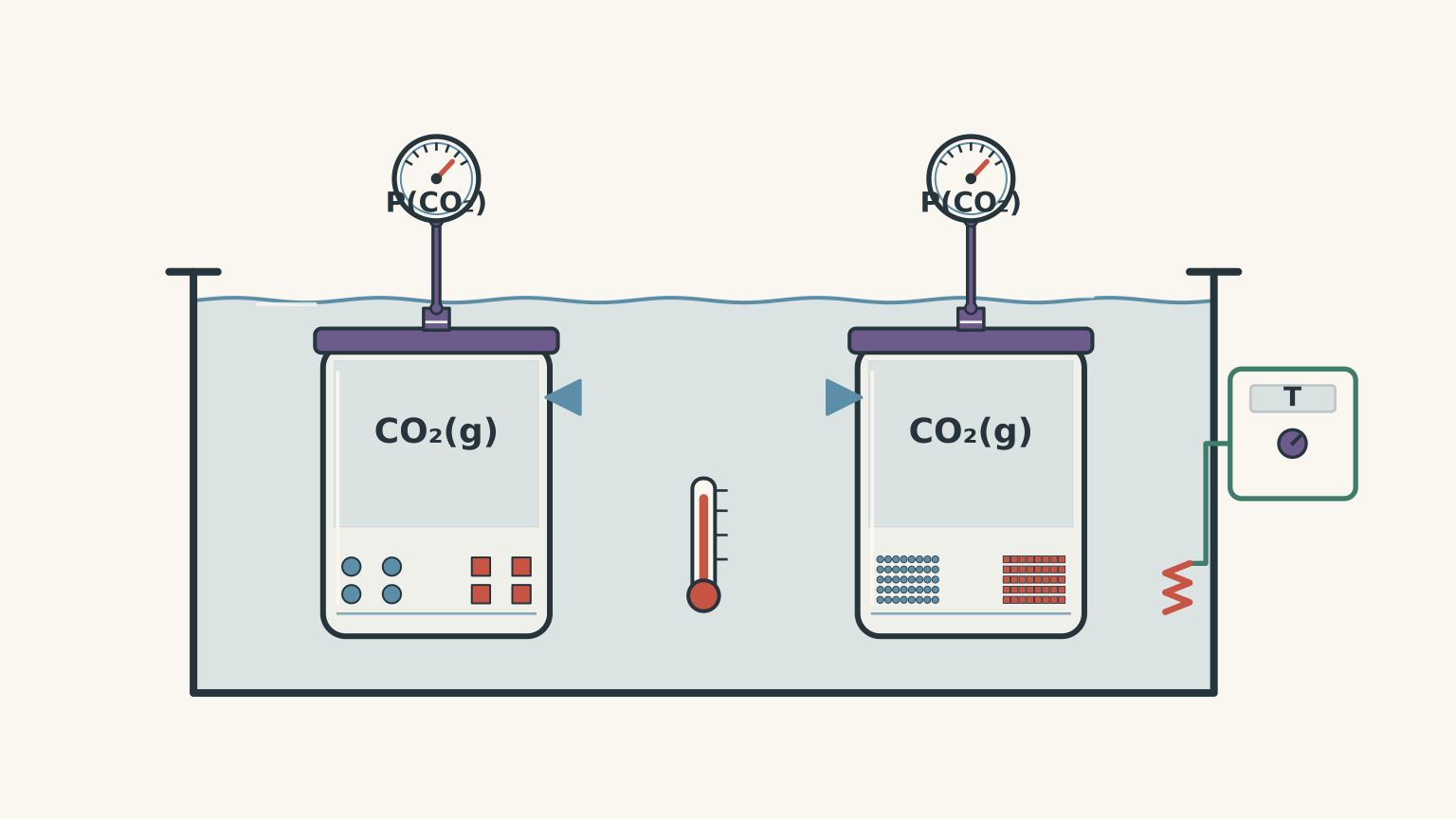
Imagine two identical sealed vessels. Both contain calcium carbonate and calcium oxide, and both are maintained at the same temperature.
However, their solid contents are different:
- Vessel A contains 0.50 g of calcium carbonate and 0.50 g of calcium oxide.
- Vessel B contains 5.00 g of calcium carbonate and 5.00 g of calcium oxide.
Both vessels have the same gas volume and enough of each solid to maintain the two solid phases throughout the experiment.
What would you predict about their final carbon dioxide pressures?
You might expect Vessel B to produce a different pressure because it contains ten times as much solid.
In fact, both vessels reach the same equilibrium carbon dioxide pressure.
Due to technical limitations, this figure may display incorrectly or contain inaccuracies. Please check key details against your course materials.
What should the experiment show?
The question being tested is whether changing the amount of a pure solid changes the equilibrium position.
If we incorrectly included the solid substances as concentration terms, we might write:
\[ K_p = \frac{p_{\ce{CO2}}[\ce{CaO}]} {[\ce{CaCO3}]} \]
This would suggest that changing the relative amounts of calcium carbonate and calcium oxide could change the equilibrium carbon dioxide pressure.
But this is not the correct expression.
For a controlled comparison, we would:
- Place both vessels in the same temperature-controlled environment.
- Maintain identical gas volumes.
- Record the carbon dioxide pressure using pressure sensors.
- Allow both reactions to proceed until their pressures stop changing.
- Confirm that both solid phases are still present.
The following results are illustrative, not measurements from an actual experiment.
| Measurement | Vessel A | Vessel B |
|---|---|---|
| Initial CaCO3 mass | 0.50 g | 5.00 g |
| Initial CaO mass | 0.50 g | 5.00 g |
| Temperature | Same | Same |
| Gas volume | 1.00 L | 1.00 L |
| Final equilibrium CO2 pressure | 0.40 bar | 0.40 bar |
The equilibrium pressures are identical despite the different solid quantities.
Why does the experimental design matter?
A first attempt at this comparison could give misleading results.
For example, measuring both vessels after exactly five minutes might show different pressures. However, that could simply mean one reaction is proceeding faster.
The surface area of the solids affects reaction rates. It does not change the equilibrium constant for the same pure solid phases at the same temperature.
A reliable comparison therefore needs to measure the final pressure after equilibrium has been reached, rather than comparing arbitrary readings during the reaction.
The gas volume and temperature must also remain controlled.
The important observation is that changing the amount of solid does not change the final equilibrium pressure, provided both solid phases remain present.
So why does this happen?
02The real reason: pure solids have constant activity
The key is a thermodynamic quantity called activity.
Activity describes the effective contribution of a substance to an equilibrium relationship. It is used in the exact thermodynamic expression for an equilibrium constant.
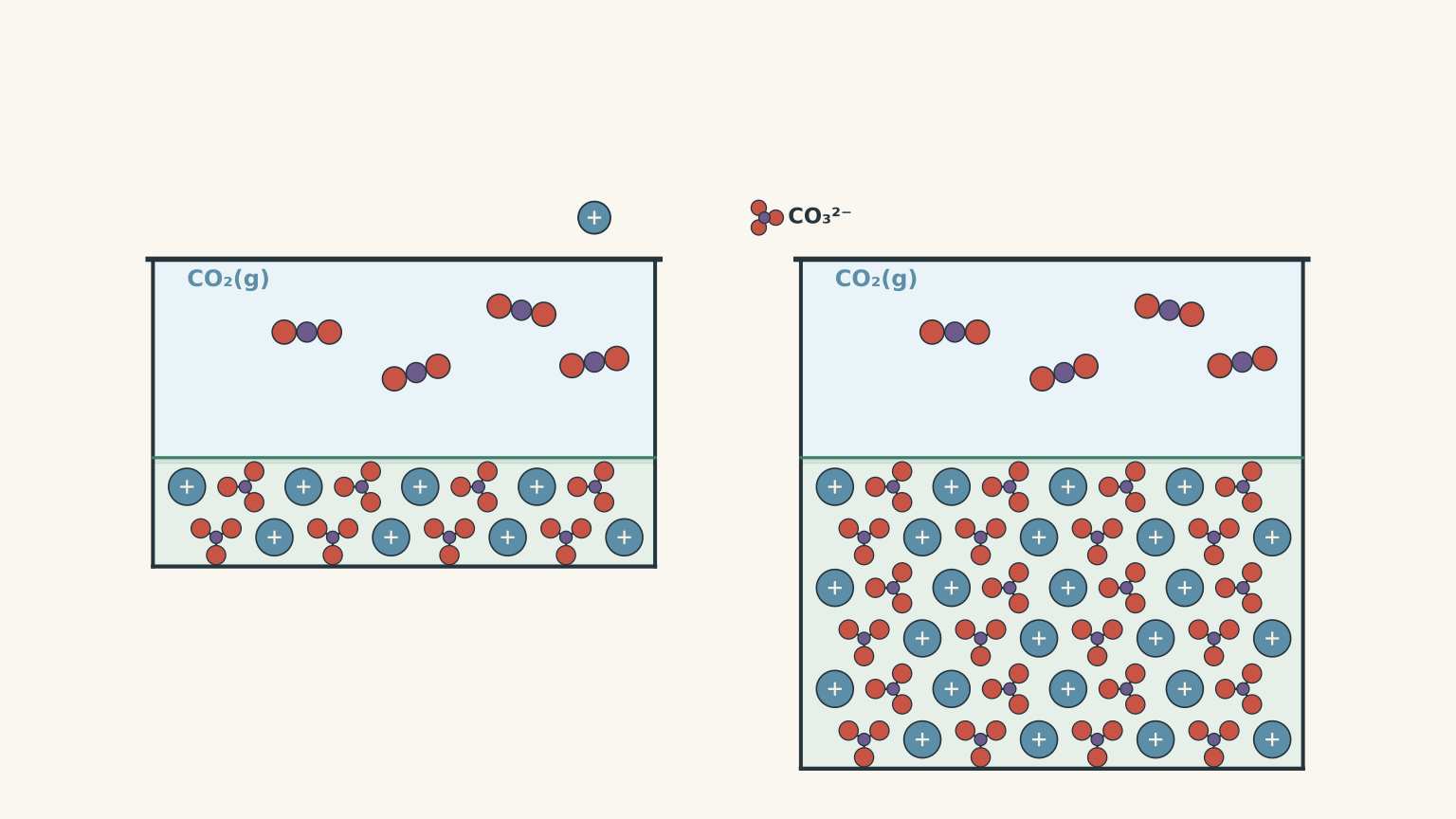
For a pure solid, its activity is taken as 1.
This is because adding more of a pure solid does not change the chemical potential of that solid phase at the same temperature and pressure.
Think about a block of pure copper. If you add another block of copper, you increase the total amount of copper. You do not change the intrinsic properties of the copper itself.
The analogy is useful for understanding why amount and concentration are different ideas here. However, equilibrium expressions are based on thermodynamic activity, not simply on density or physical size.
Due to technical limitations, this figure may display incorrectly or contain inaccuracies. Please check key details against your course materials.
For the calcium carbonate reaction:
\[ \ce{CaCO3(s) <=> CaO(s) + CO2(g)} \]
The exact thermodynamic equilibrium expression is:
\[ K = \frac{a_{\ce{CaO}}a_{\ce{CO2}}} {a_{\ce{CaCO3}}} \]
Here, \(a\) represents the activity of each substance.
Because calcium carbonate and calcium oxide are pure solids:
\[ a_{\ce{CaCO3}}=1 \]
\[ a_{\ce{CaO}}=1 \]
Substituting these values gives:
\[ K = \frac{1\times a_{\ce{CO2}}}{1} \]
Therefore:
\[ \boxed{K=a_{\ce{CO2}}} \]
The two solid terms disappear because their activities are both 1.
This is the fundamental reason pure solids are left out of equilibrium expressions.
What does this look like in HSC Chemistry?
At HSC level, equilibrium expressions are commonly written using concentrations or partial pressures, depending on the question.
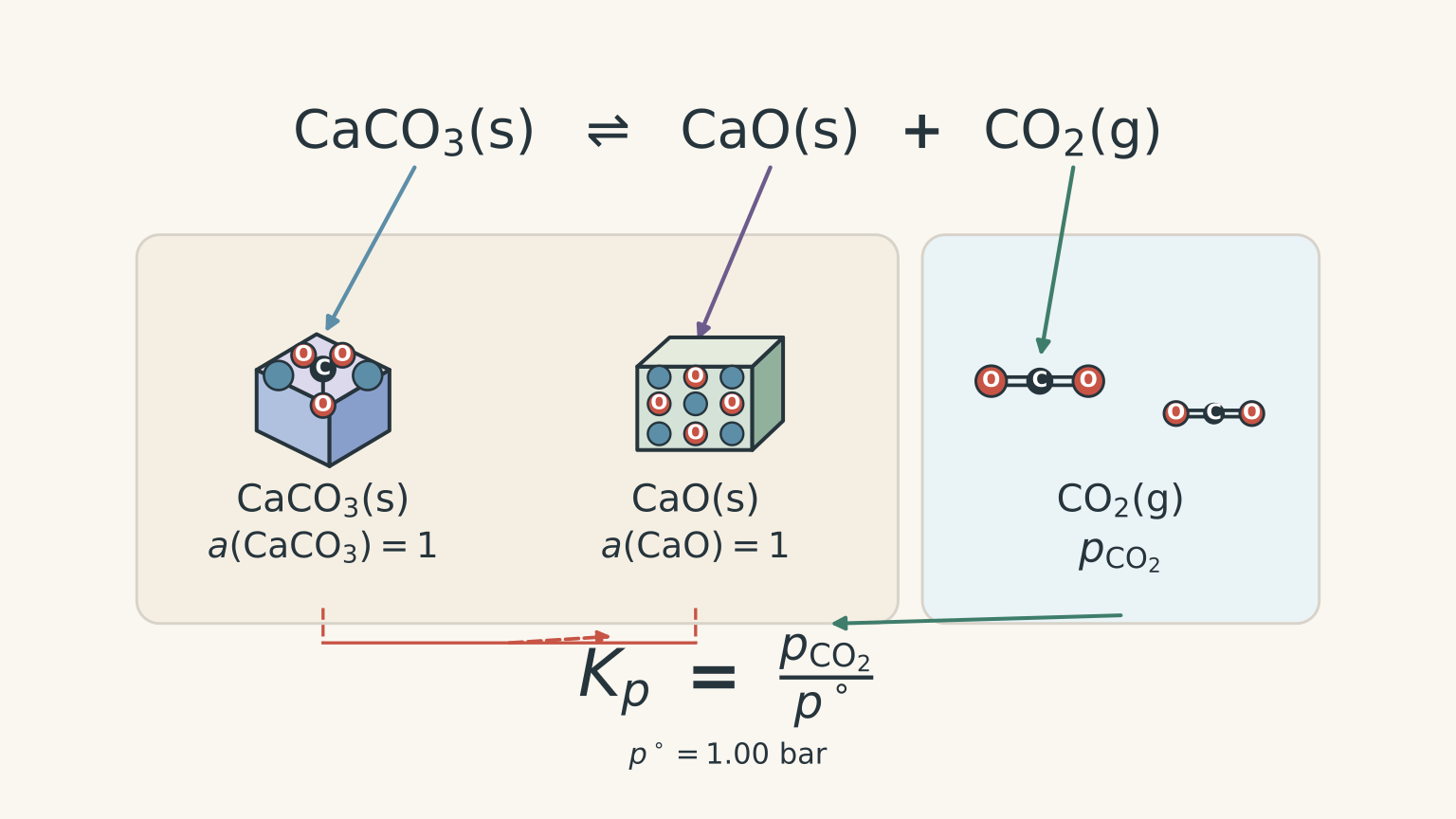
For a concentration-based expression, the calcium carbonate reaction becomes:
\[ K_c=[\ce{CO2}] \]
For a pressure-based expression, the more rigorous dimensionless form is:
\[ K_p=\frac{p_{\ce{CO2}}}{p^\circ} \]
Here:
- \(p_{\ce{CO2}}\) is the equilibrium partial pressure of carbon dioxide.
- \(p^\circ\) is the standard pressure, taken here as 1.00 bar.
In simplified HSC notation, you may also see this written as \(K_p=p_{\ce{CO2}}\).
The important point is that neither calcium carbonate nor calcium oxide appears in the expression.
Due to technical limitations, this figure may display incorrectly or contain inaccuracies. Please check key details against your course materials.
What about reactions with several solids and gases?
The same rule applies, even when the balanced equation becomes more complicated.
Consider:
\[ \ce{Fe2O3(s) + 3CO(g) <=> 2Fe(s) + 3CO2(g)} \]
This reaction involves:
- Iron(III) oxide, a pure solid reactant.
- Carbon monoxide, a gaseous reactant.
- Iron, a pure solid product.
- Carbon dioxide, a gaseous product.
The two solids are omitted.
The gaseous species are included, with their stoichiometric coefficients becoming powers.
Therefore:
\[ \boxed{ K_p= \frac{(p_{\ce{CO2}}/p^\circ)^3} {(p_{\ce{CO}}/p^\circ)^3} } \]
Notice that the coefficients of the solids have not been transferred into the expression.
This is worth remembering: coefficients still matter when calculating reacting mole ratios, but pure solid species do not appear in the equilibrium expression.
03What is actually important about the amount of solid?
There is a distinction that catches students out.
Adding more pure solid does not change the equilibrium expression. However, the amount of solid can still affect how far a reaction proceeds before a reactant is exhausted.
Consider these four situations.
| Change to the system | Effect on equilibrium |
|---|---|
| Add more of an existing pure solid | No change to \(K\) or equilibrium position, provided the other conditions and gas volume remain unchanged |
| Grind a solid into smaller particles | Can increase reaction rate, but does not change \(K\) |
| Change the temperature | Can change \(K\) |
| Completely consume one solid phase | The usual equilibrium condition requiring that solid phase to be present can no longer be assumed |
The final situation is particularly important.
If all the calcium carbonate disappears, there is no longer a calcium carbonate solid phase available to participate in the forward reaction.
The system may therefore be unable to reach the equilibrium pressure that would exist if both calcium carbonate and calcium oxide were present.
We will examine this more carefully in the final practice question.
Pure solid does not mean every solid mixture
The word pure matters.
The rule that a solid’s activity equals 1 applies to a pure solid phase. A solid solution or alloy can have a variable activity, so more advanced thermodynamic treatments do not automatically omit every substance simply because it is labelled as a solid.
For standard HSC equilibrium-expression questions, however, a substance identified as a pure solid is omitted.
04Temperature and the size of the equilibrium constant
There is another assumption you must preserve when using this rule.
The equilibrium constant is specific to the temperature.
Adding more calcium carbonate at a fixed temperature does not change \(K\). Changing the temperature generally does.
Why?
Because temperature changes the thermodynamic properties of the substances involved, which changes the equilibrium relationship.
For example, the decomposition of calcium carbonate is endothermic:
\[ \ce{CaCO3(s) <=> CaO(s) + CO2(g)} \]
Increasing the temperature favours the forward decomposition reaction and increases its equilibrium constant.
The pure solids remain omitted. It is the value of \(K\), not the list of species in the expression, that changes.
A useful way to keep the distinction clear is:
- Changing the amount of a pure solid does not change its activity.
- Changing the temperature can change the equilibrium constant.
- Changing the amount of a solid can determine whether enough reactant remains to establish the usual equilibrium.
Does a large equilibrium constant mean lots of solid product?
Not necessarily.
Consider the iron oxide reaction again:
\[ \ce{Fe2O3(s) + 3CO(g) <=> 2Fe(s) + 3CO2(g)} \]
Suppose its equilibrium constant is:
\[ K_p=27 \]
This indicates that the equilibrium favours products for the reaction as written.
However, it does not mean that there are 27 times as many moles of iron as iron(III) oxide.
Both solids are absent from the expression.
In fact, because the gaseous coefficients are equal:
\[ K_p= \left( \frac{p_{\ce{CO2}}} {p_{\ce{CO}}} \right)^3 \]
Therefore:
\[ 27= \left( \frac{p_{\ce{CO2}}} {p_{\ce{CO}}} \right)^3 \]
Taking the cube root:
\[ \frac{p_{\ce{CO2}}}{p_{\ce{CO}}}=3 \]
The equilibrium carbon dioxide pressure is three times the equilibrium carbon monoxide pressure.
It is not 27 times greater.
A large \(K\) also does not tell you how quickly equilibrium is reached. That depends on reaction kinetics.
Finally, the equilibrium constant alone cannot tell you the total amount of solid converted. You need information about the initial quantities and the extent of reaction.
05Worked examples
Worked example: Finding the equilibrium constant for a solid decomposition
A sealed vessel contains calcium carbonate and calcium oxide at equilibrium:
\[ \ce{CaCO3(s) <=> CaO(s) + CO2(g)} \]
At a particular temperature, the equilibrium carbon dioxide pressure is 0.40 bar.
Calculate \(K_p\), using a standard pressure of 1.00 bar. Explain what happens if an additional 4.0 g of calcium carbonate is added, assuming both solid phases remain present and the gas volume is unchanged.
Step 1
Calcium carbonate and calcium oxide are pure solids, so both are omitted.
Carbon dioxide is a gas, so it is included.
Step 2
\[ K_p=\frac{p_{\ce{CO2}}}{p^\circ} \]
Step 3
\[ K_p=\frac{0.40}{1.00} \]
\[ \boxed{K_p=0.40} \]
Step 4
Adding more calcium carbonate does not change its activity. It remains a pure solid with an activity of 1.
Therefore, the equilibrium constant remains 0.40.
Because the system was already at equilibrium, adding more solid does not shift the equilibrium position under the stated conditions.
The carbon dioxide equilibrium pressure remains 0.40 bar.
Worked example: Calculating an equilibrium constant when several solids are present
At a fixed temperature, the following reaction reaches equilibrium:
\[ \ce{Fe2O3(s) + 3CO(g) <=> 2Fe(s) + 3CO2(g)} \]
The equilibrium partial pressures are:
\[ p_{\ce{CO}}=0.20\ \mathrm{bar} \]
\[ p_{\ce{CO2}}=0.60\ \mathrm{bar} \]
Calculate \(K_p\), using a standard pressure of 1.00 bar.
Step 1
Iron(III) oxide and iron are pure solids, so they are omitted.
Carbon monoxide and carbon dioxide are gases, so they are included.
Step 2
\[ K_p= \frac{(p_{\ce{CO2}}/p^\circ)^3} {(p_{\ce{CO}}/p^\circ)^3} \]
Step 3
\[ K_p= \frac{(0.60/1.00)^3} {(0.20/1.00)^3} \]
\[ K_p=\frac{0.216}{0.008} \]
\[ \boxed{K_p=27} \]
Step 4
The equilibrium favours products for the reaction as written.
However, the value of 27 does not represent a ratio of solid product to solid reactant.
The expression only contains the gaseous species. Their equilibrium partial pressure ratio is 3, and cubing that ratio gives the equilibrium constant of 27.
06Questions and solutions
Question 1
Consider the following heterogeneous equilibrium:
\[ \ce{MgCO3(s) <=> MgO(s) + CO2(g)} \]
Write the equilibrium expression \(K_p\). Explain why each substance is included or omitted.
Solution 1
The correct expression is:
\[ \boxed{K_p=\frac{p_{\ce{CO2}}}{p^\circ}} \]
Magnesium carbonate and magnesium oxide are pure solids. Their activities are both taken as 1, so neither appears in the equilibrium expression.
Carbon dioxide is a gas, so its partial pressure is included.
The important distinction is that magnesium carbonate is still a reactant, even though it is omitted from the expression. Being omitted does not mean that a substance does not participate in the reaction.
Question 2
Consider the equilibrium:
\[ \ce{Fe2O3(s) + 3CO(g) <=> 2Fe(s) + 3CO2(g)} \]
At a particular temperature, the equilibrium partial pressures are:
- \(p_{\ce{CO}}=0.25\ \mathrm{bar}\)
- \(p_{\ce{CO2}}=0.50\ \mathrm{bar}\)
Use a standard pressure of 1.00 bar.
a) Calculate \(K_p\).
b) A student adds 0.10 mol of pure iron to the equilibrium mixture. Predict whether the equilibrium shifts and explain your reasoning. Assume both solid phases remain present and the gas volume is unchanged.
Solution 2
a) The equilibrium constant is \(K_p=8.0\).
First, identify the species that appear in the expression.
Both iron(III) oxide and iron are pure solids, so they are omitted.
The correct expression is:
\[ K_p= \frac{(p_{\ce{CO2}}/p^\circ)^3} {(p_{\ce{CO}}/p^\circ)^3} \]
Substitute the supplied values:
\[ K_p= \frac{(0.50/1.00)^3} {(0.25/1.00)^3} \]
\[ K_p=\frac{0.125}{0.015625} \]
\[ \boxed{K_p=8.0} \]
b) The equilibrium does not shift.
Adding more iron does not change its activity because iron is a pure solid.
Its activity remains 1, regardless of the additional amount.
The equilibrium expression therefore remains unchanged, and the system has no thermodynamic reason to shift in either direction.
This conclusion assumes that the temperature and gas volume remain constant and both solid phases are still present.
Question 3
Two identical sealed vessels each contain the following equilibrium system:
\[ \ce{CaCO3(s) <=> CaO(s) + CO2(g)} \]
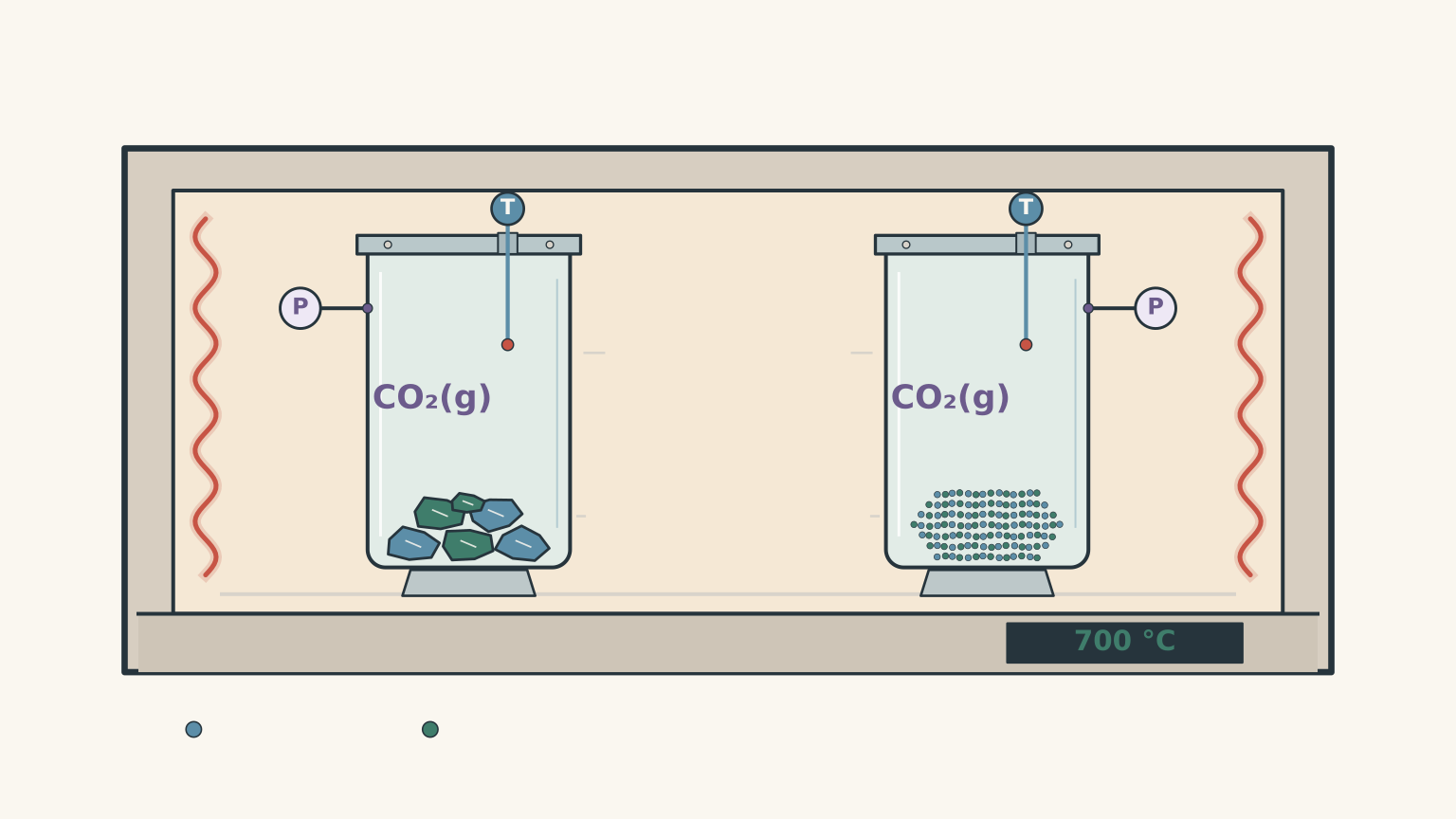
Both vessels are maintained at 700°C and have identical gas volumes.
- Vessel A contains coarse calcium carbonate and calcium oxide pieces.
- Vessel B contains the same masses of both substances, but they have been ground into fine powders.
Assume the particles remain ordinary macroscopic solids, both solid phases remain present, and no other reactions occur.
a) Which vessel would you expect to reach equilibrium more quickly?
b) Would their final equilibrium carbon dioxide pressures be different?
c) Explain why surface area can affect one result without affecting the other.
Due to technical limitations, this figure may display incorrectly or contain inaccuracies. Please check key details against your course materials.
Solution 3
Vessel B should generally reach equilibrium more quickly, but both vessels will have the same final equilibrium carbon dioxide pressure.
a) Vessel B contains finely powdered solids, which provide a greater exposed surface area than the coarse pieces in Vessel A.
More solid surface is available for reactions to occur. This can increase the reaction rate, allowing equilibrium to be established more quickly.
b) The final equilibrium pressures are identical.
The equilibrium expression is:
\[ K_p=\frac{p_{\ce{CO2}}}{p^\circ} \]
Neither calcium carbonate nor calcium oxide appears in the expression.
Both vessels have the same temperature, so they have the same equilibrium constant.
Consequently, their equilibrium carbon dioxide pressures must be the same.
c) Surface area affects reaction kinetics, which describes how quickly a reaction occurs.
The equilibrium constant describes the final thermodynamic relationship between the substances.
These are different ideas.
Grinding a solid can make equilibrium occur faster without changing the equilibrium position.
A common mistake is to assume that faster reactions must produce different equilibrium concentrations. They do not.
Question 4
Consider the equilibrium:
\[ \ce{Fe2O3(s) + 3CO(g) <=> 2Fe(s) + 3CO2(g)} \]
At temperature \(T_1\), the equilibrium constant is:
\[ K_{p,1}=8.0 \]
At equilibrium, the partial pressures are:
\[ p_{\ce{CO}}=0.25\ \mathrm{bar} \]
\[ p_{\ce{CO2}}=0.50\ \mathrm{bar} \]
The vessel is then rapidly transferred to a different temperature, \(T_2\), where the supplied equilibrium constant is:
\[ K_{p,2}=1.0 \]
Assume the vessel is rigid, the gases behave ideally, and no reaction occurs during the instantaneous temperature change. Both gas partial pressures therefore initially change by the same proportional factor.
a) Calculate the reaction quotient immediately after the temperature change.
b) Predict the direction in which the reaction will initially shift.
c) Would adding more pure iron change this prediction? Explain.
Solution 4
The reaction initially shifts in the reverse direction, and adding more iron does not change that prediction.
a) First, calculate the reaction quotient at the new temperature.
The reaction quotient has the same expression as the equilibrium constant:
\[ Q_p= \frac{(p_{\ce{CO2}}/p^\circ)^3} {(p_{\ce{CO}}/p^\circ)^3} \]
Before the temperature change:
\[ Q_p= \frac{(0.50/1.00)^3} {(0.25/1.00)^3} \]
\[ Q_p=8.0 \]
The temperature change causes both gas partial pressures to change by the same proportional factor because the vessel is rigid and no reaction occurs during the temperature change.
Their ratio therefore remains unchanged.
Consequently:
\[ \boxed{Q_{p,\text{immediate}}=8.0} \]
b) Compare the reaction quotient with the new equilibrium constant.
\[ Q_p=8.0 \]
\[ K_{p,2}=1.0 \]
Therefore:
\[ Q_p>K_{p,2} \]
The reaction shifts in the reverse direction to reduce the reaction quotient.
The reverse reaction is:
\[ \ce{2Fe(s) + 3CO2(g) -> Fe2O3(s) + 3CO(g)} \]
Carbon dioxide is consumed, while carbon monoxide is produced.
Notice that the temperature change has altered the equilibrium constant, even though the equilibrium expression has not changed.
c) Adding more pure iron does not change the reaction quotient.
Iron is a pure solid, so its activity remains 1.
The reaction therefore still initially shifts in the reverse direction.
This question demonstrates why you must distinguish changes in temperature from changes in the amount of a pure solid.
Question 5
A sealed, rigid 1.00 L vessel is maintained at 1000 K.
It contains the following reversible reaction:
\[ \ce{CaCO3(s) <=> CaO(s) + CO2(g)} \]
For this question, use the following illustrative equilibrium data:
\[ K_p=0.80 \]
The standard pressure is 1.00 bar.
The initial contents are:
- \(0.0020\ \mathrm{mol}\) of pure calcium carbonate.
- \(0.010\ \mathrm{mol}\) of pure calcium oxide.
- No carbon dioxide gas.
Assume ideal gas behaviour, no other reactions, and that the calcium oxide remains present throughout.
Use:
\[ R=0.08314\ \mathrm{L\,bar\,mol^{-1}\,K^{-1}} \]
A student argues:
“The equilibrium constant fixes the carbon dioxide pressure at 0.80 bar. The amount of calcium carbonate cannot matter because it is left out of the expression.”
Another student argues:
“If the final pressure is below the equilibrium pressure, the reaction must keep moving forward until it reaches 0.80 bar.”
Both arguments appear reasonable. However, neither accounts for the amount of solid available.
a) Calculate the number of moles of carbon dioxide required to reach the usual two-solid equilibrium pressure of 0.80 bar.
b) Determine whether the initial calcium carbonate supply is sufficient to reach this pressure.
c) If it is insufficient, calculate the maximum carbon dioxide pressure that can be produced.
d) Explain why the condition \(Q_p<K_p\) does not mean that the reaction must continue until \(Q_p=K_p\).
e) Now suppose the initial calcium carbonate amount is increased to \(0.020\ \mathrm{mol}\), with all other conditions unchanged. Determine whether the system can now reach the two-solid equilibrium, and calculate the amount of calcium carbonate remaining.
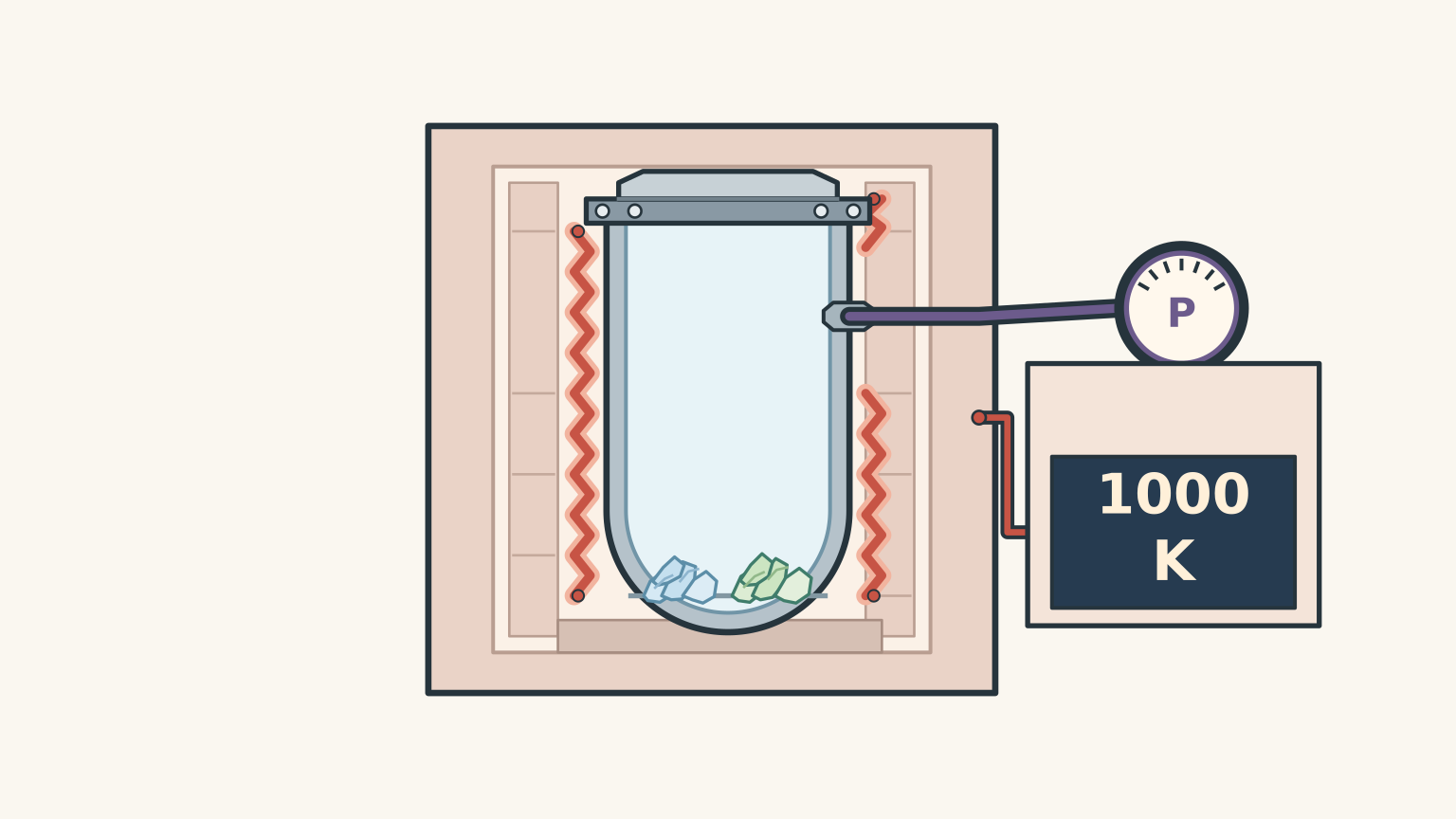
Due to technical limitations, this figure may display incorrectly or contain inaccuracies. Please check key details against your course materials.
Solution 5
The initial calcium carbonate supply is insufficient to reach the usual two-solid equilibrium. All the calcium carbonate is consumed, producing a final carbon dioxide pressure of approximately 0.166 bar.
This is the important exception to the tempting assumption that the equilibrium pressure must always be reached.
a) Calculate the carbon dioxide required to reach equilibrium.
The equilibrium expression is:
\[ K_p=\frac{p_{\ce{CO2}}}{p^\circ} \]
Since \(K_p=0.80\) and \(p^\circ=1.00\ \mathrm{bar}\):
\[ p_{\ce{CO2}}=0.80\ \mathrm{bar} \]
Use the ideal gas equation:
\[ PV=nRT \]
Rearrange to find the number of moles:
\[ n=\frac{PV}{RT} \]
Substitute:
\[ n= \frac{0.80\times1.00} {0.08314\times1000} \]
\[ \boxed{n=0.00962\ \mathrm{mol}} \]
The vessel requires approximately 0.00962 mol of carbon dioxide to reach the equilibrium pressure of 0.80 bar.
b) Check whether enough calcium carbonate is available.
The balanced equation is:
\[ \ce{CaCO3(s) <=> CaO(s) + CO2(g)} \]
The mole ratio between calcium carbonate and carbon dioxide is 1:1.
Therefore, decomposing all the available calcium carbonate can produce a maximum of:
\[ n_{\ce{CO2}}=0.0020\ \mathrm{mol} \]
However, reaching the equilibrium pressure requires:
\[ n_{\ce{CO2}}=0.00962\ \mathrm{mol} \]
The available calcium carbonate can only produce a fraction of the required carbon dioxide.
Therefore, the calcium carbonate is completely consumed before the system can reach the usual two-solid equilibrium.
c) Calculate the maximum carbon dioxide pressure.
Once all calcium carbonate has decomposed, the maximum carbon dioxide amount is 0.0020 mol.
Using the ideal gas equation:
\[ P=\frac{nRT}{V} \]
Substitute:
\[ P= \frac{0.0020\times0.08314\times1000} {1.00} \]
\[ \boxed{P=0.166\ \mathrm{bar}} \]
The maximum carbon dioxide pressure is approximately 0.166 bar.
At this point, all calcium carbonate has been consumed. Calcium oxide remains in the vessel.
The system cannot reach the equilibrium pressure of 0.80 bar because it does not contain enough calcium carbonate to produce the required quantity of carbon dioxide.
d) Resolve the disagreement about the reaction quotient.
At the final pressure:
\[ Q_p=\frac{0.166}{1.00} \]
\[ Q_p=0.166 \]
Therefore:
\[ Q_p<K_p \]
Normally, this inequality indicates that the forward reaction is thermodynamically favoured.
However, there is an important restriction: the reaction cannot continue forward because all the calcium carbonate has been consumed.
The reaction quotient predicts the preferred direction when the necessary reactants are available. It does not guarantee that the system has enough material to continue reacting.
The final state is therefore a reactant-exhaustion endpoint, not the usual dynamic equilibrium in which both solid phases are present.
This is why the amount of a pure solid can matter even though it does not appear in the equilibrium expression.
e) Repeat the reasoning with 0.020 mol of calcium carbonate.
The required carbon dioxide amount is still:
\[ n_{\ce{CO2}}=0.00962\ \mathrm{mol} \]
The initial calcium carbonate amount is now:
\[ n_{\ce{CaCO3}}=0.020\ \mathrm{mol} \]
Since:
\[ 0.020>0.00962 \]
there is enough calcium carbonate to produce the required carbon dioxide while leaving some calcium carbonate unreacted.
The amount remaining is:
\[ n_{\text{remaining}} = 0.020-0.00962 \]
\[ \boxed{ n_{\text{remaining}}=0.01038\ \mathrm{mol} } \]
The system can now reach the usual two-solid equilibrium pressure of 0.80 bar.
The calcium oxide amount also increases by 0.00962 mol, so its final amount is:
\[ 0.010+0.00962 = 0.01962\ \mathrm{mol} \]
Both solid phases remain present.
The final comparison is:
| Initial CaCO3 | Final CO2 pressure | Final state |
|---|---|---|
| 0.0020 mol | 0.166 bar | All CaCO3 consumed |
| 0.020 mol | 0.80 bar | Both solid phases remain |
The two experiments have the same temperature and equilibrium constant. Yet their final pressures differ because one experiment runs out of calcium carbonate before reaching the usual equilibrium condition.
This is the crucial distinction:
The amount of a pure solid does not affect its activity or the equilibrium expression, but it can determine whether the system has enough material to establish the equilibrium described by that expression.
07What to remember when writing equilibrium expressions
When you encounter a reaction containing solids, separate two questions.
First, which substances belong in the equilibrium expression?
- Include gaseous and aqueous species.
- Omit pure solid species.
- Omit pure liquids.
- Convert the coefficients of included species into powers.
Second, can the system actually reach the equilibrium you are calculating?
- Check that the required solid phases remain present.
- Keep the temperature assumption consistent.
- Remember that changing the amount of a pure solid does not change \(K\).
- Do not interpret the magnitude of \(K\) as a reaction rate or a direct measure of how much solid has reacted.
If you want to strengthen the underlying rules, read Equilibrium Expressions for Homogeneous Reactions | HSC Chemistry.
The same principle also explains why solid ionic compounds are omitted when deriving solubility product expressions. See How to Derive Ksp Expressions for HSC Chemistry.
Once you can distinguish activity from amount, writing expressions becomes much more reliable. More importantly, you can recognise when an apparently straightforward equilibrium calculation is limited by the actual substances available in the reaction vessel.