
Primary and Secondary Isotope Effects
Two samples of the same chemical reaction are tested under identical conditions. The molecules have the same structure, except that one contains hydrogen where the other contains deuterium, a heavier isotope of hydrogen.
Two samples of the same chemical reaction are tested under identical conditions. The molecules have the same structure, except that one contains hydrogen where the other contains deuterium, a heavier isotope of hydrogen.
You might predict that both samples react at exactly the same rate. After all, hydrogen and deuterium have the same number of protons and the same electronic structure. Yet replacing just one hydrogen atom can make a reaction several times slower.
The important question is where the isotope is located. Is it attached to an atom involved in a bond being broken or formed, or is it somewhere else in the molecule?
This difference gives us two important concepts: primary isotope effects and secondary isotope effects. Both help chemists investigate reaction mechanisms by observing how isotopic substitution changes reaction rates.
01The Year 11 starting point
In the NSW Chemistry 11-12 Syllabus (2025), the Chemical reactions focus area includes constructing a metal activity series using practical investigation data and comparing it with information from secondary sources.
The activity series provides a way to compare how readily different metals lose electrons and undergo oxidation. For example, if zinc displaces copper from copper(II) sulfate solution, the observation provides evidence that zinc is more reactive than copper.
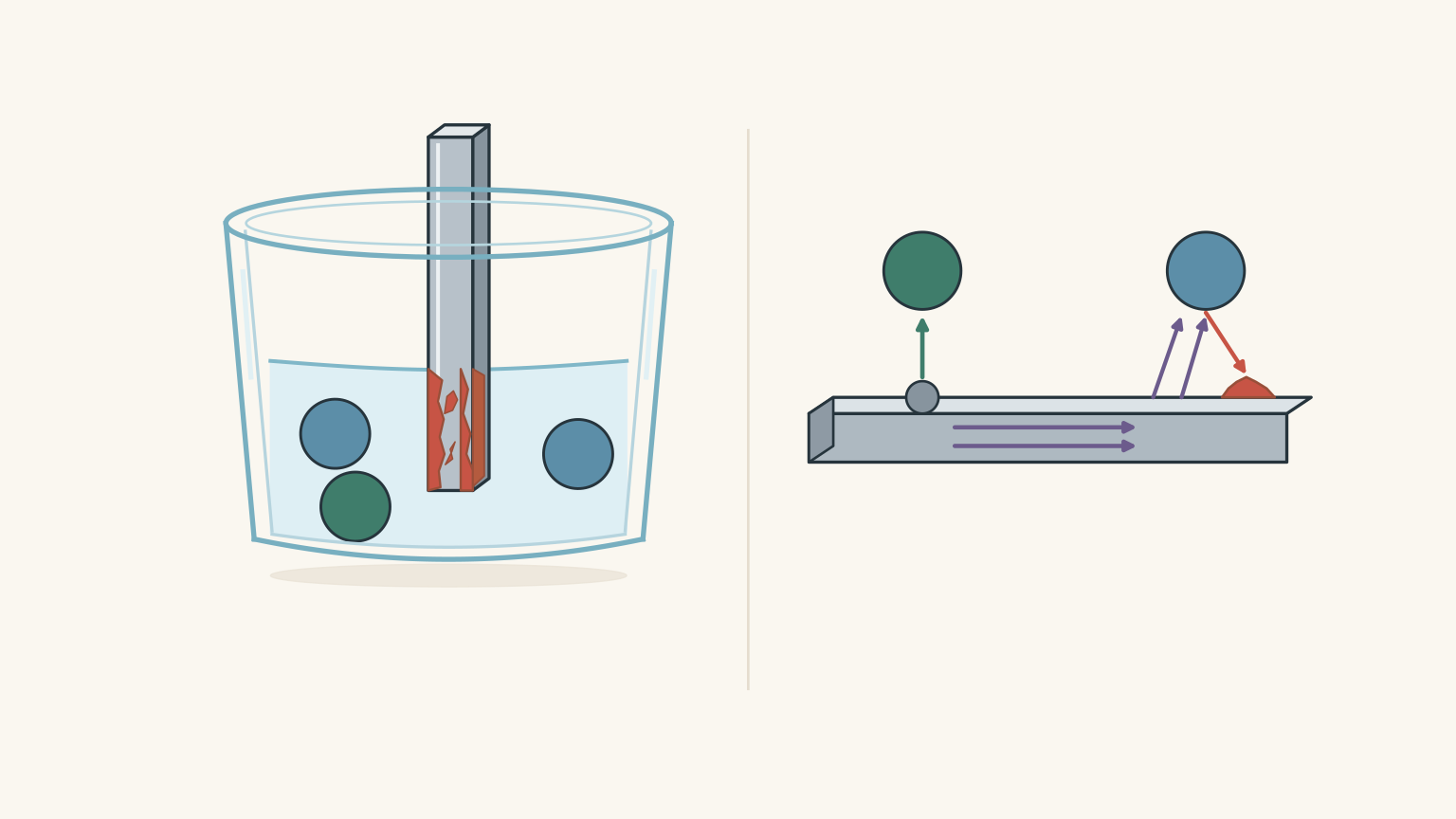
Due to technical limitations, this figure may display incorrectly or contain inaccuracies. Please check key details against your course materials.
This gives you a useful starting model: chemical reactions involve changes in bonding and electron arrangements, and observations allow us to investigate how reactions occur.
Isotope effects ask a more specialised question. What happens when we change the mass of an atom without changing its identity or electronic structure?
The 2025 NSW Chemistry syllabus is scheduled for implementation from 2028. This article uses its Chemical reactions content as a foundation, but primary and secondary isotope effects go beyond the required syllabus. They are an extension topic, not a Year 11 or HSC assessment requirement.
02What changes when an isotope is substituted?
An isotope is an atom with the same number of protons as another atom of the same element, but a different number of neutrons.
For hydrogen, the two isotopes most relevant to this discussion are:
| Isotope | Symbol | Protons | Neutrons | Approximate mass |
|---|---|---|---|---|
| Protium | \({}^{1}\mathrm{H}\) | 1 | 0 | 1 u |
| Deuterium | \({}^{2}\mathrm{H}\), or D | 1 | 1 | 2 u |
The atomic number is unchanged, so both isotopes have the same number of electrons in their neutral atoms. Their chemical bonding is broadly similar.
However, their masses are different.
A molecule containing deuterium instead of hydrogen, with all other atoms and connections unchanged, is called an isotopologue.
Why does mass affect a reaction rate?
Picture a chemical bond as two masses connected by a spring.
If you replace one of the masses with a heavier one, the spring vibrates more slowly, even though the spring itself has not changed.
A chemical bond behaves approximately like this. Its vibrational frequency depends on the masses of the bonded atoms.
For a simple two-atom bond-stretching model:
\[ \nu=\frac{1}{2\pi} \sqrt{\frac{k_{\mathrm{bond}}}{\mu}} \]
where:
- \(\nu\) is the vibrational frequency.
- \(k_{\mathrm{bond}}\) is the bond force constant, which describes the stiffness of the bond.
- \(\mu\) is the reduced mass of the two bonded atoms.
The reduced mass is calculated using:
\[ \mu=\frac{m_1m_2}{m_1+m_2} \]
Here, \(m_1\) and \(m_2\) are the masses of the two atoms.
Consider a carbon-hydrogen bond compared with a carbon-deuterium bond. Using approximate atomic masses of 12 u for carbon, 1 u for hydrogen, and 2 u for deuterium:
\[ \mu_{\mathrm{C-H}}= \frac{12\times1}{12+1} =0.92\ \mathrm{u} \]
\[ \mu_{\mathrm{C-D}}= \frac{12\times2}{12+2} =1.71\ \mathrm{u} \]
The carbon-deuterium bond therefore has a greater reduced mass.
Assuming approximately the same bond force constant:
\[ \frac{\nu_{\mathrm{C-D}}}{\nu_{\mathrm{C-H}}} = \sqrt{\frac{0.92}{1.71}} \]
\[ \frac{\nu_{\mathrm{C-D}}}{\nu_{\mathrm{C-H}}} \approx 0.73 \]
The C-D bond vibrates at approximately 73% of the C-H bond’s vibrational frequency in this simplified model.
Zero-point energy: the important connection
Chemical bonds have vibrational energy even when molecules are at their lowest possible energy state. This minimum vibrational energy is called zero-point energy.
For a simple quantum harmonic oscillator:
\[ E_0=\frac{1}{2}h\nu \]
where:
- \(E_0\) is the zero-point energy.
- \(h\) is Planck’s constant.
- \(\nu\) is the vibrational frequency.
Since C-H vibrates at a higher frequency than C-D, its zero-point energy is also higher.
This difference becomes important when a chemical reaction stretches, weakens, or breaks a bond.
If a C-H bond is being broken during a reaction, the difference in vibrational energy between the starting molecule and the transition state can make the hydrogen-containing molecule react faster than its deuterium-containing counterpart.
A transition state is the highest-energy arrangement along a reaction pathway. It represents the point at which bonds are partly broken and partly formed.
The isotope substitution does not substantially change the underlying electronic potential energy surface. Instead, it changes the vibrational energy levels and nuclear motion on that surface.
The spring analogy is useful, but it has limits. Real molecules have several interacting vibrational modes, and the transition state can involve changes to many bonds at once. The simple spring model helps explain the origin of isotope effects, but it does not predict every experimental rate ratio.
03Primary isotope effects: when the labelled bond is changing
A primary kinetic isotope effect occurs when an isotope replaces an atom involved in a bond being made or broken during the rate-controlling step or a relevant pre-equilibrium step of a reaction.
For example, consider a reaction in which a carbon-hydrogen bond must be broken to form a product.
Now imagine replacing that hydrogen with deuterium.
The two substrates follow broadly similar reaction pathways, but the C-D bond has a different vibrational energy from the original C-H bond.
Breaking or substantially weakening the C-D bond generally requires a greater effective activation energy than doing the same to C-H in a typical bond-cleavage process.
Consequently, the hydrogen-containing substrate commonly reacts faster.
Measuring a primary isotope effect
The kinetic isotope effect (KIE) is usually expressed as a ratio of rate constants:
\[ \mathrm{KIE}=\frac{k_H}{k_D} \]
where:
- \(k_H\) is the rate constant for the hydrogen-containing substrate.
- \(k_D\) is the rate constant for the deuterium-containing substrate.
Both measurements must be made under the same reaction conditions.
There are two possible directions.
Normal kinetic isotope effect
\[ \frac{k_H}{k_D}>1 \]
The hydrogen-containing substrate reacts faster than the deuterated substrate.
This is common when a C-H bond is broken during the rate-controlling step.
Inverse kinetic isotope effect
\[ \frac{k_H}{k_D}<1 \]
The deuterated substrate reacts faster.
An inverse effect can occur when isotopic substitution changes the relative vibrational contributions to the reactant and transition-state energies in the opposite direction.
The terms normal and inverse describe the direction of the rate difference. They do not tell you whether an effect is primary or secondary.
A real example: bromination of acetone
Consider the acid-catalysed bromination of acetone.
Acetone can undergo tautomerisation to form an enol. During this process, a hydrogen attached to the carbon next to the carbonyl group is removed.
The simplified net transformation is:
\[ \ce{CH3COCH3 <=> CH3C(OH)=CH2} \]
The carbon next to the carbonyl group is called the alpha carbon. Its hydrogen is called an alpha hydrogen.
The enol subsequently reacts with bromine to form the brominated product.
Now consider what happens when the alpha hydrogen is replaced with deuterium.
The C-D bond must be broken during enol formation, just as the C-H bond must be broken in the original substrate.
A substantial primary isotope effect is observed. A commonly reported value for this reaction is approximately:
\[ \frac{k_H}{k_D}\approx7 \]
This means the hydrogen-containing substrate reacts approximately seven times faster than the deuterated substrate under the reported conditions.
This result supports the conclusion that enol formation, involving alpha C-H bond cleavage, is the rate-controlling step.
It is a useful example of how isotope substitution can provide evidence about a reaction mechanism rather than simply measuring how fast a reaction occurs.
The example is discussed in Chemistry LibreTexts’ treatment of kinetic isotope effects.
Does a primary isotope effect always have to be large?
No.
Hydrogen-to-deuterium substitution produces a relatively large change in atomic mass, so it can produce substantial kinetic isotope effects.
Substituting carbon-12 with carbon-13 produces a smaller relative mass change. Even when the carbon atom is directly involved in bond formation or breaking, the resulting primary isotope effect is often much smaller.
The classification depends on where the isotope is located and what happens to its bonding, not simply on the size of the measured rate difference.
04Secondary isotope effects: when the labelled bond remains intact
A secondary kinetic isotope effect occurs when isotopic substitution changes the reaction rate even though no bond to the labelled atom is made or broken during the rate-controlling or relevant pre-equilibrium step.
The isotope is usually near the reaction centre.
This is the crucial difference:
- Primary isotope effect: a bond involving the labelled atom is made or broken.
- Secondary isotope effect: bonds involving the labelled atom remain intact, but its surrounding molecular environment changes.
Why should the second situation affect the rate?
Because the reaction changes the structure and bonding environment around the labelled atom.
That can alter vibrational frequencies, molecular geometry, and the energy of the transition state.
Secondary isotope effects are often smaller than primary effects, but they can still provide useful mechanistic evidence.
Alpha-secondary isotope effects
An alpha-secondary isotope effect occurs when the isotope is attached to the reaction-centre carbon, but the bond to the isotope remains intact.
Consider nucleophilic addition to an aldehyde.
A nucleophile, represented by \(\mathrm{Nu}^{-}\), attacks the carbonyl carbon:
\[ \ce{R-C(=O)-H + Nu^- -> R-C(O^-)(H)(Nu)} \]
Here, \(R\) represents the remaining organic group, and \(\mathrm{Nu}^{-}\) is a nucleophile.
The carbonyl carbon changes from approximately trigonal planar, associated with \(sp^2\) hybridisation, to tetrahedral, associated with \(sp^3\) hybridisation.
Now replace the hydrogen attached to that carbon with deuterium:
\[ \ce{R-C(=O)-D + Nu^- -> R-C(O^-)(D)(Nu)} \]
Notice something important.
The C-D bond remains intact throughout the addition. The reaction changes the bonding of the carbonyl carbon, but it does not break the bond involving deuterium.
The change in hybridisation alters the vibrational environment of the C-D bond. This can produce a measurable secondary isotope effect.
This is an alpha-secondary isotope effect because the isotope is attached to the reaction-centre carbon.
Beta-secondary isotope effects
A beta-secondary isotope effect occurs when the isotope is located on a neighbouring carbon rather than the reaction-centre carbon.
Consider the ionisation of an alkyl bromide in an SN1-type reaction.
The carbon-bromine bond breaks, producing a carbocation:
\[ \ce{R-CH(Br)-CH3 -> R-CH^+-CH3 + Br^-} \]
Now imagine that the hydrogen atoms on the neighbouring methyl group are replaced with deuterium:
\[ \ce{R-CH(Br)-CD3 -> R-CH^+-CD3 + Br^-} \]
The C-D bonds are not broken during the ionisation step.
However, they can influence the developing carbocation through an interaction called hyperconjugation.
Hyperconjugation involves electron-density donation from a sigma bond, such as a C-H bond, into a neighbouring orbital. This can help stabilise a developing carbocation.
Changing hydrogen to deuterium changes the vibrational properties of the neighbouring bonds and can therefore affect the transition-state energy.
The result is a beta-secondary isotope effect.
Can secondary isotope effects be normal or inverse?
Yes.
A secondary isotope effect can be either normal or inverse.
Its direction depends on how the vibrational properties of the labelled bonds change between the reactant and transition state.
For example:
- A ratio of \(k_H/k_D=1.10\) is a normal secondary isotope effect. The H-containing substrate reacts 10% faster.
- A ratio of \(k_H/k_D=0.90\) is an inverse secondary isotope effect. The D-containing substrate reacts faster.
The important point is that secondary isotope effects do not follow the simple expectation that hydrogen must always react faster than deuterium.
The exact direction depends on the reaction mechanism and the changes in molecular vibrations.
The IUPAC Gold Book distinguishes these effects according to whether bonds to the labelled atom are made or broken. See its definitions of primary isotope effects and secondary isotope effects.
A terminology warning: Primary and secondary isotope effects are not the same classification as primary and secondary alcohols. In alcohol nomenclature, the terms describe the carbon attached to the hydroxyl group. Here, they describe the position of the isotope relative to a reaction centre. See Primary, Secondary and Tertiary Alcohols for HSC Chemistry for that separate classification.
05How to distinguish primary and secondary isotope effects
When analysing an unfamiliar reaction, don’t begin by looking at the size of the rate ratio.
Start with the mechanism.
| Feature | Primary isotope effect | Secondary isotope effect |
|---|---|---|
| Isotope position | On an atom involved in a bond being made or broken | On an atom whose bonds remain intact |
| Relationship to reaction centre | Directly involved in the bonding change | Usually close to the reaction centre |
| Common example | C-H cleavage during enol formation | C-D remaining intact during a change in hybridisation |
| Typical magnitude | Can be several-fold for H/D | Usually smaller, but can be measurable |
| Direction | Often normal for bond cleavage | Normal or inverse |
Use this decision process:
Step 1: Identify the rate-controlling step or any relevant pre-equilibrium step.
Step 2: Identify which bonds are being made and broken in that step.
Step 3: Locate the isotope in the substrate.
Step 4: Ask whether a bond involving that isotope changes.
- If yes, the effect is primary.
- If no, but the isotope substitution influences the rate, the effect is secondary.
Step 5: Calculate the isotope effect using the appropriate rate constants and separately identify whether it is normal or inverse.
One final complication matters. An isotope effect can also arise from a rapid, reversible pre-equilibrium before the rate-controlling step. Therefore, observing a primary isotope effect does not automatically prove that the labelled bond is broken in the slowest step.
Also, the isotope label must remain at the intended position during the experiment. Hydrogen and deuterium can exchange with certain solvents or other molecules, which can complicate the interpretation.
06Worked example 1: Calculating a primary isotope effect
Two isotopologues undergo the same first-order reaction at 298 K.
The hydrogen-containing substrate has a rate constant of \(3.0\times10^{-3}\ \mathrm{s^{-1}}\), while the deuterated substrate has a rate constant of \(5.0\times10^{-4}\ \mathrm{s^{-1}}\).
The isotope is located at a C-H bond that is broken during the rate-controlling step.
Calculate the kinetic isotope effect and classify it.
Step 1
\[ \mathrm{KIE}=\frac{k_H}{k_D} \]
Step 2
\[ \mathrm{KIE}= \frac{3.0\times10^{-3}} {5.0\times10^{-4}} \]
Step 3
\[ \mathrm{KIE}=6.0 \]
The units cancel because both rate constants have units of \(\mathrm{s^{-1}}\).
Step 4
The hydrogen-containing substrate reacts six times faster than the deuterated substrate.
This is a normal primary kinetic isotope effect because:
- The ratio is greater than one.
- The isotope is located at a C-H bond broken during the rate-controlling step.
- The large difference is consistent with the different vibrational energies of C-H and C-D.
The result supports a mechanism involving C-H bond cleavage during the rate-controlling step.
07Worked example 2: Identifying an inverse secondary isotope effect
A carbonyl compound undergoes nucleophilic addition.
The carbonyl carbon changes from \(sp^2\) to \(sp^3\) hybridisation, but the hydrogen attached to that carbon remains bonded throughout the reaction.
Two otherwise identical substrates are tested:
- Hydrogen-containing substrate: \(k_H=9.0\times10^{-3}\ \mathrm{s^{-1}}\).
- Deuterium-containing substrate: \(k_D=1.0\times10^{-2}\ \mathrm{s^{-1}}\).
Calculate the isotope effect and explain its classification.
The data are illustrative rather than experimental measurements.
Step 1
\[ \mathrm{KIE}=\frac{k_H}{k_D} \]
Step 2
\[ \mathrm{KIE}= \frac{9.0\times10^{-3}} {1.0\times10^{-2}} \]
Step 3
\[ \mathrm{KIE}=0.90 \]
Step 4
Since the ratio is less than one, the effect is inverse.
The deuterated substrate reacts faster:
\[ \frac{k_D}{k_H}=\frac{1}{0.90} \]
\[ \frac{k_D}{k_H}=1.11 \]
It reacts approximately 11% faster than the hydrogen-containing substrate.
Step 5
The C-H or C-D bond remains intact during the reaction.
The carbonyl carbon changes hybridisation from \(sp^2\) to \(sp^3\), changing the vibrational environment of the attached isotope.
Therefore, this is an inverse alpha-secondary isotope effect.
The important distinction is that the isotope affects the rate without its own bond being broken or formed.
08Questions and solutions
Question 1
A first-order reaction is investigated using two isotopologues at the same temperature.
The hydrogen-containing substrate has a half-life of 5.0 minutes, while the deuterated substrate has a half-life of 20.0 minutes.
Assume the isotope is located at a C-H bond broken during the rate-controlling step.
Calculate the kinetic isotope effect and classify it.
Solution 1
The kinetic isotope effect is 4.0, indicating a normal primary isotope effect.
For a first-order reaction:
\[ t_{1/2}=\frac{0.693}{k} \]
where \(t_{1/2}\) is the half-life and \(k\) is the first-order rate constant.
Step 1: Calculate the rate constant for the hydrogen-containing substrate.
\[ k_H=\frac{0.693}{5.0} \]
\[ k_H=0.139\ \mathrm{min^{-1}} \]
Step 2: Calculate the rate constant for the deuterated substrate.
\[ k_D=\frac{0.693}{20.0} \]
\[ k_D=0.0347\ \mathrm{min^{-1}} \]
Step 3: Calculate the isotope effect.
\[ \mathrm{KIE}=\frac{0.139}{0.0347} \]
\[ \boxed{\mathrm{KIE}=4.0} \]
The hydrogen-containing substrate reacts four times faster.
This is a normal primary isotope effect because the C-H bond is broken during the rate-controlling step. The longer half-life of the deuterated substrate is consistent with the greater effective energy requirement associated with breaking the C-D bond.
Question 2
An acid-catalysed reaction involving a carbonyl compound is investigated using three separately labelled substrates.
The measured kinetic isotope effects at 298 K are:
| Isotopic substitution | Measured \(k_H/k_D\) |
|---|---|
| Alpha C-H replaced by C-D | 5.60 |
| Beta C-H replaced by C-D | 1.08 |
| Remote methyl C-H replaced by C-D | 1.00 |
Assume all experiments use the same solvent and reaction conditions, and that the isotope labels remain in their original positions.
The proposed mechanism involves enol formation, but the rate-controlling step has not yet been established.
Interpret all three results. Which result provides the strongest evidence for C-H bond cleavage during the rate-controlling or pre-equilibrium step?
Solution 2
The alpha isotope substitution provides the strongest evidence for C-H bond cleavage during the rate-controlling or pre-equilibrium step.
Each result gives different mechanistic information.
Step 1: Analyse the alpha substitution.
\[ \frac{k_H}{k_D}=5.60 \]
This is a substantial normal isotope effect.
The alpha hydrogen is next to the carbonyl group and can be removed during enol formation.
The large rate difference strongly supports a mechanism in which the alpha C-H bond is broken during the rate-controlling or pre-equilibrium step.
This is consistent with enolisation.
Step 2: Analyse the beta substitution.
\[ \frac{k_H}{k_D}=1.08 \]
This is a small normal isotope effect.
The beta C-D bond is not directly broken during the proposed reaction step. However, the neighbouring molecular environment can change as the transition state forms.
This is consistent with a beta-secondary isotope effect.
Step 3: Analyse the remote substitution.
\[ \frac{k_H}{k_D}=1.00 \]
There is no measurable isotope effect within the stated experimental uncertainty.
The remote label has little influence on the reaction’s rate under these conditions.
Step 4: Evaluate the overall evidence.
The alpha substitution produces a much larger effect than either of the other substitutions.
This supports alpha C-H bond cleavage during an important step in the mechanism.
However, the results do not independently prove the complete mechanism. In particular, a primary isotope effect can also originate from a rapid pre-equilibrium.
Additional kinetic evidence is needed to establish exactly which step controls the overall reaction rate.
Question 3
A nucleophilic addition reaction involving an aldehyde is investigated using carbon isotopes.
The carbonyl carbon is replaced with carbon-13 in one substrate, while the original substrate contains carbon-12 at that position.
At 298 K, the measured rate constants are:
\[ k_{12}=2.05\times10^{-3}\ \mathrm{s^{-1}} \]
\[ k_{13}=2.00\times10^{-3}\ \mathrm{s^{-1}} \]
A separate experiment using carbon-13 at a remote methyl carbon produces no measurable isotope effect.
Calculate the rate ratio for the carbonyl-carbon substitution. Explain why this is classified as a primary isotope effect even though the rate difference is small.
Solution 3
The carbonyl-carbon substitution produces a primary heavy-atom isotope effect of 1.025.
Step 1: Write the appropriate isotope-effect ratio.
\[ \mathrm{KIE}=\frac{k_{12}}{k_{13}} \]
Here, \(k_{12}\) and \(k_{13}\) represent the rate constants for the carbon-12 and carbon-13 substrates, respectively.
Step 2: Substitute the values.
\[ \mathrm{KIE}= \frac{2.05\times10^{-3}} {2.00\times10^{-3}} \]
Step 3: Calculate.
\[ \boxed{\mathrm{KIE}=1.025} \]
The carbon-12 substrate reacts approximately 2.5% faster.
Step 4: Classify the isotope effect.
The carbonyl carbon is directly involved in the nucleophilic addition.
During the reaction:
- A new bond forms between the carbonyl carbon and the nucleophile.
- The carbon-oxygen double bond changes into a single bond.
The carbonyl carbon therefore undergoes a change in bonding during the reaction step.
Because the carbon-13 label is located on this atom, the substitution produces a primary isotope effect.
Step 5: Explain why the effect is small.
Carbon-12 and carbon-13 differ in mass by only one mass unit.
This is a much smaller relative mass difference than replacing hydrogen with deuterium, which approximately doubles the mass.
Consequently, heavy-atom isotope effects are often smaller than hydrogen-deuterium isotope effects.
The remote methyl substitution, meanwhile, produces no measurable effect because the labelled carbon is not directly involved in the bonding changes.
The key lesson is that isotope-effect classification depends on the position of the isotope, not the size of the measured ratio.
Question 4
A reaction proceeds through the following two-step mechanism:
\[ \ce{S-H <=>[fast] I + H+} \]
\[ \ce{I + X ->[slow] P} \]
The first step is a fast, reversible deprotonation that breaks a substrate C-H bond. The second step consumes intermediate \(I\) and controls product formation.
Here:
- \(S-H\) is the hydrogen-containing substrate.
- \(I\) is the intermediate formed after deprotonation.
- \(X\) is a reagent that reacts with the intermediate.
- \(P\) is the final product.
The equilibrium constants for the first step satisfy:
\[ \frac{K_H}{K_D}=3.0 \]
The second-step rate constant is identical for both isotopologues.
Assuming identical starting concentrations and constant concentrations of \(\mathrm{H}^{+}\) and \(X\), determine the observed kinetic isotope effect.
Does the result prove that C-H bond cleavage is the rate-controlling step?
Solution 4
The observed kinetic isotope effect is 3.0, but this does not prove that C-H bond cleavage is the slow step.
The important detail is that the C-H bond is broken in a fast pre-equilibrium.
Step 1: Understand the first reaction step.
The first step is a rapid, reversible deprotonation.
It produces intermediate \(I\), and the equilibrium position depends on whether the original substrate contains hydrogen or deuterium.
The equilibrium constants are:
\[ K_H=\frac{[I_H][H^+]}{[S-H]} \]
\[ K_D=\frac{[I_D][H^+]}{[S-D]} \]
The subscripts H and D distinguish the two isotopic versions.
Step 2: Consider the rate of the second step.
The second step is:
\[ \ce{I + X -> P} \]
Its rate is:
\[ v=k_2[I][X] \]
Here, \(k_2\) is the rate constant for the second step.
Since \(k_2\), \([H^+]\), and \([X]\) are the same for both experiments, the difference in observed reaction rates comes from the different equilibrium concentrations of the intermediates.
Step 3: Determine the observed isotope effect.
Under the stated conditions, the observed rate ratio is:
\[ \frac{k_{\mathrm{obs},H}} {k_{\mathrm{obs},D}} = \frac{K_H}{K_D} \]
Therefore:
\[ \boxed{\mathrm{KIE}=3.0} \]
Step 4: Interpret the result.
The hydrogen-containing substrate produces three times the observed reaction rate.
The isotope substitution is primary because a bond involving the labelled hydrogen is broken in the pre-equilibrium step.
However, the second step still controls product formation.
This exposes an important limitation of a common interpretation:
A primary isotope effect does not necessarily mean that the labelled bond is broken in the rate-controlling step itself. It can also arise from a preceding equilibrium that changes the concentration of an intermediate.
Question 5
A substrate can form the same product through two competing, parallel reaction pathways.
The two pathways have the following properties:
Pathway A
- Breaks the labelled C-H bond during its rate-controlling step.
- Has an intrinsic primary isotope effect of:
\[ \frac{k_{A,H}}{k_{A,D}}=5.0 \]
Pathway B
- Does not break or form a bond involving the labelled hydrogen.
- Has the same rate constant for both isotopologues.
At one set of reaction conditions, the measured pathway rate constants are:
| Pathway rate constant | H substrate | D substrate |
|---|---|---|
| Pathway A | \(8.0\times10^{-3}\ \mathrm{s^{-1}}\) | \(1.6\times10^{-3}\ \mathrm{s^{-1}}\) |
| Pathway B | \(2.0\times10^{-3}\ \mathrm{s^{-1}}\) | \(2.0\times10^{-3}\ \mathrm{s^{-1}}\) |
Assume both pathways are first-order in the substrate, operate independently, and produce the same product.
(a) Calculate the observed rate constant for each isotopologue and determine the overall kinetic isotope effect.
(b) A catalyst change increases the rate constant for pathway B to \(18.0\times10^{-3}\ \mathrm{s^{-1}}\), without changing either pathway A rate constant.
Calculate the new overall kinetic isotope effect.
(c) Explain why the observed isotope effect can become much smaller than the intrinsic primary isotope effect, even though pathway A still involves C-H bond cleavage.
Solution 5
The overall isotope effect is initially 2.78, not 5.0. After pathway B becomes faster, the observed isotope effect falls to approximately 1.33.
The reason is that the two pathways contribute to the total reaction rate differently.
Step 1: Calculate the overall rate constant for the hydrogen-containing substrate.
For independent parallel first-order pathways, the observed rate constants add:
\[ k_{\mathrm{obs},H}=k_{A,H}+k_B \]
Substituting:
\[ k_{\mathrm{obs},H} =(8.0+2.0)\times10^{-3} \]
\[ \boxed{k_{\mathrm{obs},H}=1.00\times10^{-2}\ \mathrm{s^{-1}}} \]
Step 2: Calculate the overall rate constant for the deuterated substrate.
\[ k_{\mathrm{obs},D}=k_{A,D}+k_B \]
\[ k_{\mathrm{obs},D} =(1.6+2.0)\times10^{-3} \]
\[ \boxed{k_{\mathrm{obs},D}=3.6\times10^{-3}\ \mathrm{s^{-1}}} \]
Step 3: Calculate the overall isotope effect.
\[ \mathrm{KIE}= \frac{k_{\mathrm{obs},H}} {k_{\mathrm{obs},D}} \]
\[ =\frac{10.0\times10^{-3}} {3.6\times10^{-3}} \]
\[ \boxed{\mathrm{KIE}=2.78} \]
Notice that the intrinsic isotope effect for pathway A is 5.0, but the overall observed isotope effect is only 2.78.
Pathway B contributes equally to both isotopologues, reducing the difference between their total reaction rates.
Step 4: Recalculate after the catalyst change.
The new pathway B rate constant is:
\[ k_B=18.0\times10^{-3}\ \mathrm{s^{-1}} \]
For the hydrogen-containing substrate:
\[ k_{\mathrm{obs},H} =(8.0+18.0)\times10^{-3} \]
\[ k_{\mathrm{obs},H} =26.0\times10^{-3}\ \mathrm{s^{-1}} \]
For the deuterated substrate:
\[ k_{\mathrm{obs},D} =(1.6+18.0)\times10^{-3} \]
\[ k_{\mathrm{obs},D} =19.6\times10^{-3}\ \mathrm{s^{-1}} \]
The new isotope effect is:
\[ \mathrm{KIE}=\frac{26.0}{19.6} \]
\[ \boxed{\mathrm{KIE}=1.33} \]
Step 5: Explain the change in the observed isotope effect.
Pathway A still involves breaking the labelled C-H bond, so its intrinsic primary isotope effect remains 5.0.
However, pathway B is now much faster and contributes substantially to the overall reaction rate.
Because pathway B is unaffected by isotope substitution, it allows both isotopologues to react at more similar overall rates.
As pathway B becomes increasingly dominant, the observed isotope effect approaches one.
This is the important conceptual result: an observed isotope effect close to one does not prove that no C-H bond is broken during the reaction.
A primary isotope effect can be masked by another pathway that is insensitive to the isotope substitution.
The result also shows why chemists need to consider the entire reaction mechanism rather than assigning a mechanism from one rate ratio alone.
09What this allows you to investigate next
Primary and secondary isotope effects turn a small difference in atomic mass into useful evidence about molecular behaviour.
A primary effect can indicate that a labelled bond participates directly in an important reaction step. A secondary effect can reveal changes in molecular geometry and bonding even when the labelled bond remains intact.
Neither result independently establishes an entire mechanism. The strongest conclusions come from combining isotope-effect measurements with rate laws, concentration dependence, product analysis, and temperature-dependent reaction rates.
A useful next connection is understanding how rate constants relate to reaction half-lives and how temperature changes those values. See tutorgum’s guide to Temperature-Dependent Reaction Half-Lives.