
Autocatalysis: How Products Speed Up Their Own Formation
Discover how a reaction product can act as a catalyst to accelerate its own formation. Explore the permanganate-oxalate reaction, understand changing reaction rates, and practise with worked examples and challenging HSC-style questions.
Mix acidified potassium permanganate with oxalate, and something unusual can happen. The purple solution changes very slowly at first, then fades rapidly. Add a small amount of manganese(II) ions before the reaction starts, and the delay becomes much shorter.
The reaction has produced a substance that helps it produce more of that same substance. In other words, the reaction is helping to speed itself up.
This behaviour is called autocatalysis. It is an extension beyond the required content of the NSW Chemistry 11-12 Syllabus (2025), not an assessment requirement. The Year 11 Chemical reactions focus area provides the prerequisite knowledge: metal displacement, redox half-equations, and reaction rates. NESA schedules the 2025 syllabus for Year 11 implementation from 2028; Year 11 here identifies the starting knowledge, not an exam requirement.
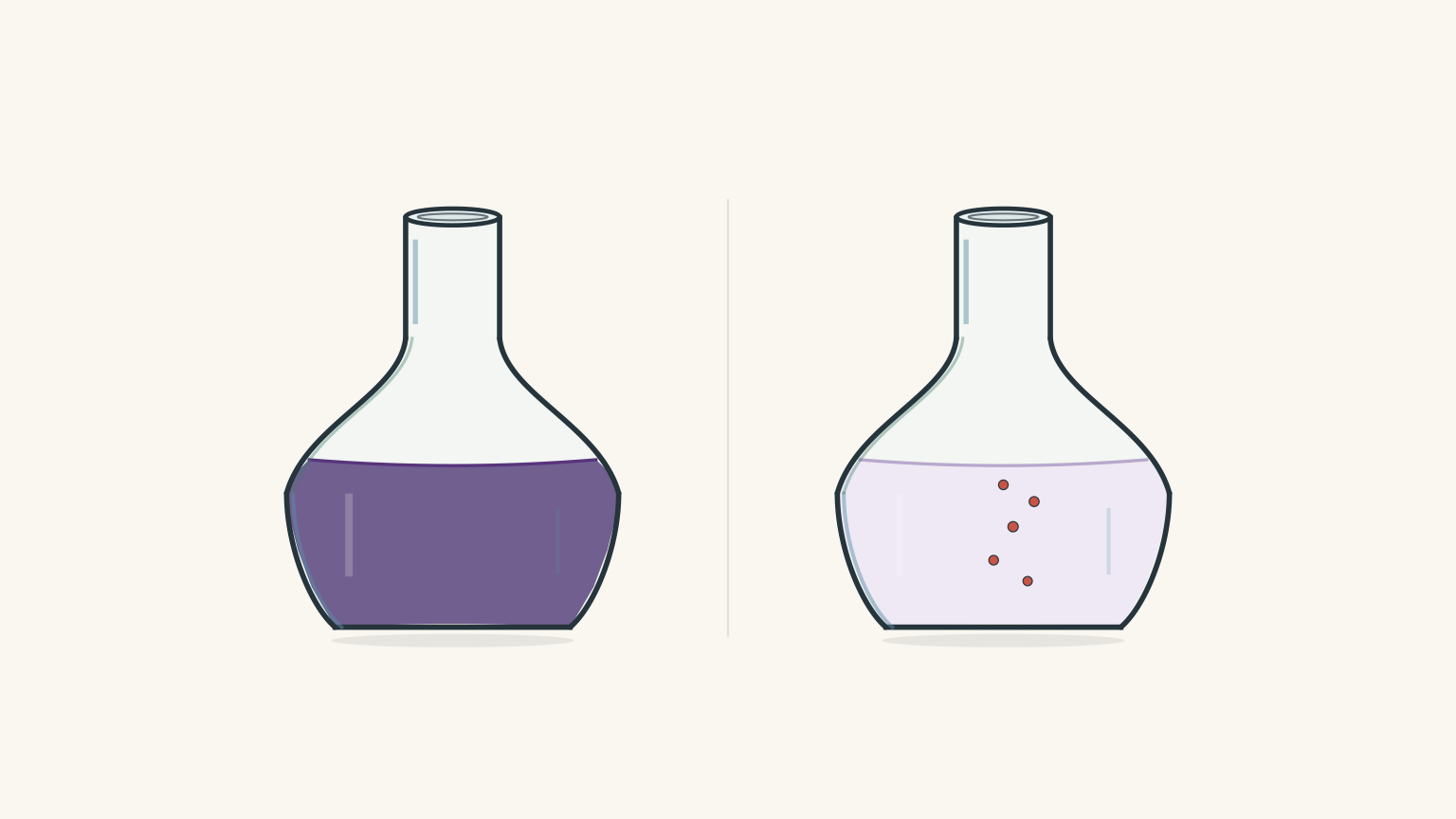
Due to technical limitations, this figure may display incorrectly or contain inaccuracies. Please check key details against your course materials.
01Start with the redox bookkeeping
Before looking at why a reaction accelerates, make sure you can track the electrons.
Consider a familiar metal displacement reaction. A strip of zinc is placed in a solution containing copper(II) ions.
Zinc atoms lose electrons and enter the solution as zinc ions:
\[ \ce{Zn(s) -> Zn^2+(aq) + 2e^-} \]
Copper(II) ions gain those electrons and form solid copper:
\[ \ce{Cu^2+(aq) + 2e^- -> Cu(s)} \]
Combining the half-equations gives:
\[ \ce{Zn(s) + Cu^2+(aq) -> Zn^2+(aq) + Cu(s)} \]
Zinc is oxidised because it loses electrons. Copper(II) ions are reduced because they gain electrons.
This is the basic redox model you need:
- Oxidation involves the loss of electrons.
- Reduction involves the gain of electrons.
- Half-equations show the electron transfer.
- The overall equation shows the substances consumed and produced.
But notice something important: these equations tell us which substances react and what forms. They do not, by themselves, tell us how the reaction rate changes over time.
That is a kinetics question.
02When a product helps make itself
Imagine a reaction between a reactant, A, and a product, P.
Normally, as A gets used up, the reaction becomes slower. There are fewer reactant particles available to collide successfully.
Now introduce a different possibility.
Suppose P can act as a catalyst for the reaction that produces more P.
Predict what happens as the reaction proceeds.
Initially, there is very little P, so there is very little catalytic activity. As the reaction produces P, more catalyst becomes available. The reaction speeds up, which produces P even faster.
This creates a feedback loop:
\[ \text{More P} \longrightarrow \text{Faster reaction} \longrightarrow \text{More P} \]
The process is called autocatalysis.
The International Union of Pure and Applied Chemistry (IUPAC) defines an autocatalytic reaction as one in which a product, or a reaction intermediate, also functions as a catalyst.
A simple way to picture it
Think about a snowball rolling down a snowy hill.
A small snowball picks up snow as it rolls. As it becomes larger, it can collect more snow with each movement. Its growth becomes increasingly rapid.
In this analogy:
- The available snow represents the reactant.
- The growing snowball represents the product.
- The increasing size represents the increasing concentration of autocatalyst.
The analogy has a limit. Molecules do not physically roll around collecting other molecules. Instead, the product participates in a chemical reaction pathway that makes further product formation faster.
The important idea is the feedback: the more product you have, the more effectively the reaction can produce additional product.
How does a catalyst increase reaction rate?
A catalyst provides an alternative reaction pathway with a lower activation energy.
Activation energy is the minimum energy barrier that reacting particles must overcome for a successful reaction.
At the same temperature, lowering this barrier increases the proportion of particles capable of reacting successfully.
An autocatalyst does the same thing, but its concentration increases as the reaction proceeds.
There is an important distinction here:
An ordinary catalyst is supplied to the reaction from outside. An autocatalyst is generated by the reaction itself.
The catalyst can participate in intermediate steps, but it is regenerated through the catalytic cycle. The overall reaction can therefore produce additional catalyst without consuming the catalyst permanently.
03A real example: the permanganate-oxalate reaction
Now apply the idea to a redox reaction.
Acidified permanganate ions, \(\mathrm{MnO_{4}}^{-}\), react with oxalate ions, \(\mathrm{C_{2}O_{4}}^{2-}\).
Permanganate ions are purple. During the reaction, they are reduced to manganese(II) ions, \(\mathrm{Mn}^{2+}\), which are very pale pink and can appear almost colourless in dilute solution.
Oxalate ions are oxidised to carbon dioxide.
The overall reaction is:
\[ \ce{ 2MnO4^- + 5C2O4^2- + 16H+ -> 2Mn^2+ + 10CO2 + 8H2O } \]
Let’s build this equation using the half-equation method you already know.
Step 1: Write the oxidation half-equation
Oxalate ions are converted into carbon dioxide.
\[ \ce{C2O4^2- -> 2CO2 + 2e^-} \]
Electrons appear on the right because oxidation involves electron loss.
Step 2: Write the reduction half-equation
In sufficiently acidic solution, permanganate ions are reduced to manganese(II) ions.
\[ \ce{ MnO4^- + 8H+ + 5e^- -> Mn^2+ + 4H2O } \]
Electrons appear on the left because reduction involves electron gain.
Step 3: Balance the electrons
The oxidation half-equation produces two electrons, while the reduction half-equation consumes five.
The lowest common multiple is ten.
Multiply the oxidation half-equation by five and the reduction half-equation by two.
\[ \ce{ 5C2O4^2- -> 10CO2 + 10e^- } \]
\[ \ce{ 2MnO4^- + 16H+ + 10e^- -> 2Mn^2+ + 8H2O } \]
Step 4: Combine the equations
The ten electrons cancel.
\[ \ce{ 2MnO4^- + 5C2O4^2- + 16H+ -> 2Mn^2+ + 10CO2 + 8H2O } \]
The equation is balanced for both atoms and charge.
Now look closely at the products.
The reaction produces \(\mathrm{Mn}^{2+}\).
Here is the unusual part: these manganese(II) ions also catalyse further reaction between permanganate and oxalate.
Manganese(II) is the autocatalyst.
Why does the reaction accelerate?
At the beginning, there is little or no added manganese(II).
The reaction can still begin through a slower initial pathway. This produces the first small amount of \(\mathrm{Mn}^{2+}\).
As the concentration of manganese(II) increases, the autocatalytic pathway becomes more significant.
Manganese(II) participates in reactions involving oxalate complexes and other manganese species, including manganese(III) intermediates. These processes help drive further oxidation of oxalate, with manganese(II) regenerated through parts of the catalytic cycle.
The exact mechanism is more complicated than a single collision between manganese(II) and permanganate. Researchers have investigated several manganese species and short-lived intermediates involved in the reaction.
For this extension, you need to understand the overall feedback mechanism, not memorise a proposed university-level reaction sequence.
There is also an important condition: the balanced equation above assumes sufficiently acidic conditions so that permanganate is reduced to \(\mathrm{Mn}^{2+}\). Under less acidic conditions, manganese dioxide can form instead, changing the reaction chemistry.
The practical observation is particularly useful:
- Without an initial manganese(II) seed, the reaction may have a noticeable slow period.
- With manganese(II) already present, the reaction can proceed much faster from the beginning.
- As the unseeded reaction produces manganese(II), it can also accelerate.
This is a clear example of a product helping catalyse its own formation.
The reaction is discussed here as a chemical mechanism, not as a home experiment. Acidified permanganate and strong acids require appropriate supervised laboratory controls.
04Why the rate doesn’t increase forever
It might seem that an autocatalytic reaction should become faster and faster until every reactant has disappeared.
That prediction misses one important constraint.
The reaction needs both the reactant and the autocatalyst.
As the reaction proceeds:
- The concentration of autocatalyst increases.
- The concentration of the original reactant decreases.
At first, the increase in catalyst concentration has the stronger effect. Eventually, the shortage of reactant becomes more important.
The reaction therefore has three broad stages.
| Stage | What is happening? | Reaction rate |
|---|---|---|
| Early | Little autocatalyst has formed. | Low |
| Middle | Autocatalyst accumulates while plenty of reactant remains. | Increasing |
| Late | Much of the reactant has been consumed. | Decreasing |
This gives us two different graphs to think about.
Product concentration against time: The curve is typically S-shaped, also called sigmoidal. Product forms slowly at first, then rapidly, before approaching its final concentration.
Reaction rate against time: The curve rises to a maximum and then falls. The rate does not keep increasing indefinitely.
Notice the difference between concentration and rate.
The concentration of product can continue increasing even while the reaction rate is decreasing. It simply means that product is still forming, but at a slower rate.
This is one of the most important distinctions in reaction kinetics.
05A simple mathematical model
We can describe the autocatalytic behaviour using a deliberately simplified reaction:
\[ \ce{A + P -> 2P} \]
Here:
- \(A\) represents the reactant.
- \(P\) represents the product that acts as an autocatalyst.
- \(k\) is the rate constant.
- \([A]\) is the concentration of A in \(\mathrm{mol\,L^{-1}}\).
- \([P]\) is the concentration of P in \(\mathrm{mol\,L^{-1}}\).
- \(r\) is the reaction rate in \(\mathrm{mol\,L^{-1}\,s^{-1}}\).
For this simplified elementary reaction, the rate law is:
\[ r=k[A][P] \]
This is an illustrative model of the autocatalytic pathway. It is not the experimentally established rate law for the permanganate-oxalate reaction.
The equation captures the two competing effects:
- Increasing \([P]\) increases the rate.
- Decreasing \([A]\) decreases the rate.
For a closed, constant-volume system with one-to-one conversion of A into P, we can assume:
\[ [A]+[P]=C \]
Here, \(C\) is the constant total concentration of A and P.
Rearranging:
\[ [A]=C-[P] \]
Substitute this into the rate law:
\[ r=k[P](C-[P]) \]
This tells us something interesting.
The rate is greatest when the two concentrations are equal:
\[ [A]=[P]=\frac{C}{2} \]
At this point, there is a substantial amount of autocatalyst available, but there is also still plenty of reactant.
Before this point, increasing the autocatalyst concentration makes the reaction faster overall.
After this point, reactant depletion becomes increasingly important, and the rate falls.
This model assumes a single simplified autocatalytic pathway, constant temperature, constant volume, and no competing reactions. Real chemical systems can have more complicated rate laws and additional intermediates.
Worked example: calculate the rate at a particular instant
A simplified autocatalytic reaction follows:
\[ r=k[A][P] \]
At a particular instant:
- \(k=0.40\ \mathrm{L\,mol^{-1}\,s^{-1}}\)
- \([A]=0.15\ \mathrm{mol\,L^{-1}}\)
- \([P]=0.020\ \mathrm{mol\,L^{-1}}\)
Calculate the reaction rate.
Step 1
We are given the simplified autocatalytic model:
\[ r=k[A][P] \]
Step 2
\[ \begin{aligned} r&=0.40\times0.15\times0.020\\ &=0.0012 \end{aligned} \]
Step 3
\[ r=1.2\times10^{-3} \ \mathrm{mol\,L^{-1}\,s^{-1}} \]
Step 4
The reaction is producing product at a rate of \(1.2\times10^{-3}\ \mathrm{mol\,L^{-1}\,s^{-1}}\) at this instant.
The rate depends on both the remaining reactant and the autocatalyst concentration.
Worked example: how much faster does the reaction become?
A closed system follows the same simplified rate law.
Initially:
\[ [A]=0.18\ \mathrm{mol\,L^{-1}} \]
\[ [P]=0.020\ \mathrm{mol\,L^{-1}} \]
Later, after some reaction has occurred:
\[ [A]=0.12\ \mathrm{mol\,L^{-1}} \]
\[ [P]=0.080\ \mathrm{mol\,L^{-1}} \]
The rate constant remains:
\[ k=0.50\ \mathrm{L\,mol^{-1}\,s^{-1}} \]
Calculate the initial and later rates, then determine how many times faster the reaction has become.
Step 1
\[ \begin{aligned} r_1&=k[A][P]\\ &=0.50\times0.18\times0.020\\ &=0.0018 \end{aligned} \]
Therefore:
\[ r_1=1.8\times10^{-3} \ \mathrm{mol\,L^{-1}\,s^{-1}} \]
Step 2
\[ \begin{aligned} r_2&=0.50\times0.12\times0.080\\ &=0.0048 \end{aligned} \]
Therefore:
\[ r_2=4.8\times10^{-3} \ \mathrm{mol\,L^{-1}\,s^{-1}} \]
Step 3
\[ \begin{aligned} \frac{r_2}{r_1} &=\frac{0.0048}{0.0018}\\ &=2.67 \end{aligned} \]
The later reaction rate is approximately 2.67 times the initial rate.
Step 4
The reactant concentration decreased from \(0.18\) to \(0.12\ \mathrm{mol\,L^{-1}}\).
However, the autocatalyst concentration increased from \(0.020\) to \(0.080\ \mathrm{mol\,L^{-1}}\).
The increase in autocatalyst concentration more than compensates for the decrease in reactant concentration.
This is the central feature of autocatalysis: the reaction can become faster even while consuming its original reactants.
06Questions and solutions
Question 1
In the acidic reaction between permanganate ions and oxalate ions, manganese(II) ions are produced.
Explain why this reaction can be classified as autocatalytic.
Solution 1
Manganese(II) ions are the autocatalyst because they are both a product of the overall reaction and a catalyst for further reaction.
As the reaction proceeds, more \(\mathrm{Mn}^{2+}\) forms. These ions help accelerate further oxidation of oxalate, increasing the reaction rate.
The concentration of the autocatalyst therefore increases as the reaction produces it.
Simply being a product is not enough to make a substance an autocatalyst. It must also increase the rate of the reaction that produces it.
Question 2
A simplified autocatalytic reaction follows:
\[ r=k[A][P] \]
The reaction occurs in a closed system with constant volume.
Initially:
\[ [A]_0=0.190\ \mathrm{mol\,L^{-1}} \]
\[ [P]_0=0.010\ \mathrm{mol\,L^{-1}} \]
Assume that one mole of A produces one mole of P.
After 20.0% of the initial amount of A has reacted, calculate the factor by which the reaction rate has changed.
Assume the temperature and rate constant remain unchanged.
Solution 2
The reaction rate has increased by a factor of 3.84.
To establish this, calculate the concentrations before and after the reaction progresses, then compare the two rates.
Step 1: Calculate the initial rate.
Using the simplified rate law:
\[ r_0=k[A]_0[P]_0 \]
Substituting:
\[ r_0=k(0.190)(0.010) \]
\[ r_0=0.00190k \]
We leave \(k\) in the expression because we only need the ratio of rates.
Step 2: Calculate the amount of A consumed.
The fraction consumed is 20.0%.
\[ \begin{aligned} \Delta[A] &=0.200\times0.190\\ &=0.0380\ \mathrm{mol\,L^{-1}} \end{aligned} \]
The remaining concentration of A is:
\[ [A]=0.190-0.0380 \]
\[ [A]=0.152\ \mathrm{mol\,L^{-1}} \]
Step 3: Calculate the new concentration of P.
Because A and P have a one-to-one relationship, the concentration of P increases by \(0.0380\ \mathrm{mol\,L^{-1}}\).
\[ [P]=0.010+0.0380 \]
\[ [P]=0.0480\ \mathrm{mol\,L^{-1}} \]
Step 4: Calculate the later reaction rate.
\[ \begin{aligned} r_1&=k(0.152)(0.0480)\\ &=0.007296k \end{aligned} \]
Step 5: Calculate the rate ratio.
\[ \begin{aligned} \frac{r_1}{r_0} &=\frac{0.007296k}{0.00190k}\\ &=3.84 \end{aligned} \]
The rate has increased by a factor of 3.84.
Notice that only 20% of the original reactant has been consumed, yet the reaction is already substantially faster.
The reason is the increasing concentration of the autocatalyst.
Question 3
Two identical mixtures contain the same initial concentrations of acidified permanganate and oxalate.
- Mixture A initially contains no added manganese(II).
- Mixture B initially contains a small amount of manganese(II).
Assume that the added manganese(II) acts only as a catalyst seed, both mixtures have the same temperature and volume, and no significant side reactions occur.
Explain:
a) Which mixture should initially react faster?
b) How should their reaction progress curves differ?
c) Should the two mixtures produce the same amount of carbon dioxide from the original reactants at completion?
Solution 3
Mixture B should initially react faster, but both mixtures should produce the same amount of carbon dioxide from the original reactants at completion.
Part a: Initial reaction rate
Mixture B already contains manganese(II), so the autocatalytic pathway can operate immediately.
Mixture A must first produce some manganese(II) through the slower initial reaction pathway.
Therefore, mixture B has the greater initial reaction rate.
Part b: Reaction progress
Mixture A should initially have a slower rate, followed by increasing acceleration as manganese(II) accumulates.
Mixture B should have a shorter induction period and reach its faster reaction stage earlier.
Both mixtures eventually slow down as their reactants become depleted.
Part c: Final carbon dioxide production
The amount of carbon dioxide formed from the original reactants is determined by the balanced chemical equation and the limiting reactant.
Adding manganese(II) changes the reaction rate, not the stoichiometric amount of carbon dioxide that can be produced from the original reactants.
Therefore, both mixtures produce the same amount of new carbon dioxide, assuming identical initial reactant quantities and no competing reactions.
The seeded mixture does contain additional manganese(II) from the beginning. This does not mean it has produced more manganese(II) through the reaction itself.
A catalyst changes how quickly a reaction proceeds, not its overall stoichiometric requirements.
Question 4
During an unseeded permanganate-oxalate reaction, the concentration of manganese(II) increases while the solution temperature also rises from 20°C to 28°C.
The purple permanganate colour begins disappearing more rapidly.
A student concludes that the increasing manganese(II) concentration must be responsible for all the acceleration.
Evaluate this conclusion and propose a suitable investigation to determine whether manganese(II) is responsible for the increased reaction rate.
Solution 4
The student’s conclusion is not justified because temperature is also changing and can independently increase the reaction rate.
An increase in temperature gives reacting particles greater average kinetic energy. A greater proportion of particles can overcome the activation energy barrier, increasing the rate of reaction.
Therefore, the observed acceleration could result from:
- Increasing manganese(II) concentration.
- Increasing temperature.
- A combination of both effects.
A controlled investigation is needed to separate these explanations.
Step 1: Prepare two otherwise identical reaction systems.
Both should have the same initial concentrations of permanganate, oxalate, and acid.
One system should contain a known initial manganese(II) seed, while the other should not.
Step 2: Control the experimental conditions.
Maintain the same temperature, total volume, acidity, and ionic strength.
The amount of added salt and any dilution effects should also be accounted for.
Step 3: Monitor the reaction rate.
The disappearance of purple permanganate can be monitored using its absorbance at an appropriate wavelength.
A faster decrease in absorbance indicates a faster rate of permanganate consumption.
Step 4: Compare the results.
If the seeded mixture reacts faster under otherwise identical conditions, this supports the conclusion that manganese(II) catalyses the reaction.
Since the overall reaction also produces manganese(II), this supports the classification of the reaction as autocatalytic.
The key experimental principle is to change the proposed cause while controlling other variables that could produce the same observation.
Question 5
Consider a closed autocatalytic system described by the simplified model:
\[ r=k[A][P] \]
Assume:
\[ [A]+[P]=0.20\ \mathrm{mol\,L^{-1}} \]
and:
\[ k=0.50\ \mathrm{L\,mol^{-1}\,s^{-1}} \]
Two samples are taken from the same reaction at different times.
Both samples have the same instantaneous reaction rate:
\[ r=1.8\times10^{-3} \ \mathrm{mol\,L^{-1}\,s^{-1}} \]
However, the later sample contains a higher concentration of P.
a) Determine the possible concentrations of A and P in each sample.
b) Identify which sample represents the earlier stage of the reaction.
c) Calculate the maximum possible reaction rate in this system.
d) Explain why these results challenge the prediction that an autocatalytic reaction must always become faster as time passes.
Solution 5
The earlier sample contains \(0.180\ \mathrm{mol\,L^{-1}}\) of A and \(0.020\ \mathrm{mol\,L^{-1}}\) of P.
The later sample contains \(0.020\ \mathrm{mol\,L^{-1}}\) of A and \(0.180\ \mathrm{mol\,L^{-1}}\) of P.
The maximum reaction rate occurs halfway through the conversion, when both concentrations equal \(0.100\ \mathrm{mol\,L^{-1}}\).
Part a: Determine the two possible compositions
We are given:
\[ r=k[A][P] \]
Substitute the known rate and rate constant:
\[ 1.8\times10^{-3}=0.50[A][P] \]
Rearrange:
\[ [A][P]=0.0036 \]
We also know:
\[ [A]+[P]=0.20 \]
Therefore:
\[ [A]=0.20-[P] \]
Substitute into the rate expression:
\[ [P](0.20-[P])=0.0036 \]
Expand:
\[ [P]^2-0.20[P]+0.0036=0 \]
Factorise:
\[ ([P]-0.020)([P]-0.180)=0 \]
Therefore, there are two possible product concentrations:
\[ [P]=0.020\ \mathrm{mol\,L^{-1}} \]
or:
\[ [P]=0.180\ \mathrm{mol\,L^{-1}} \]
Using the total concentration constraint, the corresponding reactant concentrations are:
| Sample | [A] (mol L⁻¹) | [P] (mol L⁻¹) |
|---|---|---|
| Possible state 1 | 0.180 | 0.020 |
| Possible state 2 | 0.020 | 0.180 |
Part b: Identify the earlier sample
The first sample is earlier because it contains less product and more original reactant.
As the reaction proceeds, A is converted into P.
Therefore:
- Earlier sample: \([A]=0.180\), \([P]=0.020\).
- Later sample: \([A]=0.020\), \([P]=0.180\).
Both have exactly the same reaction rate despite having very different compositions.
Part c: Calculate the maximum reaction rate
The rate equation is:
\[ r=k[A][P] \]
The total concentration is fixed:
\[ [A]+[P]=0.20 \]
The product \([A][P]\) is maximised when the two concentrations are equal.
Therefore:
\[ [A]=[P]=0.100\ \mathrm{mol\,L^{-1}} \]
Substitute into the rate equation:
\[ \begin{aligned} r_{\max} &=0.50\times0.100\times0.100\\ &=0.0050 \end{aligned} \]
Hence:
\[ \boxed{ r_{\max}=5.0\times10^{-3} \ \mathrm{mol\,L^{-1}\,s^{-1}} } \]
This is greater than the rate measured in either sample.
Part d: Explain the changing reaction rate
The reaction rate does not depend only on the amount of autocatalyst present.
It depends on the product of the reactant concentration and the autocatalyst concentration.
Initially, increasing P has a strong positive effect on the rate because A is still abundant.
However, as the reaction continues, A becomes increasingly depleted.
Eventually, the decreasing concentration of A outweighs the increasing concentration of P.
The reaction therefore reaches a maximum rate and subsequently slows down.
The tempting prediction is that more autocatalyst must always mean a faster reaction. The missing constraint is the decreasing reactant concentration.
This is why the same instantaneous rate can occur at two completely different stages of an autocatalytic reaction.
It also shows why a single rate measurement cannot tell you how far an autocatalytic reaction has progressed.
07Where autocatalysis fits into reaction kinetics
Autocatalysis adds a feedback mechanism to the reaction-rate ideas you already know.
You can now distinguish three important situations:
- An ordinary reaction slows as reactants are consumed.
- A catalysed reaction has an alternative pathway that increases its rate.
- An autocatalytic reaction produces a catalyst that helps accelerate its own formation.
The permanganate-oxalate reaction brings these ideas together through redox chemistry, half-equations, reaction mechanisms, and changing reaction rates.
A useful next step is to compare autocatalysis with other mechanisms that produce changing reaction rates. In particular, tutorgum’s Reaction Mechanisms and Rate-Determining Steps explains how individual reaction steps control the overall rate, while Consecutive Reactions: How Intermediates Form and Disappear explores how intermediate concentrations change throughout a reaction.
The key decision when analysing an unusual rate curve is to ask whether the reaction is simply running out of reactants, or whether something being produced is changing the pathway and accelerating further reaction.
08Sources and further reading
The following scientific and educational sources support the definitions, reaction chemistry, and mechanistic discussion in this article.
- IUPAC Gold Book: Autocatalytic reaction – the formal chemical definition of autocatalysis.
- Royal Society of Chemistry: Rate of reaction of potassium manganate(VII) and oxalic acid – educational explanation of the permanganate-oxalate reaction and its manganese(II) autocatalyst.
- Institut Català d’Investigació Química: Catalysis and autocatalysis – an educational discussion of the manganese(II)-catalysed reaction.
- Kovács et al. (2004), Decomposition of the permanganate/oxalic acid overall reaction to elementary steps based on integer programming theory, Physical Chemistry Chemical Physics – primary research examining the detailed reaction mechanism and the role of intermediate species.
- NSW Chemistry 11-12 Syllabus (2025) – official syllabus and implementation information.