
Chain Branching: How One Radical Produces Two Chain Carriers
Learn how radical chain reactions branch when one reactive intermediate produces multiple chain carriers. This extension builds on Year 11 redox concepts, with reaction mechanisms, worked examples, and challenging practice questions.
A single hydrogen radical can react with an oxygen molecule and produce two new radicals. One reactive particle goes in, but two reactive particles come out. If those new radicals continue reacting, the number of active particles in the reaction can grow rapidly.
This is called chain branching. It is an extension beyond the required Year 11 Chemistry content, not an HSC assessment requirement. The Year 11 Chemical reactions material is simply the assumed starting point.
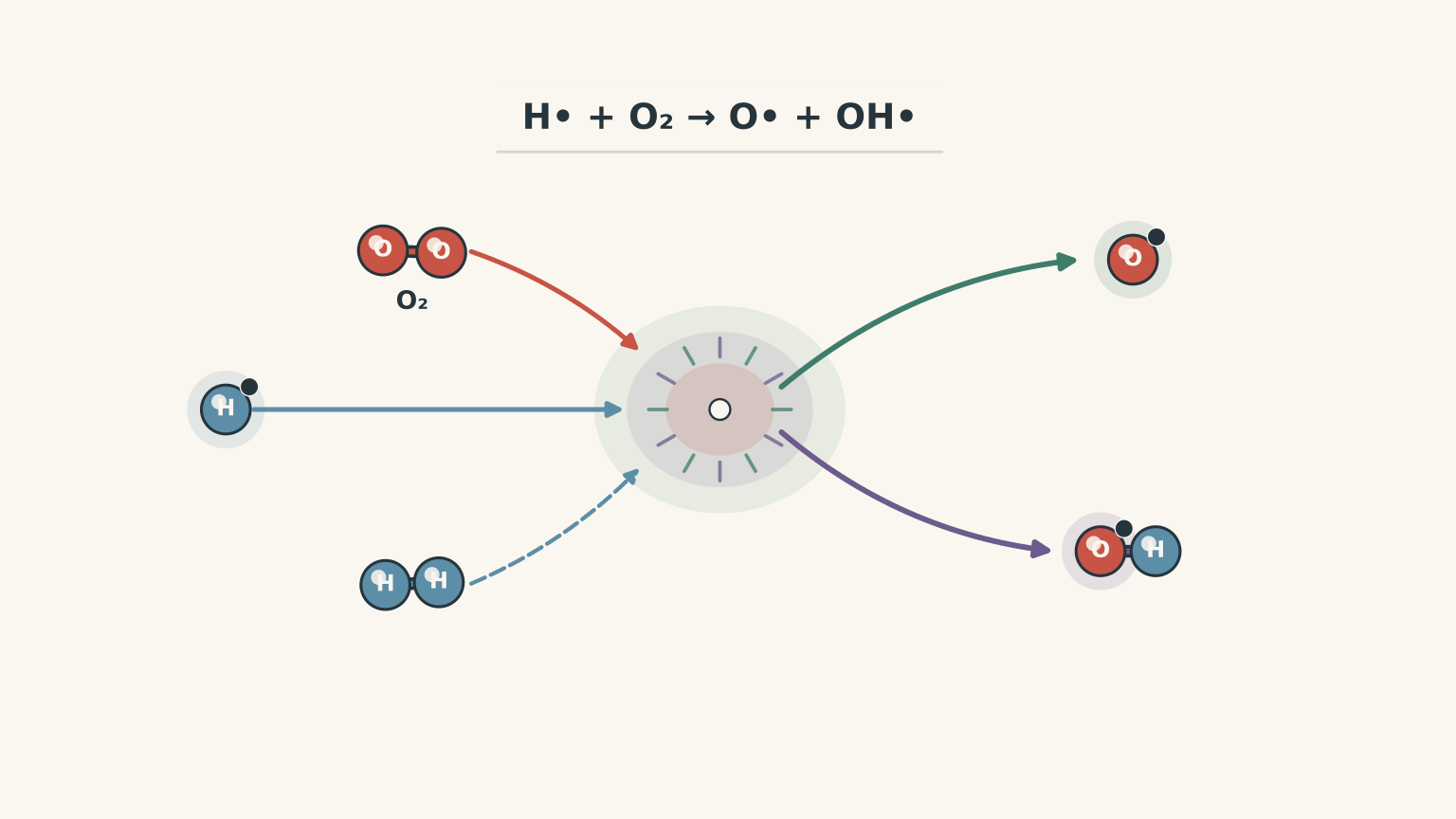
Due to technical limitations, this figure may display incorrectly or contain inaccuracies. Please check key details against your course materials.
01First, what does redox have to do with it?
Before looking at chain branching, recall what happens to electrons during an oxidation-reduction reaction.
- Oxidation is the loss of electrons. It corresponds to an increase in oxidation state.
- Reduction is the gain of electrons. It corresponds to a decrease in oxidation state.
Consider the overall reaction between hydrogen and oxygen:
\[ \ce{2H2 + O2 -> 2H2O} \]
The oxidation states change as follows:
| Element | Initial oxidation state | Final oxidation state | Change |
|---|---|---|---|
| Hydrogen | 0 | +1 | Oxidation |
| Oxygen | 0 | -2 | Reduction |
Hydrogen loses electron density and is oxidised. Oxygen gains electron density and is reduced.
Therefore:
- \(\ce{H2}\) is the reducing agent.
- \(\ce{O2}\) is the oxidising agent.
Oxidation states are a bookkeeping system. In covalent reactions, they help us track how bonding electrons are redistributed, even when electrons are not transferred as free particles.
There is another question we can ask about this reaction, though.
The balanced equation tells us what goes in and what comes out. Does it tell us exactly how the reaction happens?
No. It doesn’t tell us which molecules collide first, which intermediates form, or how many individual reaction steps occur.
That is where reaction mechanisms become important.
02Understanding radical chain reactions
A reaction mechanism describes the sequence of individual steps that produces the overall reaction.
Some mechanisms involve highly reactive particles called free radicals.
A free radical is an atom or molecule containing at least one unpaired electron. We represent a radical using a dot.
For example:
- \(\ce{H^.}\) is a hydrogen radical.
- \(\ce{O^.}\) is an oxygen atom radical.
- \(\ce{OH^.}\) is a hydroxyl radical.
The dot indicates an unpaired electron. It does not represent a negative charge.
Be careful with \(\ce{OH^.}\) and \(\mathrm{OH}^{-}\). The first is a neutral hydroxyl radical. The second is the hydroxide ion.
Radicals are often highly reactive because their electronic configurations make them likely to participate in further reactions.
An important idea is that a radical can react with a stable molecule and produce another radical. This allows a reaction to continue through a sequence of steps.
A reactive intermediate formed in one step and consumed in another is sometimes called a reaction intermediate. If it participates in carrying a chain reaction forward, it can also be called a chain carrier.
The IUPAC definition of a chain carrier includes atoms and radicals involved in chain-propagating reactions.
The three basic stages
A simplified radical chain reaction can involve three types of steps.
1. Initiation
Initiation produces the first reactive radicals.
For example, an energy-rich collision can split a hydrogen molecule:
\[ \ce{H2 + M -> 2H^. + M} \]
Here, \(M\) represents a third molecule involved in the collision. It is unchanged chemically.
The collision supplies energy to break the H-H bond, producing two hydrogen radicals.
2. Propagation
Propagation occurs when a radical reacts with another molecule and produces a new radical.
For example:
\[ \ce{OH^. + H2 -> H2O + H^.} \]
One hydroxyl radical reacts with hydrogen to form water and a hydrogen radical.
Notice what happened to the chain carrier:
- One radical was consumed.
- One new radical was produced.
The chain continues, but the number of carriers has not increased.
3. Termination
Termination removes chain carriers, usually by combining reactive species to form more stable products.
For example:
\[ \ce{H^. + OH^. + M -> H2O + M} \]
Two radicals are consumed, producing water.
The chain carriers are removed rather than regenerated.
If you want to explore how intermediates are formed and consumed across a sequence of reactions, see Consecutive Reactions: How Intermediates Form and Disappear.
03The key idea: one chain carrier produces two
Ordinary propagation maintains the number of chain carriers.
Chain branching is different.
In chain branching, a reaction step produces more chain carriers than it consumes. The number of active intermediates increases.
IUPAC defines chain branching in terms of a net increase in the number of chain carriers during a chain reaction.
Let’s examine a specific example.
Hydrogen and oxygen: the branching reaction
In a simplified high-temperature hydrogen-oxygen reaction mechanism, hydrogen radicals can react with oxygen molecules:
\[ \boxed{\ce{H^. + O2 -> O^. + OH^.}} \]
Look carefully at the reactants and products.
On the reactant side, there is one chain carrier:
- One hydrogen radical.
On the product side, there are two chain carriers:
- One oxygen atom radical.
- One hydroxyl radical.
The oxygen molecule is a reactant in this simplified mechanism, rather than a chain carrier being counted in the propagation sequence.
Chain branching
\[ 1\text{ chain carrier} \longrightarrow 2\text{ chain carriers} \]
The number of chain carriers has increased by one.
This is the defining feature of chain branching.
But the process does not stop there.
The newly formed oxygen radical can also participate in a branching reaction:
\[ \ce{O^. + H2 -> OH^. + H^.} \]
Again, one chain carrier produces two.
The hydroxyl radicals can then continue the reaction through ordinary propagation:
\[ \ce{OH^. + H2 -> H2O + H^.} \]
This last step maintains the number of chain carriers.
We can compare the three reactions:
| Reaction | Carriers consumed | Carriers produced | Classification |
|---|---|---|---|
| \(\ce{H^. + O2 -> O^. + OH^.}\) | 1 | 2 | Branching |
| \(\ce{O^. + H2 -> OH^. + H^.}\) | 1 | 2 | Branching |
| \(\ce{OH^. + H2 -> H2O + H^.}\) | 1 | 1 | Propagation |
The first two reactions increase the number of chain carriers. The third keeps the chain moving without increasing their number.
Why does this matter?
Imagine a relay race.
In ordinary propagation, one runner passes the baton to another runner. The race continues with one active runner at a time.
In chain branching, one active runner effectively produces two runners who can each continue the race.
In termination, two runners leave the race.
The analogy is useful for understanding the changing number of chain carriers. However, it has a limitation: real radicals are not interchangeable runners. Hydrogen, oxygen, and hydroxyl radicals have different chemical reactivities, so producing two radicals does not guarantee that both will react at the same speed.
What happens to the overall equation?
We can combine the three reactions to see how chain branching affects the overall reaction.
Starting with one hydrogen radical:
- One \(\ce{H^.}\) reacts with \(\ce{O2}\), producing \(\ce{O^.}\) and \(\ce{OH^.}\).
- The \(\ce{O^.}\) reacts with \(\ce{H2}\), producing another \(\ce{OH^.}\) and another \(\ce{H^.}\).
- Both hydroxyl radicals react with hydrogen, each producing water and another hydrogen radical.
We started with one hydrogen radical and finished with three hydrogen radicals.
The two branching steps have increased the number of chain carriers, while the propagation steps have maintained their number.
Adding the reactions and cancelling intermediates gives:
\[ \ce{3H2 + O2 -> 2H2O + 2H^.} \]
This is a net bookkeeping equation for the sequence, not a single elementary reaction.
The important result is that two additional hydrogen radicals have been generated while the stable reactants have been converted into water.
04Why doesn’t every chain reaction keep branching?
At this point, you might predict that once a branching reaction starts, the number of radicals must keep increasing.
That sounds reasonable. If one radical produces two, surely those two can each produce two more.
In an idealised model where every carrier branches and none are removed, the number could grow like this:
\[ 1 \rightarrow 2 \rightarrow 4 \rightarrow 8 \]
However, real chemical reactions are more complicated.
Three important factors affect whether the radical population actually grows.
1. Different radicals have different reactivities
Not every radical is equally effective at continuing a chain reaction.
For example, hydrogen radicals can react with oxygen through the branching pathway:
\[ \ce{H^. + O2 -> O^. + OH^.} \]
However, another possible reaction is:
\[ \ce{H^. + O2 + M -> HO2^. + M} \]
This produces a hydroperoxyl radical, \(\ce{HO2^.}\).
The symbol \(M\) represents a third-body molecule. It helps remove excess energy from the association reaction and remains chemically unchanged.
This reaction converts one chain carrier into another:
\[ 1 \rightarrow 1 \]
It is not a branching step.
The hydroperoxyl radical is still a radical. However, it is less reactive than the hydrogen radical in the simplified high-temperature chain mechanism.
Consequently, converting hydrogen radicals into hydroperoxyl radicals can divert carriers away from the faster branching pathway.
2. Pressure and temperature change which pathways compete
The hydrogen-oxygen system is particularly interesting because its reaction pathways depend strongly on conditions.
At sufficiently high temperatures, the reaction
\[ \ce{H^. + O2 -> O^. + OH^.} \]
can play an important role in chain branching.
At other temperatures and pressures, reactions producing \(\ce{HO2^.}\) and other peroxide intermediates become more important.
Increasing pressure can favour reactions involving a third-body collision partner. This can divert hydrogen radicals into pathways that do not immediately increase the number of chain carriers.
However, it would be incorrect to conclude that higher pressure always suppresses branching.
Hydroperoxyl radicals can participate in further reactions, including pathways that eventually produce hydrogen peroxide:
\[ \ce{HO2^. + H2 -> H2O2 + H^.} \]
Hydrogen peroxide can subsequently decompose:
\[ \ce{H2O2 + M -> 2OH^. + M} \]
This produces two hydroxyl radicals.
The intermediate hydrogen peroxide provides a route for delayed radical multiplication.
In some reaction systems, this type of delayed process is associated with degenerate chain branching. A relatively long-lived intermediate forms first, and its later decomposition produces additional chain carriers.
The important point is that branching does not always occur immediately after the original radical forms.
These pathways are part of a much larger hydrogen-oxygen reaction network. The three main reactions introduced earlier are a simplified high-temperature teaching model, not a complete description of combustion.
Princeton University’s combustion teaching materials discuss these branching pathways, the competing HO2 reactions, and the effects of pressure.
3. Termination competes with branching
Even when branching reactions produce additional radicals, termination reactions can remove them.
Consider the reaction:
\[ \ce{H^. + OH^. + M -> H2O + M} \]
Two chain carriers combine to form a stable product.
The overall number of chain carriers decreases.
This means that the radical population depends on the balance between production and removal.
We can express the idea using:
\[ \Delta N = N_{\text{after}}-N_{\text{before}} \]
Here:
- \(N\) is the number of chain carriers.
- \(\Delta N\) is the change in their number.
If \(\Delta N\) is positive, there has been a net increase.
If \(\Delta N\) is zero, the number of carriers has remained constant.
If \(\Delta N\) is negative, there has been a net loss.
For a reaction to undergo sustained chain growth, branching must compete successfully against termination and other processes that remove or divert reactive intermediates.
If branching dominates, the radical population can grow rapidly, accelerating the reaction.
If termination dominates, the reaction chain can slow down or die out.
This competition is one reason why chain branching is important when explaining rapid combustion and chemical ignition.
05A distinction worth remembering: chemical branching versus structural branching
There are two different meanings of branching in chemistry.
Chain branching in reaction kinetics describes an increase in the number of reactive intermediates during a chain reaction.
Structural branching describes a molecule whose carbon backbone contains branches rather than forming one continuous, unbranched chain.
For example, branching in polyethylene changes how polymer chains pack together, affecting properties such as density.
That is a different concept from radical chain branching. See Why branching Changes the Density of Polyethylene for the structural meaning.
The distinction is simple:
- Reaction branching changes the number of chain carriers.
- Molecular branching changes the arrangement of atoms in a molecule.
06Worked examples
Worked example: classify a branching reaction
Consider the reaction:
\[ \ce{H^. + O2 -> O^. + OH^.} \]
How many chain carriers are consumed and produced? Explain why this reaction is classified as chain branching.
Step 1
There is one hydrogen radical, \(\ce{H^.}\).
Therefore, one chain carrier is consumed.
Step 2
There are two radicals:
- One oxygen radical, \(\ce{O^.}\).
- One hydroxyl radical, \(\ce{OH^.}\).
Therefore, two chain carriers are produced.
Step 3
\[ \begin{aligned} \Delta N &= N_{\text{after}}-N_{\text{before}}\\ &=2-1\\ &=+1 \end{aligned} \]
Step 4
The reaction is a chain-branching reaction because one chain carrier produces two new chain carriers.
The number of carriers increases by one per reaction event.
Notice that this does not mean the entire radical population doubles. If a reaction mixture initially contains 50 chain carriers and just one undergoes this reaction, the population increases to 51, not 100.
Worked example: follow the radicals through a reaction sequence
A reaction mixture initially contains one hydrogen radical.
It undergoes the following sequence:
- One reaction of \(\ce{H^. + O2 -> O^. + OH^.}\).
- One reaction of \(\ce{O^. + H2 -> OH^. + H^.}\).
- Each hydroxyl radical produced undergoes \(\ce{OH^. + H2 -> H2O + H^.}\) once.
Assume sufficient hydrogen and oxygen are available and no termination reactions occur.
Determine the final number of chain carriers and the net increase.
Step 1
The mixture starts with one hydrogen radical.
\[ N_{\text{initial}}=1 \]
Step 2
\[ \ce{H^. + O2 -> O^. + OH^.} \]
One hydrogen radical is consumed, producing two radicals.
The mixture now contains:
- One \(\ce{O^.}\).
- One \(\ce{OH^.}\).
Therefore:
\[ N=2 \]
Step 3
\[ \ce{O^. + H2 -> OH^. + H^.} \]
The oxygen radical is consumed and replaced by two radicals.
Importantly, the hydroxyl radical from the previous step is still present.
The mixture now contains:
- Two \(\ce{OH^.}\) radicals.
- One \(\ce{H^.}\) radical.
Therefore:
\[ N=3 \]
Step 4
\[ \ce{OH^. + H2 -> H2O + H^.} \]
Each hydroxyl radical is converted into one hydrogen radical.
The number of chain carriers remains unchanged.
The mixture finishes with three hydrogen radicals:
\[ N_{\text{final}}=3 \]
Step 5
\[ \begin{aligned} \Delta N &= 3-1\\ &=+2 \end{aligned} \]
The sequence has produced two additional chain carriers.
The corresponding net reaction is:
\[ \ce{3H2 + O2 -> 2H2O + 2H^.} \]
This equation summarises the sequence after the intermediate species have been cancelled. It is not an elementary reaction.
The key lesson is that the two branching steps increase the carrier population, while the propagation steps maintain it.
07Questions and solutions
Question 1
Consider the reaction:
\[ \ce{O^. + H2 -> OH^. + H^.} \]
Identify whether this is a branching, propagation, or termination reaction.
Calculate the change in the number of chain carriers during one reaction event.
Solution 1
This is a chain-branching reaction, producing a net increase of one chain carrier.
The reactant side contains one chain carrier: \(\ce{O^.}\).
The product side contains two chain carriers: \(\ce{OH^.}\) and \(\ce{H^.}\).
Therefore:
\[ \Delta N=2-1=+1 \]
The hydrogen molecule supplies additional atoms for the new radicals, while the original oxygen radical is consumed.
The number of chain carriers increases because one active intermediate produces two new active intermediates.
Question 2
The overall reaction between hydrogen and oxygen is:
\[ \ce{2H2 + O2 -> 2H2O} \]
(a) Identify which element is oxidised and which is reduced.
(b) Identify the oxidising agent and reducing agent.
(c) Explain why the balanced equation does not provide enough information to determine whether the reaction involves chain branching.
Solution 2
(a) Hydrogen is oxidised, while oxygen is reduced.
Hydrogen changes from oxidation state 0 in \(\ce{H2}\) to +1 in water.
Oxygen changes from oxidation state 0 in \(\ce{O2}\) to -2 in water.
Hydrogen loses electron density, while oxygen gains electron density.
(b) Hydrogen is the reducing agent, and oxygen is the oxidising agent.
The reducing agent causes another substance to be reduced and is itself oxidised.
The oxidising agent causes another substance to be oxidised and is itself reduced.
(c) The balanced equation only shows the overall reactants and products. It does not reveal the individual elementary reactions occurring between them.
For example, hydrogen oxidation can involve:
\[ \ce{H^. + O2 -> O^. + OH^.} \]
This intermediate step increases the number of chain carriers.
Those radicals can then participate in further propagation and branching reactions.
When the individual reactions are added together, the intermediates cancel, leaving the overall balanced equation.
Therefore, two reaction mechanisms can have the same overall chemical equation but very different sequences of intermediates and reaction rates.
Redox accounting tells us how oxidation states change. Chain branching tells us how the population of reactive intermediates changes.
Question 3
A simplified reaction mixture initially contains:
- 8 hydrogen radicals, \(\ce{H^.}\).
- 2 oxygen radicals, \(\ce{O^.}\).
Two reaction stages occur.
Stage A: All eight hydrogen radicals undergo:
\[ \ce{H^. + O2 -> O^. + OH^.} \]
Stage B: Every oxygen radical present after Stage A undergoes:
\[ \ce{O^. + H2 -> OH^. + H^.} \]
Assume sufficient reactants are available and no other reactions occur.
Calculate:
(a) The number of chain carriers after Stage A.
(b) The number of chain carriers after Stage B.
(c) The net increase in chain carriers across both stages.
Solution 3
There are 28 chain carriers after Stage B, representing a net increase of 18.
(a) After Stage A
The mixture initially contains:
\[ 8+2=10 \]
chain carriers.
Each of the eight hydrogen radicals produces one oxygen radical and one hydroxyl radical.
Therefore, Stage A creates:
- 8 new oxygen radicals.
- 8 new hydroxyl radicals.
The original two oxygen radicals remain.
The total is:
\[ N_A=2+8+8=18 \]
(b) After Stage B
There are now ten oxygen radicals:
- Eight produced during Stage A.
- Two present initially.
Each oxygen radical undergoes:
\[ \ce{O^. + H2 -> OH^. + H^.} \]
Each reaction produces two new chain carriers.
Therefore, Stage B produces:
- 10 hydroxyl radicals.
- 10 hydrogen radicals.
The eight hydroxyl radicals produced during Stage A are also still present.
The final population is:
\[ N_B=8+10+10 \]
\[ N_B=28 \]
(c) Net increase
The initial population was 10, and the final population is 28.
\[ \begin{aligned} \Delta N &=28-10\\ &=+18 \end{aligned} \]
The increase is 18 chain carriers.
A common mistake would be to consider only the eight original hydrogen radicals and conclude that the population doubles to 16.
That ignores the two oxygen radicals already present and the fact that all ten oxygen radicals undergo a second branching reaction.
The correct approach is to track every carrier that remains available after each reaction stage.
Question 4
In a simplified hydrogen-oxygen reaction system, hydrogen radicals can follow two competing pathways.
Pathway A:
\[ \ce{H^. + O2 -> O^. + OH^.} \]
This is a chain-branching reaction.
Pathway B:
\[ \ce{H^. + O2 + M -> HO2^. + M} \]
This converts one chain carrier into one hydroperoxyl radical. The third body, \(M\), is unchanged chemically.
Consider two hypothetical reaction mixtures, each beginning with 100 hydrogen radicals.
| Condition | Pathway A | Pathway B |
|---|---|---|
| Lower pressure | 70 reactions | 30 reactions |
| Higher pressure | 25 reactions | 75 reactions |
Assume that all \(\ce{HO2^.}\) radicals remain as single chain carriers during the observation period and that no further reactions or termination occur.
(a) Calculate the net increase in chain carriers under each condition.
(b) Explain why the higher-pressure mixture produces a smaller immediate increase in chain carriers.
(c) Does this demonstrate that increasing pressure always suppresses chain branching? Explain.
Solution 4
The lower-pressure mixture gains 70 chain carriers, while the higher-pressure mixture gains 25.
(a) Calculate the changes.
For the lower-pressure mixture:
Each Pathway A reaction consumes one carrier and produces two. Its net contribution is therefore +1.
Each Pathway B reaction replaces one carrier with another. Its net contribution is zero.
Therefore:
\[ \begin{aligned} \Delta N_{\text{low}} &=70(2-1)+30(1-1)\\ &=70 \end{aligned} \]
The final population is:
\[ N_{\text{low}}=100+70=170 \]
For the higher-pressure mixture:
\[ \begin{aligned} \Delta N_{\text{high}} &=25(2-1)+75(1-1)\\ &=25 \end{aligned} \]
The final population is:
\[ N_{\text{high}}=100+25=125 \]
(b) Explain the difference.
At higher pressure, a larger proportion of hydrogen radicals follows Pathway B.
This reaction produces one hydroperoxyl radical rather than two chain carriers.
Consequently, fewer immediate branching events occur, and the total carrier population increases by a smaller amount.
Notice that Pathway B does not destroy the radical. It changes its identity.
This distinction matters because a radical’s chemical reactivity influences how effectively it can continue a chain reaction.
(c) No. Higher pressure does not universally suppress chain branching.
The result only describes the simplified reaction model and observation period given in the question.
In a real hydrogen-oxygen system, hydroperoxyl radicals can participate in further reactions. For example:
\[ \ce{HO2^. + H2 -> H2O2 + H^.} \]
The hydrogen peroxide can subsequently decompose:
\[ \ce{H2O2 + M -> 2OH^. + M} \]
This creates additional chain carriers.
Therefore, the overall effect of pressure depends on the competing reaction pathways, including the formation and subsequent reactions of peroxide intermediates.
The important distinction is between immediate branching and the longer-term behaviour of the entire reaction network.
Question 5
A simplified, isothermal hydrogen-oxygen reaction model initially contains 12 hydrogen radicals.
Assume that sufficient hydrogen and oxygen are available, and that the following reactions occur during a particular interval.
Reaction A: Twelve hydrogen radicals undergo:
\[ \ce{H^. + O2 -> O^. + OH^.} \]
Reaction B: Every oxygen radical produced in Reaction A undergoes:
\[ \ce{O^. + H2 -> OH^. + H^.} \]
This reaction occurs 12 times.
Reaction C: Exactly 12 hydrogen radicals each combine with one hydroxyl radical through:
\[ \ce{H^. + OH^. + M -> H2O + M} \]
Reaction D: Every hydroxyl radical remaining after Reaction C undergoes:
\[ \ce{OH^. + H2 -> H2O + H^.} \]
Assume that:
- Reactions occur in the order A, B, C, then D.
- No reverse reactions or other reactions occur.
- \(M\) is chemically unchanged.
- All specified reactions proceed completely.
Answer the following:
(a) Determine the number of chain carriers immediately after Reaction B.
(b) Determine the number of chain carriers remaining after Reaction D.
(c) Calculate the total number of water molecules produced.
(d) A student claims that no chain branching occurred because the final number of chain carriers equals the initial number. Evaluate this claim.
(e) Another student claims that the presence of branching steps guarantees runaway growth. Explain why this conclusion is incorrect.
(f) Write the net balanced reaction after all intermediate species have been cancelled.
Solution 5
The final mixture contains 12 chain carriers, and 24 water molecules have formed. Both branching reactions occurred, but termination exactly balanced their net increase in this particular model.
(a) Number of carriers after Reaction B
Initially:
\[ N_{\text{initial}}=12 \]
Reaction A occurs 12 times.
Each event consumes one hydrogen radical and produces two new radicals.
Therefore:
\[ 12 \rightarrow 24 \]
There are now:
- 12 oxygen radicals.
- 12 hydroxyl radicals.
The total is 24.
Reaction B then consumes all 12 oxygen radicals.
Each produces one hydroxyl radical and one hydrogen radical.
Therefore, Reaction B creates another 12 chain carriers.
After Reaction B, the mixture contains:
- 24 hydroxyl radicals.
- 12 hydrogen radicals.
Thus:
\[ N_B=24+12=36 \]
There are 36 chain carriers.
(b) Number of carriers after Reaction D
Reaction C occurs 12 times:
\[ \ce{H^. + OH^. + M -> H2O + M} \]
Each event consumes two chain carriers.
Twelve events therefore consume:
\[ 12\times2=24 \]
chain carriers.
Before Reaction C, there were 36 carriers.
After Reaction C:
\[ N_C=36-24=12 \]
These 12 remaining carriers are all hydroxyl radicals.
Reaction D then occurs 12 times:
\[ \ce{OH^. + H2 -> H2O + H^.} \]
Each reaction consumes one chain carrier and produces one new chain carrier.
The total therefore remains unchanged.
\[ N_D=12 \]
The final mixture contains 12 hydrogen radicals.
(c) Total water produced
Reaction C produces one water molecule per reaction event.
It occurs 12 times:
\[ n_{\ce{H2O},C}=12 \]
Reaction D also produces one water molecule per reaction event.
It also occurs 12 times:
\[ n_{\ce{H2O},D}=12 \]
Therefore:
\[ n_{\ce{H2O}}=12+12 \]
\[ \boxed{24\text{ water molecules}} \]
(d) Was there chain branching?
Yes. The student’s conclusion is incorrect.
Reactions A and B are both branching reactions.
Reaction A increases the carrier population from 12 to 24.
Reaction B increases it from 24 to 36.
The reason the final population returns to 12 is that Reaction C removes 24 chain carriers.
This exactly offsets the combined increase produced by the two branching stages.
Reaction D then maintains the remaining carrier population.
The final number of radicals alone does not reveal which reaction steps occurred along the way.
This is an important distinction: individual branching events can occur even when there is no net increase in the overall radical population.
(e) Do branching steps guarantee runaway growth?
No. Branching does not automatically produce runaway growth.
The outcome depends on the balance between branching, propagation, and termination.
In this model, branching creates 24 additional carriers across Reactions A and B.
However, Reaction C removes 24 carriers.
The two effects balance exactly.
For sustained growth, branching must continue to produce carriers faster than competing processes remove them.
In a real reaction system, the situation is even more complicated because different radicals have different reactivities, reactant concentrations change, and temperature and pressure influence competing pathways.
Therefore, identifying a branching step is not enough to predict an explosion or runaway reaction.
(f) Net balanced equation
We can add the four reaction stages together and cancel the intermediate radicals.
Reaction A consumes 12 oxygen molecules.
Reaction B consumes 12 hydrogen molecules.
Reaction D consumes another 12 hydrogen molecules.
Reactions C and D together produce 24 water molecules.
The net reaction is:
\[ \ce{24H2 + 12O2 -> 24H2O} \]
Dividing by 12 gives the familiar overall equation:
\[ \boxed{\ce{2H2 + O2 -> 2H2O}} \]
The hydrogen and oxygen radicals have disappeared from the net equation because they are intermediates.
This demonstrates why the overall balanced equation cannot tell you whether a reaction proceeds through a branching mechanism.
Two systems can have the same overall chemical equation while having very different intermediate reaction pathways and reaction rates.
08Where to go next
Chain branching gives you a way to understand why a reaction can accelerate even when its overall chemical equation appears relatively simple.
The next step is to connect the number of chain carriers to reaction rates.
In particular, consider how the rates of branching and termination compete over time. This leads naturally into chemical kinetics, concentration changes, and the relationship between reaction mechanisms and observed reaction rates.
For further scientific reference:
- IUPAC Gold Book: Chain branching – the formal definition of chain branching.
- IUPAC Gold Book: Chain carriers – the role of reactive intermediates in chain reactions.
- Princeton University, Combustion Physics – hydrogen-oxygen chain mechanisms, radical branching, and pressure effects.
- NESA, Chemistry 11-12 Syllabus (2025) – syllabus scope and implementation information.
The central idea to retain is that a chain reaction does not have to replace one reactive intermediate with exactly one new intermediate. When one chain carrier produces multiple new carriers, the reaction can branch, creating the potential for much faster chemical change.