
Why Alcohol Combustion Enthalpy Changes with Chain Length
Understand why longer-chain alcohols generally release more energy per mole during combustion, why structural isomers have different combustion enthalpies, and how calorimetry experiments measure the trend.
An alcohol with four carbon atoms generally releases more energy when one mole burns completely than an alcohol with one carbon atom. The reason is straightforward: the larger alcohol contains more carbon and hydrogen atoms that can be oxidised to carbon dioxide and water, releasing more energy overall.

This means the standard enthalpy of combustion generally becomes more negative as the carbon chain gets longer. However, there are two important details to understand: why the additional atoms release energy, and why comparing energy per mole is different from comparing energy per gram. Alcohol structure also matters, particularly when you compare combustion with other reactions such as oxidation, substitution, and elimination.

## Why does combustion enthalpy change with chain length?

### More carbon atoms mean more energy released per mole

Consider the first four straight-chain alcohols:

- Methanol: \(\ce{CH3OH}\)
- Ethanol: \(\ce{CH3CH2OH}\)
- Propan-1-ol: \(\ce{CH3CH2CH2OH}\)
- Butan-1-ol: \(\ce{CH3CH2CH2CH2OH}\)

Each successive alcohol contains one additional \(\ce{CH2}\) group. This adds one carbon atom and two hydrogen atoms to the molecule.

During complete combustion, the carbon atoms form carbon dioxide, while the hydrogen atoms form water. The additional \(\ce{CH2}\) group therefore produces additional combustion products and contributes additional energy release.

For example:

\[
\ce{CH3OH + 3/2O2 -> CO2 + 2H2O}
\]

\[
\ce{C2H5OH + 3O2 -> 2CO2 + 3H2O}
\]

\[
\ce{C3H7OH + 9/2O2 -> 3CO2 + 4H2O}
\]

Notice the pattern. Each additional carbon atom produces another mole of \(\ce{CO2}\) per mole of alcohol burned. The number of water molecules also increases because the longer-chain alcohol contains more hydrogen atoms.

[IMAGE: Four structural representations of methanol, ethanol, propan-1-ol and butan-1-ol arranged from shortest to longest carbon chain. Highlight the additional CH2 group at each step, then show the corresponding complete combustion products with increasing numbers of CO2 and H2O molecules. Include a clear connection between molecular size and the amount of combustion products formed.]

The standard enthalpy of combustion, \(\Delta H_c^\circ\), is the enthalpy change when one mole of a substance undergoes complete combustion under standard conditions.

It is negative because combustion is exothermic: the reaction transfers energy to the surroundings.

As the alcohol chain gets longer, more atoms are oxidised per mole of alcohol. Consequently, more energy is generally released, making \(\Delta H_c^\circ\) more negative.

**The important distinction is that this is a comparison per mole of alcohol, not per molecule of carbon or per gram of fuel.**

### Why the energy change is not simply proportional to the number of carbon atoms

You might predict that doubling the number of carbon atoms would exactly double the energy released. That is not quite right.

Combustion enthalpy depends on the energy difference between the reactants and products. It is not determined only by counting carbon atoms.

The energy required to break bonds in the alcohol and oxygen must be considered alongside the energy released when new bonds form in carbon dioxide and water. The final result depends on the complete molecular structures and their enthalpies of formation.

A useful way to understand the trend is to compare the additional \(\ce{CH2}\) group. Adding this group generally increases the energy released during complete oxidation, but the exact increase depends on the molecular environment.
What the data actually shows
The pattern becomes clearer when we compare measured thermochemical values rather than relying on molecular size alone.
The following are approximate reference values for liquid alcohols undergoing complete combustion. They are rounded data, provided to illustrate the trend.
| Alcohol | Formula | \(\Delta H_c^\circ\) (kJ mol\(^{-1}\)) |
|---|---|---|
| Methanol | \(\ce{CH4O}\) | −729 |
| Ethanol | \(\ce{C2H6O}\) | −1372 |
| Propan-1-ol | \(\ce{C3H8O}\) | −2022 |
| Butan-1-ol | \(\ce{C4H10O}\) | −2680 |
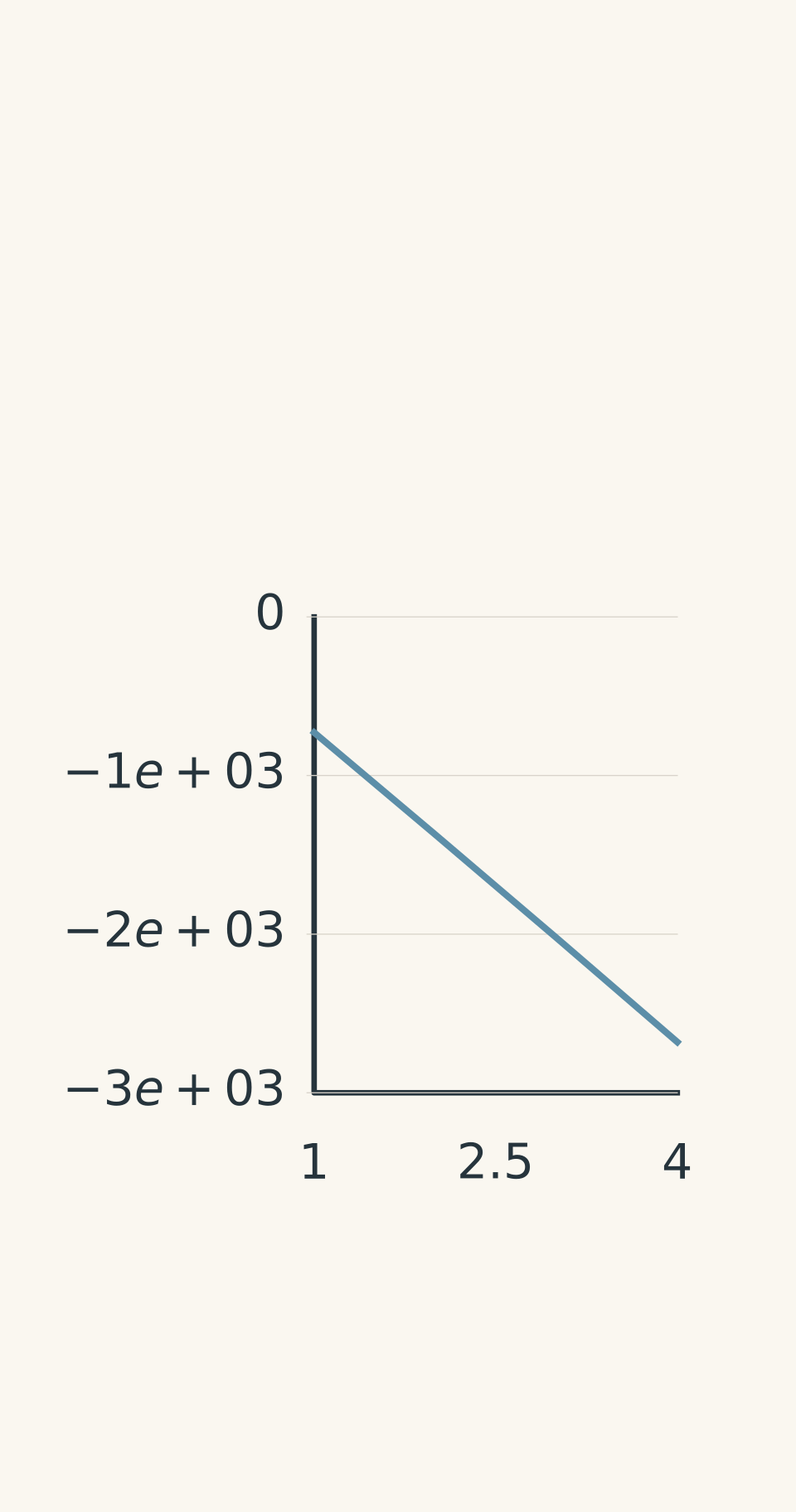
- Liquid alcohols
Due to technical limitations, this figure may display incorrectly or contain inaccuracies. Please check key details against your course materials.
Look at the change between consecutive alcohols:
| Comparison | Change in combustion enthalpy |
|---|---|
| Methanol to ethanol | −643 kJ mol\(^{-1}\) |
| Ethanol to propan-1-ol | −650 kJ mol\(^{-1}\) |
| Propan-1-ol to butan-1-ol | −658 kJ mol\(^{-1}\) |
Each additional \(\ce{CH2}\) group makes the molar enthalpy of combustion approximately 650 kJ mol\(^{-1}\) more negative in this series.
That is a useful pattern. The alcohols belong to the same homologous series, so each successive member has a similar chemical environment, with one extra \(\ce{CH2}\) group.
The increase is approximately regular, rather than exactly identical. The molecular structure and the energy of the reactants and products still determine the precise value.
Why the sign matters
A student might describe the change from −1372 to −2022 kJ mol\(^{-1}\) as an increase because 2022 is greater than 1372.
Be careful with negative numbers.
The numerical value decreases from −1372 to −2022. However, the magnitude of the energy released increases from 1372 to 2022 kJ per mole.
In other words:
- More negative \(\Delta H_c^\circ\) means more energy released.
- Less negative \(\Delta H_c^\circ\) means less energy released.
- A positive enthalpy change would indicate an endothermic reaction, not combustion under these conditions.
01Molar enthalpy versus energy per gram
Suppose you have 10 g of ethanol and 10 g of butan-1-ol. Which sample releases more energy during complete combustion?
You might assume ethanol releases more energy because its combustion enthalpy is a familiar, large negative number. But that number refers to one mole, not one gram.
The longer-chain alcohol has a larger molar mass. Therefore, the same mass contains fewer moles.
To compare equal masses, divide the magnitude of the molar combustion enthalpy by the molar mass:
\[ \text{Energy per gram} = \frac{|\Delta H_c^\circ|}{M} \]
Here, \(M\) is the molar mass in g mol\(^{-1}\). The result is expressed in kJ g\(^{-1}\).
Worked example: Which alcohol releases more energy per gram?
Compare ethanol and butan-1-ol using the reference values above.
Step 1: Calculate the molar mass of each alcohol.
For ethanol, \(\ce{C2H6O}\):
\[ M=(2\times12.01)+(6\times1.008)+16.00 \]
\[ M=46.07\text{ g mol}^{-1} \]
For butan-1-ol, \(\ce{C4H10O}\):
\[ M=(4\times12.01)+(10\times1.008)+16.00 \]
\[ M=74.12\text{ g mol}^{-1} \]
Step 2: Calculate energy released per gram.
For ethanol:
\[ \frac{1372}{46.07} =29.78\text{ kJ g}^{-1} \]
For butan-1-ol:
\[ \frac{2680}{74.12} =36.16\text{ kJ g}^{-1} \]
Step 3: Compare the results.
Butan-1-ol releases approximately 36.16 kJ per gram, compared with 29.78 kJ per gram for ethanol.
Therefore, butan-1-ol releases more energy per gram in this comparison, as well as more energy per mole.
The distinction matters because a question about the energy released by one mole requires molar enthalpy, while a question about the energy available from a particular mass requires energy per gram.
02How do chemists test this trend experimentally?
A data table shows the pattern, but how could you investigate it in a school laboratory?
The basic problem is to measure the energy released when a known amount of alcohol burns. You then need to compare different alcohols fairly.
The original measurement problem
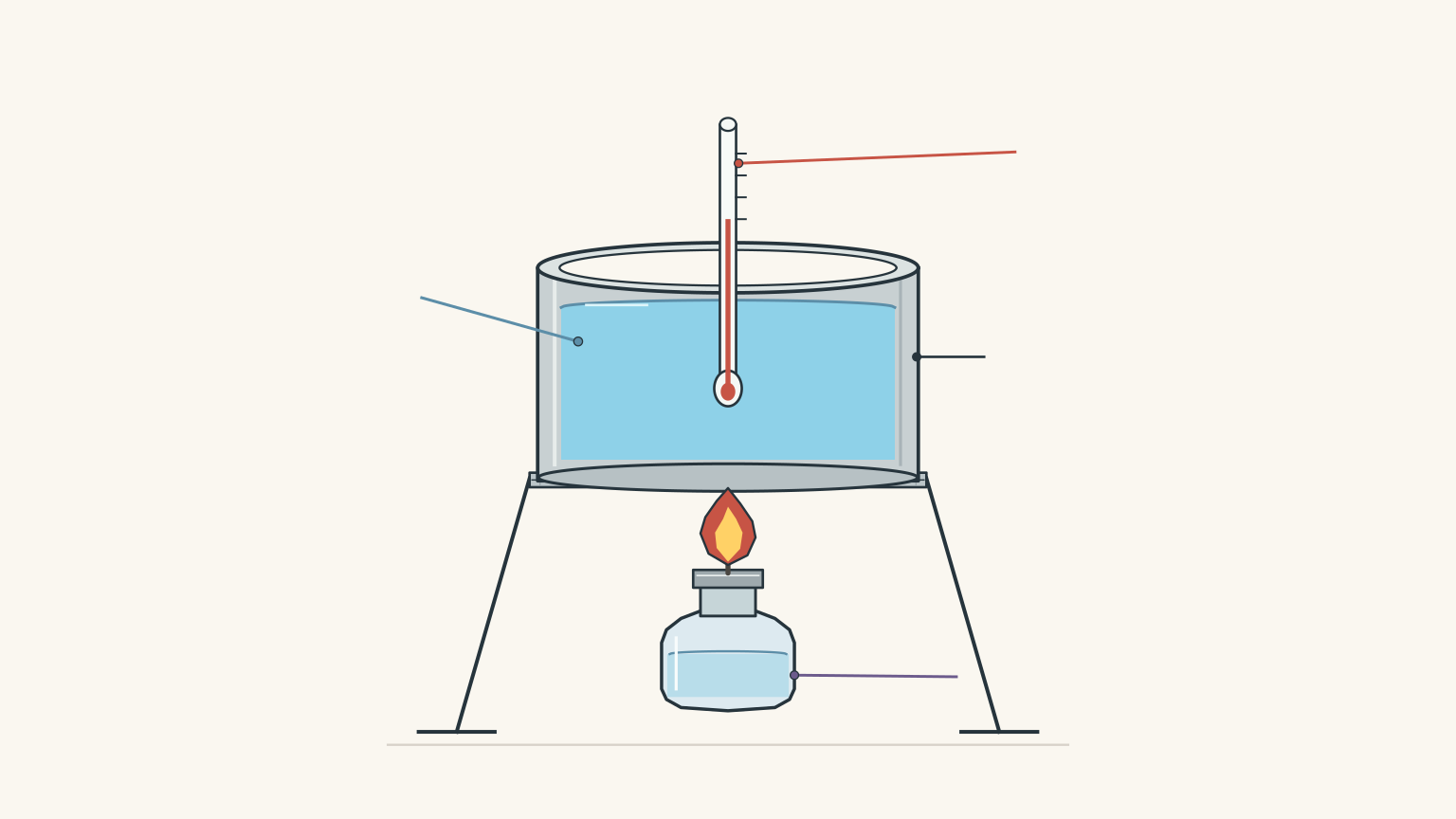
A simple school calorimetry experiment uses a spirit burner containing an alcohol, positioned beneath a metal can or beaker containing a known mass of water.
The burner is weighed before heating. The water’s initial temperature is recorded. The alcohol is ignited, and the flame heats the water. After heating, the final water temperature is recorded and the burner is weighed again.
The mass lost by the burner estimates the mass of alcohol consumed.
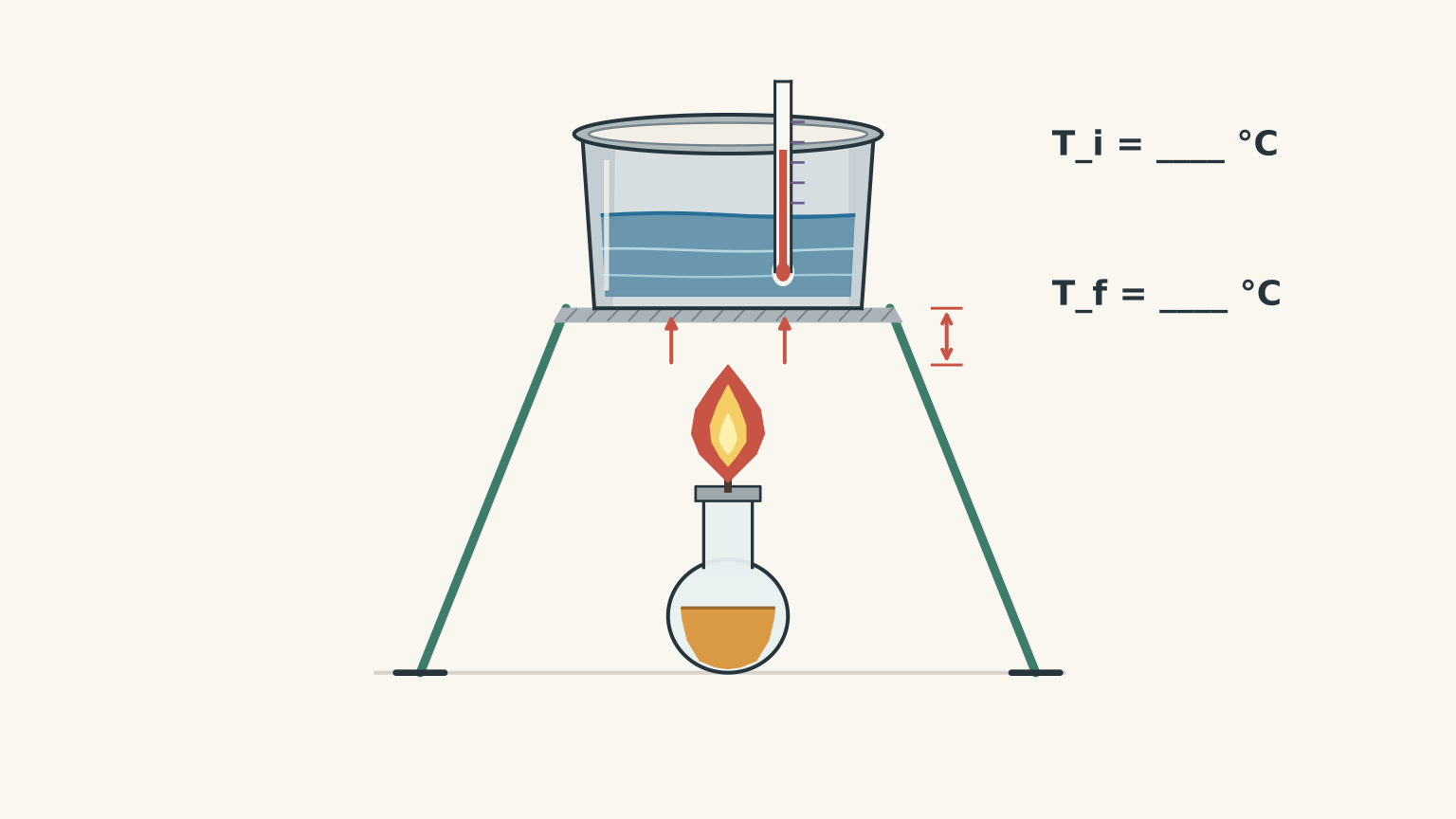
Due to technical limitations, this figure may display incorrectly or contain inaccuracies. Please check key details against your course materials.
The intended prediction is that longer-chain alcohols will release more energy per mole. The water should gain more energy when a comparable amount of substance is burned, provided the experiment captures the released heat effectively.
But there is a problem: the flame does not transfer all its energy into the water.
Some energy heats the surrounding air, the metal container, and the equipment. In addition, incomplete combustion can produce carbon monoxide or soot instead of the expected carbon dioxide.
The measured energy will therefore usually be smaller than the theoretical energy of complete combustion.
What is actually measured?
The heat gained by the water is estimated using:
\[ q=mc\Delta T \]
where:
- \(q\) is heat absorbed by the water, in joules (J).
- \(m\) is the mass of water, in grams (g).
- \(c\) is the specific heat capacity of water, \(4.18\text{ J g}^{-1}\text{ °C}^{-1}\).
- \(\Delta T\) is the water’s temperature increase, in °C.
The energy released by the alcohol is estimated from the heat gained by the water, assuming the heat transfer is complete.
The number of moles of alcohol burned is:
\[ n=\frac{m_{\text{alcohol}}}{M} \]
The experimental molar enthalpy of combustion is then:
\[ \Delta H_c= -\frac{q}{1000n} \]
The factor of 1000 converts joules into kilojoules.
The negative sign indicates that the combustion reaction releases energy.
Notice that two separate measurements are needed: the temperature increase tells you how much energy the water absorbed, while the burner mass loss tells you how much alcohol was consumed.
This is why comparing temperature increases alone is not enough.
How the experiment can be improved
The first design can be improved without changing the chemistry.
A metal calorimeter with a lid, insulation, and a draught shield reduces heat escaping to the surroundings. Stirring the water helps distribute heat evenly, while keeping the burner at a fixed distance makes comparisons more consistent.
The experiment should also control:
- The mass of water used.
- The distance between the flame and the container.
- The length of the burner wick.
- The initial water temperature.
- The time between weighing and lighting the burner, to minimise fuel evaporation.
Each alcohol should be tested several times, and the results averaged.
However, these improvements cannot guarantee complete combustion. A more controlled apparatus is a bomb calorimeter.
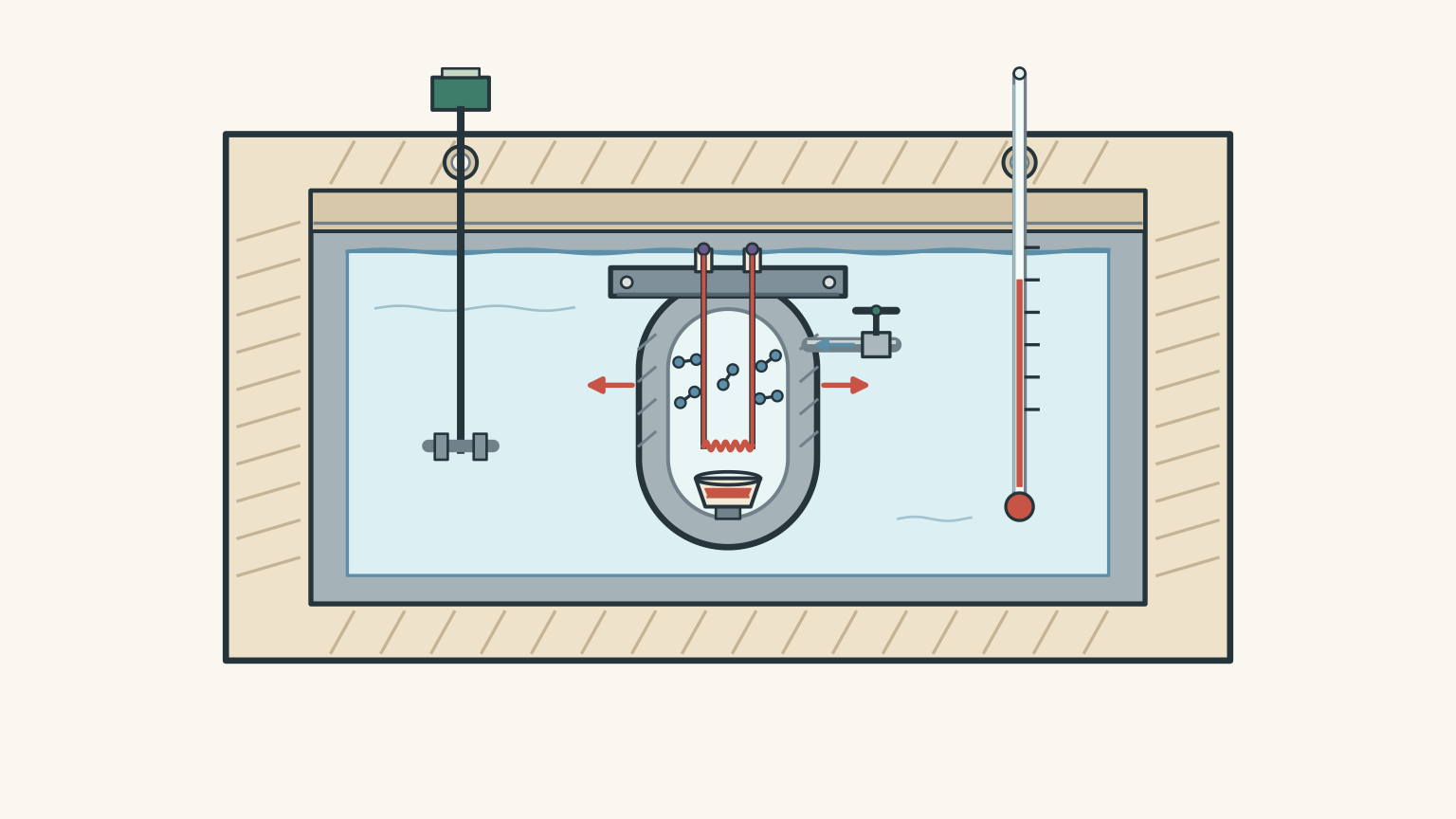
Due to technical limitations, this figure may display incorrectly or contain inaccuracies. Please check key details against your course materials.
In a bomb calorimeter:
- A known mass of fuel is placed inside the combustion vessel.
- The vessel is filled with excess oxygen and sealed.
- An electrical current ignites the fuel.
- The released energy heats the bomb and surrounding water.
- The temperature rise is measured, using a calibrated calorimeter to account for its heat capacity.
The excess oxygen promotes complete combustion, while the sealed, insulated arrangement gives much better control over energy transfer.
A bomb calorimeter operates at constant volume, so its direct measurement relates to the change in internal energy rather than directly to enthalpy. Converting between the two requires an additional thermodynamic correction. This is an extension beyond the basic school calorimetry calculation.
The key experimental lesson is that a larger temperature rise does not automatically mean a larger molar enthalpy of combustion. You must account for the amount of alcohol actually burned.
03Why alcohol classification matters
So far, we have compared alcohols by the number of carbon atoms in their chains. But alcohols can also be classified according to the structure around the carbon bonded to the hydroxyl group, \(\ce{-OH}\).
This classification is particularly important when predicting oxidation products.
Primary, secondary, and tertiary alcohols
The classification depends on how many other carbon atoms are attached to the carbon carrying the \(\ce{-OH}\) group.
| Alcohol type | Carbon attached to \(\ce{-OH}\) is bonded to | Example |
|---|---|---|
| Primary | One other carbon | Propan-1-ol |
| Secondary | Two other carbons | Propan-2-ol |
| Tertiary | Three other carbons | 2-methylpropan-2-ol |
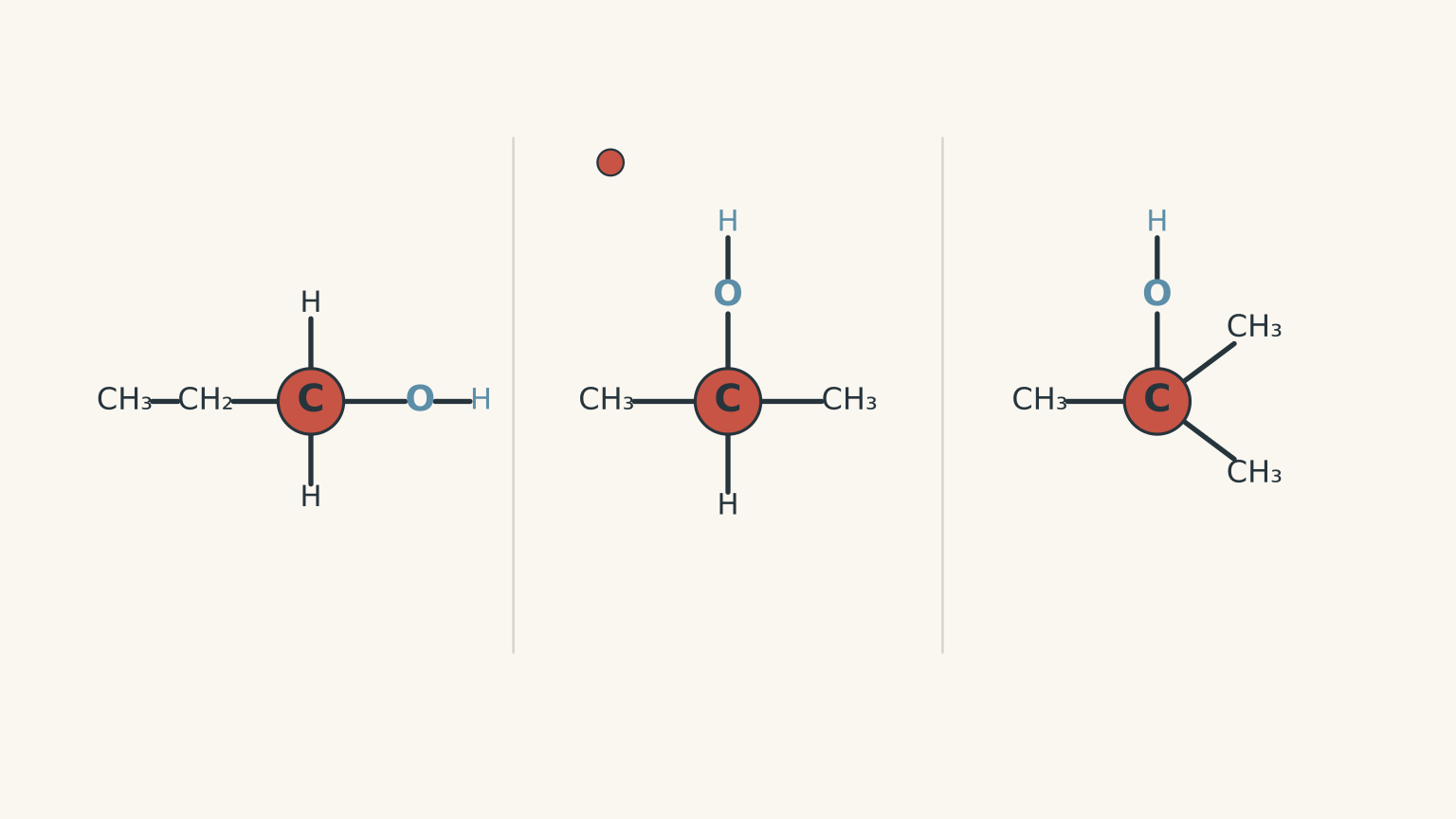
Due to technical limitations, this figure may display incorrectly or contain inaccuracies. Please check key details against your course materials.
For example:
- Propan-1-ol, \(\ce{CH3CH2CH2OH}\), is primary.
- Propan-2-ol, \(\ce{CH3CH(OH)CH3}\), is secondary.
- 2-methylpropan-2-ol, \(\ce{(CH3)3COH}\), is tertiary.
Why does this matter?
Because the classification determines how the alcohol behaves under certain reaction conditions. However, it does not prevent an alcohol from undergoing complete combustion.
Oxidation: why the classification changes the products
Oxidation of alcohols using acidified potassium dichromate(VI) or acidified potassium permanganate depends on the type of alcohol.
For a primary alcohol, controlled oxidation produces an aldehyde. Further oxidation produces a carboxylic acid.
For a secondary alcohol, oxidation produces a ketone.
A tertiary alcohol does not undergo oxidation under the usual HSC oxidation conditions because the carbon bonded to the \(\ce{-OH}\) group has no hydrogen attached to it.
| Alcohol | First oxidation product | Further oxidation under usual conditions |
|---|---|---|
| Primary | Aldehyde | Carboxylic acid |
| Secondary | Ketone | No further simple oxidation |
| Tertiary | No reaction under usual conditions | No reaction |
The reaction conditions matter:
- To obtain an aldehyde from a primary alcohol, use a controlled amount of oxidising agent and distil the aldehyde as it forms.
- To obtain a carboxylic acid, heat the primary alcohol under reflux with excess oxidising agent.
- To obtain a ketone from a secondary alcohol, heat it with an appropriate oxidising agent, commonly under reflux.
- Tertiary alcohols do not react with these usual oxidising conditions.
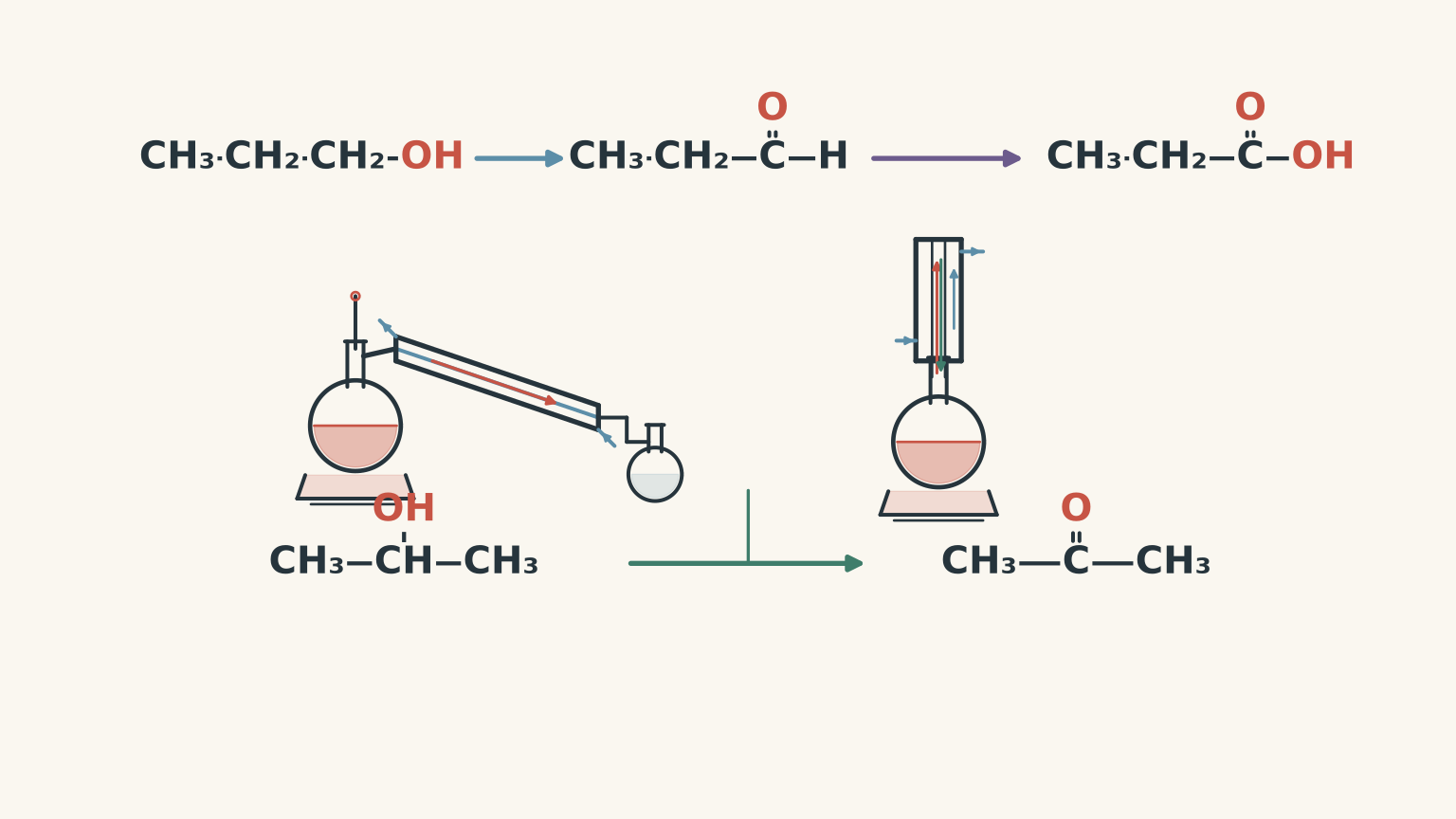
Due to technical limitations, this figure may display incorrectly or contain inaccuracies. Please check key details against your course materials.
Notice that oxidation is different from combustion.
Oxidation under controlled laboratory conditions changes the functional group while generally retaining the carbon skeleton. Combustion completely oxidises the carbon and hydrogen atoms, producing carbon dioxide and water.
This explains a common misconception: a tertiary alcohol may resist oxidation with acidified dichromate, but it can still burn in oxygen.
The absence of a hydrogen atom on the carbon carrying \(\ce{-OH}\) does not stop the molecule from undergoing complete combustion. Combustion is a much more extensive reaction.
Substitution: replacing the hydroxyl group
Alcohols can also undergo substitution reactions.
In a substitution reaction, one atom or functional group is replaced by another.
For example, ethanol reacts with hydrogen bromide when heated to produce bromoethane and water:
\[ \ce{CH3CH2OH + HBr -> CH3CH2Br + H2O} \]
The \(\ce{-OH}\) group is replaced by bromine.
Alcohols can also be produced by the reverse type of substitution pathway. For example, bromoethane reacts with aqueous sodium hydroxide when heated under reflux:
\[ \ce{CH3CH2Br + NaOH -> CH3CH2OH + NaBr} \]
The bromine is replaced by a hydroxyl group.
The carbon chain is retained in both reactions. Substitution changes the functional group, rather than adding another carbon atom.
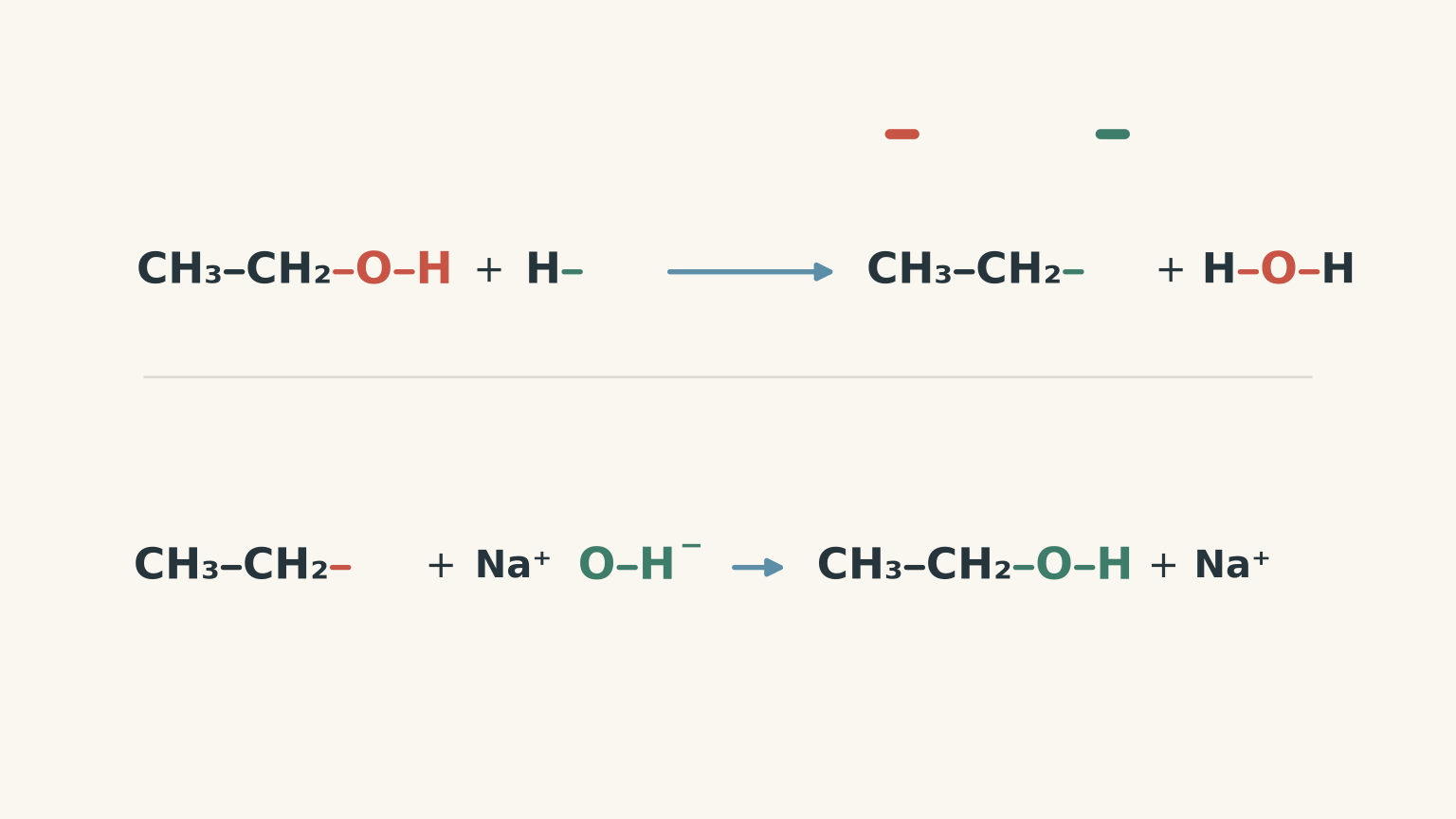
Due to technical limitations, this figure may display incorrectly or contain inaccuracies. Please check key details against your course materials.
Elimination: removing water to form an alkene
An alcohol can also undergo elimination.
During dehydration, a hydrogen atom and the hydroxyl group are removed from adjacent carbon atoms. These atoms combine to form water, while a carbon-carbon double bond forms.
For example, ethanol can be dehydrated to produce ethene:
\[ \ce{CH3CH2OH -> CH2=CH2 + H2O} \]
The usual school-level conditions are concentrated sulfuric acid and heating to approximately \(170^\circ\text{C}\). Hot aluminium oxide can also act as a dehydration catalyst.
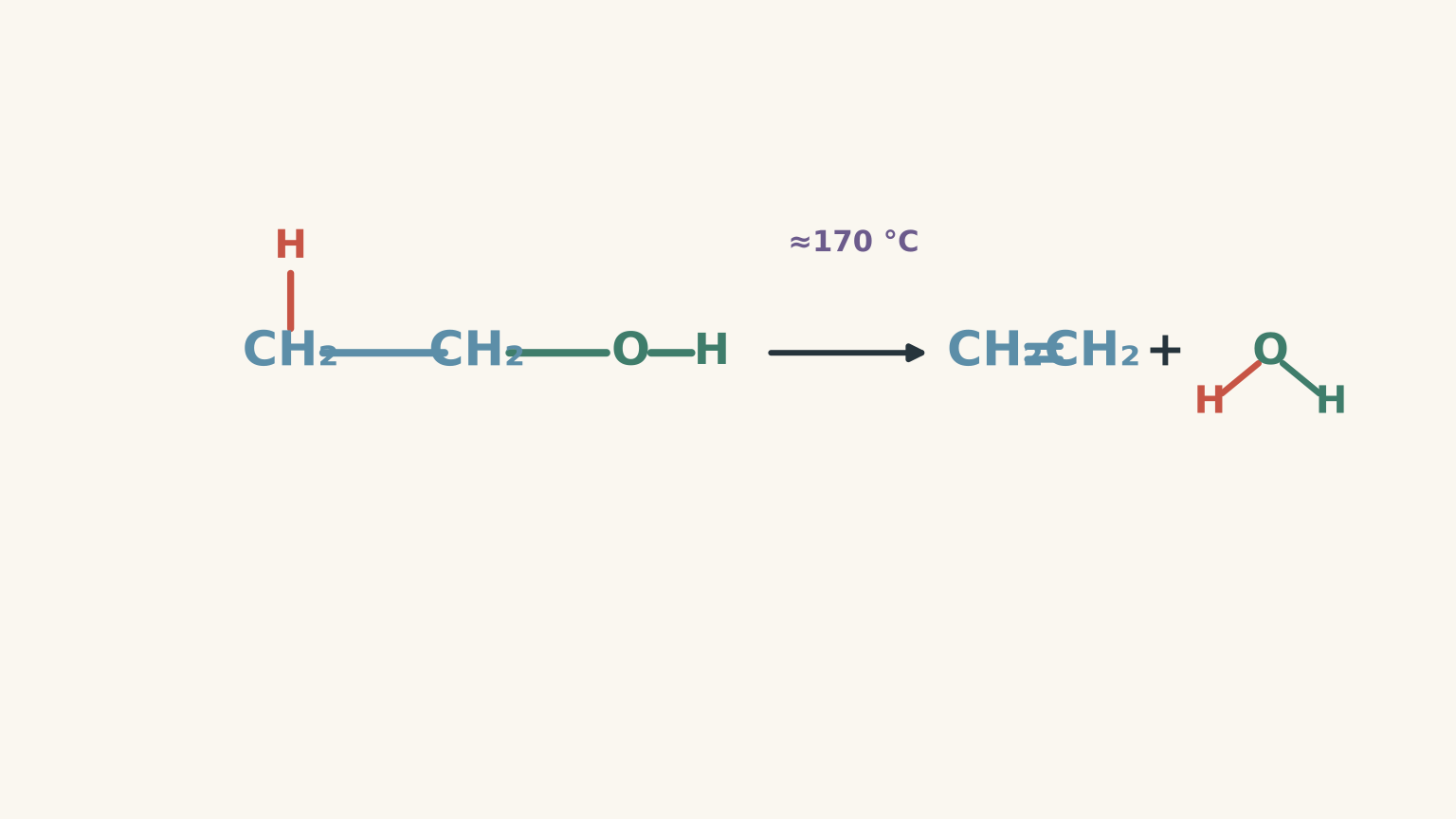
Due to technical limitations, this figure may display incorrectly or contain inaccuracies. Please check key details against your course materials.
The three reaction pathways can be distinguished by their products:
| Reaction | Typical conditions | Main product |
|---|---|---|
| Oxidation | Acidified dichromate or permanganate, controlled heating | Aldehyde, ketone, or carboxylic acid |
| Substitution | Hydrogen halide, often with heating | Haloalkane and water |
| Elimination | Concentrated sulfuric acid, approximately \(170^\circ\text{C}\) | Alkene and water |
| Combustion | Excess oxygen and ignition | Carbon dioxide and water |
These reactions help explain why alcohol classification matters in organic chemistry. But none changes the central explanation for the chain-length trend: complete combustion of a larger alcohol generally releases more energy per mole because more carbon and hydrogen atoms are oxidised.
04The important exception: alcohols with the same number of carbon atoms
Here is a useful test of your understanding.
Propan-1-ol and propan-2-ol both have three carbon atoms and the same molecular formula, \(\ce{C3H8O}\).
However, their approximate standard enthalpies of combustion are different:
| Alcohol | Classification | \(\Delta H_c^\circ\) (kJ mol\(^{-1}\)) |
|---|---|---|
| Propan-1-ol | Primary | −2022 |
| Propan-2-ol | Secondary | −1994 |
Propan-1-ol releases approximately 28 kJ more energy per mole than propan-2-ol.
Why?
They are structural isomers. They have the same molecular formula but different arrangements of atoms. Their different structures give them different enthalpies of formation, so the energy difference between their reactants and combustion products is not identical.
The important point is that chain length is not the only factor affecting combustion enthalpy.
For alcohols in the same homologous series, increasing chain length produces a strong general trend. However, structural isomers can have slightly different combustion enthalpies even when they contain exactly the same number of carbon atoms.
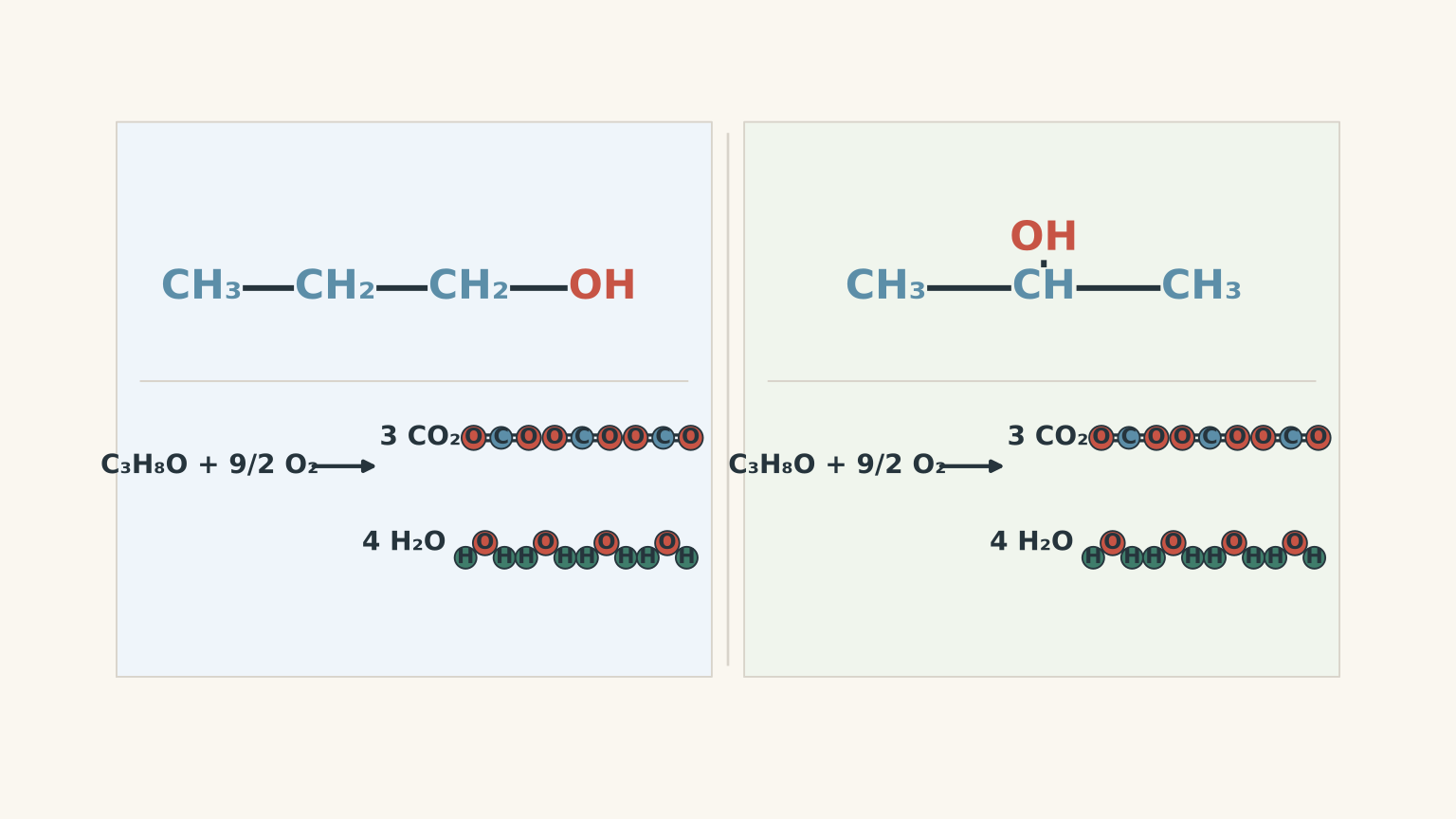
Due to technical limitations, this figure may display incorrectly or contain inaccuracies. Please check key details against your course materials.
Worked example: Calculate an experimental enthalpy of combustion
A student burns 0.250 g of ethanol beneath a metal container holding 150.0 g of water. The water temperature increases from 22.0°C to 33.2°C.
Calculate the experimental molar enthalpy of combustion of ethanol.
Use:
- Specific heat capacity of water = \(4.18\text{ J g}^{-1}\text{ °C}^{-1}\)
- Molar mass of ethanol = \(46.07\text{ g mol}^{-1}\)
Assume the measured temperature increase is due to energy transferred from the burning ethanol to the water.
Step 1: Calculate the temperature change.
\[ \Delta T=33.2-22.0=11.2^\circ\text{C} \]
Step 2: Calculate the heat absorbed by the water.
\[ \begin{aligned} q&=mc\Delta T\\\ &=150.0\times4.18\times11.2\\\ &=7022.4\text{ J}\\\ &=7.0224\text{ kJ} \end{aligned} \]
Step 3: Calculate the moles of ethanol burned.
\[ \begin{aligned} n&=\frac{m}{M}\\\ &=\frac{0.250}{46.07}\\\ &=0.00543\text{ mol} \end{aligned} \]
Step 4: Calculate the experimental molar enthalpy of combustion.
\[ \begin{aligned} \Delta H_c&=-\frac{q}{n}\\\ &=-\frac{7.0224}{0.00543}\\\ &=-1294\text{ kJ mol}^{-1} \end{aligned} \]
Final answer
\[ \boxed{\Delta H_c=-1294\text{ kJ mol}^{-1}} \]
Step 5: Compare with the reference value.
The approximate reference value is −1372 kJ mol\(^{-1}\).
The experimental result is less negative, meaning it records less energy released per mole than the reference value.
This is expected in a simple open calorimeter because some energy escapes into the surroundings or heats the apparatus rather than the water. Incomplete combustion can also reduce the measured energy.
The calculation is useful even though the experimental value is not exact. It shows how to convert a temperature change into an estimate of molar combustion enthalpy.
05A quick way to approach alcohol questions
When you encounter an alcohol reaction or combustion question, separate three decisions.
1. Identify the carbon chain.
Count the carbon atoms. For a saturated monohydric alcohol, the general molecular formula is \(\ce{C_nH_{2n+2}O}\).
2. Identify the type of reaction.
- Complete combustion: carbon dioxide and water.
- Oxidation: products depend on whether the alcohol is primary, secondary, or tertiary.
- Substitution: one functional group is replaced by another.
- Elimination: atoms or groups are removed to form a double bond.
3. Check the conditions and the quantity being compared.
For combustion enthalpy, check whether the question asks for energy per mole or per gram. For oxidation, substitution, and elimination, check the reagents and temperature before predicting the product.
This prevents a common error: using the classification of an alcohol to predict a reaction that is actually controlled by different conditions.
06Questions and solutions
Question 1
A student burns 0.160 g of methanol beneath a container holding 100.0 g of water. The water temperature increases from 21.0°C to 29.0°C.
Calculate the experimental molar enthalpy of combustion of methanol.
Use:
- \(c_{\text{water}}=4.18\text{ J g}^{-1}\text{ °C}^{-1}\)
- \(M_{\text{methanol}}=32.04\text{ g mol}^{-1}\)
Assume the heat measured by the water comes from the combustion reaction.
Due to technical limitations, this figure may display incorrectly or contain inaccuracies. Please check key details against your course materials.
Solution 1
The experimental enthalpy of combustion is approximately −670 kJ mol\(^{-1}\).
First, calculate the heat absorbed by the water:
\[ \begin{aligned} q&=mc\Delta T\\\ &=100.0\times4.18\times(29.0-21.0)\\\ &=3344\text{ J}\\\ &=3.344\text{ kJ} \end{aligned} \]
Next, calculate the moles of methanol burned:
\[ n=\frac{0.160}{32.04} =0.00499\text{ mol} \]
Finally:
\[ \begin{aligned} \Delta H_c&=-\frac{q}{n}\\\ &=-\frac{3.344}{0.00499}\\\ &=-670\text{ kJ mol}^{-1} \end{aligned} \]
The negative sign indicates an exothermic reaction.
The result is less negative than the approximate reference value of −729 kJ mol\(^{-1}\). This is consistent with heat escaping from the open apparatus and other experimental limitations.
Question 2
A student investigates the relationship between carbon chain length and molar enthalpy of combustion.
They burn 0.500 g of each of three alcohols. Each alcohol heats 100.0 g of water.
The following temperature increases are recorded:
| Alcohol | Temperature increase |
|---|---|
| Methanol | 6.2°C |
| Ethanol | 9.0°C |
| Propan-1-ol | 10.1°C |
Use the following molar masses:
- Methanol: 32.04 g mol\(^{-1}\)
- Ethanol: 46.07 g mol\(^{-1}\)
- Propan-1-ol: 60.10 g mol\(^{-1}\)
Assume that each experiment captures the same fraction of the energy released.
(a) Calculate the heat absorbed by the water in each experiment.
(b) Calculate the experimental molar enthalpy of combustion for each alcohol.
(c) Explain whether the results support the expected relationship between chain length and molar combustion enthalpy.
Solution 2
The calculated experimental values become progressively more negative from methanol to propan-1-ol, supporting the expected chain-length trend.
(a) Calculate the heat absorbed.
Use \(q=mc\Delta T\).
For methanol:
\[ q=100.0\times4.18\times6.2 =2591.6\text{ J} \]
\[ q=2.592\text{ kJ} \]
For ethanol:
\[ q=100.0\times4.18\times9.0 =3762\text{ J} \]
\[ q=3.762\text{ kJ} \]
For propan-1-ol:
\[ q=100.0\times4.18\times10.1 =4221.8\text{ J} \]
\[ q=4.222\text{ kJ} \]
(b) Calculate the experimental molar enthalpies.
For methanol:
\[ n=\frac{0.500}{32.04} =0.01561\text{ mol} \]
\[ \Delta H_c=-\frac{2.592}{0.01561} =-166.1\text{ kJ mol}^{-1} \]
For ethanol:
\[ n=\frac{0.500}{46.07} =0.01085\text{ mol} \]
\[ \Delta H_c=-\frac{3.762}{0.01085} =-346.5\text{ kJ mol}^{-1} \]
For propan-1-ol:
\[ n=\frac{0.500}{60.10} =0.00832\text{ mol} \]
\[ \Delta H_c=-\frac{4.222}{0.00832} =-507.5\text{ kJ mol}^{-1} \]
The results can be summarised as:
| Alcohol | Experimental \(\Delta H_c\) (kJ mol\(^{-1}\)) |
|---|---|
| Methanol | −166.1 |
| Ethanol | −346.5 |
| Propan-1-ol | −507.5 |
(c) Explain the trend.
The results support the expected trend because the experimental enthalpy becomes more negative as the number of carbon atoms increases.
Each successive alcohol contains an additional \(\ce{CH2}\) group, allowing more carbon and hydrogen atoms to be oxidised during complete combustion.
The values are much less negative than the reference values because the simple apparatus does not capture all the energy released.
Also, equal masses do not contain equal numbers of moles. This is why the molar mass must be included in the calculation rather than comparing temperature increases alone.
Question 3
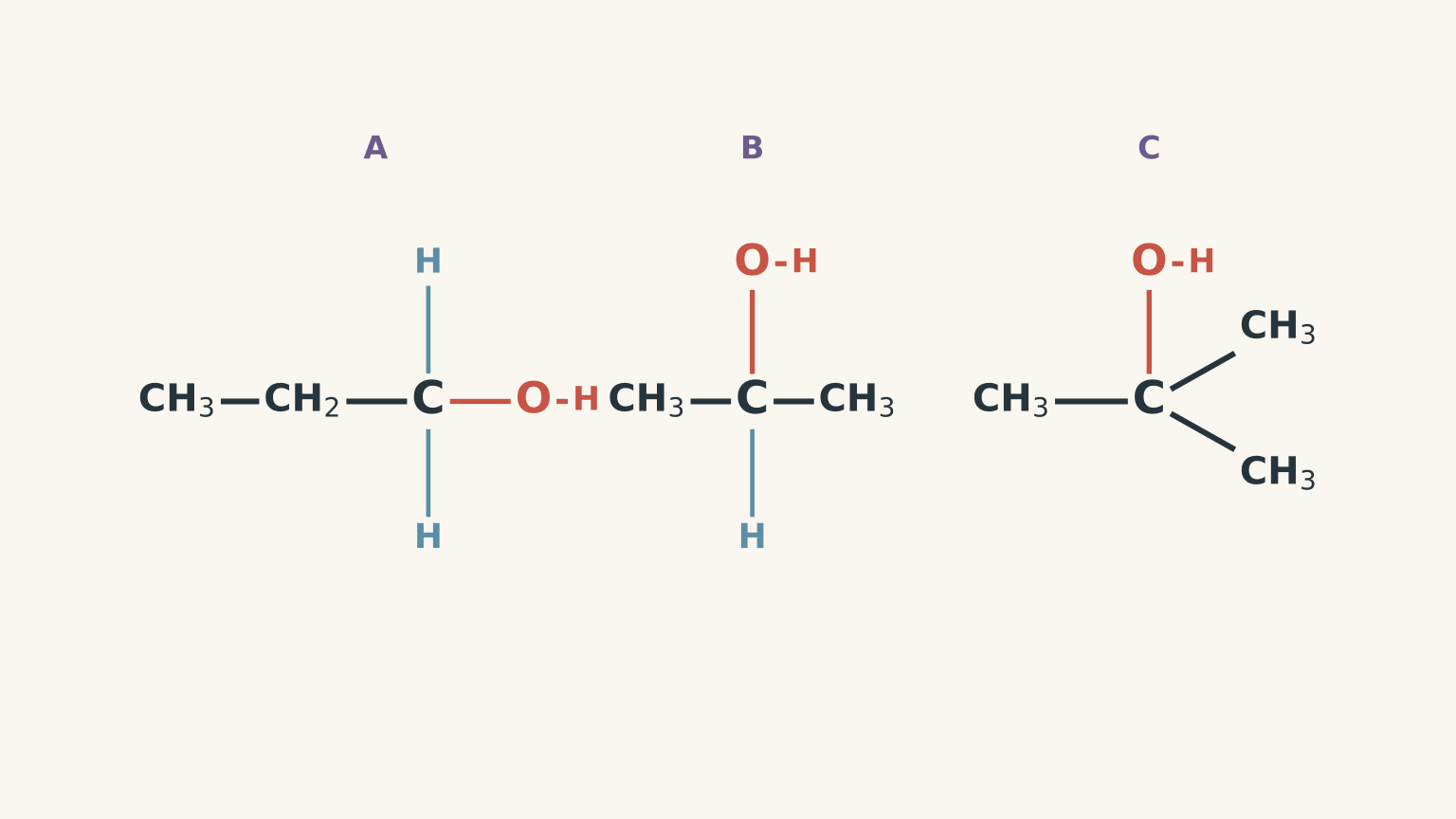
Three alcohols have the following structural formulae:
- A: \(\ce{CH3CH2CH2OH}\)
- B: \(\ce{CH3CH(OH)CH3}\)
- C: \(\ce{(CH3)3COH}\)
(a) Classify each alcohol as primary, secondary, or tertiary.
(b) Predict the oxidation product of A under controlled oxidation, followed by further oxidation under reflux with excess acidified potassium dichromate(VI).
(c) Predict the oxidation product of B.
(d) Explain why C does not react with acidified potassium dichromate(VI) under usual HSC oxidation conditions.
(e) Write a balanced equation for the complete combustion of C.
Due to technical limitations, this figure may display incorrectly or contain inaccuracies. Please check key details against your course materials.
Solution 3
A is primary, B is secondary, and C is tertiary. Their oxidation behaviour differs, but all three can undergo complete combustion.
(a) Classify the alcohols.
- A is propan-1-ol, a primary alcohol. The carbon bonded to OH is attached to one other carbon.
- B is propan-2-ol, a secondary alcohol. The carbon bonded to OH is attached to two other carbons.
- C is 2-methylpropan-2-ol, a tertiary alcohol. The carbon bonded to OH is attached to three other carbons.
(b) Oxidation of A.
Controlled oxidation with limited acidified potassium dichromate(VI), followed by distillation, produces propanal:
\[ \ce{CH3CH2CH2OH + [O] -> CH3CH2CHO + H2O} \]
Further oxidation using excess oxidising agent under reflux produces propanoic acid:
\[ \ce{CH3CH2CHO + [O] -> CH3CH2COOH} \]
Distillation allows the aldehyde to be removed before it undergoes further oxidation. Reflux keeps the reactants in the reaction vessel, allowing further oxidation to occur.
(c) Oxidation of B.
Propan-2-ol undergoes oxidation to form propanone:
\[ \ce{CH3CH(OH)CH3 + [O] -> CH3COCH3 + H2O} \]
A secondary alcohol forms a ketone under these conditions.
(d) Oxidation of C.
C does not undergo the usual oxidation reaction because the carbon carrying the OH group has no hydrogen attached to it.
This prevents the normal oxidation pathway that converts primary and secondary alcohols into carbonyl compounds.
(e) Complete combustion of C.
The balanced equation is:
\[ \ce{2C4H10O + 12O2 -> 8CO2 + 10H2O} \]
Although C resists oxidation with the usual laboratory oxidising agents, it can still undergo complete combustion.
The key distinction is that controlled oxidation of an alcohol generally changes its functional group, while combustion oxidises the entire carbon skeleton.
Question 4
Two unknown alcohols, X and Y, have the molecular formula \(\ce{C3H8O}\).
When oxidised under controlled conditions:
- X produces propanal. Under reflux with excess acidified potassium dichromate(VI), it produces propanoic acid.
- Y produces propanone.
The approximate molar enthalpies of combustion are:
| Alcohol | \(\Delta H_c^\circ\) |
|---|---|
| Propan-1-ol | −2022 kJ mol\(^{-1}\) |
| Propan-2-ol | −1994 kJ mol\(^{-1}\) |
(a) Identify the structural formula and classification of X and Y.
(b) Calculate the difference between their molar enthalpies of combustion.
(c) Explain why the two alcohols have different combustion enthalpies despite having the same molecular formula.
(d) Explain why the oxidation results do not mean that Y releases more energy during combustion.
Solution 4
X is propan-1-ol, and Y is propan-2-ol. Propan-1-ol has the more negative combustion enthalpy by 28 kJ mol\(^{-1}\).
(a) Identify the alcohols.
X produces propanal under controlled oxidation and propanoic acid under further oxidation.
This identifies X as a primary alcohol:
\[ \ce{CH3CH2CH2OH} \]
Y produces propanone, identifying it as a secondary alcohol:
\[ \ce{CH3CH(OH)CH3} \]
(b) Calculate the difference.
\[ \begin{aligned} \Delta H_{\text{difference}} &=|-2022-(-1994)|\\\ &=28\text{ kJ mol}^{-1} \end{aligned} \]
Propan-1-ol releases approximately 28 kJ more energy per mole.
(c) Explain the difference.
The two alcohols are structural isomers.
They have the same molecular formula and molar mass, but the OH group occupies a different position in the carbon chain.
This changes the molecular arrangement and the enthalpy of the reactant. Consequently, the overall enthalpy change during combustion is slightly different.
The products are the same quantities of carbon dioxide and water per mole of alcohol, but the reactants do not have identical enthalpies.
(d) Explain the oxidation misconception.
Y forming propanone does not mean it releases more energy during combustion.
Oxidation classification predicts the products of controlled oxidation. Combustion is a separate reaction involving complete oxidation of the molecule.
The fact that one alcohol forms a ketone and the other forms an aldehyde or carboxylic acid under controlled conditions does not determine which has the more negative enthalpy of combustion.
Question 5
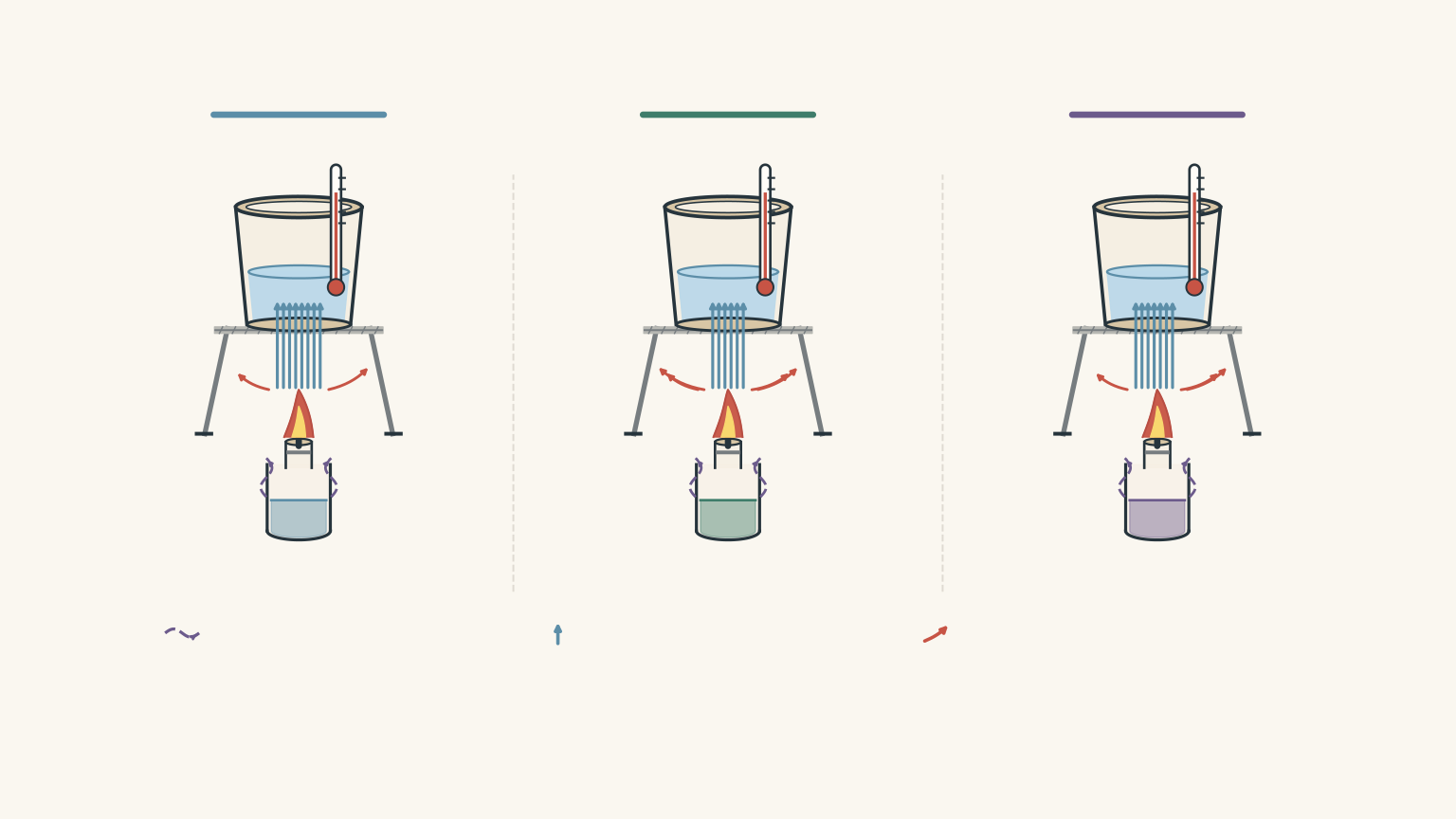
A chemistry class investigates the combustion enthalpies of ethanol, propan-1-ol, and propan-2-ol using three open calorimeters.
The students notice that propan-2-ol produces the largest measured heat gain in the water. They conclude that it must have the most negative molar enthalpy of combustion.
However, the experiments have different heat-capture efficiencies, and some fuel evaporates without burning.
The following data are provided. All figures are illustrative experimental data.
| Measurement | Ethanol | Propan-1-ol | Propan-2-ol |
|---|---|---|---|
| Total burner mass decrease (g) | 0.240 | 0.360 | 0.340 |
| Fuel evaporated in blank trial (g) | 0.020 | 0.060 | 0.040 |
| Heat gained by water (kJ) | 5.24 | 6.05 | 6.77 |
| Heat-capture efficiency | 80% | 60% | 68% |
The heat-capture efficiency is the fraction of the total combustion energy that reaches the water.
Use the following molar masses:
- Ethanol: 46.07 g mol\(^{-1}\)
- Propan-1-ol: 60.10 g mol\(^{-1}\)
- Propan-2-ol: 60.10 g mol\(^{-1}\)
Assume that:
- The evaporation measured in each blank trial is representative of evaporation during combustion.
- All remaining fuel mass loss is due to combustion.
- Combustion is complete.
- The stated heat-capture efficiencies are accurate.
- The measured heat gain by the water is due to the fuel combustion.
Due to technical limitations, this figure may display incorrectly or contain inaccuracies. Please check key details against your course materials.
(a) Calculate the actual mass of fuel burned in each experiment.
(b) Calculate the moles of each alcohol burned.
(c) Calculate the total combustion energy released by each sample, correcting for the heat-capture efficiency.
(d) Calculate the experimental molar enthalpy of combustion for each alcohol.
(e) Determine whether the student’s conclusion is correct. Explain why the largest measured water temperature increase does not necessarily identify the alcohol with the most negative molar enthalpy of combustion.
(f) Use your results to explain how chain length and structural isomerism affect the comparison.
Solution 5
The student’s conclusion is incorrect. After correcting for evaporation, heat-capture efficiency, and the number of moles burned, propan-1-ol has the most negative experimental molar enthalpy of combustion.
(a) Calculate the actual mass burned.
Subtract the fuel evaporated from the total burner mass decrease.
For ethanol:
\[ m=0.240-0.020=0.220\text{ g} \]
For propan-1-ol:
\[ m=0.360-0.060=0.300\text{ g} \]
For propan-2-ol:
\[ m=0.340-0.040=0.300\text{ g} \]
The resulting masses are:
| Alcohol | Actual mass burned (g) |
|---|---|
| Ethanol | 0.220 |
| Propan-1-ol | 0.300 |
| Propan-2-ol | 0.300 |
This correction matters because a decrease in burner mass does not necessarily mean that all the missing fuel reacted.
(b) Calculate the moles burned.
Use:
\[ n=\frac{m}{M} \]
For ethanol:
\[ n=\frac{0.220}{46.07} =0.004775\text{ mol} \]
For propan-1-ol:
\[ n=\frac{0.300}{60.10} =0.004992\text{ mol} \]
For propan-2-ol:
\[ n=\frac{0.300}{60.10} =0.004992\text{ mol} \]
Notice that propan-1-ol and propan-2-ol contain equal numbers of moles because they have the same molecular formula and molar mass.
(c) Correct for heat-capture efficiency.
The heat gained by the water represents only part of the total energy released.
Use:
\[ q_{\text{combustion}} = \frac{q_{\text{water}}}{\text{efficiency}} \]
Convert the percentages into decimal fractions.
For ethanol:
\[ q=\frac{5.24}{0.80} =6.55\text{ kJ} \]
For propan-1-ol:
\[ q=\frac{6.05}{0.60} =10.083\text{ kJ} \]
For propan-2-ol:
\[ q=\frac{6.77}{0.68} =9.956\text{ kJ} \]
These are the estimated total combustion energies released by the three samples.
(d) Calculate the molar enthalpies of combustion.
Use:
\[ \Delta H_c=-\frac{q_{\text{combustion}}}{n} \]
For ethanol:
\[ \Delta H_c =-\frac{6.55}{0.004775} \]
\[ \Delta H_c\approx-1372\text{ kJ mol}^{-1} \]
For propan-1-ol:
\[ \Delta H_c =-\frac{10.083}{0.004992} \]
\[ \Delta H_c\approx-2020\text{ kJ mol}^{-1} \]
For propan-2-ol:
\[ \Delta H_c =-\frac{9.956}{0.004992} \]
\[ \Delta H_c\approx-1995\text{ kJ mol}^{-1} \]
The corrected results are:
| Alcohol | Corrected \(\Delta H_c\) (kJ mol\(^{-1}\)) |
|---|---|
| Ethanol | −1372 |
| Propan-1-ol | −2020 |
| Propan-2-ol | −1995 |
(e) Evaluate the student’s conclusion.
The conclusion is incorrect because the student compares the heat gained by the water without accounting for the different experimental conditions.
Propan-2-ol gives the largest measured heat gain, 6.77 kJ. However, its heat-capture efficiency is greater than that of propan-1-ol, and both the fuel evaporation and the number of moles burned must also be considered.
After making the corrections, propan-1-ol releases more energy per mole.
This demonstrates why raw temperature increases cannot be used as a direct measure of molar combustion enthalpy.
(f) Explain the chain-length and structural effects.
Ethanol contains two carbon atoms, while both propan-1-ol and propan-2-ol contain three.
The corrected results show that the three-carbon alcohols have more negative combustion enthalpies than ethanol. This supports the general trend of increasing energy release per mole as chain length increases.
However, propan-1-ol and propan-2-ol are structural isomers. They have the same molecular formula and number of carbon atoms, but slightly different combustion enthalpies.
Propan-1-ol releases approximately 25 kJ more energy per mole than propan-2-ol in these illustrative results.
The final distinction is important: chain length explains the broad trend, structural arrangement explains smaller differences between isomers, and experimental conditions determine how accurately that trend is measured.
07Syllabus context and further study
As of November 2026, the Chemistry Stage 6 Syllabus (2017) remains the syllabus used for current HSC cohorts. The Chemistry 11-12 Syllabus (2025) is scheduled for implementation from 2028, with the first HSC examination under the new syllabus in 2029. This explanation is written for the current 2017 course. NESA syllabus implementation information. 【turn991901view0】
The combustion values used in this article are rounded reference data adapted from the National Institute of Education’s Book of Data for Teachers of Chemistry (2010), page 15. Different thermochemical data tables may give slightly different values. Always use the data supplied in an assessment question where applicable. Reference data. 【turn681161view0】
For the next step, practise balancing combustion equations and connecting the amount of alcohol burned to the quantities of carbon dioxide and water produced.
- Combustion of Alcohols: Balancing HSC Chemistry Equations
- Enthalpy of Combustion of Alcohols: HSC Chemistry Guide
The central distinction to remember is this: longer alcohol chains generally produce more energy per mole during complete combustion, but molecular structure and experimental conditions determine the precise value you measure.