
How to Use Hund’s Rule in Orbital-Box Diagrams for HSC Chemistry
Learn how to apply Hund's rule to orbital-box diagrams for atoms and ions, including electron filling, pairing, and transition-metal ionisation. Includes worked examples, common mistakes, and five practice questions with detailed solutions.
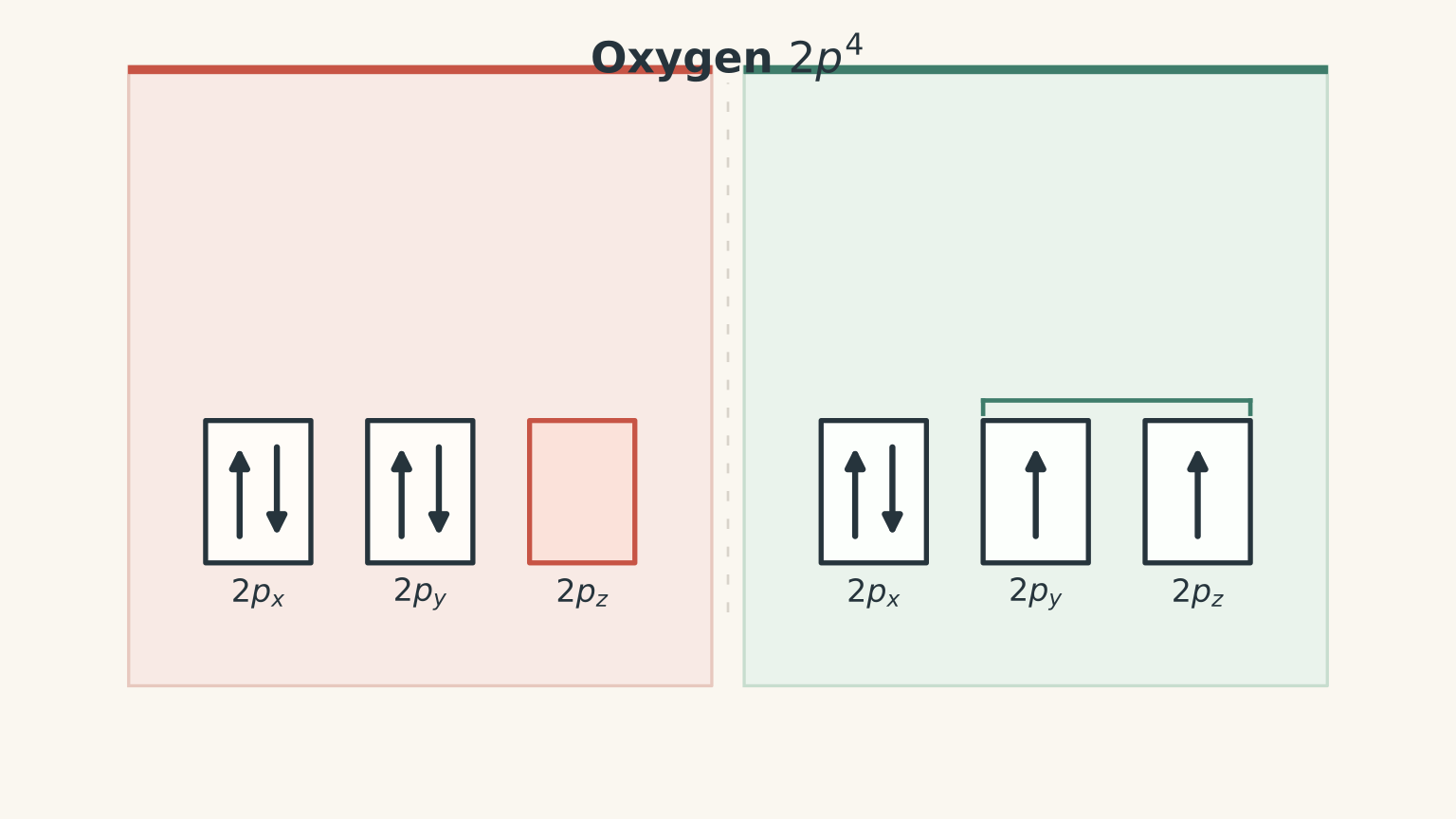
An oxygen atom has four electrons in its \(2p\) subshell. You draw three orbital boxes and arrange them like this:
[↑↓] [↑↓] [ ]
Every electron fits, and no box contains more than two. So why is the diagram wrong for an oxygen atom in its lowest-energy state?
The problem is that you’ve paired electrons while an equal-energy orbital is still empty.
Hund’s rule tells you to place one electron in each orbital of equal energy, with parallel spins, before pairing any electrons.
For oxygen, the correct ground-state arrangement is:
[↑↓] [↑] [↑]
Three electrons occupy separate orbitals first. The fourth pairs with one of them.
Due to technical limitations, this figure may display incorrectly or contain inaccuracies. Please check key details against your course materials.
This small difference is what Hund’s rule is for. It helps you choose between electron arrangements that satisfy the basic capacity rules but don’t have the same energy.
01What Hund’s rule actually controls
An orbital-box diagram shows how electrons are distributed among orbitals.
Each box represents one orbital. Each arrow represents one electron, with the arrow’s direction indicating its spin state.
↑represents one spin orientation.↓represents the opposite spin orientation.[↑↓]represents two electrons paired in one orbital.[↑]represents one electron occupying an orbital.[ ]represents an empty orbital.
The arrows aren’t showing electrons moving upwards or downwards. Spin is a quantum property, not a direction of travel.
An orbital isn’t a little container, either. It describes a quantum state associated with a spatial probability distribution around the nucleus.
If the difference between shells, subshells, and orbitals is still confusing, the guide to shells, subshells and orbitals explains that structure in more detail.
Why do some subshells have more boxes?
A subshell contains a particular number of orbitals.
| Subshell | Number of orbitals | Maximum electrons |
|---|---|---|
| \(s\) | 1 | 2 |
| \(p\) | 3 | 6 |
| \(d\) | 5 | 10 |
| \(f\) | 7 | 14 |
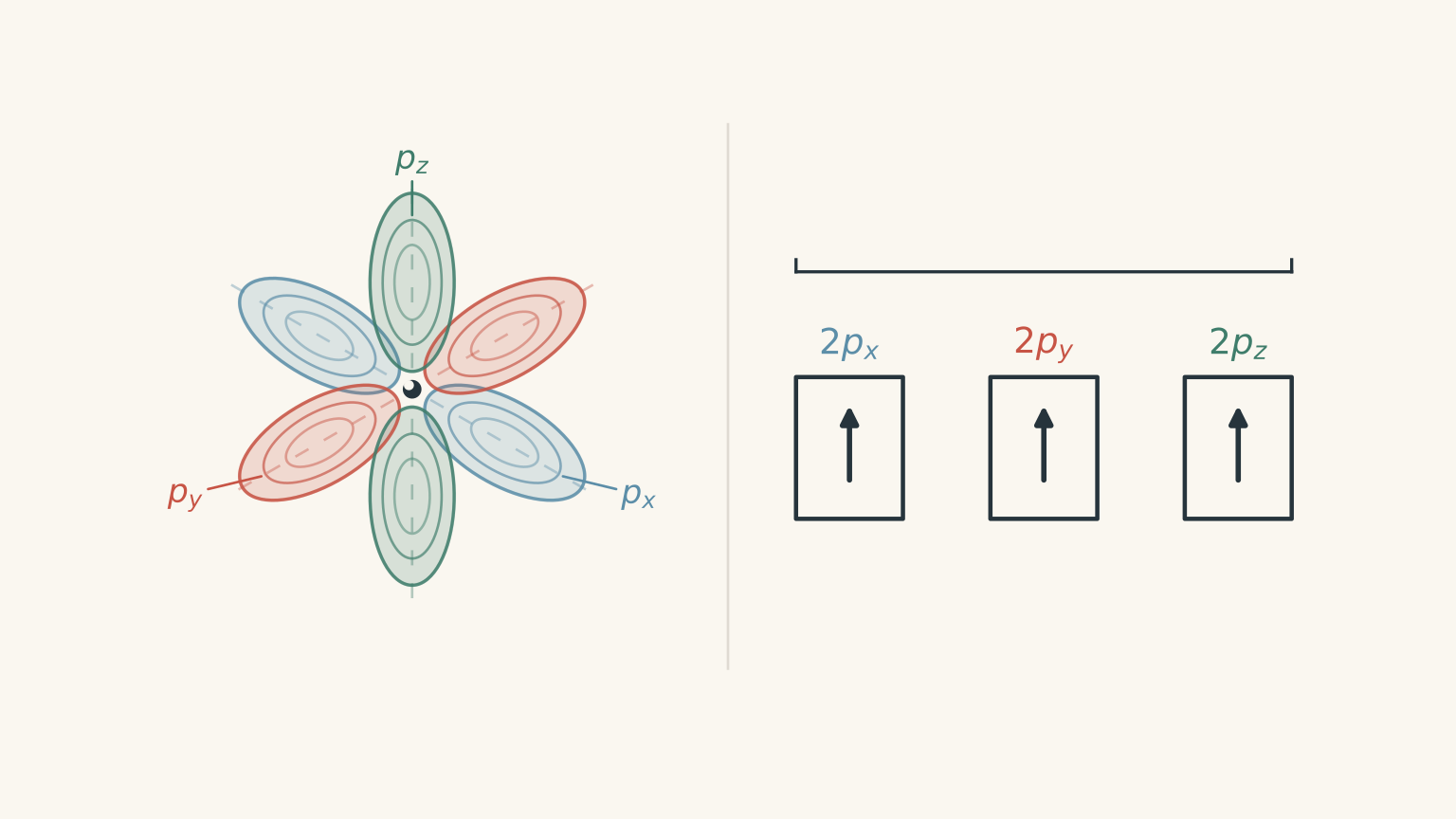
For example, a \(p\) subshell has three orbitals. In an isolated atom, those three orbitals have equal energy.
That means Hund’s rule applies when you distribute electrons among them.
Due to technical limitations, this figure may display incorrectly or contain inaccuracies. Please check key details against your course materials.
For a \(p^3\) arrangement, imagine placing electrons one at a time.
The first electron occupies one orbital. The second has a choice: share that orbital or occupy an empty one.
Which arrangement should have lower energy?
For these equal-energy orbitals, the second electron occupies a different orbital with parallel spin. The third does the same.
The resulting arrangement is:
[↑] [↑] [↑]
The reason isn’t simply that electrons want to stay physically far apart. The preference comes from quantum-mechanical interactions, including exchange effects associated with electrons having parallel spins.
In the appropriate atomic states, these effects reduce the total energy.
This is the physical basis behind the simplified box-filling rule.
Three rules, three different jobs
Students often make mistakes because they remember Hund’s rule but forget which problem it’s supposed to solve.
| Principle | What it tells you | Mistake it prevents |
|---|---|---|
| Aufbau principle | Electrons generally fill lower-energy available states first. | Occupying a higher-energy subshell unnecessarily. |
| Pauli exclusion principle | One orbital holds at most two electrons, and they must have opposite spins. | Drawing [↑↑] in one box. |
| Hund’s rule | Within an equal-energy set, occupy orbitals singly with parallel spins before pairing. | Drawing [↑↓] [ ] [ ] for \(p^2\) in its ground state. |
These principles work together.
For \(2p^4\):
- Pauli’s principle allows
[↑↓] [↑↓] [ ]because neither occupied box violates its capacity. - Hund’s rule rejects that arrangement as the usual lowest-energy arrangement.
- The preferred arrangement is
[↑↓] [↑] [↑].
There are two other valid ways to position the paired box: [↑] [↑↓] [↑] and [↑] [↑] [↑↓].
Those are equivalent choices of orbital orientation. The first box doesn’t have a special right to receive the pair.
Reversing every arrow also describes an equivalent spin orientation.
02How atomic spectra helped establish Hund’s rule
Hund’s rule wasn’t originally invented as a trick for filling boxes.
In the 1920s, physicists were trying to explain the complicated patterns of spectral lines emitted by atoms containing several electrons.
The central problem was that knowing how many electrons occupied a subshell wasn’t enough to predict all the atom’s energy states.
Two states could involve the same occupied subshells but differ in how the electrons’ angular momenta and spins were combined.
Were those states equally energetic? If not, what determined which one had the lowest energy?
Following the evidence through a spectrometer
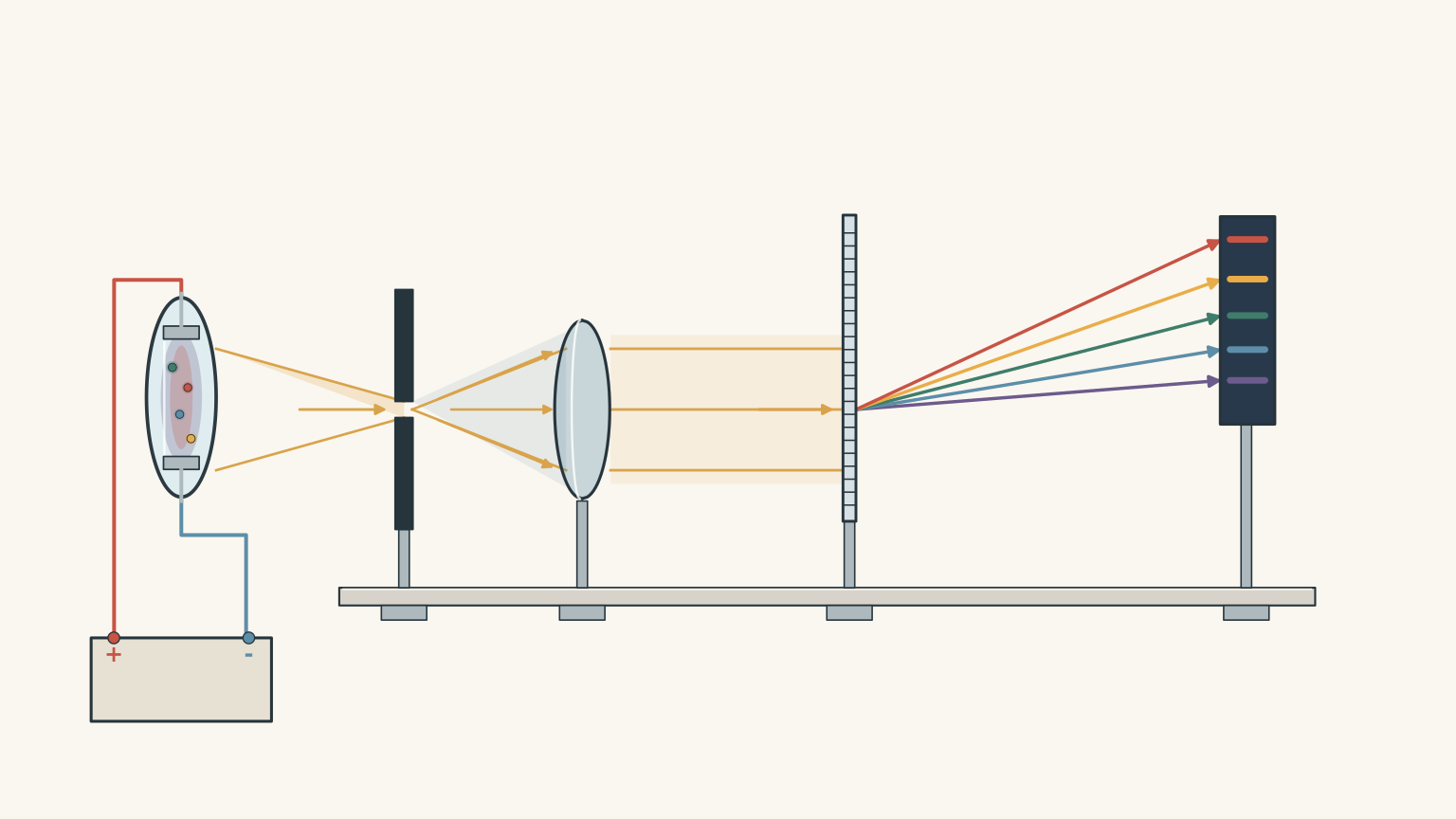
A typical atomic-emission experiment works like this:
- A light source containing excited gaseous atoms is produced, for example, using an electrical discharge or plasma.
- As the atoms return from higher-energy states to lower-energy states, they emit photons.
- Light from the source passes through a narrow entrance slit.
- A prism or diffraction grating separates the light according to wavelength.
- A detector records the positions and intensities of the spectral lines.
Each line corresponds to a transition between allowed atomic energy levels.
Due to technical limitations, this figure may display incorrectly or contain inaccuracies. Please check key details against your course materials.
What would you predict if different electron-spin arrangements of the same configuration always had the same energy?
You wouldn’t expect those arrangements to produce different energy terms that could be distinguished through careful spectral analysis.
But detailed atomic spectra revealed multiple energy terms, with a consistent preference for certain spin arrangements.
A coarse spectrum can reveal that an atom emits particular wavelengths, but it cannot reliably separate every closely spaced line. Narrower entrance slits and higher-resolution spectrometers improve that separation.
Even then, observing a line isn’t enough to identify an electron-spin arrangement. Researchers must assign transitions to energy levels and interpret patterns across the spectrum.
Friedrich Hund used evidence from atomic spectra to formulate his rules in 1925. The familiar school-level instruction about filling boxes is a later, simplified way of applying the first rule.
A real example: carbon’s lowest-energy state
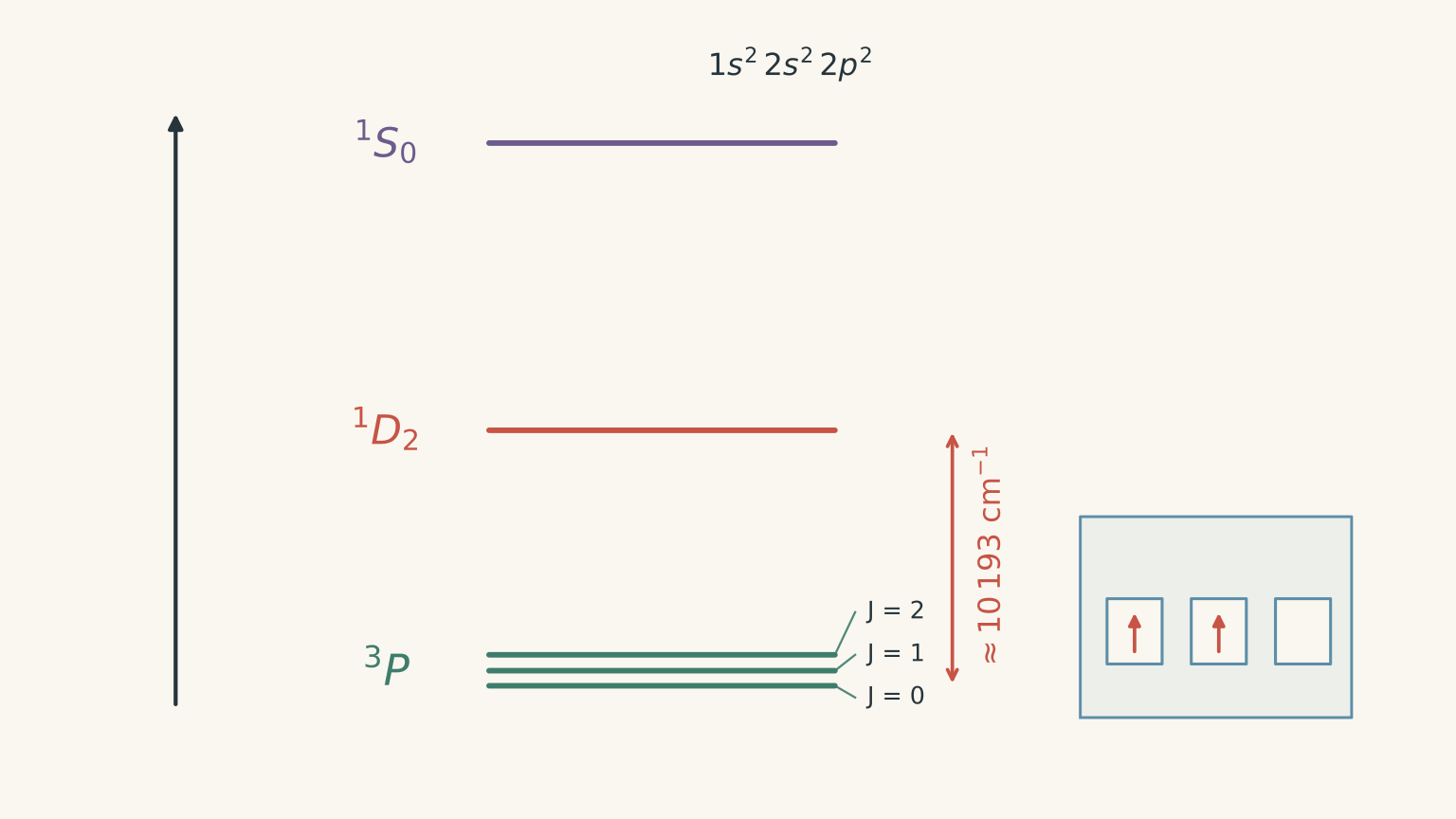
Carbon has six electrons, with the ground-state configuration:
\[ 1s^2\,2s^2\,2p^2 \]
Its two \(2p\) electrons occupy separate orbitals with parallel spins:
[↑] [↑] [ ]
The more precise spectroscopic description of carbon’s ground state is a triplet state, written \(^{3}P\).
Other states with the same \(2p^2\) electron count include singlet states, written \(^{1}D\) and \(^{1}S\).
The word triplet refers to spin multiplicity, not to three electrons.
The NIST atomic energy-level data for neutral carbon place the lowest triplet level below the singlet levels.
That is a concrete example of the energy ordering described by Hund’s first rule.
Due to technical limitations, this figure may display incorrectly or contain inaccuracies. Please check key details against your course materials.
A small calculation: how large is the energy difference?
NIST lists the \(^{1}D\) level approximately \(10\,192.66\ \mathrm{cm}^{-1}\) above carbon’s lowest \(^{3}P\) level.
The unit \(\mathrm{cm}^{-1}\) is a spectroscopic wavenumber, an inverse length used to represent energy differences.
Convert it to inverse metres:
\[ 10\,192.66\ \mathrm{cm}^{-1} =1.019266\times10^6\ \mathrm{m}^{-1} \]
We can calculate the energy separation using:
\[ \Delta E=hc\tilde{\nu} \]
Here:
- \(\Delta E\) is the energy difference in joules, \(\mathrm{J}\).
- \(h=6.626\times10^{-34}\ \mathrm{J\,s}\) is Planck’s constant.
- \(c=3.00\times10^8\ \mathrm{m/s}\) is the speed of light.
- \(\tilde{\nu}\) is the spectroscopic wavenumber in \(\mathrm{m}^{-1}\).
Substituting:
\[ \begin{aligned} \Delta E&=hc\tilde{\nu}\\ &=(6.626\times10^{-34}\ \mathrm{J\,s})\\ &\quad\times(3.00\times10^8\ \mathrm{m/s})\\ &\quad\times(1.019266\times10^6\ \mathrm{m}^{-1})\\ &\approx2.02\times10^{-19}\ \mathrm{J} \end{aligned} \]
Using \(1\ \mathrm{eV}=1.602\times10^{-19}\ \mathrm{J}\):
\[ \Delta E\approx1.26\ \mathrm{eV} \]
So these two carbon energy levels are separated by approximately \(1.26\ \mathrm{eV}\), where an electronvolt is a small unit of energy.
This is a real atomic energy difference, not an illustrative pairing cost.
It doesn’t necessarily correspond to a bright spectral line directly connecting those levels. Spectroscopic selection rules determine which transitions are allowed or sufficiently probable to observe.
The important conclusion is that states with the same electron configuration can have different energies.
Hund’s rule predicts part of that ordering.
It doesn’t describe every detail. The carbon term symbols, for example, contain information about total orbital angular momentum that a simple orbital-box diagram leaves out.
03A reliable method for filling orbital boxes
You can now apply the rule without relying on guesswork.
Step 1: Calculate the number of electrons
Start with the atomic number, \(Z\), which gives the number of protons.
A neutral atom has the same number of electrons as protons.
For an ion, account for the charge.
\[ N_e=Z-q \]
Here \(N_e\) is the number of electrons and \(q\) is the signed ionic charge in units of the elementary charge.
For example:
- \(\mathrm{Na}^{+}\): \(N_e=11-1=10\) electrons.
- \(\mathrm{O}^{2-}\): \(N_e=8-(-2)=10\) electrons.
- \(\mathrm{Fe}^{3+}\): \(N_e=26-3=23\) electrons.
A positive charge means electrons have been lost. A negative charge means electrons have been gained.
Step 2: Write the electron configuration
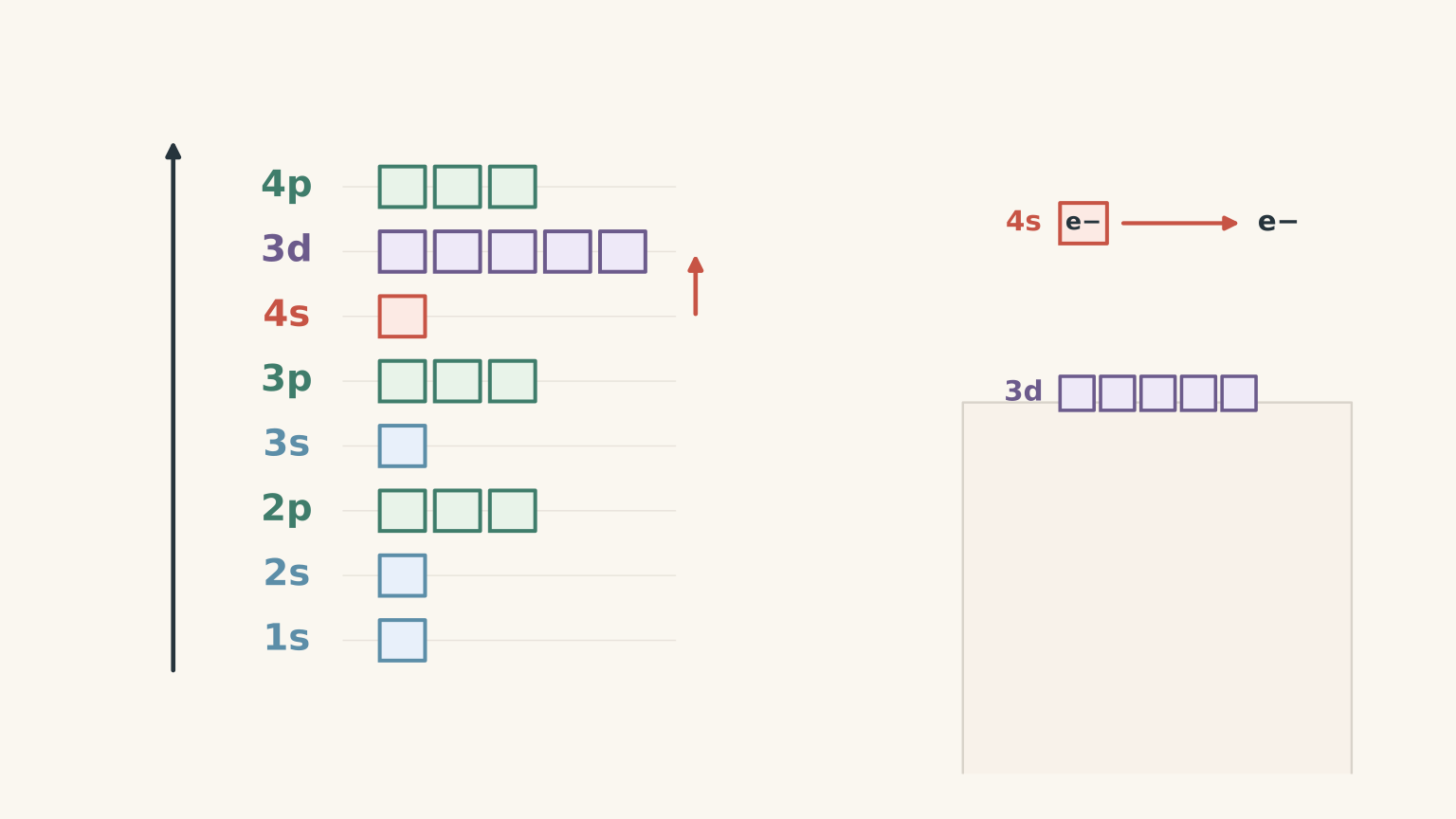
For neutral atoms in the range considered here, the usual filling sequence is:
\[ 1s,\ 2s,\ 2p,\ 3s,\ 3p,\ 4s,\ 3d,\ 4p \]
The \(4s\) subshell is generally occupied before \(3d\) when constructing neutral-atom configurations across the first transition series.
However, this is a filling convention, not a promise that \(4s\) always remains lower in energy after other electrons are added.
Chromium and copper are important exceptions to the simplest predicted neutral-atom configurations:
\[ \begin{aligned} \ce{Cr}:&\ [\mathrm{Ar}]\,3d^5\,4s^1\\ \ce{Cu}:&\ [\mathrm{Ar}]\,3d^{10}\,4s^1 \end{aligned} \]
The notation \([\mathrm{Ar}]\) represents the first 18 electrons, arranged like argon.
These exceptions arise because \(3d\) and \(4s\) energies are close, and the energies of complete electron arrangements must be considered.
Don’t use Hund’s rule by itself to invent other exceptions.
Due to technical limitations, this figure may display incorrectly or contain inaccuracies. Please check key details against your course materials.
Step 3: If it’s an ion, apply the removal convention before drawing boxes
For a main-group ion, add or remove the appropriate electrons to obtain the ion’s ground-state configuration.
For first-row transition metals, use the neutral atom as your starting point, then remove the \(4s\) electrons before the \(3d\) electrons.
For instance:
\[ \ce{Fe}: [\mathrm{Ar}]\,3d^6\,4s^2 \]
After removing two electrons:
\[ \mathrm{Fe}^{2+}: [\mathrm{Ar}]\,3d^6 \]
The \(4s\) electrons have gone.
A common mistake is to remove two \(3d\) electrons because the \(3d\) subshell was occupied after \(4s\) in the basic Aufbau sequence.
The filling sequence and ionisation sequence are not simply reversals of each other.
Step 4: Draw the boxes and apply Hund’s rule
Draw one box for each orbital in the subshell.
Place an upward arrow in every equal-energy box before adding a downward arrow to form a pair.
For example, consider \(3d^6\).
There are five \(3d\) orbitals. The first five electrons occupy separate orbitals, and the sixth pairs with one of them.
3d: [↑↓] [↑] [↑] [↑] [↑]
There are six electrons altogether, but four are unpaired.
Step 5: Audit your diagram
Before moving on, check three things:
- Does the total number of arrows match the required electron count?
- Does every paired box contain opposite arrows?
- Have you filled each equal-energy orbital singly before pairing?
If all three checks pass, you have applied the normal ground-state filling conventions correctly.
The qualification is important: these are simplified diagrams for atoms or ions where the orbitals being filled can be treated as equivalent in energy. Strongly split orbitals in some chemical environments require more information.
04Worked example: Draw bromine’s orbital-box diagram
A neutral bromine atom has atomic number \(35\). Write its electron configuration, draw its \(4p\) orbital-box diagram, and determine how many unpaired electrons it contains.
Step 1
Bromine is neutral, so it has:
\[ N_e=35-0=35\text{ electrons} \]
Step 2
Using the argon core:
\[ [\mathrm{Ar}]\,3d^{10}\,4s^2\,4p^5 \]
Check the total:
\[ 18+10+2+5=35 \]
Step 3
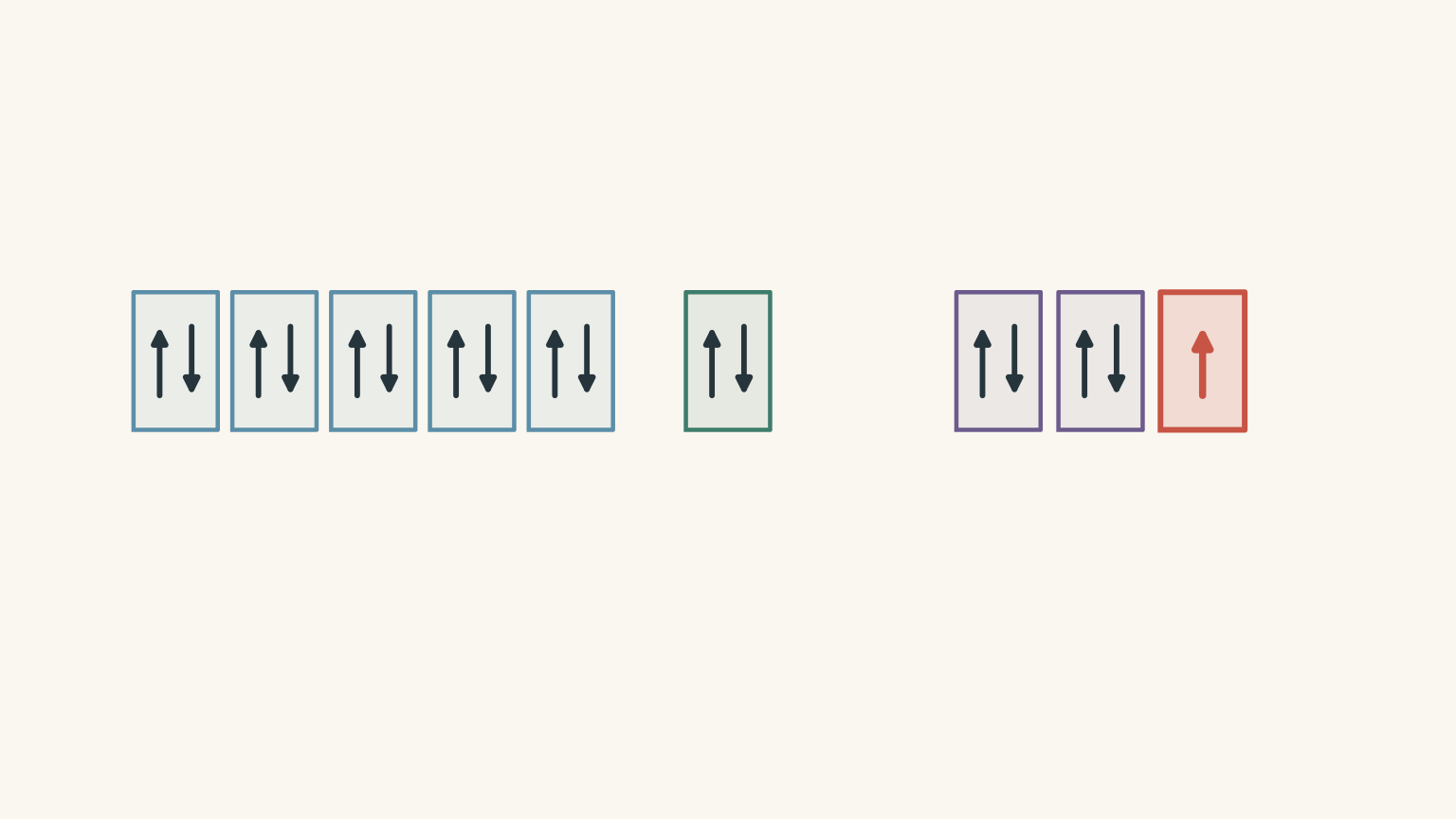
The \(4p\) subshell has three orbitals.
Place the first three \(4p\) electrons separately:
[↑] [↑] [↑]
The fourth and fifth electrons must now pair with electrons already present.
The final arrangement is:
4p: [↑↓] [↑↓] [↑]
Step 4
The two paired orbitals contain four electrons. The remaining orbital contains one unpaired electron.
Therefore, a neutral bromine atom has one unpaired electron in its ground-state orbital-box model.
This is a useful example because the last subshell contains five electrons, not five orbitals.
A superscript tells you the electron count. The subshell letter tells you how many boxes are available.
Due to technical limitations, this figure may display incorrectly or contain inaccuracies. Please check key details against your course materials.
05Worked example: Why does chromium(III) have three unpaired electrons?
Chromium has atomic number \(24\). Determine the ground-state electron configuration and \(3d\) orbital-box diagram of \(\mathrm{Cr}^{3+}\).
Explain why it is incorrect to remove three electrons directly from the neutral atom’s \(3d\) subshell.
Step 1
Chromium is one of the important exceptions to the simple filling sequence.
Its ground-state configuration is:
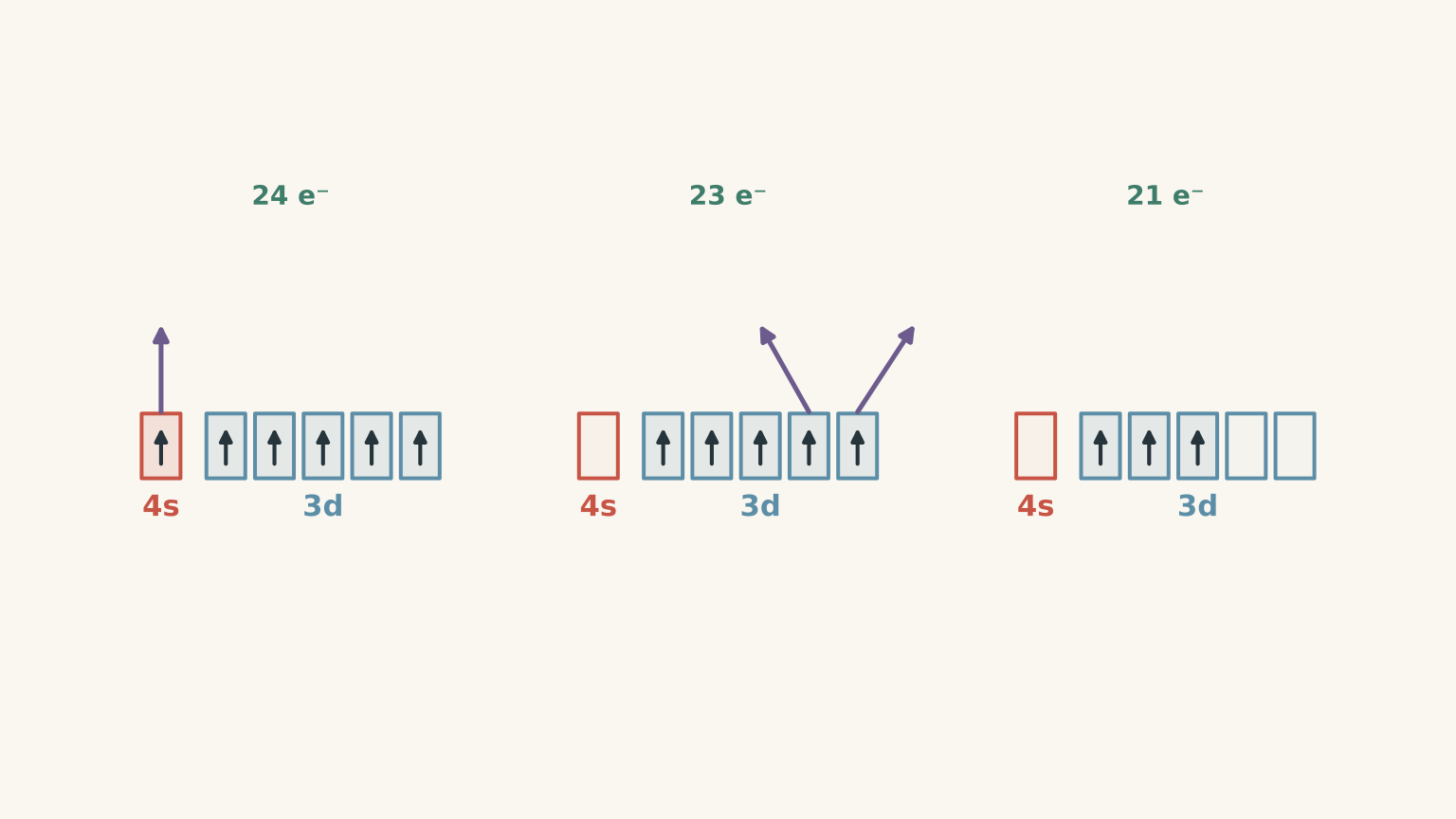
\[ \ce{Cr}: [\mathrm{Ar}]\,3d^5\,4s^1 \]
The \(3d\) orbitals each contain one electron, while the \(4s\) orbital also contains one electron.
Step 2
To form \(\mathrm{Cr}^{3+}\), chromium loses three electrons.
Remove the \(4s\) electron first, then two \(3d\) electrons.
\[ \begin{aligned} \ce{Cr}:&\ [\mathrm{Ar}]\,3d^5\,4s^1\\ \mathrm{Cr}^{+}:&\ [\mathrm{Ar}]\,3d^5\\ \mathrm{Cr}^{3+}:&\ [\mathrm{Ar}]\,3d^3 \end{aligned} \]
The final ion has:
\[ N_e=24-3=21\text{ electrons} \]
This agrees with the configuration: 18 argon-core electrons plus three \(3d\) electrons.
Step 3
There are five \(3d\) orbitals and three electrons.
All three can occupy separate boxes:
3d: [↑] [↑] [↑] [ ] [ ]
Step 4
All three \(3d\) electrons are unpaired.
Therefore, \(\mathrm{Cr}^{3+}\) has three unpaired electrons in this ground-state model.
The tempting alternative is to remove electrons from \(3d\) simply because it appears later than \(4s\) in the construction sequence.
That would leave electrons in the wrong subshell for the ion.
Another tempting idea is that chromium must keep its half-filled \(3d^5\) arrangement because it’s particularly stable. But that stability doesn’t prevent further ionisation. The ion’s electron count and the correct removal order still matter.
Due to technical limitations, this figure may display incorrectly or contain inaccuracies. Please check key details against your course materials.
06Questions and solutions
The first question checks the filling method. The next four move into ions, competing explanations, and the limits of Hund’s rule.
Unless stated otherwise, assume isolated atoms or ions in their ground states, with the usual simplified orbital energies.
Question 1
A neutral nitrogen atom has atomic number \(7\).
A student draws its \(2p\) subshell as:
[↑↓] [↑] [ ]
Explain why this isn’t the usual ground-state arrangement. Draw the correct \(2p\) orbital boxes and state how many unpaired electrons nitrogen has.
Solution 1
Nitrogen has three unpaired electrons in its ground-state \(2p\) subshell. The student’s diagram pairs two electrons while an equal-energy orbital is empty, violating Hund’s rule.
Nitrogen has seven electrons:
\[ 1s^2\,2s^2\,2p^3 \]
The first four electrons fill the \(1s\) and \(2s\) orbitals.
Three electrons remain for the three \(2p\) orbitals.
Hund’s rule places them separately with parallel spins:
2p: [↑] [↑] [↑]
All three are unpaired.
The student’s arrangement satisfies Pauli’s exclusion principle, but that alone doesn’t make it the lowest-energy arrangement.
Hund’s rule determines the preferred distribution among the equal-energy \(2p\) orbitals.
Question 2
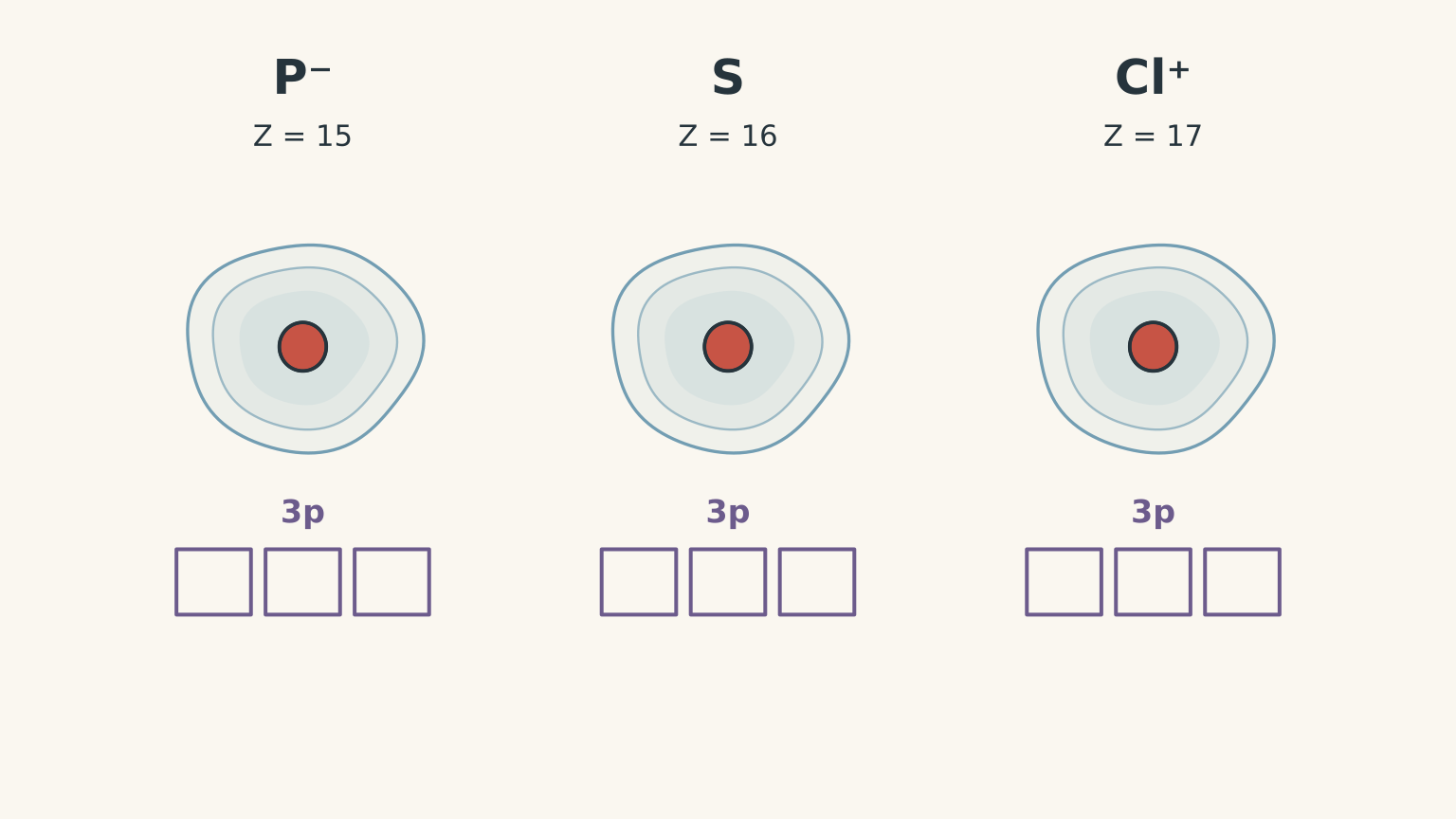
Consider three isolated, ground-state species:
- Neutral sulfur, \(\ce{S}\), with \(Z=16\).
- The phosphide ion \(\mathrm{P}^{-}\), with \(Z=15\).
- The chlorine cation \(\mathrm{Cl}^{+}\), with \(Z=17\).
Here, \(\mathrm{P}^{-}\) and \(\mathrm{Cl}^{+}\) are considered as isolated atomic ions, not necessarily as species in ordinary ionic solids.
A student argues that the three species must have different \(3p\) arrangements because they are different elements with different charges.
Determine their \(3p\) orbital-box arrangements and unpaired-electron counts.
Then rank the three species from smallest to largest in approximate electron-cloud size, and explain why identical orbital-box patterns don’t imply identical energy levels.
Due to technical limitations, this figure may display incorrectly or contain inaccuracies. Please check key details against your course materials.
Solution 2
All three species have the same \(3p^4\) box arrangement and two unpaired electrons. Their approximate size order is \(\ce{Cl+ < S < P-}\), because the chlorine nucleus attracts the same number of electrons more strongly.
First, calculate the electron counts.
For sulfur:
\[ N_e=16-0=16 \]
For \(\mathrm{P}^{-}\):
\[ N_e=15-(-1)=16 \]
For \(\mathrm{Cl}^{+}\):
\[ N_e=17-1=16 \]
Each has 16 electrons, so all three have the configuration:
\[ [\mathrm{Ne}]\,3s^2\,3p^4 \]
Here \([\mathrm{Ne}]\) represents the ten inner electrons arranged like neon.
Applying Hund’s rule:
3p: [↑↓] [↑] [↑]
Each species has two unpaired electrons.
These species are isoelectronic: they contain the same number of electrons and have the same ground-state subshell occupancies.
But they don’t have the same number of protons.
| Species | Protons | Electrons |
|---|---|---|
| \(\mathrm{P}^{-}\) | 15 | 16 |
| \(\ce{S}\) | 16 | 16 |
| \(\mathrm{Cl}^{+}\) | 17 | 16 |
Because the number of electrons is unchanged, the increase in nuclear charge generally pulls their electron distributions closer to the nucleus.
Therefore:
\[ r(\mathrm{Cl}^{+})<r(\ce{S})<r(\mathrm{P}^{-}) \]
Here \(r\) represents a characteristic size of the electron cloud, not a sharply defined outer boundary.
The tempting argument is that identical boxes must mean identical atoms internally.
But the boxes only show how many electrons occupy each orbital. They don’t specify the absolute orbital energies, radial distributions, or nuclear attraction.
So the species can have identical box patterns while differing in size and spectral behaviour.
Question 3
A student starts with the neutral iron configuration:
\[ [\mathrm{Ar}]\,3d^6\,4s^2 \]
They then predict:
\[ \begin{aligned} \mathrm{Fe}^{2+}:&\ [\mathrm{Ar}]\,3d^4\,4s^2\\ \mathrm{Fe}^{3+}:&\ [\mathrm{Ar}]\,3d^3\,4s^2 \end{aligned} \]
Their explanation is that the \(3d\) electrons must be removed first because \(3d\) is filled after \(4s\).
Correct both configurations, construct their \(3d\) orbital-box diagrams, and determine which ion has more unpaired electrons.
Explain why removing an electron can increase the number of unpaired electrons.
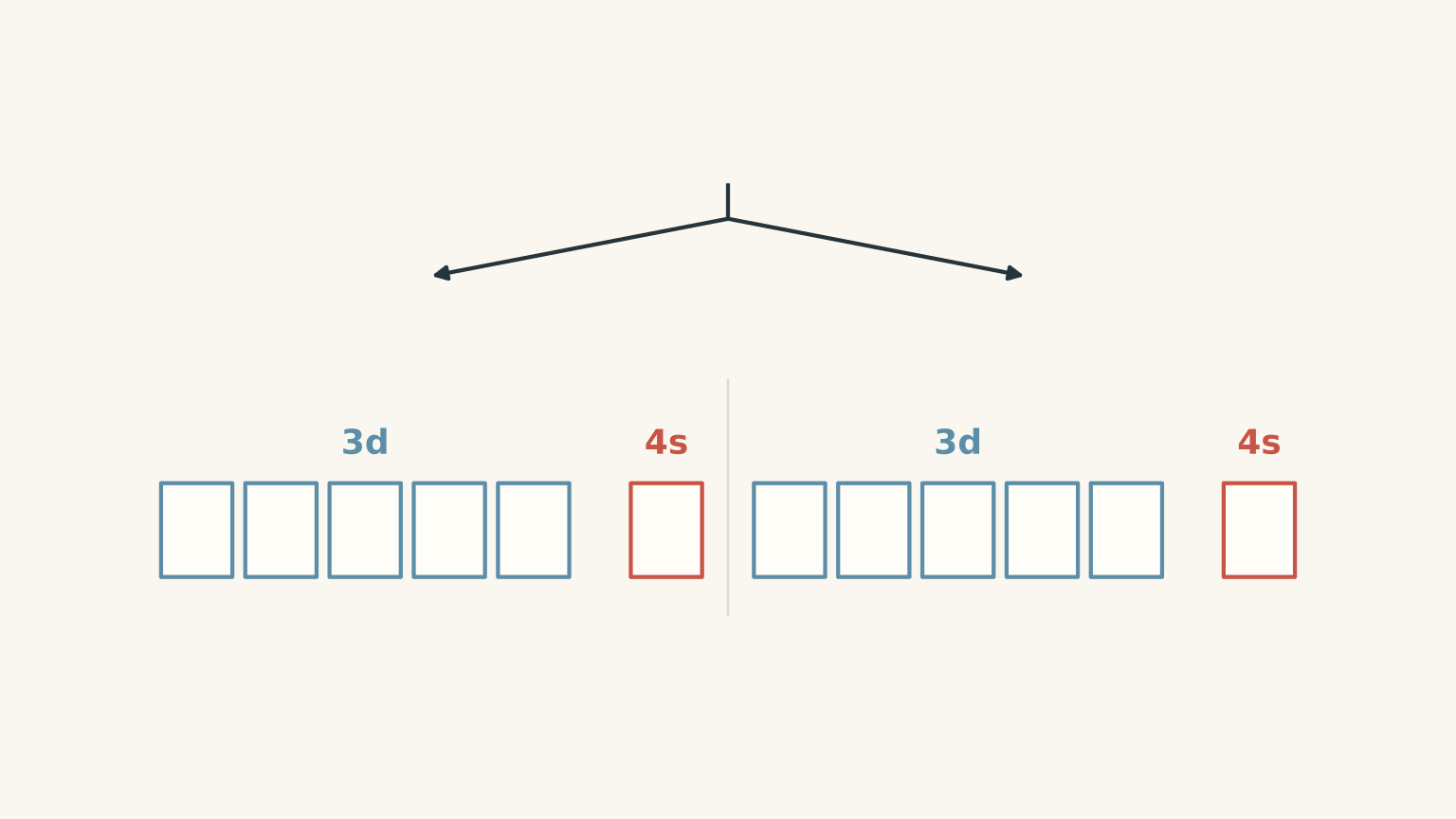
Due to technical limitations, this figure may display incorrectly or contain inaccuracies. Please check key details against your course materials.
Solution 3
The correct configurations are \(\mathrm{Fe}^{2+}=[\mathrm{Ar}]\,3d^6\) and \(\mathrm{Fe}^{3+}=[\mathrm{Ar}]\,3d^5\). The \(\mathrm{Fe}^{3+}\) ion has five unpaired electrons, one more than the four in \(\mathrm{Fe}^{2+}\).
Iron has atomic number \(26\), and its neutral configuration is:
\[ [\mathrm{Ar}]\,3d^6\,4s^2 \]
For first-row transition-metal cations, the \(4s\) electrons are removed before the \(3d\) electrons.
Therefore:
\[ \mathrm{Fe}^{2+}: [\mathrm{Ar}]\,3d^6 \]
Its electron count is:
\[ 26-2=24 \]
That is 18 core electrons plus six \(3d\) electrons.
Applying Hund’s rule:
3d: [↑↓] [↑] [↑] [↑] [↑]
There are four unpaired electrons.
To form \(\mathrm{Fe}^{3+}\), remove another electron, now from \(3d\):
\[ \mathrm{Fe}^{3+}: [\mathrm{Ar}]\,3d^5 \]
Its electron count is:
\[ 26-3=23 \]
The five \(3d\) electrons occupy the five orbitals separately:
3d: [↑] [↑] [↑] [↑] [↑]
There are five unpaired electrons.
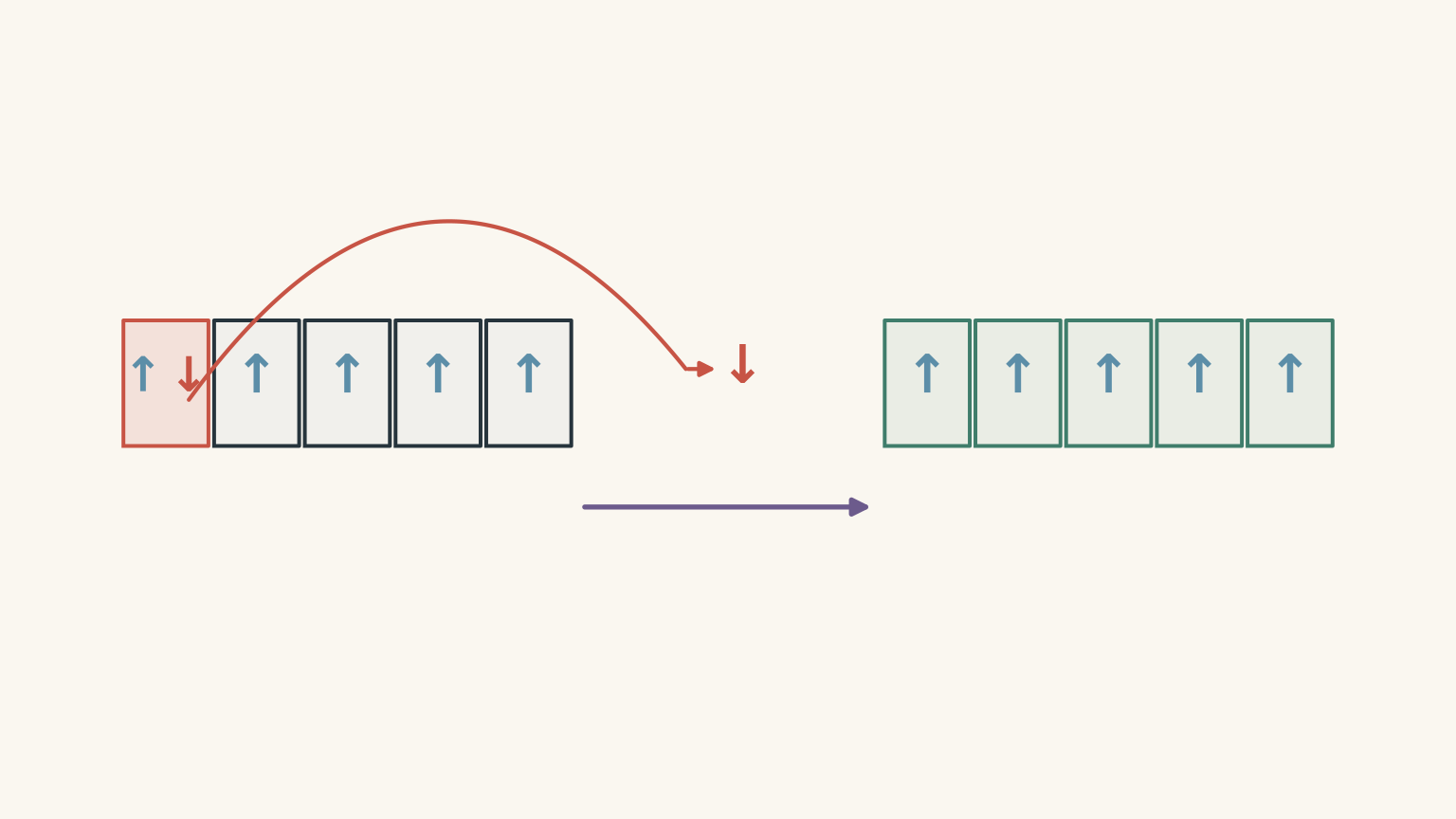
Due to technical limitations, this figure may display incorrectly or contain inaccuracies. Please check key details against your course materials.
The surprise is that removing one electron breaks a pair.
In \(3d^6\), one orbital contains two electrons with opposite spins. Removing one of those electrons leaves a singly occupied orbital.
The number of electrons decreases by one, but the number of unpaired electrons increases by one.
That doesn’t contradict Hund’s rule. It follows from it.
These counts describe the usual isolated-ion orbital model. In compounds, interactions with surrounding ligands can change the energies of the \(d\) orbitals and, in some cases, the number of unpaired electrons.
Question 4
Copper has atomic number \(29\), and zinc has atomic number \(30\).
A student’s report makes two claims:
- Both \(\mathrm{Cu}^{2+}\) and \(\mathrm{Zn}^{2+}\) have completely filled \(3d\) subshells because both metals lose two electrons.
- An ion with a greater positive charge must have fewer unpaired electrons.
Determine the configurations and \(3d\) orbital-box diagrams for \(\mathrm{Cu}^{+}\), \(\mathrm{Cu}^{2+}\), and \(\mathrm{Zn}^{2+}\).
Identify which two ions have identical subshell occupancies, and evaluate both claims.
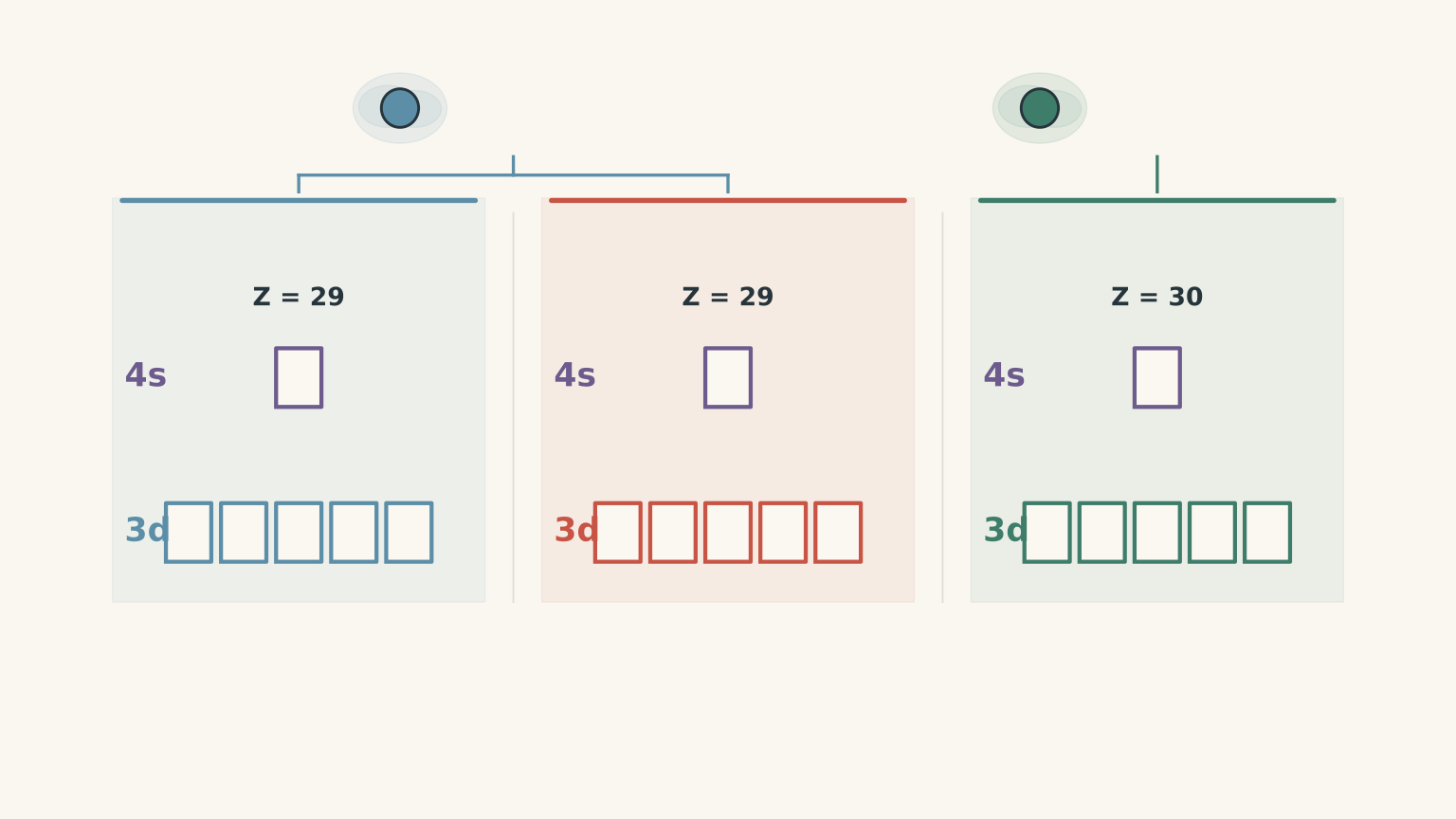
Due to technical limitations, this figure may display incorrectly or contain inaccuracies. Please check key details against your course materials.
Solution 4
The correct results are: \(\mathrm{Cu}^{+}\) has \(3d^{10}\) with no unpaired electrons, \(\mathrm{Cu}^{2+}\) has \(3d^9\) with one unpaired electron, and \(\mathrm{Zn}^{2+}\) has \(3d^{10}\) with no unpaired electrons. Both student claims are incorrect.
Start with the actual neutral-atom configurations:
\[ \begin{aligned} \ce{Cu}:&\ [\mathrm{Ar}]\,3d^{10}\,4s^1\\ \ce{Zn}:&\ [\mathrm{Ar}]\,3d^{10}\,4s^2 \end{aligned} \]
Copper is an exception to the simple predicted Aufbau arrangement. It has one \(4s\) electron and a filled \(3d\) subshell.
For \(\mathrm{Cu}^{+}\):
Remove copper’s single \(4s\) electron:
\[ \mathrm{Cu}^{+}: [\mathrm{Ar}]\,3d^{10} \]
The five \(3d\) orbitals are fully occupied:
[↑↓] [↑↓] [↑↓] [↑↓] [↑↓]
There are zero unpaired electrons.
For \(\mathrm{Cu}^{2+}\):
Remove a second electron, now from \(3d\):
\[ \mathrm{Cu}^{2+}: [\mathrm{Ar}]\,3d^9 \]
The orbital-box diagram is:
[↑↓] [↑↓] [↑↓] [↑↓] [↑]
There is one unpaired electron.
For \(\mathrm{Zn}^{2+}\):
Zinc starts with two \(4s\) electrons. Both are removed:
\[ \mathrm{Zn}^{2+}: [\mathrm{Ar}]\,3d^{10} \]
Its five \(3d\) orbitals remain fully paired.
Therefore, \(\mathrm{Cu}^{+}\) and \(\mathrm{Zn}^{2+}\) have identical subshell occupancies.
Their electron counts confirm this:
\[ \begin{aligned} N_e(\mathrm{Cu}^{+})&=29-1=28\\ N_e(\mathrm{Zn}^{2+})&=30-2=28 \end{aligned} \]
The first claim fails because copper and zinc have different neutral configurations. Copper has only one \(4s\) electron to lose before removal begins from \(3d\).
The second claim fails because unpaired-electron counts depend on the arrangement of the remaining electrons, not directly on ionic charge.
In fact:
- \(\mathrm{Cu}^{+}\) has zero unpaired electrons.
- \(\mathrm{Cu}^{2+}\) has one unpaired electron.
Increasing the positive charge from \(+1\) to \(+2\) increases the unpaired-electron count in this case.
The filled \(3d^{10}\) subshell is a stable arrangement, but it isn’t immune to electron removal.
Question 5
Extension beyond the standard HSC orbital-box model
The usual Hund’s rule method assumes that orbitals within the same \(d\) subshell have equal energy.
Now consider a hypothetical model in which the five \(3d\) orbitals have been split into two energy groups by the ion’s surroundings:
- Three orbitals have the lower energy.
- Two orbitals have a higher energy.
- Placing each electron in a higher-energy orbital adds an energy cost \(\Delta\).
- Pairing two electrons in the same orbital adds an energy cost \(P=1.00\ \mathrm{eV}\).
Treat these as illustrative model parameters, not measured values for a particular iron compound.
Assume all three lower orbitals are equivalent to each other, both higher orbitals are equivalent, and all other energy effects are ignored when comparing arrangements within each ion.
An \(\mathrm{Fe}^{2+}\) ion occupies environment A, where:
\[ \Delta_A=1.40\ \mathrm{eV} \]
It is then converted into \(\mathrm{Fe}^{3+}\) and transferred to environment B, where:
\[ \Delta_B=0.60\ \mathrm{eV} \]
The pairing cost remains \(1.00\ \mathrm{eV}\).
For each ion:
- Determine the lowest-energy orbital arrangement by considering configurations with zero, one, and two electrons in the higher group.
- State the number of unpaired electrons.
- Evaluate the claim that the \(\mathrm{Fe}^{3+}\) arrangement can be obtained simply by erasing one arrow from the original \(\mathrm{Fe}^{2+}\) diagram.
- Explain whether subtracting the two lowest model energies would give the ionisation energy.
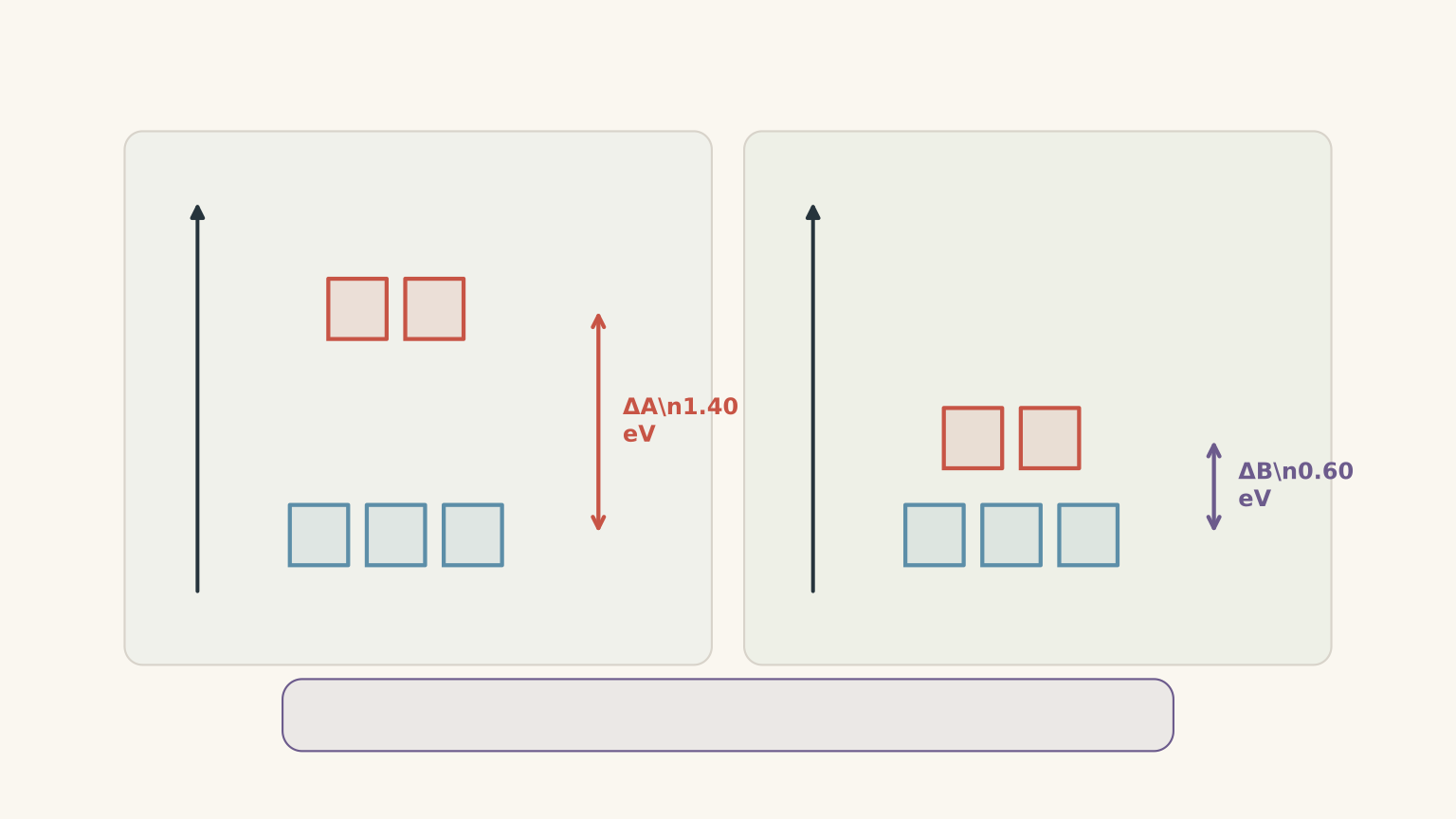
Due to technical limitations, this figure may display incorrectly or contain inaccuracies. Please check key details against your course materials.
Solution 5
The lowest-energy arrangement for \(\mathrm{Fe}^{2+}\) in environment A has zero unpaired electrons, while the lowest-energy arrangement for \(\mathrm{Fe}^{3+}\) in environment B has five. Removing one electron is accompanied by a major rearrangement because the relative orbital energies have changed.
The model-energy difference is not the ionisation energy.
The key is that Hund’s familiar instruction only applies directly to orbitals of equal energy. Here, occupying a higher orbital has an extra cost that competes with the cost of pairing electrons.
First, consider \(\mathrm{Fe}^{2+}\) in environment A.
The ion has six \(3d\) electrons:
\[ \mathrm{Fe}^{2+}: [\mathrm{Ar}]\,3d^6 \]
There are three possible distributions worth comparing in this simplified model.
| Lower-group electrons | Higher-group electrons | Pairs | Unpaired electrons |
|---|---|---|---|
| 6 | 0 | 3 | 0 |
| 5 | 1 | 2 | 2 |
| 4 | 2 | 1 | 4 |
Each pair costs \(1.00\ \mathrm{eV}\). Each electron in the higher group costs \(1.40\ \mathrm{eV}\).
For six electrons in the lower group:
\[ E_1=3(1.00)=3.00\ \mathrm{eV} \]
For five lower and one higher:
\[ \begin{aligned} E_2&=2(1.00)+1(1.40)\\ &=3.40\ \mathrm{eV} \end{aligned} \]
For four lower and two higher:
\[ \begin{aligned} E_3&=1(1.00)+2(1.40)\\ &=3.80\ \mathrm{eV} \end{aligned} \]
The lowest energy is \(3.00\ \mathrm{eV}\), so all six electrons occupy the lower three orbitals.
The arrangement is:
Lower: [↑↓] [↑↓] [↑↓]
Higher: [ ] [ ]
Every electron is paired.
Why doesn’t the ion follow the familiar five-singles-before-pairing pattern?
Because the higher two orbitals are no longer equal in energy to the lower three. Moving an electron upwards costs more energy than forming an additional pair saves in this model.
Now consider \(\mathrm{Fe}^{3+}\) in environment B.
The ion has five \(3d\) electrons:
\[ \mathrm{Fe}^{3+}: [\mathrm{Ar}]\,3d^5 \]
The energy gap is now only \(0.60\ \mathrm{eV}\).
Compare the three possible distributions:
| Lower-group electrons | Higher-group electrons | Pairs | Unpaired electrons |
|---|---|---|---|
| 5 | 0 | 2 | 1 |
| 4 | 1 | 1 | 3 |
| 3 | 2 | 0 | 5 |
For five electrons in the lower group:
\[ E_1=2(1.00)=2.00\ \mathrm{eV} \]
For four lower and one higher:
\[ \begin{aligned} E_2&=1(1.00)+1(0.60)\\ &=1.60\ \mathrm{eV} \end{aligned} \]
For three lower and two higher:
\[ \begin{aligned} E_3&=2(0.60)\\ &=1.20\ \mathrm{eV} \end{aligned} \]
This time, the lowest energy is \(1.20\ \mathrm{eV}\).
The preferred arrangement is:
Lower: [↑] [↑] [↑]
Higher: [↑] [↑]
All five electrons are unpaired.
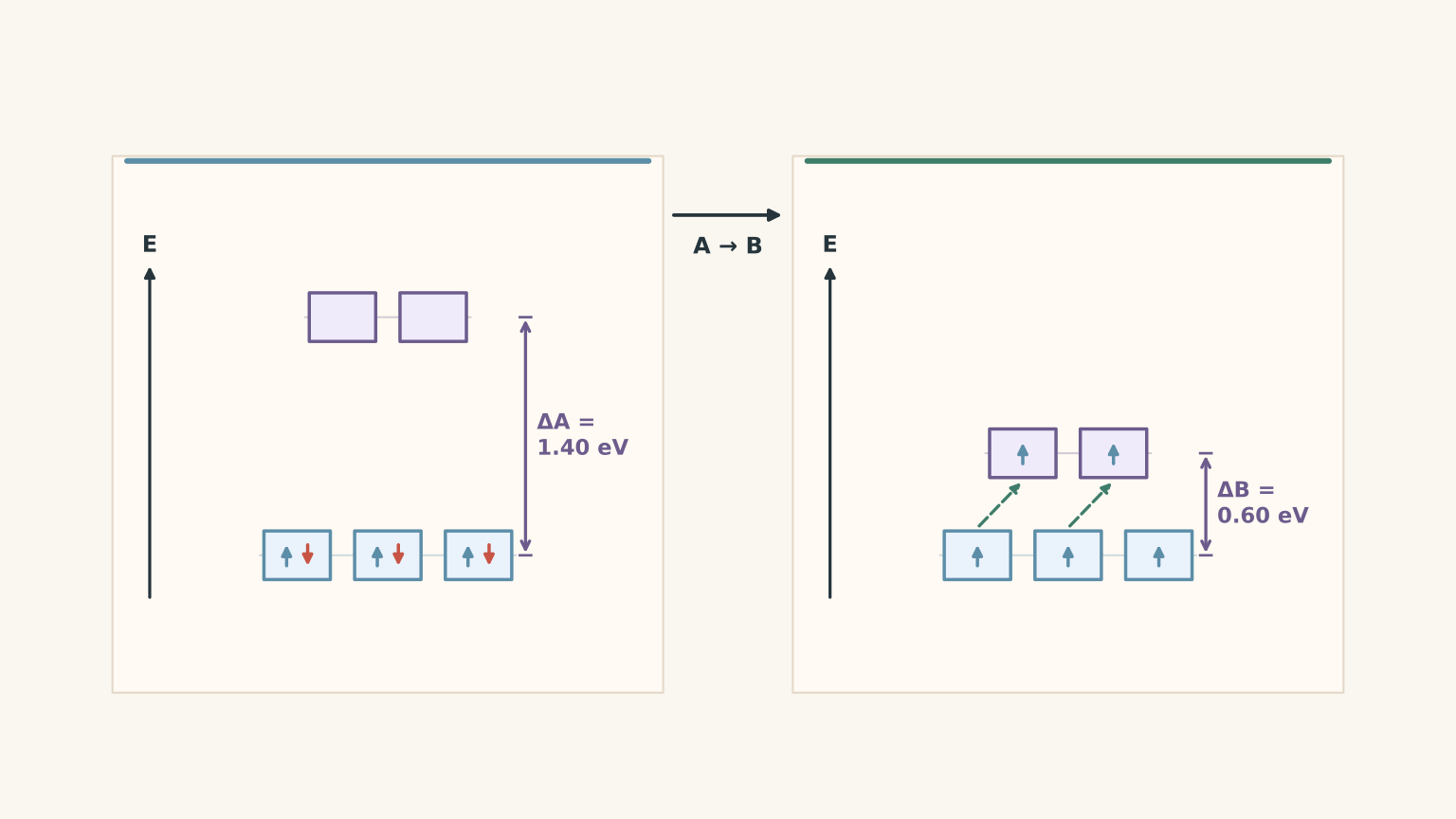
Due to technical limitations, this figure may display incorrectly or contain inaccuracies. Please check key details against your course materials.
Why can’t we just erase one arrow?
Erasing an arrow from the original \(\mathrm{Fe}^{2+}\) arrangement would leave two paired lower orbitals and one singly occupied lower orbital.
That would produce:
Lower: [↑↓] [↑↓] [↑]
Higher: [ ] [ ]
It has one unpaired electron, but its model energy in environment B is \(2.00\ \mathrm{eV}\).
The five-singles arrangement has a lower energy of \(1.20\ \mathrm{eV}\).
The remaining electrons therefore rearrange when the relative orbital energies change.
The charge changes by one unit, but the number of unpaired electrons changes from zero to five.
That is the conceptual trap: the electronic ground state must be reconsidered after the conditions change. An orbital-box diagram isn’t a permanent allocation of named electrons to fixed compartments.
Finally, why isn’t the energy difference an ionisation energy?
It would be tempting to calculate:
\[ 1.20-3.00=-1.80\ \mathrm{eV} \]
and conclude that ionisation releases energy.
That conclusion would be invalid.
The calculated values include only the relative pairing and orbital-splitting costs within each ion. They omit the different nuclear attraction energies, other electron interactions, and environmental energy changes.
The energy zero for the two species has not been established on a common basis.
You therefore cannot subtract the two relative arrangement energies to determine the energy required to remove an electron.
The actual ionisation-energy calculation would require the relevant total initial and final state energies, along with a clearly defined process.
This extension exposes the exact limitation of Hund’s familiar box-filling method: the rule helps identify the preferred spin arrangement among equivalent orbitals, but it doesn’t override other energy differences.
That is also why electron configurations, spectroscopy, and magnetic behaviour are connected without being interchangeable. A box diagram predicts an arrangement under stated assumptions; experimental evidence is needed to establish the real energy states.
For a more focused treatment of what the resulting unpaired-electron count tells you, continue with How to Find Unpaired Electrons in Atoms and Ions.
For syllabus context, these core filling and ionisation methods are relevant to electron configuration and spdf notation in the NSW Chemistry Stage 6 Syllabus (2017), which remains the syllabus being taught in 2026. The new Chemistry 11-12 Syllabus (2025) begins implementation in 2028, according to NESA’s published transition schedule. The split-orbital energy-cost model in Question 5 is an extension, not a requirement to learn ligand-field theory for the 2017 HSC course.