
How to Recognise a Base Without a Hydroxide Group
Learn why ammonia and other substances can act as bases without containing hydroxide. Follow proton transfers, identify conjugate acid-base pairs, and work through examples that distinguish base strength, amount, and concentration.
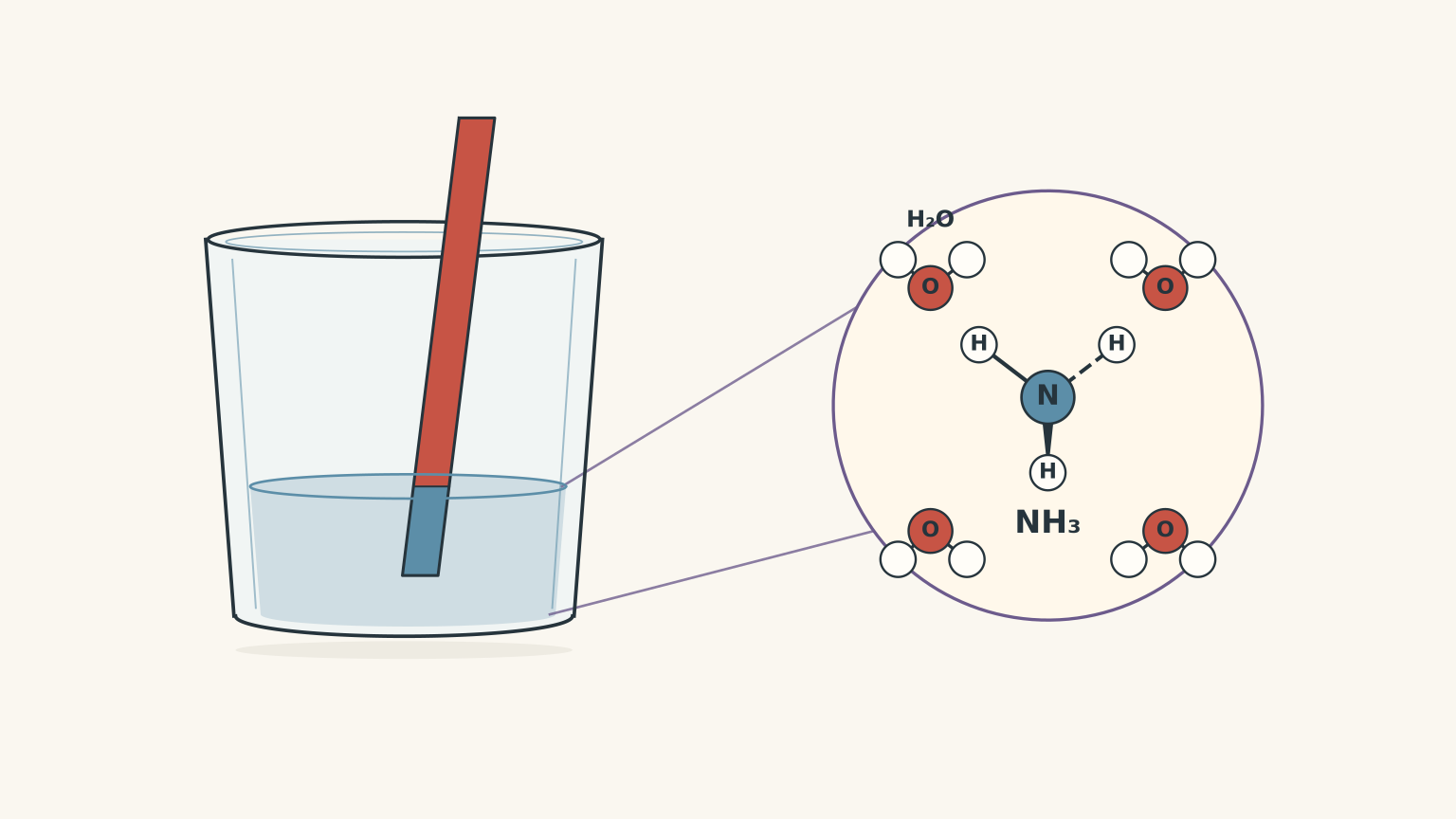
Aqueous ammonia can turn red litmus paper blue, even though its chemical formula, \(\ce{NH3}\), contains no oxygen and no hydroxide ion. So how can it be a base?
The answer is proton transfer. Ammonia is a Brønsted-Lowry base because it accepts a proton (\(\mathrm{H}^{+}\)) from water. This reaction produces hydroxide ions (\(\mathrm{OH}^{-}\)) in the solution, even though they were never part of the original ammonia molecule.
This gives you a much more reliable way to recognise a base: look for a particle that accepts a proton, rather than searching its formula for \(\mathrm{OH}^{-}\).
Due to technical limitations, this figure may display incorrectly or contain inaccuracies. Please check key details against your course materials.
01The key test: does the substance accept a proton?
Consider ammonia, \(\ce{NH3}\).
A nitrogen atom has five valence electrons. In ammonia, three of these are involved in N-H bonds, leaving one lone pair of electrons on the nitrogen atom.
That lone pair is important. It can form a new bond with a proton.
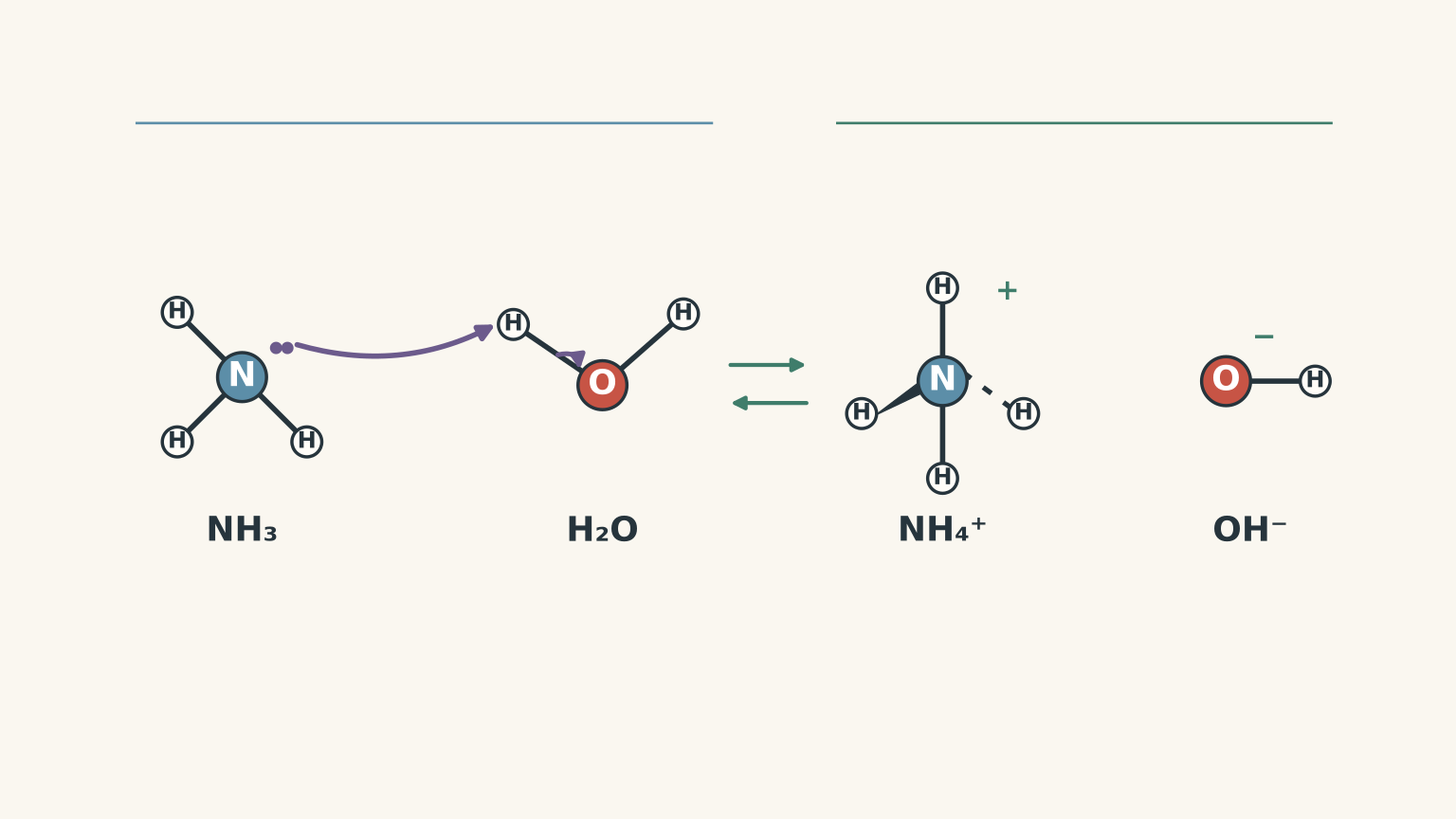
When ammonia dissolves in water, the following equilibrium occurs:
\[ \ce{NH3 + H2O <=> NH4+ + OH^-} \]
Follow what happens to each reactant.
- \(\ce{NH3}\) gains a proton and becomes \(\ce{NH4+}\).
- \(\ce{H2O}\) loses a proton and becomes \(\mathrm{OH}^{-}\).
Ammonia has accepted a proton, so it is the base. Water has donated a proton, so it is the acid.
Notice where the hydroxide ion comes from. Water loses a proton, leaving behind \(\mathrm{OH}^{-}\). The hydroxide ion is a product of the reaction, not a group originally attached to ammonia.
Due to technical limitations, this figure may display incorrectly or contain inaccuracies. Please check key details against your course materials.
Where do conjugate acid-base pairs fit in?
Whenever a proton is transferred, two conjugate acid-base pairs are formed.
A conjugate pair consists of two species that differ by exactly one proton.
For the ammonia reaction:
| Original species | After proton transfer | Role |
|---|---|---|
| \(\ce{NH3}\) | \(\ce{NH4+}\) | Base and conjugate acid |
| \(\ce{H2O}\) | \(\mathrm{OH}^{-}\) | Acid and conjugate base |
The conjugate pairs are:
- \(\ce{NH4+ / NH3}\)
- \(\ce{H2O / OH^-}\)
There is a useful charge check here.
When ammonia gains \(\mathrm{H}^{+}\), its charge increases from 0 to +1. When water loses \(\mathrm{H}^{+}\), its charge decreases from 0 to −1.
This is exactly what you should expect when identifying conjugate pairs.
The important distinction: a base does not need to contain hydroxide ions. It needs to be able to accept a proton in the reaction being considered.
02What does an experiment actually tell us?
There is a useful experimental problem here.
Suppose you have two colourless solutions. One contains sodium hydroxide, and the other contains ammonia. Both are basic, but only one contains hydroxide ions as part of the original dissolved compound.
Can a simple indicator test distinguish them?
Not reliably.
The first test: use an indicator
Dip red litmus paper into each solution.
Both solutions turn the red litmus blue. This tells you that both solutions are basic.
However, it does not explain how each solution became basic.
An indicator measures the behaviour of the solution. It does not reveal the molecular structure of the substance responsible.
We need a more informative investigation.
The revised investigation: measure pH and perform a titration
Imagine setting up a comparison using two solutions:
- 25.0 mL of 0.100 mol L\(^{-1}\) sodium hydroxide.
- 25.0 mL of 0.100 mol L\(^{-1}\) ammonia.
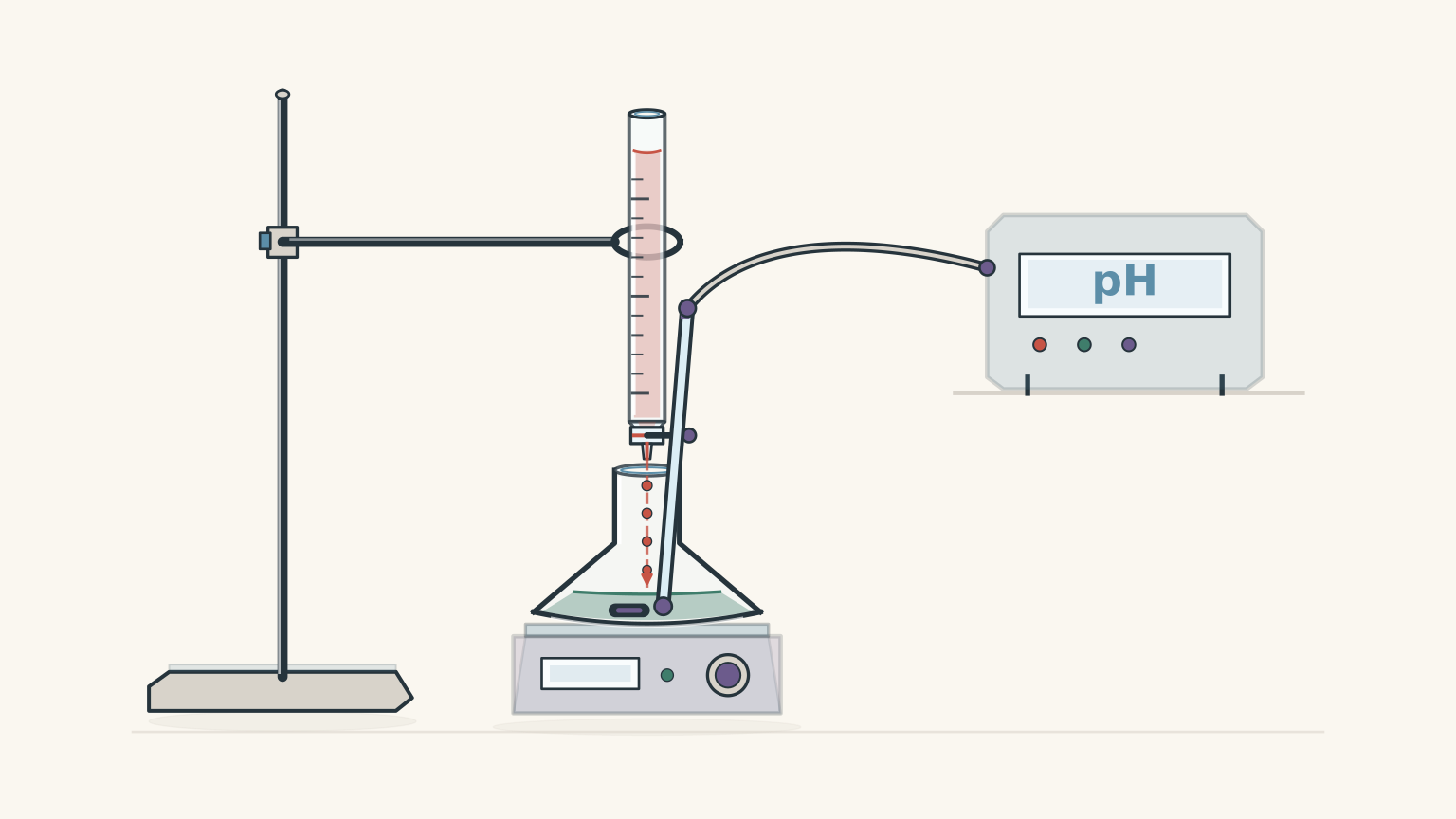
Use a calibrated pH probe to measure the initial pH of each solution.
Then transfer each solution into a separate conical flask. Place a burette containing 0.100 mol L\(^{-1}\) hydrochloric acid above each flask. Add the acid gradually while stirring, recording the pH as you go.
This lets you investigate two different properties:
- The initial pH tells you about the hydroxide concentration in the solution.
- The volume of hydrochloric acid required for neutralisation tells you how much base was initially present.
Due to technical limitations, this figure may display incorrectly or contain inaccuracies. Please check key details against your course materials.
What should we predict?
Both solutions contain the same number of moles of base.
However, ammonia is a weak base, while sodium hydroxide is a strong base.
Sodium hydroxide dissociates essentially completely in water:
\[ \ce{NaOH -> Na+ + OH^-} \]
Ammonia only partially reacts with water:
\[ \ce{NH3 + H2O <=> NH4+ + OH^-} \]
Therefore, we expect the sodium hydroxide solution to have a higher initial pH.
We also expect both solutions to require the same volume of hydrochloric acid at the equivalence point because they contain equal amounts of base and react with acid in a 1:1 mole ratio.
Calculating the expected pH of ammonia
For ammonia, the base dissociation constant at 25°C is approximately:
\[ K_b=1.8\times10^{-5} \]
The equilibrium expression is:
\[ K_b=\frac{[\ce{NH4+}][\mathrm{OH}^{-}]}{[\ce{NH3}]} \]
Let \(x\) represent the equilibrium concentration of hydroxide ions, in mol L\(^{-1}\).
For an initial ammonia concentration of 0.100 mol L\(^{-1}\):
\[ 1.8\times10^{-5} =\frac{x^2}{0.100-x} \]
Since the reaction is limited, we can approximate \(0.100-x\) as 0.100.
Rearranging:
\[ \begin{aligned} x&\approx\sqrt{(1.8\times10^{-5})(0.100)}\\ &=1.34\times10^{-3}\ \mathrm{mol\,L^{-1}} \end{aligned} \]
Therefore:
\[ \begin{aligned} \mathrm{pOH}&=-\log(1.34\times10^{-3})\\ &=2.87\\ \mathrm{pH}&=14.00-2.87\\ &=11.13 \end{aligned} \]
The approximation is reasonable because only about 1.34% of the initial ammonia concentration reacts with water.
For sodium hydroxide, complete dissociation gives:
\[ [\mathrm{OH}^{-}]=0.100\ \mathrm{mol\,L^{-1}} \]
Its pOH is 1.00, giving a pH of 13.00.
Comparing the expected results
The following values are calculated illustrations, not recorded experimental measurements. Assume 25°C, ideal dilute solutions, and 0.100 mol L\(^{-1}\) hydrochloric acid.
| Property | Sodium hydroxide | Ammonia |
|---|---|---|
| Initial concentration | 0.100 M | 0.100 M |
| Initial pH | 13.00 | 11.13 |
| Base strength | Strong | Weak |
| Moles of base | 0.00250 mol | 0.00250 mol |
| HCl required at equivalence | 25.0 mL | 25.0 mL |
Why do both solutions require the same volume of hydrochloric acid?
Calculate the number of moles in either solution:
\[ n=cV \]
\[ n=0.100\times0.0250 \]
\[ n=0.00250\ \mathrm{mol} \]
Both bases react with hydrochloric acid in a 1:1 mole ratio.
Therefore:
\[ V=\frac{n}{c} \]
\[ V=\frac{0.00250}{0.100} =0.0250\ \mathrm{L} \]
\[ \boxed{V=25.0\ \mathrm{mL}} \]
The result is important. Ammonia has a lower initial pH because it is a weak base, but it still contains the same total number of proton-accepting ammonia molecules.
The first test, using litmus, could not explain the difference. The titration reveals the amount of base, while the proton-transfer model explains why ammonia produces hydroxide ions in water.
This is where the Brønsted-Lowry model becomes useful: it identifies a base through proton acceptance, rather than relying on the presence of hydroxide in its original formula.
03A reliable method for recognising bases without hydroxide
When you encounter an unfamiliar substance in an HSC Chemistry question, use this process.
Step 1: Identify the reaction partner.
A substance’s role depends on what it reacts with. You cannot always classify a species as an acid or base by looking at its formula alone.
Step 2: Track the proton.
Compare the reactants and products.
- If a species gains one \(\mathrm{H}^{+}\), it is acting as a base.
- If a species loses one \(\mathrm{H}^{+}\), it is acting as an acid.
Step 3: Identify the conjugate species.
- A base gains a proton to form its conjugate acid.
- An acid loses a proton to form its conjugate base.
Step 4: Check the charges.
Gaining a proton increases the charge by one. Losing a proton decreases the charge by one.
Step 5: Check that the equation is balanced.
Make sure atoms and total charge are conserved.
Three common bases that do not need a hydroxide group
| Species | Proton accepted | Conjugate acid |
|---|---|---|
| Ammonia, \(\ce{NH3}\) | \(\mathrm{H}^{+}\) | \(\ce{NH4+}\) |
| Methylamine, \(\ce{CH3NH2}\) | \(\mathrm{H}^{+}\) | \(\ce{CH3NH3+}\) |
| Carbonate, \(\mathrm{CO_{3}}^{2-}\) | \(\mathrm{H}^{+}\) | \(\mathrm{HCO_{3}}^{-}\) |
Notice that these examples use different structures.
Ammonia and methylamine contain nitrogen atoms with lone pairs that can accept protons. Carbonate accepts a proton through its available electron density.
The presence of a nitrogen atom is a useful structural clue for amines, but always confirm the actual proton transfer in the reaction.
If you need to identify amines and other organic functional groups from structural formulae, see HSC Chemistry: How to Identify Organic Functional Groups.
A small terminology trap: hydroxide versus hydroxyl
These two terms are related, but they are not interchangeable.
- Hydroxide ion: \(\mathrm{OH}^{-}\), a negatively charged ion.
- Hydroxyl group: \(\ce{-OH}\), a covalently bonded group within a molecule.
For example, an alcohol contains a hydroxyl group. That does not automatically make it a strong base or mean it releases hydroxide ions in water.
Likewise, ammonia contains neither a hydroxide ion nor a hydroxyl group, yet it acts as a base by accepting a proton.
04Base strength, amount and concentration are different
Recognising ammonia as a base is only part of the problem. You also need to understand how strongly it behaves as a base and how much of it is present.
These three ideas are often confused in HSC questions.
| Concept | What it describes | How to identify it |
|---|---|---|
| Base strength | How extensively a base reacts with water | \(K_b\) |
| Amount | The total number of moles of base present | \(n\), in mol |
| Concentration | The amount of substance per unit volume | \(c\), in mol L\(^{-1}\) |
1. Base strength
Base strength describes how readily a base accepts protons in a particular acid-base environment.
For a base reacting with water:
\[ \ce{B + H2O <=> BH+ + OH^-} \]
The base dissociation constant is:
\[ K_b=\frac{[\ce{BH+}][\mathrm{OH}^{-}]}{[\ce{B}]} \]
A larger \(K_b\) indicates a stronger base in this aqueous equilibrium.
A strong base reacts essentially completely with water or dissociates completely to produce hydroxide ions. A weak base reacts only partially.
For example:
- Sodium hydroxide is a strong base.
- Ammonia is a weak base.
This does not mean ammonia is present in a smaller amount. It simply means a smaller proportion of its molecules react with water at equilibrium.
2. Amount of base
The amount of a substance tells you how many moles are present.
It does not tell you how concentrated the solution is.
The relationship is:
\[ n=cV \]
where:
- \(n\) is the amount in moles (mol).
- \(c\) is the concentration in mol L\(^{-1}\).
- \(V\) is the volume in litres (L).
For example, 50.0 mL of 0.100 mol L\(^{-1}\) ammonia contains:
\[ n=0.100\times0.0500 \]
\[ n=0.00500\ \mathrm{mol} \]
3. Concentration of base
Concentration tells you how much base is dissolved in a particular volume of solution.
Two ammonia solutions can contain the same total number of moles but have different concentrations if their volumes differ.
Similarly, a solution can have a high concentration of a weak base or a low concentration of a strong base.
Remember: strong does not mean concentrated, and weak does not mean dilute.
A pH measurement alone cannot tell you the total amount of base in a solution. It reflects the equilibrium concentrations of acidic and basic species, not the total number of base particles available to react.
This distinction becomes especially important when comparing solutions with similar pH values but very different acid-neutralising capacities.
05Worked examples
Worked example: Is methylamine a base without hydroxide?
Methylamine, \(\ce{CH3NH2}\), is dissolved in water. Explain why it behaves as a Brønsted-Lowry base, write the chemical equation, and identify both conjugate acid-base pairs.
Step 1
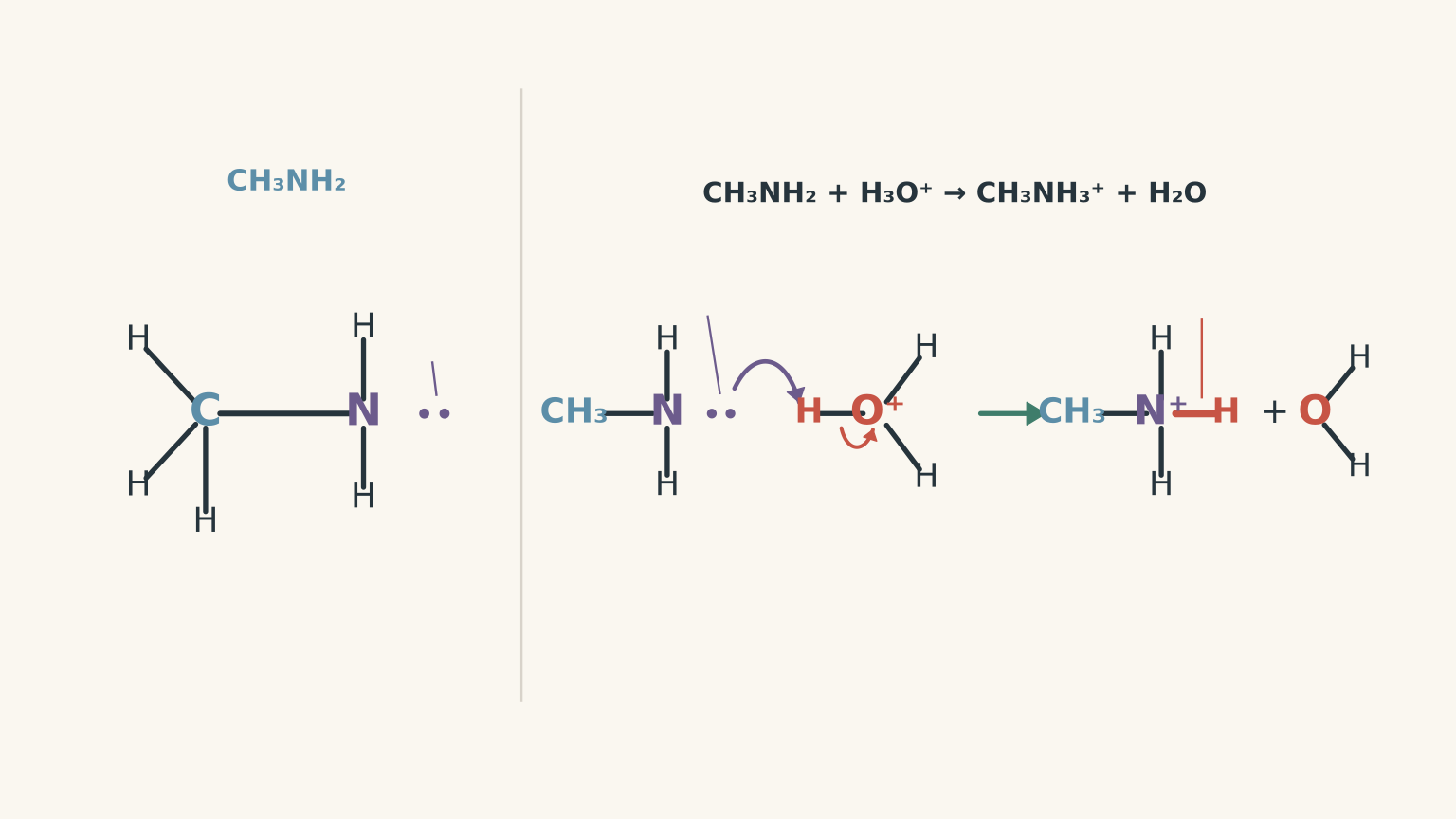
Methylamine contains a nitrogen atom with a lone pair of electrons.
This lone pair can accept a proton, so methylamine can act as a Brønsted-Lowry base.
Step 2
Methylamine accepts a proton from water:
\[ \ce{CH3NH2 + H2O <=> CH3NH3+ + OH^-} \]
Step 3
- \(\ce{CH3NH2}\) accepts a proton, so it is the base.
- \(\ce{H2O}\) donates a proton, so it is the acid.
Step 4
Methylamine gains a proton to become methylammonium:
\[ \ce{CH3NH3+ / CH3NH2} \]
Water loses a proton to become hydroxide:
\[ \ce{H2O / OH^-} \]
Therefore, methylamine is a base even though its molecular formula contains no hydroxide group.
Due to technical limitations, this figure may display incorrectly or contain inaccuracies. Please check key details against your course materials.
Worked example: Calculate the acid needed to neutralise methylamine
A student titrates 25.0 mL of 0.120 mol L\(^{-1}\) methylamine with 0.0800 mol L\(^{-1}\) hydrochloric acid.
Calculate the volume of hydrochloric acid required to reach the equivalence point. Write the net ionic equation and identify the conjugate acid-base pairs.
Step 1
Use:
\[ n=cV \]
Convert the volume into litres:
\[ 25.0\ \mathrm{mL}=0.0250\ \mathrm{L} \]
Substitute:
\[ \begin{aligned} n&=0.120\times0.0250\\ &=0.00300\ \mathrm{mol} \end{aligned} \]
There are 0.00300 mol of methylamine.
Step 2
Hydrochloric acid supplies hydronium ions in water.
\[ \ce{CH3NH2 + H3O+ -> CH3NH3+ + H2O} \]
One mole of methylamine reacts with one mole of hydronium ions.
The mole ratio is 1:1.
Step 3
At equivalence:
\[ n(\ce{H3O+})=0.00300\ \mathrm{mol} \]
Step 4
Rearrange the concentration formula:
\[ V=\frac{n}{c} \]
Substitute:
\[ \begin{aligned} V&=\frac{0.00300}{0.0800}\\ &=0.0375\ \mathrm{L}\\ &=37.5\ \mathrm{mL} \end{aligned} \]
The required volume is 37.5 mL of hydrochloric acid.
Step 5
Methylamine accepts a proton:
\[ \ce{CH3NH3+ / CH3NH2} \]
Hydronium donates a proton:
\[ \ce{H3O+ / H2O} \]
The important point is that the amount of acid required depends on the initial amount of methylamine and the reaction stoichiometry, not simply on whether methylamine is a strong or weak base.
06Questions and solutions
Question 1
Sodium carbonate dissolves in water and the following equilibrium is established:
\[ \ce{CO3^2- + H2O <=> HCO3^- + OH^-} \]
Identify the Brønsted-Lowry acid and base, and write both conjugate acid-base pairs.
Explain why carbonate is classified as a base even though its formula contains no hydroxide ion.
Solution 1
The carbonate ion is the Brønsted-Lowry base, while water is the Brønsted-Lowry acid.
Carbonate accepts a proton from water:
\[ \ce{CO3^2- -> HCO3^-} \]
Its charge changes from −2 to −1 because it gains a positively charged proton.
Water donates that proton:
\[ \ce{H2O -> OH^-} \]
The conjugate pairs are:
- \(\ce{HCO3^- / CO3^2-}\)
- \(\ce{H2O / OH^-}\)
Carbonate is a base because it accepts a proton, not because it contains hydroxide.
The hydroxide ions in the solution are produced when water loses protons during the equilibrium reaction.
This is a useful example because carbonate contains no hydrogen atoms initially. A base does not need to contain hydrogen or hydroxide to accept a proton.
Question 2
Hydrogen carbonate ions, \(\mathrm{HCO_{3}}^{-}\), participate in two different reactions.
In reaction A:
\[ \ce{HCO3^- + H3O+ -> H2CO3 + H2O} \]
In reaction B:
\[ \ce{HCO3^- + OH^- -> CO3^2- + H2O} \]
A student argues that hydrogen carbonate must always be an acid because it contains hydrogen.
Evaluate this claim.
For each reaction:
- Identify the acid and base.
- Identify both conjugate pairs.
- Explain why the role of hydrogen carbonate changes.
Solution 2
The student’s claim is incorrect. Hydrogen carbonate acts as a base in reaction A and an acid in reaction B.
Reaction A
\[ \ce{HCO3^- + H3O+ -> H2CO3 + H2O} \]
Hydrogen carbonate gains a proton to form carbonic acid.
Therefore:
- Base: \(\mathrm{HCO_{3}}^{-}\)
- Acid: \(\ce{H3O+}\)
The conjugate pairs are:
- \(\ce{H2CO3 / HCO3^-}\)
- \(\ce{H3O+ / H2O}\)
Reaction B
\[ \ce{HCO3^- + OH^- -> CO3^2- + H2O} \]
Hydrogen carbonate loses a proton to form carbonate.
Therefore:
- Acid: \(\mathrm{HCO_{3}}^{-}\)
- Base: \(\mathrm{OH}^{-}\)
The conjugate pairs are:
- \(\ce{HCO3^- / CO3^2-}\)
- \(\ce{H2O / OH^-}\)
Hydrogen carbonate changes its role because the reaction partner changes.
With hydronium, it accepts a proton. With hydroxide, it donates a proton.
A species that can both donate and accept protons is called amphiprotic.
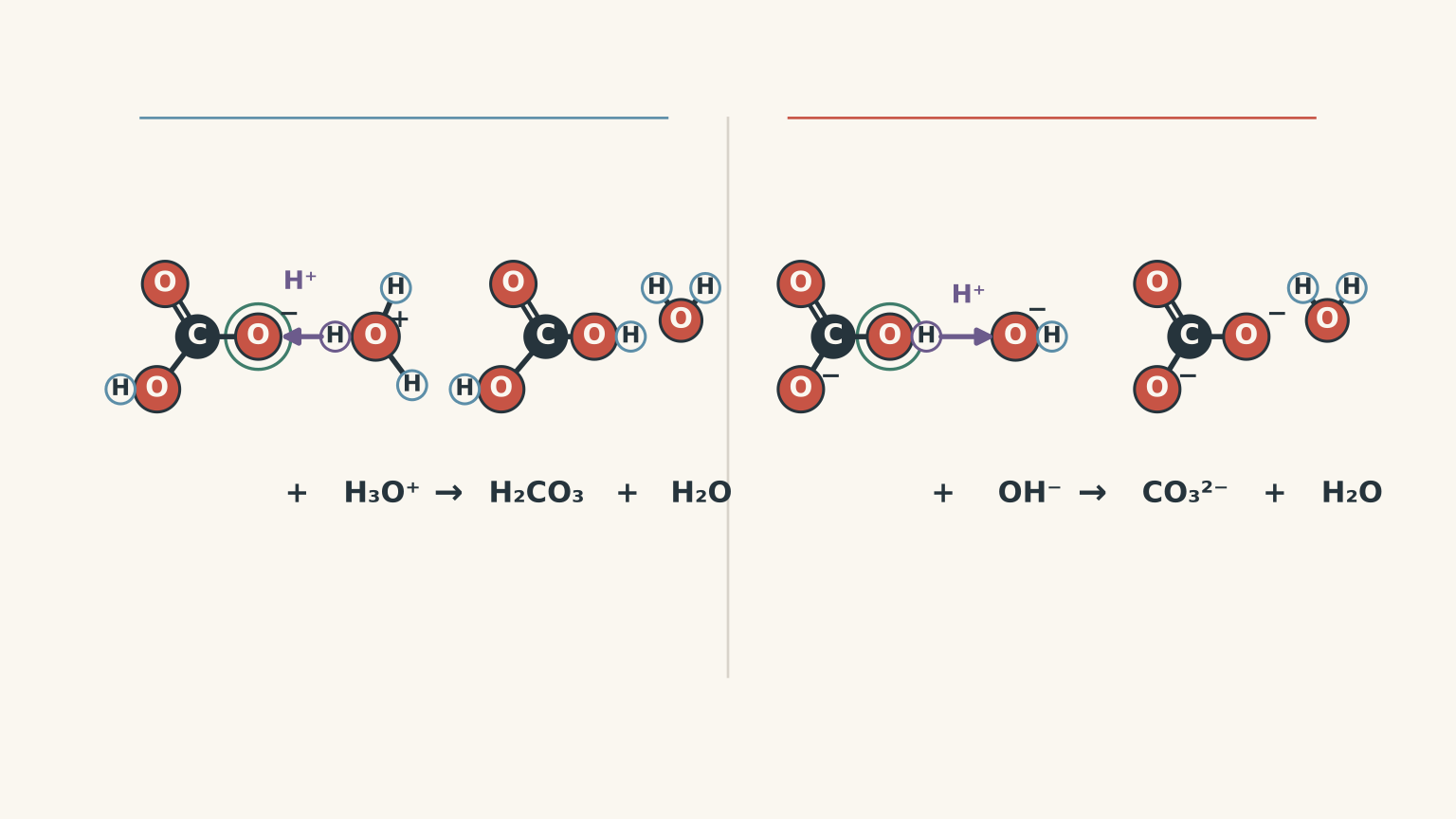
Due to technical limitations, this figure may display incorrectly or contain inaccuracies. Please check key details against your course materials.
The presence of a hydrogen atom is not enough to classify a substance as an acid. You must establish whether that hydrogen is actually transferred in the reaction.
Question 3
A student has 15.0 mL of 0.120 mol L\(^{-1}\) sodium carbonate solution.
The solution is titrated with 0.100 mol L\(^{-1}\) hydrochloric acid until the second equivalence point is reached. At this point, all carbonate ions have been converted into carbonic acid.
Calculate the volume of hydrochloric acid required.
Explain why two moles of hydrochloric acid are required per mole of carbonate ions.
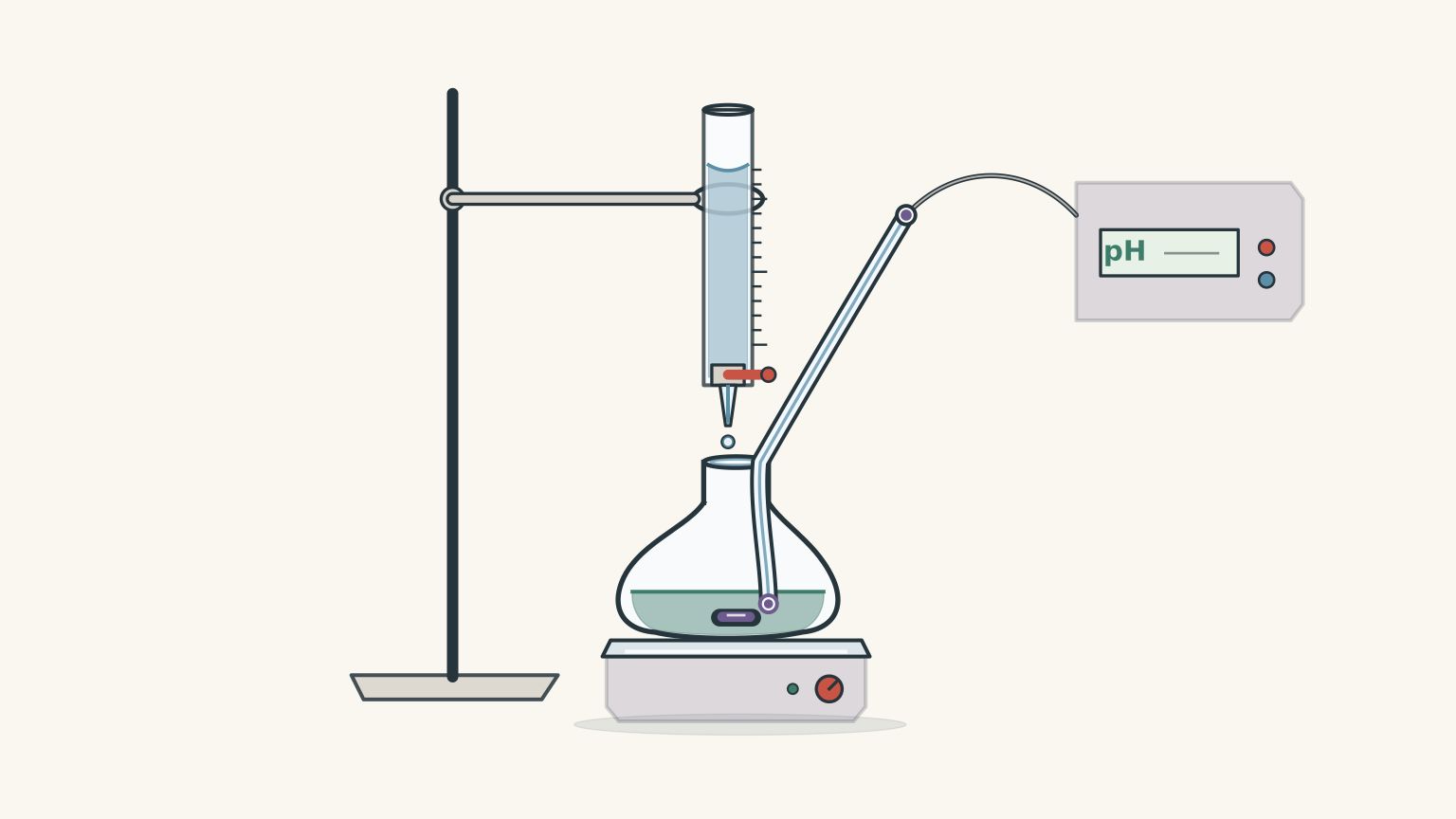
Due to technical limitations, this figure may display incorrectly or contain inaccuracies. Please check key details against your course materials.
Solution 3
The required volume of hydrochloric acid is 36.0 mL.
The carbonate ion can accept two protons, so two moles of hydronium ions are required for each mole of carbonate ions.
Step 1: Write the overall reaction.
\[ \ce{CO3^2- + 2H3O+ -> H2CO3 + 2H2O} \]
The mole ratio is:
\[ 1\ \mathrm{mol}\ \mathrm{CO_{3}}^{2-} : 2\ \mathrm{mol}\ \ce{H3O+} \]
Step 2: Calculate the initial amount of carbonate.
\[ n=cV \]
\[ \begin{aligned} n&=0.120\times0.0150\\ &=0.00180\ \mathrm{mol} \end{aligned} \]
Step 3: Calculate the amount of hydronium ions required.
Using the 1:2 mole ratio:
\[ n(\ce{H3O+})=2\times0.00180 \]
\[ n(\ce{H3O+})=0.00360\ \mathrm{mol} \]
Step 4: Calculate the volume of hydrochloric acid.
\[ V=\frac{n}{c} \]
\[ \begin{aligned} V&=\frac{0.00360}{0.100}\\ &=0.0360\ \mathrm{L}\\ &=36.0\ \mathrm{mL} \end{aligned} \]
Therefore, 36.0 mL of hydrochloric acid is required.
The important detail is that carbonate accepts protons in two stages. It first forms hydrogen carbonate, then accepts another proton to form carbonic acid.
Stopping at the first proton transfer would give an incorrect answer because the question specifies the second equivalence point.
Question 4
Two ammonia solutions are prepared at 25°C.
- Solution A contains 40.0 mL of 0.250 mol L\(^{-1}\) ammonia.
- Solution B contains 100.0 mL of 0.100 mol L\(^{-1}\) ammonia.
The base dissociation constant of ammonia is \(1.8\times10^{-5}\).
Determine:
- The amount of ammonia in each solution.
- Which solution has the higher concentration.
- Which solution has the higher pH.
- Whether the two solutions have different base strengths.
Use the approximation \(x\ll c\) when calculating the equilibrium hydroxide concentration.
Solution 4
Both solutions contain 0.0100 mol of ammonia, but solution A has the higher concentration and the higher pH. Their base strengths are identical.
Step 1: Calculate the amount in solution A.
\[ \begin{aligned} n_A&=cV\\ &=0.250\times0.0400\\ &=0.0100\ \mathrm{mol} \end{aligned} \]
Step 2: Calculate the amount in solution B.
\[ \begin{aligned} n_B&=cV\\ &=0.100\times0.100\\ &=0.0100\ \mathrm{mol} \end{aligned} \]
Both solutions contain the same amount of ammonia.
However, solution A contains that amount in a smaller volume.
Therefore, solution A is more concentrated.
Step 3: Compare the hydroxide concentrations.
For ammonia:
\[ \ce{NH3 + H2O <=> NH4+ + OH^-} \]
Using the weak-base approximation:
\[ [\mathrm{OH}^{-}]\approx\sqrt{K_b c} \]
For solution A:
\[ \begin{aligned} [\mathrm{OH}^{-}]_A &\approx\sqrt{(1.8\times10^{-5})(0.250)}\\ &=2.12\times10^{-3}\ \mathrm{mol\,L^{-1}} \end{aligned} \]
For solution B:
\[ \begin{aligned} [\mathrm{OH}^{-}]_B &\approx\sqrt{(1.8\times10^{-5})(0.100)}\\ &=1.34\times10^{-3}\ \mathrm{mol\,L^{-1}} \end{aligned} \]
Step 4: Compare their pH values.
At 25°C:
\[ \mathrm{pH}=14.00-\mathrm{pOH} \]
For solution A:
\[ \begin{aligned} \mathrm{pOH}_A&=-\log(2.12\times10^{-3})\\ &=2.67\\ \mathrm{pH}_A&=11.33 \end{aligned} \]
For solution B:
\[ \begin{aligned} \mathrm{pOH}_B&=-\log(1.34\times10^{-3})\\ &=2.87\\ \mathrm{pH}_B&=11.13 \end{aligned} \]
Solution A has the higher pH because its higher concentration produces a higher equilibrium hydroxide concentration.
Step 5: Compare base strength.
Both solutions contain ammonia at the same temperature.
Therefore, they have the same \(K_b\) and the same base strength.
Changing the concentration does not change the identity or intrinsic strength of the base.
This question separates three ideas:
- Amount: both solutions contain 0.0100 mol.
- Concentration: solution A is more concentrated.
- Strength: both solutions contain the same weak base.
Question 5
Two solutions, A and B, are prepared at 25°C.
Solution A contains 50.0 mL of 0.100 mol L\(^{-1}\) ammonia.
Solution B contains 50.0 mL of sodium hydroxide at a concentration chosen to give exactly the same initial pH as solution A.
You are given:
\[ K_b(\ce{NH3})=1.8\times10^{-5} \]
Assume ideal dilute solutions and that \(x\ll0.100\) mol L\(^{-1}\) when calculating the ammonia equilibrium.
Both solutions are titrated separately with 0.100 mol L\(^{-1}\) hydrochloric acid until complete neutralisation.
Determine:
- The equilibrium hydroxide concentration in solution A.
- The required sodium hydroxide concentration in solution B.
- The volume of hydrochloric acid required to neutralise each solution.
- The ratio of the amounts of acid required.
Finally, explain how the two solutions can have the same initial pH but require such different volumes of hydrochloric acid.
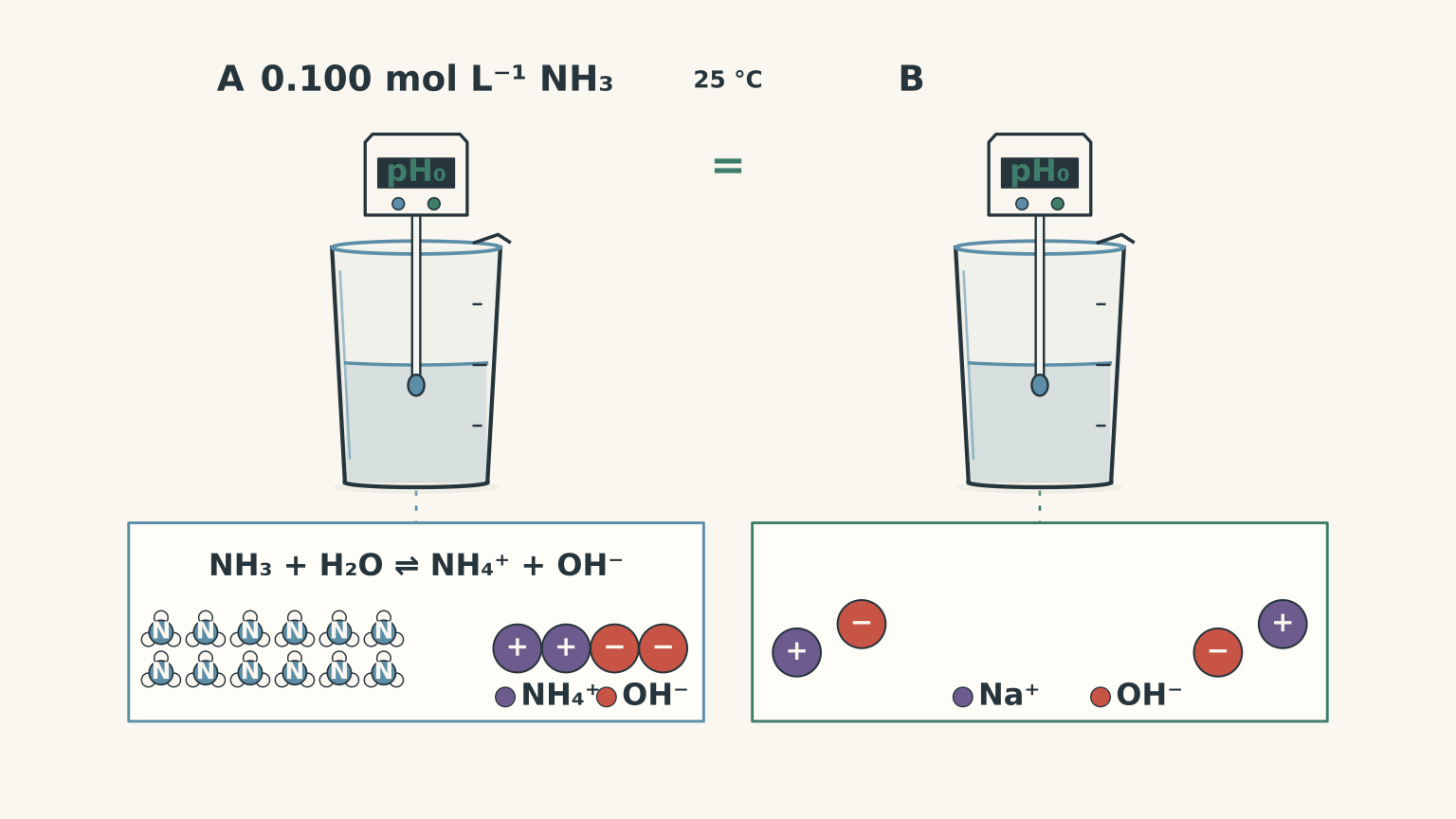
Due to technical limitations, this figure may display incorrectly or contain inaccuracies. Please check key details against your course materials.
Solution 5
Solution A requires approximately 50.0 mL of hydrochloric acid, while solution B requires only 0.670 mL.
Despite having the same initial pH, solution A contains approximately 75 times as much proton-accepting base as solution B.
This is the key distinction between pH and total neutralising capacity.
Step 1: Calculate the equilibrium hydroxide concentration in solution A.
Ammonia reacts with water:
\[ \ce{NH3 + H2O <=> NH4+ + OH^-} \]
The equilibrium expression is:
\[ K_b=\frac{[\ce{NH4+}][\mathrm{OH}^{-}]}{[\ce{NH3}]} \]
Let \(x\) represent the equilibrium hydroxide concentration.
Using the supplied approximation:
\[ \begin{aligned} 1.8\times10^{-5}&\approx\frac{x^2}{0.100}\\ x^2&=(1.8\times10^{-5})(0.100)\\ x&=\sqrt{1.8\times10^{-6}}\\ x&=1.34\times10^{-3}\ \mathrm{mol\,L^{-1}} \end{aligned} \]
Therefore:
\[ [\mathrm{OH}^{-}]_A=1.34\times10^{-3}\ \mathrm{mol\,L^{-1}} \]
Step 2: Determine the sodium hydroxide concentration in solution B.
Sodium hydroxide is a strong base and dissociates essentially completely:
\[ \ce{NaOH -> Na+ + OH^-} \]
Therefore, its hydroxide concentration is approximately equal to its original sodium hydroxide concentration.
Since both solutions have the same initial pH, they have the same hydroxide concentration at 25°C.
Thus:
\[ c_B=1.34\times10^{-3}\ \mathrm{mol\,L^{-1}} \]
Step 3: Calculate the amount of ammonia in solution A.
\[ n_A=cV \]
\[ \begin{aligned} n_A&=0.100\times0.0500\\ &=0.00500\ \mathrm{mol} \end{aligned} \]
Each ammonia molecule can accept one proton.
Therefore, 0.00500 mol of hydrochloric acid is required for complete neutralisation.
Using the acid concentration:
\[ \begin{aligned} V_A&=\frac{0.00500}{0.100}\\ &=0.0500\ \mathrm{L}\\ &=50.0\ \mathrm{mL} \end{aligned} \]
Step 4: Calculate the amount of sodium hydroxide in solution B.
\[ n_B=cV \]
\[ \begin{aligned} n_B&=(1.34\times10^{-3})(0.0500)\\ &=6.70\times10^{-5}\ \mathrm{mol} \end{aligned} \]
The reaction with hydrochloric acid is 1:1.
Therefore:
\[ \begin{aligned} V_B&=\frac{6.70\times10^{-5}}{0.100}\\ &=6.70\times10^{-4}\ \mathrm{L}\\ &=0.670\ \mathrm{mL} \end{aligned} \]
Step 5: Compare the volumes of hydrochloric acid.
\[ \text{Ratio}=\frac{50.0}{0.670} \]
\[ \text{Ratio}\approx74.6 \]
Solution A requires approximately 74.6 times as much hydrochloric acid as solution B.
Step 6: Explain the surprising result.
The tempting conclusion is that two solutions with identical pH values must contain similar amounts of base.
That is incorrect.
The pH measures the equilibrium concentration of hydroxide and hydronium ions. It does not measure the total number of base particles available to react.
In solution A, ammonia is a weak base. Only a small proportion of the ammonia reacts with water to produce hydroxide ions. However, the solution still contains a substantial reservoir of unreacted ammonia molecules that can accept protons when acid is added.
In solution B, sodium hydroxide is a strong base. It dissociates essentially completely, but its concentration is much lower.
Consequently:
- Solution A contains more total base and has a higher neutralising capacity.
- Solution B contains less total base, even though its initial pH is identical.
- Ammonia is the weaker base, while sodium hydroxide is the stronger base.
The surprising result comes from confusing the equilibrium concentration of hydroxide ions with the total amount of base available to react.
This is why pH, concentration, amount, and strength must be treated as separate properties.
07Where to go next
Once you can recognise a base by its ability to accept a proton, the next useful step is recognising species that can also donate one.
Hydrogen carbonate, \(\mathrm{HCO_{3}}^{-}\), is a good example. It can act as either an acid or a base depending on its reaction partner.
That leads directly to amphiprotic substances and their conjugate pairs, which are important when analysing more complicated HSC acid-base reactions.
Continue with How to Distinguish Amphiprotic from Amphoteric in HSC Chemistry.