
Why Oxidation Always Occurs at the Anode in Electrochemical Cells
Find out why the anode is always the site of oxidation, even though it is negative in galvanic cells and positive in electrolytic cells. Learn to identify electrode reactions, interpret ion movement, and use standard reduction potentials without confusing them with measured cell voltages.
A zinc-copper galvanic cell has a negative anode. A copper-plating cell has a positive anode. How can both electrodes be called anodes if they have opposite charges?
The answer is that anode does not mean positive electrode or negative electrode. It means the electrode where oxidation occurs. Oxidation is the loss of electrons, and this happens at the anode in every electrochemical cell.
The distinction is important because electrochemical cells can operate in opposite ways. Some produce electrical energy through spontaneous chemical reactions, while others use an external power supply to force chemical reactions to occur. The electrode polarities change, but the definitions of anode and cathode do not.
01Why oxidation always occurs at the anode
Start with two rules:
- Oxidation is the loss of electrons.
- Reduction is the gain of electrons.
For example, consider a zinc atom becoming a zinc ion:
\[ \ce{Zn(s) -> Zn^2+(aq) + 2e^-} \]
The zinc atom loses two electrons. It has been oxidised.
Now consider a copper ion becoming a copper atom:
\[ \ce{Cu^2+(aq) + 2e^- -> Cu(s)} \]
The copper ion gains two electrons. It has been reduced.
In an electrochemical cell, these reactions occur at different electrodes:
| Electrode | Reaction | What happens to electrons? |
|---|---|---|
| Anode | Oxidation | Electrons are released into the electrode |
| Cathode | Reduction | Electrons are transferred from the electrode to reacting species |
This is the defining relationship. The IUPAC Gold Book defines an anode as the electrode at which oxidation takes place.
Think of each electrode as an electron hand-off point.
At the anode, a reacting species transfers electrons to the conducting electrode. At the cathode, another species accepts electrons from the electrode.
The analogy has one limitation: electrons travel through the metal and external wires, while ions carry charge through the electrolyte. Electrons do not travel through the salt bridge.
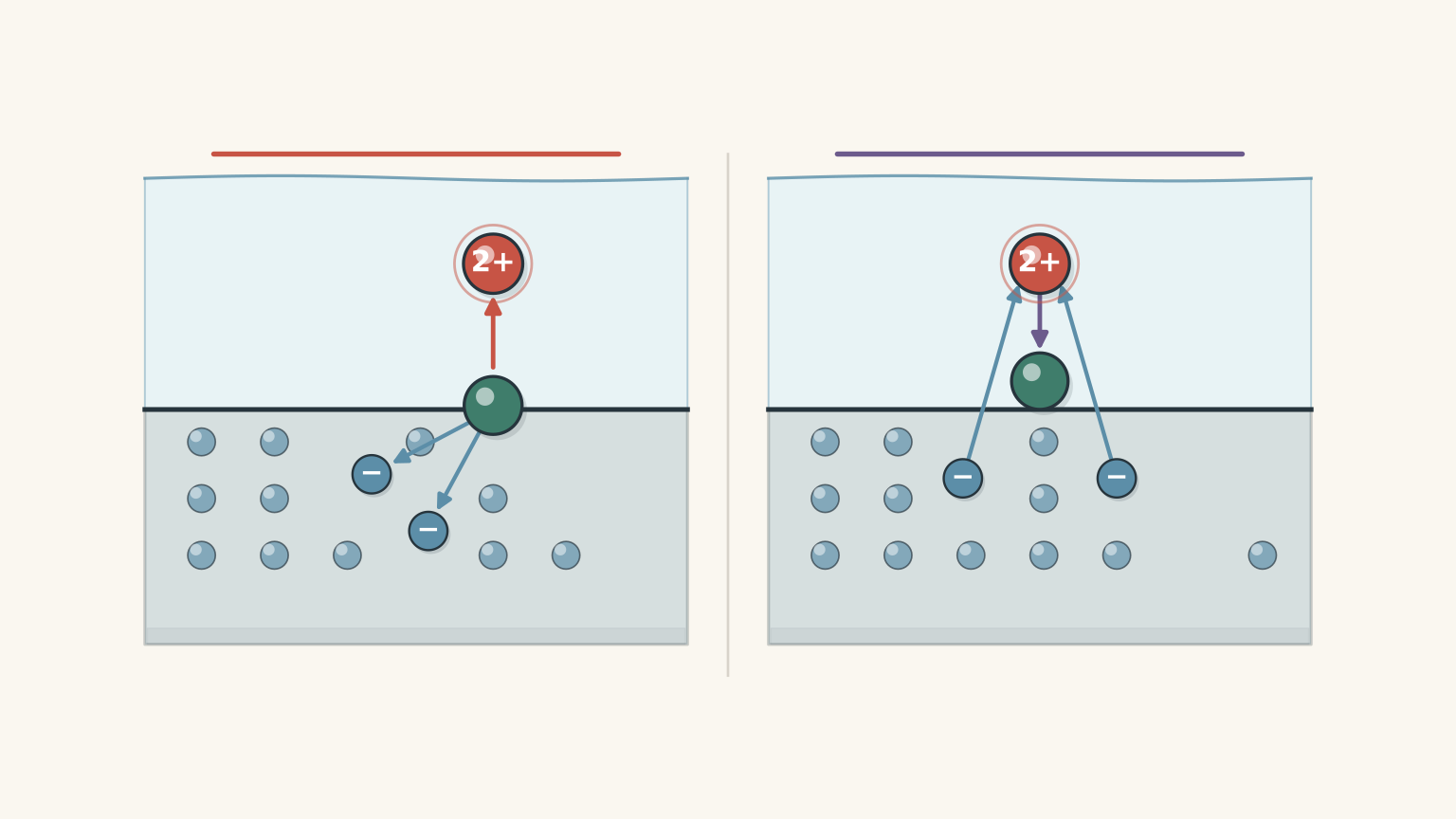
Due to technical limitations, this figure may display incorrectly or contain inaccuracies. Please check key details against your course materials.
The reason oxidation occurs at the anode in every electrochemical cell is therefore straightforward: the name identifies the location of the oxidation half-reaction. It is not a label assigned according to the electrode’s electrical charge.
02Where did the names anode and cathode come from?
There is an interesting historical reason these terms can be confusing.
In 1834, Michael Faraday was investigating electrolysis. He needed a consistent vocabulary to describe the electrodes, the electrolyte, and the particles moving through it.
William Whewell, a scientist and scholar, suggested several terms that Faraday adopted, including anode, cathode, anion, and cation.
In their correspondence, Whewell connected the terminology to the direction of ion movement:
- Anions were the particles that moved towards the anode.
- Cations were the particles that moved towards the cathode.
The original terminology developed in the context of electrolysis, where the electrodes were connected to an external source of electricity.
You can read Whewell’s original 1834 correspondence with Faraday, alongside this historical account in Nature.
The important distinction is between the historical naming context and the modern chemical definition. Today, the reaction at the electrode determines its name:
- Anode: oxidation.
- Cathode: reduction.
This remains true even when the electrical polarity changes.
03Compare the two types of electrochemical cells
To understand why the anode can be positive in one cell and negative in another, we need to look at how each cell operates.
1. Galvanic cells: the anode is negative
A galvanic cell produces electrical energy from a spontaneous redox reaction.
Consider a familiar zinc-copper cell.
The apparatus consists of:
- A zinc strip immersed in a zinc sulfate solution in one beaker.
- A copper strip immersed in a copper sulfate solution in another beaker.
- A wire connecting the two metal strips through a voltmeter.
- A salt bridge connecting the two solutions and allowing ions to move between the half-cells.
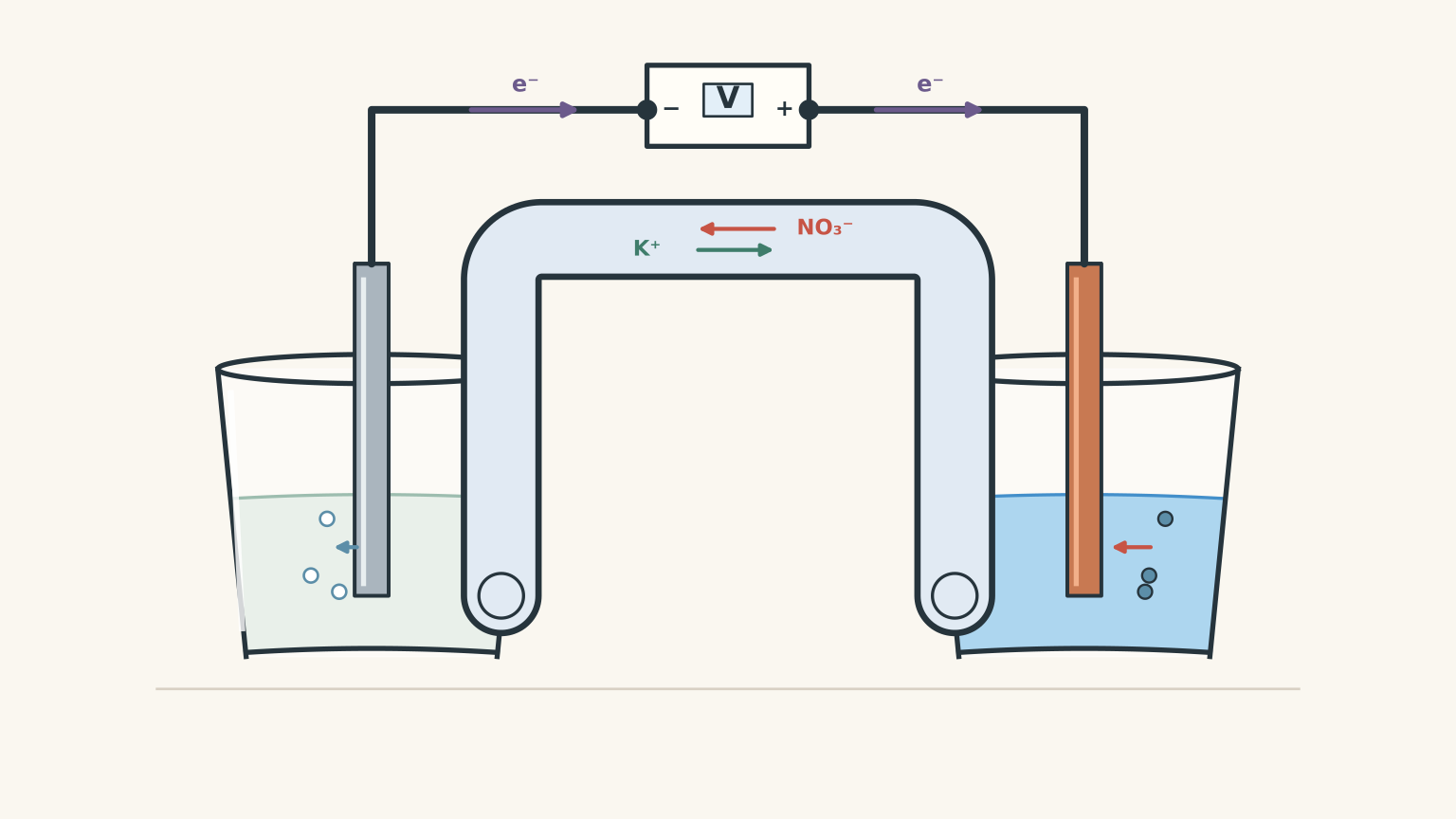
Due to technical limitations, this figure may display incorrectly or contain inaccuracies. Please check key details against your course materials.
When the cell operates, zinc atoms lose electrons and enter the solution as zinc ions.
The oxidation half-equation is:
\[ \ce{Zn(s) -> Zn^2+(aq) + 2e^-} \]
This happens at the zinc electrode, making it the anode.
The electrons travel through the external wire towards the copper electrode.
At the copper electrode, copper ions gain electrons and form solid copper:
\[ \ce{Cu^2+(aq) + 2e^- -> Cu(s)} \]
This is reduction, so the copper electrode is the cathode.
Notice what happens to the electrode charges.
The zinc electrode releases electrons into the external circuit, making it negative relative to the copper electrode. The copper electrode receives electrons through the circuit, making it positive relative to the zinc electrode.
Therefore:
- Zinc is the negative anode.
- Copper is the positive cathode.
Oxidation still occurs at the anode. Nothing about the definition has changed.
What happens to the ions?
Electrons travel through the external wire, but ions must also move through the electrolyte to maintain electrical neutrality.
At the zinc electrode, zinc ions enter the solution. This increases the positive charge in that half-cell.
Anions from the salt bridge, such as \(\mathrm{NO_{3}}^{-}\), move towards the zinc compartment to balance the additional positive charge.
At the copper electrode, copper ions are removed from the solution as they become solid copper. Cations from the salt bridge, such as \(\mathrm{K}^{+}\), move towards the copper compartment to compensate.
This gives us an important distinction:
- Electrons move through the external circuit.
- Ions move through the electrolyte and salt bridge.
The salt bridge does not carry electrons. It completes the circuit by allowing ionic movement.
2. Electrolytic cells: the anode is positive
Now consider an electrolytic cell.
Unlike a galvanic cell, an electrolytic cell requires an external power supply to drive a non-spontaneous chemical reaction.
A useful example is the electrolysis of copper(II) sulfate using copper electrodes.
The apparatus consists of a beaker containing aqueous copper(II) sulfate and two copper strips immersed in the solution.
The strips are connected to a direct-current power supply:
- The positive terminal connects to one copper strip.
- The negative terminal connects to the other copper strip.
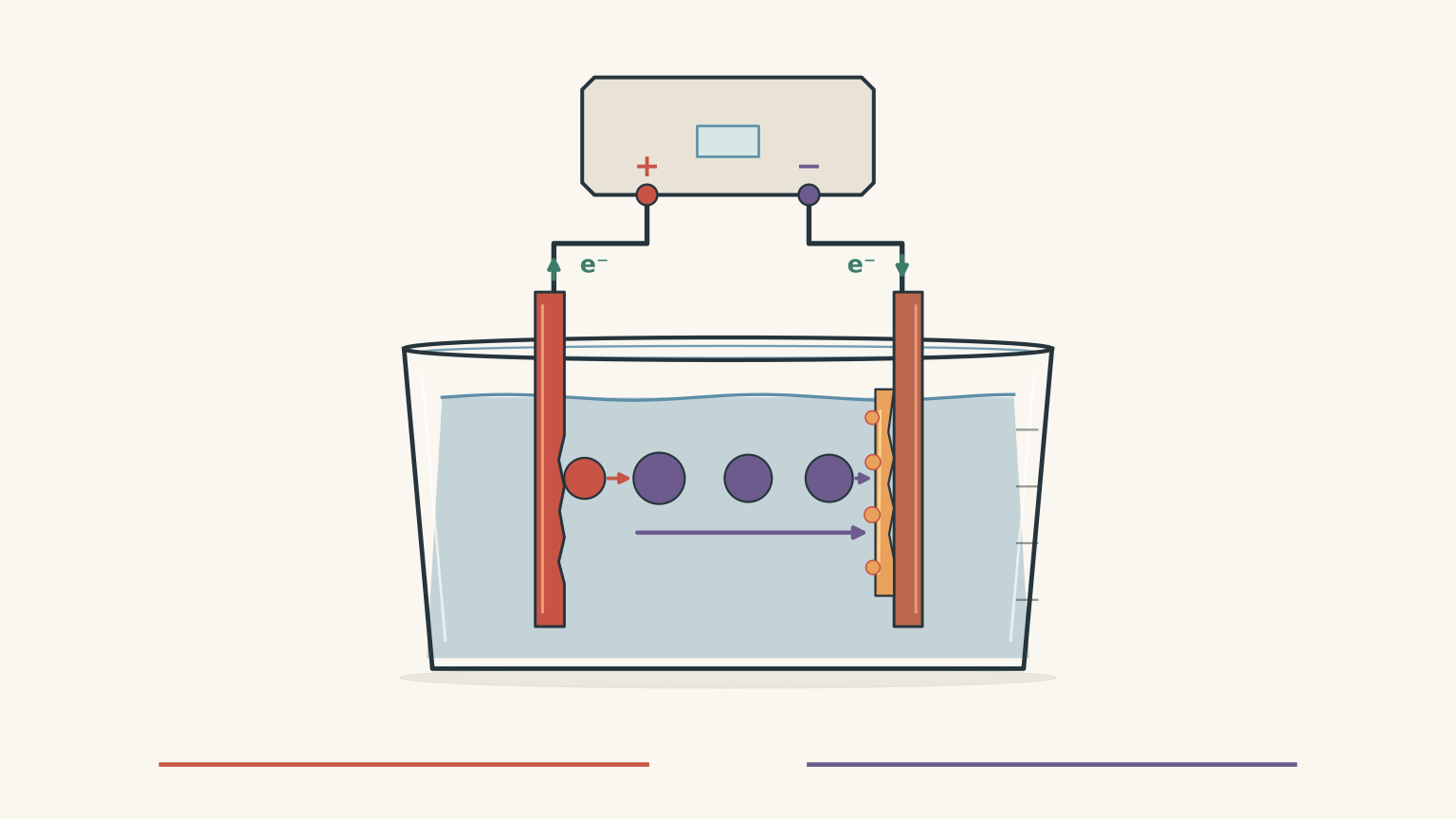
Due to technical limitations, this figure may display incorrectly or contain inaccuracies. Please check key details against your course materials.
What do you predict happens to the copper strips?
The positive electrode loses copper atoms as they become copper ions in solution:
\[ \ce{Cu(s) -> Cu^2+(aq) + 2e^-} \]
This is oxidation.
Therefore, the positive electrode is the anode.
At the negative electrode, copper ions gain electrons and become solid copper:
\[ \ce{Cu^2+(aq) + 2e^- -> Cu(s)} \]
This is reduction, so the negative electrode is the cathode.
The observable results are:
- The anode loses mass as copper dissolves.
- The cathode gains mass as copper is deposited.
The power supply removes electrons from the anode through its positive terminal and supplies electrons to the cathode through its negative terminal.
The reactions are the same type of electron transfer as in the galvanic cell, but the external power supply now drives the process.
The anode is positive because it is connected to the positive terminal of the power supply. It is still the anode because oxidation occurs there.
Compare galvanic and electrolytic cells
| Feature | Galvanic cell | Electrolytic cell |
|---|---|---|
| Energy conversion | Chemical to electrical | Electrical to chemical |
| Reaction | Spontaneous | Non-spontaneous |
| Anode reaction | Oxidation | Oxidation |
| Anode charge | Negative | Positive |
| Cathode reaction | Reduction | Reduction |
| Cathode charge | Positive | Negative |
| Energy source | Spontaneous redox reaction | External power supply |
The most important pattern is that the electrode reactions never change their definitions.
Anode = oxidation. Cathode = reduction.
Only the electrode polarities change.
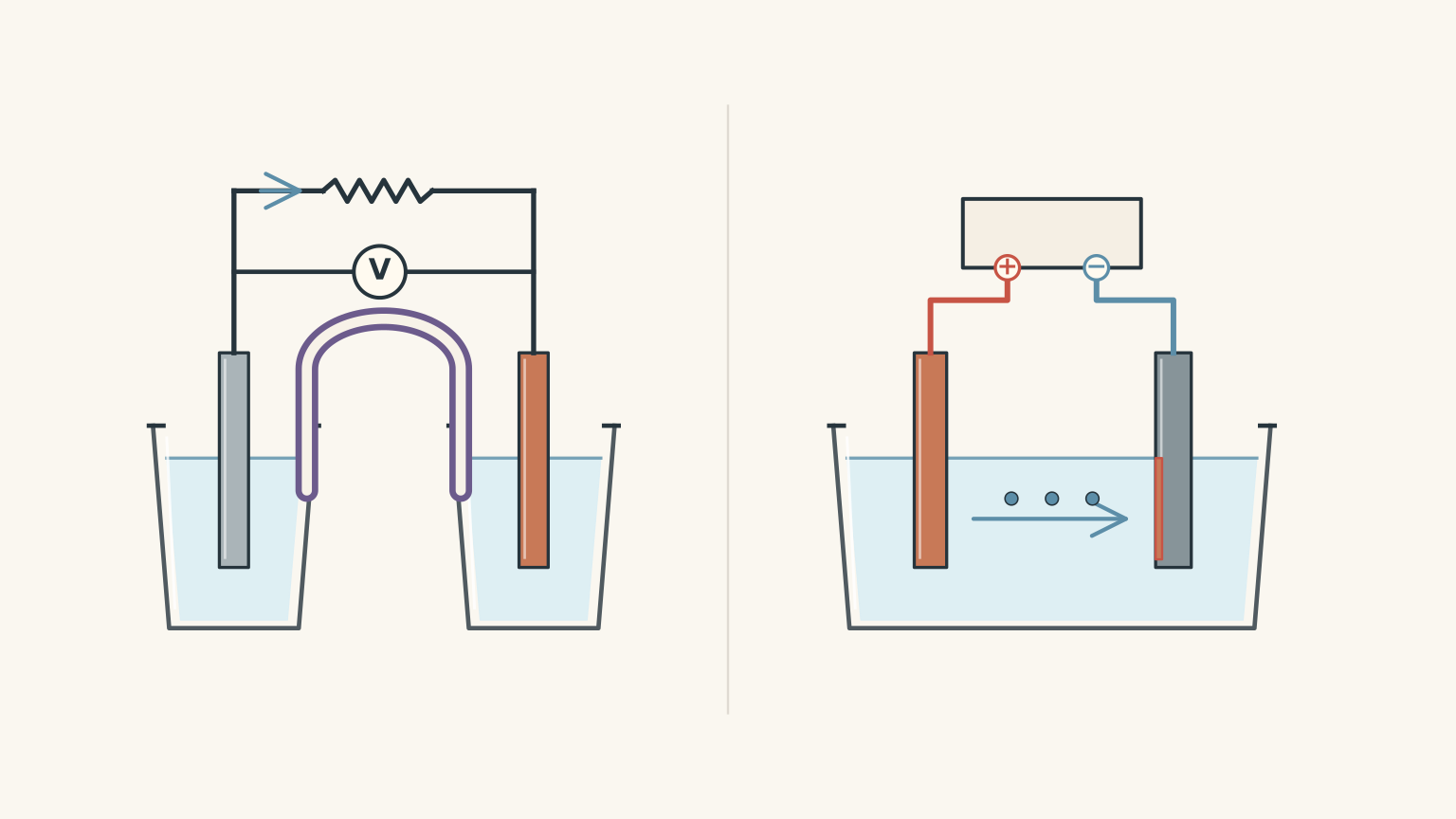
Due to technical limitations, this figure may display incorrectly or contain inaccuracies. Please check key details against your course materials.
04How do ions move towards the anode?
The movement of ions provides another useful way to understand electrochemical cells, but it can also create a common misconception.
In an electrolytic cell:
- Anions, which are negatively charged, migrate towards the positive anode.
- Cations, which are positively charged, migrate towards the negative cathode.
This happens because opposite electrical charges attract.
However, arriving at an electrode does not guarantee that an ion will be discharged there.
For example, during electrolysis of aqueous copper(II) sulfate with inert graphite electrodes, copper ions can be reduced at the cathode:
\[ \ce{Cu^2+(aq) + 2e^- -> Cu(s)} \]
At the anode, water is oxidised, producing oxygen gas:
\[ \ce{2H2O(l) -> O2(g) + 4H+(aq) + 4e^-} \]
Sulfate ions migrate towards the anode, but they are not the species being oxidised in this example.
The electrode material and the species available in solution influence which electrode reaction occurs.
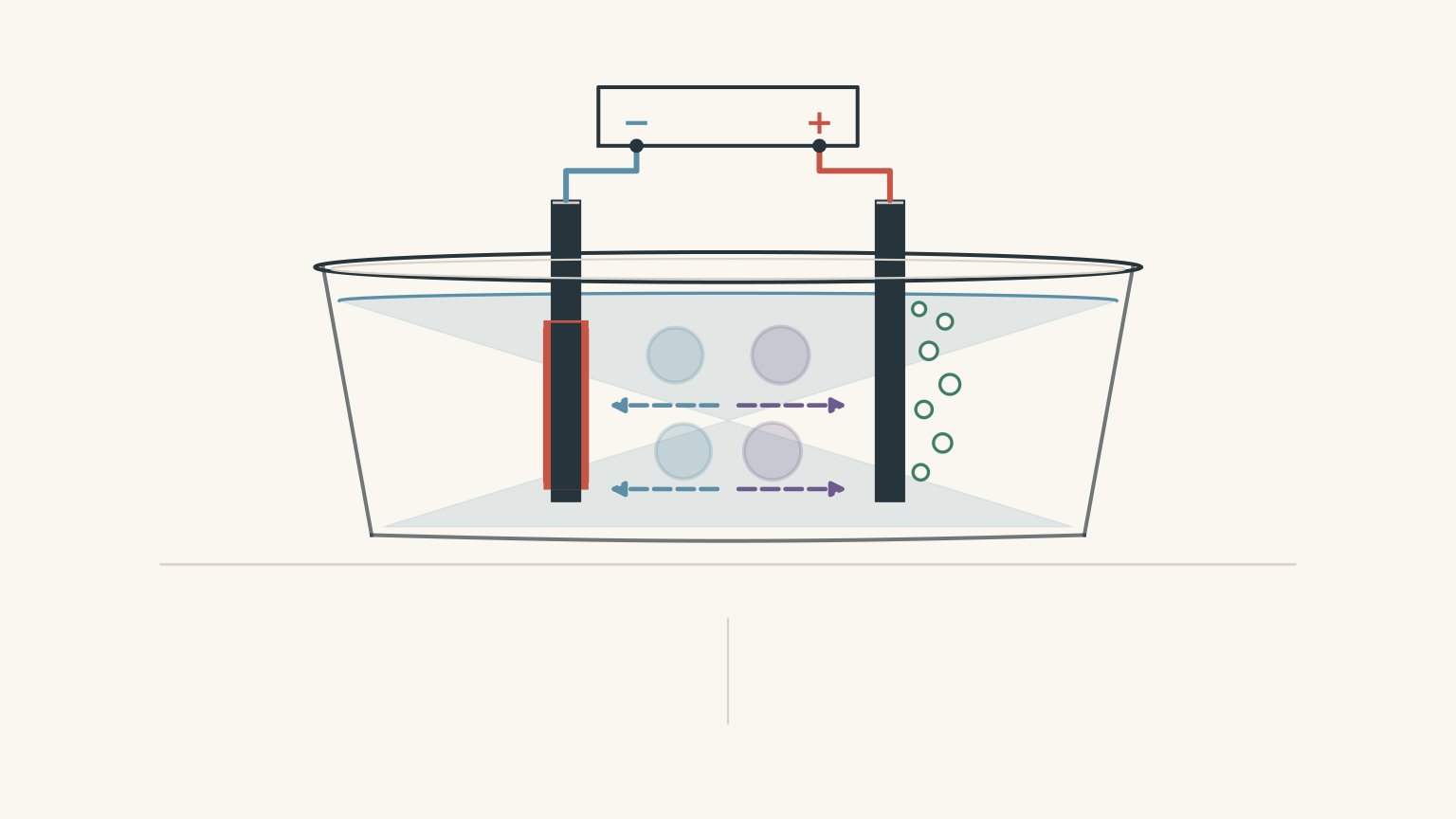
Due to technical limitations, this figure may display incorrectly or contain inaccuracies. Please check key details against your course materials.
In a galvanic cell with a salt bridge, the situation is slightly different.
Anions migrate towards the anode compartment to balance the positive ions produced by oxidation. Cations migrate towards the cathode compartment to compensate for positive ions being consumed during reduction.
Do not confuse these two ideas:
- Ion migration describes where charged particles move.
- Oxidation and reduction describe what happens to electrons during chemical reactions.
The anode is identified by oxidation, not simply by the presence of anions.
05How standard reduction potentials help identify the anode
So far, we have identified the anode by looking directly at the electrode reactions.
But what if a question gives you a table of standard reduction potentials and asks you to predict which electrode is the anode?
You need to understand the convention used in these tables.
A standard reduction potential, written as \(E^\circ\), measures the tendency of a chemical species to undergo reduction by gaining electrons.
Standard reduction potential tables list half-equations in the reduction direction.
For example:
| Reduction half-equation | Standard reduction potential |
|---|---|
| \(\ce{Ag+ + e^- -> Ag}\) | +0.80 V |
| \(\ce{Cu^2+ + 2e^- -> Cu}\) | +0.34 V |
| \(\ce{Zn^2+ + 2e^- -> Zn}\) | -0.76 V |
| \(\ce{Al^3+ + 3e^- -> Al}\) | -1.66 V |
| \(\ce{Mg^2+ + 2e^- -> Mg}\) | -2.37 V |
Values are illustrative standard reduction potentials, rounded to two decimal places.
A more positive reduction potential indicates a greater tendency for reduction under standard conditions, relative to the standard hydrogen electrode.
For a spontaneous galvanic cell under standard conditions:
- The half-reaction with the more positive reduction potential occurs as reduction at the cathode.
- The other half-reaction is reversed, so that oxidation occurs at the anode.
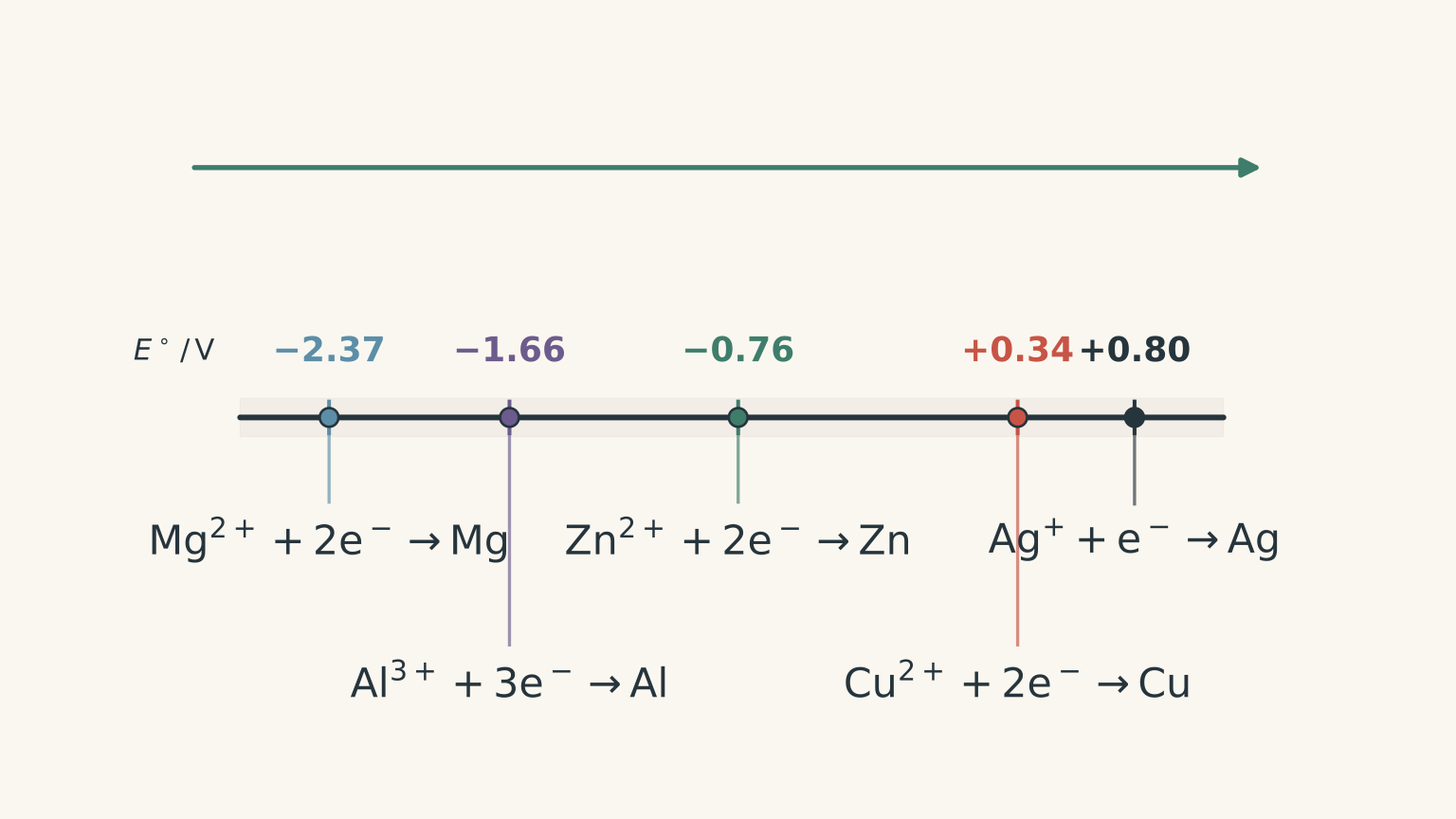
Due to technical limitations, this figure may display incorrectly or contain inaccuracies. Please check key details against your course materials.
What are standard conditions?
Standard reduction potentials are reference values measured under specified standard-state conditions.
At HSC level, the usual conventions are:
- Temperature: 25°C or 298 K.
- Aqueous solutions: 1.0 mol L⁻¹.
- Gases: 100 kPa.
- Pure solids and liquids: their standard states.
Strictly, dissolved species are described using unit activity, with 1.0 mol L⁻¹ serving as the usual school-level approximation.
All standard electrode potentials are measured relative to the standard hydrogen electrode, which is assigned a potential of 0.00 V.
This matters because a real electrochemical cell is rarely constructed under perfectly standard conditions.
If the concentration of an ion changes, the electrode potential can also change. Temperature and gas pressure can affect it as well.
Therefore, a measured cell voltage does not necessarily equal the calculated standard cell potential.
The cell potential equation
When using a table of standard reduction potentials, calculate the standard cell potential using:
\[ E^\circ_{\mathrm{cell}} = E^\circ_{\mathrm{red,cathode}} - E^\circ_{\mathrm{red,anode}} \]
Both values are taken from the table in their reduction direction.
Alternatively, you can reverse the anode half-equation and add its oxidation potential to the cathode reduction potential.
Remember two important rules:
- Reversing a half-equation reverses the sign of its electrode potential.
- Multiplying a half-equation by a coefficient to balance electrons does not multiply its electrode potential.
A positive standard cell potential indicates that the reaction, as written, is spontaneous under standard conditions. A negative value indicates that the reaction is non-spontaneous under those conditions.
A negative cell potential does not mean the anode is negative. It describes the thermodynamic favourability of the overall reaction direction.
For a more detailed explanation of the calculation, see How to Calculate Cell Potential from Reduction Potentials.
06Worked examples
Worked example: Identify the anode in a zinc-copper galvanic cell
A galvanic cell contains a zinc electrode in 1.0 mol L⁻¹ zinc sulfate solution and a copper electrode in 1.0 mol L⁻¹ copper sulfate solution.
The standard reduction potentials are:
\[ \begin{aligned} \ce{Zn^2+ + 2e^- &-> Zn} & E^\circ &= -0.76\ \mathrm{V}\\ \ce{Cu^2+ + 2e^- &-> Cu} & E^\circ &= +0.34\ \mathrm{V} \end{aligned} \]
Identify the anode and cathode, write the two half-equations, and calculate the standard cell potential.
Step 1
The more positive reduction potential is for copper:
\[ E^\circ_{\ce{Cu^2+/Cu}}=+0.34\ \mathrm{V} \]
Therefore, copper ions undergo reduction at the cathode.
\[ \ce{Cu^2+(aq) + 2e^- -> Cu(s)} \]
Step 2
Zinc has the less positive reduction potential.
Its reduction half-equation must be reversed to represent oxidation:
\[ \ce{Zn(s) -> Zn^2+(aq) + 2e^-} \]
Zinc is therefore the anode.
Step 3
Use the standard cell potential equation:
\[ E^\circ_{\mathrm{cell}} = E^\circ_{\mathrm{cathode}} - E^\circ_{\mathrm{anode}} \]
Substitute the reduction potentials:
\[ \begin{aligned} E^\circ_{\mathrm{cell}} &=+0.34-(-0.76)\\ &=+0.34+0.76\\ &=\boxed{+1.10\ \mathrm{V}} \end{aligned} \]
Step 4
Because this is a galvanic cell:
- Zinc is the negative anode.
- Copper is the positive cathode.
- Electrons flow through the external wire from zinc to copper.
The positive cell potential confirms that the overall reaction is spontaneous under standard conditions.
The key point is that zinc is identified as the anode because it is oxidised, not simply because it is negative.
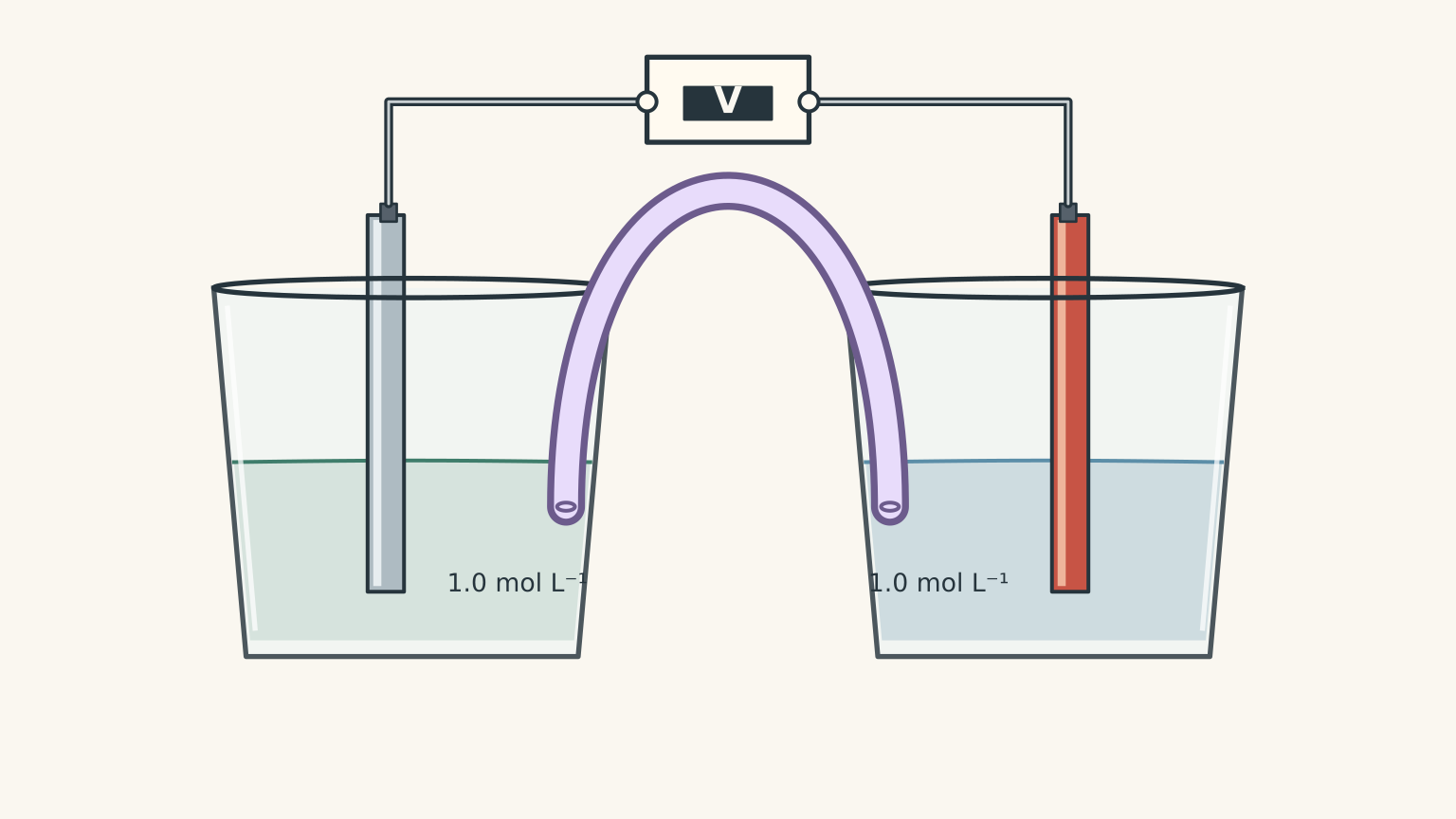
Due to technical limitations, this figure may display incorrectly or contain inaccuracies. Please check key details against your course materials.
Worked example: Calculate cell potential when three electrons must be balanced
An aluminium-silver galvanic cell is constructed using the following half-cells:
\[ \ce{Al^3+(aq) + 3e^- -> Al(s)} \]
\[ E^\circ=-1.66\ \mathrm{V} \]
\[ \ce{Ag+(aq) + e^- -> Ag(s)} \]
\[ E^\circ=+0.80\ \mathrm{V} \]
Determine the anode and cathode, write the balanced overall equation, and calculate the standard cell potential.
Step 1
Silver has the more positive standard reduction potential:
\[ +0.80\ \mathrm{V}>-1.66\ \mathrm{V} \]
Therefore, silver ions undergo reduction at the cathode.
\[ \ce{Ag+(aq) + e^- -> Ag(s)} \]
Step 2
Aluminium has the less positive reduction potential, so its half-equation is reversed.
\[ \ce{Al(s) -> Al^3+(aq) + 3e^-} \]
Aluminium is the anode because oxidation occurs there.
Step 3
The aluminium half-equation releases three electrons, while the silver half-equation consumes one electron.
Multiply the silver half-equation by three:
\[ \ce{3Ag+(aq) + 3e^- -> 3Ag(s)} \]
Add the two half-equations:
\[ \ce{Al(s) + 3Ag+(aq) -> Al^3+(aq) + 3Ag(s)} \]
The overall equation is balanced for both atoms and charge.
Step 4
\[ \begin{aligned} E^\circ_{\mathrm{cell}} &=E^\circ_{\mathrm{cathode}} -E^\circ_{\mathrm{anode}}\\ &=+0.80-(-1.66)\\ &=+0.80+1.66\\ &=\boxed{+2.46\ \mathrm{V}} \end{aligned} \]
Notice that we do not multiply the silver reduction potential by three.
Electrode potential is an intensive quantity. It does not change when the half-equation is multiplied to balance electrons.
Step 5
The positive standard cell potential indicates a spontaneous reaction under standard conditions.
Aluminium is the negative anode, where oxidation occurs, and silver is the positive cathode, where reduction occurs.
The balanced equation also shows that two moles of aluminium would release six moles of electrons, which are accepted by six moles of silver ions.

Due to technical limitations, this figure may display incorrectly or contain inaccuracies. Please check key details against your course materials.
07Questions and solutions
The following questions test more than your ability to remember that oxidation occurs at the anode. You will need to interpret electrode reactions, distinguish standard potentials from measured voltages, and recognise when the physical electrode changes its role.
Question 1
A galvanic cell is constructed using magnesium and silver electrodes.
The standard reduction potentials are:
\[ \begin{aligned} \ce{Mg^2+ + 2e^- -> Mg} &\quad E^\circ=-2.37\ \mathrm{V}\\ \ce{Ag+ + e^- -> Ag} &\quad E^\circ=+0.80\ \mathrm{V} \end{aligned} \]
Identify:
a) The anode and cathode.
b) The oxidation and reduction half-equations.
c) The standard cell potential.
d) The direction of electron flow through the external circuit.

Due to technical limitations, this figure may display incorrectly or contain inaccuracies. Please check key details against your course materials.
Solution 1
Magnesium is the anode, silver is the cathode, and the standard cell potential is +3.17 V.
a) Identify the electrodes.
Silver has the more positive reduction potential, so it undergoes reduction at the cathode.
Magnesium has the less positive reduction potential, so its half-equation is reversed and oxidation occurs at the anode.
b) Write the half-equations.
Oxidation at the magnesium anode:
\[ \ce{Mg(s) -> Mg^2+(aq) + 2e^-} \]
Reduction at the silver cathode:
\[ \ce{2Ag+(aq) + 2e^- -> 2Ag(s)} \]
The silver half-equation has been multiplied by two to balance the electrons.
c) Calculate the standard cell potential.
\[ \begin{aligned} E^\circ_{\mathrm{cell}} &=E^\circ_{\mathrm{cathode}} -E^\circ_{\mathrm{anode}}\\ &=+0.80-(-2.37)\\ &=\boxed{+3.17\ \mathrm{V}} \end{aligned} \]
d) Determine electron flow.
Electrons travel from the magnesium electrode to the silver electrode through the external wire.
Magnesium is the negative anode because it releases electrons. Silver is the positive cathode because it accepts electrons.
The positive cell potential confirms that the reaction is spontaneous under standard conditions.
Question 2
An aqueous copper(II) sulfate solution is electrolysed using two inert graphite electrodes.
The positive terminal of a DC power supply is connected to electrode A, and the negative terminal is connected to electrode B.
The experiment produces copper metal at electrode B and oxygen gas at electrode A.
a) Identify the anode and cathode.
b) Write the half-equation occurring at each electrode.
c) Explain why sulfate ions can migrate towards electrode A without being oxidised.
d) Explain how the electrode polarities demonstrate that the anode is not always negative.
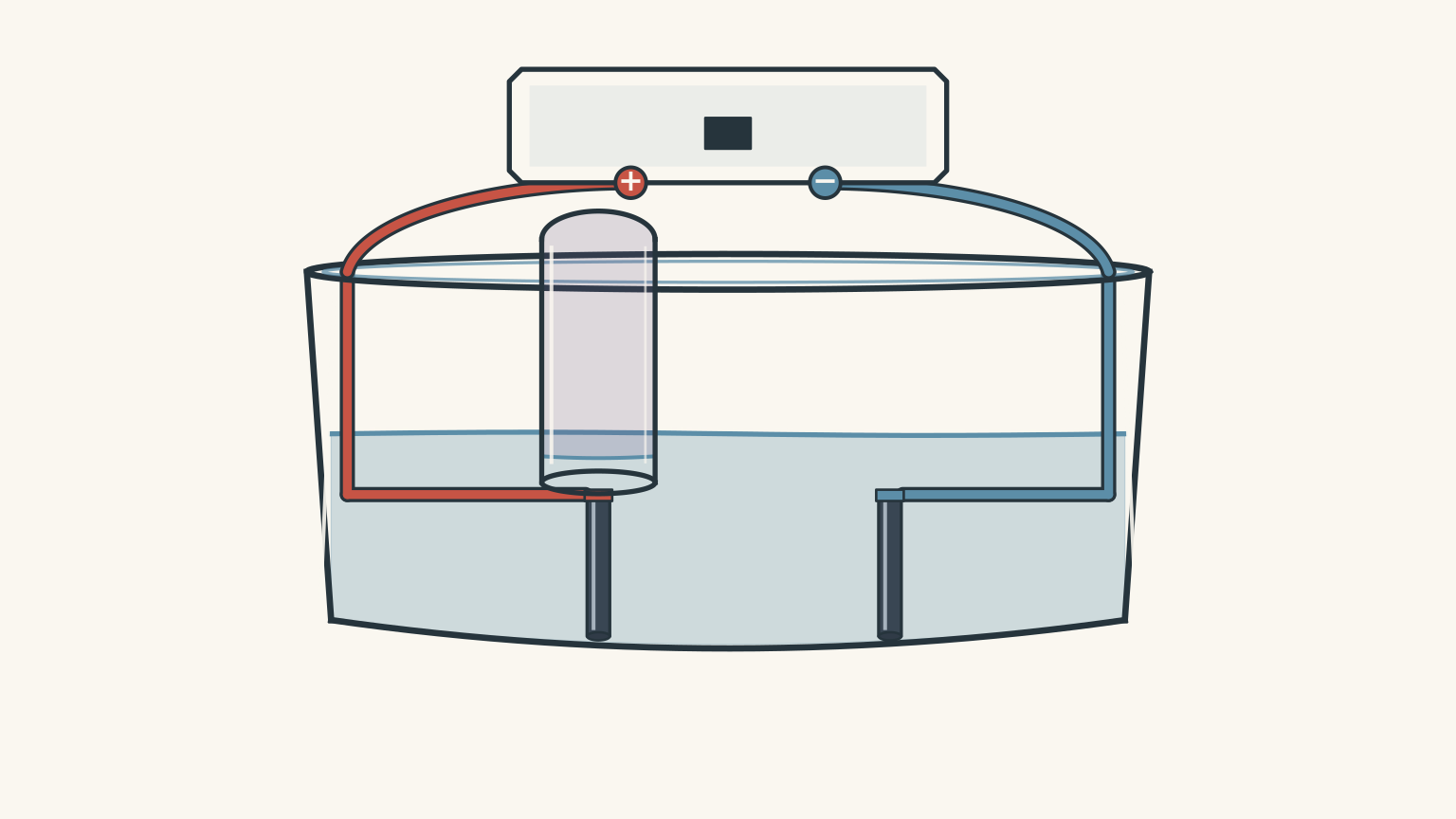
Due to technical limitations, this figure may display incorrectly or contain inaccuracies. Please check key details against your course materials.
Solution 2
Electrode A is the positive anode, and electrode B is the negative cathode. Water is oxidised at A, while copper ions are reduced at B.
a) Identify the electrodes.
Electrode A is connected to the positive terminal of the power supply. It is the anode because oxidation occurs there.
Electrode B is connected to the negative terminal. It is the cathode because reduction occurs there.
b) Write the half-equations.
At the anode, water loses electrons and produces oxygen gas:
\[ \ce{2H2O(l) -> O2(g) + 4H+(aq) + 4e^-} \]
At the cathode, copper ions gain electrons and form solid copper:
\[ \ce{Cu^2+(aq) + 2e^- -> Cu(s)} \]
Both equations represent electron transfer in the correct direction.
c) Explain the movement of sulfate ions.
Sulfate ions are negatively charged, so they migrate towards the positive anode.
However, migration does not mean they must undergo oxidation.
In this experiment, water is oxidised at the anode, producing oxygen gas and hydrogen ions. Sulfate ions remain in solution and help maintain charge balance.
This is why it is incorrect to assume that every anion reaching the anode must be oxidised.
d) Explain the significance of the electrode polarities.
The anode is positive in this electrolytic cell because it is connected to the positive terminal of the external power supply.
Nevertheless, oxidation still occurs there.
This demonstrates that electrode identity depends on the reaction, not the electrical polarity.
Question 3
A student constructs a zinc-copper galvanic cell under the following conditions.
The standard reduction potentials are:
\[ \begin{aligned} \ce{Zn^2+ + 2e^- -> Zn} &\quad E^\circ=-0.76\ \mathrm{V}\\ \ce{Cu^2+ + 2e^- -> Cu} &\quad E^\circ=+0.34\ \mathrm{V} \end{aligned} \]
The experimental conditions and observations are shown below.
Illustrative experimental data (not published measurements):
| Variable | Experimental value |
|---|---|
| Temperature | 22°C |
| Zinc ion concentration | 0.50 mol L⁻¹ |
| Copper ion concentration | 0.10 mol L⁻¹ |
| Voltmeter red lead | Copper electrode |
| Voltmeter black lead | Zinc electrode |
| Initial open-circuit voltage | +1.08 V |
When the cell is operated briefly, the zinc electrode loses mass while the copper electrode gains mass.
A student argues:
“The standard cell potential is +1.10 V, but the measured voltage is only +1.08 V. Therefore, the zinc electrode cannot be the anode.”
Evaluate the student’s reasoning. Identify the anode and cathode, and explain the difference between the calculated standard cell potential and the experimental measurement.
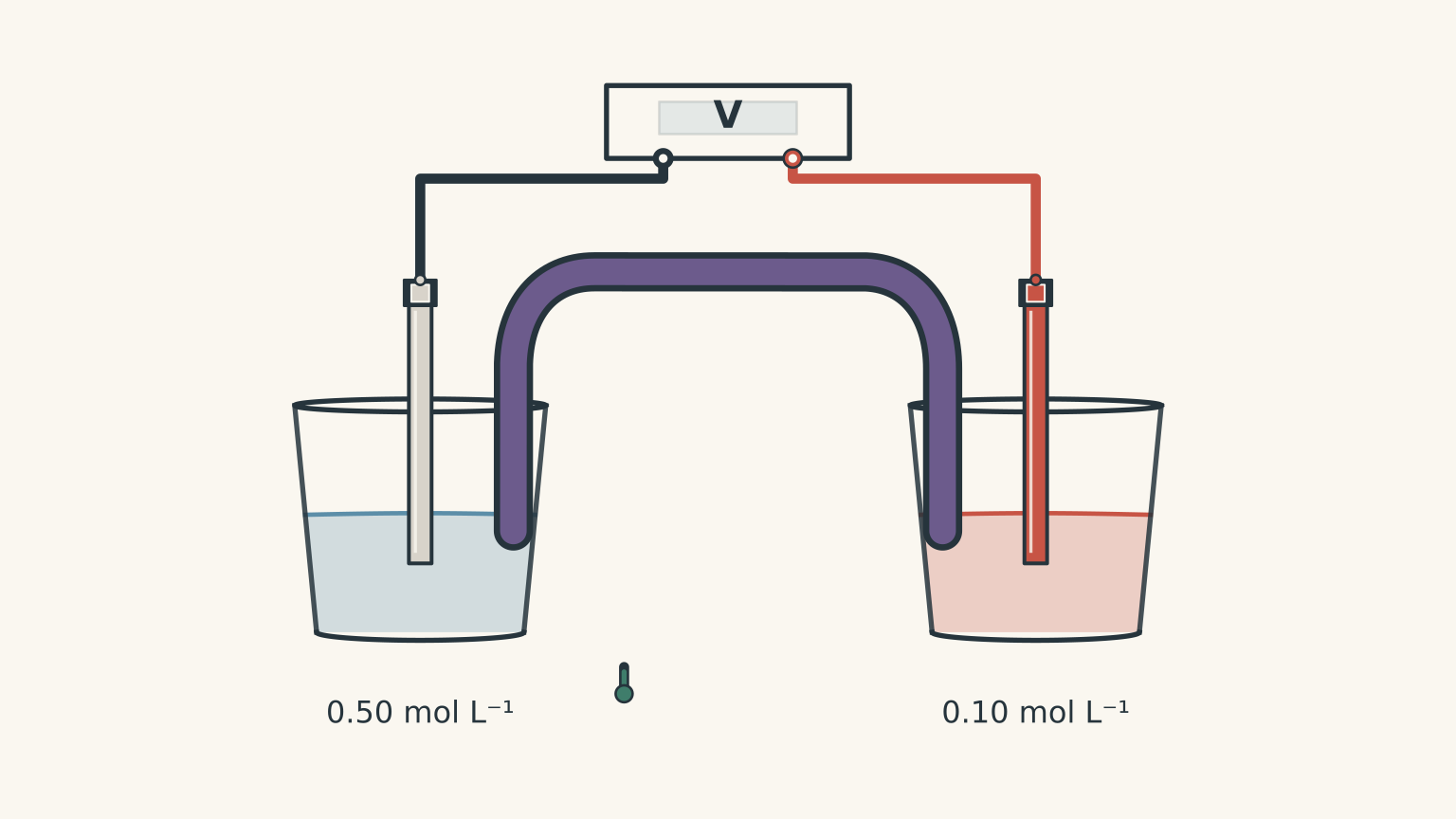
Due to technical limitations, this figure may display incorrectly or contain inaccuracies. Please check key details against your course materials.
Solution 3
The student is incorrect. Zinc remains the anode, and copper remains the cathode. The measured voltage does not need to equal the standard cell potential.
Step 1: Calculate the standard cell potential.
The standard reduction potential for copper is more positive, so copper undergoes reduction.
Zinc undergoes oxidation.
\[ \begin{aligned} E^\circ_{\mathrm{cell}} &=E^\circ_{\mathrm{cathode}} -E^\circ_{\mathrm{anode}}\\ &=+0.34-(-0.76)\\ &=\boxed{+1.10\ \mathrm{V}} \end{aligned} \]
This is the theoretical standard cell potential under standard conditions.
Step 2: Identify the actual anode and cathode.
The experimental observations provide direct evidence.
The zinc electrode loses mass, meaning zinc atoms enter the solution as zinc ions:
\[ \ce{Zn(s) -> Zn^2+(aq) + 2e^-} \]
This is oxidation, so zinc is the anode.
The copper electrode gains mass because copper ions are reduced and deposited as solid copper:
\[ \ce{Cu^2+(aq) + 2e^- -> Cu(s)} \]
This is reduction, so copper is the cathode.
Step 3: Explain the measured voltage.
The cell is not operating under standard conditions.
The temperature is 22°C rather than 25°C, and neither solution has a concentration of 1.0 mol L⁻¹.
These differences affect the actual electrode potentials and therefore the measured cell voltage.
The high-impedance voltmeter measures the open-circuit potential under the experimental conditions, not the standard cell potential.
A measured voltage of +1.08 V is therefore not inconsistent with a calculated standard potential of +1.10 V.
If the cell were supplying current to a load, internal resistance and electrode overpotentials could also affect the terminal voltage.
Step 4: Interpret the voltmeter reading.
The positive reading means that the copper electrode is at a higher electrical potential than the zinc electrode.
This is consistent with copper being the positive cathode and zinc being the negative anode in the operating galvanic cell.
The student’s mistake is treating the standard potential as an exact prediction of every experimental measurement.
Standard potentials are reference values. Actual electrode reactions and measured potentials depend on the conditions of the cell.
Question 4
A reversible electrochemical cell contains two half-cells with inert graphite electrodes.
The first half-cell contains the \(\ce{Fe^3+/Fe^2+}\) redox couple, and the second contains the \(\ce{I2/I^-}\) redox couple.
Their standard reduction potentials are:
\[ \ce{Fe^3+ + e^- -> Fe^2+} \qquad E^\circ=+0.77\ \mathrm{V} \]
\[ \ce{I2 + 2e^- -> 2I^-} \qquad E^\circ=+0.54\ \mathrm{V} \]
Initially, the cell operates spontaneously and produces electrical energy.
The cell is then connected to an external power supply that forces the overall reaction to proceed in the reverse direction.
Assume there are no competing electrode reactions.
a) Identify the anode and cathode during spontaneous operation.
b) Write the balanced overall equation during spontaneous operation.
c) Identify the anode and cathode during charging, when the reaction is forced in reverse.
d) Calculate the standard cell potential for the reverse reaction.
e) Explain why the physical graphite electrodes exchange their anode and cathode roles.
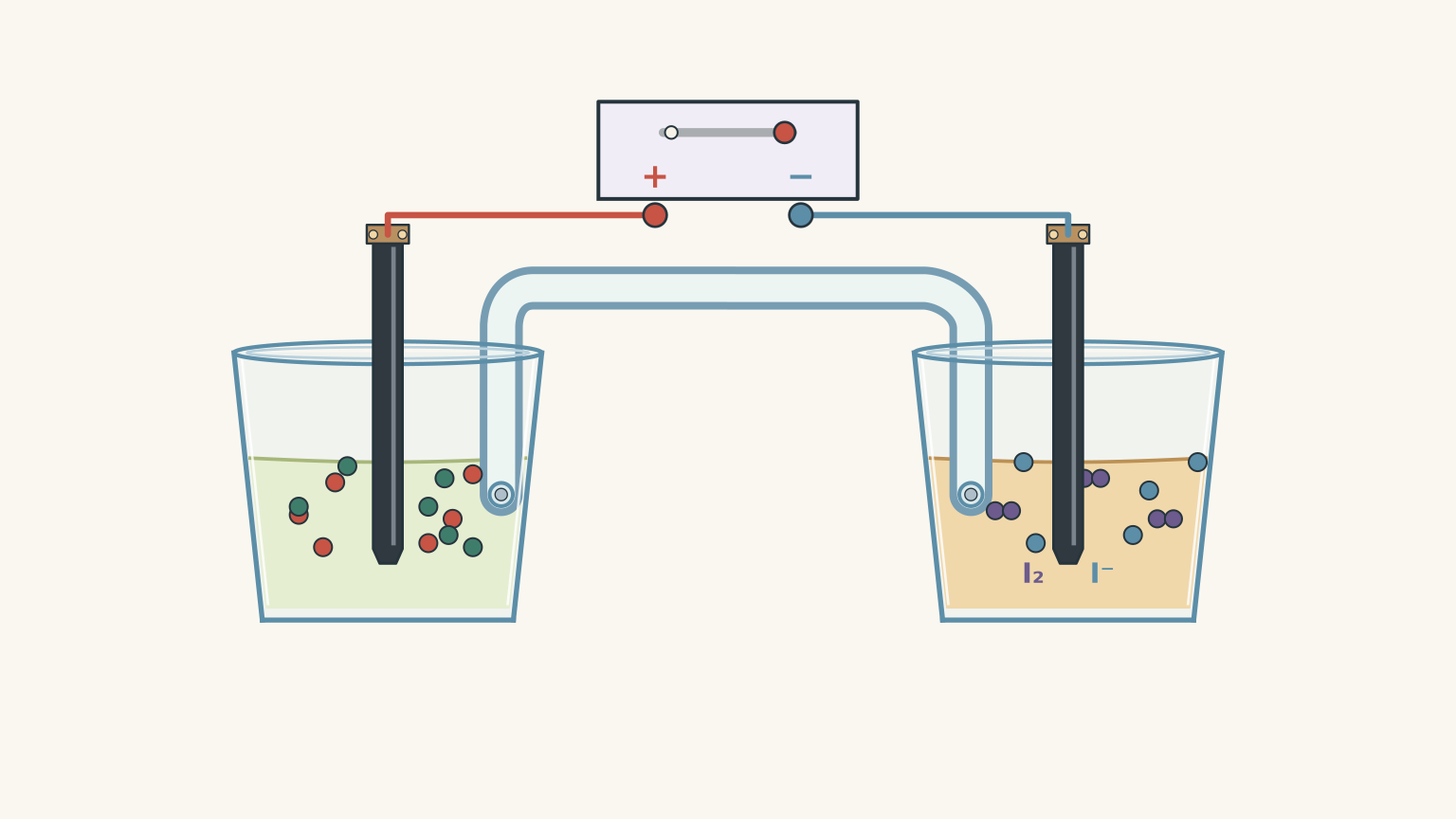
Due to technical limitations, this figure may display incorrectly or contain inaccuracies. Please check key details against your course materials.
Solution 4
During spontaneous operation, the iodine/iodide electrode is the anode and the iron redox electrode is the cathode. During charging, these roles reverse.
a) Identify the electrodes during spontaneous operation.
The iron redox couple has the more positive reduction potential:
\[ +0.77\ \mathrm{V}>+0.54\ \mathrm{V} \]
Therefore, iron(III) ions are reduced at the cathode:
\[ \ce{Fe^3+(aq) + e^- -> Fe^2+(aq)} \]
Iodide ions are oxidised at the anode:
\[ \ce{2I^-(aq) -> I2(aq) + 2e^-} \]
b) Write the balanced overall equation.
Multiply the iron reduction half-equation by two:
\[ \ce{2Fe^3+(aq) + 2e^- -> 2Fe^2+(aq)} \]
Add the half-equations:
\[ \ce{2Fe^3+(aq) + 2I^-(aq) -> 2Fe^2+(aq) + I2(aq)} \]
The standard cell potential is:
\[ \begin{aligned} E^\circ_{\mathrm{cell}} &=+0.77-(+0.54)\\ &=\boxed{+0.23\ \mathrm{V}} \end{aligned} \]
The positive value confirms that this reaction is spontaneous under standard conditions.
c) Identify the electrodes during charging.
The external power supply forces the reaction to reverse.
The iron(II) ions now lose electrons:
\[ \ce{2Fe^2+(aq) -> 2Fe^3+(aq) + 2e^-} \]
Oxidation occurs at the iron redox electrode, making it the anode.
Iodine gains electrons:
\[ \ce{I2(aq) + 2e^- -> 2I^-(aq)} \]
Reduction occurs at the iodine/iodide electrode, making it the cathode.
During charging, the iron electrode is therefore the anode, and the iodine electrode is the cathode.
d) Calculate the standard cell potential for the reverse reaction.
Use the reduction potential for iodine at the cathode and iron at the anode:
\[ \begin{aligned} E^\circ_{\mathrm{cell}} &=E^\circ_{\mathrm{cathode}} -E^\circ_{\mathrm{anode}}\\ &=+0.54-(+0.77)\\ &=\boxed{-0.23\ \mathrm{V}} \end{aligned} \]
The negative value indicates that the reverse reaction is non-spontaneous under standard conditions.
The external power supply must provide sufficient voltage to drive the reaction. In practice, the required voltage is greater than the ideal reversible value because of resistance and electrode overpotentials.
e) Explain why the electrode roles reverse.
The graphite electrodes have not changed their physical identities or positions.
What has changed is the direction of the chemical reaction.
During discharge, iodide is oxidised and iron(III) is reduced.
During charging, iron(II) is oxidised and iodine is reduced.
The anode and cathode are therefore identified by the reactions occurring at the electrodes, not by the physical material or permanent position of the electrodes.
This is an important reason why defining anode as the positive or negative electrode will lead to incorrect answers.
Question 5
A student constructs a concentration cell using two identical copper electrodes.
Both half-cells contain aqueous copper(II) sulfate, but their initial concentrations are different.
The following illustrative experimental conditions apply:
| Variable | Left half-cell | Right half-cell |
|---|---|---|
| Copper electrode | Cu(s) | Cu(s) |
| Initial \(\mathrm{Cu}^{2+}\) concentration | 0.010 mol L⁻¹ | 1.00 mol L⁻¹ |
| Solution volume | 100 mL | 100 mL |
| Temperature | 25°C | 25°C |
The two half-cells are connected by a potassium nitrate salt bridge and an external wire.
Both electrodes have the same standard reduction potential:
\[ \ce{Cu^2+(aq) + 2e^- -> Cu(s)} \]
\[ E^\circ=+0.34\ \mathrm{V} \]
Initially, a high-impedance voltmeter gives an illustrative reading of +0.059 V, with its red lead connected to the right-hand electrode.
A small current then flows through the circuit.
Assume ideal solution behaviour, negligible volume change, and no competing reactions.
a) Identify the anode and cathode, despite both electrodes having identical standard reduction potentials.
b) Write the oxidation and reduction half-equations.
c) Explain why the concentration difference can produce a cell potential even though the standard reduction potentials are identical.
d) Determine the direction of electron flow and the direction of ion movement through the salt bridge.
e) Predict what happens to the two copper ion concentrations as the cell operates.
f) Explain what happens when the two concentrations eventually become equal. Do the original anode and cathode labels still describe ongoing net electrode reactions?
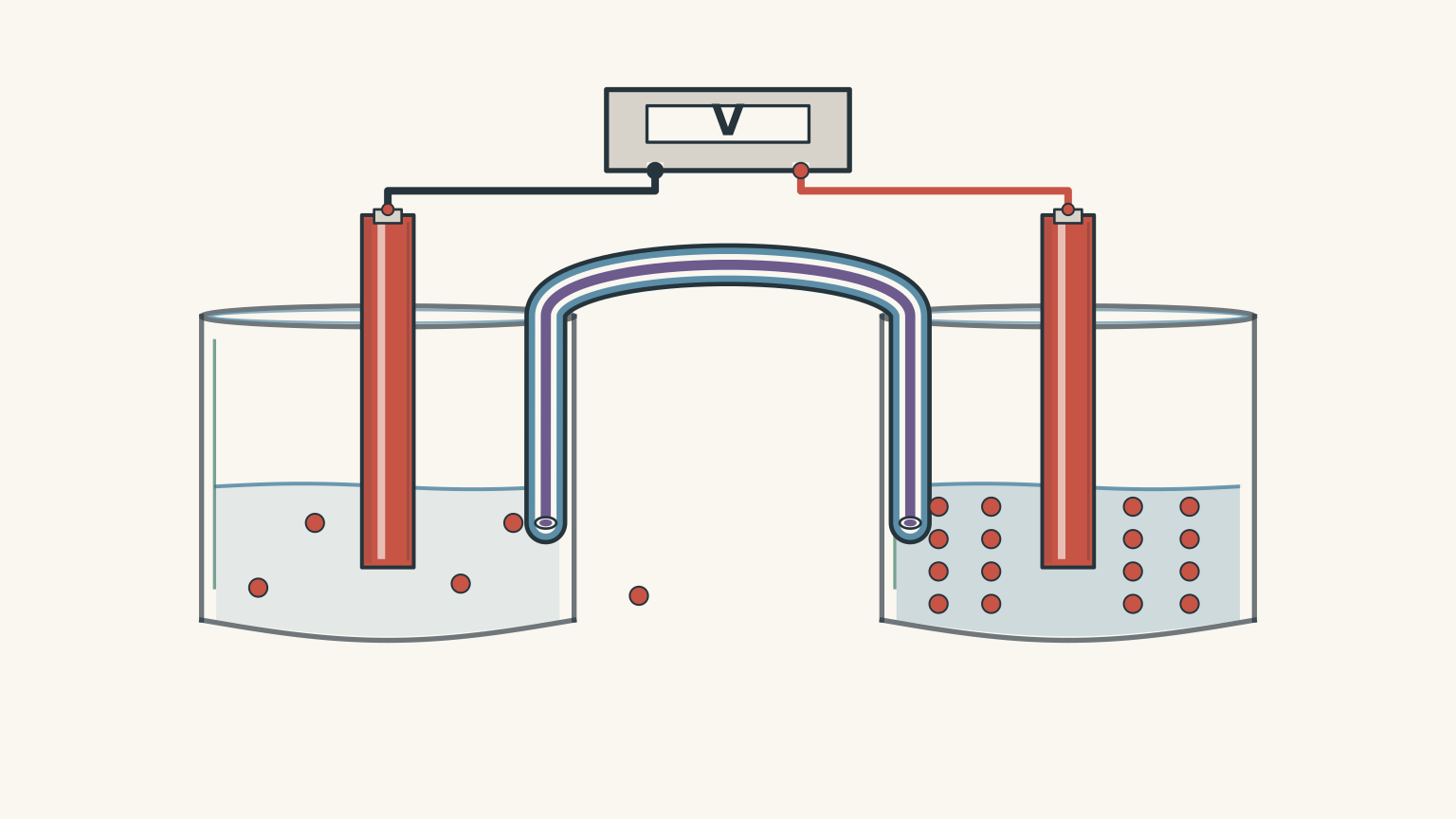
Due to technical limitations, this figure may display incorrectly or contain inaccuracies. Please check key details against your course materials.
Solution 5
The dilute half-cell on the left is the anode, and the concentrated half-cell on the right is the cathode while the cell is operating. The concentration difference, rather than a difference in electrode materials or standard reduction potentials, drives the reaction.
This is the most important conceptual distinction in the question.
a) Identify the electrodes.
Both electrodes are copper, and both have the same standard reduction potential:
\[ E^\circ=+0.34\ \mathrm{V} \]
Therefore, simply comparing the standard reduction potentials cannot identify the anode and cathode.
Instead, we must consider the actual conditions.
The left-hand solution has a much lower copper ion concentration. The cell operates in a direction that reduces this concentration difference.
At the dilute electrode, copper metal is oxidised, producing additional copper ions.
Therefore, the left electrode is the anode.
At the concentrated electrode, copper ions are reduced and deposited as copper metal.
Therefore, the right electrode is the cathode.
b) Write the half-equations.
At the left-hand anode:
\[ \ce{Cu(s) -> Cu^2+(aq) + 2e^-} \]
At the right-hand cathode:
\[ \ce{Cu^2+(aq) + 2e^- -> Cu(s)} \]
Notice that the same copper redox couple operates at both electrodes.
The direction of the reaction differs because the concentrations are different.
c) Explain why a cell potential exists.
A common assumption is that identical electrodes must have identical potentials, meaning no voltage can be produced.
That conclusion is incorrect because the actual electrode potentials depend on the conditions at each electrode.
Although the standard reduction potentials are identical, the copper ion concentrations are not.
The difference in concentration produces a difference in actual electrode potential. This creates a potential difference between the two electrodes and allows a spontaneous reaction to occur.
The illustrative voltmeter reading of +0.059 V is consistent with an ideal copper concentration cell at 25°C with a 100:1 concentration ratio.
A more advanced quantitative treatment uses the Nernst equation to calculate the effect of concentration on electrode potential. The important reasoning here is that standard potentials alone do not describe every actual electrochemical cell.
d) Explain electron and ion movement.
Electrons move through the external wire from the left-hand dilute electrode to the right-hand concentrated electrode.
The salt bridge also allows ions to move:
- Nitrate ions, \(\mathrm{NO_{3}}^{-}\), migrate towards the left-hand anode compartment.
- Potassium ions, \(\mathrm{K}^{+}\), migrate towards the right-hand cathode compartment.
This maintains electrical neutrality as copper ions are produced on the left and consumed on the right.
The positive voltmeter reading is also consistent with the right-hand electrode being at a higher potential than the left-hand electrode.
e) Predict the concentration changes.
At the anode, copper metal dissolves into the left-hand solution.
This increases the concentration of \(\mathrm{Cu}^{2+}\) ions.
At the cathode, copper ions are removed from the right-hand solution as they become solid copper.
This decreases the concentration of \(\mathrm{Cu}^{2+}\) ions.
Therefore:
- The left-hand concentration increases from 0.010 mol L⁻¹.
- The right-hand concentration decreases from 1.00 mol L⁻¹.
The difference between the concentrations gradually becomes smaller.
Because the solution volumes are equal and assumed constant, the final equal concentration, if the cell reaches equilibrium, is:
\[ \begin{aligned} [\mathrm{Cu}^{2+}]_{\mathrm{final}} &=\frac{0.010+1.00}{2}\\ &=\boxed{0.505\ \mathrm{mol\,L^{-1}}} \end{aligned} \]
The copper transferred from the left electrode to the right electrode is what allows the concentrations to approach equality.
f) Explain what happens when the concentrations become equal.
Once both solutions reach the same copper ion concentration, the concentration difference no longer provides a driving force for the net reaction.
The actual electrode potentials become equal, and the cell potential approaches:
\[ E_{\mathrm{cell}}=0.00\ \mathrm{V} \]
There is no longer a net current through the external circuit.
The original anode and cathode labels describe the direction of operation while the cell was producing current. At equilibrium, there is no net oxidation at one electrode coupled to net reduction at the other.
This is the subtle point that makes the example challenging.
The standard reduction potential table gives identical values for the two electrodes, yet a cell can still produce electricity because the actual concentrations differ.
The direction of oxidation and reduction is determined by the actual operating conditions, not simply by comparing standard reduction potentials.
08The key rule to carry into your next electrochemistry question
Whenever you are asked to identify an anode or cathode, start with the half-reactions rather than the electrode charges.
Use this sequence:
- Identify which species loses electrons. That is oxidation.
- Identify which electrode supports that oxidation reaction. That is the anode.
- Identify which species gains electrons. That is reduction.
- Identify which electrode supports that reduction reaction. That is the cathode.
- Only then determine the electrode polarities from whether the cell is galvanic or electrolytic.
| What you need to identify | Remember |
|---|---|
| Anode | Oxidation, loss of electrons |
| Cathode | Reduction, gain of electrons |
| Galvanic anode | Negative |
| Electrolytic anode | Positive |
| Galvanic cathode | Positive |
| Electrolytic cathode | Negative |
The most reliable rule is simple: oxidation always occurs at the anode, regardless of its electrical charge.
This is the foundation for understanding galvanic cell notation, predicting electron flow, and calculating cell potentials.
To practise applying the sign conventions to galvanic cell diagrams, continue with Anode or Cathode? A Reliable Sign Check for Galvanic Cells.
Course-scope note: NESA’s Chemistry Stage 6 (2017) syllabus remains in use for Year 12 until the new Chemistry 11-12 (2025) syllabus is implemented for Year 12 in Term 4 2028. This article uses electrolytic cells as a comparison to explain the universal electrode definitions; it should not be interpreted as a claim that every electrolysis detail is prescribed HSC content. See NESA’s syllabus implementation information.