
Linear Free-Energy Relationships: Comparing Chemical Equilibria
Explore how molecular substituents influence related chemical equilibria using linear free-energy relationships. Learn the Hammett equation, interpret reaction and substituent constants, and understand why these relationships have limits. An extension topic beyond the required NSW Year 12 Chemistry syllabus.
Imagine two beakers containing the same concentration of two different weak acids: benzoic acid and 4-nitrobenzoic acid. Which solution will contain more hydrogen ions at equilibrium?
Predict before reading on. The 4-nitrobenzoic acid will ionise more extensively. Replacing a hydrogen on the benzene ring with a nitro group changes the electronic environment of the acid, making proton loss more favourable.
Now consider a second substitution. What happens if the nitro group is replaced with a methoxy group? The effect can reverse.
This raises a more interesting question: can the way a structural change affects one chemical equilibrium help us predict its effect on another related equilibrium?
Yes, under suitable conditions. The mathematical approach used to investigate this is called a linear free-energy relationship (LFER).
Where this fits: Linear free-energy relationships are extension material beyond the required NSW Year 12 Chemistry syllabus. Year 12 acid-base chemistry is the prerequisite, not an assessment requirement. The ideas below build on your understanding of pH, hydrogen ion concentration, and acid dissociation constants.
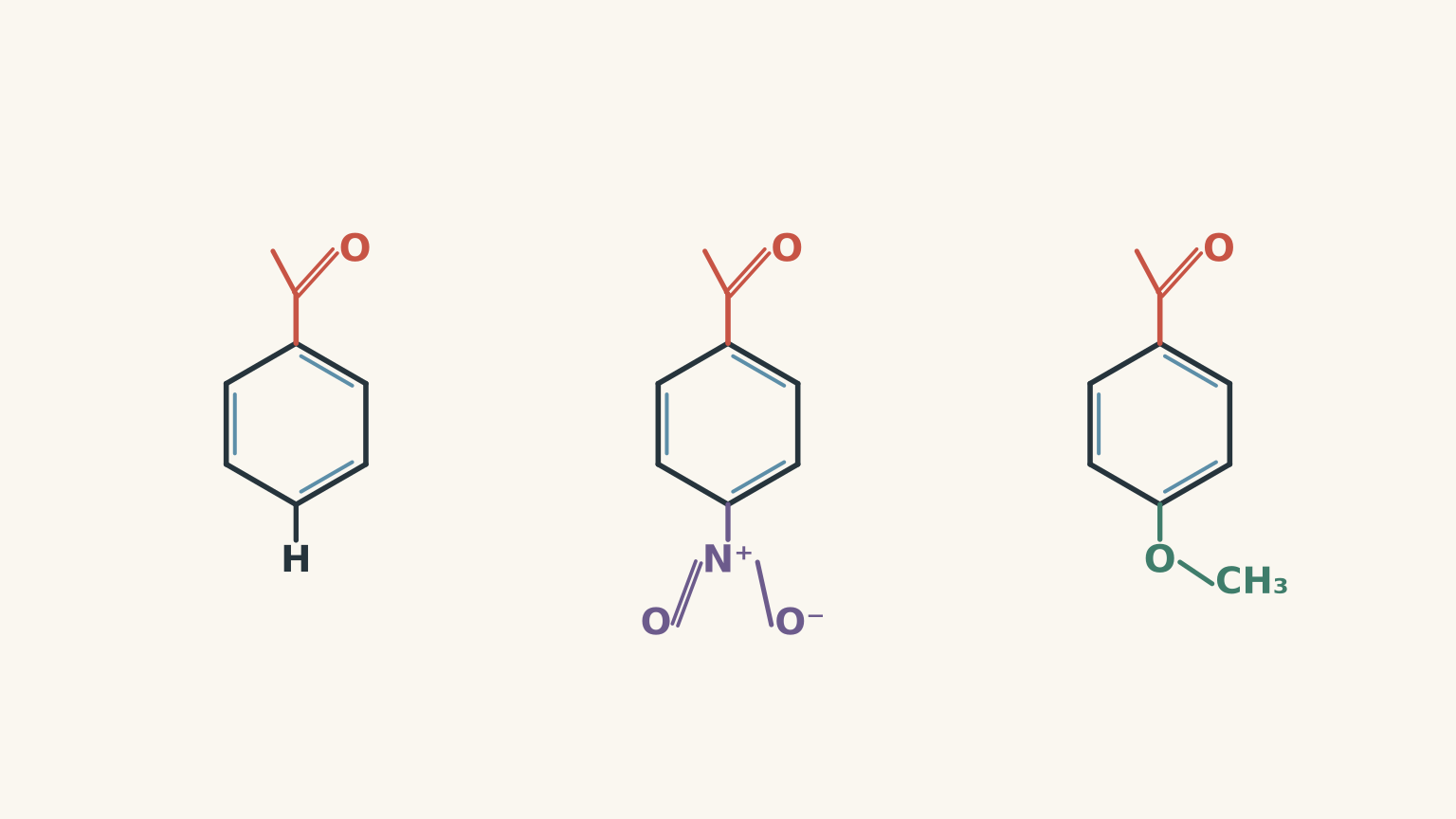
Due to technical limitations, this figure may display incorrectly or contain inaccuracies. Please check key details against your course materials.
01Start with acid strength and equilibrium
Before comparing different chemical reactions, we need to establish what is actually changing.
You already know that pH describes the acidity of an aqueous solution. In the usual Year 12 approximation:
\[ \mathrm{pH}=-\log_{10}[H^+] \]
Here, \([H^+]\) is the hydrogen ion concentration in mol L\(^{-1}\).
Rearranging:
\[ [H^+]=10^{-\mathrm{pH}} \]
This gives you an immediate way to interpret the pH scale.
- A solution with pH 2 has ten times the hydrogen ion concentration of a solution with pH 3.
- A solution with pH 2 has one hundred times the hydrogen ion concentration of a solution with pH 4.
However, there is an important distinction between the acidity of a solution and the intrinsic strength of an acid.
A concentrated weak acid can produce a lower pH than a very dilute strong acid. You cannot rank acid strengths from pH readings alone unless the concentrations and other relevant conditions are considered.
The acid dissociation constant
Consider a general weak acid, HA, reacting with water:
\[ \ce{HA + H2O <=> H3O+ + A-} \]
The acid transfers a proton to water, producing hydronium ions and its conjugate base, A⁻.
The acid dissociation constant is:
\[ K_a=\frac{[H_3O^+][A^-]}{[HA]} \]
In this concentration-based expression, square brackets represent equilibrium concentrations in mol L\(^{-1}\).
A larger \(K_a\) means the equilibrium favours ionisation more strongly. The acid is therefore stronger.
Chemists also use the logarithmic quantity:
\[ \mathrm{p}K_a=-\log_{10}K_a \]
This reverses the direction:
- Large \(K_a\): strong acid, low pKa.
- Small \(K_a\): weak acid, high pKa.
For dilute aqueous solutions, concentration-based expressions are useful approximations. Strictly, pH and thermodynamic equilibrium constants are defined using activities rather than raw concentrations. This distinction is explained in the IUPAC Gold Book definition of pH.
The important foundation is this:
pH describes the hydrogen ion activity of a solution, while Ka describes the equilibrium tendency of an acid to donate a proton under specified conditions.
LFERs compare changes in equilibrium constants such as \(K_a\), rather than simply comparing the pH of different solutions.
02Why free energy is involved
Suppose you have two acids with different equilibrium constants.
One has \(K_a=10^{-4}\), while the other has \(K_a=10^{-5}\).
The first acid ionises more extensively. But what does that tell us about the energy of the two equilibria?
To answer this, we need one connection from thermodynamics.
The standard Gibbs free energy change of a reaction is related to its equilibrium constant by:
\[ \Delta_r G^\circ=-RT\ln K \]
Where:
- \(\Delta_r G^\circ\) is the standard Gibbs free energy change, measured in J mol\(^{-1}\).
- \(R\) is the gas constant, \(8.314\ \mathrm{J\,mol^{-1}\,K^{-1}}\).
- \(T\) is the absolute temperature in kelvin.
- \(K\) is the dimensionless thermodynamic equilibrium constant.
- \(\ln\) is the natural logarithm.
This equation tells us something useful.
A larger equilibrium constant corresponds to a more negative standard Gibbs free energy change.
For a reaction written in the forward direction, a more negative \(\Delta_r G^\circ\) means the products are more thermodynamically favoured relative to the reactants under standard-state conditions.
You can explore the broader relationship in Gibbs Free Energy and Reaction Spontaneity for HSC Chemistry.
Why logarithms produce a straight-line relationship
The relationship between equilibrium constants and free energy is logarithmic.
Using base-10 logarithms:
\[ \Delta_r G^\circ=-2.303RT\log_{10}K \]
At 298 K:
\[ 2.303RT\approx 5.71\ \mathrm{kJ\,mol^{-1}} \]
This means that increasing an equilibrium constant by a factor of ten makes the standard Gibbs free energy change approximately \(5.71\ \mathrm{kJ\,mol^{-1}}\) more negative.
Notice the pattern:
- A tenfold increase in \(K\) produces a fixed change in standard free energy.
- A hundredfold increase produces twice that change.
- A thousandfold increase produces three times that change.
The logarithm turns multiplicative changes in equilibrium constants into additive changes in free energy.
This is the foundation of a linear free-energy relationship.
An LFER exists when a series of related structural changes produces proportional changes in the free energy of different reactions.
It is an empirical relationship. Thermodynamics does not require every reaction series to follow a straight line.
03The Hammett equation: connecting molecular structure to equilibrium
One of the best-known linear free-energy relationships is the Hammett equation.
It was developed by American chemist Louis Hammett to investigate how substituents attached to benzene rings influence chemical reactions.
The key idea is surprisingly simple.
Instead of comparing completely different molecules, compare a family of molecules with the same basic structure but different substituents.
For example, consider benzoic acid.
Its structure contains a benzene ring attached to a carboxylic acid group.
Now replace one hydrogen on the benzene ring with a different group:
- \(-NO_2\): nitro group.
- \(-Cl\): chlorine substituent.
- \(-OCH_3\): methoxy group.
- \(-CH_3\): methyl group.
The rest of the molecular structure remains unchanged.
We can then investigate how each substituent affects the equilibrium for acid dissociation.
The reference reaction
Unsubstituted benzoic acid provides the reference system.
Its acid dissociation equilibrium is:
\[ \ce{C6H5COOH + H2O <=> C6H5COO- + H3O+} \]
Let its acid dissociation constant be \(K_{a,H}\).
For a substituted benzoic acid, let the corresponding equilibrium constant be \(K_{a,X}\), where X represents the substituent.
The difference between these two equilibrium constants measures the effect of introducing X.
However, we need a way to describe the electronic influence of each substituent independently of the particular reaction being investigated.
This leads to the substituent constant.
The substituent constant, σ
The Greek letter sigma, \(\sigma\), represents the electronic effect of a substituent relative to hydrogen.
For the Hammett reference system, it is defined using the ionisation of substituted benzoic acids:
\[ \sigma_X= \log_{10}\left( \frac{K_{a,X}}{K_{a,H}} \right) \]
Here, both equilibrium constants refer to the benzoic acid reference family.
The definition gives us three important possibilities.
Positive sigma
If \(\sigma_X>0\), the substituent increases the acid dissociation constant relative to benzoic acid.
This is commonly associated with an electron-withdrawing substituent.
For example, a nitro group has a positive sigma value.
Negative sigma
If \(\sigma_X<0\), the substituent decreases the acid dissociation constant relative to benzoic acid.
This is commonly associated with an electron-donating substituent.
A para-methoxy group is an example.
Zero sigma
If \(\sigma_X=0\), the substituent produces no change relative to the hydrogen reference in this particular scale.
Hydrogen itself has a sigma value of zero by definition.
Common substituent constants
The following are standard approximate Hammett substituent constants for substituents in the meta and para positions.
| Substituent | Meta \(\sigma_m\) | Para \(\sigma_p\) |
|---|---|---|
| H | 0.00 | 0.00 |
| \(-CH_3\) | -0.07 | -0.17 |
| \(-OCH_3\) | +0.12 | -0.27 |
| \(-Cl\) | +0.37 | +0.23 |
| \(-NO_2\) | +0.71 | +0.78 |
These values are empirical. They are based on the measured effects of substituents on benzoic acid ionisation.
Notice something interesting: the methoxy group has a positive meta sigma value but a negative para sigma value.
We will return to why this happens.
The reaction constant, ρ
We now have a way to describe the substituent.
But we still need to describe how sensitive a particular reaction is to that substituent.
This is the job of the reaction constant, represented by the Greek letter rho, \(\rho\).
The Hammett equation is:
\[ \boxed{ \log_{10}\left(\frac{K_X}{K_H}\right) =\rho\sigma_X } \]
Where:
- \(K_X\) is the equilibrium constant for the substituted compound.
- \(K_H\) is the equilibrium constant for the corresponding unsubstituted compound.
- \(\sigma_X\) is the substituent constant.
- \(\rho\) is the reaction constant.
The equation tells us that the logarithm of the relative equilibrium constants is proportional to the substituent constant.
For the ionisation of benzoic acid in water at 25°C, \(\rho\) is defined as 1.00.
This makes sense because the substituent constants were originally defined using that reference equilibrium.
However, other reactions have different reaction constants.
For example, published Hammett correlations report approximately:
| Equilibrium | Reaction constant, \(\rho\) |
|---|---|
| Benzoic acid ionisation | 1.00 |
| Phenol ionisation | 2.11 |
| Cinnamic acid ionisation | 0.47 |
These values apply to the specified aqueous conditions at 25°C.
The same substituent can therefore produce different changes in different equilibria.
That is the central idea of LFERs: the structural effect can be shared, but the sensitivity of each reaction is not necessarily the same.
What does the reaction constant tell us?
The magnitude of \(\rho\) tells us how sensitive the reaction is to substituent effects.
A large positive value means that electron-withdrawing substituents produce a relatively large increase in the equilibrium constant.
A smaller positive value means the equilibrium is less sensitive.
A negative value means electron-withdrawing substituents decrease the equilibrium constant for the reaction as written.
The sign also depends on the direction in which the equilibrium is written. Reversing a reaction replaces its equilibrium constant with its reciprocal and reverses the sign of the corresponding reaction constant.
04Why the same substituent can affect different equilibria differently
Let’s return to the nitro group.
A nitro group is electron-withdrawing. In the benzoic acid reference system, this makes acid dissociation more favourable.
But does it produce exactly the same change in every acid-base equilibrium?
No.
The reaction constant determines how strongly a particular equilibrium responds to the substituent.
Consider two acids:
- Benzoic acid, which forms a benzoate ion after losing a proton.
- Phenol, which forms a phenoxide ion after losing a proton.
Both undergo acid dissociation, but their conjugate bases have different electronic structures.
This difference matters.
Benzoate and phenoxide are not electronically identical
In benzoate, the negative charge is shared between the two oxygen atoms of the carboxylate group.
In phenoxide, the negative charge can also be delocalised through the benzene ring.
This creates a different opportunity for substituents to influence the stability of the conjugate base.
Consider a para-nitro group attached to phenol.
The nitro group can participate in resonance interactions with the aromatic ring. This can provide additional stabilisation of the negative charge in the phenoxide system.
The same electronic interaction is not captured to the same extent by the ordinary benzoic acid reference scale.
This explains an important limitation of the standard Hammett equation.
Some para-substituted phenols show stronger electronic effects than the ordinary sigma values predict.
Chemists have developed modified substituent constants, including \(\sigma^-\), for reactions in which negative charge is developed and additional resonance stabilisation is important.
The lesson is not that the Hammett equation is wrong.
The lesson is that the equation must describe the chemistry actually occurring.
When should you be cautious about an LFER?
There are several situations where applying a standard Hammett relationship without checking its assumptions can produce misleading predictions.
| Situation | Why it matters |
|---|---|
| Different reaction mechanisms | The structural change may influence the reactions through different interactions. |
| Different solvents or temperatures | Solvation and thermal effects can change the reaction constant. |
| Ortho substitution | Groups close to the reaction centre can introduce steric and other proximity effects. |
| Strong resonance interactions | Standard substituent constants may not capture additional stabilisation or destabilisation. |
| Equilibrium versus reaction rate | Equilibrium constants and rate constants describe different free-energy changes. |
Ortho substituents are particularly interesting.
In a meta- or para-substituted benzoic acid, the substituent is relatively separated from the carboxyl group.
An ortho substituent sits immediately beside it.
This can introduce steric interactions, alter molecular geometry, and create additional interactions that are absent from the meta and para systems.
As a result, ortho-substituted compounds often deviate from the standard Hammett relationship.
A straight line that works well for meta and para compounds should not automatically be extended to ortho compounds.
Equilibrium relationships are not automatically rate relationships
There is another distinction worth making.
The Hammett approach can also be applied to reaction rates:
\[ \log_{10}\left(\frac{k_X}{k_H}\right) =\rho\sigma_X \]
Here, \(k_X\) and \(k_H\) are rate constants rather than equilibrium constants.
The underlying free-energy quantity is now the activation Gibbs free energy, \(\Delta G^\ddagger\), rather than the standard reaction Gibbs free energy, \(\Delta_r G^\circ\).
A reaction can have a favourable equilibrium but still proceed slowly because its activation barrier is large.
Therefore, a relationship established using equilibrium constants cannot simply be substituted into a rate equation.
The same mathematical form does not mean the same physical process.
05Worked examples
Worked example: Predicting the acidity of 4-nitrobenzoic acid
Benzoic acid has a pKa of approximately 4.20 at 25°C. The para-nitro substituent has a Hammett constant of \(\sigma_p=+0.78\).
Assuming the standard Hammett relationship applies, calculate the pKa of 4-nitrobenzoic acid and determine how its acid dissociation constant compares with that of benzoic acid.
Step 1
We are comparing the ionisation of substituted benzoic acid with the ionisation of ordinary benzoic acid.
For this reference equilibrium:
\[ \rho=1.00 \]
We are also given:
\[ \sigma_p=+0.78 \]
Step 2
\[ \log_{10}\left(\frac{K_{a,X}}{K_{a,H}}\right) =\rho\sigma \]
Substituting:
\[ \log_{10}\left(\frac{K_{a,X}}{K_{a,H}}\right) =1.00(0.78) \]
Therefore:
\[ \frac{K_{a,X}}{K_{a,H}}=10^{0.78} \]
\[ \boxed{\frac{K_{a,X}}{K_{a,H}}\approx6.03} \]
The substituted acid has an acid dissociation constant approximately six times larger than that of benzoic acid.
Step 3
Remember:
\[ \mathrm{p}K_a=-\log_{10}K_a \]
Therefore:
\[ \log_{10}\left(\frac{K_{a,X}}{K_{a,H}}\right) =\mathrm{p}K_{a,H}-\mathrm{p}K_{a,X} \]
Substituting:
\[ 0.78=4.20-\mathrm{p}K_{a,X} \]
Rearranging:
\[ \boxed{\mathrm{p}K_{a,X}=3.42} \]
The pKa of 4-nitrobenzoic acid is approximately 3.42.
Interpretation
The nitro group increases the acidity of benzoic acid by increasing its acid dissociation constant.
The lower pKa is consistent with the more favourable formation of the conjugate base.
Notice that we did not need to calculate the equilibrium concentrations of every species. The Hammett relationship allowed us to predict the relative equilibrium position from a substituent constant.
Worked example: Comparing the same substituent in two acid-base equilibria
A meta-nitro substituent is introduced into two different molecules: benzoic acid and phenol.
At 25°C in water, use the following information:
- The meta-nitro substituent has \(\sigma_m=+0.71\).
- The reaction constant for benzoic acid ionisation is \(\rho=1.00\).
- The reaction constant for phenol ionisation is \(\rho=2.11\).
Calculate the relative acid dissociation constants for both substituted compounds. Then calculate the change in standard Gibbs free energy for each ionisation equilibrium relative to its unsubstituted reference.
Step 1
For both reactions:
\[ \log_{10}\left(\frac{K_X}{K_H}\right) =\rho\sigma \]
The substituent constant is identical in both cases.
However, the reaction constants are different.
This means we should calculate each equilibrium separately.
Step 2
For benzoic acid:
\[ \rho=1.00 \]
Therefore:
\[ \log_{10}\left(\frac{K_{a,X}}{K_{a,H}}\right) =1.00(0.71) \]
\[ \frac{K_{a,X}}{K_{a,H}}=10^{0.71} \]
\[ \boxed{\frac{K_{a,X}}{K_{a,H}}\approx5.13} \]
The meta-nitro substituent increases the acid dissociation constant by a factor of approximately 5.13.
Step 3
For phenol:
\[ \rho=2.11 \]
Therefore:
\[ \log_{10}\left(\frac{K_{a,X}}{K_{a,H}}\right) =2.11(0.71) \]
\[ =1.4981 \]
Taking the antilogarithm:
\[ \frac{K_{a,X}}{K_{a,H}} =10^{1.4981} \]
\[ \boxed{\frac{K_{a,X}}{K_{a,H}}\approx31.5} \]
The same substituent now increases the acid dissociation constant by a factor of approximately 31.5.
Step 4
We know:
\[ \Delta_r G^\circ=-2.303RT\log_{10}K \]
For the difference between the substituted and unsubstituted reactions:
\[ \Delta\Delta_r G^\circ =-2.303RT\rho\sigma \]
At 298 K:
\[ 2.303RT\approx5.71\ \mathrm{kJ\,mol^{-1}} \]
For benzoic acid:
\[ \begin{aligned} \Delta\Delta_r G^\circ &=-5.71(1.00)(0.71)\\ &=-4.05\ \mathrm{kJ\,mol^{-1}} \end{aligned} \]
For phenol:
\[ \begin{aligned} \Delta\Delta_r G^\circ &=-5.71(2.11)(0.71)\\ &=-8.55\ \mathrm{kJ\,mol^{-1}} \end{aligned} \]
Interpretation
The same meta-nitro substituent produces a larger change in the phenol ionisation equilibrium than in the benzoic acid ionisation equilibrium.
The reason is the different reaction constants.
The phenol equilibrium is more sensitive to the substituent effect, as indicated by its larger \(\rho\).
This is precisely why you cannot assume that a relationship established for one equilibrium automatically applies to another.
06Common misconceptions
There are a few tempting mistakes when working with linear free-energy relationships.
| Misconception | What is actually correct |
|---|---|
| A lower pH always means a stronger acid. | pH depends on solution conditions and concentration. Compare Ka or pKa to assess acid strength. |
| Sigma is the same for every position of a substituent. | Meta and para substituents can have different sigma values because their electronic effects differ. |
| A positive sigma always means the equilibrium constant increases. | The direction depends on the sign of the reaction constant, rho. |
| Rho is a property of the substituent. | Rho belongs to the reaction and its conditions. Sigma describes the substituent. |
| Every related reaction must have the same rho. | Different equilibria can have different sensitivities to the same substituent. |
| A straight line proves that two reactions have identical mechanisms. | A linear correlation supports a shared pattern of substituent effects, but does not independently prove an identical mechanism. |
| An LFER for equilibrium constants can predict reaction rates. | Equilibrium and rate relationships involve different free-energy quantities. |
The most important habit is to identify the reaction before choosing the equation.
Do not start by looking for a sigma value and immediately multiplying it by a number.
First establish which equilibrium you are investigating, which reference compound you are using, and whether the substituent scale is appropriate.
07Questions and solutions
Question 1
At 25°C, the para-chloro substituent has a Hammett constant of \(\sigma_p=+0.23\).
The pKa of benzoic acid is 4.20. Assume the standard Hammett relationship applies to the ionisation of para-substituted benzoic acids.
Calculate:
a) The ratio of the acid dissociation constants of 4-chlorobenzoic acid and benzoic acid.
b) The pKa of 4-chlorobenzoic acid.
Solution 1
4-Chlorobenzoic acid has a pKa of 3.97 and an acid dissociation constant approximately 1.70 times that of benzoic acid.
Step 1: Identify the reaction constant.
This is the reference benzoic acid ionisation series.
Therefore:
\[ \rho=1.00 \]
We are given:
\[ \sigma_p=+0.23 \]
Step 2: Calculate the relative acid dissociation constants.
Using the Hammett equation:
\[ \log_{10}\left(\frac{K_{a,X}}{K_{a,H}}\right) =\rho\sigma \]
Substituting:
\[ \log_{10}\left(\frac{K_{a,X}}{K_{a,H}}\right) =1.00(0.23) \]
Therefore:
\[ \frac{K_{a,X}}{K_{a,H}}=10^{0.23} \]
\[ \boxed{\frac{K_{a,X}}{K_{a,H}}=1.70} \]
Step 3: Calculate the pKa.
We know:
\[ \mathrm{p}K_{a,H}-\mathrm{p}K_{a,X}=0.23 \]
Substituting:
\[ 4.20-\mathrm{p}K_{a,X}=0.23 \]
Therefore:
\[ \boxed{\mathrm{p}K_{a,X}=3.97} \]
The positive sigma value indicates that the chlorine substituent increases acid dissociation relative to benzoic acid.
The important point is that a positive sigma value has a quantitative meaning only when it is combined with the appropriate reaction constant.
Question 2
The ionisation of substituted cinnamic acids in water at 25°C has a reaction constant of \(\rho=0.47\).
A meta-nitro substituent has a standard substituent constant of \(\sigma_m=+0.71\).
Calculate:
a) The ratio of the substituted and unsubstituted acid dissociation constants.
b) The difference in standard Gibbs free energy between the two ionisation reactions at 298 K.
c) Explain why using \(\rho=1.00\) would produce an incorrect prediction.
Solution 2
The substituted cinnamic acid has an acid dissociation constant approximately 2.16 times larger than the unsubstituted acid, and its standard ionisation free energy is approximately 1.91 kJ mol\(^{-1}\) more negative.
Step 1: Identify the reaction constant and substituent constant.
We are given:
\[ \rho=0.47 \]
\[ \sigma_m=+0.71 \]
The reaction constant is not 1.00 because we are investigating cinnamic acid ionisation rather than the reference benzoic acid ionisation.
Step 2: Calculate the relative equilibrium constant.
\[ \log_{10}\left(\frac{K_{a,X}}{K_{a,H}}\right) =\rho\sigma \]
Substituting:
\[ =0.47(0.71) \]
\[ =0.3337 \]
Taking the antilogarithm:
\[ \frac{K_{a,X}}{K_{a,H}} =10^{0.3337} \]
\[ \boxed{\frac{K_{a,X}}{K_{a,H}}\approx2.16} \]
Step 3: Calculate the difference in standard Gibbs free energy.
Use:
\[ \Delta\Delta_r G^\circ =-2.303RT\rho\sigma \]
At 298 K:
\[ \Delta\Delta_r G^\circ =-5.71(0.47)(0.71) \]
\[ \boxed{\Delta\Delta_r G^\circ \approx-1.91\ \mathrm{kJ\,mol^{-1}}} \]
The negative result means the substituted acid has a more favourable standard ionisation free energy.
Step 4: Explain why \(\rho=1.00\) is inappropriate.
The value of 1.00 belongs to the reference benzoic acid ionisation equilibrium.
Cinnamic acid has a different reaction constant because its ionisation equilibrium responds differently to substituent effects.
Using 1.00 would predict:
\[ \frac{K_{a,X}}{K_{a,H}}=10^{0.71} \]
\[ \approx5.13 \]
This substantially overestimates the relative equilibrium constant.
The error comes from selecting the wrong reaction constant, not from an incorrect logarithmic calculation.
Question 3
Two isomers of methoxybenzoic acid are investigated:
- 3-methoxybenzoic acid has \(\sigma_m=+0.12\).
- 4-methoxybenzoic acid has \(\sigma_p=-0.27\).
Assume both undergo benzoic acid-type ionisation in water at 25°C, with \(\rho=1.00\).
Using a pKa of 4.20 for benzoic acid, calculate:
a) The relative acid dissociation constant of each isomer compared with benzoic acid.
b) The pKa of each isomer.
c) The ratio of the acid dissociation constants of 3-methoxybenzoic acid and 4-methoxybenzoic acid.
Explain why the same methoxy group produces different effects at the two positions.
Solution 3
3-Methoxybenzoic acid has a pKa of 4.08, while 4-methoxybenzoic acid has a pKa of 4.47. The meta isomer has an acid dissociation constant approximately 2.45 times larger than that of the para isomer.
Step 1: Calculate the relative equilibrium constant for the meta isomer.
For 3-methoxybenzoic acid:
\[ \rho=1.00,\qquad \sigma_m=+0.12 \]
Using:
\[ \log_{10}\left(\frac{K_{a,m}}{K_{a,H}}\right) =\rho\sigma_m \]
\[ =1.00(0.12)=0.12 \]
Therefore:
\[ \frac{K_{a,m}}{K_{a,H}}=10^{0.12} \]
\[ \boxed{\frac{K_{a,m}}{K_{a,H}}\approx1.32} \]
Step 2: Calculate the relative equilibrium constant for the para isomer.
For 4-methoxybenzoic acid:
\[ \rho=1.00,\qquad \sigma_p=-0.27 \]
Therefore:
\[ \log_{10}\left(\frac{K_{a,p}}{K_{a,H}}\right) =1.00(-0.27) \]
\[ =-0.27 \]
Taking the antilogarithm:
\[ \frac{K_{a,p}}{K_{a,H}}=10^{-0.27} \]
\[ \boxed{\frac{K_{a,p}}{K_{a,H}}\approx0.537} \]
Step 3: Calculate the pKa values.
For the meta isomer:
\[ \mathrm{p}K_{a,m}=4.20-0.12 \]
\[ \boxed{\mathrm{p}K_{a,m}=4.08} \]
For the para isomer:
\[ \mathrm{p}K_{a,p}=4.20-(-0.27) \]
\[ \boxed{\mathrm{p}K_{a,p}=4.47} \]
Step 4: Compare the two isomers directly.
Divide their relative equilibrium constants:
\[ \frac{K_{a,m}}{K_{a,p}} =\frac{10^{0.12}}{10^{-0.27}} \]
Combining the powers:
\[ =10^{0.39} \]
\[ \boxed{\frac{K_{a,m}}{K_{a,p}}\approx2.45} \]
The meta isomer is therefore approximately 2.45 times more acidic than the para isomer in terms of its acid dissociation constant.
Step 5: Explain the electronic difference.
The methoxy group has both inductive and resonance effects.
Its electronegative oxygen withdraws electron density through the sigma-bond framework. This inductive effect is important for the meta isomer.
At the para position, however, the methoxy group can donate electron density into the aromatic ring through resonance.
This resonance donation changes the overall electronic effect of the substituent.
Consequently, the meta and para methoxy groups have opposite sigma signs.
The trap is to assume that a substituent has one fixed electronic effect regardless of where it is attached.
Question 4
A researcher investigates the ionisation of a series of substituted benzoic acids.
When the logarithm of the relative acid dissociation constants is plotted against the standard Hammett substituent constants, the meta- and para-substituted compounds follow an approximately straight line.
However, the ortho-substituted compounds sit consistently away from the line.
A student argues that the ortho results should simply be removed and that the resulting straight line proves the Hammett equation applies to every positional isomer of benzoic acid.
Evaluate this argument.
Explain:
a) Why the meta- and para-substituted compounds might follow a linear relationship.
b) Why the ortho compounds may deviate.
c) What conclusion the researcher can legitimately draw from the results.
Solution 4
The researcher can conclude that the standard Hammett relationship describes the meta- and para-substituted compounds reasonably well, but cannot claim that it applies universally to ortho-substituted compounds.
Step 1: Explain the meta and para correlation.
The standard Hammett relationship assumes that substituent effects can be described using a common electronic parameter.
For many meta- and para-substituted benzoic acids, the electronic influence of X changes the acid dissociation equilibrium in a sufficiently consistent way to produce an approximately straight line.
The slope of this line is the reaction constant, \(\rho\).
Step 2: Consider the physical difference introduced by ortho substitution.
An ortho substituent is immediately adjacent to the carboxyl group.
This proximity introduces interactions that are less important for meta and para substituents.
For example:
- Steric interactions can change molecular geometry.
- Intramolecular interactions can influence the stability of the acid or conjugate base.
- Nearby groups can alter solvation and local electronic interactions.
These additional effects mean that the standard sigma constant may no longer describe the full influence of the substituent.
Step 3: Evaluate the removal of the ortho compounds.
Removing the ortho compounds is not automatically wrong.
If the researcher is specifically investigating whether the standard Hammett relationship applies to meta- and para-substituted benzoic acids, analysing those groups separately is reasonable.
However, the researcher must clearly state this limitation.
Silently removing compounds that disagree with the proposed model would be poor scientific practice.
Step 4: State the justified conclusion.
The results support a linear free-energy relationship for the investigated meta- and para-substituted compounds under the specified conditions.
They do not establish a universal relationship for every positional isomer.
The deviation is useful information. It suggests that additional structural interactions influence the ortho compounds and that a more suitable model may be needed.
A good model explains the pattern of the data, including where its assumptions stop working.
Question 5
A chemist investigates two families of acid-base equilibria in water at 25°C:
- A series of substituted benzoic acids.
- A series of substituted phenols.
Both families undergo proton loss, and both contain para-substituted benzene rings.
Most of the compounds in each family follow approximately linear Hammett relationships when plotted using the standard benzoic acid substituent constants.
However, para-nitrophenol lies noticeably above the predicted line for the phenol series. Its measured acid dissociation constant is larger than the ordinary Hammett equation predicts.
A student makes two claims:
- Both reactions involve proton loss, so they should have the same reaction constant, \(\rho\).
- The para-nitrophenol result must be an experimental error because it does not follow the straight line.
Assume the measurements are reliable, the solvent and temperature are controlled, and the equilibrium constants have been determined correctly.
Evaluate both claims.
In your answer:
a) Explain why the two acid-base families do not necessarily have the same reaction constant.
b) Explain why para-nitrophenol can deviate from the standard Hammett prediction.
c) Identify an appropriate modification to the substituent model.
d) Explain why a deviation from a linear relationship does not automatically invalidate the entire LFER approach.
Solution 5
Both claims are incorrect. The two acid-base equilibria can have different reaction constants, and para-nitrophenol can deviate because its conjugate base experiences additional resonance stabilisation that is not adequately represented by the ordinary benzoic acid substituent scale.
Step 1: Distinguish the two reaction systems.
Although both reactions involve proton loss, they produce different conjugate bases.
Benzoic acid forms benzoate:
\[ \ce{C6H5COOH <=> C6H5COO- + H+} \]
Phenol forms phenoxide:
\[ \ce{C6H5OH <=> C6H5O- + H+} \]
These conjugate bases have different electron distributions.
Therefore, the substituent can influence their relative stabilities by different amounts.
The reaction constant describes the sensitivity of a particular reaction to the electronic effects represented by sigma.
It is not determined simply by whether a reaction involves proton loss.
For comparison, the standard reaction constants are approximately:
\[ \rho_{\text{benzoic acid}}=1.00 \]
\[ \rho_{\text{phenol}}=2.11 \]
The different values demonstrate that the two acid-base equilibria respond differently to substituent effects.
Step 2: Investigate the para-nitrophenol deviation.
The key is the electronic structure of the phenoxide ion.
When phenol loses a proton, the resulting negative charge can be delocalised through the aromatic ring.
In particular, resonance contributors can place negative charge at the ortho and para positions.
A para-nitro group provides an additional pathway for stabilising this negative charge through conjugation.
This additional resonance interaction makes the formation of the phenoxide ion more favourable.
The ordinary para-nitro sigma constant is based on benzoic acid ionisation. It does not fully represent this additional interaction in the phenoxide system.
Consequently, para-nitrophenol can be more acidic than the standard Hammett prediction suggests.
Step 3: Select a more appropriate substituent model.
For reactions involving the development or delocalisation of negative charge, chemists can use modified substituent constants such as \(\sigma^-\).
These constants account more appropriately for substituents that provide additional resonance stabilisation of anionic systems.
The important qualification is that a modified substituent scale must be used with a reaction constant calibrated for that scale.
You cannot simply substitute a different sigma value into an unrelated equation and assume the original slope remains valid.
Step 4: Decide whether the original LFER is invalid.
The deviation does not automatically invalidate the entire Hammett approach.
Instead, it tells us that the ordinary substituent constants do not fully describe every electronic interaction in the phenol system.
A sensible investigation would:
- Confirm that all measurements were made under comparable conditions.
- Check whether other strongly resonance-interacting para substituents also deviate.
- Compare meta-substituted compounds, where direct resonance interaction with the substituent is restricted.
- Investigate whether a modified substituent scale produces a more consistent relationship.
If the deviation follows a systematic structural pattern, it is evidence that the model needs refinement rather than proof that the measurements are wrong.
The deeper lesson: two reactions can belong to the same broad chemical category and still respond differently to changes in molecular structure. A useful LFER must capture the electronic interactions that actually operate in the reaction being studied.
07Sources and further reading
The extension concepts in this article draw on established physical organic chemistry and thermodynamics.
Hammett, L. P. (1937). The Effect of Structure upon the Reactions of Organic Compounds. Benzene Derivatives. Journal of the American Chemical Society, 59, 96-103. The original paper developing the Hammett relationship.
Linear Free Energy Relationships – Reusch Virtual Textbook. Covers substituent constants, reaction constants, positional effects, and deviations from standard Hammett relationships.
Linear Free Energy Relationships: Applying the Hammett Equation – Vancouver Island University. A university chemistry teaching resource covering the derivation and experimental application of the equation.
IUPAC Gold Book: pH. The formal definition of pH in terms of hydrogen ion activity.
Gibbs (Free) Energy – Chemistry LibreTexts. Explains the connection between Gibbs free energy and equilibrium constants.
08Where this leads next
You can now use molecular structure to make predictions about changes in equilibrium constants, rather than treating every acid as an isolated case.
The next useful step is connecting those equilibrium constants back to solution behaviour.
Once you know how a substituent changes \(K_a\), you can combine that information with pH to predict the relative amounts of an acid and its conjugate base.
That is the foundation of acid-base speciation diagrams, where pH determines which chemical species dominates in solution.
You can develop that connection further in Acid-Base Speciation Diagrams: Reading Species vs pH.