
How to Label Gibbs-Energy Questions by HSC Syllabus Edition
Learn how to distinguish Gibbs-energy questions from reaction-rate and equilibrium questions across the 2017 and 2025 NSW HSC Chemistry syllabuses, with worked examples and practice solutions.
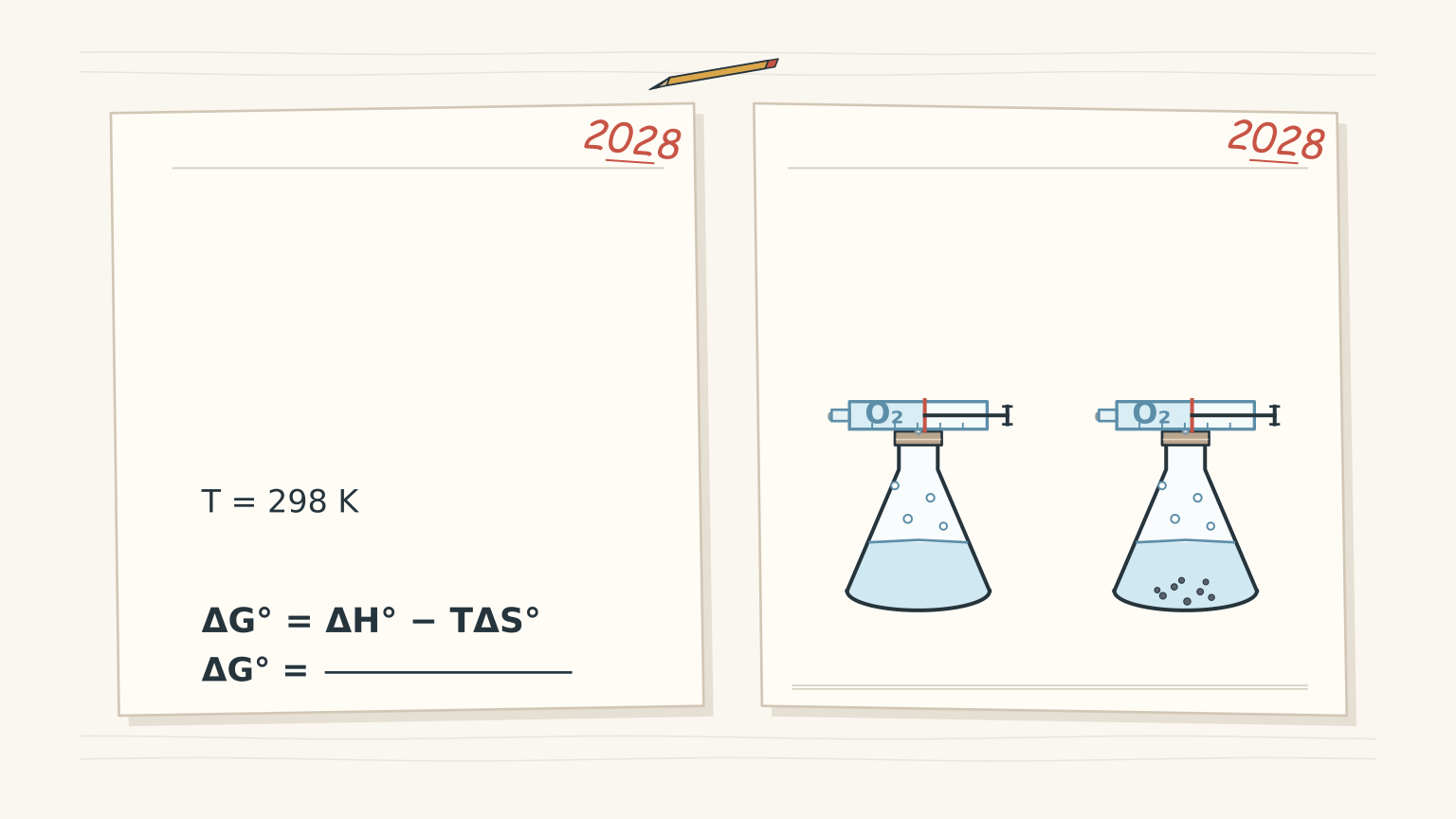
Two Chemistry worksheets are both labelled “2028”. One asks you to calculate Gibbs free energy and decide whether a reaction is spontaneous. The other asks why adding a catalyst makes oxygen gas appear faster. Should they both be labelled as questions from the 2025 HSC Chemistry syllabus?
No. The Gibbs calculation belongs to the Chemistry Stage 6 Syllabus (2017), specifically Year 11 Module 4: Drivers of Reactions. The catalyst question covers content also included in the Chemistry 11-12 Syllabus (2025). The year printed on a worksheet doesn’t tell you which syllabus content it assesses.
The safest method is to label each question by its required chemistry, its original syllabus edition, and whether that method is assessed in the edition you’re studying. Gibbs free energy, reaction rate, and electrochemical spontaneity are related ideas, but they are not interchangeable syllabus requirements.
Due to technical limitations, this figure may display incorrectly or contain inaccuracies. Please check key details against your course materials.
01Which HSC Chemistry syllabus edition applies?
NSW has two relevant Chemistry syllabus editions during the transition to the new course.
The Chemistry Stage 6 Syllabus (2017) contains a dedicated section on entropy, Gibbs free energy, and reaction spontaneity. It also includes Hess’s law.
The Chemistry 11-12 Syllabus (2025) reorganises this content. It includes reaction rates, catalysts, enthalpy changes, calorimetry, and energy profiles, but it does not explicitly prescribe calculations using the Gibbs free-energy equation.
That difference determines whether a Gibbs-energy question is core syllabus practice or extension work.
The implementation dates
| Teaching or examination period | Syllabus edition |
|---|---|
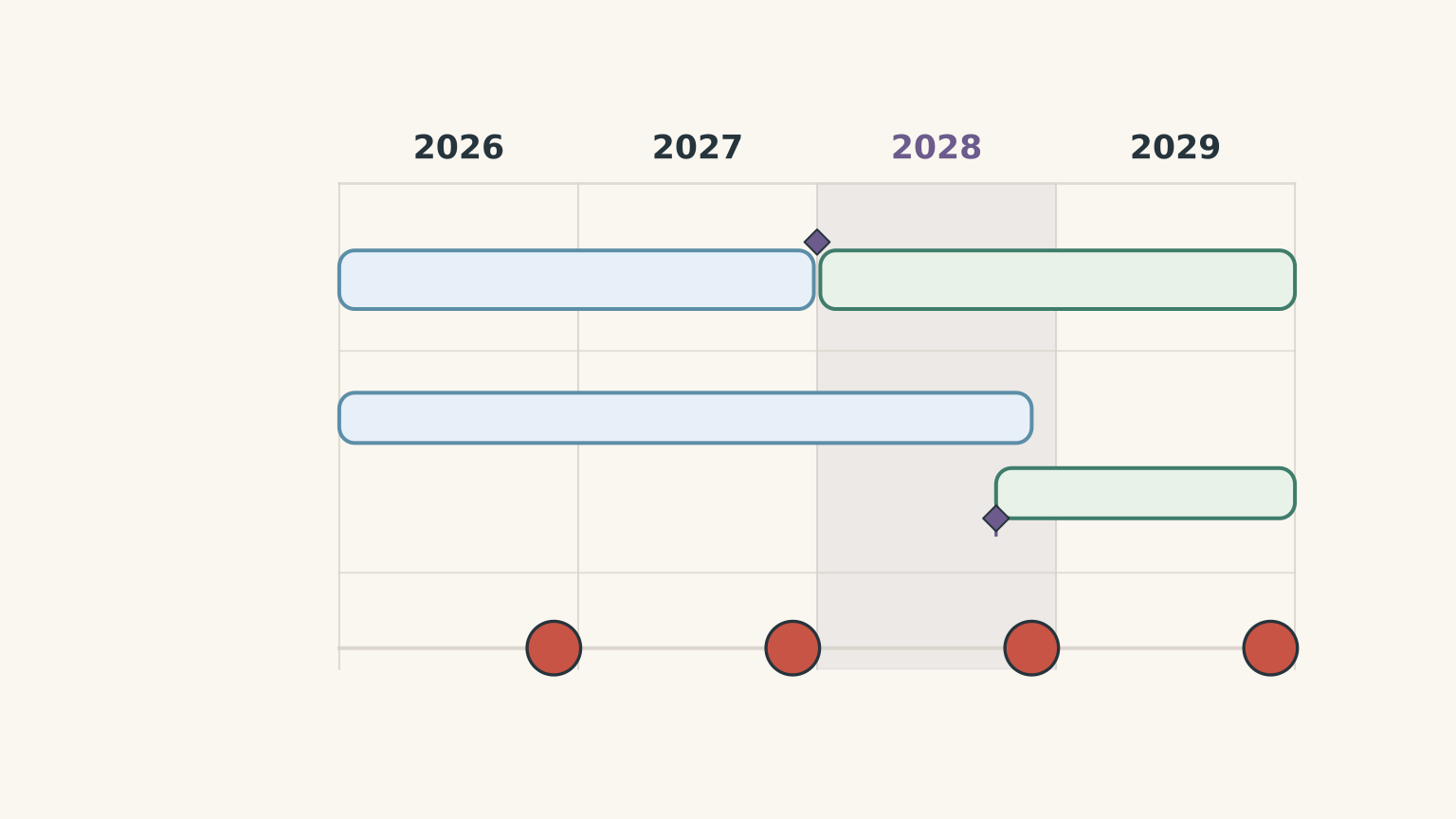
| 2026-2027 | Chemistry Stage 6 (2017) |
| 2028 Year 11, from Term 1 | Chemistry 11-12 (2025) |
| 2028 Year 12, completing the 2028 HSC | Chemistry Stage 6 (2017) |
| 2028 Year 12, commencing in Term 4 for the 2029 HSC | Chemistry 11-12 (2025) |
| 2029 HSC | First HSC examination under Chemistry 11-12 (2025) |
These dates follow NESA’s published implementation schedule, current as at November 2026.
You can verify the two editions using NESA’s Chemistry Stage 6 Syllabus (2017) and Chemistry 11-12 Syllabus (2025).
Notice the unusual situation in 2028. A Year 11 student and a student completing Year 12 can be studying different Chemistry syllabuses at the same time.
Due to technical limitations, this figure may display incorrectly or contain inaccuracies. Please check key details against your course materials.
02A reliable method for labelling questions
Imagine you’re sorting an archive of practice questions.
One file was written in 2026, but its explanation of catalysts is still useful for students studying the 2025 syllabus. Another was written in 2028 but asks students to calculate \(\Delta G^\circ\), which isn’t an explicitly prescribed calculation in the new syllabus.
Neither the creation date nor the presence of a familiar keyword is enough.
Use two labels:
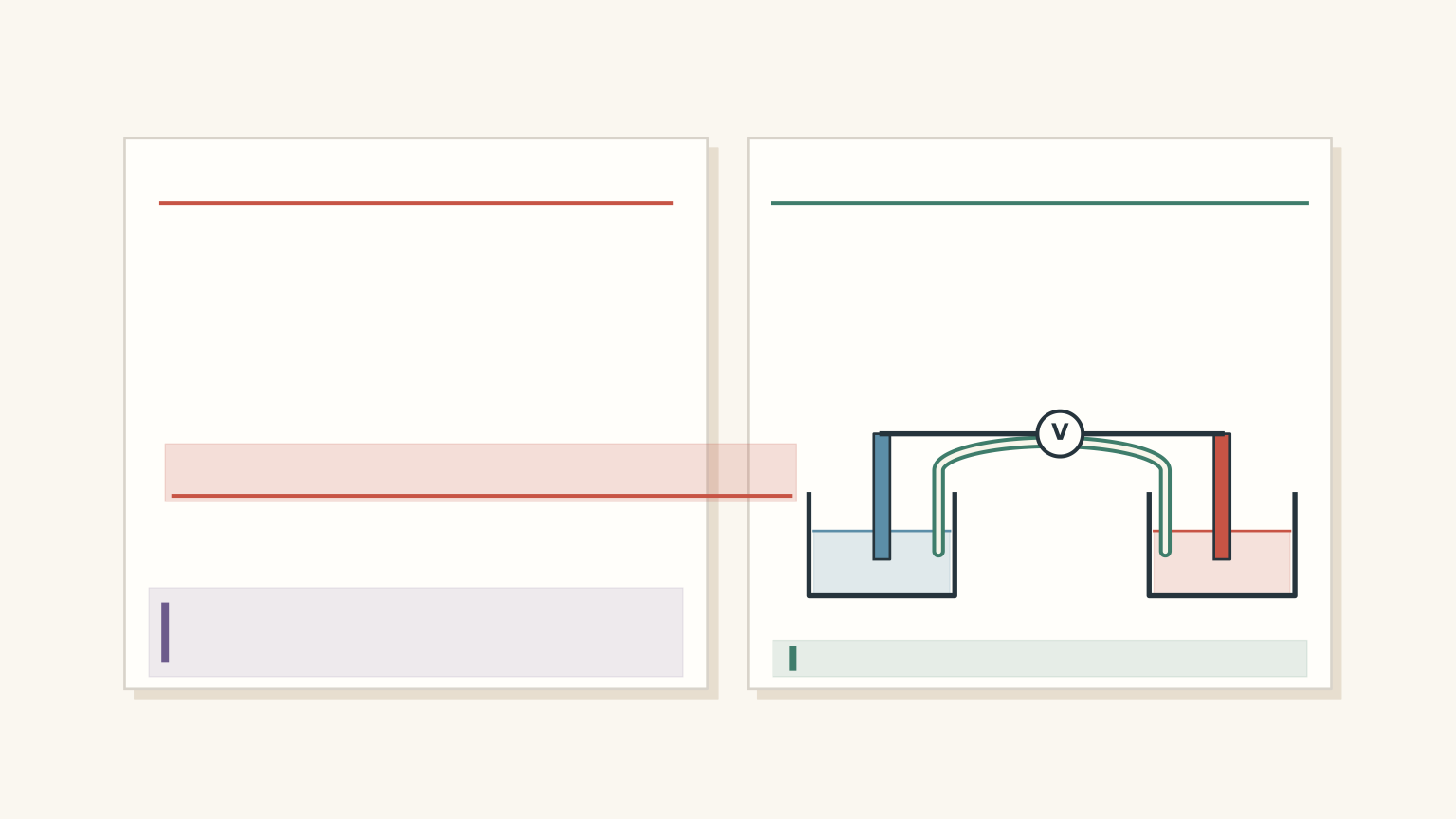
Source edition: Which syllabus was the question originally written for?
Assessment alignment: Does the student’s current syllabus explicitly require the knowledge and method needed to answer it?
These labels can be different. A question written for the 2017 syllabus may still practise a skill required in the 2025 syllabus.
Match the required method to the syllabus
| What the question requires | Appropriate syllabus label |
|---|---|
| Calculate \(\Delta G^\circ=\Delta H^\circ-T\Delta S^\circ\) | 2017 Year 11, Module 4. Extension for the 2025 syllabus |
| Predict how temperature changes Gibbs-energy spontaneity | 2017 Year 11, Module 4. Extension for the 2025 syllabus |
| Use a Hess cycle to find reaction enthalpy | 2017 Year 11, Module 4. Extension for the 2025 syllabus |
| Calculate reaction enthalpy using calorimetry | Content shared by the editions; included in 2025 Year 11 Chemical reactions |
| Explain reaction rates using collision theory and activation energy | Content shared by the editions; included in 2025 Year 11 Chemical reactions |
| Explain how a catalyst changes activation energy | Content shared by the editions; included in 2025 Year 11 Chemical reactions |
| Calculate a standard cell potential and predict redox spontaneity | Included in 2025 Year 12 Applying chemical ideas |
| Analyse a reversible reaction using equilibrium constants | Included in 2025 Year 12 Equilibrium |
Here, extension means useful chemistry that goes beyond the explicitly prescribed content of the 2025 syllabus. A school may choose to teach it, but that does not make it a specified 2025 HSC examination requirement.
The important distinction is that the word “spontaneous” is not exclusive to the old syllabus. The 2025 course also considers spontaneity when studying galvanic cells.
It is the required method, not the word itself, that determines the label.
Due to technical limitations, this figure may display incorrectly or contain inaccuracies. Please check key details against your course materials.
03Why reaction speed cannot establish Gibbs-energy spontaneity
Consider a simple experiment.
Hydrogen peroxide can decompose to produce water and oxygen:
\[ \ce{2H2O2(aq) -> 2H2O(l) + O2(g)} \]
Suppose you want to investigate how a catalyst affects this reaction.
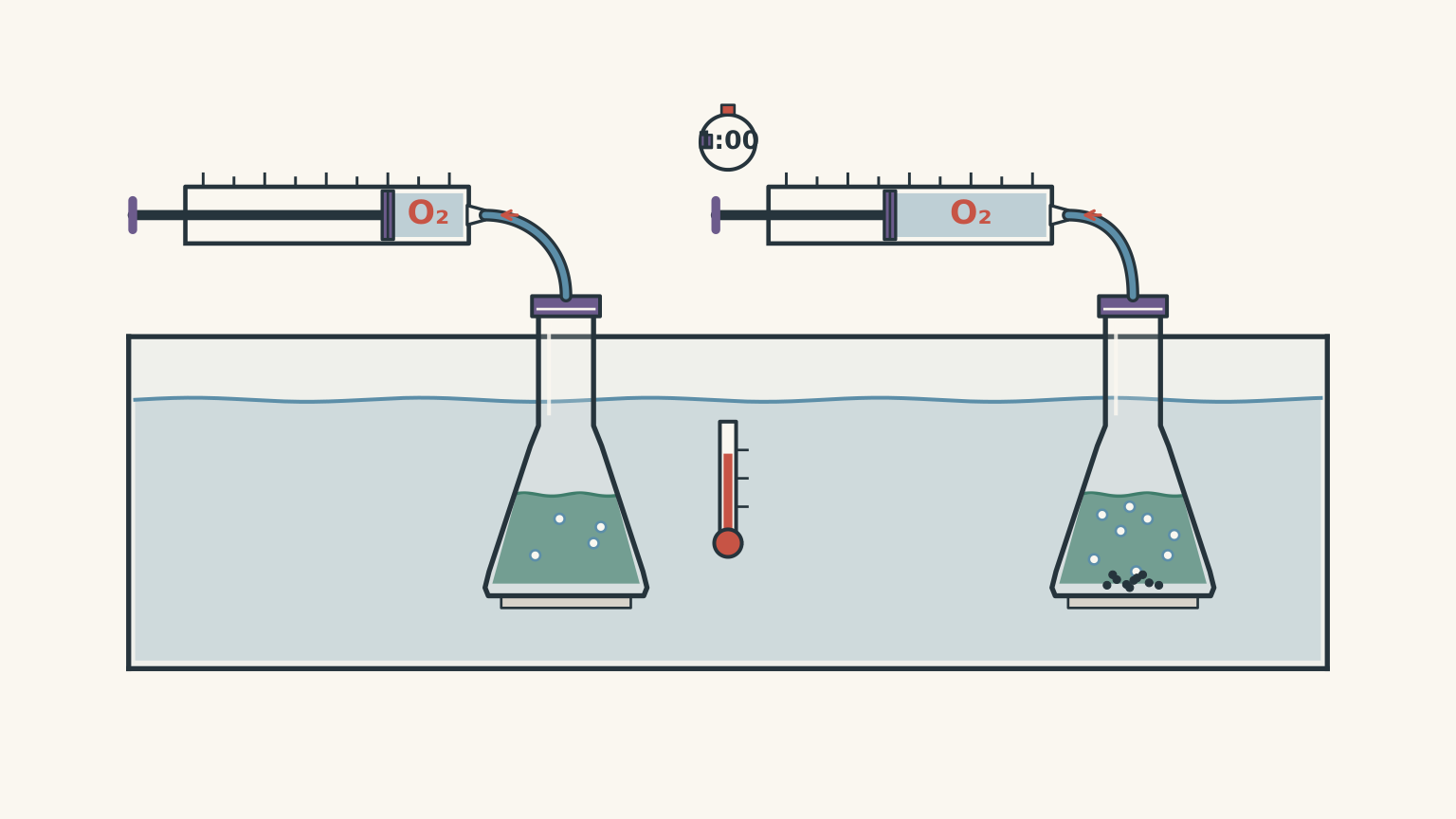
You prepare two conical flasks, each containing the same volume and concentration of dilute hydrogen peroxide.
Each flask is sealed with a bung connected by a delivery tube to a gas syringe. Oxygen produced in the flask travels through the tube and pushes the syringe plunger outwards.
The first flask contains no added catalyst. The second contains manganese dioxide, which catalyses hydrogen peroxide decomposition.
Both flasks are maintained at the same temperature, with equal initial reactant amounts and comparable gas-collection conditions.
Due to technical limitations, this figure may display incorrectly or contain inaccuracies. Please check key details against your course materials.
Predict the observation
If the catalyst increases the reaction rate, what should happen to the oxygen collected during the first minute?
The catalysed flask should produce oxygen faster. Its gas syringe will generally show a larger volume at the same elapsed time.
That prediction concerns reaction rate.
Now consider a different prediction: if the uncatalysed flask produces very little gas in the first minute, does that mean the reaction is thermodynamically nonspontaneous?
No. A slow reaction can still be thermodynamically favourable.
The gas syringe measures how quickly oxygen is produced. It does not directly measure Gibbs free energy.
What the original experiment cannot tell us
The first design has an important limitation.
Even if one flask produces considerably more oxygen during the observation period, that tells us about kinetics rather than the Gibbs free-energy change.
Reaction kinetics describes how rapidly a chemical reaction proceeds.
Thermodynamics describes whether the change is energetically favourable under specified conditions.
These are separate questions.
A catalyst provides an alternative reaction pathway with a lower activation energy. It does not change the Gibbs free-energy difference between the same initial and final thermodynamic states.
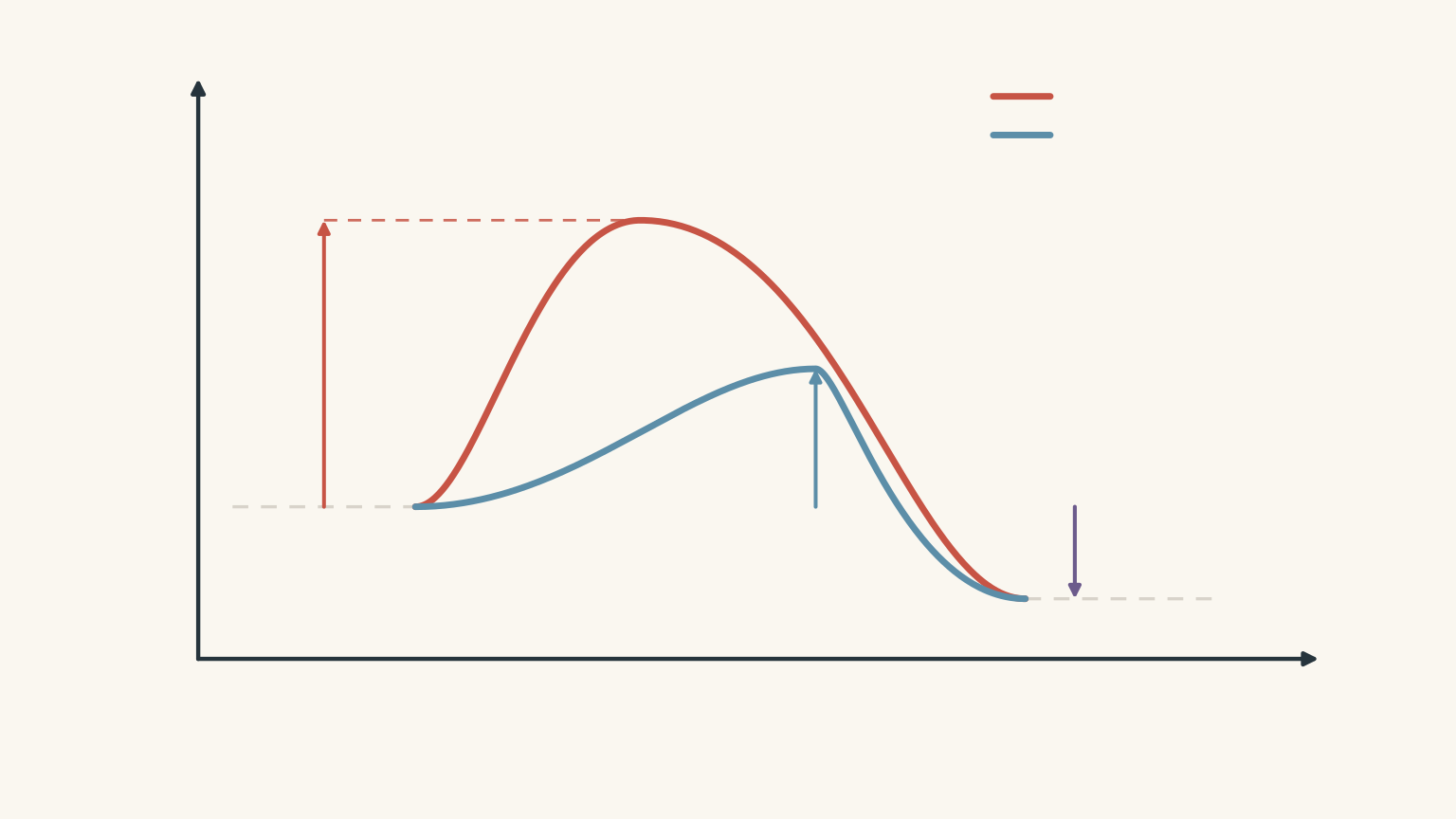
Due to technical limitations, this figure may display incorrectly or contain inaccuracies. Please check key details against your course materials.
How would we investigate thermodynamic feasibility instead?
We would need information about both the enthalpy and entropy changes at a specified temperature.
Calorimetry can help us determine an enthalpy change by measuring heat transferred during a reaction. However, a gas syringe and thermometer alone do not supply all the information needed to determine entropy change.
For a 2017-syllabus Gibbs calculation, we can use appropriate standard thermodynamic data and the equation:
\[ \Delta G^\circ=\Delta H^\circ-T\Delta S^\circ \]
Here:
- \(\Delta G^\circ\) is the standard Gibbs free-energy change, in \(\mathrm{kJ\,mol^{-1}}\).
- \(\Delta H^\circ\) is the standard enthalpy change, in \(\mathrm{kJ\,mol^{-1}}\).
- \(T\) is absolute temperature, in kelvin (\(\mathrm{K}\)).
- \(\Delta S^\circ\) is the standard entropy change, converted to \(\mathrm{kJ\,mol^{-1}\,K^{-1}}\).
The superscript \(^{\circ}\) indicates standard-state values.
At a specified temperature, a negative \(\Delta G^\circ\) means the forward reaction is thermodynamically favourable under standard-state conditions. A positive value means it is unfavourable in that direction under standard-state conditions.
A value of zero means the standard-state Gibbs free energies of reactants and products are equal. For an actual reacting mixture, equilibrium requires the Gibbs free-energy change under its actual conditions to be zero.
That final qualification matters: the composition of a real mixture can affect which direction it moves towards equilibrium.
For the full theory behind this equation, see Gibbs Free Energy and Reaction Spontaneity for HSC Chemistry.
04Worked example: Label and solve a Gibbs-energy question
An archived Year 11 Chemistry question from 2026 describes the following hypothetical decomposition:
\[ \ce{MN(s) -> M(s) + N(g)} \]
The supplied standard thermodynamic data are:
\[ \Delta H^\circ=+36.0\ \mathrm{kJ\,mol^{-1}} \]
\[ \Delta S^\circ=+150\ \mathrm{J\,mol^{-1}\,K^{-1}} \]
Determine \(\Delta G^\circ\) at \(298\ \mathrm{K}\), explain what the result means, and decide how the question should be labelled if it is reused for a Year 11 class following the 2025 syllabus.
All numerical data are illustrative. Assume the stated standard enthalpy and entropy values apply at \(298\ \mathrm{K}\).
Step 1
The question requires the Gibbs free-energy equation, so its source edition is Chemistry Stage 6 (2017), Year 11 Module 4.
For a class following the 2025 syllabus, the calculation is extension work rather than explicitly prescribed core content.
Step 2
Enthalpy is given in kilojoules per mole, so entropy must also use kilojoules.
\[ \begin{aligned} \Delta S^\circ &=\frac{150}{1000}\\ &=0.150\ \mathrm{kJ\,mol^{-1}\,K^{-1}} \end{aligned} \]
Step 3
\[ \begin{aligned} \Delta G^\circ &=\Delta H^\circ-T\Delta S^\circ\\ &=36.0-(298)(0.150)\\ &=36.0-44.7\\ &=-8.70\ \mathrm{kJ\,mol^{-1}} \end{aligned} \]
The enthalpy contribution is positive, so it opposes spontaneity. The positive entropy change contributes a negative term to \(\Delta G^\circ\), favouring the decomposition.
At \(298\ \mathrm{K}\), the entropy contribution is larger.
Step 4
Because \(\Delta G^\circ=-8.70\ \mathrm{kJ\,mol^{-1}}\), the forward decomposition is thermodynamically favourable under standard-state conditions at \(298\ \mathrm{K}\).
We have not calculated how quickly it occurs.
The final labels should be:
Source: 2017 Chemistry, Year 11 Module 4 – Entropy and Gibbs Free Energy.
2025 assessment alignment: Extension – Gibbs free-energy calculation not explicitly prescribed.
A useful temperature detail
The conclusion depends on temperature.
Because the reaction has both positive enthalpy and positive entropy changes, increasing temperature strengthens the favourable entropy contribution.
Under the simplifying assumption that \(\Delta H^\circ\) and \(\Delta S^\circ\) remain constant, the standard Gibbs-energy change reaches zero at:
\[ \begin{aligned} T&=\frac{\Delta H^\circ}{\Delta S^\circ}\\ &=\frac{36.0}{0.150}\\ &=240\ \mathrm{K} \end{aligned} \]
Above \(240\ \mathrm{K}\), the calculated \(\Delta G^\circ\) is negative. Below \(240\ \mathrm{K}\), it is positive.
This is a prediction from the model, not evidence that the reaction will suddenly become fast at \(240\ \mathrm{K}\). Real enthalpy and entropy values can also vary with temperature, and phase changes may invalidate the constant-value assumption.
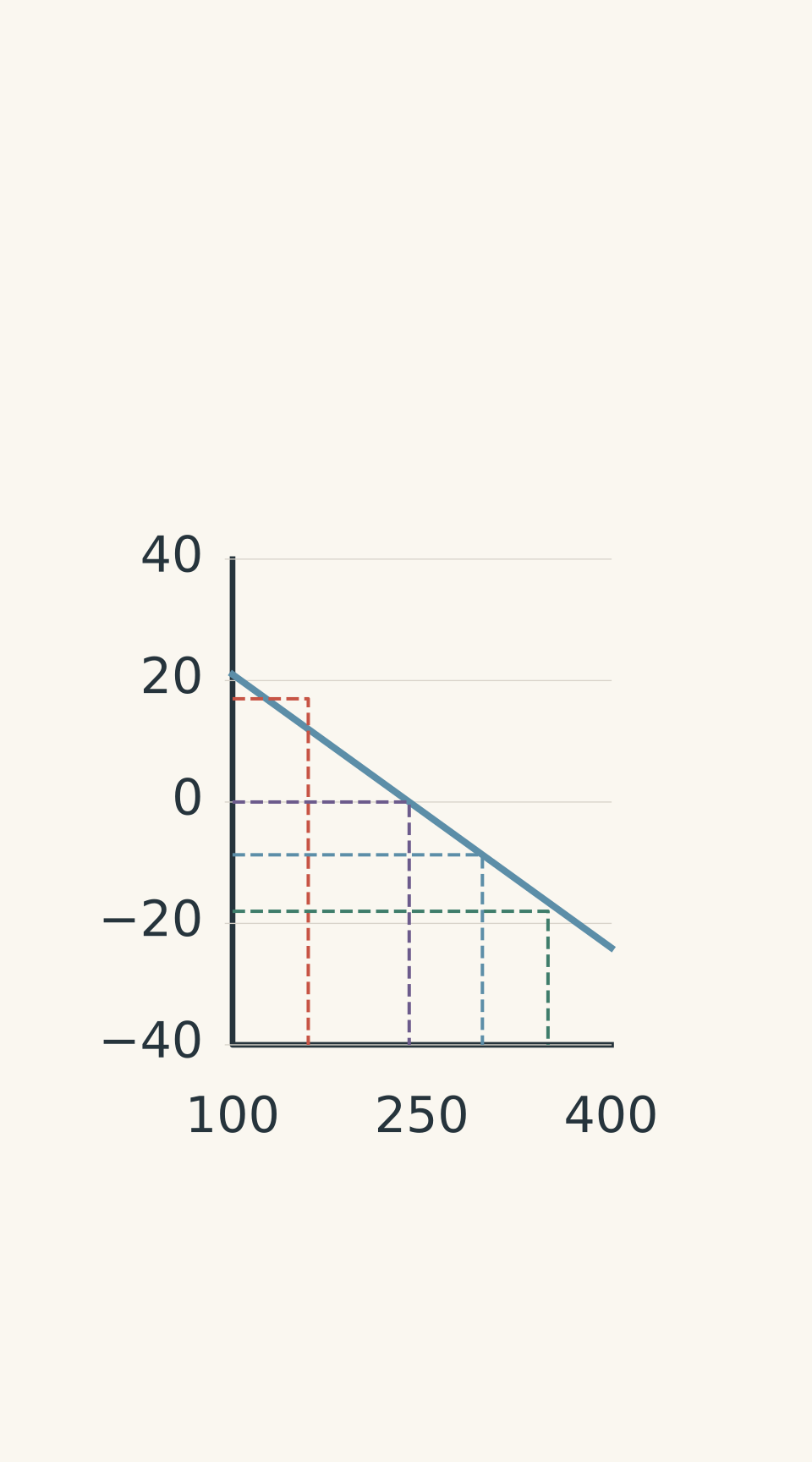
Due to technical limitations, this figure may display incorrectly or contain inaccuracies. Please check key details against your course materials.
05Worked example: The same reaction can be fast or slow
Two identical flasks initially contain equal amounts of dilute hydrogen peroxide at \(298\ \mathrm{K}\).
Flask A contains no added catalyst. Flask B contains a manganese dioxide catalyst.
Each flask is connected to a gas syringe.
The following illustrative results are supplied:
| Measurement | Flask A | Flask B |
|---|---|---|
| Oxygen collected after 60 s | 4.0 mL | 28.0 mL |
| Oxygen eventually collected | 50.0 mL | 50.0 mL |
Assume the flasks have no leaks, the gas is collected at the same pressure and temperature, and the catalyst does not change the initial amount of hydrogen peroxide.
Calculate the average oxygen-production rates over the first minute. Explain whether the catalyst changes thermodynamic feasibility, and label the question for a 2028 Year 11 class.
Step 1
The gas syringes record oxygen volume over time.
Average gas-production rate is:
\[ r=\frac{\Delta V}{\Delta t} \]
Here, \(r\) is average gas-volume production rate in \(\mathrm{mL\,s^{-1}}\), \(\Delta V\) is the volume of oxygen collected in millilitres, and \(\Delta t\) is elapsed time in seconds.
Step 2
For Flask A:
\[ \begin{aligned} r_A&=\frac{4.0\ \mathrm{mL}}{60\ \mathrm{s}}\\ &=0.0667\ \mathrm{mL\,s^{-1}} \end{aligned} \]
For Flask B:
\[ \begin{aligned} r_B&=\frac{28.0\ \mathrm{mL}}{60\ \mathrm{s}}\\ &=0.467\ \mathrm{mL\,s^{-1}} \end{aligned} \]
The ratio is:
\[ \frac{r_B}{r_A}=\frac{28.0}{4.0}=7.0 \]
Flask B produces oxygen seven times as quickly on average during the first minute.
Step 3
The catalyst has increased the reaction rate by providing a lower-activation-energy pathway.
It has not changed the standard Gibbs free-energy change of the overall reaction.
Both flasks eventually produce the same oxygen volume in this illustrative experiment, consistent with the same starting reactant amount and overall chemical change.
A tempting mistake is to say Flask B is “more spontaneous” because it reacts faster.
That is not what the measurements establish. No Gibbs-energy values have been determined.
Step 4
This is a 2025 Year 11 Chemical reactions question about reaction rates and catalysts. It also overlaps with content in the 2017 syllabus.
If it originally came from a 2017 worksheet, keep that source label while adding its 2025 assessment alignment.
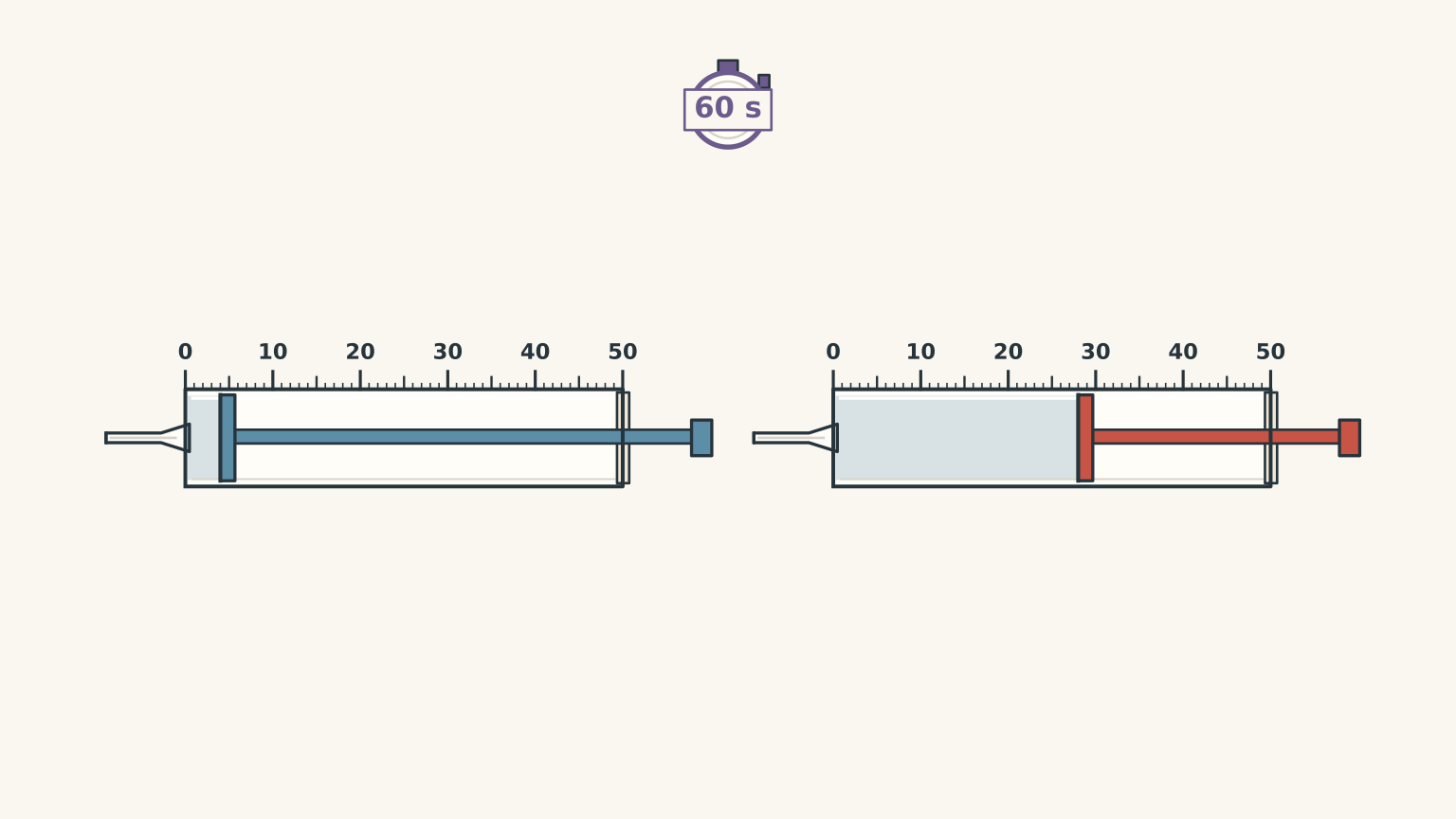
Due to technical limitations, this figure may display incorrectly or contain inaccuracies. Please check key details against your course materials.
06What if one question contains both syllabus editions?
A mixed question should be labelled by its parts rather than forced into one category.
Suppose a problem first asks you to calculate the enthalpy change of a reaction using calorimetry. It then asks for Gibbs free energy using entropy data.
The first calculation is within the 2025 syllabus.
The second introduces the 2017-specific Gibbs-energy method.
The correct label for the whole question is therefore something like:
Mixed content – 2025 Year 11 energy changes, plus 2017 Gibbs free-energy extension.
The same principle applies to Hess cycles. Calculating an enthalpy change is not automatically outside the 2025 syllabus, but a question that requires Hess’s law introduces a method explicitly included in the 2017 course rather than the 2025 prescribed content.
A useful final test is to remove the word “spontaneous” from the question.
If the remaining task asks for a gas-production rate, activation energy, or a standard cell potential, it has not suddenly become a Gibbs calculation.
If it requires \(\Delta H^\circ-T\Delta S^\circ\), the Gibbs method is still there, regardless of how the question is worded.
For a closer explanation of the difference between spontaneous, fast, exothermic, and thermodynamically favourable, see Reaction Spontaneity and Gibbs Free Energy: HSC Chemistry.
07Questions and solutions
The questions below become progressively more demanding. Each uses original scenarios or illustrative data, not reproduced HSC examination questions.
Question 1
A Chemistry question supplies the following standard thermodynamic data for a hypothetical reaction:
\[ \Delta H^\circ=-18.0\ \mathrm{kJ\,mol^{-1}} \]
\[ \Delta S^\circ=-40.0\ \mathrm{J\,mol^{-1}\,K^{-1}} \]
At \(298\ \mathrm{K}\):
a. Calculate \(\Delta G^\circ\).
b. Determine whether the forward reaction is thermodynamically favourable under standard-state conditions.
c. State the appropriate syllabus label for this calculation.
Solution 1
The standard Gibbs free-energy change is \(-6.08\ \mathrm{kJ\,mol^{-1}}\), so the forward reaction is thermodynamically favourable under standard-state conditions at \(298\ \mathrm{K}\). The question should be labelled 2017 Year 11 Module 4, or extension for the 2025 syllabus.
First, convert the entropy units:
\[ \begin{aligned} \Delta S^\circ &=\frac{-40.0}{1000}\\ &=-0.0400\ \mathrm{kJ\,mol^{-1}\,K^{-1}} \end{aligned} \]
Now calculate:
\[ \begin{aligned} \Delta G^\circ &=\Delta H^\circ-T\Delta S^\circ\\ &=-18.0-(298)(-0.0400)\\ &=-18.0+11.92\\ &=-6.08\ \mathrm{kJ\,mol^{-1}} \end{aligned} \]
The negative value favours the forward reaction under standard-state conditions.
The negative entropy change opposes spontaneity, but at \(298\ \mathrm{K}\), the favourable enthalpy contribution is greater.
The tempting mistake is to see \(\Delta S^\circ<0\) and immediately call the reaction nonspontaneous.
Both contributions must be considered together.
The Gibbs equation identifies the syllabus requirement. It is explicitly included in the 2017 course, not as a prescribed calculation in the 2025 course.
Question 2
A Year 11 Chemistry class in 2028 compares the reaction of calcium carbonate with excess hydrochloric acid:
\[ \ce{CaCO3(s) + 2HCl(aq) ->} \]
\[ \ce{CaCl2(aq) + H2O(l) + CO2(g)} \]
Two identical, sealed reaction flasks are connected to separate gas syringes.
Flask A contains calcium carbonate chips. Flask B contains the same amount of calcium carbonate as a fine powder.
The acid concentration, acid volume, initial temperature, and all other relevant conditions are the same.
The following illustrative data are obtained:
| Measurement | Chips | Powder |
|---|---|---|
| \(\ce{CO2}\) collected after 30 s | 12.0 mL | 40.0 mL |
| Final \(\ce{CO2}\) collected | 55.0 mL | 55.0 mL |
Assume gas collection is complete, with no leaks or significant gas dissolution.
a. Calculate the average gas-production rate over the first 30 seconds for each flask.
b. Explain why the powdered calcium carbonate produces gas faster.
c. A student claims that the powdered calcium carbonate is more thermodynamically spontaneous and releases more total energy because it reacts faster. Evaluate both claims.
d. State the 2025 syllabus alignment. Would adding a requirement to calculate \(\Delta G^\circ\) change the label?
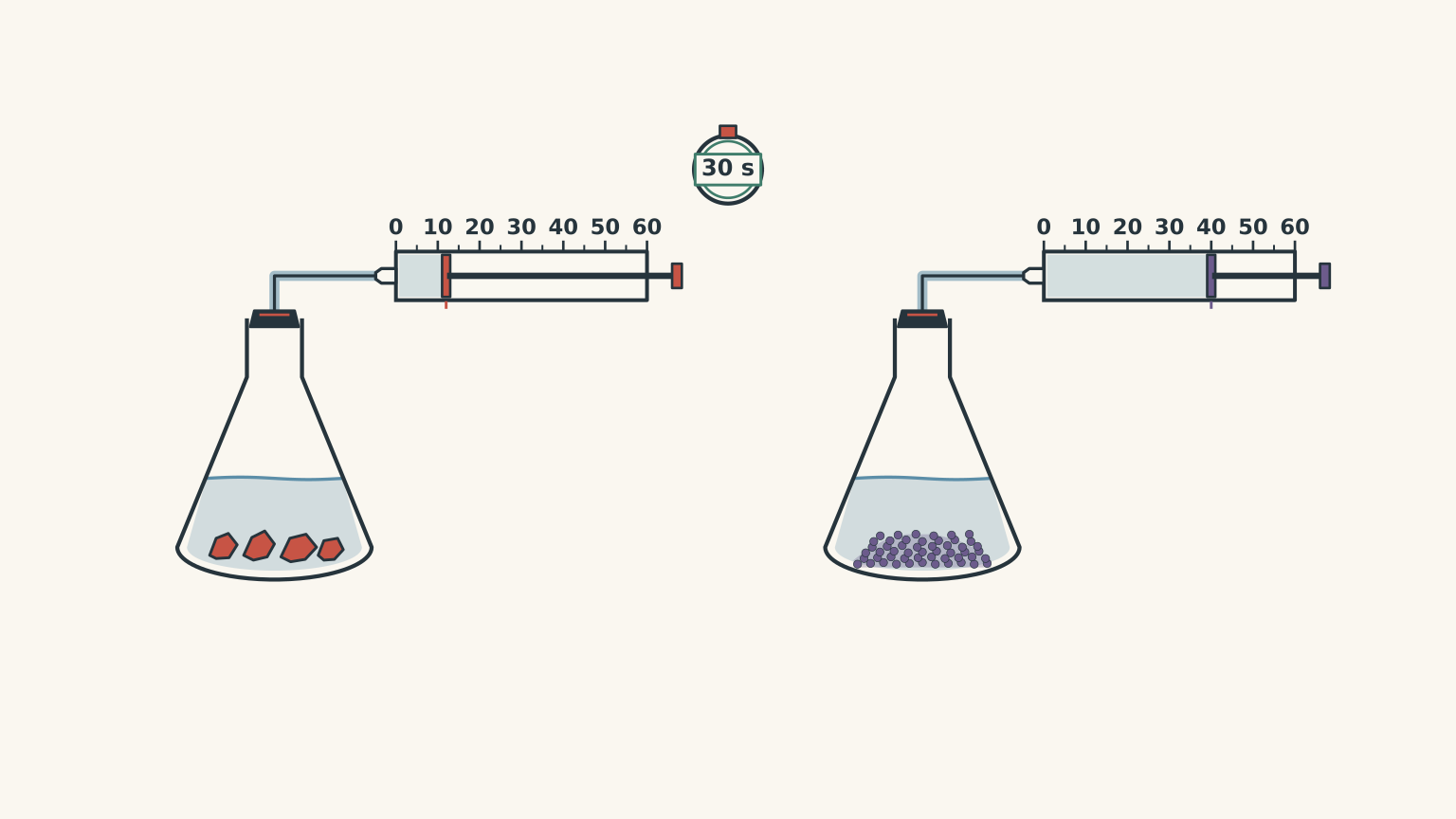
Due to technical limitations, this figure may display incorrectly or contain inaccuracies. Please check key details against your course materials.
Solution 2
The powdered calcium carbonate has an average initial gas-production rate of \(1.33\ \mathrm{mL\,s^{-1}}\), compared with \(0.400\ \mathrm{mL\,s^{-1}}\) for the chips. The difference is explained by greater exposed surface area, not a change in Gibbs free energy or total reaction enthalpy.
Part a
Average rate is:
\[ r=\frac{\Delta V}{\Delta t} \]
For the chips:
\[ r_A=\frac{12.0}{30} =0.400\ \mathrm{mL\,s^{-1}} \]
For the powder:
\[ r_B=\frac{40.0}{30} =1.33\ \mathrm{mL\,s^{-1}} \]
The powdered sample produces gas approximately \(3.33\) times as quickly over the first 30 seconds.
Part b
The powder exposes a greater surface area to the hydrochloric acid.
This allows more effective collisions between reactant particles per unit time, increasing the reaction rate.
The chemical equation and overall chemical change remain the same.
Part c
Neither claim is justified.
The greater reaction rate does not prove a more negative Gibbs free-energy change. Particle size affects how rapidly the reaction proceeds, not the thermodynamic difference between the same overall initial and final states.
The claim about total energy is also incorrect.
Both samples contain the same amount of calcium carbonate, react completely with excess acid, and produce the same amount of carbon dioxide.
For the same overall reaction under comparable conditions, the total reaction enthalpy change is the same.
The powder may release heat more quickly, but that does not mean it releases more heat overall.
The tempting route is to connect vigorous bubbling with greater energy release or greater spontaneity.
The controlling fact is that rate, enthalpy, and Gibbs free energy describe different properties of the reaction.
Part d
The original question aligns with 2025 Year 11 Chemical reactions, particularly reaction rates, surface area, and collision theory.
Adding a Gibbs-energy calculation would introduce 2017-specific content.
The revised question should be labelled mixed content, with its Gibbs part identified as extension for students following the 2025 syllabus.
Question 3
A student constructs a galvanic cell using zinc and copper half-cells.
The zinc electrode is immersed in a solution containing \(\ce{Zn^2+(aq)}\). The copper electrode is immersed in a solution containing \(\ce{Cu^2+(aq)}\).
The half-cells can be connected by a salt bridge, and an external wire contains a switch.
The standard reduction potentials are:
| Reduction half-equation | \(E^\circ\) |
|---|---|
| \(\ce{Cu^2+(aq) + 2e^- -> Cu(s)}\) | \(+0.34\ \mathrm{V}\) |
| \(\ce{Zn^2+(aq) + 2e^- -> Zn(s)}\) | \(-0.76\ \mathrm{V}\) |
Assume standard-state conditions at \(298\ \mathrm{K}\).
a. Determine the overall spontaneous redox reaction and calculate the standard cell potential, \(E^\circ_{\mathrm{cell}}\).
b. Predict whether a sustained current can flow when the external switch is closed but the salt bridge is removed.
c. Explain why a positive standard cell potential does not guarantee a particular reaction rate.
d. An online question bank labels this as “2017 Gibbs free energy” because it asks about spontaneity. Explain why that label is misleading, and identify the relevant 2025 syllabus content.
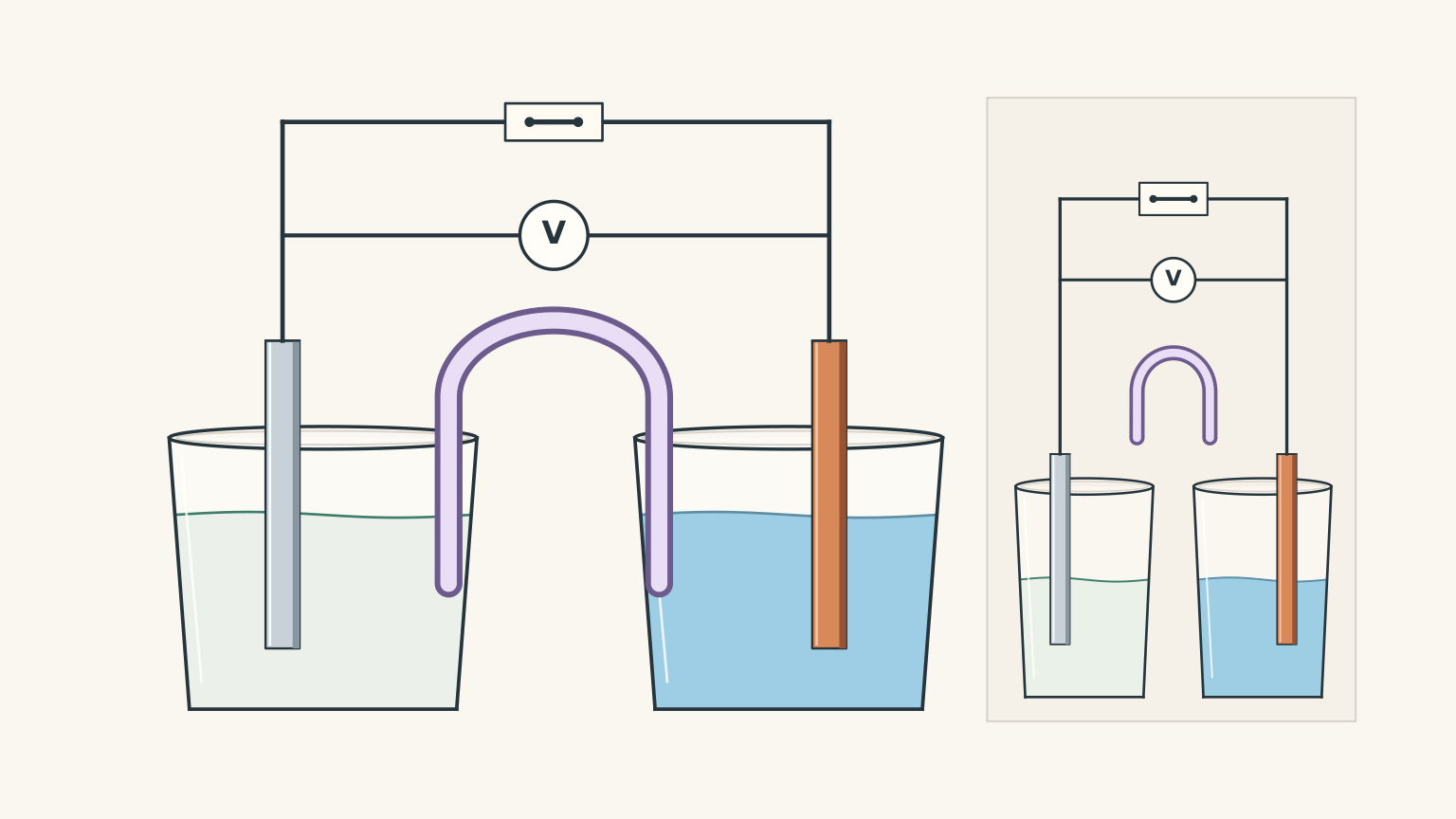
Due to technical limitations, this figure may display incorrectly or contain inaccuracies. Please check key details against your course materials.
Solution 3
The standard cell potential is \(+1.10\ \mathrm{V}\), so the overall redox reaction is thermodynamically favourable under standard conditions. However, removing the salt bridge prevents sustained current, despite the positive cell potential. This is a 2025 Year 12 electrochemistry question, not a Gibbs-equation question.
Part a
Copper has the more positive standard reduction potential, so copper ions undergo reduction.
Zinc undergoes oxidation.
Oxidation:
\[ \ce{Zn(s) -> Zn^2+(aq) + 2e^-} \]
Reduction:
\[ \ce{Cu^2+(aq) + 2e^- -> Cu(s)} \]
Overall:
\[ \ce{Zn(s) + Cu^2+(aq) ->} \]
\[ \ce{Zn^2+(aq) + Cu(s)} \]
Use:
\[ E^\circ_{\mathrm{cell}} = E^\circ_{\mathrm{cathode}} - E^\circ_{\mathrm{anode}} \]
Both values used are standard reduction potentials.
Substitute:
\[ \begin{aligned} E^\circ_{\mathrm{cell}} &=0.34-(-0.76)\\ &=+1.10\ \mathrm{V} \end{aligned} \]
The positive standard cell potential predicts a thermodynamically favourable overall reaction under standard-state conditions.
Part b
A sustained current cannot flow when the salt bridge is removed.
Electrons can initially begin transferring through the external circuit, but charge quickly builds up in the separate half-cells.
The salt bridge normally allows ions to move between the half-cells, maintaining electrical neutrality.
Without this internal ionic pathway, charge separation opposes further electron transfer and sustained current stops.
The tempting conclusion is that a positive cell potential should guarantee electricity whenever the switch is closed.
The missing constraint is a complete electrochemical circuit, including an ionic pathway.
Part c
Cell potential concerns thermodynamic driving force, not the speed of electrode reactions.
Reaction rates depend on additional factors, including activation barriers, electrode surface conditions, concentrations, and temperature.
A reaction can be thermodynamically favourable but kinetically slow.
Part d
The relevant 2025 content is Year 12 Applying chemical ideas, which includes standard reduction potentials, galvanic cells, and predictions of redox spontaneity.
The calculation uses \(E^\circ_{\mathrm{cell}}\), not \(\Delta G^\circ=\Delta H^\circ-T\Delta S^\circ\).
Calling it a Gibbs-energy question simply because it mentions spontaneity would confuse the concept being tested with a particular mathematical method.
Question 4
A reaction proceeds through a hypothetical intermediate:
\[ \ce{A -> B -> C} \]
A student uses two separately measured enthalpy changes to determine the overall change from A to C.
The following illustrative values are supplied:
| Quantity | Value |
|---|---|
| \(\Delta H^\circ_1\), A to B | \(+20.0\pm0.5\ \mathrm{kJ\,mol^{-1}}\) |
| \(\Delta H^\circ_2\), B to C | \(-50.0\pm0.5\ \mathrm{kJ\,mol^{-1}}\) |
| \(\Delta S^\circ\), A to C | \(-100\pm5\ \mathrm{J\,mol^{-1}\,K^{-1}}\) |
| Temperature | \(298\ \mathrm{K}\) |
Assume the reaction equations and coefficients are consistent, temperature is exact for this exercise, and all quoted uncertainty ranges are absolute possible bounds rather than statistical standard deviations.
a. Calculate the best-estimate overall enthalpy change using Hess’s law.
b. Calculate the best-estimate standard Gibbs free-energy change.
c. Determine the smallest and largest Gibbs-energy changes allowed by the stated measurement bounds.
d. A student concludes that the reaction is definitely spontaneous because the calculated \(\Delta G^\circ\) is negative. Evaluate that conclusion.
e. Explain how the complete question should be labelled for the 2017 and 2025 syllabus editions.
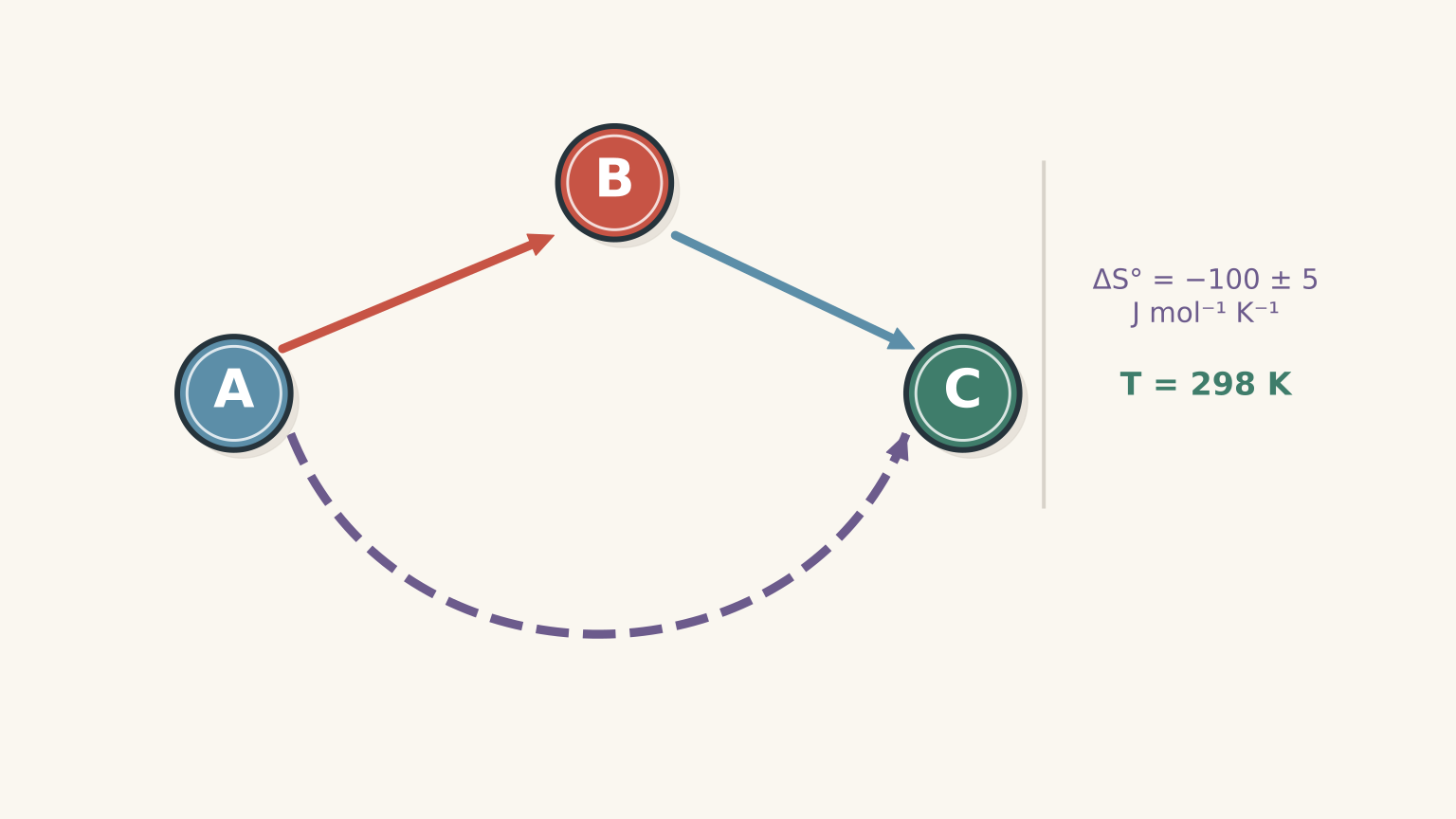
Due to technical limitations, this figure may display incorrectly or contain inaccuracies. Please check key details against your course materials.
Solution 4
The best-estimate Gibbs free-energy change is \(-0.20\ \mathrm{kJ\,mol^{-1}}\), but its possible range extends from \(-2.69\) to \(+2.29\ \mathrm{kJ\,mol^{-1}}\). Therefore, the data do not establish the sign of \(\Delta G^\circ\) with certainty. The combined Hess-law and Gibbs calculation is 2017-specific content.
Part a
Hess’s law allows enthalpy changes to be added when the chemical equations combine to give the overall reaction.
\[ \begin{aligned} \Delta H^\circ &=\Delta H^\circ_1+\Delta H^\circ_2\\ &=20.0+(-50.0)\\ &=-30.0\ \mathrm{kJ\,mol^{-1}} \end{aligned} \]
The overall reaction is exothermic.
The largest possible combined uncertainty is:
\[ 0.5+0.5=1.0\ \mathrm{kJ\,mol^{-1}} \]
Thus:
\[ \Delta H^\circ=-30.0\pm1.0\ \mathrm{kJ\,mol^{-1}} \]
Part b
Convert entropy into kilojoules:
\[ \Delta S^\circ =-0.100\ \mathrm{kJ\,mol^{-1}\,K^{-1}} \]
Calculate:
\[ \begin{aligned} \Delta G^\circ &=\Delta H^\circ-T\Delta S^\circ\\ &=-30.0-(298)(-0.100)\\ &=-30.0+29.8\\ &=-0.20\ \mathrm{kJ\,mol^{-1}} \end{aligned} \]
The best-estimate result is slightly negative.
Part c
The stated uncertainty gives:
\[ -31.0\leq\Delta H^\circ\leq-29.0 \]
in \(\mathrm{kJ\,mol^{-1}}\), and:
\[ -0.105\leq\Delta S^\circ\leq-0.095 \]
in \(\mathrm{kJ\,mol^{-1}\,K^{-1}}\).
The smallest possible \(\Delta G^\circ\) occurs with the most negative enthalpy and least negative entropy:
\[ \begin{aligned} \Delta G^\circ_{\min} &=-31.0-(298)(-0.095)\\ &=-31.0+28.31\\ &=-2.69\ \mathrm{kJ\,mol^{-1}} \end{aligned} \]
The largest possible value occurs with the least negative enthalpy and most negative entropy:
\[ \begin{aligned} \Delta G^\circ_{\max} &=-29.0-(298)(-0.105)\\ &=-29.0+31.29\\ &=+2.29\ \mathrm{kJ\,mol^{-1}} \end{aligned} \]
Both signs are allowed by the measurement ranges.
Part d
The claim of definite spontaneity is not justified.
The best-estimate result favours the forward reaction under standard-state conditions, but the uncertainty range crosses zero.
A slightly positive Gibbs-energy change would instead predict that the forward reaction is unfavourable under standard-state conditions.
This is more subtle than simply checking whether your calculator displays a minus sign.
The governing constraint is the precision of the underlying thermodynamic measurements.
If the uncertainty is large enough to change the sign, the conclusion must reflect that limitation.
Part e
The full question combines Hess’s law and Gibbs free energy, both explicitly included in the 2017 Year 11 Module 4 content.
The 2025 syllabus includes energy changes and enthalpy calculations, but does not explicitly prescribe Hess-cycle calculations or the Gibbs-energy equation.
For a 2025 class, label the complete problem as extension rather than a core 2025 assessment question.
Question 5
A hypothetical reversible reaction converts dissolved substance A into dissolved substance B:
\[ \ce{A(aq) <=> B(aq)} \]
At constant pressure, the supplied standard thermodynamic data are:
\[ \Delta H^\circ=+48.0\ \mathrm{kJ\,mol^{-1}} \]
\[ \Delta S^\circ=+160\ \mathrm{J\,mol^{-1}\,K^{-1}} \]
Assume these values remain constant between \(298\ \mathrm{K}\) and \(350\ \mathrm{K}\).
Two identical sealed optical cells, each containing \(1.00\ \mathrm{L}\) of solution, are prepared at \(298\ \mathrm{K}\).
Their initial concentrations are:
| Initial concentration | Cell 1 | Cell 2 |
|---|---|---|
| \([\ce{A}]\) | \(0.90\ \mathrm{mol\,L^{-1}}\) | \(0.10\ \mathrm{mol\,L^{-1}}\) |
| \([\ce{B}]\) | \(0.10\ \mathrm{mol\,L^{-1}}\) | \(0.90\ \mathrm{mol\,L^{-1}}\) |
A catalyst is added only to Cell 1. The catalyst does not change solution volume, temperature, or equilibrium composition.
For this hypothetical reaction, the equilibrium constants have been supplied independently:
| Temperature | Equilibrium constant \(K\) |
|---|---|
| \(298\ \mathrm{K}\) | \(0.88\) |
| \(350\ \mathrm{K}\) | \(15.6\) |
Assume ideal dilute-solution behaviour, constant total concentration \([\ce{A}]+[\ce{B}]=1.00\ \mathrm{mol\,L^{-1}}\), and no side reactions. Both cells are allowed to reach equilibrium at \(298\ \mathrm{K}\), then warmed to \(350\ \mathrm{K}\).
a. Calculate \(\Delta G^\circ\) at \(298\ \mathrm{K}\). Is the forward reaction thermodynamically favourable under standard-state conditions?
b. Before either cell reaches equilibrium, determine the direction of net reaction in each cell at \(298\ \mathrm{K}\). Explain any apparent contradiction with part a.
c. Calculate the equilibrium concentration of B at \(298\ \mathrm{K}\). Will the catalyst change that final concentration?
d. Immediately after both equilibrium mixtures are warmed to \(350\ \mathrm{K}\), determine the direction of net reaction and the new equilibrium concentration of B. Explain the roles of temperature and the catalyst.
e. A question bank labels this entire problem “2025 HSC Gibbs free energy and equilibrium”. Is that a valid label? Give a more accurate classification.
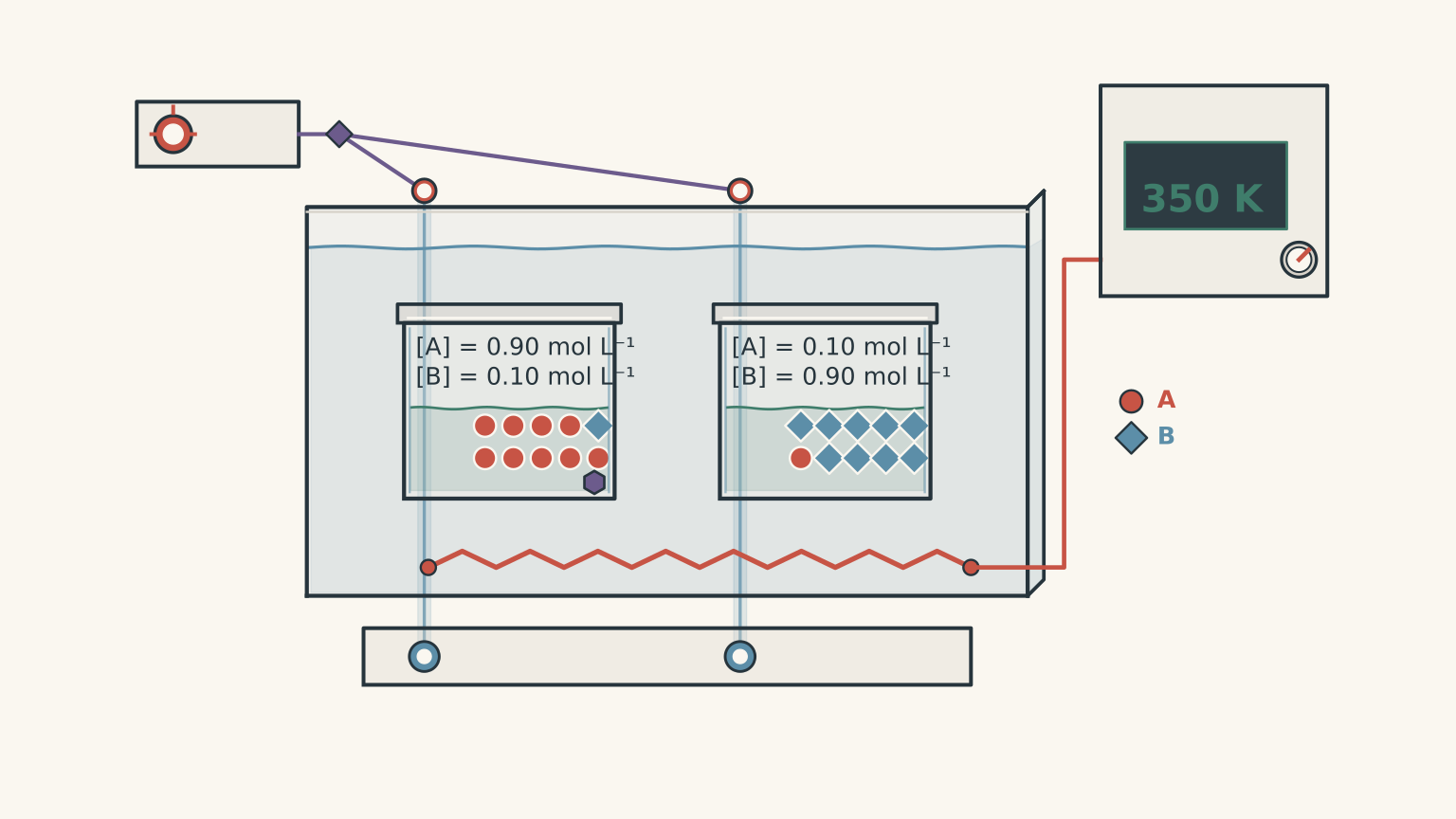
Due to technical limitations, this figure may display incorrectly or contain inaccuracies. Please check key details against your course materials.
Solution 5
At \(298\ \mathrm{K}\), Cell 1 initially reacts towards B while Cell 2 initially reacts towards A, even though the standard Gibbs free-energy change is positive. Both reach the same equilibrium composition. Warming then favours further production of B, while the catalyst changes only how quickly equilibrium is approached. The problem combines 2017 Gibbs-energy extension content with equilibrium and catalyst concepts covered in the 2025 syllabus.
The central insight is that the sign of \(\Delta G^\circ\), the direction of reaction in a particular mixture, and the reaction rate are three different pieces of information.
Part a: Standard Gibbs free energy
Convert the standard entropy change:
\[ \Delta S^\circ =0.160\ \mathrm{kJ\,mol^{-1}\,K^{-1}} \]
Then:
\[ \begin{aligned} \Delta G^\circ &=\Delta H^\circ-T\Delta S^\circ\\ &=48.0-(298)(0.160)\\ &=48.0-47.68\\ &=+0.320\ \mathrm{kJ\,mol^{-1}} \end{aligned} \]
The forward reaction is thermodynamically unfavourable under standard-state conditions at \(298\ \mathrm{K}\).
A student might now predict that neither cell can initially produce more B.
That prediction is incorrect.
Part b: Determine the direction in each actual mixture
For this reversible reaction, the reaction quotient is:
\[ Q=\frac{[\ce{B}]}{[\ce{A}]} \]
Here, \(Q\) describes the current product-to-reactant concentration ratio. The equilibrium constant \(K\) describes that ratio at equilibrium.
For the specified ideal dilute-solution model, we can compare the numerical values directly.
The decision rule is:
- If \(Q<K\), net reaction proceeds towards products.
- If \(Q>K\), net reaction proceeds towards reactants.
- If \(Q=K\), the mixture is at equilibrium.
At \(298\ \mathrm{K}\), \(K=0.88\).
For Cell 1:
\[ Q_1=\frac{0.10}{0.90}=0.111 \]
Because \(0.111<0.88\), Cell 1 initially reacts towards B.
For Cell 2:
\[ Q_2=\frac{0.90}{0.10}=9.00 \]
Because \(9.00>0.88\), Cell 2 initially reacts towards A.
There is no contradiction.
The positive \(\Delta G^\circ\) describes the standard-state tendency. The actual direction in a particular mixture depends on its composition.
Cell 1 contains much less B than its equilibrium ratio requires, so producing B moves it towards equilibrium.
Cell 2 contains too much B relative to A, so the reverse reaction is favoured.
Both can be true for the same chemical reaction at the same temperature.
Part c: Find the equilibrium composition
At equilibrium:
\[ K=\frac{[\ce{B}]_{\mathrm{eq}}} {[\ce{A}]_{\mathrm{eq}}} =0.88 \]
The total concentration is \(1.00\ \mathrm{mol\,L^{-1}}\).
Let \(b\) be the equilibrium concentration of B in \(\mathrm{mol\,L^{-1}}\).
Then the concentration of A is \(1.00-b\), using concentrations expressed numerically in \(\mathrm{mol\,L^{-1}}\).
\[ \begin{aligned} 0.88&=\frac{b}{1.00-b}\\ 0.88-0.88b&=b\\ 1.88b&=0.88\\ b&=0.468 \end{aligned} \]
Therefore:
\[ [\ce{B}]_{\mathrm{eq}} =0.468\ \mathrm{mol\,L^{-1}} \]
and:
\[ [\ce{A}]_{\mathrm{eq}} =0.532\ \mathrm{mol\,L^{-1}} \]
Both cells reach this composition at \(298\ \mathrm{K}\).
The catalyst may make Cell 1 approach equilibrium faster, but it does not change \(K\) or the final equilibrium concentrations.
A catalyst speeds up both forward and reverse reaction pathways without changing the overall thermodynamic equilibrium.
Part d: Warm both equilibrium mixtures to 350 K
Immediately after warming, before any further reaction, the concentration ratio remains approximately:
\[ Q=0.88 \]
But the equilibrium constant at \(350\ \mathrm{K}\) is now:
\[ K=15.6 \]
Because:
\[ Q<K \]
both mixtures move towards B.
The new equilibrium concentration can be calculated in the same way:
\[ 15.6=\frac{b}{1.00-b} \]
Rearrange:
\[ \begin{aligned} 15.6-15.6b&=b\\ 16.6b&=15.6\\ b&=0.940 \end{aligned} \]
Thus:
\[ [\ce{B}]_{\mathrm{eq}} =0.940\ \mathrm{mol\,L^{-1}} \]
Both cells now favour a much higher proportion of B at equilibrium.
This is also consistent with the reaction being endothermic.
Increasing temperature favours the endothermic direction, which in this case is the forward reaction.
We can confirm the standard Gibbs-energy prediction:
\[ \begin{aligned} \Delta G^\circ &=48.0-(350)(0.160)\\ &=48.0-56.0\\ &=-8.00\ \mathrm{kJ\,mol^{-1}} \end{aligned} \]
At \(350\ \mathrm{K}\), the forward reaction is thermodynamically favourable under standard-state conditions.
Heating has changed the equilibrium constant and the standard Gibbs-energy change.
The catalyst has not changed either quantity. It may change the time needed to reach the new equilibrium.
This is the decisive contrast: temperature can affect both kinetics and equilibrium, while a catalyst affects kinetics without changing equilibrium.
Part e: Classify the syllabus content
The label “2025 HSC Gibbs free energy and equilibrium” is misleading because it presents the entire question as explicitly prescribed 2025 content.
A more accurate classification is:
| Question component | Syllabus classification |
|---|---|
| Calculating \(\Delta G^\circ\) using \(\Delta H^\circ-T\Delta S^\circ\) | 2017 Year 11 Module 4; extension for 2025 |
| Comparing reaction quotient \(Q\) and equilibrium constant \(K\) | 2025 Year 12 Equilibrium |
| Calculating and interpreting equilibrium concentrations | 2025 Year 12 Equilibrium |
| Explaining catalyst effects on reaction rate and equilibrium | Relevant 2025 Chemical reactions and Equilibrium content |
| Combining standard Gibbs energy, actual mixture composition, and equilibrium | Integrated extension question for a 2025 student |
The complete question is therefore best labelled:
Mixed syllabus content – 2025 equilibrium and kinetics, with 2017 Gibbs-energy extension.
The hardest mistake in this question is not arithmetic. It is assuming that a thermodynamic prediction made for standard states tells you exactly what every possible mixture must do.
It doesn’t.
For future HSC questions, first identify the syllabus edition, then identify whether the evidence concerns heat transfer, reaction speed, standard-state thermodynamics, or the actual equilibrium position. This leads directly into a more general skill: deciding which chemical model can answer a question, and recognising when the information provided cannot support the conclusion being claimed.