
IUPAC Naming of Alcohols, Aldehydes and Ketones to C8
Learn how to name alcohols, aldehydes, and ketones using correct parent chains, locants, and functional-group priorities for HSC Chemistry.
Take the molecule \(\ce{CH3CH(CH3)CH2CH(OH)CH3}\). One student numbers from the left and gets 2-methylpentan-4-ol. Another numbers from the right and gets 4-methylpentan-2-ol. Both have used the same five-carbon chain. Both have found the same branch. So why is only one name correct?
Before reading on, predict which feature gets first choice of the smaller number: the methyl branch or the \(\ce{-OH}\) group.
It is the \(\ce{-OH}\) group. The correct name is 4-methylpentan-2-ol. Once an important functional group appears, numbering is no longer just a hunt for the smallest branch number.
That idea is the key to naming alcohols, aldehydes, and ketones reliably.
01The basic job of an IUPAC name
An IUPAC name is a set of instructions for rebuilding a molecule.
For the oxygenated compounds in this guide, you need to communicate three main things:
- how many carbons are in the parent chain,
- which important functional group is present, and
- where that group, and any branches, are located.
If the name is 4-methylpentan-2-ol, for example:
penttells you the parent chain contains five carbons,2-oltells you an \(\ce{-OH}\) group is attached to carbon 2, and4-methyltells you a methyl branch is attached to carbon 4.
If carbon-chain naming is still shaky, revise the broader IUPAC naming process for organic compounds to C8 first.
02Recognise the three oxygenated functional groups
Alcohols, aldehydes, and ketones all contain oxygen, but the oxygen is connected differently.
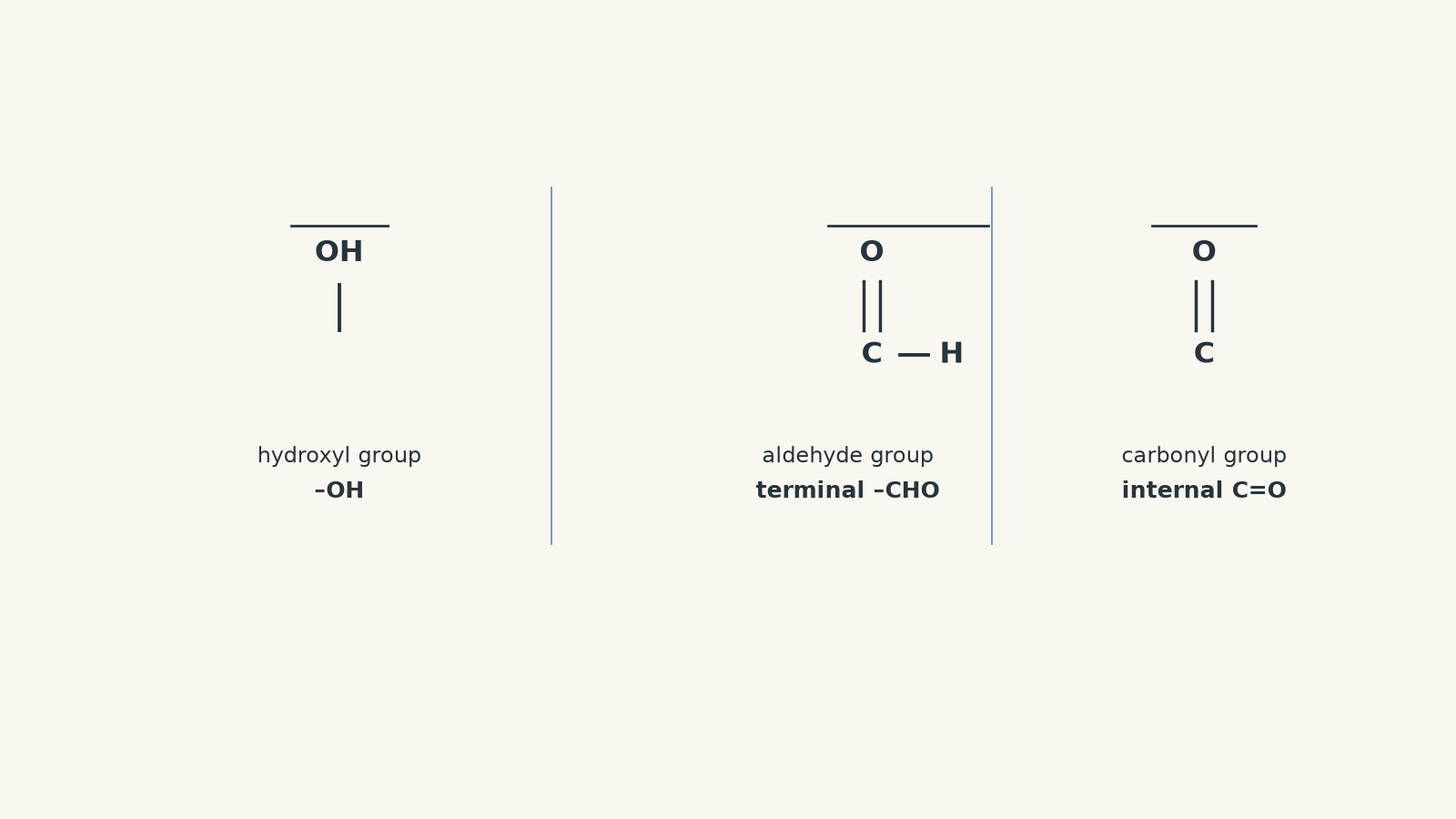
| Family | Functional group | Key structural feature | Suffix |
|---|---|---|---|
| Alcohol | \(\ce{-OH}\) | hydroxyl group attached to a carbon | -ol |
| Aldehyde | \(\ce{-CHO}\) | carbonyl group at the end of a chain | -al |
| Ketone | \(\ce{>C=O}\) | carbonyl group within a chain | -one |
A carbonyl group is a carbon atom double-bonded to oxygen, \(\ce{C=O}\).
The important difference between an aldehyde and a ketone is therefore not whether they contain a carbonyl group. Both do. It is where that carbonyl sits.
In an aldehyde, the carbonyl carbon is at the end of the chain and is bonded to a hydrogen.
In a ketone, the carbonyl carbon sits between two carbon atoms.
03First, get the carbon root right
For compounds up to eight carbons, these roots need to become automatic.
| Number of carbons | Root |
|---|---|
| 1 | meth- |
| 2 | eth- |
| 3 | prop- |
| 4 | but- |
| 5 | pent- |
| 6 | hex- |
| 7 | hept- |
| 8 | oct- |
But there is an important upgrade to the usual instruction, “find the longest chain”.
You need the longest suitable chain containing the principal functional group.
If you choose a beautiful eight-carbon chain but leave the group that controls the suffix hanging off the side, you have chosen the wrong parent.
Think of the principal functional group as someone insisting on being in the group photo. It doesn’t matter that you found a slightly bigger group of people somewhere else. If the important person isn’t in the photo, it isn’t the photo you were asked for.
The analogy stops there: molecules aren’t socially insecure. The precise rule is that the parent structure must contain the functional group being expressed by the suffix.
04Naming alcohols
An alcohol contains the hydroxyl group, \(\ce{-OH}\).
Consider:
\[ \ce{CH3CH2CH(OH)CH2CH3} \]
There are five carbons in the parent chain, so the root is pent-.
The \(\ce{-OH}\) group is on carbon 3 whichever end you start from. The name is:
pentan-3-ol
Now consider:
\[ \ce{CH3CH(OH)CH2CH2CH3} \]
If you number from the left, the hydroxyl group is on carbon 2.
If you number from the right, it is on carbon 4.
Which direction wins? Carbon 2, because the hydroxyl group controls the numbering before an ordinary alkyl branch does.
The name is pentan-2-ol.
The alcohol naming method
For a simple alcohol:
- Find the longest carbon chain containing the carbon bonded to \(\ce{-OH}\).
- Number the chain from the end giving the \(\ce{-OH}\) group the lowest possible locant.
- Name and locate any branches.
- Replace the alkane ending with
-ol, including the hydroxyl locant.
So a six-carbon parent with \(\ce{-OH}\) on carbon 2 becomes hexan-2-ol.
The number 2 is a locant: a number specifying a position in the structure.
Worked example: Name a branched alcohol
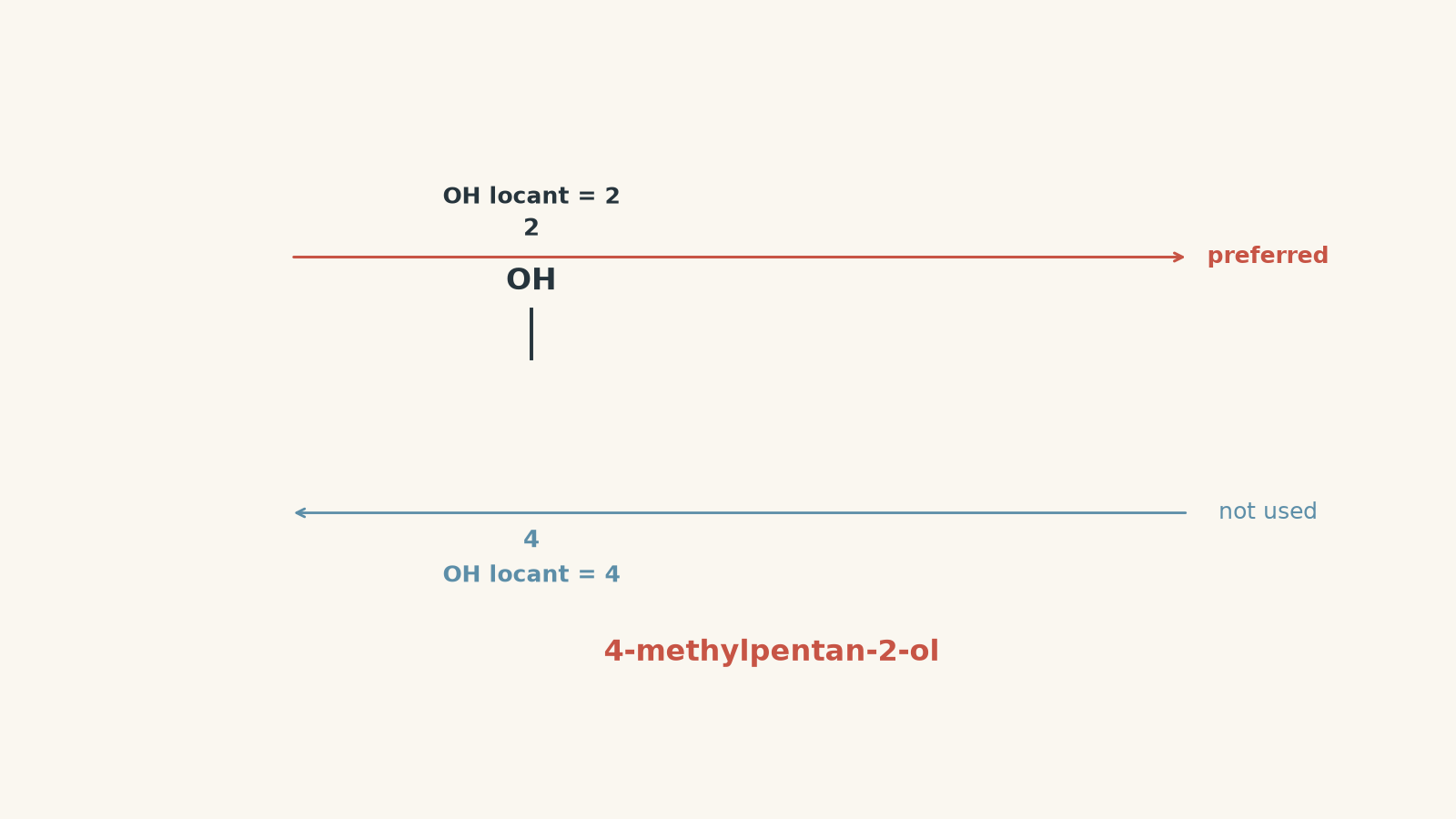
Name \(\ce{CH3CH(CH3)CH2CH(OH)CH3}\).
Step 1
The longest suitable chain contains five carbons, so the parent is based on pentane.
Step 2
Numbering from the right places \(\ce{-OH}\) on carbon 2. Numbering from the left would put it on carbon 4.
The hydroxyl group must receive the lower number.
Step 3
With the correct numbering, the methyl branch is on carbon 4.
Step 4
The name is 4-methylpentan-2-ol.
The tempting name 2-methylpentan-4-ol gives the branch a nicer number, but sacrifices the lower hydroxyl locant. That reverses the actual priority.
If methyl and ethyl branches are causing trouble, the guide to naming methyl and ethyl branched chains covers that part separately.
05Naming ketones
A ketone contains an internal carbonyl group.
For example:
\[ \ce{CH3COCH2CH3} \]
The parent contains four carbons, and the carbonyl carbon is carbon 2.
The name is butan-2-one.
You cannot have butan-1-one as a ketone. If the carbonyl carbon were at the end and bonded to a hydrogen, the compound would instead belong to the aldehyde family.
For ketones, the process is similar to alcohol naming:
- Find the longest chain containing the carbonyl carbon.
- Number it to give the carbonyl carbon the lowest possible locant.
- Locate and name branches.
- use the suffix
-one.
Worked example: Name a branched ketone
Name \(\ce{CH3CH2COCH(CH3)CH2CH3}\).
Step 1
The parent contains six carbons, giving hex-.
Step 2
From the left, the \(\ce{C=O}\) carbon is carbon 3.
From the right, it would be carbon 4.
So we number from the left.
Step 3
The methyl group is on carbon 4.
Step 4
The compound is 4-methylhexan-3-one.
Notice what did not happen. We did not reverse the numbering just to turn 4-methyl into 3-methyl. The ketone suffix controls the direction first.
06Naming aldehydes
Aldehydes have one useful feature that makes their numbering easier.
Their \(\ce{-CHO}\) group is at the end of the parent chain.
Consider:
\[ \ce{CH3CH2CH2CHO} \]
Count carefully. There are four carbons, not three.
The carbon inside \(\ce{-CHO}\) is part of the parent chain.
That carbon is automatically carbon 1, so the compound is butanal.
You do not normally write butan-1-al. An aldehyde carbon at the end of an open chain has no alternative position, so the locant would add nothing useful.
This is a common place to lose a carbon. A student sees \(\ce{CH3CH2CH2}\), says “three carbons”, and treats \(\ce{CHO}\) like something attached afterwards. It isn’t. The aldehyde carbon counts.
Worked example: Number an aldehyde correctly
Name \(\ce{OHC-CH2-CH(CH3)-CH2-CH3}\).
Step 1
The longest suitable chain has five carbons. The parent is pentanal.
Step 2
There is no decision to make here. The \(\ce{CHO}\) carbon begins the numbering.
Step 3
The methyl group is attached to carbon 3.
Step 4
The compound is 3-methylpentanal.
Writing 3-methylpentan-1-al is unnecessary for this open-chain aldehyde.
07Functional-group priority: what if more than one appears?
Now the interesting part.
Suppose one molecule contains both an \(\ce{-OH}\) group and a ketone carbonyl. Which one gets the suffix?
You cannot simply make up something like pentanolone and hope everyone understands what happened.
One functional group is chosen as the principal functional group. It determines the suffix and has priority when the chain is numbered.
For the three groups in this guide, the priority is:
\[ \text{aldehyde} > \text{ketone} > \text{alcohol} \]
This priority is a naming rule. It does not mean aldehydes are “more important chemicals”, more reactive in every reaction, or somehow better than alcohols. It tells you which functional group controls the systematic name when these groups compete.
| If the molecule contains… | Principal group | Suffix | Lower-priority group becomes… |
|---|---|---|---|
| aldehyde + ketone | aldehyde | -al | ketone carbonyl: oxo- |
| aldehyde + alcohol | aldehyde | -al | alcohol group: hydroxy- |
| ketone + alcohol | ketone | -one | alcohol group: hydroxy- |
So an alcohol that loses the suffix competition does not disappear. Its \(\ce{-OH}\) group is described using the prefix hydroxy-.
Likewise, a ketone carbonyl that loses to an aldehyde is described using oxo-.
Predict the numbering
Consider:
\[ \ce{CH3COCH2CH2OH} \]
From the left, the ketone carbonyl is on carbon 2 and the hydroxyl group is on carbon 4.
From the right, the hydroxyl group is on carbon 1 and the ketone carbonyl is on carbon 3.
Which numbering should we choose?
It is tempting to start beside the \(\ce{-OH}\) because 1 looks impressively low. But the ketone has higher priority than the alcohol.
The ketone therefore receives the suffix and the lower locant.
The compound is 4-hydroxybutan-2-one.
This is why “start from the end with the smallest-looking numbers” is not a safe naming method. You need to know which feature is entitled to those numbers.
08A reliable decision order
When alcohols, aldehydes, ketones, and branches are mixed together, use this sequence.
1. Identify every functional group
Look specifically for:
- \(\ce{-CHO}\): aldehyde,
- internal \(\ce{C=O}\): ketone,
- \(\ce{-OH}\): alcohol.
Do this before numbering anything.
2. Choose the principal functional group
Among the three groups here:
\[ \text{aldehyde} > \text{ketone} > \text{alcohol} \]
The highest-priority group supplies the suffix.
3. Choose a valid parent chain
The parent must contain the principal functional group.
Then choose the appropriate longest chain.
Do not automatically choose the longest carbon path anywhere in the molecule before checking the functional group.
4. Number for the principal group
Give the principal functional group the lowest permitted locant.
For an open-chain aldehyde, its carbon is automatically carbon 1.
Only after that do branches and lower-priority groups get their numbers.
5. Convert lower-priority groups to prefixes
For the combinations considered here:
- \(\ce{-OH}\) becomes
hydroxy-, - a lower-priority carbonyl becomes
oxo-.
6. Add branches and assemble the name
Prefixes are placed alphabetically in the final name. Numerical locants do not affect alphabetical order.
For example, hydroxy comes before methyl.
09Worked example: Three oxygenated groups in one molecule
Name:
\[ \ce{OHC-CH2-CO-CH2-CH(OH)-CH3} \]
Step 1
The molecule contains:
- an aldehyde,
- a ketone carbonyl, and
- an alcohol group.
Step 2
The aldehyde has the highest priority of the three, so the suffix must be -al.
The six-carbon parent is therefore based on hexanal.
Step 3
The aldehyde carbon is carbon 1 automatically.
This places the ketone carbonyl at carbon 3 and the hydroxyl group at carbon 5.
Step 4
The ketone carbonyl becomes 3-oxo.
The alcohol becomes 5-hydroxy.
Step 5
hydroxy comes before oxo.
The full name is 5-hydroxy-3-oxohexanal.
The name records the same atoms as the structure. Nothing has been removed because a group lost the suffix competition; the group is simply described differently.
10The most tempting mistakes
Mistake 1: Giving a branch the lowest number
Suppose numbering one way gives:
- hydroxyl at carbon 2,
- methyl at carbon 5.
The other gives:
- hydroxyl at carbon 5,
- methyl at carbon 2.
For an alcohol, choose the first direction. The principal \(\ce{-OH}\) group wins before the branch.
Mistake 2: Forgetting that the aldehyde carbon counts
In \(\ce{CH3CH2CHO}\), there are three carbons.
The compound is propanal, not ethanal.
Mistake 3: Calling every \(\ce{C=O}\) compound a ketone
A carbonyl at the end as \(\ce{-CHO}\) identifies an aldehyde.
A ketone carbonyl sits inside the carbon skeleton between carbon groups.
Mistake 4: Choosing the parent before finding the functional group
“Longest chain” is incomplete advice.
A useful rule is:
Find the principal functional group first, then find the appropriate longest parent containing it.
Mistake 5: Assuming the lowest number anywhere decides the numbering
It doesn’t.
A lower-priority feature cannot steal a low number from a higher-priority functional group.
A hydroxy group at carbon 1 does not beat a ketone that would otherwise move from carbon 2 to carbon 3.
11Questions and solutions
Question 1
Give the IUPAC name of:
\[ \ce{CH3CH2CH(OH)CH2CH3} \]
Solution 1
The compound is pentan-3-ol.
The longest chain containing the carbon bonded to \(\ce{-OH}\) has five carbons, giving the root pent-.
The hydroxyl group lies on carbon 3:
\[ \ce{CH3-CH2-CH(OH)-CH2-CH3} \]
Numbering from either end gives the same locant, 3.
Because the principal functional group is an alcohol, the suffix is -ol, producing pentan-3-ol.
A tempting mistake is to count only until reaching the \(\ce{-OH}\) group. The entire continuous parent chain must be counted.
Question 2
Give the IUPAC name of:
\[ \ce{CH3CH2COCH(CH3)CH2CH3} \]
Explain why numbering from the opposite end is incorrect.
Solution 2
The compound is 4-methylhexan-3-one.
The longest chain containing the carbonyl carbon has six carbons, so the parent is a hexanone.
Numbering from the left gives:
- ketone carbonyl at carbon 3,
- methyl branch at carbon 4.
Numbering from the right gives:
- ketone carbonyl at carbon 4,
- methyl branch at carbon 3.
The ketone carbonyl determines the numbering before the methyl branch does. Therefore:
\[ \text{carbonyl locant }3 < 4 \]
and the correct name is 4-methylhexan-3-one.
The tempting alternative, 3-methylhexan-4-one, gives the branch the smaller number but gives the principal functional group the larger number. That is the exact reason it fails.
Question 3
A student names the compound
\[ \ce{CH3CH2CH(CH3)CH2CHO} \]
as 3-methylbutanal because they count only the four carbons before the \(\ce{-CHO}\) group.
Determine the correct name and explain the error.
Solution 3
The correct name is 3-methylpentanal.
The aldehyde carbon in \(\ce{-CHO}\) belongs to the parent chain. Counting from that carbon gives:
- carbon 1: \(\ce{CHO}\),
- carbon 2: \(\ce{CH2}\),
- carbon 3: \(\ce{CH(CH3)}\),
- carbon 4: \(\ce{CH2}\),
- carbon 5: \(\ce{CH3}\).
The parent therefore contains five carbons:
\[ \ce{CHO-CH2-CH(CH3)-CH2-CH3} \]
so its aldehyde name is pentanal.
The methyl substituent is on carbon 3, producing 3-methylpentanal.
The tempting mistake comes from visually treating \(\ce{CHO}\) as if it were a separate attachment. Chemically, its carbon is part of the carbon skeleton and must be counted.
Question 4
Consider:
\[ \ce{CH3CH(OH)CH2COCH(CH3)CH2CH3} \]
The carbonyl carbon lies at carbon 4 whichever end of the seven-carbon chain is chosen.
One numbering direction gives a hydroxyl group at carbon 2 and a methyl group at carbon 5. The other gives a methyl group at carbon 3 and a hydroxyl group at carbon 6.
Determine the correct IUPAC name and justify the direction of numbering.
Solution 4
The correct name is 2-hydroxy-5-methylheptan-4-one.
First, the molecule contains both an alcohol and a ketone. The ketone has higher naming priority, so it receives the suffix -one. The \(\ce{-OH}\) group becomes the prefix hydroxy-.
The parent chain has seven carbons, and the ketone carbonyl is at carbon 4 from either direction:
\[ \text{heptan-4-one} \]
The principal functional group therefore cannot break the numbering tie.
We now compare the locants of the remaining prefixes.
One direction gives locants 2 and 5:
- 2-hydroxy,
- 5-methyl.
The reverse direction gives locants 3 and 6:
- 3-methyl,
- 6-hydroxy.
At the first point of difference, \(2 < 3\), so the first numbering direction is preferred.
Finally, the prefixes are written alphabetically: hydroxy before methyl.
This gives 2-hydroxy-5-methylheptan-4-one.
The tempting route is to focus on the methyl branch because the ketone is tied. But once the principal-group locant is tied, the remaining locants must be compared systematically; you do not simply choose whichever individual branch number looks attractive.
Question 5
A molecule has the following connectivity:
\[ \ce{OHC-C(OH)(CH2CH3)-CH2-C(=O)-CH3} \]
A student notices that a continuous six-carbon path can be traced from the end of the ethyl group, through the central carbon, and across the ketone-containing side of the molecule. They therefore propose using a six-carbon ketone as the parent.
Determine the correct IUPAC name. Explain why the apparently longer six-carbon path is not the parent chain.
Solution 5
The correct name is 2-ethyl-2-hydroxy-4-oxopentanal.
The crucial point is that the molecule contains an aldehyde, a ketone, and an alcohol. Their naming priority is:
\[ \text{aldehyde} > \text{ketone} > \text{alcohol} \]
The aldehyde must therefore supply the suffix.
That immediately constrains the parent: it must include the aldehyde carbon.
Starting at the aldehyde carbon and following the longest available path through the ketone-containing side gives a five-carbon parent:
\[ \ce{CHO-C-CH2-CO-CH3} \]
The parent is therefore pentanal, with the aldehyde carbon fixed as carbon 1.
The remaining features are then located:
- carbon 2 has an ethyl substituent,
- carbon 2 has an \(\ce{-OH}\) group, which becomes
2-hydroxy, - carbon 4 contains the lower-priority ketone carbonyl, which becomes
4-oxo.
Putting the prefixes in alphabetical order gives:
2-ethyl-2-hydroxy-4-oxopentanal
The six-carbon path is real, but it excludes the aldehyde carbon. That makes it unsuitable as the parent for a molecule whose highest-priority functional group is the aldehyde.
This is the trap in the shortcut “always choose the longest chain”. Chain length matters only after the requirements of the principal functional group have been satisfied.
Once this priority system is solid, naming more complicated organic molecules becomes much less like memorising separate rules. The same decision keeps returning: identify the group that controls the name, choose a parent that contains it, number for that group first, then describe everything else around it.